Why this chapter matters. This chapter drew 3 real questions in the seven papers from NDA II 2023 to NDA II 2026: two on the moment of a force and one on the vectors along the sides and diagonals of a regular hexagon. The count is small, but each question is a direct use of one formula from the last two chapters. Two of the real questions are solved in section 6, followed by three practice questions in the exam style.
What you will be able to do
- Find the work done by a constant force with a dot product.
- Find the moment of a force about a point with a cross product.
- Write a force from its magnitude and direction, and add forces.
- Use vectors to prove and use simple facts about triangles, parallelograms and the regular hexagon.
Before you start you should know: \overrightarrow{AB} = \vec{b} - \vec{a} and unit vectors (Chapter M7-1), the dot product (Chapter M7-2) and the cross product (Chapter M7-3).
1. Work done by a force
When a constant force \vec{F} moves a particle through a displacement \vec{d}, the work done is
W = \vec{F} \cdot \vec{d}
The displacement is end minus start: if the particle moves from A to B, then \vec{d} = \overrightarrow{AB}. Work is a number, not a vector. It is zero when the force is perpendicular to the displacement.
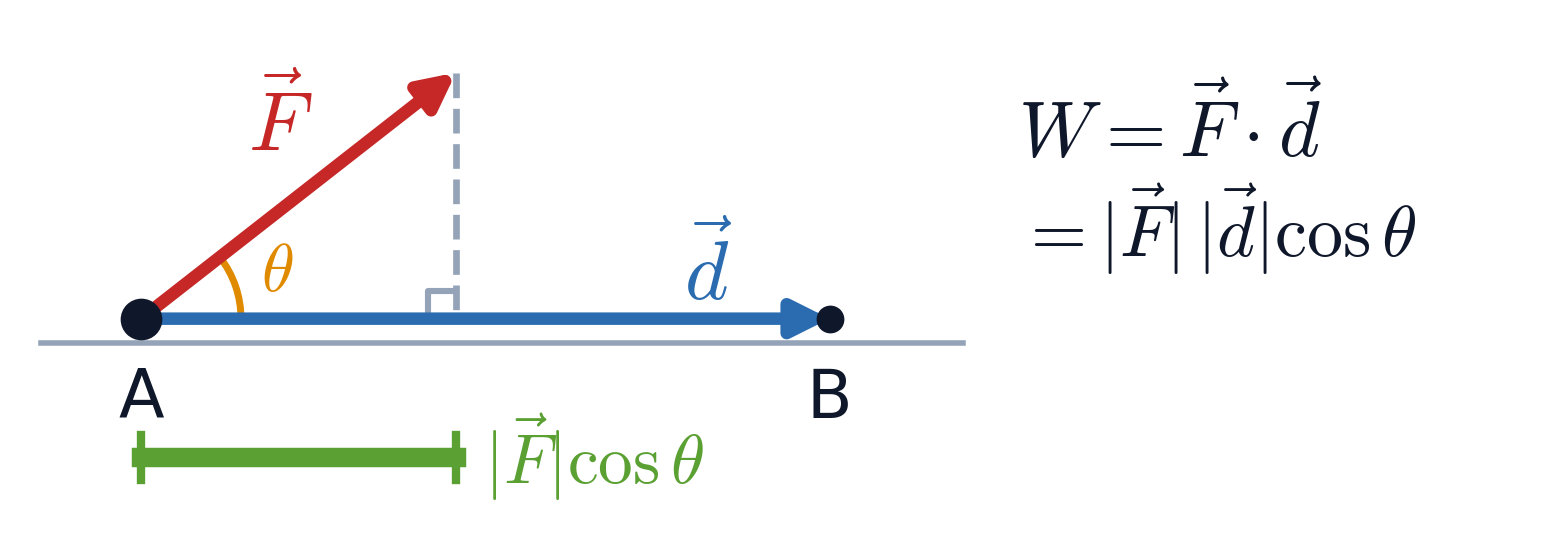
The picture shows why a dot product appears: only the part of the force along the displacement, |\vec{F}|\cos\theta, does work.
If several forces act together, add them first. The sum is called the resultant. Then take its dot product with \vec{d}.
For example, the force \vec{F} = 4\hat{i} + \hat{j} - 3\hat{k} moves a particle from A(1, 2, 3) to B(3, 4, 5). Then \vec{d} = 2\hat{i} + 2\hat{j} + 2\hat{k} and W = 8 + 2 - 6 = 4 units.
2. Moment of a force about a point
A force \vec{F} acts at a point A. Its moment (or torque) about a point O measures its power to turn a body about O:
\vec{M} = \vec{r} \times \vec{F}, \qquad \text{where } \vec{r} = \overrightarrow{OA}
Here \vec{r} goes from the point about which the moment is taken to the point where the force acts. The moment is a vector. Its magnitude is |\vec{F}| times the perpendicular distance from O to the line along which the force acts.
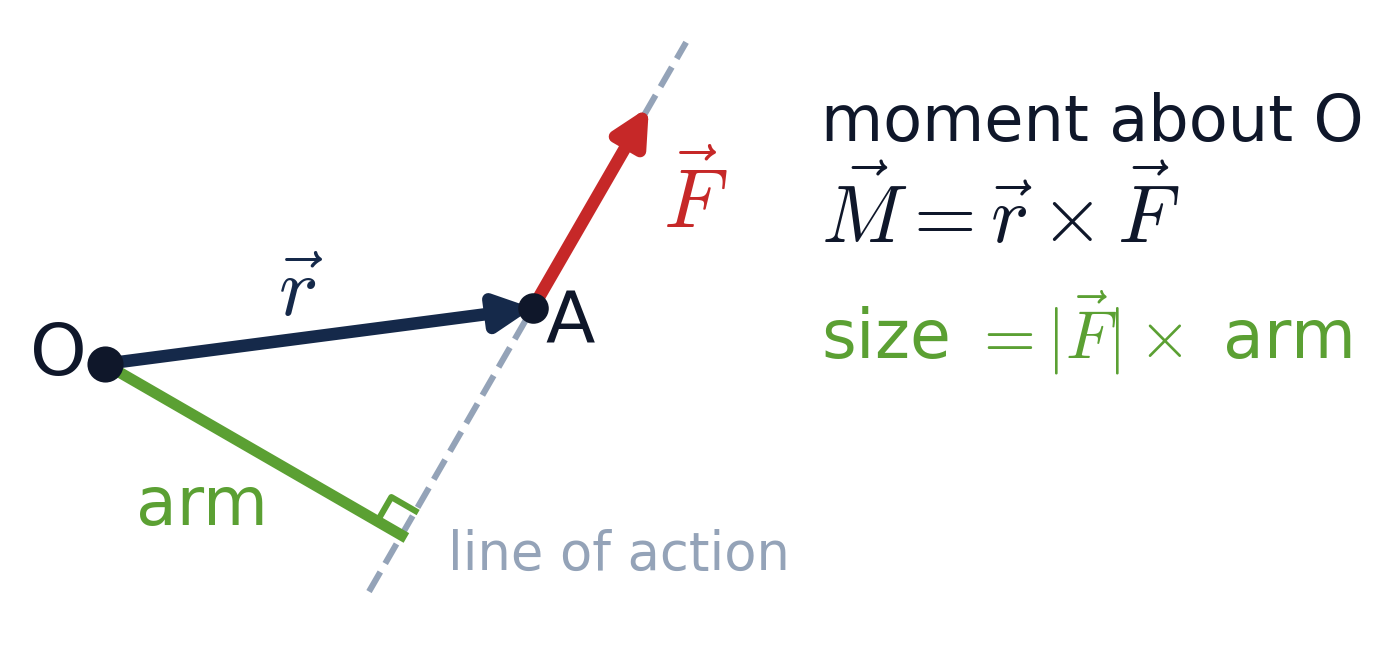
In the picture that perpendicular distance is marked "arm", and the line along which the force acts is its line of action.
Three facts that are asked:
- The order matters. It is \vec{r} \times \vec{F}. The other order gives the opposite sign.
- If the force is moved along its own line of action, the moment does not change. (\vec{r} changes by a multiple of \vec{F}, and \vec{F} \times \vec{F} = \vec{0}.) In this sense the moment does not depend on which point of that line is taken as the point of application.
- The moment about a line through O (an axis), with unit vector \hat{n} along it, is the number (\vec{r} \times \vec{F}) \cdot \hat{n}. It is a scalar.
3. Forces as vectors
A force of magnitude F acting in the direction of a vector \vec{u} is F\hat{u}: the magnitude times the unit vector. For example, a force of magnitude 6 along 2\hat{i} - 2\hat{j} + \hat{k} (which has length 3) is \dfrac{6}{3}(2\hat{i} - 2\hat{j} + \hat{k}) = 4\hat{i} - 4\hat{j} + 2\hat{k}.
A particle is in equilibrium when the forces on it add up to \vec{0}.
4. Geometry with vectors
In this table \vec{a}, \vec{b}, \vec{c} are the position vectors of A, B, C, except in the rows on the parallelogram, where \vec{a} and \vec{b} are its adjacent sides.
| Figure | Fact in vectors |
|---|---|
| Midpoint of AB | \dfrac{\vec{a} + \vec{b}}{2} |
| Centroid of triangle ABC | \dfrac{\vec{a} + \vec{b} + \vec{c}}{3} |
| Area of triangle ABC | \dfrac{1}{2}\lvert \overrightarrow{AB} \times \overrightarrow{AC} \rvert |
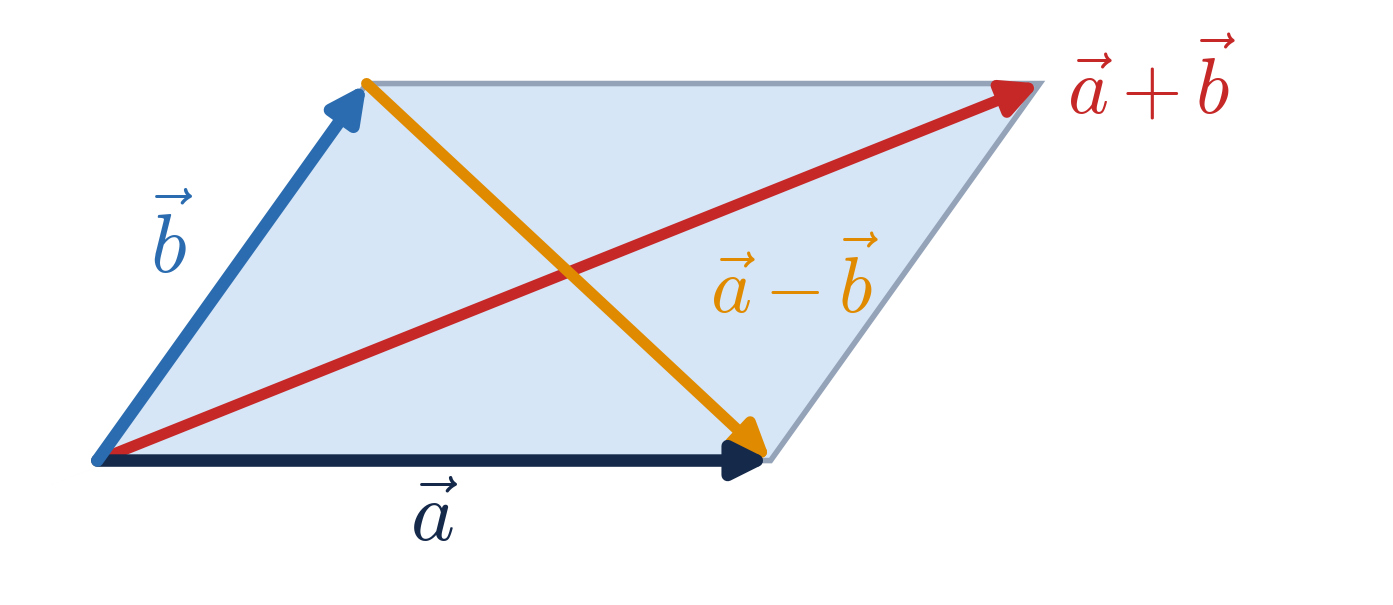
| Parallelogram with adjacent sides \vec{a}, \vec{b} | Its diagonals are \vec{a} + \vec{b} and \vec{a} - \vec{b}. Its area is \lvert \vec{a} \times \vec{b} \rvert |
| Parallelogram with diagonals \vec{d_1}, \vec{d_2} | Its area is \dfrac{1}{2}\lvert \vec{d_1} \times \vec{d_2} \rvert |
| Rhombus (all sides equal) | The diagonals are perpendicular |
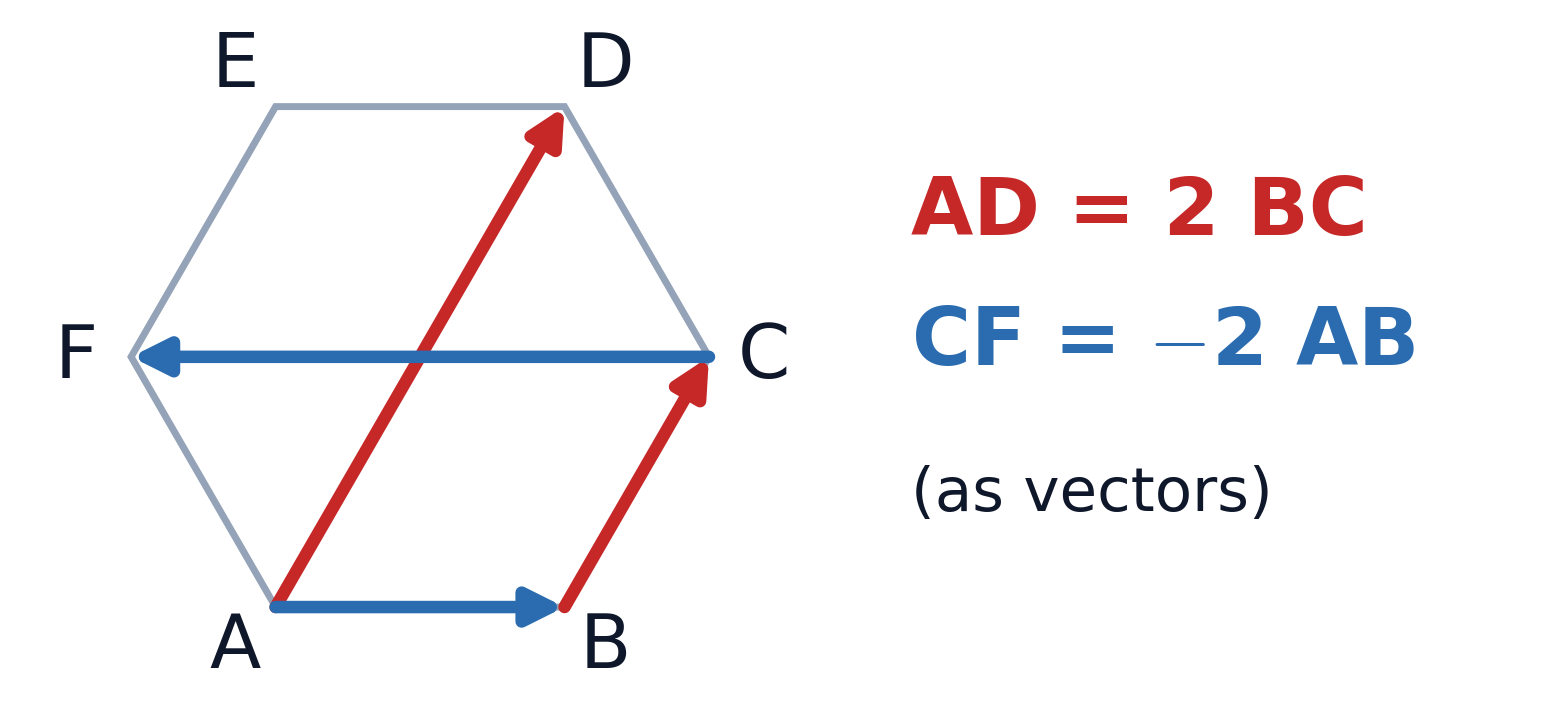
| Regular hexagon ABCDEF | Each long diagonal is parallel to a side and twice as long: \overrightarrow{AD} = 2\overrightarrow{BC}, \overrightarrow{BE} = 2\overrightarrow{CD}, \overrightarrow{CF} = 2\overrightarrow{DE}. Opposite sides are equal and opposite: \overrightarrow{DE} = -\overrightarrow{AB}, \overrightarrow{EF} = -\overrightarrow{BC}, \overrightarrow{FA} = -\overrightarrow{CD} |
5. Worked examples
Example 1. Two forces \vec{F_1} = \hat{i} + 2\hat{j} + 3\hat{k} and \vec{F_2} = 3\hat{i} - \hat{j} + \hat{k} act on a particle and move it from A(1, 0, 2) to B(3, 1, 4). Find the work done.
Resultant: \vec{F} = 4\hat{i} + \hat{j} + 4\hat{k}. Displacement: \vec{d} = 2\hat{i} + \hat{j} + 2\hat{k}. Work = 8 + 1 + 8 = 17 units.
Example 2. A force \vec{F} = 3\hat{i} + 2\hat{j} - 4\hat{k} acts at the point A(1, -1, 2). Find its moment about the point P(2, -1, 3).
\vec{r} = \overrightarrow{PA} = (1 - 2)\hat{i} + (-1 + 1)\hat{j} + (2 - 3)\hat{k} = -\hat{i} - \hat{k}. Then
\vec{r} \times \vec{F} = \begin{vmatrix} \hat{i} & \hat{j} & \hat{k} \\ -1 & 0 & -1 \\ 3 & 2 & -4 \end{vmatrix} = (0 + 2)\hat{i} - (4 + 3)\hat{j} + (-2 - 0)\hat{k} = 2\hat{i} - 7\hat{j} - 2\hat{k}
The magnitude of the moment is \sqrt{4 + 49 + 4} = \sqrt{57}.
Example 3. A force of magnitude 6 units acts along 2\hat{i} - 2\hat{j} + \hat{k} and moves a particle from the origin to the point (3, 1, 2). Find the work done.
From section 3, \vec{F} = 4\hat{i} - 4\hat{j} + 2\hat{k}. The displacement is 3\hat{i} + \hat{j} + 2\hat{k}. Work = 12 - 4 + 4 = 12 units.
Example 4. The diagonals of a parallelogram are \vec{d_1} = 3\hat{i} + \hat{j} - 2\hat{k} and \vec{d_2} = \hat{i} - 3\hat{j} + 4\hat{k}. Find its area.
\vec{d_1} \times \vec{d_2} = \begin{vmatrix} \hat{i} & \hat{j} & \hat{k} \\ 3 & 1 & -2 \\ 1 & -3 & 4 \end{vmatrix} = (4 - 6)\hat{i} - (12 + 2)\hat{j} + (-9 - 1)\hat{k} = -2\hat{i} - 14\hat{j} - 10\hat{k}
Its magnitude is \sqrt{4 + 196 + 100} = \sqrt{300} = 10\sqrt{3}. The area is half of this: 5\sqrt{3} square units.
Example 5. Show that the diagonals of a rhombus are perpendicular.
Let the adjacent sides be \vec{a} and \vec{b}, with |\vec{a}| = |\vec{b}|. The diagonals are \vec{a} + \vec{b} and \vec{a} - \vec{b}. Their dot product is (\vec{a} + \vec{b}) \cdot (\vec{a} - \vec{b}) = |\vec{a}|^2 - |\vec{b}|^2 = 0. So they are perpendicular.
6. From the real papers
Only two real questions are given here. The third question captured on this chapter (NDA II 2024, Q54, on the regular hexagon) is from a paper whose official answers we do not have, so practice question 2 below takes its place.
NDA II 2025, Q70. A force \vec{F} = 2\hat{i} - \lambda\hat{j} + 5\hat{k} is applied at the point A(1, 2, 5). If its moment about the point B(-1, -2, 3) is 16\hat{i} - 6\hat{j} + 2\lambda\hat{k}, then what is the value of \lambda?
(a) -2 (b) 0 (c) 1 (d) 2
Solution. \vec{r} = \overrightarrow{BA} = 2\hat{i} + 4\hat{j} + 2\hat{k}. Then \vec{r} \times \vec{F} = \begin{vmatrix} \hat{i} & \hat{j} & \hat{k} \\ 2 & 4 & 2 \\ 2 & -\lambda & 5 \end{vmatrix} = (20 + 2\lambda)\hat{i} - (10 - 4)\hat{j} + (-2\lambda - 8)\hat{k}. Compare the \hat{i} parts: 20 + 2\lambda = 16, so \lambda = -2. The \hat{k} parts agree: -2(-2) - 8 = -4 = 2\lambda. Answer (a).
NDA I 2024, Q68. Consider the following in respect of moment of a force : 1. The moment of force about a point is independent of point of application of force. 2. The moment of a force about a line is a vector quantity. Which of the statements given above is/are correct?
(a) 1 only (b) 2 only (c) Both 1 and 2 (d) Neither 1 nor 2
Solution. Statement 1 is the second fact of section 2: the point of application may be any point on the line of action of the force, and the moment \vec{r} \times \vec{F} is the same. So 1 is correct. Statement 2 is wrong: the moment about a line is the number (\vec{r} \times \vec{F}) \cdot \hat{n}, a scalar. Answer (a).
Practice questions in the exam style
These three questions are our own, written in the style of the paper. They are not from a real paper.
Practice 1. A force \vec{F} = 2\hat{i} + \lambda\hat{j} - \hat{k} displaces a particle from the point (1, 1, 1) to the point (3, 4, 2). If the work done is 9 units, what is the value of \lambda?
(a) 1 (b) 2 (c) 3 (d) 4
Solution. \vec{d} = 2\hat{i} + 3\hat{j} + \hat{k}. Work = 4 + 3\lambda - 1 = 9, so \lambda = 2. Answer (b).
Practice 2. Let ABCDEF be a regular hexagon. If \overrightarrow{AB} + \overrightarrow{AC} + \overrightarrow{AD} + \overrightarrow{AE} + \overrightarrow{AF} = k\,\overrightarrow{AD}, what is the value of k?
(a) 2 (b) 3 (c) 4 (d) 6
Solution. In a regular hexagon \overrightarrow{AE} = \overrightarrow{BD} and \overrightarrow{AF} = \overrightarrow{CD}. So \overrightarrow{AB} + \overrightarrow{AE} = \overrightarrow{AB} + \overrightarrow{BD} = \overrightarrow{AD}, and \overrightarrow{AC} + \overrightarrow{AF} = \overrightarrow{AC} + \overrightarrow{CD} = \overrightarrow{AD}. With the middle term, the sum is 3\overrightarrow{AD}. Answer (b).
Practice 3. A force \hat{i} + \hat{j} + \hat{k} acts at the point (1, 2, 3). What is its moment about the origin?
(a) -\hat{i} + 2\hat{j} - \hat{k} (b) \hat{i} - 2\hat{j} + \hat{k} (c) \hat{i} + 2\hat{j} + 3\hat{k} (d) 2\hat{i} + 3\hat{j} + 4\hat{k}
Solution. \vec{r} = \hat{i} + 2\hat{j} + 3\hat{k}. Then \vec{r} \times \vec{F} = (2 - 3)\hat{i} - (1 - 3)\hat{j} + (1 - 2)\hat{k} = -\hat{i} + 2\hat{j} - \hat{k}. Option (b) is \vec{F} \times \vec{r}, the wrong order. Answer (a).
7. Mistakes that cost marks
- Writing the moment as \vec{F} \times \vec{r}. It is \vec{r} \times \vec{F}. The wrong order gives every sign wrong.
- Taking \vec{r} the wrong way. \vec{r} starts at the point about which the moment is taken and ends at the point where the force acts.
- Using a position vector as the displacement. The displacement is end minus start. It equals the position vector of the end only when the particle starts from the origin.
- Mixing scalar and vector. Work is a scalar. The moment about a point is a vector. The moment about a line is a scalar.
8. Quick check
Do these without help. Answers are at the end.
- A force 5\hat{i} - \hat{j} + 2\hat{k} moves a particle from (1, 1, 1) to (4, 3, 1). Find the work done.
- A force 5\hat{k} acts at the point (2, 1, 0). Find its moment about the origin.
- Find the centroid of the triangle whose vertices have position vectors \hat{i} + 2\hat{j} + 3\hat{k}, 3\hat{i} - \hat{k} and 2\hat{i} + \hat{j} + \hat{k}.
- Write the force of magnitude 10 units that acts along 3\hat{i} + 4\hat{j}.
- The adjacent sides of a parallelogram are \hat{i} + 2\hat{j} + 2\hat{k} and 2\hat{i} - 2\hat{j} + \hat{k}. Are its diagonals perpendicular?
9. Read and watch more, free
| What | Where | Language |
|---|---|---|
| Textbook | NCERT Class 12 Mathematics, Chapter 10 Vector Algebra (for the geometry; it has no separate section on work or moment) · Hindi edition | English, Hindi |
| Self-study notes | NIOS Mathematics, Lesson 34 Vectors · Hindi edition | English, Hindi |
| Textbook, with examples on work and torque | OpenStax Calculus Volume 3, Chapter 2 Vectors in Space (the sections on the dot product and the cross product) | English |
| Video, the whole unit for NDA in five classes | Chandigarh Career Group: Vector class 1 to 5 (the first five videos of the playlist) | Hinglish (judged from the titles) |
| Video, the whole unit in one class | Defence Wallah: VECTORS in One Shot (in the Fast Track 2021 playlist, about 2 hours) | Hinglish |
| Video, taught in English, harder than NDA level | Vedantu JEE English: Vector Algebra and 3D Geometry (the last video of the playlist, about 5 hours) | English |
The videos were chosen from their titles, length and views; they have not yet been watched by a teacher.
Answers to the quick check
- \vec{d} = 3\hat{i} + 2\hat{j}, so the work is 15 - 2 + 0 = 13 units.
- \vec{r} \times \vec{F} = (2\hat{i} + \hat{j}) \times 5\hat{k} = 10(\hat{i} \times \hat{k}) + 5(\hat{j} \times \hat{k}) = -10\hat{j} + 5\hat{i}, that is 5\hat{i} - 10\hat{j}.
- \dfrac{(1 + 3 + 2)\hat{i} + (2 + 0 + 1)\hat{j} + (3 - 1 + 1)\hat{k}}{3} = 2\hat{i} + \hat{j} + \hat{k}.
- The length of 3\hat{i} + 4\hat{j} is 5, so the force is \dfrac{10}{5}(3\hat{i} + 4\hat{j}) = 6\hat{i} + 8\hat{j}.
- Yes. Both sides have length 3, so the figure is a rhombus: (\vec{a} + \vec{b}) \cdot (\vec{a} - \vec{b}) = 9 - 9 = 0.
Next chapter: Data, frequency distributions and graphs.