Why this chapter matters. This chapter drew 12 real questions in the seven papers from NDA II 2023 to NDA II 2026. They ask for the angle between two vectors, for the projection of one vector on another, whether two vectors are perpendicular, and what follows when a sum such as \vec{a} + \vec{b} is a unit vector. Six of them are solved in section 7.
What you will be able to do
- Find \vec{a} \cdot \vec{b} from components, or from the magnitudes and the angle.
- Find the angle between two vectors and test whether they are perpendicular.
- Find the projection of one vector on another.
- Expand |\vec{a} + \vec{b}|^2 and use it in questions on unit vectors.
Before you start you should know: components, magnitude, unit vectors and \overrightarrow{AB} = \vec{b} - \vec{a} (Chapter M7-1), and the values of \cos at the standard angles.
1. What the dot product is
The dot product (or scalar product) of two vectors is
\vec{a} \cdot \vec{b} = |\vec{a}|\,|\vec{b}|\cos\theta
where \theta is the angle between them, taken from 0 to \pi. The answer is a number, not a vector.
The magnitudes are positive, so the sign of the dot product comes from \cos\theta:
| Angle between the vectors | \vec{a} \cdot \vec{b} |
|---|---|
| Acute (less than 90^\circ) | Positive |
| Right angle (90^\circ) | Zero |
| Obtuse (more than 90^\circ) | Negative |
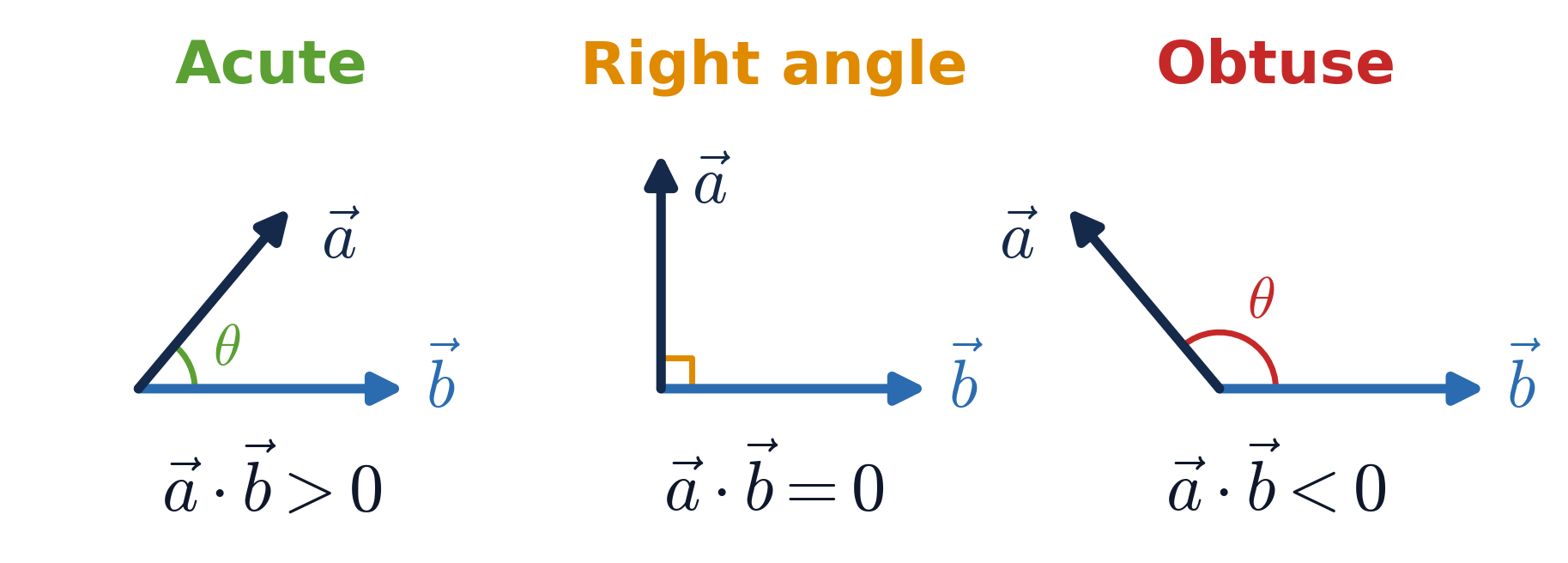
So two non-zero vectors are perpendicular exactly when their dot product is zero. This is the test asked most often.
2. The dot product in components
The unit vectors along the axes are perpendicular to each other and have length 1. So
\hat{i} \cdot \hat{i} = \hat{j} \cdot \hat{j} = \hat{k} \cdot \hat{k} = 1, \qquad \hat{i} \cdot \hat{j} = \hat{j} \cdot \hat{k} = \hat{k} \cdot \hat{i} = 0
From this, for \vec{a} = a_1\hat{i} + a_2\hat{j} + a_3\hat{k} and \vec{b} = b_1\hat{i} + b_2\hat{j} + b_3\hat{k}:
\vec{a} \cdot \vec{b} = a_1b_1 + a_2b_2 + a_3b_3
Multiply matching components and add. For example, (\hat{i} - 2\hat{j} + 3\hat{k}) \cdot (3\hat{i} - 2\hat{j} + \hat{k}) = 3 + 4 + 3 = 10.
3. The angle between two vectors
Put the two forms of the dot product together:
\cos\theta = \frac{\vec{a} \cdot \vec{b}}{|\vec{a}|\,|\vec{b}|}
4. Projection
The projection of \vec{a} on \vec{b} is the length of the shadow of \vec{a} on the line of \vec{b}. It equals |\vec{a}|\cos\theta, which is
\text{projection of } \vec{a} \text{ on } \vec{b} = \frac{\vec{a} \cdot \vec{b}}{|\vec{b}|}
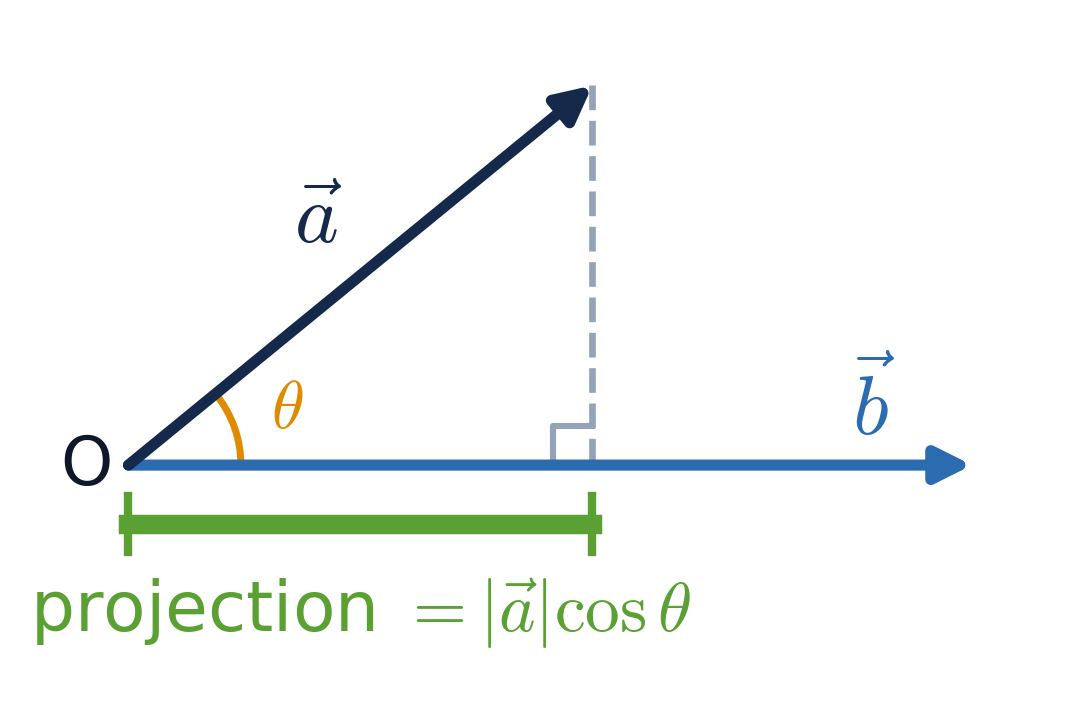
Divide by the magnitude of the vector you project on. The projection is negative when the angle is obtuse. If the question asks for the projection as a vector, multiply this number by the unit vector \hat{b}.
5. The algebra of the dot product
The dot product behaves like ordinary multiplication in these ways:
| Rule | In symbols |
|---|---|
| The order does not matter | \vec{a} \cdot \vec{b} = \vec{b} \cdot \vec{a} |
| Brackets open as usual | \vec{a} \cdot (\vec{b} + \vec{c}) = \vec{a} \cdot \vec{b} + \vec{a} \cdot \vec{c} |
| A vector dotted with itself gives its length squared | \vec{a} \cdot \vec{a} = \lvert \vec{a} \rvert^2 |
| Length of a sum | \lvert \vec{a} + \vec{b} \rvert^2 = \lvert \vec{a} \rvert^2 + 2\,\vec{a} \cdot \vec{b} + \lvert \vec{b} \rvert^2 |
| Length of a difference | \lvert \vec{a} - \vec{b} \rvert^2 = \lvert \vec{a} \rvert^2 - 2\,\vec{a} \cdot \vec{b} + \lvert \vec{b} \rvert^2 |
| Sum times difference | (\vec{a} + \vec{b}) \cdot (\vec{a} - \vec{b}) = \lvert \vec{a} \rvert^2 - \lvert \vec{b} \rvert^2 |
| Three vectors | \lvert \vec{a} + \vec{b} + \vec{c} \rvert^2 = \lvert \vec{a} \rvert^2 + \lvert \vec{b} \rvert^2 + \lvert \vec{c} \rvert^2 + 2(\vec{a} \cdot \vec{b} + \vec{b} \cdot \vec{c} + \vec{c} \cdot \vec{a}) |
For unit vectors the work is shorter still: |\vec{a}| = |\vec{b}| = 1, so \vec{a} \cdot \vec{b} = \cos\theta.
6. Worked examples
Example 1. Find the angle between \vec{a} = \hat{i} - 2\hat{j} + 3\hat{k} and \vec{b} = 3\hat{i} - 2\hat{j} + \hat{k}.
\vec{a} \cdot \vec{b} = 3 + 4 + 3 = 10. |\vec{a}| = \sqrt{1 + 4 + 9} = \sqrt{14} and |\vec{b}| = \sqrt{9 + 4 + 1} = \sqrt{14}.
So \cos\theta = \dfrac{10}{\sqrt{14}\sqrt{14}} = \dfrac{5}{7}, and \theta = \cos^{-1}\dfrac{5}{7}.
Example 2. For what value of \lambda are 2\hat{i} + \lambda\hat{j} + \hat{k} and \hat{i} - 2\hat{j} + 3\hat{k} perpendicular?
The dot product must be zero: 2 - 2\lambda + 3 = 0, so \lambda = \dfrac{5}{2}.
Example 3. Find the projection of \vec{a} = 2\hat{i} + 3\hat{j} + 2\hat{k} on \vec{b} = \hat{i} + 2\hat{j} + \hat{k}.
\vec{a} \cdot \vec{b} = 2 + 6 + 2 = 10 and |\vec{b}| = \sqrt{1 + 4 + 1} = \sqrt{6}. The projection is \dfrac{10}{\sqrt{6}} = \dfrac{5\sqrt{6}}{3}.
Example 4. |\vec{a}| = 3, |\vec{b}| = 4 and the angle between them is 60^\circ. Find |\vec{a} + \vec{b}| and |\vec{a} - \vec{b}|.
\vec{a} \cdot \vec{b} = 3 \times 4 \times \dfrac{1}{2} = 6.
|\vec{a} + \vec{b}|^2 = 9 + 12 + 16 = 37, so |\vec{a} + \vec{b}| = \sqrt{37}.
|\vec{a} - \vec{b}|^2 = 9 - 12 + 16 = 13, so |\vec{a} - \vec{b}| = \sqrt{13}.
Example 5. \vec{a} and \vec{b} are unit vectors and |\vec{a} + \vec{b}| = \sqrt{3}. Find the angle between them and |\vec{a} - \vec{b}|.
|\vec{a} + \vec{b}|^2 = 1 + 2\cos\theta + 1 = 3, so \cos\theta = \dfrac{1}{2} and \theta = 60^\circ.
|\vec{a} - \vec{b}|^2 = 1 - 2\cos\theta + 1 = 1, so |\vec{a} - \vec{b}| = 1.
7. From the real papers
Try each question for 75 seconds before reading the solution.
NDA II 2023, Q91. What is the length of projection of the vector \hat{i} + 2\hat{j} + 3\hat{k} on the vector 2\hat{i} + 3\hat{j} - 2\hat{k}?
(a) \frac{1}{\sqrt{17}} (b) \frac{2}{\sqrt{17}} (c) \frac{3}{\sqrt{17}} (d) \frac{2}{\sqrt{14}}
Solution. \vec{a} \cdot \vec{b} = 2 + 6 - 6 = 2 and |\vec{b}| = \sqrt{4 + 9 + 4} = \sqrt{17}. The projection is \dfrac{2}{\sqrt{17}}. Answer (b).
NDA I 2025, Q66. A line makes angles \alpha, \beta and \gamma with the positive directions of the coordinate axes. If \vec{a} = (\sin^2\alpha)\hat{i} + (\sin^2\beta)\hat{j} + (\sin^2\gamma)\hat{k} and \vec{b} = \hat{i} + \hat{j} + \hat{k}, then what is \vec{a} \cdot \vec{b} equal to?
(a) -2 (b) -1 (c) 1 (d) 2
Solution. \vec{a} \cdot \vec{b} = \sin^2\alpha + \sin^2\beta + \sin^2\gamma = 3 - (\cos^2\alpha + \cos^2\beta + \cos^2\gamma). The squares of the direction cosines add up to 1 (Chapter M7-1), so the value is 3 - 1 = 2. Answer (d).
NDA II 2025, Q69. The position vectors of the vertices A, B, C and D of a quadrilateral ABCD are given by 3\hat{i} + 4\hat{j} - 2\hat{k}, 4\hat{i} - 4\hat{j} - 3\hat{k}, 2\hat{i} - 3\hat{j} + 2\hat{k} and 6\hat{i} - 2\hat{j} + \hat{k} respectively. What is the angle between the diagonals AC and BD of the quadrilateral?
(a) 90^\circ (b) 75^\circ (c) 60^\circ (d) 45^\circ
Solution. End minus start: \overrightarrow{AC} = -\hat{i} - 7\hat{j} + 4\hat{k} and \overrightarrow{BD} = 2\hat{i} + 2\hat{j} + 4\hat{k}. Their dot product is -2 - 14 + 16 = 0, so the diagonals are perpendicular. Answer (a).
NDA I 2026, Q65. For the next two (02) items that follow : Let \vec{a}, \vec{b}, \vec{c}, \vec{a} + \vec{b}, \vec{b} + \vec{c}, \vec{a} + \vec{b} + \vec{c} be unit vectors. What is the angle between \vec{a} and \vec{b}?
(a) \frac{\pi}{6} (b) \frac{\pi}{4} (c) \frac{\pi}{2} (d) \frac{2\pi}{3}
Solution. |\vec{a} + \vec{b}|^2 = |\vec{a}|^2 + 2\,\vec{a} \cdot \vec{b} + |\vec{b}|^2. All three lengths are 1, so 1 = 1 + 2\,\vec{a} \cdot \vec{b} + 1 and \vec{a} \cdot \vec{b} = -\dfrac{1}{2}. For unit vectors this is \cos\theta, so \theta = \dfrac{2\pi}{3}. Answer (d).
NDA I 2024, Q70. Let \vec{a} and \vec{b} are two vectors of magnitude 4 inclined at an angle \frac{\pi}{3}, then what is the angle between \vec{a} and \vec{a} - \vec{b}?
(a) \frac{\pi}{2} (b) \frac{\pi}{3} (c) \frac{\pi}{4} (d) \frac{\pi}{6}
Solution. \vec{a} \cdot \vec{b} = 4 \times 4 \times \dfrac{1}{2} = 8. Then \vec{a} \cdot (\vec{a} - \vec{b}) = 16 - 8 = 8, and |\vec{a} - \vec{b}|^2 = 16 - 16 + 16 = 16, so |\vec{a} - \vec{b}| = 4. Hence \cos\phi = \dfrac{8}{4 \times 4} = \dfrac{1}{2} and \phi = \dfrac{\pi}{3}. (The vectors \vec{a}, \vec{b} and \vec{a} - \vec{b} form an equilateral triangle.) Answer (b).
NDA II 2026, Q67. The scalar projection of \vec{a} = \lambda\hat{i} + \hat{j} - 2\hat{k} on \vec{b} = 2\hat{i} - \hat{j} - \lambda\hat{k} is 7/3. What is the value of \lambda?
(a) 1 (b) 2 (c) 3 (d) 4
Solution. \vec{a} \cdot \vec{b} = 2\lambda - 1 + 2\lambda = 4\lambda - 1 and |\vec{b}| = \sqrt{5 + \lambda^2}. So \dfrac{4\lambda - 1}{\sqrt{5 + \lambda^2}} = \dfrac{7}{3}. Solving this takes time; testing the options is faster. \lambda = 2 gives \dfrac{7}{\sqrt{9}} = \dfrac{7}{3}, which fits. Answer (b).
8. Mistakes that cost marks
- Dividing by the wrong magnitude in a projection. The projection of \vec{a} on \vec{b} is \dfrac{\vec{a} \cdot \vec{b}}{|\vec{b}|}. The vector after the word "on" goes below.
- Writing |\vec{a} + \vec{b}|^2 = |\vec{a}|^2 + |\vec{b}|^2. The middle term 2\,\vec{a} \cdot \vec{b} is missing. It is zero only when the vectors are perpendicular.
- Treating \vec{a} \cdot \vec{b} as a vector. It is a number. So (\vec{a} \cdot \vec{b}) \cdot \vec{c} has no meaning as a dot product.
- Cancelling a vector. From \vec{a} \cdot \vec{b} = 0 you cannot say that \vec{a} or \vec{b} is zero; they may be perpendicular. From \vec{a} \cdot \vec{b} = \vec{a} \cdot \vec{c} you cannot say that \vec{b} = \vec{c}.
9. Quick check
Do these without help. Answers are at the end.
- Find (2\hat{i} - \hat{j} + 3\hat{k}) \cdot (\hat{i} + 4\hat{j} + 2\hat{k}).
- For what value of \lambda are \lambda\hat{i} + 2\hat{j} - 3\hat{k} and 2\hat{i} + \hat{j} + 4\hat{k} perpendicular?
- Find the angle between \hat{i} + \hat{j} and \hat{j} + \hat{k}.
- Find the projection of 4\hat{i} - 3\hat{j} + \hat{k} on 2\hat{i} + \hat{j} + 2\hat{k}.
- |\vec{a}| = 2, |\vec{b}| = 3 and the angle between them is 60^\circ. Find |\vec{a} + \vec{b}|.
10. Read and watch more, free
| What | Where | Language |
|---|---|---|
| Textbook | NCERT Class 12 Mathematics, Chapter 10 Vector Algebra (the section on the scalar product) · Hindi edition | English, Hindi |
| Self-study notes | NIOS Mathematics, Lesson 34 Vectors · Hindi edition | English, Hindi |
| Textbook, more examples | OpenStax Calculus Volume 3, Chapter 2 Vectors in Space (the section on the dot product) | English |
| Video, the whole unit for NDA in five classes | Chandigarh Career Group: Vector class 1 to 5 (the first five videos of the playlist) | Hinglish (judged from the titles) |
| Video, the whole unit in one class | Defence Wallah: VECTORS in One Shot (in the Fast Track 2021 playlist, about 2 hours) | Hinglish |
| Video, taught in English, harder than NDA level | Vedantu JEE English: Vector Algebra and 3D Geometry (the last video of the playlist, about 5 hours) | English |
The videos were chosen from their titles, length and views; they have not yet been watched by a teacher.
Answers to the quick check
- 2 - 4 + 6 = 4.
- 2\lambda + 2 - 12 = 0, so \lambda = 5.
- \cos\theta = \dfrac{0 + 1 + 0}{\sqrt{2}\sqrt{2}} = \dfrac{1}{2}, so \theta = 60^\circ.
- \dfrac{8 - 3 + 2}{\sqrt{4 + 1 + 4}} = \dfrac{7}{3}.
- \vec{a} \cdot \vec{b} = 2 \times 3 \times \dfrac{1}{2} = 3, so |\vec{a} + \vec{b}|^2 = 4 + 6 + 9 = 19 and |\vec{a} + \vec{b}| = \sqrt{19}.
Next chapter: The cross product.