Why this chapter matters. We found about 3 questions from this chapter in the 12 papers we hold, from 2017 to 2026: one on the thermos flask and two on why the boiling point of water changes with pressure, which is the principle of the pressure cooker. That is a low count, but the syllabus names all six devices, and no school textbook teaches the siphon, the pumps, the hydrometer or the pressure cooker. A student who has read this chapter can answer what most others must guess. Learn first the one principle behind each device; the parts follow from it.
What you will be able to do
- Give, in one line each, the principle on which the six devices work.
- Explain why a siphon and a hand pump cannot raise water through more than about 10 metres.
- Say why a balloon rises and how a hydrometer reads the density of a liquid.
- Match each part of a pressure cooker and a thermos flask with its job.
Before you start you should know: density and the principle of Archimedes (Chapter P1-1), atmospheric pressure (Chapter P1-2), boiling and the three ways heat travels (Chapter P2-2).
1. Two ideas that run through the chapter
Atmospheric pressure can hold up a column of water about 10 metres high. The air presses on every open surface with a pressure of about 1.01 \times 10^5 pascal. A column of water of height h presses down with a pressure h \rho g. The two are equal when
h = \frac{P}{\rho g} = \frac{1.01 \times 10^5}{1000 \times 9.8} \approx 10.3 \text{ m}
This is the same idea as the mercury barometer, where the column is 76 cm because mercury is 13.6 times as dense as water.
A body floats when the upthrust on it equals its weight. The upthrust equals the weight of the fluid pushed aside (the principle of Archimedes). It holds for gases as well as liquids.
| Device | Principle in one line |
|---|---|
| Siphon | Atmospheric pressure and gravity move a liquid over a rise, from a higher surface to a lower outlet |
| Lift pump, force pump | Atmospheric pressure pushes water up into a space where the pressure has been lowered |
| Bicycle pump | Air is compressed until its pressure is more than the pressure in the tyre |
| Balloon | Upthrust of the air (Archimedes): the balloon is lighter than the air it pushes aside |
| Hydrometer | Law of flotation: a floating body sinks deeper in a lighter liquid |
| Pressure cooker | The boiling point of water rises when the pressure on it rises |
| Thermos flask | Conduction, convection and radiation are all cut down together |
2. The siphon
What it is for. Emptying a tank or drum that cannot be tilted: taking fuel out of a vehicle's tank, draining an aquarium.
The parts. Only a bent tube, with one short arm and one long arm.
How it works.
- The tube is first filled completely with the liquid. The short arm is dipped in the upper vessel. The end of the long arm is kept lower than the liquid surface in the upper vessel.
- The liquid in the long arm is the heavier column, so it runs down and out.
- This lowers the pressure at the top of the bend. Atmospheric pressure on the liquid in the upper vessel pushes more liquid up the short arm to take its place.
- The flow goes on until the two liquid levels are equal, or the upper vessel is empty down to the tube's mouth, or air enters the tube.
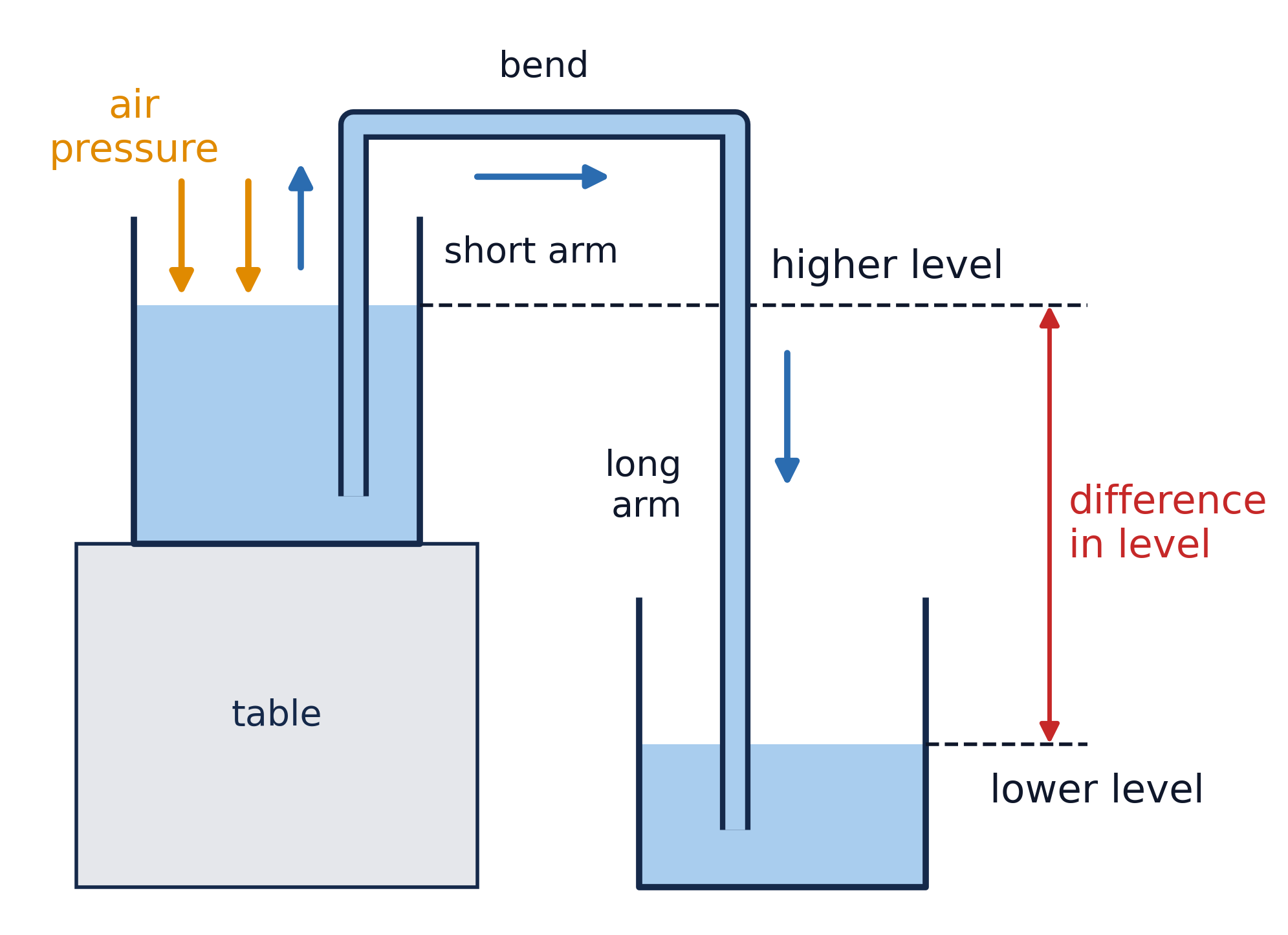
Exam facts. The top of the bend must not be more than about 10 m above the water surface, because atmospheric pressure cannot push water higher. A siphon as described here does not work in a vacuum. It never carries liquid to a level higher than the surface it started from.
3. Pumps
The lift pump (the common hand pump)
What it is for. Raising water from a well or a bore.
The parts. A barrel (cylinder); a piston with a valve in it that opens upwards; a second valve at the bottom of the barrel that also opens upwards; a pipe down to the water; a handle, which is a first-class lever; a spout.
How it works.
- Upstroke. The piston rises and its valve stays shut. The pressure below the piston falls. Atmospheric pressure on the water in the well pushes water up the pipe, through the bottom valve, into the barrel.
- Downstroke. The bottom valve shuts, so the water cannot go back. The piston valve opens and the water passes above the piston.
- Next upstroke. The piston lifts the water above it to the spout, and more water enters below.
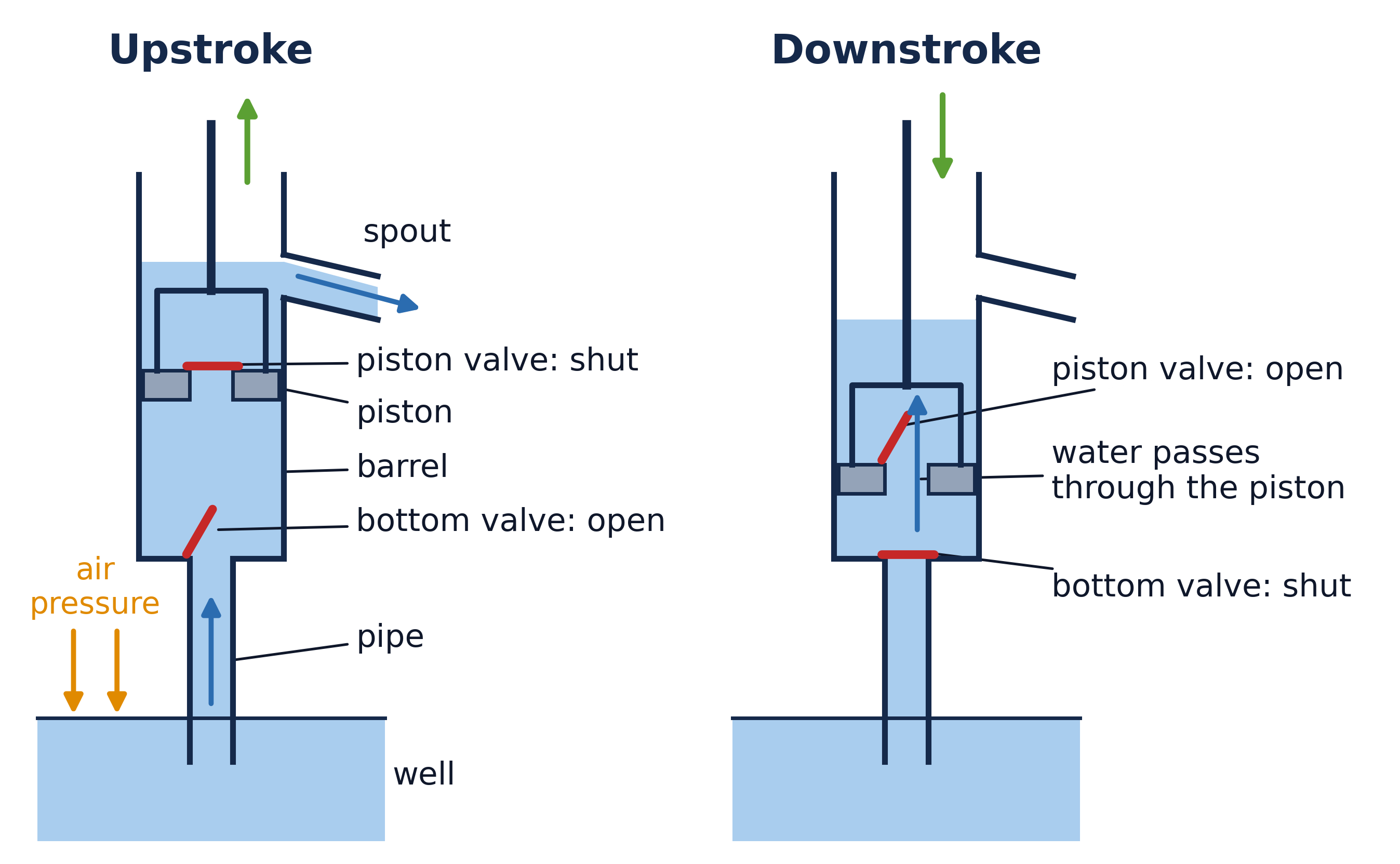
Exam fact. The pump does not "pull" the water: the atmosphere pushes it. So the piston of a lift pump cannot be more than about 10 m above the water in the well. In practice the limit is lower, because valves leak a little.
The force pump
What it is for. Sending water to a height, for example to an overhead tank.
How it differs. The piston is solid, with no valve. A delivery pipe with its own valve leaves the barrel near the bottom.
- Upstroke. As in the lift pump, atmospheric pressure pushes water into the barrel through the bottom valve.
- Downstroke. The bottom valve shuts. The piston forces the water out through the delivery valve and up the delivery pipe.
Exam fact. On the delivery side the height is not limited to 10 m: it depends on the force on the piston. Only the suction side has the 10 m limit.
The bicycle pump
What it is for. Forcing air into a tyre. It is a compression pump.
The parts. A barrel; a piston with a soft leather or rubber cup washer, which acts as a valve; a tube to the tyre; the tyre's own valve, which lets air in but not out.
How it works.
- Push. The air in the barrel is compressed. Its pressure presses the washer tightly against the barrel, so no air leaks back.
- When the pressure in the barrel becomes greater than the pressure in the tyre, the tyre valve opens and air enters the tyre.
- Pull. The pressure below the piston falls. The tyre valve shuts. Outside air slips past the edge of the washer and fills the barrel again.
Exam fact. The barrel becomes warm in use. Work is done on the air in compressing it quickly, and this raises its temperature.
4. The balloon
What it is for. Lifting people or instruments into the air: weather balloons, hot-air balloons.
The principle. The air pushes up on a balloon with a force equal to the weight of the air the balloon pushes aside. If this upthrust is more than the total weight of the balloon, the gas in it and the load, the balloon rises.
| Kind | What fills it | Why it is lighter than the air around it |
|---|---|---|
| Hot-air balloon | Air heated by a burner below the open mouth | Heated air expands and some of it leaves, so the air left inside is less dense than the cooler air outside |
| Gas balloon | Hydrogen or helium | These gases are much less dense than air at the same temperature and pressure |
How a hot-air balloon is flown.
- The burner heats the air in the bag. The balloon becomes lighter than the air it displaces and rises.
- As it climbs, the outside air becomes thinner (less dense), so the upthrust becomes smaller.
- The balloon stops rising at the height where the upthrust equals its weight.
- To come down, the pilot lets the air inside cool or lets some hot air out at the top.
Exam facts. Hydrogen is the lightest gas but it burns. Helium is the next lightest and does not burn, so it is the safe choice. A sealed gas balloon swells as it rises, because the outside pressure falls.
5. The hydrometer
What it is for. Measuring the relative density (specific gravity) of a liquid directly, without weighing.
The parts. A closed glass tube with a wide bulb, a weight of lead shot or mercury at the bottom so that it floats upright, and a narrow stem carrying the scale.
How it works.
- A floating body pushes aside liquid equal to its own weight (the law of flotation).
- The weight of the hydrometer is fixed. In a lighter liquid it must push aside a larger volume, so it sinks deeper. In a denser liquid it floats higher.
- The relative density is read on the stem at the liquid surface.
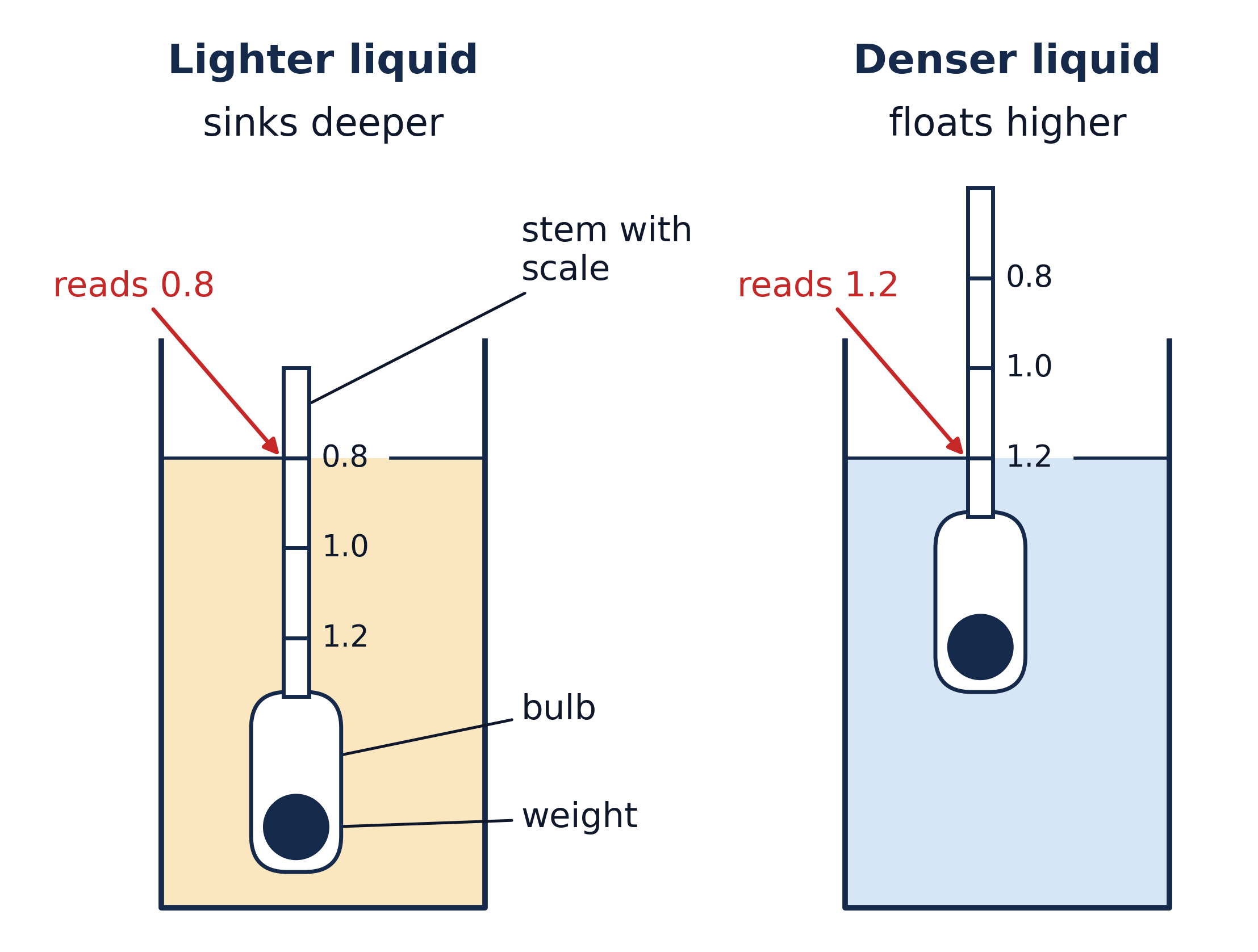
Exam facts.
- The numbers on the scale increase downwards: the smallest reading is at the top of the stem.
- A lactometer is a hydrometer for milk. Milk is slightly denser than water, so when water has been added the lactometer sinks deeper.
- A hydrometer is also used to test the acid of a lead-acid battery. The relative density of the acid falls as the battery is discharged.
6. The pressure cooker
What it is for. Cooking food faster and with less fuel. It is necessary in the mountains, where food cooks slowly in an open pot.
The principle. The boiling point of a liquid rises when the pressure on it rises, and falls when the pressure falls. Water in an open pot at sea level cannot become hotter than 100 °C, however strong the flame.
| Part | Its job |
|---|---|
| Strong body and lid, of aluminium or steel | To stand the pressure |
| Rubber ring (gasket) | Makes the lid airtight, so the steam cannot escape |
| Weight on the vent (the "whistle") | Lifts and lets steam out when the pressure reaches the working value, so the pressure stays steady |
| Safety valve | A plug that gives way and releases the steam if the vent is blocked and the pressure becomes dangerous |
How it works.
- Water is heated in the closed cooker and steam forms. It cannot escape, so the pressure inside rises to about twice the atmospheric pressure.
- At this pressure water boils at about 120 °C instead of 100 °C.
- The food is in hotter water and steam, so it cooks in much less time.
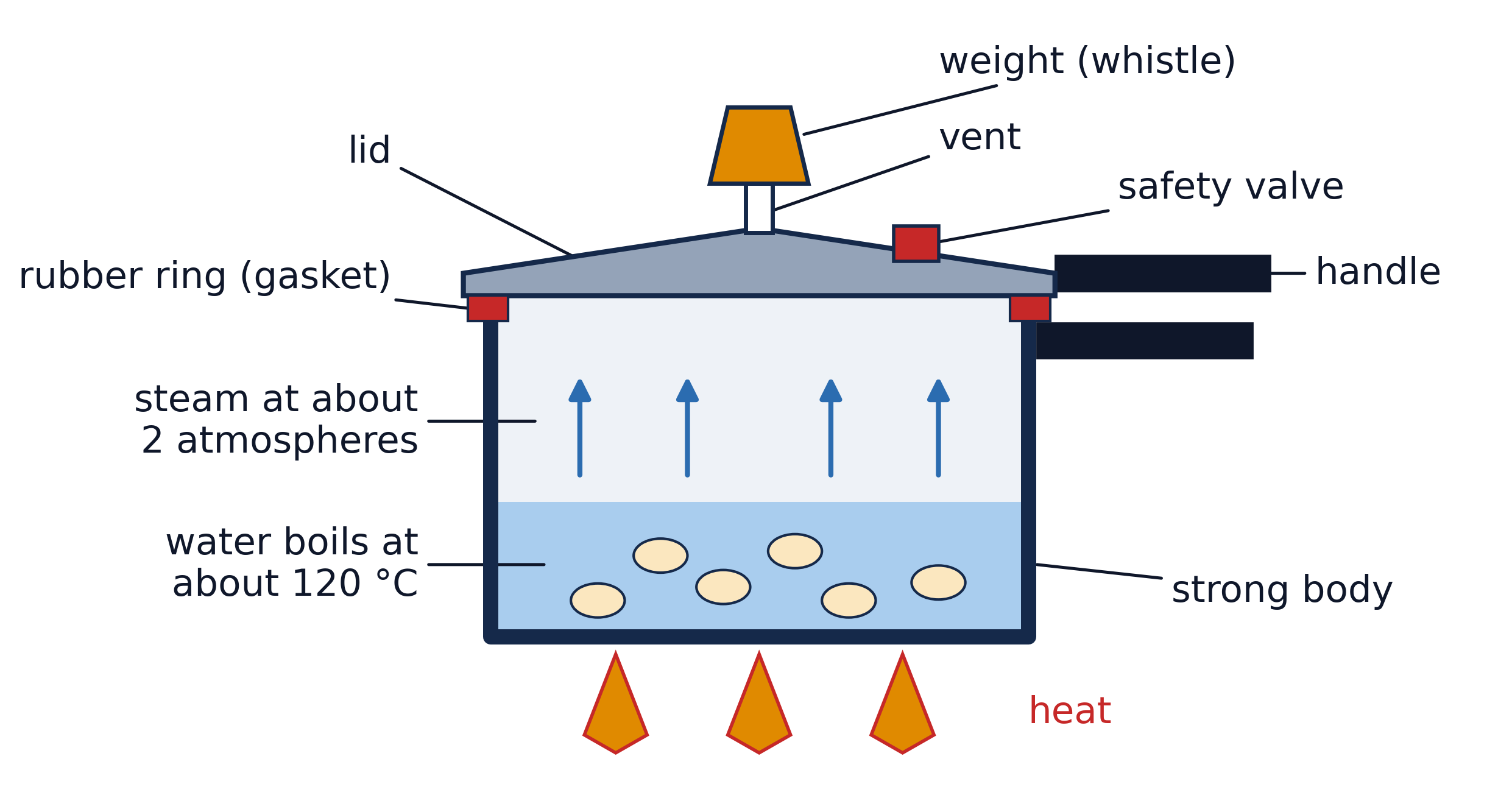
Exam fact. On a mountain the air pressure is lower, so water in an open pot boils below 100 °C: at about 90 °C at a height of 3,000 m. Pulses and rice then take very long to cook. The pressure cooker removes the problem.
7. The thermos flask
What it is for. Keeping a hot liquid hot or a cold liquid cold for many hours. It is also called a vacuum flask or Dewar flask, after Sir James Dewar, who invented it.
The principle. Heat travels in three ways. The flask blocks all three.
| Part | Which way of heat transfer it cuts down |
|---|---|
| Double-walled glass vessel (glass is a poor conductor) | Conduction |
| Vacuum between the two walls | Conduction and convection, since both need a material |
| Silvered (shiny) surfaces of the walls | Radiation: a shiny surface is a poor radiator and a good reflector |
| Stopper of cork or plastic | Conduction through the mouth, and convection and evaporation above the liquid |
| Outer case with cork or rubber supports | Protects the glass; the supports are poor conductors |
How it works.
- Hot tea is poured in and the stopper is closed.
- Heat cannot cross the vacuum by conduction or convection.
- The little heat that the shiny inner wall radiates is reflected back by the shiny outer wall.
- The only leak is through the stopper and the neck, which is why the tea does cool in the end.
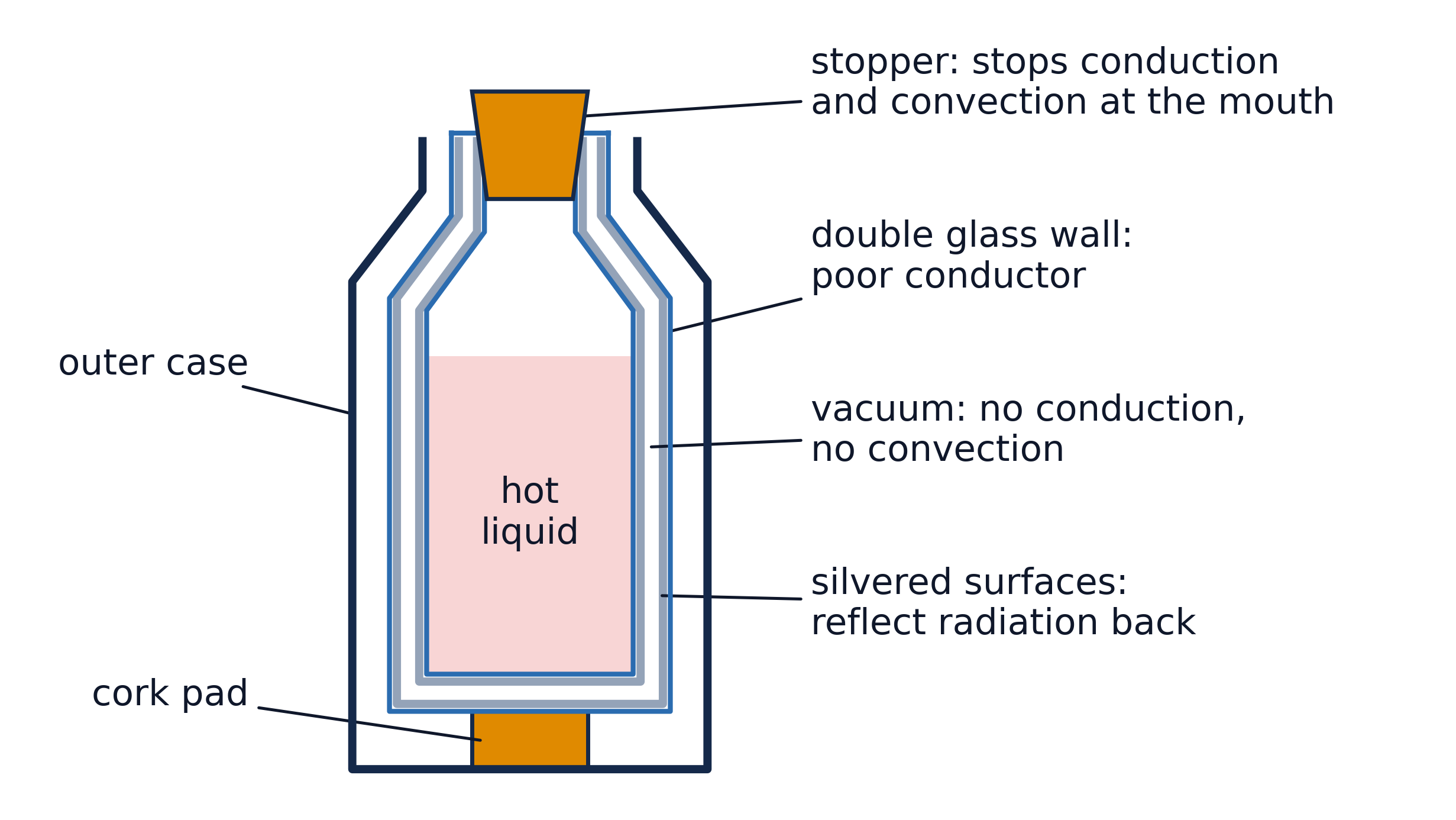
Exam fact. The flask works equally in both directions. It keeps ice cold because heat from outside cannot get in.
What the papers have asked
| Paper | The idea asked | The answer in one line |
|---|---|---|
| NDA II 2017 | Why water boils at a lower temperature at high altitudes | The air pressure is less there, and the boiling point falls with pressure |
| NDA I 2019 | Which statement about a thermos flask is not correct | The wrong one said the inner wall radiates a good amount of heat. A shiny wall is a poor radiator |
| NDA II 2023 | When a heated liquid starts to boil | When its vapour pressure becomes equal to the atmospheric pressure |
Only three were found, so this table is short. The siphon, the pumps, the balloon and the hydrometer were not asked as devices in these 12 papers. Questions on floating bodies and on atmospheric pressure were asked often, and those are the same two ideas (see Chapters P1-1 and P1-2).
Worked examples
Example 1 (single fact). A lift pump cannot raise water from a well in which the water is 15 m below the pump. What is the reason?
(a) The handle is too short to give enough force (b) Atmospheric pressure can support a column of water only about 10 m high (c) Water becomes denser at depth (d) The valves open the wrong way at that depth
Solution. In a lift pump the water is pushed up by atmospheric pressure, which balances a water column of about 10.3 m and no more. A stronger arm does not help, so (a) is the tempting wrong option. Answer (b).
Example 2 (statements). Consider the following statements about a thermos flask:
- The vacuum between its walls stops the loss of heat by radiation.
- The silvering on its walls reduces the loss of heat by radiation.
Which of the statements given above is/are correct?
(a) 1 only (b) 2 only (c) Both 1 and 2 (d) Neither 1 nor 2
Solution. Radiation needs no material: the Sun's heat reaches us through empty space. So a vacuum does not stop radiation; it stops conduction and convection. Statement 1 is wrong. A silvered surface is a poor radiator and reflects radiation back, so statement 2 is correct. Answer (b).
Example 3 (matching lists). Match List I with List II.
| List I | List II |
|---|---|
| A. Hydrometer | 1. The boiling point rises with pressure |
| B. Pressure cooker | 2. A floating body sinks deeper in a lighter liquid |
| C. Hot-air balloon | 3. Atmospheric pressure pushes water into a space at lower pressure |
| D. Lift pump | 4. Warm air is less dense than cold air |
(a) A-2, B-1, C-4, D-3 (b) A-4, B-1, C-2, D-3 (c) A-2, B-3, C-4, D-1 (d) A-3, B-1, C-4, D-2
Solution. The hydrometer is a floating body (2). The cooker raises the boiling point by raising the pressure (1). The balloon rises because its hot air is lighter than the air outside (4). The pump lowers the pressure in its barrel and the atmosphere pushes water in (3). Option (b) confuses the hydrometer and the balloon: both float, but the hydrometer floats in a liquid. Answer (a).
Example 4 (short calculation). A test tube loaded with lead shot floats upright with 10 cm of its length under water. In another liquid it floats with 12.5 cm under the surface. What is the relative density of that liquid?
(a) 0.8 (b) 1.25 (c) 2.5 (d) 0.25
Solution. The tube displaces its own weight of each liquid. For a tube of uniform width the volume under the surface is proportional to the length under the surface, so 10 \times 1 = 12.5 \times d, which gives d = 10 / 12.5 = 0.8. The tube sinks deeper, so the liquid must be lighter than water. Option (b) has the ratio upside down. Answer (a).
Example 5 (short calculation). A hot-air balloon has a volume of 1000 m³. The density of the air outside is 1.2 kg/m³ and of the hot air inside is 0.9 kg/m³. What is the greatest total mass of bag, basket and load that it can lift?
(a) 300 kg (b) 900 kg (c) 1200 kg (d) 2100 kg
Solution. Mass of air pushed aside = 1000 \times 1.2 = 1200 kg. Mass of hot air inside = 1000 \times 0.9 = 900 kg. The balloon just floats when the total mass equals the mass of air pushed aside, so bag, basket and load can be 1200 - 900 = 300 kg. Option (c) forgets that the hot air inside also has weight. Answer (a).
Mistakes that cost marks
- "The pump sucks the water up." Nothing pulls the water. The atmosphere pushes it into the space where the pressure is low. This is why there is a 10 m limit.
- Saying the vacuum in a thermos flask stops radiation. The vacuum stops conduction and convection. The silvering deals with radiation.
- Saying a pressure cooker works by "more heat". The flame is the same. The higher pressure raises the boiling point, so the water is hotter.
- Reading the hydrometer the wrong way. Deeper means lighter liquid. The larger numbers are at the bottom of the stem.
Quick check
Do these without help. Answers are at the end.
- Name two conditions that must be met for a siphon to start and keep running.
- In a lift pump, on which stroke does water enter the barrel from the well?
- Why is helium preferred to hydrogen for filling balloons?
- A lactometer floats lower in a sample of milk than it does in pure milk. What does this show?
- Which part of a thermos flask reduces loss of heat by radiation, and which parts reduce conduction?
Read and watch more, free
| What | Where | Language |
|---|---|---|
| Textbook, floating and air pressure | NCERT Class 8 Curiosity, Chapters 5 and 6 | English (the Hindi edition is on the same NCERT site) |
| Self-study notes, hydrometer and thermos flask | NIOS Science and Technology (212), Lesson 11 Gravitation and Lesson 14 Thermal Energy | English, Hindi |
| Open textbook, Archimedes and the hydrometer | OpenStax: Archimedes' principle | English |
| Encyclopedia pages for the devices no textbook covers | Siphon · Pump · Hydrometer · Pressure cooker · Vacuum flask · Hot-air balloon | English |
| Video, the whole instruments list | Defence Wallah: General Appliances and Instrument in One Shot (78 minutes) | Hinglish |
| Video, the whole instruments list | Learn with Sumit: NDA Physics Important Instruments (42 minutes) | Hindi, Hinglish |
The videos were chosen from their titles, length and views; they have not yet been watched by a teacher.
Answers to the quick check
- The tube must be completely filled with the liquid, and its outlet must be lower than the liquid surface in the upper vessel. (Also, the bend must be less than about 10 m above that surface for water.)
- On the upstroke. The pressure under the rising piston falls and atmospheric pressure pushes the water in.
- Helium does not burn. Hydrogen is lighter but catches fire easily.
- The sample is less dense than pure milk, so water has probably been added.
- The silvered surfaces reduce radiation. The vacuum, the glass walls and the cork or plastic stopper reduce conduction.
Next chapter: How they work: gramophone, telegraph, telephone, periscope, telescope, microscope, compass, lightning conductor, fuse.