Why this chapter matters. We found 5 questions from this chapter in the 12 papers we hold, from 2017 to 2026: four on the simple pendulum and one on levers. The pendulum questions are all of one kind: "the length, the mass or g is changed, what happens to the time period?" They are answered in under a minute from one formula. Learn that formula and what the period does not depend on first; then learn the three classes of lever.
What you will be able to do
- Write the period of a simple pendulum and say at once how it changes when the length, the mass, the amplitude or the place is changed.
- Find the mechanical advantage of a fixed pulley, a movable pulley and a set of pulleys.
- Name the class of any lever from the positions of the fulcrum, the load and the effort, and use the principle of moments to find the effort.
- Explain why no machine saves work.
Before you start you should know: force and weight (Chapter P1-4), acceleration due to gravity g (Chapter P1-6) and work as force × distance (Chapter P1-7).
1. The simple pendulum
What it is for. Keeping time. A pendulum clock counts the swings of a pendulum. In the laboratory a pendulum is also used to measure g.
What it is. A small heavy ball, called the bob, hung from a fixed point by a light thread that does not stretch.
| Word | Meaning |
|---|---|
| Mean position | The lowest point, where the bob rests when it is not swinging |
| Oscillation | One complete swing: from one end to the other end and back again |
| Amplitude | The greatest distance (or angle) of the bob from the mean position |
| Time period T | The time for one oscillation, in seconds |
| Frequency f | The number of oscillations in one second, f = 1/T, in hertz |
| Length L | Measured from the point of suspension to the centre of the bob |
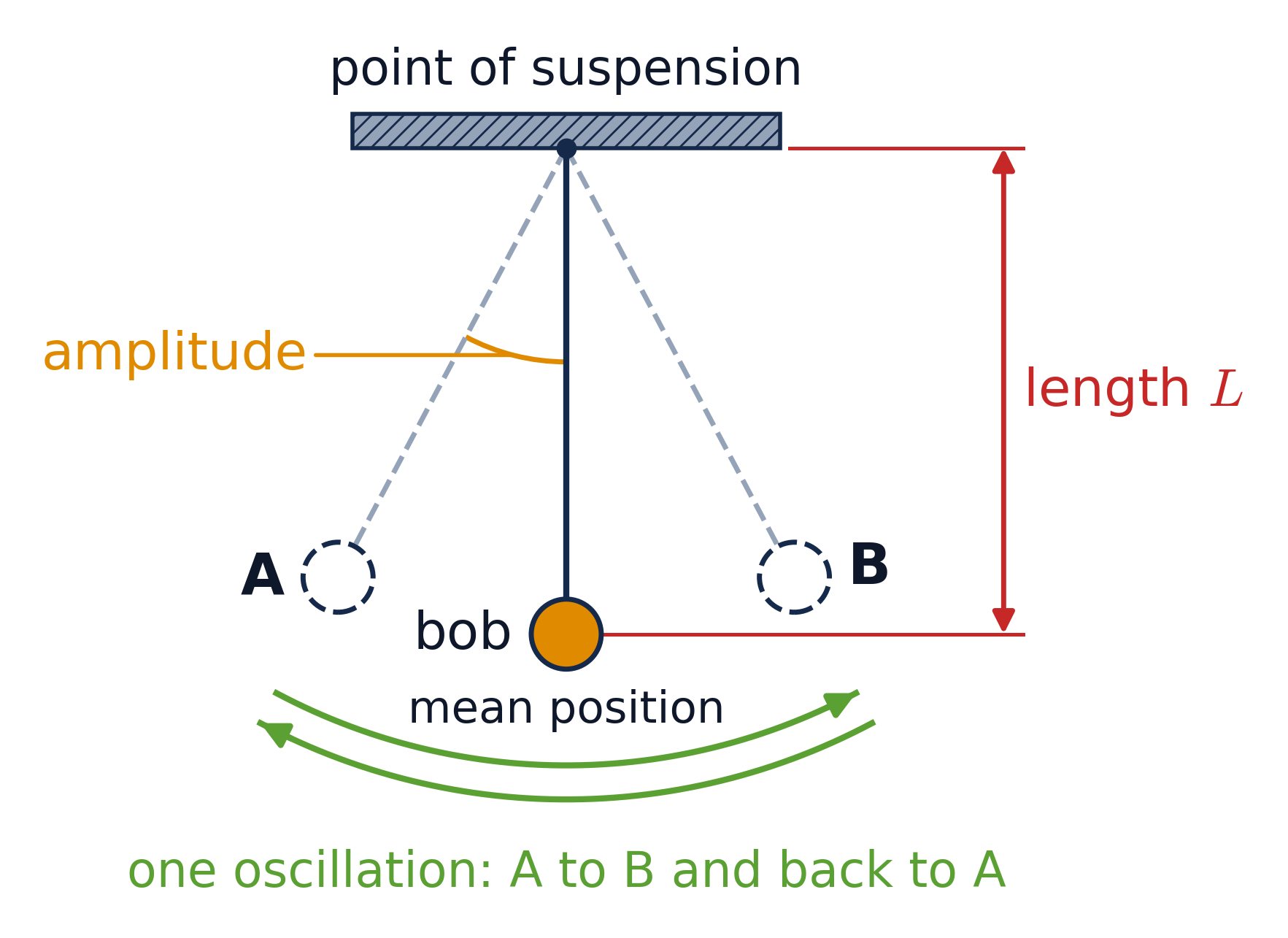
The principle. When the bob is pulled to one side and let go, its weight pulls it back towards the mean position. For a small swing this pull is proportional to the displacement from the mean position. Such a motion is called simple harmonic motion, and its period does not depend on how wide the swing is. The period is
T = 2\pi\sqrt{\frac{L}{g}}
How it works, in four steps.
- At the end of the swing the bob is at its highest point and is at rest for an instant. All its energy is potential energy.
- As it falls towards the mean position, potential energy changes into kinetic energy.
- At the mean position the speed and the kinetic energy are greatest. The bob cannot stop there, so it rises on the other side.
- It stops at the same height on the other side (if air resistance is ignored) and the swing repeats.
What the period depends on. This table answers most of the questions the papers have asked.
| Change made | Effect on the period T |
|---|---|
| Length made 4 times | T becomes 2 times (T is proportional to \sqrt{L}) |
| Length made 9 times | T becomes 3 times |
| Mass of the bob changed | No change. Mass is not in the formula |
| Material of the bob changed (iron to wood, same size) | No change |
| Amplitude changed, while it stays small | No change |
| Amplitude made large (for example 60°) | T becomes slightly greater than 2\pi\sqrt{L/g} |
| Taken to a place where g is smaller (a mountain top, the Moon) | T increases (T is proportional to 1/\sqrt{g}) |
| Taken to the Moon, where g is about one-sixth | T becomes \sqrt{6} times, about 2.45 times |
Exam facts.
- A seconds pendulum has a period of 2 seconds: one second for each half swing. Its length on the Earth is about 1 metre.
- A pendulum clock runs slow in summer. The metal rod expands, L increases, so T increases and the clock loses time. In winter it runs fast.
- A pendulum clock runs slow on a high mountain, because g is a little smaller there.
- In a satellite in orbit, or in a lift falling freely, a pendulum does not swing at all, because the bob has no effective weight to pull it back.
2. Machines, and the two numbers that describe them
A simple machine lets us do a job with a smaller force, or in a more convenient direction, or faster. The force we apply is the effort. The force the machine overcomes is the load.
| Quantity | Definition | Unit |
|---|---|---|
| Mechanical advantage (MA) | load ÷ effort | none (a ratio) |
| Velocity ratio (VR) | distance moved by the effort ÷ distance moved by the load | none |
| Efficiency | work got out ÷ work put in = MA ÷ VR | none, often given as a per cent |
If MA is greater than 1 the machine multiplies force. If MA is less than 1 the machine multiplies speed and distance instead.
No machine saves work. In an ideal machine with no friction, effort × distance moved by effort = load × distance moved by load. If the effort is one-quarter of the load, the effort must move four times as far. In a real machine friction wastes some work, so the efficiency is always less than 100 per cent.
3. Pulleys
What it is for. Lifting loads: a bucket from a well, a flag up a pole, an engine out of a vehicle in a workshop.
What it is. A wheel with a groove in its rim, turning on an axle, with a rope in the groove.
The principle. In a light rope passing over smooth pulleys the tension is the same all along the rope. So each part of the rope that holds up the load carries an equal share of it.
| Pulley | What it does | Ideal MA | Example |
|---|---|---|---|
| Single fixed pulley (the axle does not move) | Changes only the direction of the force. We pull down to lift the load up | 1 | Well, flagpole |
| Single movable pulley (the pulley rises with the load) | Two parts of the rope share the load, so the effort is half the load | 2 | Builder's hoist |
| Block and tackle (several pulleys in two blocks) | The load is shared by all the parts of rope that support the lower block | The number of those parts of rope | Cranes, lifting a boat on a ship |
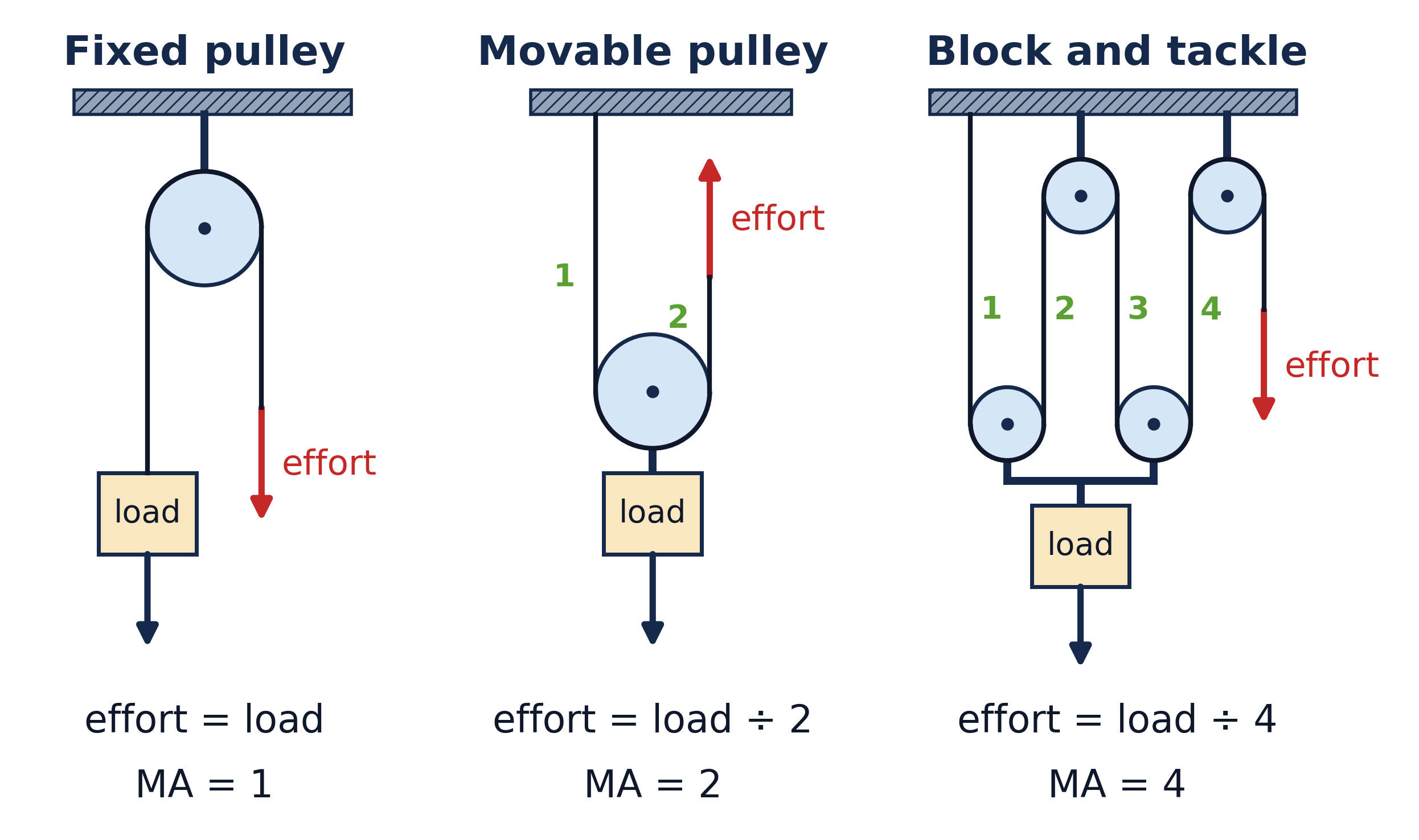
How a movable pulley works, in three steps.
- One end of the rope is tied to a fixed support. The rope goes down, round the pulley that carries the load, and up to the hand.
- Two parts of the rope hold up the load, and the tension in each is the same. So each carries half the load: effort = load ÷ 2.
- To raise the load by 1 metre, both parts must shorten by 1 metre, so the hand pulls 2 metres of rope. The work is the same.
Exam fact. A single fixed pulley gives no gain in force (MA = 1). It is used because pulling downwards is easier than lifting upwards: we can use our own weight.
4. Levers
What it is for. Moving a large load with a small effort, or moving the end of a tool quickly.
What it is. A rigid bar that turns about a fixed point called the fulcrum. The distance from the fulcrum to the effort is the effort arm. The distance from the fulcrum to the load is the load arm.
The principle is the principle of moments. When the lever is balanced,
\text{effort} \times \text{effort arm} = \text{load} \times \text{load arm}
so that
\text{MA} = \frac{\text{load}}{\text{effort}} = \frac{\text{effort arm}}{\text{load arm}}
A long effort arm and a short load arm give a large mechanical advantage.
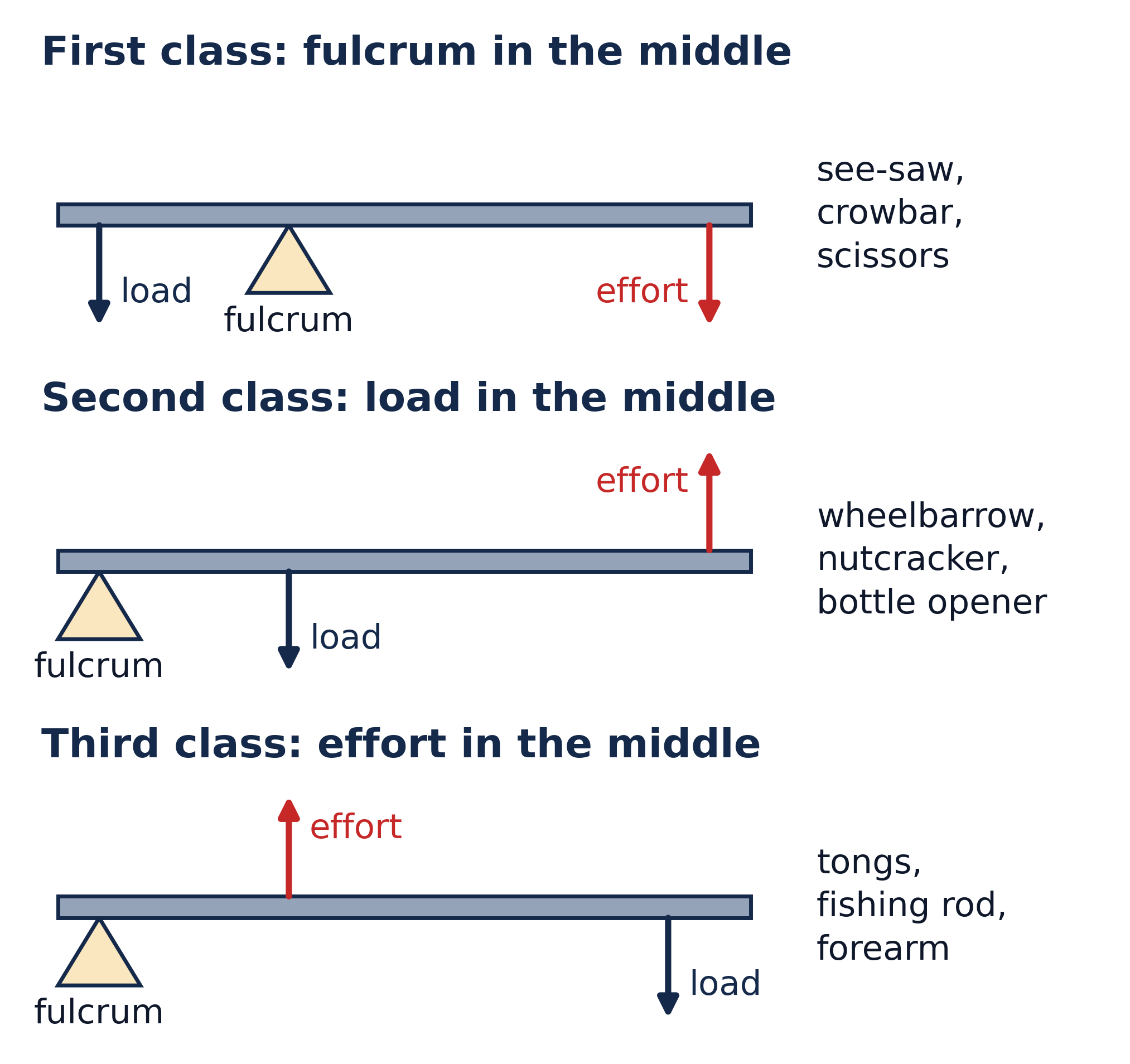
The three classes. The class is decided by which of the three is in the middle.
| Class | In the middle | Mechanical advantage | Everyday examples |
|---|---|---|---|
| First | Fulcrum | Can be more than 1, equal to 1 or less than 1 | See-saw, crowbar, scissors, pliers, beam balance, handle of a hand pump |
| Second | Load | Always more than 1 (the effort arm is the longer one) | Wheelbarrow, nutcracker, bottle opener, lemon squeezer |
| Third | Effort | Always less than 1 (the effort arm is the shorter one) | Tongs, tweezers, fishing rod, the human forearm |
A way to remember the order is the letters F, L, E: fulcrum, load, effort in the middle for classes one, two, three.
How a crowbar works, in three steps.
- The tip of the bar goes under the heavy stone. A small stone close to the tip is the fulcrum.
- The soldier pushes down on the far end. The effort arm is long, the load arm is short.
- By the principle of moments the force on the stone is larger than the push, in the ratio of the two arms. The hand moves a long way; the stone rises a little.
Why use a third-class lever at all? Its MA is less than 1, so the effort is larger than the load. But the load end moves farther and faster than the effort. A small movement of the muscle in the upper arm moves the hand through a large distance.
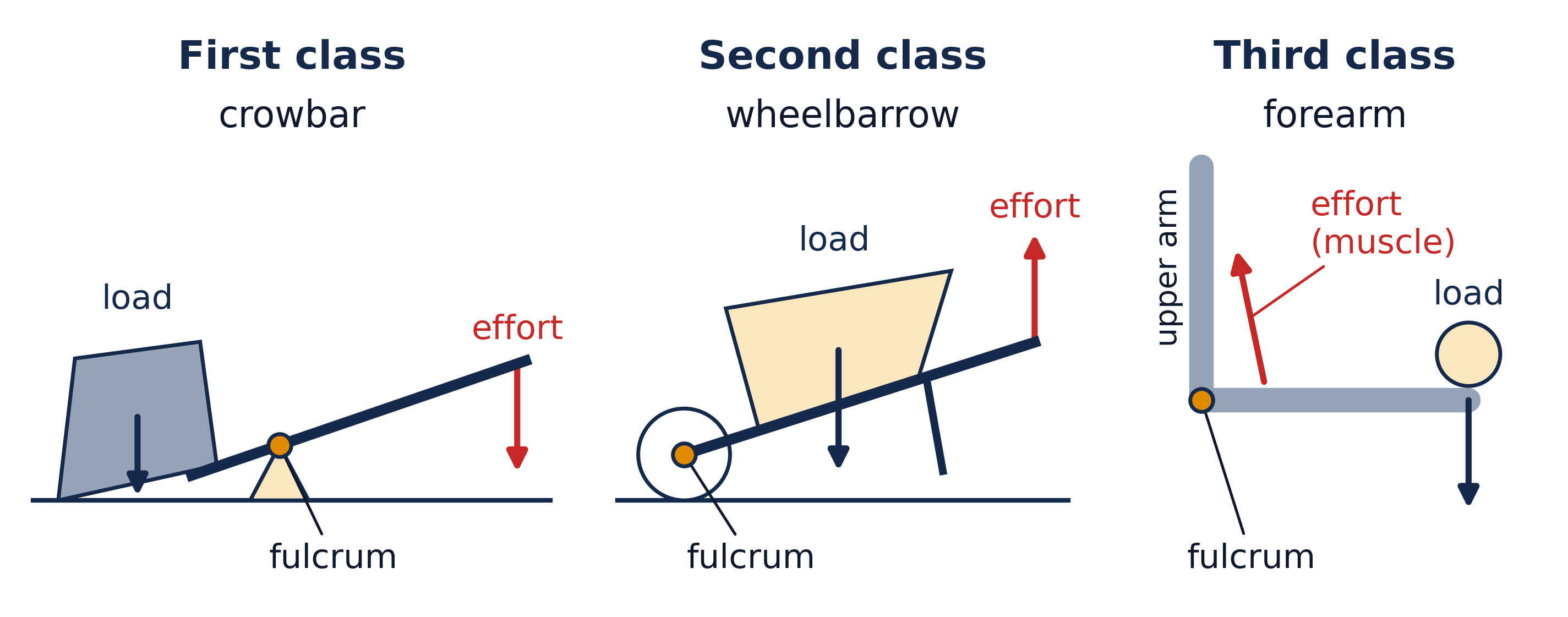
Exam fact. The human body has all three: nodding the head is first class, rising on the toes is second class, and lifting a weight in the hand with the forearm is third class.
What the papers have asked
| Paper | The idea asked | The answer in one line |
|---|---|---|
| NDA II 2019 | A second pendulum of the same length has a bob of double the mass and is at a place where g is half. Its period in terms of the first period T | \sqrt{2}\,T. Mass does not matter; halving g multiplies T by \sqrt{2} |
| NDA I 2024 | When is the period independent of amplitude, and why | Only for small amplitudes, because then the restoring force is proportional to the displacement |
| NDA II 2024 | Which sketch shows a lever of the second class | The one with the load between the fulcrum and the effort |
| NDA I 2025 | Length made four times and mass doubled: ratio of new period to old | 2 : 1. Only the length matters |
| NDA I 2026 | A pendulum swings with an amplitude of 60°. Compare its period with 2\pi\sqrt{L/g} | Slightly greater. The formula is exact only for small angles |
Pulleys have not been asked in these 12 papers. They are in the syllabus by name, so learn the table in section 3.
Worked examples
Example 1 (short calculation). The length of a simple pendulum is made nine times and the mass of its bob is made three times. What is the ratio of the new time period to the old one?
(a) 1 : 1 (b) 3 : 1 (c) 9 : 1 (d) 27 : 1
Solution. T is proportional to \sqrt{L} and does not depend on mass. \sqrt{9} = 3, so the ratio is 3 : 1. Option (c) forgets the square root. Option (d) multiplies in the mass, which is not in the formula. Answer (b).
Example 2 (statements). Consider the following statements about a pendulum clock that keeps correct time in Delhi and is then taken to a high mountain post:
- Its pendulum takes a longer time for each swing.
- The clock gains time.
Which of the statements given above is/are correct?
(a) 1 only (b) 2 only (c) Both 1 and 2 (d) Neither 1 nor 2
Solution. On the mountain g is smaller, so T = 2\pi\sqrt{L/g} is larger. Statement 1 is correct. Each swing takes longer, so the clock counts fewer swings in a day and shows less time than has passed: it loses time. Statement 2 is wrong. The tempting mistake is to think "longer period, more time shown". Answer (a).
Example 3 (matching lists). Match List I with List II.
| List I | List II |
|---|---|
| A. Wheelbarrow | 1. Effort between the fulcrum and the load |
| B. Scissors | 2. Ideal mechanical advantage 2 |
| C. Fishing rod | 3. Load between the fulcrum and the effort |
| D. Single movable pulley | 4. Fulcrum between the load and the effort |
(a) A-3, B-4, C-1, D-2 (b) A-4, B-3, C-1, D-2 (c) A-3, B-1, C-4, D-2 (d) A-1, B-4, C-3, D-2
Solution. In a wheelbarrow the wheel is the fulcrum, the hands are at the far end and the load sits between them: second class (3). In scissors the pivot is between the handles and the blades: first class (4). In a fishing rod one hand holds the end as the fulcrum and the other hand, in the middle, gives the effort: third class (1). A movable pulley halves the effort (2). Option (b) swaps the wheelbarrow and the scissors. Answer (a).
Example 4 (short calculation). A crowbar 1.5 m long is used to lift one edge of a crate. The fulcrum is 0.25 m from the end under the crate, and the crate presses on that end with a force of 600 N. What least force at the other end will lift it?
(a) 100 N (b) 120 N (c) 3000 N (d) 3600 N
Solution. Load arm = 0.25 m. Effort arm = 1.5 - 0.25 = 1.25 m. By the principle of moments, effort \times 1.25 = 600 \times 0.25, so effort = 150 / 1.25 = 120 N. The mechanical advantage is 1.25 / 0.25 = 5. Option (a) uses the whole length 1.5 m as the effort arm. Option (c) turns the ratio upside down. Answer (b).
Example 5 (short calculation). A block and tackle has four parts of rope supporting the lower block. It lifts a load of 800 N, and the effort actually needed is 250 N. What is its efficiency?
(a) 31.25 per cent (b) 64 per cent (c) 80 per cent (d) 100 per cent
Solution. The velocity ratio is 4: the rope must be pulled 4 m to raise the load 1 m. The mechanical advantage is 800 / 250 = 3.2. Efficiency = MA ÷ VR = 3.2 / 4 = 0.8, that is 80 per cent. With no friction the effort would have been 800 / 4 = 200 N; the extra 50 N is lost to friction and to lifting the lower block. Option (a) is effort ÷ load, which is not the efficiency. Answer (c).
Mistakes that cost marks
- Putting the mass into the pendulum formula. A heavier bob does not swing slower or faster. When a question changes the mass, ignore that part of it.
- Forgetting the square root. Length four times gives a period two times, not four times. And a smaller g gives a larger period.
- Saying a fixed pulley reduces the effort. It only changes the direction. Only a movable pulley shares the load.
- Naming the class of a lever from the tool's shape. Find the three points first, then ask which one is in the middle. Tongs and scissors look alike, but tongs are third class and scissors are first class.
Quick check
Do these without help. Answers are at the end.
- A pendulum has a period of 2 s. Its length is made one-quarter. What is the new period?
- Does a pendulum clock gain or lose time in winter? Why?
- What is the ideal mechanical advantage of a single fixed pulley, and why is it used?
- In a nutcracker, which is in the middle: the fulcrum, the load or the effort? Which class is it?
- A lever has an effort arm of 80 cm and a load arm of 20 cm. What effort balances a load of 200 N?
Read and watch more, free
| What | Where | Language |
|---|---|---|
| Textbook, pendulum | NCERT Class 7 Curiosity, Chapter 8, Measurement of Time and Motion | English (the Hindi edition is on the same NCERT site) |
| Textbook, levers and pulleys | NCERT Class 9 Exploration, Chapter 7, Work, Energy and Simple Machines | English (the Hindi edition, Anveshan, is on the same NCERT site) |
| Self-study notes, pendulum | NIOS Physics (312), Lesson 13 | English, Hindi |
| Open textbook | OpenStax: The simple pendulum · OpenStax: Simple machines | English |
| Video, the new Class 9 book | Magnet Brains: Class 9 Science (Exploration Book) (find the simple machines videos in the playlist) | Hinglish |
| Video, the whole instruments list | Defence Wallah: General Appliances and Instrument in One Shot (78 minutes) | Hinglish |
| Video, the whole instruments list | Learn with Sumit: NDA Physics Important Instruments (42 minutes) | Hindi, Hinglish |
The videos were chosen from their titles, length and views; they have not yet been watched by a teacher.
Answers to the quick check
- 1 s. The period is proportional to \sqrt{L}, and \sqrt{1/4} = 1/2.
- It gains time. The rod contracts in the cold, the length is smaller, the period is smaller, so the clock runs fast.
- MA = 1. It changes the direction of the force, so that we can pull down to lift a load up.
- The load (the nut) is in the middle. Second class.
- Effort \times 80 = 200 \times 20, so effort = 50 N.
Next chapter: How they work: siphon, pumps, balloon, hydrometer, pressure cooker, thermos flask.