Why this chapter matters. We found 9 questions from this chapter in the 12 papers we hold, from 2017 to 2026: two each on the telescope, the microscope, the lightning conductor and the fuse, and one on the periscope. NDA I 2026 alone had two. Most are single facts ("which lens has the larger focal length?", "what must a fuse wire be made of?"), with one short calculation on the telescope. No school textbook gathers these devices in one place. Learn the one-line principle of each device first, then the telescope and microscope table in section 6.
What you will be able to do
- State the principle of each of the nine devices in one line.
- Compare the lenses of a telescope and a compound microscope, and calculate a telescope's magnification.
- Explain why a lightning conductor is pointed and earthed.
- Explain how a fuse protects a circuit and choose a fuse for a given appliance.
Before you start you should know: reflection and lenses (Chapters P4-1 and P4-2), magnets and the Earth's magnetism (Chapter P5-1), and the heating and magnetic effects of current (Chapter P6-2).
1. The nine devices at a glance
| Device | Principle in one line | A name to remember |
|---|---|---|
| Gramophone | Sound is stored as a wavy groove; a needle in the groove vibrates and gives the sound back | Thomas Edison (phonograph, 1877), Emile Berliner (flat disc) |
| Telegraph | Magnetic effect of current: a distant electromagnet is switched on and off in a code | Samuel Morse |
| Telephone | Sound is changed into a varying electric current, and changed back into sound at the other end | Alexander Graham Bell (1876) |
| Periscope | Reflection of light, twice, at two parallel plane mirrors | |
| Telescope | Refraction through two lenses (or reflection at a concave mirror) to magnify distant objects | Galileo; Newton (reflecting type) |
| Microscope | Refraction through one or two convex lenses to magnify small, near objects | |
| Mariner's compass | A freely turning magnet sets itself along the Earth's magnetic field | |
| Lightning conductor | Charge concentrates at sharp points; a thick conductor gives the charge an easy path to the earth | Benjamin Franklin |
| Safety fuse | Heating effect of current: a thin wire of low melting point melts when the current is too large |
2. The gramophone
What it is for. Playing back recorded sound from a disc (a "record").
The principle. Sound is a vibration. In recording, the vibration is cut into the disc as a wavy spiral groove. In playing, the groove makes a needle repeat the same vibration.
The parts. A turntable that spins the disc at a steady speed; a needle (stylus); a diaphragm in the sound box; a horn.
How it works.
- The disc turns and the needle rests in the groove.
- The waves of the groove push the needle from side to side, just as the original sound moved the cutting needle.
- The needle makes the diaphragm vibrate, and the diaphragm sets the air vibrating.
- The horn makes the sound louder.
Exam fact. Edison's phonograph of 1877 recorded on a cylinder. The flat disc that we call a gramophone record came from Emile Berliner.
3. The telegraph
What it is for. Sending messages over a long wire as electric signals. It was the first electrical means of sending messages over long distances.
The principle. The magnetic effect of current. A coil of wire round a soft iron core is a magnet only while current flows.
The parts. At the sending end a battery and a key (a press switch). A long line wire. At the receiving end a sounder: an electromagnet with a small iron bar held just above it by a spring.
How it works.
- The operator presses the key. The circuit is complete and current flows in the line.
- The electromagnet at the far end pulls the iron bar down with a click.
- When the key is released the current stops, and the spring pulls the bar back.
- A short press is a "dot" and a long press a "dash". Letters are sent as sets of dots and dashes: the Morse code.
Exam fact. Soft iron is used for the core because it loses its magnetism as soon as the current stops.
4. The telephone
What it is for. Carrying speech over a distance.
The parts. A microphone (transmitter) in the mouthpiece and a receiver in the earpiece, joined by wires through an exchange.
How it works.
- The voice makes the thin diaphragm of the microphone vibrate.
- The microphone turns these vibrations into an electric current that rises and falls in the same pattern as the sound. In the old carbon microphone, the diaphragm presses on carbon grains and changes their resistance.
- The varying current travels along the wire to the other telephone.
- In the receiver the current flows through an electromagnet. Its pull on a thin iron diaphragm rises and falls with the current, so the diaphragm vibrates and gives out a copy of the sound.
| Part | Energy change |
|---|---|
| Microphone | Sound to electrical |
| Receiver (earpiece, loudspeaker) | Electrical to sound |
Exam fact. The sound itself does not travel along the wire. An electrical signal does.
5. The periscope
What it is for. Seeing over or round an obstacle while staying hidden: from a submarine below the surface, from a trench or from inside a tank.
The principle. Reflection of light at plane mirrors.
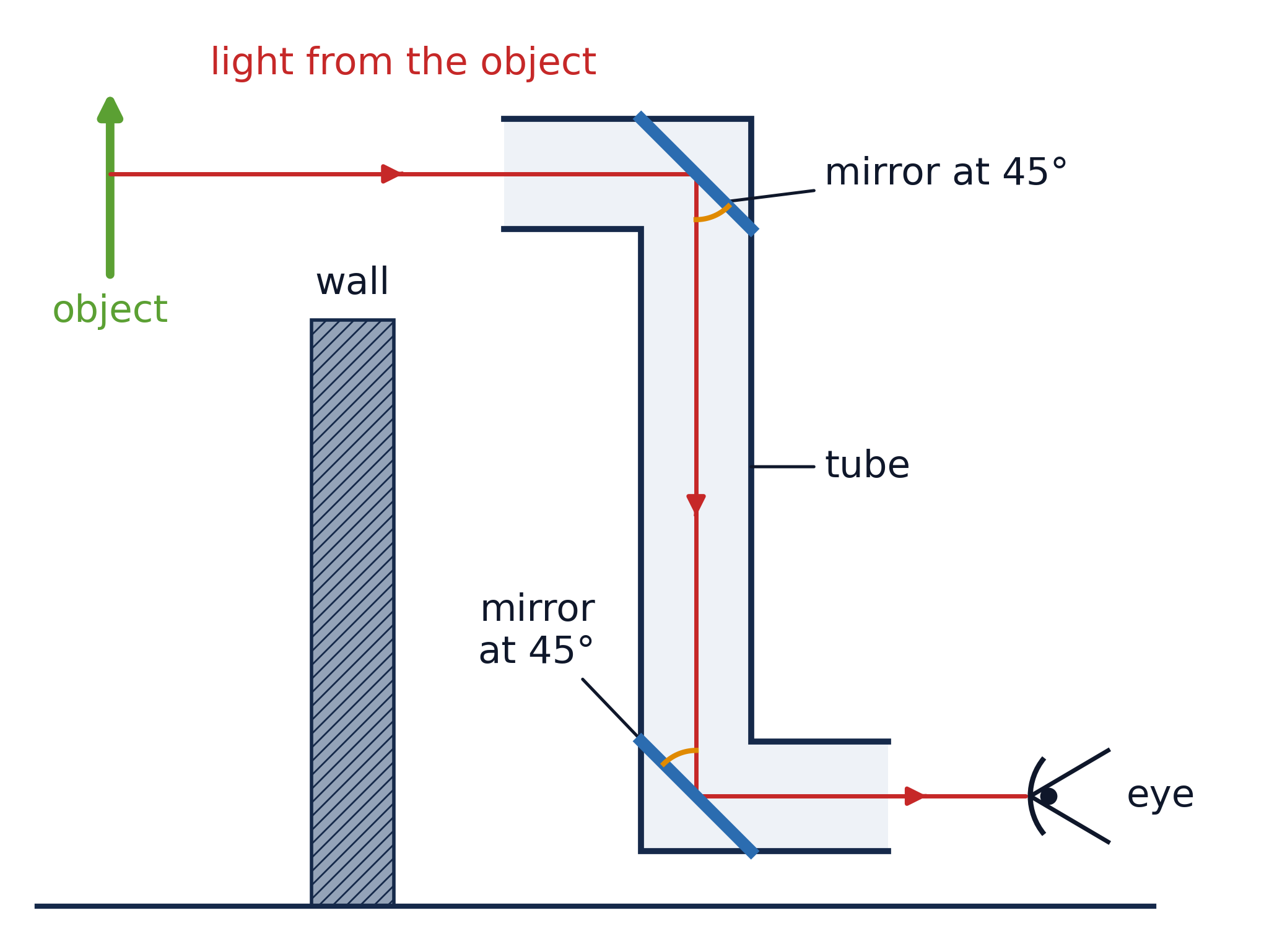
The parts. A tube with two plane mirrors, one at each bend. The mirrors face each other, are parallel, and each is at 45° to the length of the tube.
How it works.
- Light from the object enters the top opening and meets the upper mirror at 45°. It is reflected through 90°, straight down the tube.
- It meets the lower mirror at 45° and is turned through 90° again, into the eye.
- The eye sees an image that is erect and the same size as the object. The second mirror undoes the left-right reversal of the first.
Exam facts. Better periscopes use two right-angled glass prisms in place of mirrors. The prisms turn the light by total internal reflection and give a brighter image. The law of reflection does not depend on the medium the light is travelling in.
6. The telescope and the microscope
The telescope makes distant objects look nearer and larger. The microscope makes very small, near objects look larger.
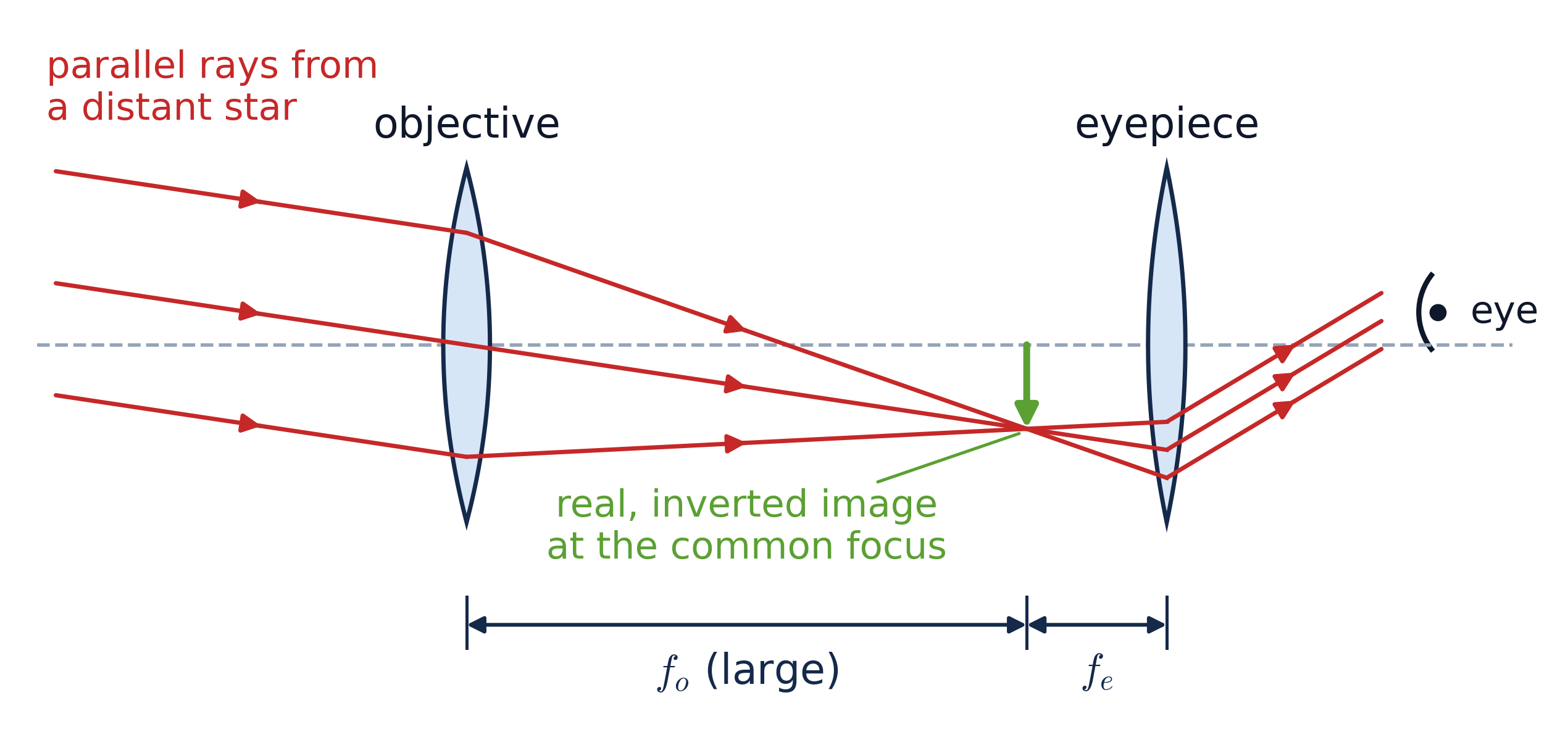
The astronomical (refracting) telescope. It has two convex lenses at the two ends of a tube.
- The objective, facing the star, has a large focal length and a large aperture (width). It forms a real, inverted, small image of the distant object at its focus.
- The eyepiece has a small focal length. It is used as a magnifying glass to look at that image.
- The final image is magnified and inverted. This does not matter for stars.
For the relaxed eye (final image at infinity):
M = \frac{f_o}{f_e} \qquad \text{length of the tube} = f_o + f_e
Here f_o and f_e are the focal lengths of the objective and the eyepiece. The large aperture collects more light, so faint stars can be seen and fine detail is clearer.
The reflecting telescope. The objective is a large concave mirror instead of a lens. Newton built the first one. Its advantages: a mirror does not split light into colours as a lens does; a large mirror is easier to make than a large lens; and it can be supported over its whole back. The largest telescopes in the world are all reflecting telescopes.
The simple microscope is one convex lens of short focal length: a magnifying glass. The object is kept within the focal length. The image is virtual, erect and magnified. When the image is formed at the least distance of clear vision, D = 25 cm,
M = 1 + \frac{D}{f}
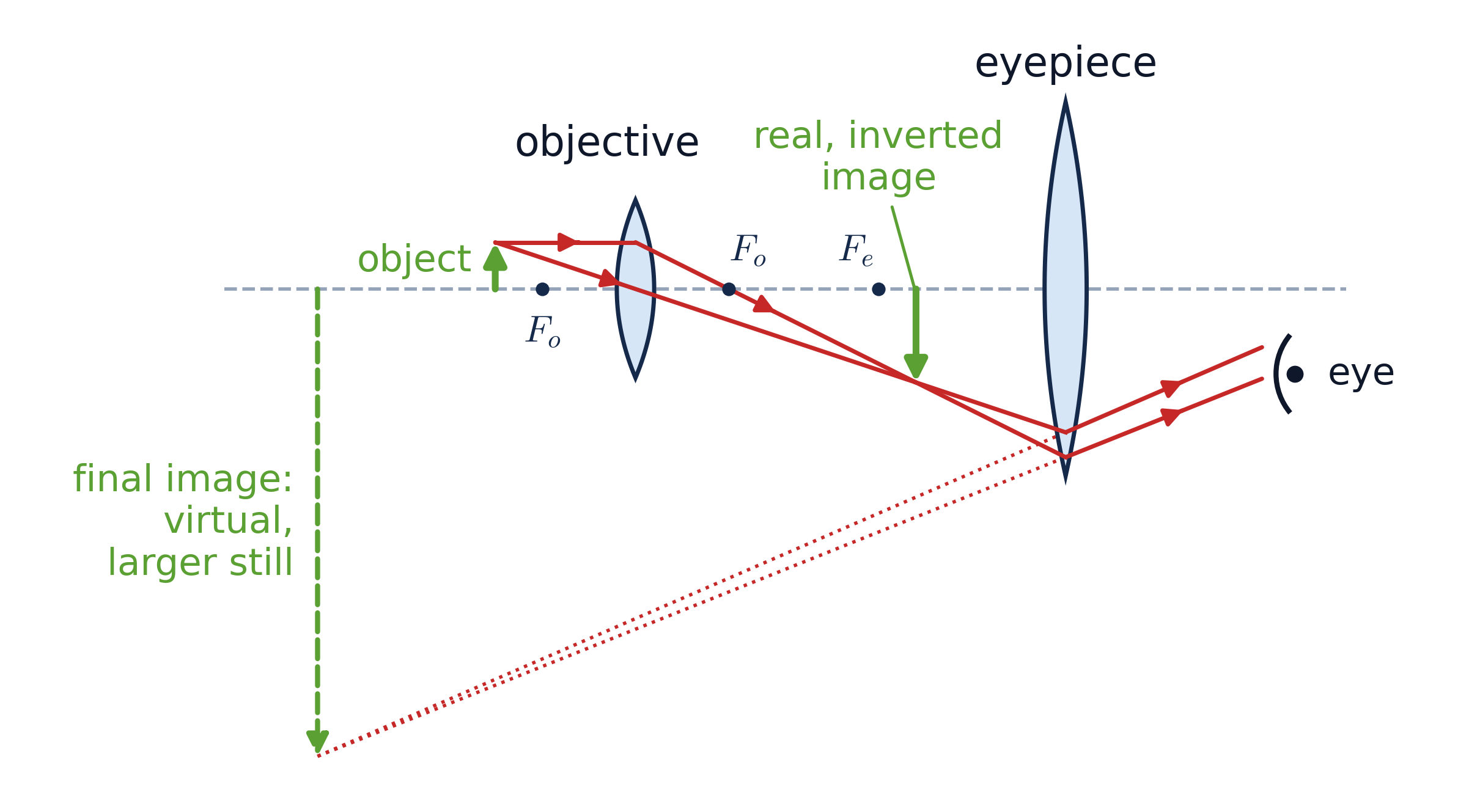
The compound microscope has two convex lenses.
- The objective has a very short focal length and a small aperture. The object is placed just beyond its focus. It forms a real, inverted, magnified image inside the tube.
- The eyepiece, of somewhat larger focal length, acts as a magnifying glass on this image.
- The final image is virtual, highly magnified and inverted compared with the object. The total magnification is the product of the two: M = m_o \times m_e.
| Astronomical telescope | Compound microscope | |
|---|---|---|
| Used for | Distant, large objects | Near, very small objects |
| Lenses | Two convex lenses | Two convex lenses |
| Objective | Large focal length, large aperture | Very small focal length, small aperture |
| Eyepiece | Small focal length | Larger focal length than its objective |
| Final image | Inverted, magnified | Inverted, magnified |
| Magnification | f_o / f_e | m_o \times m_e |
Exam fact. A laboratory microscope also has a mirror under the stage to send light up through the slide, clips to hold the slide, and coarse and fine focusing screws. NDA I 2024 asked which of four items is not a part of it.
7. The mariner's compass
What it is for. Finding direction at sea.
The principle. A magnet that is free to turn comes to rest along the Earth's magnetic field, pointing to magnetic north and south.
The parts. A light circular card marked with the directions, with magnetised needles fixed under it, balanced on a sharp pivot. A bowl of non-magnetic metal such as brass, usually filled with liquid to steady the card. Gimbals: rings on pivots that keep the bowl level when the ship rolls.
How it works.
- The card turns freely on its pivot until its magnets lie along the Earth's field.
- The north mark on the card then points to magnetic north, whatever way the ship turns.
- A line on the bowl shows the ship's head. The navigator reads the ship's heading where this line meets the card.
Exam facts. The compass shows magnetic north, not true (geographic) north. The angle between the two at a place is the magnetic declination, and the navigator corrects for it. Iron and steel near the compass disturb it, which is why the bowl is made of brass.
8. The lightning conductor
What it is for. Protecting a tall building from damage by lightning.
The principle. Two ideas. Charge on a conductor crowds at sharp points, so the electric field is strongest there. And a thick metal strip is a far easier path for charge than brick or stone.
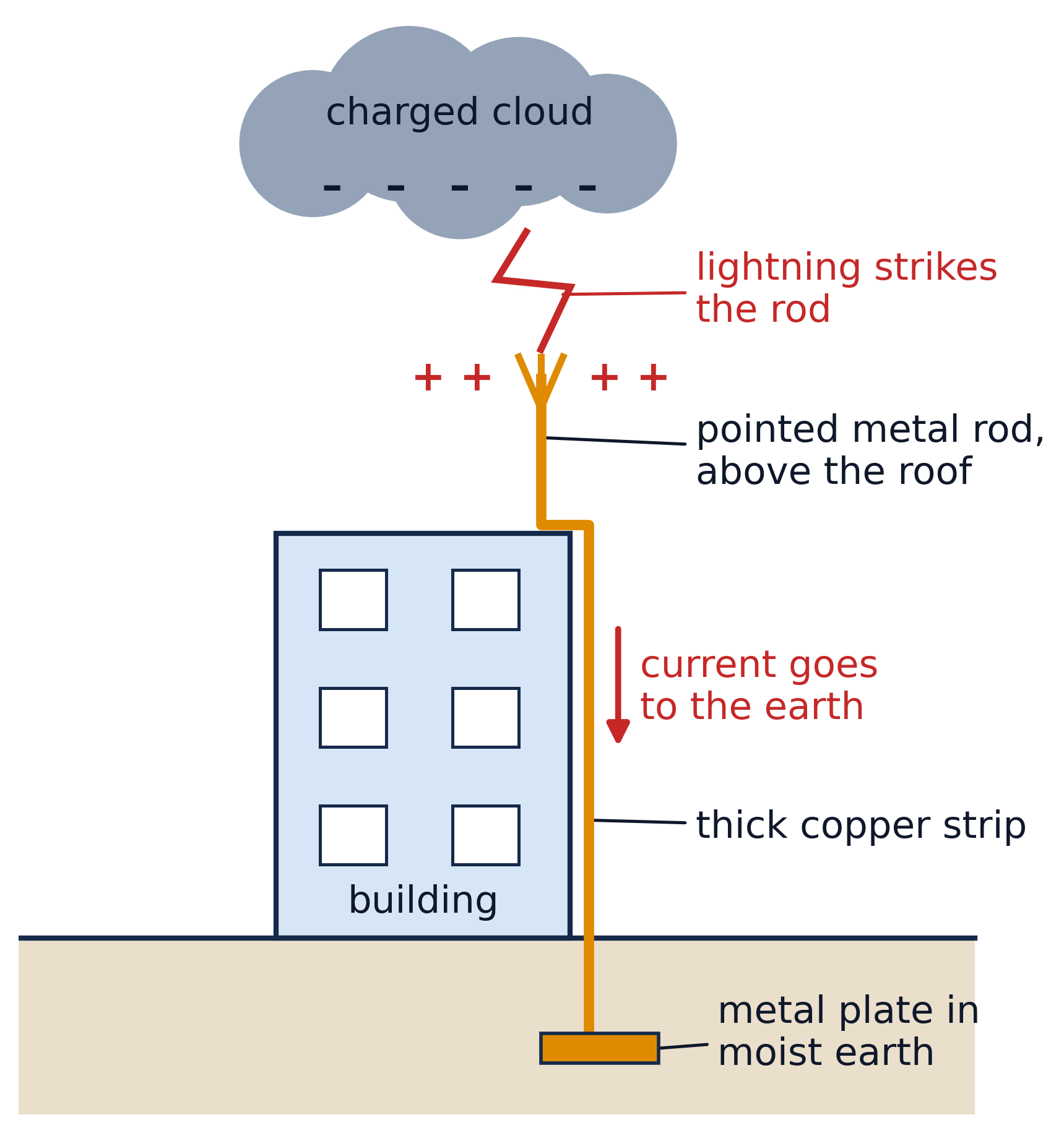
The parts. A metal rod (usually copper) with pointed spikes, fixed higher than the highest part of the building. A thick copper strip down the outside wall. A metal plate buried deep in moist earth.
How it works.
- A charged cloud passing overhead induces the opposite charge on the building and on the rod.
- The field at the sharp points is very strong. It ionises the air near them, and charge leaks away steadily into the air. This is called corona discharge, or the action of points.
- If lightning does strike, it strikes the rod, the highest and best conducting point.
- The large current passes down the thick strip to the earth and does not pass through the building.
Exam fact. The conductor is useful only if it is continuous and well earthed. A broken strip is dangerous.
9. The safety fuse and the MCB
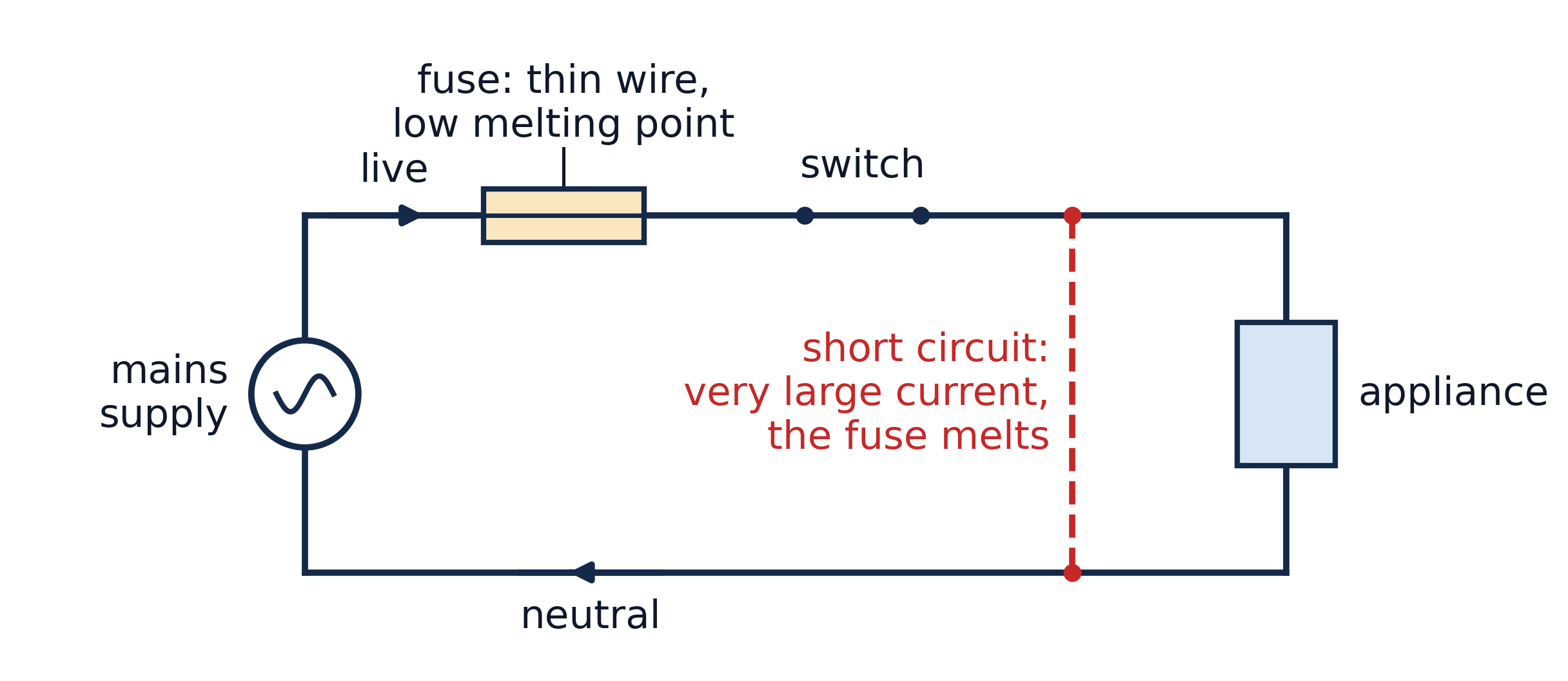
What it is for. Protecting the wiring and the appliances from too large a current.
The principle. The heating effect of current. The heat produced in a wire rises with the square of the current (H = I^2 R t).
The fuse. A short, thin wire of a material with a low melting point, such as an alloy of tin and lead. It is fixed in a porcelain or glass holder and connected in series, in the live wire.
How it works.
- In normal use the current is below the fuse's rating (5 A, 15 A and so on), and the wire is only warm.
- In a short circuit the live and neutral wires touch. The resistance of the circuit falls almost to zero and the current becomes very large. In overloading, too many appliances on one circuit draw too much current.
- The fuse wire heats, melts and breaks the circuit before the house wiring can overheat.
- After the fault is repaired, a new fuse wire of the same rating is fitted.
The MCB (miniature circuit breaker) is the modern form. It is a switch that turns itself off when the current is too large. Nothing melts. After the fault is repaired it is switched on again.
Exam facts. A fuse wire must be a conductor with a low melting point. It must never be replaced by a thick copper wire, which would not melt in time. To find the current an appliance draws, use I = P / V.
What the papers have asked
| Paper | The idea asked | The answer in one line |
|---|---|---|
| NDA I 2019 | Focal length of a telescope's eyepiece, given the objective's focal length (50 cm) and the magnification (25) | 2 cm, from M = f_o / f_e |
| NDA I 2019 | What a fuse wire must be | A conductor with a low melting point |
| NDA 2020 | The current in a circuit when a short circuit occurs | It increases very greatly |
| NDA I 2024 | The best shape for the top of a lightning conductor (four sketches) | A sharp point |
| NDA I 2024 | Which is not a part of a compound microscope | The retina; it is a part of the eye. Mirror, stage and clip are parts |
| NDA I 2024 | What a microscope may be a combination of | Two convex lenses |
| NDA II 2025 | A telescope's objective compared with its eyepiece | Larger focal length and larger aperture |
| NDA I 2026 | Why a sharp-tipped lightning rod reduces the risk of damage | The sharp tip makes the field around it very strong, and charge leaks continuously into the air (corona discharge) |
| NDA I 2026 | A two-mirror periscope with its tube filled with a transparent liquid | By our working the image is unchanged: reflection does not depend on the medium, and the light enters and leaves the liquid along the normal |
Worked examples
Example 1 (short calculation). An astronomical telescope has an objective of focal length 120 cm and gives a magnification of 30 with the final image at infinity. What are the focal length of the eyepiece and the length of the tube?
(a) 4 cm and 116 cm (b) 4 cm and 124 cm (c) 0.25 cm and 120.25 cm (d) 3600 cm and 3720 cm
Solution. M = f_o / f_e, so f_e = 120 / 30 = 4 cm. The length of the tube is f_o + f_e = 124 cm. Option (a) subtracts the focal lengths instead of adding them. Option (d) multiplies instead of dividing. Answer (b).
Example 2 (statements). Consider the following statements:
- In a compound microscope the objective has a smaller focal length than the eyepiece.
- In an astronomical telescope the objective has a smaller focal length than the eyepiece.
Which of the statements given above is/are correct?
(a) 1 only (b) 2 only (c) Both 1 and 2 (d) Neither 1 nor 2
Solution. The microscope's objective has a very short focal length: statement 1 is correct. The telescope is the other way round: its objective has the large focal length, because M = f_o / f_e must be large. Statement 2 is wrong. The two instruments are often confused because both use two convex lenses. Answer (a).
Example 3 (matching lists). Match List I with List II.
| List I | List II |
|---|---|
| A. Telegraph | 1. Heating effect of current |
| B. Safety fuse | 2. Reflection of light |
| C. Periscope | 3. Action of sharp points |
| D. Lightning conductor | 4. Magnetic effect of current |
(a) A-1, B-4, C-2, D-3 (b) A-4, B-1, C-3, D-2 (c) A-4, B-1, C-2, D-3 (d) A-4, B-3, C-2, D-1
Solution. The telegraph switches a distant electromagnet on and off (4). The fuse melts by the heat of the current (1). The periscope uses two plane mirrors (2). The lightning conductor has sharp spikes at which the field is strong (3). Option (a) swaps the two effects of current. Answer (c).
Example 4 (short calculation). A room heater is marked 2000 W, 220 V. Which of these fuses is the most suitable for its circuit?
(a) 1 A (b) 5 A (c) 10 A (d) 100 A
Solution. I = P / V = 2000 / 220 \approx 9.1 A. The fuse must carry this current without melting, so 1 A and 5 A are too small: they would melt every time the heater is switched on. A 100 A fuse would not melt even in a dangerous fault, so it protects nothing. The rating should be a little above the normal current. Answer (c).
Example 5 (single fact). Which one of the following describes the mirrors in a simple periscope?
(a) Two plane mirrors, parallel to each other, each at 45° to the tube (b) Two plane mirrors at right angles to each other (c) Two concave mirrors facing each other (d) One plane mirror and one convex mirror
Solution. Each mirror must turn the light through 90°, so each is at 45° to the tube, and the two are parallel so that the light leaves in its original direction. Curved mirrors would change the size of the image. Option (b) is tempting because the light is turned through a right angle, but it is the ray, not the pair of mirrors, that turns through 90°. Answer (a).
Mistakes that cost marks
- Mixing up the telescope and the microscope. Telescope: objective of large focal length and large aperture. Microscope: objective of very small focal length. Both use two convex lenses.
- Saying a fuse wire has a high melting point. It must melt easily, so the melting point is low. And it goes in series, in the live wire.
- Saying a lightning conductor "attracts" lightning away by magic or "repels the cloud". It works because of the strong field at its sharp points and the easy path to the earth.
- Saying a compass shows true north. It shows magnetic north. The difference is the declination.
Quick check
Do these without help. Answers are at the end.
- What effect of electric current does the telegraph use? What effect does the fuse use?
- A telescope has f_o = 100 cm and f_e = 5 cm. Find its magnification and the length of its tube for a relaxed eye.
- What kind of mirror is the objective of a reflecting telescope?
- Why does the top of a lightning conductor have sharp points?
- An electric kettle is marked 1100 W, 220 V. What current does it draw?
Read and watch more, free
| What | Where | Language |
|---|---|---|
| Textbook, telescope and microscope | NCERT Class 12 Physics Part II, Chapter 9, Ray Optics and Optical Instruments | English (the Hindi edition is on the same NCERT site) |
| Self-study notes, optical instruments | NIOS Physics (312), Lesson 23 | English, Hindi |
| Textbook, periscope and compass | NCERT Class 7 Curiosity, Chapter 11 · NCERT Class 6 Curiosity, Chapter 4 | English |
| Textbook, fuse | NCERT Class 10 Science, Chapters 11 and 12 | English (the Hindi edition is on the same NCERT site) |
| Self-study notes, telephone | NIOS Science and Technology (212), Lesson 18 Sound and Communication | English, Hindi |
| Open textbook | OpenStax: Microscopes · OpenStax: Telescopes | English |
| Encyclopedia pages for the devices no textbook covers | Phonograph · Electrical telegraph · Telephone · Periscope · Compass · Lightning rod | English |
| Video, telescope and microscope | Defence Wallah: Optics 03, Optical Instrument (66 minutes) | Hinglish |
| Video, the whole instruments list | Defence Wallah: General Appliances and Instrument in One Shot (78 minutes) | Hinglish |
| Video, the whole instruments list | Learn with Sumit: NDA Physics Important Instruments (42 minutes) | Hindi, Hinglish |
The videos were chosen from their titles, length and views; they have not yet been watched by a teacher.
Answers to the quick check
- The telegraph uses the magnetic effect. The fuse uses the heating effect.
- M = 100 / 5 = 20. Length = 100 + 5 = 105 cm.
- A concave mirror.
- Charge concentrates at sharp points, so the field there is very strong and charge leaks easily into the air. The rod also gives lightning an easy path to the earth.
- I = P / V = 1100 / 220 = 5 A.