Why this chapter matters. This chapter gave 9 questions in the 6 papers from CDS I 2024 to CDS II 2026: two in CDS II 2024, six in CDS I 2025 and one in CDS I 2026. That is three questions in every two papers on average, but it comes in bursts: a paper may have none or six. The questions are short and all are single facts or one count. What did Rutherford's experiment find, and what could his model not explain? What do isotopes share, and what do isobars share? Count the electrons in an atom or ion. Give the valency from the atomic number. Learn the table of models in section 2 and the counting rules in section 3 first: they answer six of the nine.
What you will be able to do
- Say what Thomson, Rutherford, Bohr and Chadwick each found, and what Rutherford's experiment did and did not show.
- Count protons, neutrons and electrons in any atom or ion, and spot species with the same number of electrons.
- Write the electron arrangement of the first 20 elements, read the valency from it, and count unpaired electrons in the lightest atoms.
- Tell isotopes from isobars, and work out an average atomic mass and an equivalent weight.
Before you start you should know symbols, valency in formulae, and molecular mass (Chapter K2-2).
1. The three particles inside the atom
Dalton thought the atom could not be divided. So his atomic theory explains the laws of chemical combination (Chapter K2-2), but it has no place for particles inside the atom. CDS I 2025 asked what Dalton's theory does not explain: the answer was the presence of different sub-atomic particles. Experiments with electricity in gases at low pressure showed that the atom can be divided.
When a high voltage is applied across a glass tube from which most of the air has been pumped out, rays travel from the cathode (the negative plate) to the anode. These cathode rays travel in straight lines, are bent by electric and magnetic fields, and are made of negative particles. J. J. Thomson showed that the particles are the same whatever gas or metal is used. They are electrons. The picture tube of an old television is a cathode ray tube.
| Particle | Charge | Mass | Where | Found by |
|---|---|---|---|---|
| Electron | −1 | About 1/1840 of a proton (school books often round this to 1/2000); taken as zero when counting mass | Outside the nucleus | J. J. Thomson, 1897 |
| Proton | +1 | 1 u | In the nucleus | From the positive "canal rays" seen by Goldstein in 1886; the particle was named by Rutherford |
| Neutron | 0 | 1 u (very slightly more than a proton) | In the nucleus | James Chadwick, 1932 |
Protons and neutrons together are called nucleons. The only common atom with no neutron is ordinary hydrogen.
2. Models of the atom
| Model | Picture | What it explained, and where it failed |
|---|---|---|
| Thomson (the "plum pudding" or watermelon model) | A ball of positive charge with electrons stuck in it like seeds in a watermelon | Explained why the atom is neutral. Could not explain Rutherford's result |
| Rutherford (the nuclear model, 1911) | A tiny, heavy, positive nucleus at the centre; electrons revolve around it; the rest is empty space | Explained the scattering of alpha particles. Could not explain why the atom is stable |
| Bohr (1913) | Electrons revolve only in certain fixed orbits (shells, or energy levels) and do not lose energy while they stay in them | Explained why the atom is stable |
Rutherford's gold foil experiment. Fast alpha particles (positive, mass 4 u) were fired at a very thin gold foil.
| What was seen | What it means |
|---|---|
| Most alpha particles passed straight through | Most of the atom is empty space |
| A few were turned through small angles | The positive charge takes up very little space |
| Very few, about 1 in 12,000, came almost straight back | All the positive charge and nearly all the mass are packed into a very small nucleus |
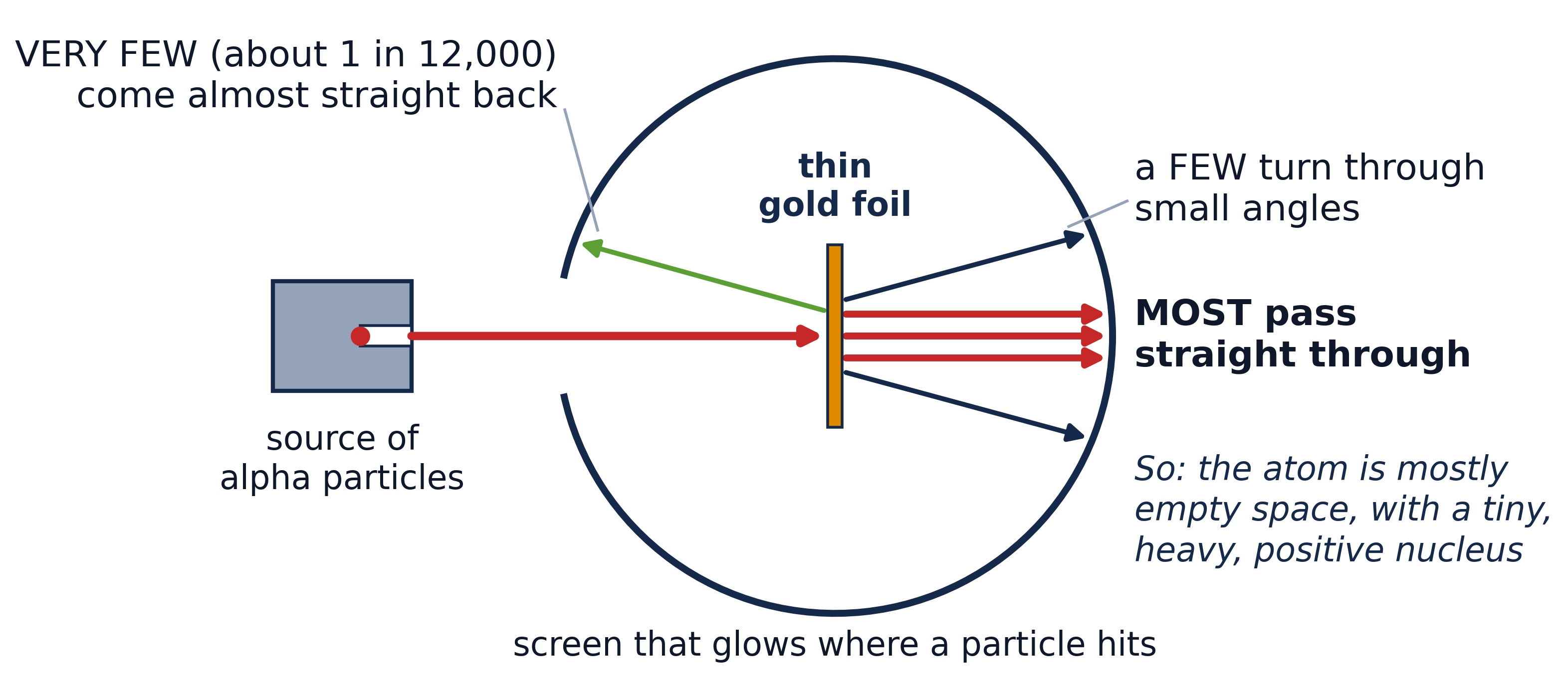
The radius of the nucleus is about 100,000 times (10⁵ times) smaller than the radius of the atom.
What Rutherford's experiment did and did not show. It discovered the atomic nucleus (asked in CDS I 2025). It did not find the neutron (that was Chadwick, 21 years later), and it did not find the electron or the proton. It did not say that electrons move in orbits of fixed energy (that is Bohr). The nucleus it found is positive, not neutral.
The weakness of Rutherford's model. A charged particle moving in a circle should keep giving out energy, so the electron should spiral into the nucleus and the atom should collapse. Bohr answered this by saying that in its allowed orbits an electron does not radiate energy. So the one thing Rutherford's model could not explain is the stability of the atom (asked in CDS I 2025). It did explain that there is a nucleus at the centre, that the nucleus is positive, and that the nucleus is very small compared with the atom.
3. Atomic number and mass number
- Atomic number (Z) = number of protons. It fixes which element the atom is, so it is the most fundamental property of an element.
- Mass number (A) = number of protons + number of neutrons = number of nucleons.
- So the number of neutrons = A − Z.
- In a neutral atom, electrons = protons = Z.
- In an ion, electrons = Z − (charge). A positive ion has lost electrons; a negative ion has gained them.
- In a molecule or a molecular ion, add the atomic numbers of all the atoms, then subtract the charge. O₂ has 8 + 8 = 16 electrons, O₂⁺ has 15 and the peroxide ion O₂²⁻ has 18. H₂ has 2, H₂⁺ has 1, the bare proton H⁺ has none, and the hydride ion H⁻ has 2, the same as a helium atom. CDS I 2025 set four such counts in one question.
Which particle decides what? The number of protons decides which element the atom is. The electrons, above all those in the outermost shell, decide how the atom reacts, because atoms meet each other with their outer electrons. So the chemical properties of an element are decided by its electrons (asked in CDS II 2024). The neutrons add mass and change almost nothing in the chemistry.
The mass number is written at the top left of the symbol and the atomic number at the bottom left.
| Species | Z | A | Protons | Neutrons | Electrons |
|---|---|---|---|---|---|
| Aluminium atom, Al | 13 | 27 | 13 | 14 | 13 |
| Aluminium ion, Al³⁺ | 13 | 27 | 13 | 14 | 10 |
| Chlorine atom, Cl | 17 | 35 | 17 | 18 | 17 |
| Chloride ion, Cl⁻ | 17 | 35 | 17 | 18 | 18 |
| Sulphide ion, S²⁻ | 16 | 32 | 16 | 16 | 18 |
Isoelectronic species have the same number of electrons. Two sets are worth knowing:
- 10 electrons: N³⁻, O²⁻, F⁻, Ne, Na⁺, Mg²⁺, Al³⁺.
- 18 electrons: S²⁻, Cl⁻, Ar, K⁺, Ca²⁺.
4. Electron shells and valency
Electrons fill shells around the nucleus, starting from the one nearest to it. The shells are named K, L, M, N (n = 1, 2, 3, 4).
| Shell | n | Largest number of electrons, 2n² |
|---|---|---|
| K | 1 | 2 |
| L | 2 | 8 |
| M | 3 | 18 |
| N | 4 | 32 |
A second rule: the outermost shell never holds more than 8 electrons. So potassium (19 electrons) is 2, 8, 8, 1 and not 2, 8, 9.
The electrons in the outermost shell are the valence electrons. An atom is stable with 8 electrons in its outer shell (2 for helium). Valency is the number of electrons an atom loses, gains or shares to reach this. With 1, 2, 3 or 4 valence electrons the valency is that number. With 5, 6 or 7 it is 8 minus that number. With a full shell it is 0.
| Element | Z | Arrangement (K, L, M, N) | Valence electrons | Valency |
|---|---|---|---|---|
| Hydrogen | 1 | 1 | 1 | 1 |
| Helium | 2 | 2 | 2 | 0 |
| Carbon | 6 | 2, 4 | 4 | 4 |
| Nitrogen | 7 | 2, 5 | 5 | 3 |
| Oxygen | 8 | 2, 6 | 6 | 2 |
| Fluorine | 9 | 2, 7 | 7 | 1 |
| Neon | 10 | 2, 8 | 8 | 0 |
| Sodium | 11 | 2, 8, 1 | 1 | 1 |
| Magnesium | 12 | 2, 8, 2 | 2 | 2 |
| Aluminium | 13 | 2, 8, 3 | 3 | 3 |
| Silicon | 14 | 2, 8, 4 | 4 | 4 |
| Phosphorus | 15 | 2, 8, 5 | 5 | 3 |
| Sulphur | 16 | 2, 8, 6 | 6 | 2 |
| Chlorine | 17 | 2, 8, 7 | 7 | 1 |
| Argon | 18 | 2, 8, 8 | 8 | 0 |
| Potassium | 19 | 2, 8, 8, 1 | 1 | 1 |
| Calcium | 20 | 2, 8, 8, 2 | 2 | 2 |
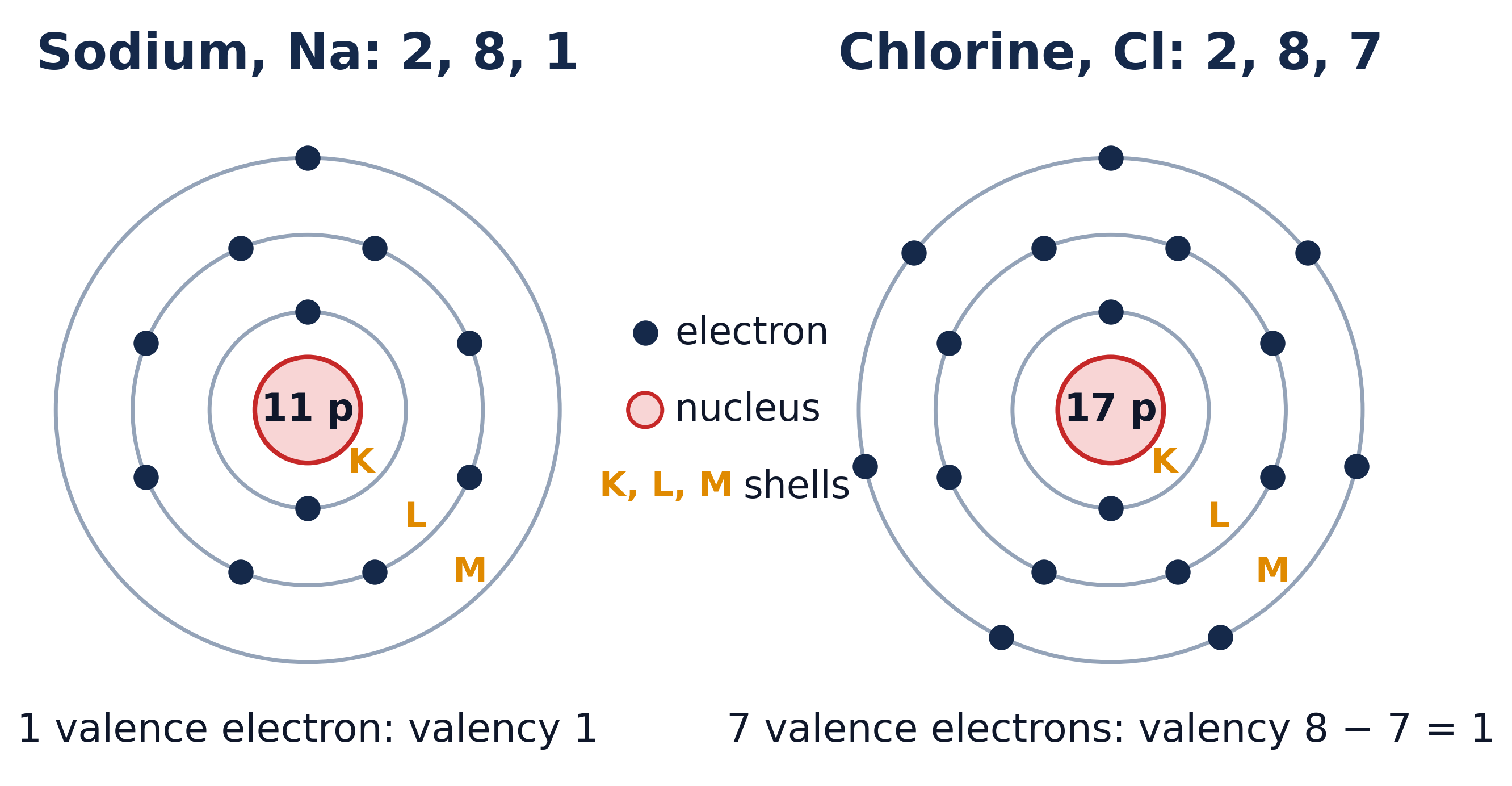
Elements in the same group of the periodic table have the same number of valence electrons and so the same valency. Sodium and potassium both have valency 1. Magnesium, calcium and barium all have valency 2. If an element X forms a chloride XCl₂, its valency is 2, so it belongs with magnesium and calcium.
CDS I 2025 gave only the atomic number 11 and asked for the name, symbol and valency. Write the arrangement: 2, 8, 1. One valence electron, so the valency is 1. Element 11 is sodium, Na.
Sub-shells and unpaired electrons, at the level asked. Each shell is made of sub-shells named s, p, d and f. An s sub-shell holds 2 electrons, p holds 6, d holds 10 and f holds 14. The K shell has only 1s. The L shell has 2s and 2p, which is why it holds 2 + 6 = 8. Sub-shells fill in the order 1s, 2s, 2p, 3s, 3p, 4s, 3d.
A p sub-shell has three orbitals, each with room for two electrons. Electrons enter the three orbitals one by one before any of them pairs up. This is Hund's rule.
| Atom | Z | Configuration | Electrons in 2p | Unpaired electrons |
|---|---|---|---|---|
| Carbon | 6 | 1s² 2s² 2p² | 2 | 2 |
| Nitrogen | 7 | 1s² 2s² 2p³ | 3, one in each orbital | 3 |
| Oxygen | 8 | 1s² 2s² 2p⁴ | 4, one pair and two single | 2 |
| Fluorine | 9 | 1s² 2s² 2p⁵ | 5, two pairs and one single | 1 |
| Neon | 10 | 1s² 2s² 2p⁶ | 6, all paired | 0 |
Carbon has only two unpaired electrons on paper, but it uses all four of its outer electrons in bonding, so carbon is tetravalent (valency 4). CDS I 2026 put four such facts in pairs and asked for the wrong pair. Nitrogen with three unpaired electrons, carbon as tetravalent and chlorine with two stable isotopes were right. "Helium: diatomic gas" was wrong, because helium is monatomic.
5. Isotopes and isobars
| Isotopes | Isobars | |
|---|---|---|
| Meaning | Atoms of the same element with different mass numbers | Atoms of different elements with the same mass number |
| Same | Atomic number (protons) | Mass number |
| Different | Number of neutrons | Atomic number |
| Chemical properties | The same | Different |
| Examples | Hydrogen: protium (A = 1), deuterium (A = 2), tritium (A = 3). Carbon-12 and carbon-14. Chlorine-35 and chlorine-37 | Argon-40 (Z = 18) and calcium-40 (Z = 20). Carbon-14 (Z = 6) and nitrogen-14 (Z = 7) |
Three points the papers use.
- Writing isotopes. The two isotopes of chlorine are written with 35 and 37 at the top and 17 at the bottom of both. The bottom number cannot change, because both are chlorine. CDS II 2024 offered pairs in which the bottom number was 18 in one symbol; those are not chlorine at all.
- Chemical properties. Isotopes have the same number of electrons arranged in the same way, so they react in the same way. They differ in mass, and so in physical properties such as density. Isobars are different elements and react differently.
- Isotones are atoms of different elements with the same number of neutrons: carbon-14, nitrogen-15 and oxygen-16 each have 8 neutrons.
Uses of isotopes
| Isotope | Use |
|---|---|
| Uranium-235 | Fuel in nuclear reactors |
| Cobalt-60 | Treatment of cancer |
| Iodine-131 | Treatment of goitre (a disease of the thyroid gland) |
| Carbon-14 | Finding the age of old remains of plants and animals |
Average atomic mass. Most elements are a mixture of isotopes, so the atomic mass in the table is an average, weighted by how much of each isotope there is.
Chlorine is chlorine-35 and chlorine-37 in the ratio 3 : 1. Average = (3 × 35 + 1 × 37) ÷ 4 = 142 ÷ 4 = 35.5 u.
The reverse question: boron has isotopes of mass 10 and 11 and an average atomic mass of 10.81. Let the percentage of boron-10 be x. Then 10x + 11(100 − x) = 1081, so x = 19. Boron is about 19% boron-10 and 81% boron-11. A quick check without algebra: 10.81 is much nearer to 11 than to 10, so boron-11 must be the larger share.
6. Atomic, molecular and equivalent weights
The atomic mass unit (u) is one-twelfth of the mass of one atom of carbon-12. The atomic mass (older books say atomic weight) of an element is the average mass of its atoms in these units. The molecular mass is the sum of the atomic masses in the formula, as in Chapter K2-2.
The equivalent weight of a substance is the mass of it that combines with or displaces 1 part by mass of hydrogen (or 8 parts of oxygen). In practice it is found by a division.
| Kind of substance | Equivalent weight | Examples |
|---|---|---|
| Element | Atomic mass ÷ valency | Oxygen 16 ÷ 2 = 8. Magnesium 24 ÷ 2 = 12. Aluminium 27 ÷ 3 = 9 |
| Acid | Molecular mass ÷ basicity (the number of H⁺ ions one molecule can give) | HCl 36.5 ÷ 1 = 36.5. H₂SO₄ 98 ÷ 2 = 49 |
| Base | Molecular mass ÷ acidity (the number of OH⁻ ions one formula unit can give) | NaOH 40 ÷ 1 = 40. Ca(OH)₂ 74 ÷ 2 = 37 |
Crystals of oxalic acid have the formula H₂C₂O₄·2H₂O. The molecular mass is 90 + 36 = 126, and the acid can give two H⁺ ions, so its equivalent weight is 126 ÷ 2 = 63. The water of crystallisation must be counted in the mass. (Equivalent weight was not asked in the six CDS papers studied. Read this section once.)
What the papers have asked
| Paper | The idea asked | The answer in one line |
|---|---|---|
| CDS II 2024 | The two isotopes of chlorine, written as symbols | Mass numbers 35 and 37, both with atomic number 17 |
| CDS II 2024 | What decides the chemical properties of an element | The electrons (the outer ones). Protons fix which element it is |
| CDS I 2025 | What isobars have in common | The mass number |
| CDS I 2025 | What Rutherford's nuclear model could not explain | The stability of the atom |
| CDS I 2025 | Name, symbol and valency of the element with atomic number 11 | Sodium, Na, 1 (arrangement 2, 8, 1) |
| CDS I 2025 | What Rutherford's gold foil experiment discovered | The atomic nucleus |
| CDS I 2025 | What Dalton's atomic theory does not explain | Sub-atomic particles. It explains the laws of conservation of mass, constant composition and multiple proportions |
| CDS I 2025 | Number of electrons in four small species of hydrogen, helium and oxygen | Add the atomic numbers, then subtract the charge (section 3) |
| CDS I 2026 | The wrong pair among four elements and a property of each | "Helium: diatomic gas". Helium is monatomic |
Worked examples
Example 1. An ion has 12 protons, 12 neutrons and 10 electrons. What are its mass number and its charge?
(a) 22 and +2 (b) 24 and −2 (c) 24 and +2 (d) 34 and +2
Solution. Mass number = protons + neutrons = 24. Electrons are never counted in it, which rules out 22 and 34. There are 2 more protons than electrons, so the charge is +2. The ion is Mg²⁺. Answer (c).
Example 2. Consider the following statements about Rutherford's alpha-particle scattering experiment:
Statement 1: Most alpha particles passed straight through the foil, which shows that most of the atom is empty space.
Statement 2: The experiment showed that electrons revolve in orbits of fixed energy.
Which of the statements given above is/are correct?
(a) 1 only (b) 2 only (c) Both 1 and 2 (d) Neither 1 nor 2
Solution. Statement 1 is the first conclusion of the experiment. Orbits of fixed energy are Bohr's idea, proposed later to explain why the atom is stable; nothing in the scattering experiment shows it. Answer (a).
Example 3. An element has two isotopes of mass 20 u and 22 u in the ratio 9 : 1. What is its average atomic mass?
(a) 20.2 u (b) 20.9 u (c) 21.0 u (d) 21.8 u
Solution. Average = (9 × 20 + 1 × 22) ÷ 10 = 202 ÷ 10 = 20.2 u. The plain middle value 21.0 would be right only if the two isotopes were equally common. Answer (a).
Example 4. Match the scientist with the contribution.
A. J. J. Thomson. B. Ernest Rutherford. C. James Chadwick. D. Niels Bohr.
Contributions: 1. Neutron. 2. Fixed energy levels for electrons. 3. Electron. 4. Nucleus.
(a) A-3, B-4, C-1, D-2 (b) A-4, B-3, C-1, D-2 (c) A-3, B-2, C-1, D-4 (d) A-1, B-4, C-3, D-2
Solution. Thomson found the electron, Rutherford the nucleus, Chadwick the neutron, and Bohr gave the fixed energy levels. Chadwick and the neutron is the surest pair; it leaves (a), (b) and (c). Thomson with the electron then leaves (a) and (c), and Rutherford with the nucleus leaves (a). Answer (a).
Example 5. Which one of the following pairs is isoelectronic? (Atomic numbers: Na 11, Mg 12, Cl 17, Ar 18, K 19)
(a) Na⁺ and Cl⁻ (b) K⁺ and Cl⁻ (c) Mg²⁺ and Ar (d) Na⁺ and K⁺
Solution. K⁺ has 19 − 1 = 18 electrons and Cl⁻ has 17 + 1 = 18. Na⁺ and Mg²⁺ have 10 each, so they do not match Cl⁻, Ar or K⁺. Option (a) is tempting because the two ions make common salt, but 10 is not 18. Answer (b).
Example 6. What is the equivalent weight of sulphuric acid, H₂SO₄? (H = 1, S = 32, O = 16)
(a) 24.5 (b) 49 (c) 98 (d) 196
Solution. Molecular mass = 2 + 32 + 64 = 98. One molecule can give two H⁺ ions, so the basicity is 2 and the equivalent weight is 98 ÷ 2 = 49. Option (c) forgets to divide. Answer (b).
Example 7. Consider the following statements:
- A nitrogen atom (Z = 7) has three unpaired electrons.
- The ion O₂⁺ has 17 electrons.
- Isobars have the same number of neutrons.
How many of the above statements are correct?
(a) Only one (b) Only two (c) All three (d) None
Solution. Nitrogen is 1s² 2s² 2p³, with one electron in each 2p orbital: statement 1 is correct. O₂ has 16 electrons and a positive charge means one has been lost, so O₂⁺ has 15, not 17: statement 2 is wrong. Isobars have the same mass number but different atomic numbers, so their neutron numbers must differ: statement 3 is wrong. Answer (a).
Mistakes that cost marks
- Getting the sign wrong for an ion. A negative ion has extra electrons: add. A positive ion has lost electrons: subtract. S²⁻ has 16 + 2 = 18 electrons, not 14.
- Counting electrons in the mass number. The mass number counts only protons and neutrons.
- Filling the M shell to 18 too early. The M shell can hold 18, but the outermost shell stops at 8. Potassium is 2, 8, 8, 1 and calcium is 2, 8, 8, 2.
- Giving Rutherford the wrong credit or the wrong failure. His experiment discovered the nucleus, not the neutron, the proton or the electron. His model failed on one point: the stability of the atom.
- Mixing up isotopes and isobars. Isotopes: same element, same Z. Isobars: same mass number, different elements.
Quick check
Do these without help. Answers are at the end.
- Q1. How many protons, neutrons and electrons are there in the ion Ca²⁺ (Z = 20, A = 40)?
- Q2. Write the electron arrangement of phosphorus (Z = 15) and give its valency.
- Q3. What is the largest number of electrons the N shell can hold?
- Q4. Argon-40 and calcium-40: are they isotopes or isobars?
- Q5. How many electrons are there in the peroxide ion, O₂²⁻? (Z of oxygen = 8)
Read and watch more, free
| What | Where | Language |
|---|---|---|
| Textbook, the atom | NCERT textbooks, the book menu: Class 9 Science Exploration, chapter 8 "Journey Inside the Atom" and chapter 9 "Atomic Foundations of Matter" | English, Hindi |
| Textbook, the atom in full, with sub-shells and Hund's rule | NCERT textbooks, the book menu: Class 11 Chemistry Part I, chapter 2 "Structure of Atom" | English, Hindi |
| Self-study notes | NIOS Science and Technology (212), lessons 3 "Atoms and Molecules" and 5 "Atomic Structure". Free on the NIOS website under "online course material"; no link is given here because the page was not among those checked for this course | English, Hindi |
| The real papers | UPSC previous question papers (the General Knowledge booklet of every CDS sitting) | English, Hindi |
| Video, chemistry in one class | eTakshila Classes: Complete GS One Shot Series for CDS 2026 (the chemistry class; it is long, so find this chapter's part) | Hinglish, judged from the titles |
| Video, topic by topic | CDS Wallah: CDS Exam Full Playlist (the chemistry videos) | Hinglish |
| Video, past questions | Reveal GK: CDS past questions by subject and topic (the chemistry parts) | Hinglish |
The videos were chosen from their titles, length and views; they have not yet been watched by a teacher.
Answers to the quick check
- Q1. 20 protons, 20 neutrons and 18 electrons.
- Q2. 2, 8, 5. Valency 8 − 5 = 3.
- Q3. 32 (2 × 4²).
- Q4. Isobars: the same mass number, but different elements (Z = 18 and Z = 20).
- Q5. 8 + 8 = 16 for the two atoms, and two more for the charge of 2−: 18.
Next chapter: Air and water.