Why this chapter matters. This chapter gave 4 questions in the 6 papers from CDS I 2024 to CDS II 2026: one in CDS II 2024, two in CDS I 2025 and one in CDS I 2026. That is about two questions in every three papers, worth 0.83 marks each. All four asked you to sort things: a substance into element, compound or mixture, an element into metal, non-metal or metalloid, and a colloid by what is spread in what. Two were single facts and one was a "which statements are not correct" question. Learn the classification in sections 2 and 3 and the table of colloids in section 4 first. The rest of the chapter (changes and separation methods) was not asked in these six papers, but it is the base for every later chemistry chapter.
What you will be able to do
- Decide in a few seconds whether a change is physical or chemical, and give the reason.
- Sort any substance into element, compound or mixture, and a mixture into solution, colloid or suspension.
- Name the dispersed phase and the dispersing medium of any common colloid.
- Choose the right method to separate a given mixture.
- Avoid the traps the papers set: ice, alloys, colloids and dissolving.
Before you start you should know the three states of matter (solid, liquid, gas) and the words melting, boiling, evaporation and condensation (Chapter K1-1). Nothing else is needed. This is the first chapter of Chemistry.
1. Physical change and chemical change
In a physical change the substance stays the same substance. Only its state, shape or size changes. Ice melts to water and water boils to steam, but all three are H₂O.
In a chemical change one or more new substances are formed. Iron rusts: the brown powder is not iron, it is a new substance, hydrated iron oxide (Fe₂O₃·xH₂O). A chemical change is also called a chemical reaction.
| Physical change | Chemical change | |
|---|---|---|
| New substance | None is formed | At least one is formed |
| Composition of the molecules | Does not change | Changes |
| Can it be reversed? | Usually, and easily | Usually not by simple means |
| Energy | Small amounts of heat taken in or given out | Often a lot of heat, light or sound |
| Examples | Melting, boiling, freezing, dissolving, sublimation, cutting, bending, heating an iron rod till it glows | Burning, rusting, cooking, digestion, souring of milk, ripening of fruit, an acid meeting a base |
Signs that a chemical change has happened: a gas is given off, the colour changes for good, a solid (a precipitate) appears in a liquid, or heat and light are produced. A soldier who leaves his rifle uncleaned in the monsoon sees one of these signs: the brown colour of rust.
Rusting needs both oxygen and water. Burning needs oxygen. When a magnesium ribbon burns with a white dazzling flame, the white ash is a new substance, magnesium oxide:
2Mg + O₂ → 2MgO
Cases the papers like
| Change | Type | Why |
|---|---|---|
| Dissolving salt or sugar in water | Physical | Evaporate the water and the salt comes back unchanged |
| Sublimation of camphor | Physical | Solid camphor becomes camphor vapour; no new substance |
| Heating an iron rod red hot | Physical | It cools back to the same iron |
| Greying of hair, ripening of fruit | Chemical | The body or the fruit makes or loses a substance (a pigment, a sugar) |
| A cut apple turning brown | Chemical | Substances in the apple react with oxygen |
| Mixing sodium hydroxide and hydrochloric acid | Chemical | Salt and water are formed: NaOH + HCl → NaCl + H₂O |
| Burning of a candle | Both | The wax melts (physical) and the wax burns to carbon dioxide and water (chemical) |
| Storing oxygen under pressure in a cylinder | Physical | Only the gas is squeezed into a smaller volume |
2. Pure substances: elements and compounds
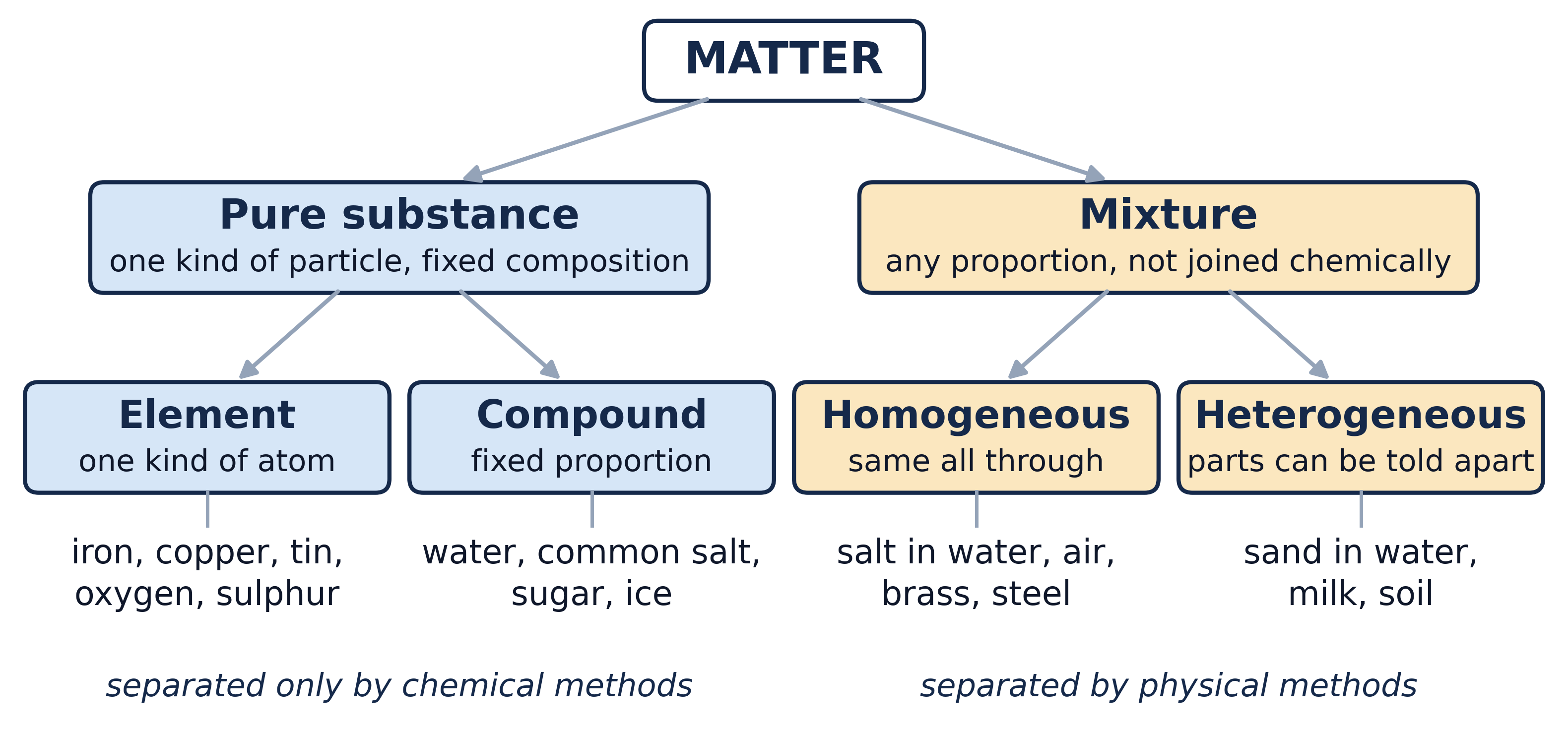
A pure substance has only one kind of particle and a fixed composition. There are two kinds.
An element cannot be broken into anything simpler by a chemical reaction. It has only one kind of atom. Iron, copper, tin, oxygen, hydrogen and sulphur are elements. There are 118 known elements.
| Kind of element | Properties | Examples |
|---|---|---|
| Metals | Shiny, conduct heat and electricity, can be beaten into sheets and drawn into wires | Iron, copper, gold, sodium, mercury |
| Non-metals | Usually dull, poor conductors | Carbon, sulphur, oxygen, iodine, bromine |
| Metalloids | Properties in between | Boron, silicon, germanium, arsenic, antimony, tellurium |
Two elements are liquid at room temperature: mercury (a metal) and bromine (a non-metal). Gallium and caesium melt just above room temperature, at about 30 °C, so they are not counted.
Three traps on this table. Iodine is shiny but it is a non-metal. Graphite conducts electricity but carbon is a non-metal. Coke is a nearly pure form of carbon made from coal, so it is a non-metal too. CDS I 2025 asked for the metalloid in a list: it was germanium.
A compound is made of two or more elements joined chemically in a fixed proportion by mass. Water is always 1 g of hydrogen to 8 g of oxygen. The compound does not behave like its elements: hydrogen burns and oxygen helps burning, but water puts out a fire. A compound can be broken up only by a chemical or electrochemical reaction, for example by passing electricity through water.
Because its composition is fixed, a compound is a pure substance. CDS I 2026 tested exactly this: the statement "a compound has a variable composition" was the wrong one. Calcium carbonate, CaCO₃, is a compound (the answer in CDS I 2025). Sugar is a compound too, but a sugar solution is a mixture.
3. Mixtures
A mixture has two or more substances mixed in any proportion and not joined chemically. Each substance keeps its own properties, and the parts can be separated by physical methods.
The classic experiment: mix iron filings and sulphur powder. A magnet pulls the iron out, so it is a mixture. Now heat the mixture strongly. A black solid, iron sulphide (FeS), forms. A magnet no longer pulls out any iron. It is now a compound.
| Mixture | Compound | |
|---|---|---|
| Proportion of the parts | Any | Fixed |
| Properties | Those of its parts | New, unlike its elements |
| Separation | Physical methods | Only chemical or electrochemical methods |
| Energy change on making it | Usually none | Heat or light is usually given out or taken in |
| Melting and boiling point | Not sharp | Sharp and fixed |
| Examples | Air, sea water, soil, milk, brass, gunpowder | Water, common salt, sugar, carbon dioxide |
Homogeneous and heterogeneous. A mixture that is the same all through is homogeneous: salt in water, sugar in water, air. A mixture in which different parts can be seen or found is heterogeneous: sand in water, oil in water, a mixture of salt crystals and sugar crystals.
Alloys are mixtures. An alloy is a homogeneous mixture of metals, or of a metal with a non-metal. Brass is copper and zinc. Bronze is copper and tin. Steel is iron with a little carbon, so it is the common alloy that has a non-metal in it.
Common traps. Ice is only solid water, a pure compound, but ice-cream is a mixture. Air, honey, milk, soil and sea water are mixtures. Tin is an element. Gunpowder is a mixture of potassium nitrate, charcoal and sulphur.
4. Solutions, colloids and suspensions
Mix a solid into a liquid and one of three things results. The difference is the size of the particles.
| True solution | Colloid | Suspension | |
|---|---|---|---|
| Example | Salt in water, copper sulphate in water | Milk, fog, smoke, starch in water | Muddy water, chalk powder in water |
| Particle size | Smaller than about 1 nm | In between, about 1 nm to 1000 nm | Larger |
| Can the particles be seen? | No | Not with the naked eye | Yes |
| Homogeneous? | Yes | No. It looks homogeneous but is heterogeneous | No, heterogeneous |
| Settles on standing? | No | No, it is stable | Yes |
| Passes through filter paper? | Yes | Yes | No, the solid stays on the paper |
| Scatters a beam of light (Tyndall effect)? | No | Yes | Yes, until the particles settle |
The Tyndall effect is the scattering of light by colloid particles, which makes the path of the beam visible. You see it when sunlight enters a dusty room through a small hole, or when the beam of a vehicle's headlight is seen in fog. Copper sulphate solution does not show it. Milk mixed with water does.
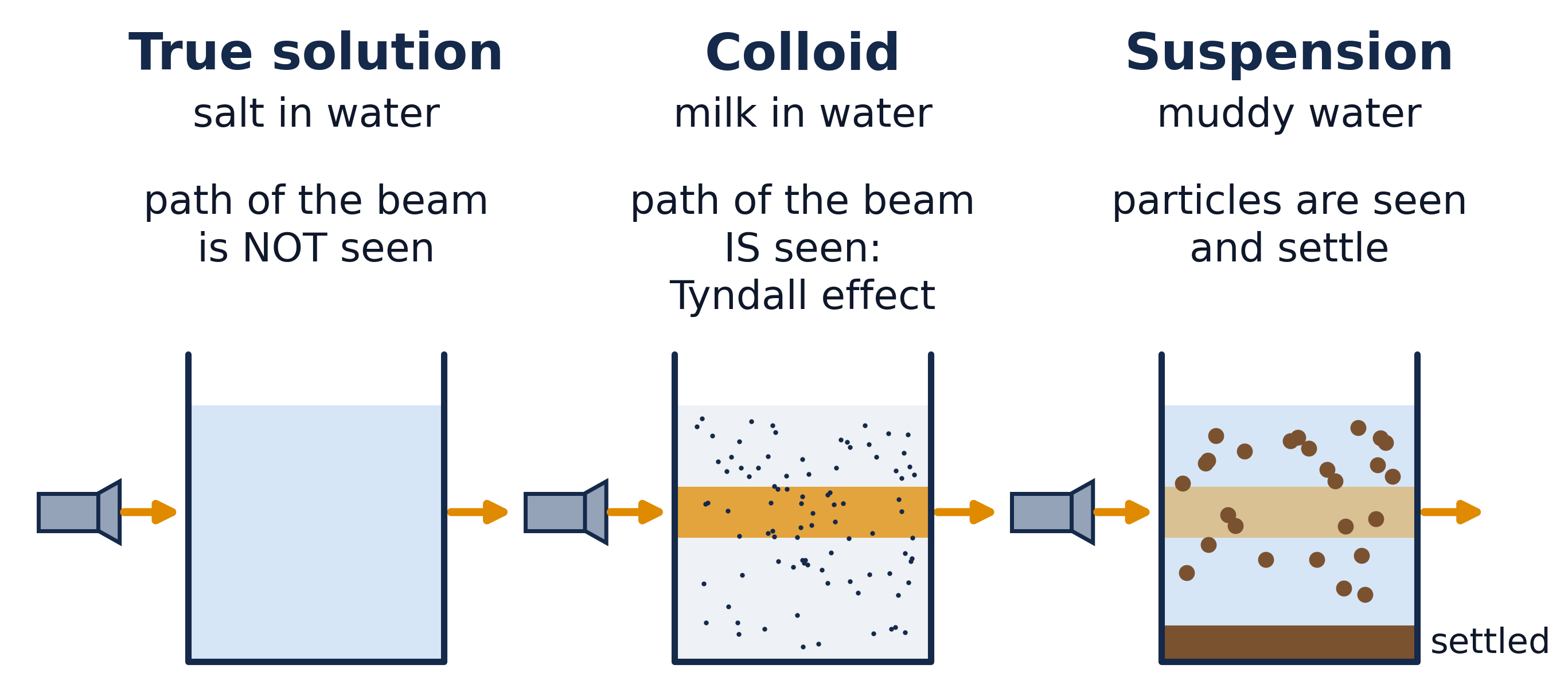
Colloid particles cannot be filtered out, but they can be separated by centrifugation.
Two words the paper uses. In a colloid one substance is spread through another. The substance that is spread as particles is the dispersed phase. The substance it is spread in is the dispersing medium (also called the dispersion medium). A colloid is named by the states of these two.
| Dispersed phase | Dispersing medium | Type of colloid | Examples |
|---|---|---|---|
| Liquid | Gas | Aerosol | Fog, clouds, mist |
| Solid | Gas | Aerosol | Smoke, vehicle exhaust |
| Gas | Liquid | Foam | Shaving cream |
| Liquid | Liquid | Emulsion | Milk, face cream |
| Solid | Liquid | Sol | Milk of magnesia, mud |
| Gas | Solid | Solid foam | Foam rubber, sponge, pumice stone |
| Liquid | Solid | Gel | Jelly, cheese, butter |
| Solid | Solid | Solid sol | Coloured gemstones, milky glass |
There are eight types, not nine. A gas spread in a gas is never a colloid, because gases mix completely and give a true solution.
CDS II 2024 asked which of four colloids has a liquid as the dispersing medium. Read the middle column: only foam, emulsion and sol have a liquid medium. Of the options, mist has a gas as its medium and jelly has a solid. Shaving cream is a gas in a liquid, so it was the answer that fits this table. (The option "foam" is the school textbook's example of a solid foam, as in foam rubber.)
Three more facts about colloids.
- The particles of a colloid move in a zig-zag path, because the molecules of the medium keep hitting them. This is Brownian movement. It is one reason a colloid does not settle.
- Colloid particles carry an electric charge. Adding a salt makes them clump together and settle. This is coagulation. It is why alum clears muddy water.
- A soap solution is a colloid. Its particles, called micelles, scatter light (Chapter K2-7).
In a solution the substance that dissolves is the solute and the substance it dissolves in is the solvent. The same solute can behave differently in different solvents: sulphur does not dissolve in water (a heterogeneous mixture), but it dissolves in carbon disulphide to give a true, homogeneous solution. CDS I 2026 used this example in a statements question.
5. Methods of separation
Each method uses one difference between the parts of the mixture.
| Method | Difference it uses | Typical use |
|---|---|---|
| Filtration | Solid does not dissolve in the liquid | Sand from water, tea leaves from tea |
| Sedimentation and decantation | Heavy solid settles | Mud from water |
| Evaporation | Solid does not turn to vapour, liquid does | Salt from sea water, dye from ink |
| Crystallisation | Pure solid forms crystals from a hot strong solution on cooling | Pure copper sulphate or alum from an impure sample |
| Distillation | Two miscible liquids with boiling points far apart (more than about 25 °C) | Acetone and water; pure water from salt water |
| Fractional distillation | Miscible liquids with boiling points close together | Petrol and kerosene, the parts of crude oil, the gases of liquid air |
| Separating funnel | Two liquids that do not mix; the heavier forms the lower layer | Oil and water, kerosene and water |
| Sublimation | One solid turns straight to vapour on heating | Ammonium chloride, camphor, naphthalene, anthracene or iodine from salt or sand |
| Chromatography | Substances move at different speeds through paper with a solvent | Colours in ink or dye, pigments in a plant extract |
| Centrifugation | Heavier particles move outward when spun fast | Cream from milk, blood and urine tests in laboratories, the dryer of a washing machine |
| Magnetic separation | One part is attracted by a magnet | Iron from sulphur or from scrap |
Three points are asked again and again.
- Evaporation or crystallisation? Both recover a dissolved solid that does not turn to vapour. Crystallisation is better for a pure product, because some solids (such as sugar) char on heating to dryness and because dissolved impurities stay behind in the liquid.
- Distillation or fractional distillation? Look at the boiling points. Far apart: simple distillation. Close together: fractional distillation, which uses a tall fractionating column.
- Gases from air. Air is cooled and compressed to a liquid, then warmed slowly in a fractionating column. Nitrogen (boiling point −196 °C) boils off first, then argon (−186 °C), then oxygen (−183 °C).
What the papers have asked
The first four rows are the questions counted for this chapter. The last two are from other parts of the paper and use the same ideas.
| Paper | The idea asked | The answer in one line |
|---|---|---|
| CDS II 2024 | Which of four colloids has a liquid as the dispersing medium | Shaving cream (a gas in a liquid). Mist has a gas as its medium, jelly a solid |
| CDS I 2025 | Which of four substances is a compound | Calcium carbonate. Silicon and tin are elements; a sugar solution is a mixture |
| CDS I 2025 | Which of four substances is a metalloid | Germanium. Iodine is a non-metal, coke is carbon, sugar is a compound |
| CDS I 2026 | Three statements on matter; pick the ones that are not correct | Only "a compound has a variable composition" is wrong. An element cannot be broken into simpler substances, and sulphur in carbon disulphide is a homogeneous mixture |
| CDS I 2026 (counted in Chapter K2-7) | A statement that soap micelles scatter light | True. A soap solution is a colloid and shows the Tyndall effect |
| CDS I 2025 (in the geography block) | A statement that humus is colloidal and so holds nutrients | True. The tiny charged particles of a colloid hold ions on their surface |
Worked examples
Example 1. Which one of the following is a chemical change?
(a) Dissolving sugar in tea (b) Souring of milk (c) Breaking of a glass tumbler (d) Melting of wax
Solution. In souring, the milk sugar is turned into a new substance, lactic acid, so it is a chemical change. Dissolving is the tempting wrong answer because the sugar "disappears", but the sugar is still there and can be got back. Answer (b).
Example 2. Consider the following statements:
Statement 1: Air is a homogeneous mixture.
Statement 2: Brass is a compound of copper and zinc.
Which of the statements given above is/are correct?
(a) 1 only (b) 2 only (c) Both 1 and 2 (d) Neither 1 nor 2
Solution. Air is the same all through, so statement 1 is correct. Brass is an alloy. The copper and zinc are mixed, not joined chemically, and their proportion can vary, so brass is a mixture and statement 2 is wrong. Answer (a).
Example 3. Match the mixture with the method used to separate it.
A. Iodine and sand. B. Mustard oil and water. C. The colours in black ink. D. Common salt from sea water.
Methods: 1. Chromatography. 2. Evaporation. 3. Sublimation. 4. Separating funnel.
(a) A-3, B-4, C-1, D-2 (b) A-3, B-1, C-4, D-2 (c) A-2, B-4, C-1, D-3 (d) A-4, B-3, C-2, D-1
Solution. Iodine sublimes and sand does not (3). Oil and water do not mix (4). Colours in ink travel at different speeds on paper (1). Salt is left when sea water evaporates (2). Start with the pair you are surest of: B-4 removes two options at once. Answer (a).
Example 4. Consider the following statements about a colloid:
Statement 1: A beam of light passing through it becomes visible.
Statement 2: Its particles settle down when it is left undisturbed.
Statement 3: It passes through an ordinary filter paper.
Which of the statements given above are correct?
(a) 1 and 2 only (b) 1 and 3 only (c) 2 and 3 only (d) 1, 2 and 3
Solution. Statement 1 is the Tyndall effect: correct. A colloid is stable and does not settle: statement 2 is wrong (that is a suspension). Colloid particles are small enough to pass through filter paper: statement 3 is correct. Answer (b).
Example 5. Ethanol boils at 78 °C and water at 100 °C. They mix completely. Which method separates them best?
(a) Separating funnel (b) Evaporation (c) Fractional distillation (d) Sublimation
Solution. The liquids mix, so a separating funnel is useless. The boiling points differ by only 22 °C, which is less than about 25 °C, so fractional distillation is needed. Evaporation would lose both liquids. Answer (c).
Example 6. Consider the following statements:
- In fog, the dispersed phase is a liquid and the dispersing medium is a gas.
- In butter, the dispersing medium is a liquid.
- Smoke and fog are both aerosols.
How many of the above statements are correct?
(a) Only one (b) Only two (c) All three (d) None
Solution. Fog is tiny drops of water in air, so statement 1 is correct. Butter is a gel: a liquid spread in a solid, so its medium is a solid and statement 2 is wrong. An aerosol is any colloid whose medium is a gas, whether the particles are solid (smoke) or liquid (fog), so statement 3 is correct. In a "how many" question one doubtful statement loses the mark, so decide each statement on its own before you count. Answer (b).
Mistakes that cost marks
- "Dissolving is a chemical change." It is physical. No new substance forms, and the solid comes back on evaporation.
- "A colloid is homogeneous because it looks uniform." A colloid is heterogeneous. Only a true solution is homogeneous.
- "Ice and water together make a mixture" or "ice is a mixture". Ice is water in the solid state, one pure compound.
- Reading "dispersing medium" as "dispersed phase". The medium is the larger part, the one the particles are spread in. Fog: the medium is air. Shaving cream: the medium is the liquid soap. Jelly: the medium is the solid.
- Mixing up the two liquid methods. Liquids that do not mix: separating funnel. Liquids that mix: distillation, and fractional distillation if the boiling points are close.
Quick check
Do these without help. Answers are at the end.
- Q1. Is the burning of a candle a physical change, a chemical change or both?
- Q2. In shaving cream, what is the dispersed phase and what is the dispersing medium?
- Q3. Which method separates cream from milk?
- Q4. Is milk a solution, a colloid or a suspension? Does it show the Tyndall effect?
- Q5. A mixture has ammonium chloride and common salt. Which method separates them?
Read and watch more, free
| What | Where | Language |
|---|---|---|
| Textbook, physical and chemical changes | NCERT textbooks, the book menu: Class 7 Science Curiosity, chapter 5 "Changes Around Us: Physical and Chemical" | English, Hindi |
| Textbook, elements, compounds and mixtures | NCERT textbooks, the book menu: Class 8 Science Curiosity, chapter 8 "Nature of Matter: Elements, Compounds, and Mixtures" | English, Hindi |
| Textbook, separation methods | NCERT textbooks, the book menu: Class 9 Science Exploration, chapter 5 "Exploring Mixtures and their Separation" | English, Hindi |
| Self-study notes | NIOS Science and Technology (212), lesson 2 "Matter". Free on the NIOS website under "online course material"; no link is given here because the page was not among those checked for this course | English, Hindi |
| The real papers | UPSC previous question papers (the General Knowledge booklet of every CDS sitting) | English, Hindi |
| Video, chemistry in one class | eTakshila Classes: Complete GS One Shot Series for CDS 2026 (the chemistry class; it is long, so find this chapter's part) | Hinglish, judged from the titles |
| Video, topic by topic | CDS Wallah: CDS Exam Full Playlist (the chemistry videos) | Hinglish |
| Video, past questions | Reveal GK: CDS past questions by subject and topic (the chemistry parts) | Hinglish |
The videos were chosen from their titles, length and views; they have not yet been watched by a teacher.
Answers to the quick check
- Q1. Both. Melting of the wax is physical; burning of the wax is chemical.
- Q2. The dispersed phase is a gas (air) and the dispersing medium is a liquid. It is a foam.
- Q3. Centrifugation.
- Q4. A colloid (an emulsion). Yes, it shows the Tyndall effect.
- Q5. Sublimation. Ammonium chloride turns to vapour on heating and the salt stays behind.
Next chapter: Formulae, equations, laws, the mole.