Why this chapter matters. This chapter gave 11 questions in the 6 papers from CDS I 2024 to CDS II 2026: five in CDS I 2024, four in CDS II 2025 and two in CDS I 2026. Three papers had none, so it comes in bursts, but when it comes it is worth three to four marks. Only one of the 11 was on the forms of carbon (graphene). The other ten were on the compounds: octane and cetane, methanol and vinegar, the nickel catalyst, benzene, the formula of a carboxylic acid, plastics, soap and micelles. So after the table of allotropes in section 2, give most of your time to sections 4 to 9. Seven of the 11 were single facts and four were "which statement is not correct".
What you will be able to do
- Compare diamond, graphite, fullerene and graphene by structure and by property.
- Tell an alkane, an alkene, an alkyne and benzene apart, and say which of them add hydrogen.
- Recognise an alcohol, an aldehyde, a ketone and a carboxylic acid from a formula, and state the key facts about methanol, ethanol and ethanoic acid.
- Explain how a soap micelle lifts grease, what octane and cetane numbers measure, and why plastics last so long.
Before you start you should know what valency and a covalent bond are (Chapter K2-3) and what an acid and a catalyst are (Chapter K2-6).
1. Why carbon is special
Carbon has atomic number 6. Its electrons are arranged 2, 4. It needs four more electrons to fill its outer shell, and it gets them by sharing. So carbon has a valency of four (it is tetravalent) and forms covalent bonds.
| Property | What it means | Example |
|---|---|---|
| Catenation | carbon atoms join to one another in long chains, branched chains and rings | the chain of 4 carbon atoms in butane |
| Tetravalency | each carbon atom forms four bonds, with carbon or with H, O, N, Cl and other elements | CH₄, CCl₄, CO₂ |
| Multiple bonds | two carbon atoms can share one, two or three pairs of electrons | ethane, ethene, ethyne |
| Isomerism | one molecular formula, more than one structure | C₄H₁₀ is butane (straight chain) or 2-methylpropane (branched) |
There is no bond of four between two carbon atoms. A triple bond is the most.
Compounds of carbon are called organic. The oxides of carbon, carbonates, hydrogencarbonates and cyanates are counted as inorganic. In 1828 Wöhler made urea, an organic compound, by heating ammonium cyanate, an inorganic one.
2. The allotropes of carbon
Allotropes are different forms of the same element in the same physical state. The atoms are the same. Only the way they are joined is different.
| Diamond | Graphite | Fullerene (C₆₀) | Graphene | |
|---|---|---|---|---|
| How the atoms are joined | each atom bonded to four others in a three-dimensional network | each atom bonded to three others in flat layers of hexagons | 60 atoms in a hollow cage like a football: 20 six-membered and 12 five-membered rings | a single layer of graphite, one atom thick |
| Hardness | the hardest natural substance | soft and slippery; the layers slide | soft solid | very strong for its thickness |
| Conducts electricity? | no: all four outer electrons are used in bonds | yes: the fourth electron of each atom is free to move | poorly | yes, very well |
| Look | transparent, sparkles | grey-black, opaque | dark solid | almost completely transparent |
| Uses | cutting, drilling, jewellery | pencil "lead", electrodes, dry lubricant | research | electronics, strong light materials |
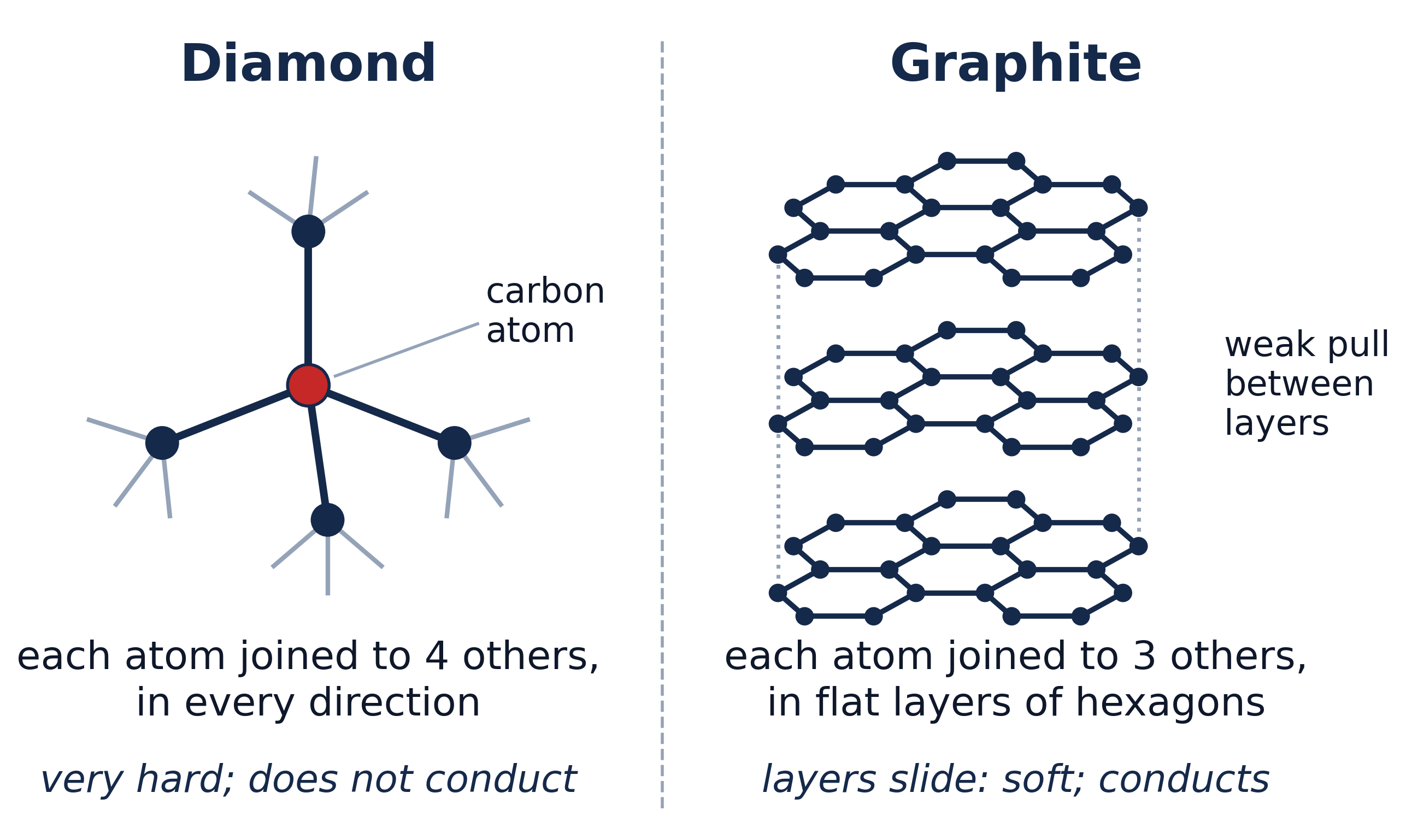
- Graphene is the thinnest material known. Its electrons move freely, so it has no energy gap to cross: it is a "zero band-gap" material. To call it a "wide band-gap semiconductor" is wrong. CDS II 2025 used exactly this as the false statement.
- Graphite is the most stable form of carbon under ordinary conditions.
- The physical properties of diamond and graphite differ. Their chemical properties are the same: each burns in oxygen to carbon dioxide only.
- Coal, coke, charcoal and lampblack are impure or finely divided carbon.
3. The two oxides of carbon
| Carbon monoxide, CO | Carbon dioxide, CO₂ | |
|---|---|---|
| Formed when | carbon burns in too little air | carbon burns in plenty of air |
| Nature of the oxide | neutral | acidic |
| Does it burn? | yes, with a blue flame | no |
| Effect on the body | very poisonous: it binds to haemoglobin, so the blood carries less oxygen | not poisonous in small amounts |
Carbon monoxide has no colour and no smell. A coal fire or a running engine in a closed room is dangerous for this reason.
4. Hydrocarbons
Compounds of carbon and hydrogen only are called hydrocarbons.
| Family | Bonds between carbon atoms | General formula | First members |
|---|---|---|---|
| Alkanes (saturated) | single only | CₙH₂ₙ₊₂ | methane CH₄, ethane C₂H₆, propane C₃H₈, butane C₄H₁₀ |
| Alkenes (unsaturated) | one double bond | CₙH₂ₙ | ethene C₂H₄, propene C₃H₆ |
| Alkynes (unsaturated) | one triple bond | CₙH₂ₙ₋₂ | ethyne C₂H₂ (acetylene) |
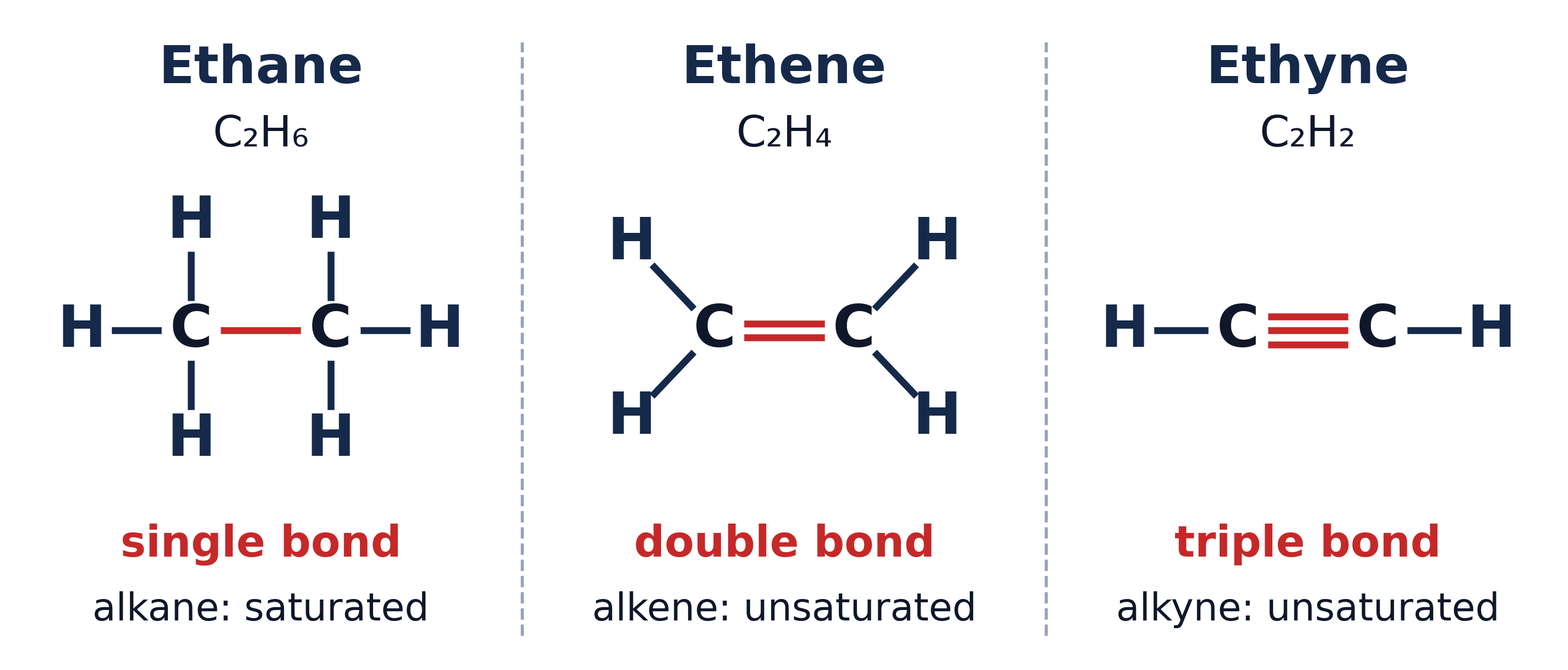
Names of the chains. 1 carbon meth-, 2 eth-, 3 prop-, 4 but-, 5 pent-, 6 hex-, 7 hept-, 8 oct-. A family whose members differ by one CH₂ unit each time is a homologous series. Its members have the same chemical properties, and their boiling points rise steadily.
Two kinds of reaction.
| Saturated (alkanes) | Unsaturated (alkenes, alkynes) | |
|---|---|---|
| Typical reaction | substitution: an H atom is replaced, as when methane reacts with chlorine in sunlight | addition: the double or triple bond opens and takes up more atoms |
| Flame | clean and blue | yellow and sooty |
Hydrogenation. Hydrogen adds to an unsaturated compound when a catalyst of nickel (or palladium) is present. The double bonds become single bonds. Vegetable oils have unsaturated chains and are liquids. Animal fats have saturated chains and are solids. Passing hydrogen through a vegetable oil over nickel turns it into a solid fat (vanaspati). CDS I 2024 and CDS I 2026 both asked for the catalyst. Copper, iron and zinc are the wrong options.
5. Benzene
Benzene, C₆H₆, is a flat ring of six carbon atoms, each carrying one hydrogen atom. It is the parent of the aromatic compounds.
| Fact | Detail |
|---|---|
| Shape | a regular hexagon, all atoms in one plane, every bond angle 120° |
| Bonds made by each carbon | three sigma bonds: two to the neighbouring carbon atoms and one to hydrogen |
| The remaining electrons | one from each carbon, six in all. They are delocalised: spread evenly round the ring as a cloud above and below the plane |
| Carbon-carbon bond length | all six are equal, about 139 pm. This lies between a single bond (154 pm) and a double bond (133 pm) |
| Reactions | very stable; prefers substitution to addition, although the formula looks unsaturated |
| History | found by Faraday in 1825; the ring structure was proposed by Kekulé in 1865 |
Benzene itself is one compound. It does not exist as a set of isomers. A statement that "benzene has six isomers" is false, and CDS II 2025 used it as the statement that is not correct.
6. Alcohols, acids and other families
Replace one hydrogen of a hydrocarbon by a group of atoms, and a new family appears. The group that decides the properties is the functional group.
| Family | Functional group | Name ends in | Example |
|---|---|---|---|
| Alcohol | –OH | -ol | ethanol, C₂H₅OH |
| Aldehyde | –CHO | -al | methanal, HCHO (formaldehyde) |
| Ketone | C=O between two carbon atoms | -one | propanone, CH₃COCH₃ (acetone) |
| Carboxylic acid | –COOH | -oic acid | ethanoic acid, CH₃COOH (acetic acid) |
To spot a carboxylic acid among formulae, look for COOH at the end. CH₃COCH₃ has no OH: it is a ketone. C₂H₆ is a plain alkane.
Ethanol is the alcohol in drinks. It is a liquid, mixes with water in all proportions and is neutral to litmus. It is a good solvent (tincture of iodine, cough syrups) and a fuel.
- With sodium it gives hydrogen: 2Na + 2C₂H₅OH → 2C₂H₅ONa + H₂.
- Heated with excess concentrated sulphuric acid at 443 K it loses water and gives ethene. Here the acid is a dehydrating agent.
- Oxidised with alkaline potassium permanganate or acidified potassium dichromate it gives ethanoic acid.
Methanol, CH₃OH, is the poison. In the liver it is oxidised to methanal. Methanal reacts quickly with the parts of the cell and makes the protoplasm coagulate, much as an egg sets on cooking. Methanol also damages the optic nerve and causes blindness. Industrial ethanol is made unfit to drink by adding methanol and a blue dye. It is then called denatured alcohol.
Ethanoic acid is a weak acid. A 5 to 8 per cent solution of it in water is vinegar, used to preserve pickles. The pure acid freezes at 290 K (about 17 °C) into ice-like crystals, so it is called glacial acetic acid. Like any acid it gives carbon dioxide with a carbonate or hydrogencarbonate.
Esters. An acid and an alcohol, warmed with a little concentrated sulphuric acid, give an ester and water:
CH₃COOH + C₂H₅OH → CH₃COOC₂H₅ + H₂O
This is esterification. The sulphuric acid is the catalyst and takes up the water formed. Esters smell sweet and fruity and are used in perfumes and flavourings. The reverse change, an ester broken down by an alkali, gives an alcohol and the sodium salt of the acid. It is called saponification because it is how soap is made.
7. Soap and the micelle
A soap is the sodium or potassium salt of a long-chain carboxylic acid. Its particle has two ends.
| End | What it is | What it likes |
|---|---|---|
| The ionic head, –COO⁻ Na⁺ | hydrophilic (water-loving) | dissolves in water |
| The long hydrocarbon tail | hydrophobic (water-hating) | dissolves in oil and grease |
In water the soap particles gather into balls called micelles. The tails point inwards, away from the water. The ionic heads sit on the surface, facing the water. Oily dirt is taken into the centre of the micelle, among the tails. The whole micelle then washes away with the water.
Three facts are asked:
- The tail, not the head, goes into the oil. "The hydrophilic part of soap is oil-like" is false.
- Micelles stay spread through the water as a colloid. Their surfaces all carry the same charge and repel one another, so they do not come together and settle out.
- Micelles are large enough to scatter light. This is why a soap solution looks cloudy.
In hard water, soap forms an insoluble scum with calcium and magnesium ions. Detergents do not, so they clean in hard water too. Chapter K2-8 has more on both.
8. Fuels, octane number and cetane number
| Fuel | What it is |
|---|---|
| Coal | mostly carbon. In order of rising carbon content: peat, lignite, bituminous, anthracite |
| Coke | almost pure carbon, made by heating coal without air |
| Petroleum | a mixture of hydrocarbons, separated by fractional distillation into petroleum gas, petrol, kerosene, diesel, lubricating oil, paraffin wax and bitumen |
| Natural gas, CNG | mainly methane |
| LPG | mainly butane, with propane. Ethyl mercaptan is added so that leaks are smelt |
| Biogas | mainly methane, with carbon dioxide; made when dung rots without air |
| Water gas | CO + H₂ (steam over red-hot coke) |
| Producer gas | CO + N₂ (air over red-hot coke) |
Calorific value is the heat given out when 1 kg of a fuel burns completely. Wood gives about 17,000 to 22,000 kJ/kg, coal 25,000 to 33,000, petrol and diesel about 45,000, methane about 50,000, LPG about 55,000 and hydrogen about 150,000, the highest.
Octane number is the measure for petrol. In a petrol engine the fuel should burn smoothly when the spark fires. If it explodes early, the engine "knocks". The octane number says how well a fuel resists knocking.
| Octane number | Cetane number | |
|---|---|---|
| Used for | petrol (spark ignition) | diesel (ignition by compression) |
| Scale of 100 | iso-octane (2,2,4-trimethylpentane), a branched alkane | cetane, which is hexadecane, C₁₆H₃₄, a straight chain |
| Scale of 0 | n-heptane, a straight chain | 1-methylnaphthalene |
| A high number means | the fuel resists knocking | the fuel catches fire quickly when compressed |
Rules for octane number:
- Among straight chains, the longer the chain, the lower the octane number. Butane (about 94) is above pentane (about 62), which is above hexane (about 25).
- Branched chains, rings and aromatic compounds score higher than a straight chain with the same number of carbon atoms. Cyclohexane (about 83) is far above hexane.
So the order asked in CDS I 2024 is butane > cyclohexane > pentane > hexane. The two scales run in opposite directions: a straight chain is poor for petrol and good for diesel.
9. Polymers and plastics
A polymer is a very large molecule made by joining thousands of small units called monomers. Plastics, synthetic fibres and rubber are all polymers.
| Polymer | Monomer | Use |
|---|---|---|
| Polythene | ethene | bags, bottles, pipes |
| PVC (polyvinyl chloride) | vinyl chloride | pipes, cable covers, rain-wear |
| Teflon | tetrafluoroethene | non-stick coating |
| Polystyrene | styrene | packing foam, disposable cups |
| Nylon-6,6 | hexamethylenediamine and adipic acid | ropes, parachutes, bristles |
| Polyester (terylene) | ethylene glycol and terephthalic acid | fabrics, bottles |
| Bakelite | phenol and formaldehyde | electrical switches, handles |
| Natural rubber | isoprene | tyres, after heating with sulphur (vulcanisation) |
Starch, cellulose and proteins are natural polymers.
- A thermoplastic softens on heating and can be moulded again: polythene, PVC.
- A thermosetting plastic is set once and does not soften again: Bakelite, melamine.
Why plastics do not degrade. The chain of a plastic is held by strong covalent carbon-carbon bonds, and no common microbe has enzymes to break them. So plastics are non-biodegradable. They do not have ionic or metallic bonds, and they do not have very high melting points. Most soften below 300 °C.
What the papers have asked
| Paper | The idea asked | The answer in one line |
|---|---|---|
| CDS I 2024 | Order of octane number of butane, pentane, hexane, cyclohexane | Butane > cyclohexane > pentane > hexane |
| CDS I 2024 | Why methanol is toxic | The liver oxidises it to methanal, which coagulates protoplasm |
| CDS I 2024 | What vinegar is | A 5 to 8 per cent solution of acetic acid in water |
| CDS I 2024 | The alkane known as cetane | Hexadecane, C₁₆H₃₄ |
| CDS I 2024 | Catalyst for turning unsaturated hydrocarbons into saturated ones | Nickel with hydrogen |
| CDS II 2025 | Not a property of graphene | It is not a wide band-gap semiconductor; it is thin, transparent and highly conducting |
| CDS II 2025 | Why plastics do not degrade easily | Strong covalent bonds |
| CDS II 2025 | Formula of a carboxylic acid | CH₃COOH; the one with the –COOH group |
| CDS II 2025 | Wrong statement on benzene | "It has six isomers" is wrong; the ring facts are right |
| CDS I 2026 | Esterification, soap and hydrogenation | Concentrated H₂SO₄ and nickel are right; the water-loving end of soap is the ionic head, not the oily tail |
| CDS I 2026 | Wrong statement on micelles | Micelles do not precipitate; the like charges keep them apart |
Worked examples
Example 1. Which one of the following has the highest octane number? (a) n-Heptane (b) n-Hexane (c) n-Pentane (d) 2,2,4-Trimethylpentane
Solution. The first three are straight chains, and straight chains knock badly. n-Heptane is the zero of the scale. 2,2,4-Trimethylpentane is iso-octane, the branched alkane that is given 100. Do not pick n-pentane just because it is the shortest of the straight chains: a short chain helps, but branching helps far more. Answer (d).
Example 2. Consider the following statements:
- In a soap micelle in water, the hydrocarbon tails point towards the centre.
- A soap solution scatters a beam of light.
- Soap micelles join together and settle at the bottom.
Which of the statements given above are correct?
Solution. The tails avoid water, so they point inwards: 1 is correct. Micelles are of colloidal size and scatter light: 2 is correct. The ionic heads on the surfaces carry the same charge and repel, so micelles stay apart: 3 is wrong. Answer: 1 and 2 only.
Example 3. Match the compound with its family: A. CH₃OH, B. HCHO, C. CH₃COCH₃, D. HCOOH; 1. Carboxylic acid, 2. Ketone, 3. Alcohol, 4. Aldehyde.
Solution. CH₃OH has –OH on carbon: an alcohol (A-3). HCHO has –CHO: an aldehyde (B-4). CH₃COCH₃ has C=O between two carbon atoms: a ketone (C-2). HCOOH has –COOH: a carboxylic acid, methanoic acid (D-1). The pair most often swapped is the aldehyde and the acid. Answer: A-3, B-4, C-2, D-1.
Example 4. Which one of the following statements about benzene is not correct? (a) All its carbon-carbon bonds are of equal length. (b) It has three fixed double bonds that are shorter than its three single bonds. (c) Its molecule is flat. (d) It prefers substitution to addition.
Solution. The six extra electrons are spread evenly round the ring, so there are no fixed single and double bonds. All six bonds are equal, about 139 pm. So (b) is false, and (a), (c) and (d) are the standard facts. Answer (b).
Example 5. How many covalent bonds are there in a molecule of butane, C₄H₁₀?
Solution. A chain of four carbon atoms has 3 carbon-carbon bonds. Each of the 10 hydrogen atoms has one bond to carbon. Total: 3 + 10 = 13. For any alkane CₙH₂ₙ₊₂ the number is 3n + 1. The wrong answer 14 comes from adding the numbers of atoms. Answer: 13.
Mistakes that cost marks
- Swapping the two fuel scales. Octane number is for petrol, and its 100 is a branched alkane. Cetane number is for diesel, and its 100 is the straight chain hexadecane.
- Saying methanol itself coagulates protoplasm. The damage is done by methanal, formed from methanol in the liver. The paper offered both, and also "oxidised to acetic acid".
- Putting the wrong end of the soap in the oil. Hydrophilic means water-loving: that is the ionic head. The hydrocarbon tail goes into the grease.
- Reading CH₃COCH₃ as an acid. It has C=O but no O–H. It is a ketone. An acid must show COOH.
Quick check
- Which metal is the usual catalyst for adding hydrogen to a vegetable oil?
- What is the molecular formula of cetane?
- Name the functional group of an aldehyde.
- Bakelite and polythene: which one is thermosetting?
- In benzene, how many sigma bonds does each carbon atom form?
Read and watch more, free
NCERT and NIOS books are free on their own websites. The NIOS lessons are named in words, without a link.
| What | Where | Language |
|---|---|---|
| Textbook, the main source | NCERT textbooks, the book menu: Class 10 Science, Chapter 4 "Carbon and its Compounds" (allotropes, hydrocarbons, ethanol, ethanoic acid, soaps and micelles) | English, Hindi |
| Textbook, for benzene and octane | NCERT textbooks, the book menu: Class 11 Chemistry Part II, the chapters "Organic Chemistry: Some Basic Principles and Techniques" and "Hydrocarbons" | English, Hindi |
| Textbook, alcohols and acids | NCERT textbooks, the book menu: Class 12 Chemistry Part II, the chapters "Alcohols, Phenols and Ethers" and "Aldehydes, Ketones and Carboxylic Acids" (read the introductions and the uses only) | English, Hindi |
| Self-study lessons | NIOS Senior Secondary course, Chemistry (313): the lessons on hydrocarbons, on alcohols and on carboxylic acids, on the NIOS website under online course material | English, Hindi |
| The real papers | UPSC previous question papers (General Knowledge booklets of every CDS sitting) | English, Hindi |
| Video, chemistry in one class | cds.journey: CDS 2 2026 GS (the chemistry one-shot; it is long, so find this chapter's part) | Hinglish |
| Video, topic by topic | CDS Wallah: CDS Exam Full Playlist (the chemistry videos) | Hinglish |
| Video, past questions | Reveal GK: CDS past questions by subject and topic (the chemistry parts) | Hinglish |
The videos were chosen from their titles, length and views; they have not yet been watched by a teacher.
Answers to the quick check
- Nickel.
- C₁₆H₃₄ (hexadecane).
- –CHO.
- Bakelite.
- Three: two to carbon atoms and one to hydrogen.
Next chapter: Fertilizers, soap and glass