Why this chapter matters. This is the most asked chemistry chapter. It gave 13 questions in the 6 papers from CDS I 2024 to CDS II 2026: about two in a paper, and seven in CDS II 2026 alone. All 13 were on acids, bases and salts. Five asked for a household chemical by its formula or chemical name (baking soda, washing soda, bleaching powder, plaster of Paris, calcium carbonate). The others asked what an acid or an alkali is, the acid found in a food, a pH value, and the product of one reaction. Three were matching lists and three were sets of statements. Not one asked what is oxidised or reduced in an equation. So learn section 7 (the table of salts) first, then sections 3 to 5. Sections 1 and 2 on oxidation and reduction are short and are needed for the chapters on metals and on the periodic table.
What you will be able to do
- Say what is oxidised, what is reduced, and which substance is the oxidising or the reducing agent in an equation.
- Find the oxidation number of an element in a compound.
- Use the three definitions of an acid (Arrhenius, Brønsted-Lowry, Lewis) and pick the Lewis acids from a list.
- Place common substances on the pH scale and give the colours of the common indicators.
- Give the name, formula and use of the salts the papers keep asking.
Before you start you should know how to balance an equation (Chapter K2-2) and what valency is (Chapter K2-3).
1. Oxidation and reduction
There are four ways of saying the same thing. Each new one covers more reactions than the one before.
| In terms of | Oxidation is | Reduction is |
|---|---|---|
| Oxygen | gain of oxygen | loss of oxygen |
| Hydrogen | loss of hydrogen | gain of hydrogen |
| Electrons | loss of electrons | gain of electrons |
| Oxidation number | a rise in oxidation number | a fall in oxidation number |
The two always happen together. If one substance is oxidised, another is reduced. Such a reaction is called a redox reaction.
The agents. This is where marks are lost.
- The oxidising agent (oxidant) oxidises the other substance. It is itself reduced.
- The reducing agent (reductant) reduces the other substance. It is itself oxidised.
Think of a soldier who hands his rifle to another. The giver ends up without it. In the same way the reducing agent gives away electrons and ends up oxidised.
Five reactions worth knowing.
| Reaction | Oxidised (the reducing agent) | Reduced (the oxidising agent) |
|---|---|---|
| CuO + H₂ → Cu + H₂O | H₂ | CuO |
| Fe + CuSO₄ → FeSO₄ + Cu | Fe | Cu²⁺ in CuSO₄ |
| Fe₂O₃ + 2Al → 2Fe + Al₂O₃ | Al | Fe₂O₃ |
| CH₄ + 2O₂ → CO₂ + 2H₂O | carbon in CH₄ | O₂ |
| Br₂ + 2I⁻ → 2Br⁻ + I₂ | I⁻ | Br₂ |
Notes on these:
- In the second reaction iron is more reactive than copper and pushes it out. The blue solution turns pale green. Iron is the reducing agent.
- The third is the thermite reaction. It gives out so much heat (it is highly exothermic) that the iron formed is molten. It is used to join railway tracks.
- In the fourth, the oxidation number of carbon rises from −4 to +4, so carbon is oxidised. Hydrogen stays at +1 on both sides. It is neither oxidised nor reduced.
Oxidation in daily life. Rusting of iron, burning of a fuel, breathing (respiration), the browning of a cut apple, and fats and oils turning rancid are all oxidation. Chips packets are filled with nitrogen to keep oxygen away from the oil. Potassium permanganate (KMnO₄) and bleaching powder purify water because they are strong oxidising agents.
2. Oxidation number
The oxidation number is the charge an atom would have if every bond were fully ionic. Four rules are enough here.
| Rule | Example |
|---|---|
| An element on its own has oxidation number 0 | Fe, H₂, O₂, Cl₂ are all 0 |
| Oxygen is −2 in almost all its compounds (it is −1 in peroxides such as H₂O₂) | H₂O, CO₂ |
| Hydrogen is +1 in its compounds with non-metals | HCl, H₂O, CH₄ |
| The numbers in a neutral compound add up to 0; in an ion they add up to the charge | see below |
Example. Vanadium in V₂O₅: let it be x. Then 2x + 5(-2) = 0, so x = +5.
Example. Manganese in KMnO₄: (+1) + x + 4(-2) = 0, so x = +7.
Mixed oxides. In Fe₃O₄, Pb₃O₄ and Mn₃O₄ the same metal is present in two oxidation states at once. Fe₃O₄ behaves as FeO·Fe₂O₃, with iron as +2 and +3. In Fe₂O₃ all the iron is +3.
3. Three ways to define an acid and a base
| Concept | An acid is | A base is | Example |
|---|---|---|---|
| Arrhenius | a substance that gives H⁺ ions in water | a substance that gives OH⁻ ions in water | HCl and NaOH |
| Brønsted-Lowry | a proton (H⁺) donor | a proton acceptor | HCl gives a proton to NH₃ |
| Lewis | an electron-pair acceptor | an electron-pair donor | BF₃ accepts a pair from NH₃ |
CDS II 2026 asked for the name of a chemical that donates a proton. That is the Brønsted-Lowry definition of an acid. (The other options were words such as hydrophilic and hydrophobic, which mean water-loving and water-hating and have nothing to do with protons.)
Lewis acids at the level asked. A Lewis acid has room for a pair of electrons. The usual examples are compounds whose central atom has fewer than eight electrons, and positive ions: BF₃, BCl₃, AlCl₃, FeCl₃, H⁺, Mg²⁺, Co³⁺. A Lewis base has a lone pair to give: NH₃, H₂O, OH⁻, F⁻. CDS I 2025 gave four sets and asked which one contains only Lewis acids. Strike out every set that holds NH₃, H₂O, OH⁻ or F⁻. The set left had an aluminium halide, a boron halide and a positive metal ion.
4. How acids and bases behave
| Acids | Bases | |
|---|---|---|
| Taste and feel | sour | bitter, soapy to touch |
| Litmus | turn blue litmus red | turn red litmus blue |
| With a reactive metal | give hydrogen: Zn + 2HCl → ZnCl₂ + H₂ | |
| With a carbonate | give carbon dioxide: Na₂CO₃ + 2HCl → 2NaCl + H₂O + CO₂ | |
| With each other | acid + base → salt + water (neutralisation); heat is given out | |
| In water | conduct electricity, because they form ions | conduct electricity, because they form ions |
A base that dissolves in water is called an alkali: NaOH, KOH, Ca(OH)₂. All alkalis are bases, but not all bases are alkalis. Copper oxide and iron hydroxide are bases that do not dissolve.
Four facts about alkalis were set as statements in CDS I 2026. "All bases dissolve in water" is wrong. The other three are right: bases that dissolve in water are called alkalis; an alkali is soapy to touch, bitter and corrosive; and dissolving an alkali in water gives out heat. Dissolving a strong acid also gives out heat, which is why acid is added slowly to water and never water to acid.
Why an acid solution conducts electricity (asked in CDS II 2026). In water an acid breaks up into ions: HCl → H⁺ + Cl⁻. The hydrogen ion joins a water molecule and is written H₃O⁺. Moving ions carry the current. Dry hydrogen chloride gas has no ions, so it does not conduct and does not change dry litmus paper. Glucose and alcohol contain hydrogen too, but they give no ions in water, so their solutions do not conduct and they are not acids.
Acids and bases with oxides.
| Reaction | Example | What it shows |
|---|---|---|
| Metal oxide + acid → salt + water | CuO + 2HCl → CuCl₂ + H₂O | Metal oxides are basic. Black copper oxide dissolves and the solution turns blue-green: the colour is copper(II) chloride (asked in CDS II 2026) |
| Non-metal oxide + base → salt + water | CO₂ + Ca(OH)₂ → CaCO₃ + H₂O | Non-metal oxides are acidic |
Strong and weak. A strong acid breaks up completely into ions in water: HCl, H₂SO₄, HNO₃. A weak acid breaks up only partly: acetic acid, carbonic acid. NaOH and KOH are strong bases; ammonium hydroxide is weak. "Strong" is not the same as "concentrated".
Mineral and organic acids. HCl, H₂SO₄ and HNO₃ are mineral acids, made from minerals. Organic acids come from plants and animals and contain carbon.
| Where it is found | Acid |
|---|---|
| Vinegar | acetic acid (ethanoic acid) |
| Lemon, orange | citric acid |
| Tamarind | tartaric acid |
| Tomato | oxalic acid |
| Sour milk, curd | lactic acid |
| Ant sting, nettle sting | methanoic acid (formic acid) |
| The stomach | hydrochloric acid |
Two more facts on acids: aqua regia, a mixture of three parts concentrated hydrochloric acid and one part concentrated nitric acid, dissolves gold; hydrofluoric acid (HF) attacks glass and is used to etch it.
5. The pH scale
pH measures how much H⁺ a solution holds. The "p" comes from potenz, the German word for power.
- The scale normally runs from 0 to 14.
- pH 7 is neutral. Below 7 is acidic. Above 7 is basic.
- More H⁺ means a lower pH. A change of one unit is a ten-fold change in H⁺.
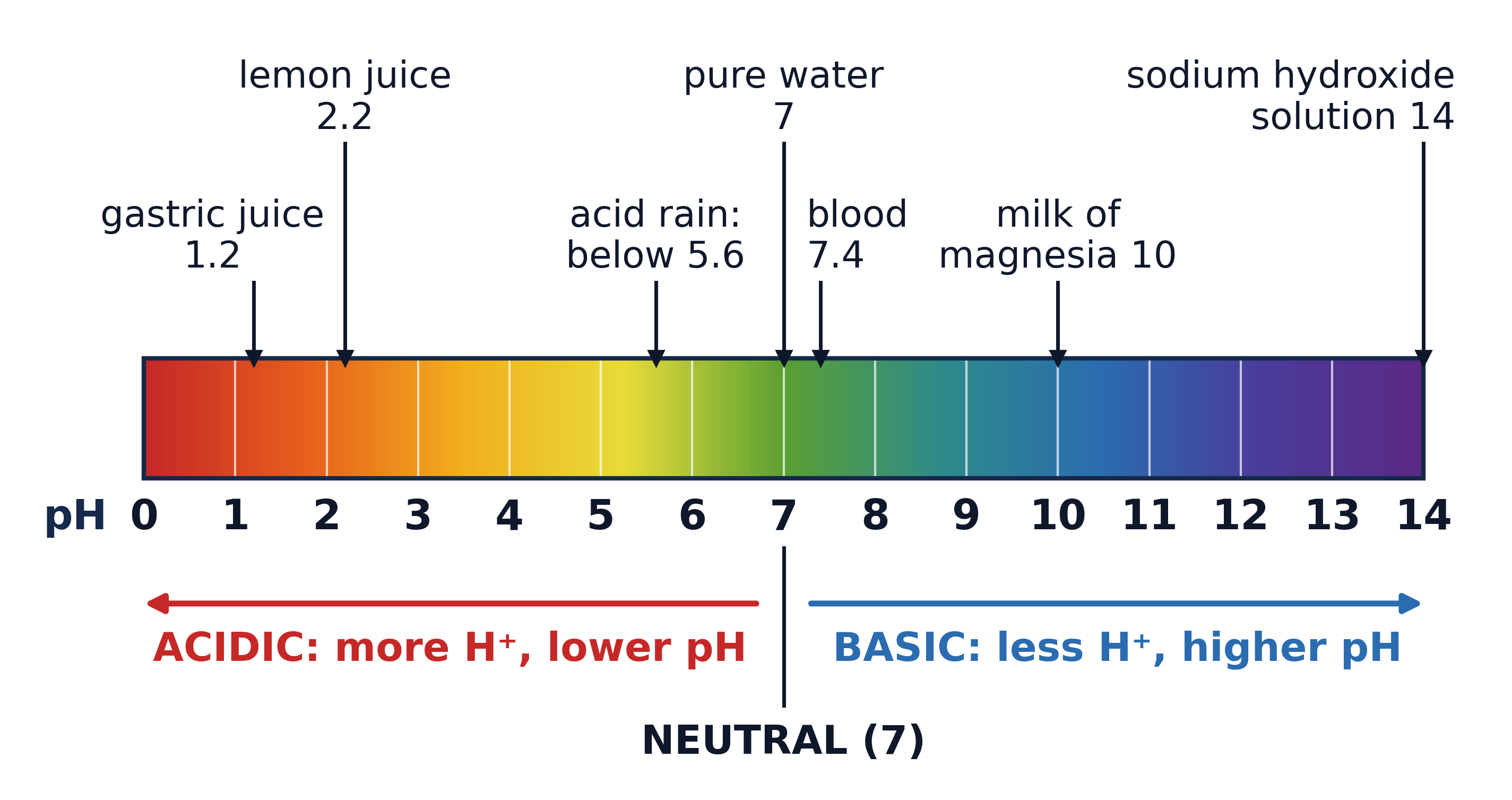
| Substance | pH, about |
|---|---|
| Gastric juice (stomach) | 1.2 |
| Lemon juice | 2.2 |
| Pure water | 7 |
| Blood | 7.4 |
| Milk of magnesia | 10 |
| Sodium hydroxide solution | 14 |
| Fact the papers have used | Value |
|---|---|
| The human body works within | pH 7.0 to 7.8 |
| Rain is called acid rain when its pH is below | 5.6 |
| Tooth enamel begins to be attacked when the pH in the mouth falls below | 5.5 (a correct statement in CDS I 2026) |
| Desirable pH of drinking water | 6.5 to 8.5 |
Acid rain is caused mainly by sulphur dioxide and oxides of nitrogen from burning fuels. Tooth enamel is a calcium phosphate (asked with the biology questions in CDS II 2025); bacteria make acid from sugar and the acid attacks it. A solution with a pH below 7 is simply called an acidic solution (asked in CDS II 2025).
Antacids. Too much acid in the stomach causes indigestion. An antacid is a mild base that neutralises it: milk of magnesia, which is magnesium hydroxide, Mg(OH)₂, or baking soda. A bee sting contains acid, so baking soda soothes it.
6. Indicators
An indicator shows by its colour whether a solution is acidic or basic.
| Indicator | In acid | In base | Note |
|---|---|---|---|
| Litmus | red | blue | a purple dye obtained from lichens |
| Phenolphthalein | colourless | pink | |
| Methyl orange | red | yellow | |
| Turmeric | stays yellow | reddish brown | a curry stain turns reddish brown with soap and yellow again when rinsed with plenty of water |
Onion, vanilla and clove oil are olfactory indicators: their smell changes in a base. Ethanol and sugar solution are neutral and change neither litmus paper.
7. Salts
A salt forms when an acid is neutralised by a base. The nature of the salt depends on its parents.
| Parents | Solution of the salt is | Example |
|---|---|---|
| Strong acid + strong base | neutral, pH 7 | NaCl |
| Strong acid + weak base | acidic | NH₄Cl |
| Weak acid + strong base | basic | Na₂CO₃, CH₃COONa |
The salts and bases to learn by heart.
| Common name | Chemical name | Formula | Main uses |
|---|---|---|---|
| Common salt | sodium chloride | NaCl | food; raw material for the next four rows |
| Caustic soda | sodium hydroxide | NaOH | soap, paper, artificial fibres |
| Bleaching powder | calcium oxychloride | CaOCl₂ | bleaching cotton and paper; making water safe to drink; an oxidising agent |
| Baking soda (also called cooking soda) | sodium hydrogencarbonate (sodium bicarbonate) | NaHCO₃ | baking powder; antacid; soda-acid fire extinguisher |
| Washing soda | sodium carbonate decahydrate | Na₂CO₃·10H₂O | glass, soap and paper; cleaning; removing permanent hardness of water |
| Soda ash | sodium carbonate without water (anhydrous) | Na₂CO₃ | glass; got by heating baking soda |
| Gypsum | calcium sulphate dihydrate | CaSO₄·2H₂O | cement; making plaster of Paris |
| Plaster of Paris | calcium sulphate hemihydrate | CaSO₄·½H₂O, also written 2CaSO₄·H₂O | plaster for broken bones; statues and casts |
| Limestone, chalk, marble | calcium carbonate | CaCO₃ | cement, lime, building |
| Quicklime | calcium oxide | CaO | making slaked lime and cement |
| Slaked lime | calcium hydroxide | Ca(OH)₂ | whitewash; its clear solution is lime water |
| Milk of magnesia | magnesium hydroxide | Mg(OH)₂ | antacid |
| Blue vitriol | copper sulphate pentahydrate | CuSO₄·5H₂O | fungicide; electroplating |
| Green vitriol | ferrous sulphate heptahydrate | FeSO₄·7H₂O | iron tablets; ink |
Five points on this table, all used in the papers.
- The paper may give the older name. Hydrogencarbonate is the same as bicarbonate. Calcium oxychloride is bleaching powder. "Sodium carbonate, 10 water" is washing soda. "Calcium sulphate, half water" is plaster of Paris (CDS II 2024 matched these four).
- Baking soda and baking powder are not the same. Baking soda is one compound, NaHCO₃. Baking powder is a mixture of baking soda and a mild edible acid such as tartaric acid, so it has no single formula. CDS I 2026 asked for the wrongly matched pair among bleaching powder, soda ash, baking powder and plaster of Paris; baking powder was the one that cannot be matched with a formula.
- Plaster of Paris has two ways of writing. Half a molecule of water for one CaSO₄ is the same as one molecule of water for two: CaSO₄·½H₂O = 2CaSO₄·H₂O. Both are right.
- Marble, chalk and limestone are three natural forms of the same compound, calcium carbonate (asked in CDS II 2026).
- Cooking soda is baking soda, NaHCO₃ (asked in CDS II 2026). The options beside it were NaCl (common salt), NaOCl (sodium hypochlorite, a liquid bleach) and Na₂CO₃ (soda ash).
How four of them are made from common salt.
- Passing electricity through salt water (the chlor-alkali process): 2NaCl + 2H₂O → 2NaOH + Cl₂ + H₂. Chlorine comes off at the anode and hydrogen at the cathode. Sodium hydroxide forms in the solution near the cathode. CDS II 2026 asked what the sodium chloride solution gives: NaOH. Sodium metal is not formed here; it comes only from molten salt with no water.
- The chlorine acts on dry slaked lime to give bleaching powder: Ca(OH)₂ + Cl₂ → CaOCl₂ + H₂O.
- Baking soda: NaCl + H₂O + CO₂ + NH₃ → NH₄Cl + NaHCO₃.
- Heating baking soda gives sodium carbonate, which is crystallised as washing soda: 2NaHCO₃ → Na₂CO₃ + H₂O + CO₂.
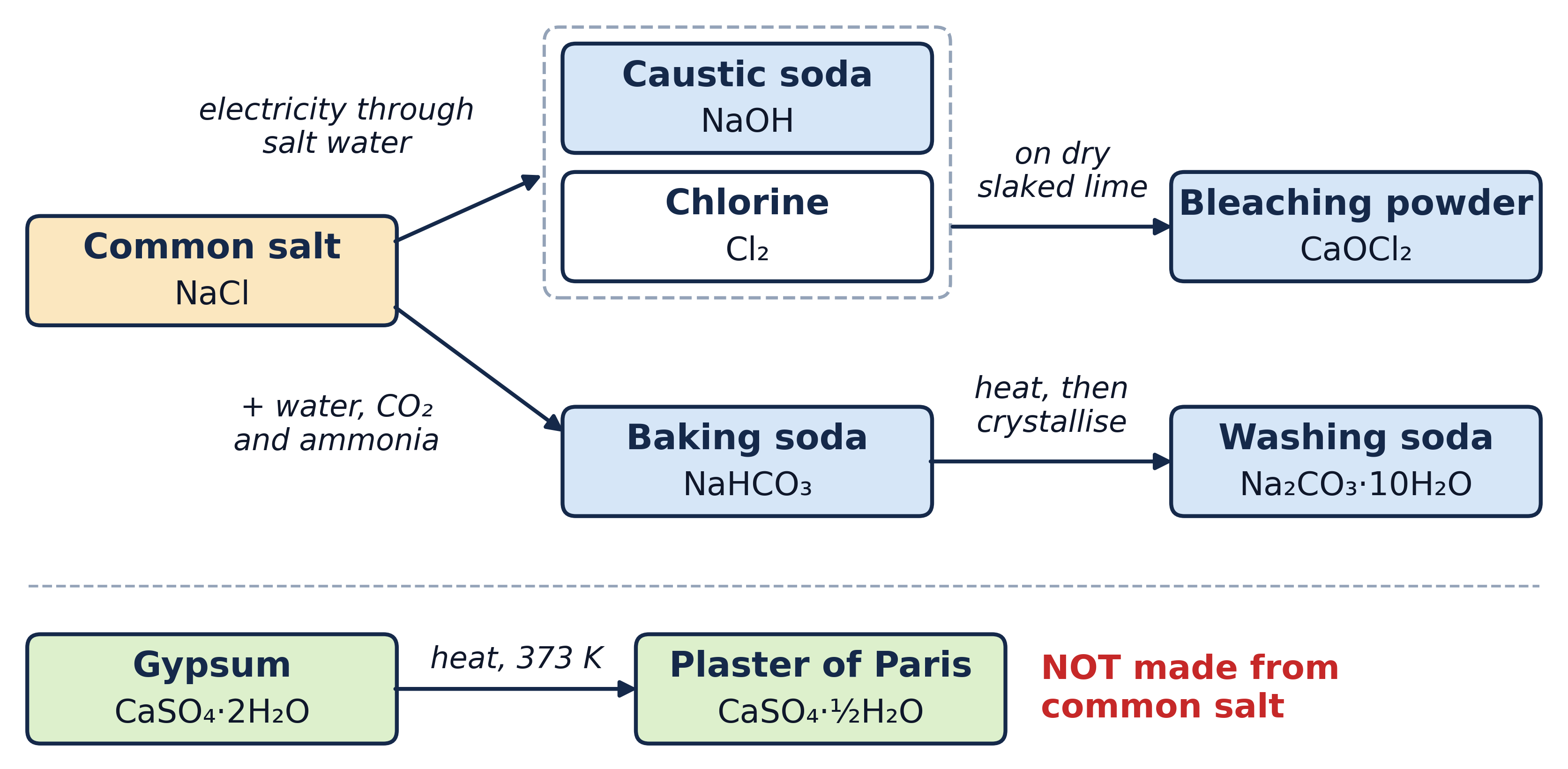
The carbon dioxide in the last equation is what makes a cake rise. Plaster of Paris is not made from common salt. It is made by heating gypsum at 373 K: CaSO₄·2H₂O → CaSO₄·½H₂O + 1½H₂O. Mixed with water it sets hard as gypsum again.
Water of crystallisation is the fixed number of water molecules in one formula unit of a salt: 5 in copper sulphate, 7 in ferrous sulphate, 10 in washing soda, 2 in gypsum. When blue copper sulphate crystals are heated they lose this water and turn white.
What the papers have asked
| Paper | The idea asked | The answer in one line |
|---|---|---|
| CDS II 2024 | Matching four trade names with chemical names | Bleaching powder: calcium oxychloride. Baking soda: sodium bicarbonate. Washing soda: sodium carbonate with 10 water. Plaster of Paris: calcium sulphate with half water |
| CDS I 2025 | The set that contains only Lewis acids | The set of electron-poor halides and a positive metal ion. NH₃, H₂O, OH⁻ and F⁻ are Lewis bases |
| CDS II 2025 | A solution with pH below 7 | An acidic solution |
| CDS I 2026 | Three statements; find the ones not correct | Only the order of reactivity was wrong (zinc is more reactive than iron). Nitrogen in food packets and tooth decay below pH 5.5 are right |
| CDS I 2026 | The wrongly matched pair of compound and formula | Baking powder. It is a mixture, not NaHCO₃ |
| CDS I 2026 | Four statements on bases and alkalis | "All bases dissolve in water" is wrong; the other three are right |
| CDS II 2026 | Forms of calcium carbonate | Marble, chalk and limestone, all three |
| CDS II 2026 | The blue-green product of hydrochloric acid on copper oxide | Copper(II) chloride |
| CDS II 2026 | Matching foods with acids | Tomato: oxalic. Sour milk: lactic. Ant sting: methanoic. Vinegar: acetic |
| CDS II 2026 | Formula of cooking soda | NaHCO₃ |
| CDS II 2026 | Product of passing electricity through sodium chloride solution | NaOH (with chlorine and hydrogen) |
| CDS II 2026 | Why an acid solution conducts electricity | It contains ions: hydrogen ions and the negative ions of the acid |
| CDS II 2026 | A chemical that donates a proton | An acid |
Worked examples
Example 1. In the reaction ZnO + C → Zn + CO, name the oxidising agent and the reducing agent.
Solution. Zinc oxide loses oxygen, so it is reduced. Carbon gains oxygen, so it is oxidised. The agent is always the other one: the substance that is reduced is the oxidising agent. So ZnO is the oxidising agent and carbon is the reducing agent. Calling carbon the oxidising agent "because it is oxidised" is the standard mistake. Answer: oxidising agent ZnO, reducing agent C.
Example 2. What is the oxidation number of chromium in K₂Cr₂O₇?
Solution. Potassium is +1 and oxygen is −2. Let chromium be x: 2(+1) + 2x + 7(-2) = 0, so 2x = 12 and x = +6. The answer +12 comes from forgetting to divide between the two chromium atoms. Answer: +6.
Example 3. Consider the following statements:
- A solution of pH 3 has a higher concentration of hydrogen ions than a solution of pH 5.
- A solution of sodium carbonate in water turns red litmus blue.
Which of the statements given above is/are correct?
Solution. A lower pH means more H⁺, so statement 1 is correct (in fact 100 times more). Sodium carbonate is the salt of a weak acid and a strong base, so its solution is basic and turns red litmus blue: statement 2 is correct. A student who thinks "all salts are neutral" marks 1 only. Answer: both 1 and 2.
Example 4. Match the common name with the formula: A. Baking soda, B. Washing soda, C. Plaster of Paris, D. Bleaching powder; 1. CaOCl₂, 2. NaHCO₃, 3. CaSO₄·½H₂O, 4. Na₂CO₃·10H₂O.
Solution. Baking soda is the hydrogencarbonate, NaHCO₃ (A-2). Washing soda is the carbonate with ten molecules of water (B-4). Plaster of Paris has half a molecule of water (C-3); the formula with two molecules of water is gypsum. Bleaching powder is CaOCl₂ (D-1). Answer: A-2, B-4, C-3, D-1.
Example 5. Which one of the following is a Lewis acid but not an Arrhenius acid: HCl, BF₃, NH₃ or NaOH?
Solution. BF₃ has only six electrons around boron, so it accepts an electron pair: it is a Lewis acid. It has no hydrogen to give as H⁺, so it is not an Arrhenius acid. HCl is the tempting option, but HCl is an acid under the Arrhenius definition. NH₃ and NaOH are bases. Answer: BF₃.
Example 6. Consider the following statements:
- Copper oxide is a base, but it is not an alkali.
- A solution of sodium hydroxide feels soapy.
- Dry hydrogen chloride gas turns dry blue litmus paper red.
How many of the above statements are correct?
(a) Only one (b) Only two (c) All three (d) None
Solution. Copper oxide neutralises acids, so it is a base, but it does not dissolve in water, so it is not an alkali: statement 1 is correct. Alkalis feel soapy: statement 2 is correct. An acid shows its acid nature only when water is present to let it form ions; the dry gas does nothing to dry litmus. Statement 3 is wrong. Answer (b).
Mistakes that cost marks
- Mixing up the agent with what happens to it. The oxidising agent is reduced. The reducing agent is oxidised.
- "Higher pH means more acidic." It is the opposite. pH 1 is far more acidic than pH 6.
- Gypsum and plaster of Paris. Gypsum is CaSO₄·2H₂O. Plaster of Paris is CaSO₄·½H₂O. The papers print the wrong one on purpose.
- Baking soda and washing soda. Baking soda is NaHCO₃ (one sodium, used in food). Washing soda is Na₂CO₃·10H₂O. Soda ash is Na₂CO₃ with no water.
- Baking soda and baking powder. Baking soda is a compound. Baking powder is a mixture of baking soda and tartaric acid.
Quick check
- In CuO + H₂ → Cu + H₂O, which substance is the reducing agent?
- What is the oxidation number of sulphur in H₂SO₄?
- What colour is phenolphthalein in a solution of sodium hydroxide?
- Give the formula of bleaching powder.
- Is a solution of ammonium chloride acidic, basic or neutral?
Read and watch more, free
| What | Where | Language |
|---|---|---|
| Textbook, the main source | NCERT textbooks, the book menu: Class 10 Science, chapter 1 "Chemical Reactions and Equations" and chapter 2 "Acids, Bases and Salts" | English, Hindi |
| Textbook, the three definitions of an acid, and Lewis acids | NCERT textbooks, the book menu: Class 11 Chemistry Part I, chapter 6 "Equilibrium" (the part on acids, bases and salts) | English, Hindi |
| Textbook, oxidation number | NCERT textbooks, the book menu: Class 11 Chemistry Part II, chapter 7 "Redox Reactions" | English, Hindi |
| Self-study notes | NIOS Science and Technology (212): lesson 4 "Chemical reactions" and lesson 8 "Acids, bases and salts". Free on the NIOS website under "online course material"; no link is given here because the page was not among those checked for this course | English, Hindi |
| The real papers | UPSC previous question papers (the General Knowledge booklet of every CDS sitting) | English, Hindi |
| Video, chemistry in one class | eTakshila Classes: Complete GS One Shot Series for CDS 2026 (the chemistry class; it is long, so find this chapter's part) | Hinglish, judged from the titles |
| Video, topic by topic | CDS Wallah: CDS Exam Full Playlist (the chemistry videos) | Hinglish |
| Video, past questions | Reveal GK: CDS past questions by subject and topic (the chemistry parts) | Hinglish |
The videos were chosen from their titles, length and views; they have not yet been watched by a teacher.
Answers to the quick check
- Hydrogen. It removes the oxygen from copper oxide and is itself oxidised to water.
- +6, because 2(+1) + x + 4(-2) = 0.
- Pink.
- CaOCl₂.
- Acidic. It is the salt of a strong acid (HCl) and a weak base (ammonium hydroxide).
Next chapter: Carbon and its compounds.