Why this chapter matters. This is the most-asked chapter of the unit: 43 questions in the seven papers from NDA II 2023 to NDA II 2026, about six in each paper. Most of them are answered by a property of definite integrals or by a quick sketch, not by long integration. This is a long chapter. Study sections 1 to 6 in one sitting and sections 7 and 8 in a second.
What you will be able to do
- Find the value of a definite integral, with or without a substitution.
- Use seven properties to shorten the work, or to avoid integrating at all.
- Handle integrands with a modulus, a greatest integer function or a periodic function.
- Find the area between a curve and the x-axis, and the area between two curves.
Before you start you should know: the standard integrals and substitution (Chapters M6-1 and M6-2), the graphs of |x|, [x], \sin x and \cos x (Chapter M5-1), and the standard curves (Chapters M4-2 to M4-4).
1. The definite integral
Let F(x) be any antiderivative of f(x). The definite integral of f(x) from a to b is
\int_a^b f(x)\,dx = \Big[F(x)\Big]_a^b = F(b) - F(a)
Here a is the lower limit and b is the upper limit. Put in the upper limit first, then subtract the value at the lower limit.
For example, \int_1^2 3x^2\,dx = \Big[x^3\Big]_1^2 = 8 - 1 = 7.
The answer is a number, not a function. There is no +\,c: the constant would appear in both F(b) and F(a) and cancel.
2. What the number means: area
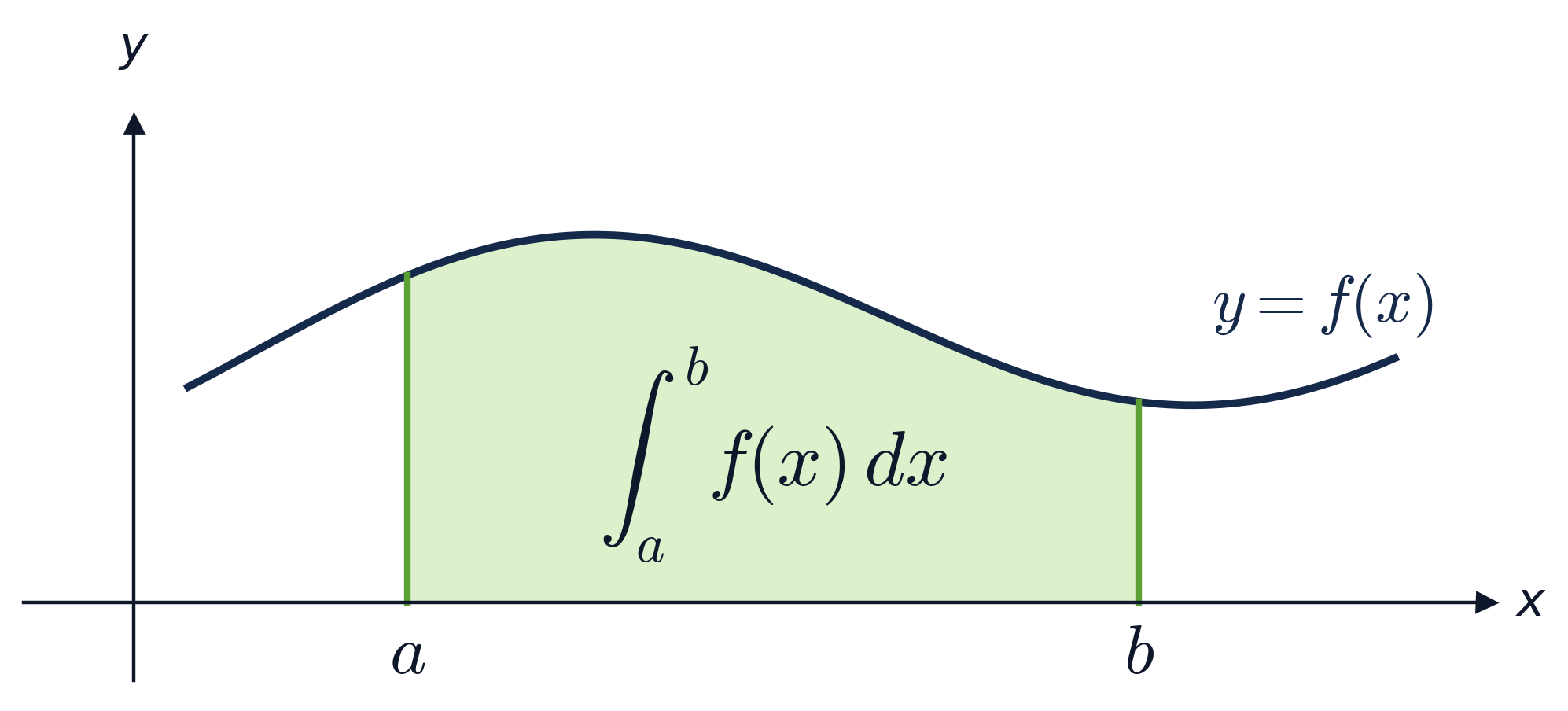
Picture the curve y = f(x) lying above the x-axis, with two vertical lines drawn at x = a and x = b. The definite integral \int_a^b f(x)\,dx is the area of the region enclosed by the curve, the x-axis and those two lines.
Check with a shape you know. The line y = 2x from x = 0 to x = 3 makes a triangle with base 3 and height 6, so its area is 9. And \int_0^3 2x\,dx = \Big[x^2\Big]_0^3 = 9.
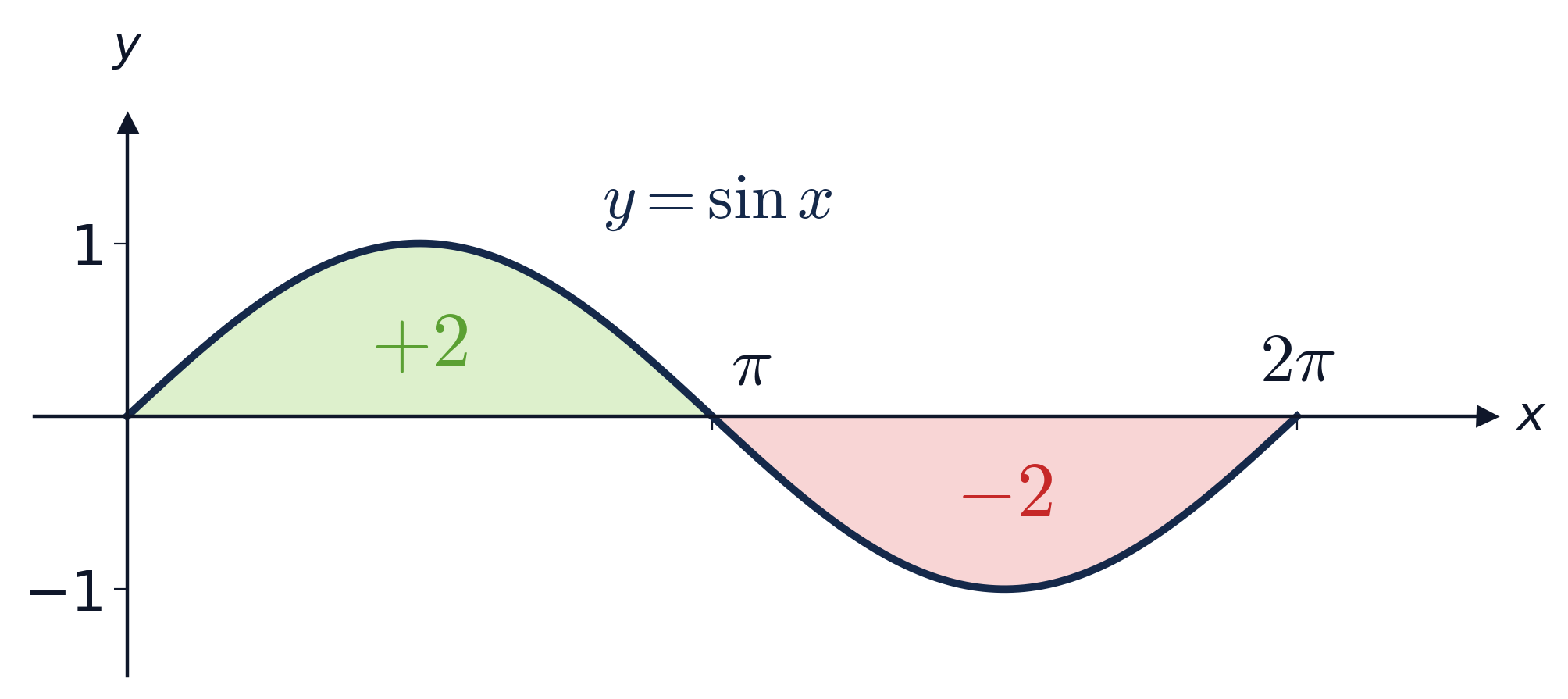
Below the axis the integral is negative. The curve y = \sin x is above the axis from 0 to \pi and below it from \pi to 2\pi. So \int_0^{\pi}\sin x\,dx = 2 and \int_{\pi}^{2\pi}\sin x\,dx = -2, and \int_0^{2\pi}\sin x\,dx = 0. But the area between the curve and the axis from 0 to 2\pi is 2 + 2 = 4. An integral adds areas with their signs. An area is always positive.
3. Substitution: change the limits too
When you put t = g(x), change the limits from values of x to values of t. Then you need not go back to x.
For example, in \int_0^1 \dfrac{2x}{1 + x^2}\,dx put t = 1 + x^2, so dt = 2x\,dx. When x = 0, t = 1. When x = 1, t = 2. The integral becomes \int_1^2 \dfrac{dt}{t} = \Big[\ln t\Big]_1^2 = \ln 2.
4. The seven properties
Learn these as a list. They are the heart of the chapter.
| Property | When to use it | |
|---|---|---|
| 1 | \displaystyle\int_a^b f(x)\,dx = \int_a^b f(t)\,dt | The letter used for the variable does not matter |
| 2 | \displaystyle\int_a^b f(x)\,dx = -\int_b^a f(x)\,dx, and \displaystyle\int_a^a f(x)\,dx = 0 | Swapping the limits changes the sign |
| 3 | \displaystyle\int_a^b f(x)\,dx = \int_a^c f(x)\,dx + \int_c^b f(x)\,dx | To split the range: modulus, greatest integer, functions defined in pieces |
| 4 | \displaystyle\int_0^a f(x)\,dx = \int_0^a f(a - x)\,dx. More generally \displaystyle\int_a^b f(x)\,dx = \int_a^b f(a + b - x)\,dx | The "add the two forms" method of section 5 |
| 5 | \displaystyle\int_{-a}^{a} f(x)\,dx = 2\int_0^a f(x)\,dx if f is even, and = 0 if f is odd | Limits of the form -a to a |
| 6 | \displaystyle\int_0^{2a} f(x)\,dx = 2\int_0^a f(x)\,dx if f(2a - x) = f(x), and = 0 if f(2a - x) = -f(x) | For example \displaystyle\int_0^{\pi}\cos x\,dx = 0, because \cos(\pi - x) = -\cos x |
| 7 | If f has period T and n is a whole number, \displaystyle\int_0^{nT} f(x)\,dx = n\int_0^T f(x)\,dx. The integral over n full periods is the same wherever it starts: \displaystyle\int_a^{a + nT} f(x)\,dx = n\int_0^T f(x)\,dx | Periodic functions such as \lvert \sin x \rvert, which has period \pi |
5. Property 4 in use: add the two forms
This is the most-asked idea of the chapter. Take
I = \int_0^{\pi/2} \frac{\sin x}{\sin x + \cos x}\,dx
Replace x by \dfrac{\pi}{2} - x. This changes \sin x into \cos x and \cos x into \sin x, and by property 4 the value stays the same:
I = \int_0^{\pi/2} \frac{\cos x}{\cos x + \sin x}\,dx
Add the two forms. The numerators add up to the denominator: 2I = \int_0^{\pi/2} 1\,dx = \dfrac{\pi}{2}. So I = \dfrac{\pi}{4}.
The same steps work when \sin x and \cos x are replaced by their squares, cubes or square roots. In general,
\int_a^b \frac{f(x)}{f(x) + f(a + b - x)}\,dx = \frac{b - a}{2}
So the answer is half the length of the range.
6. Property 5 in use: odd and even functions
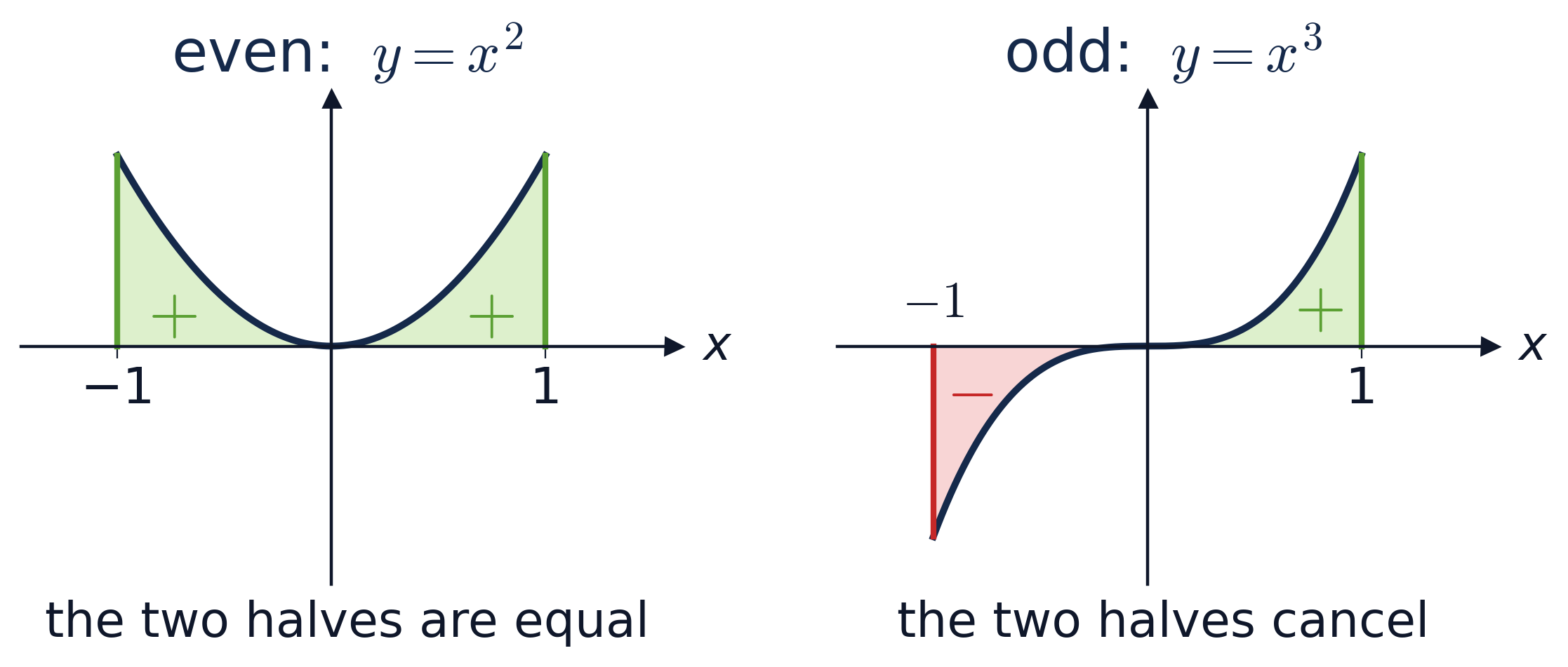
- f is even if f(-x) = f(x). Examples: x^2, \cos x, |x|. The graph is the same on both sides of the y-axis, so the area from -a to 0 equals the area from 0 to a.
- f is odd if f(-x) = -f(x). Examples: x, x^3, \sin x, \tan x. The part of the graph on the left of the y-axis is the part on the right turned upside down, so the two signed areas cancel.
To decide quickly: odd × even is odd, odd × odd is even, even × even is even. A sum of odd functions is odd.
For example, \int_{-2}^{2}(x^5 + 3x^2)\,dx = 0 + 2\int_0^2 3x^2\,dx = 2 \times 8 = 16. The odd part x^5 gives nothing.
7. Property 3 in use: modulus, greatest integer, periodic functions
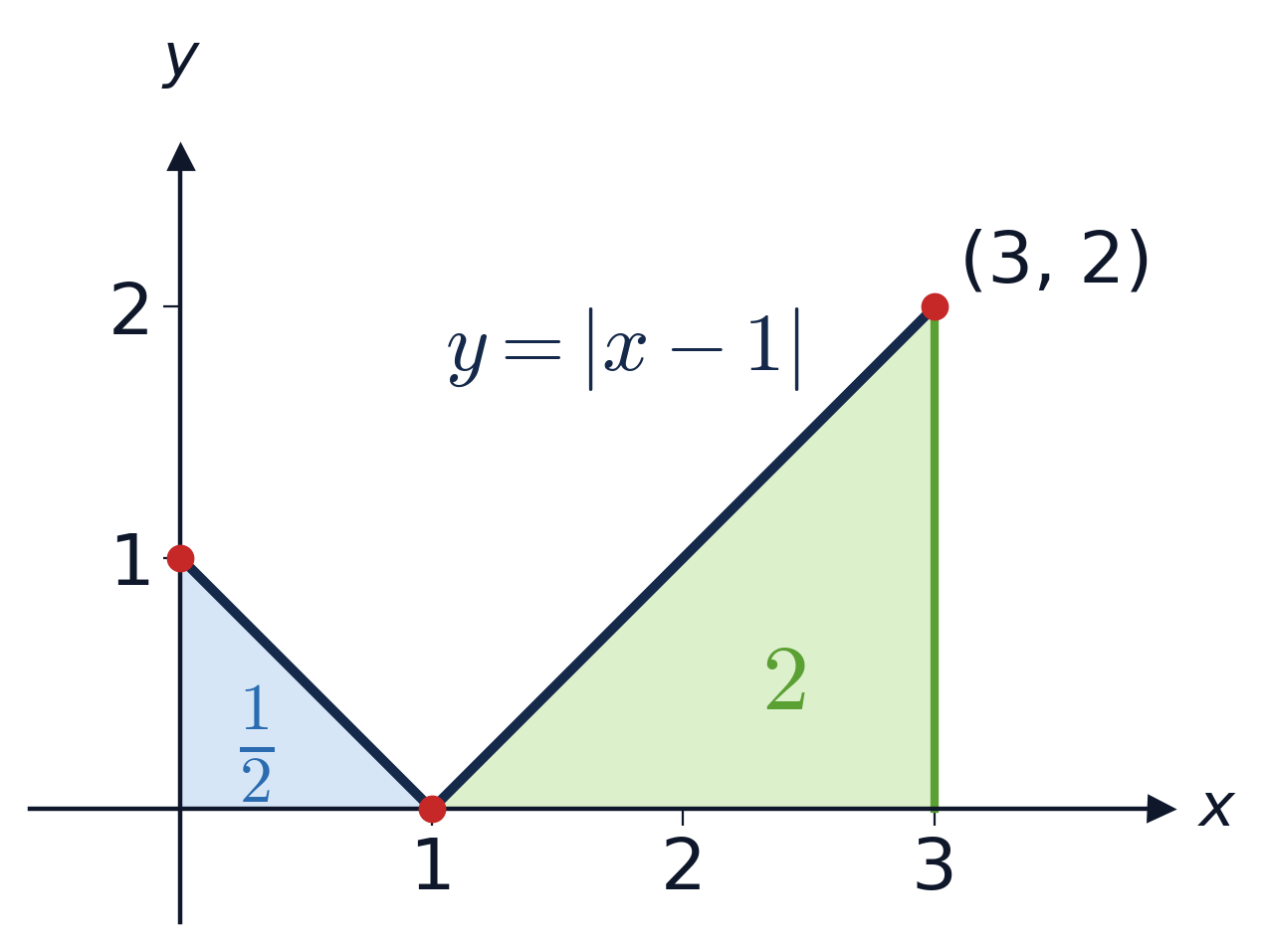
Modulus. Find where the expression inside changes sign and split the range there. In \int_0^3 |x - 1|\,dx the inside is negative for x < 1 and positive for x > 1:
\int_0^3 |x - 1|\,dx = \int_0^1 (1 - x)\,dx + \int_1^3 (x - 1)\,dx = \frac{1}{2} + 2 = \frac{5}{2}
The graph of y = |x - 1| is a V with its point at (1, 0), so the same answer comes from two triangles: \dfrac{1}{2}(1)(1) + \dfrac{1}{2}(2)(2).
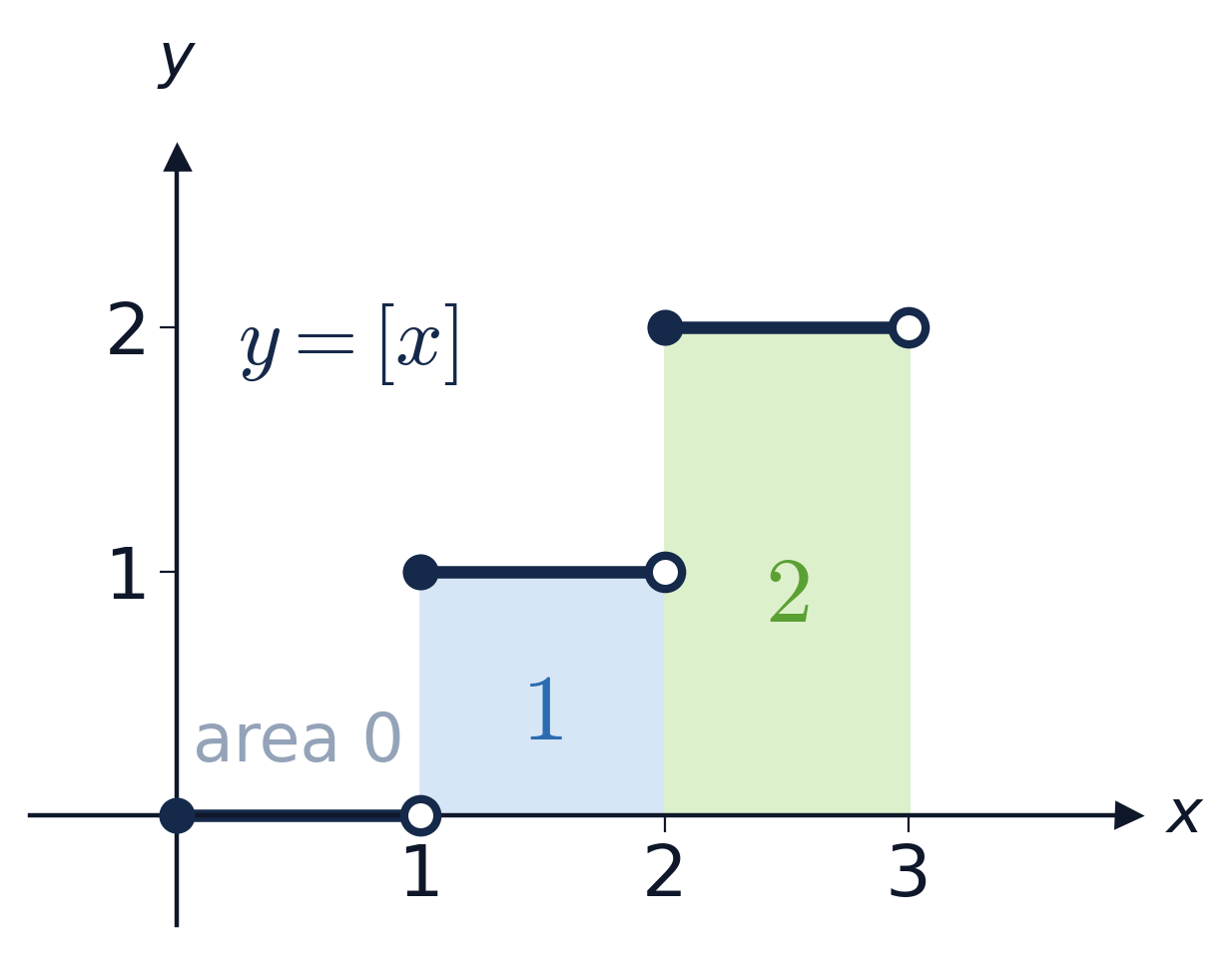
Greatest integer. [x] means the greatest integer not more than x. It is constant between one integer and the next, so split the range at every integer. \int_0^3 [x]\,dx = 0 \times 1 + 1 \times 1 + 2 \times 1 = 3. For [x^2], split where x^2 reaches a whole number.
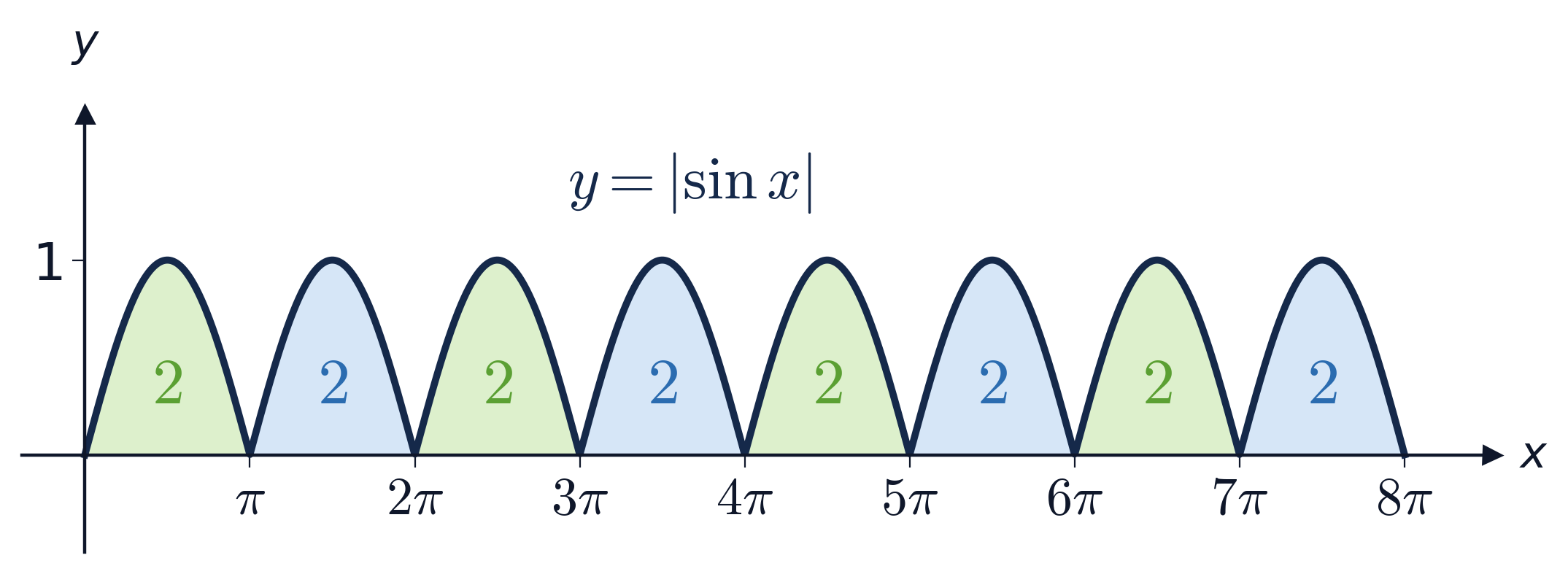
Periodic. |\sin x| has period \pi, and \int_0^{\pi}|\sin x|\,dx = \int_0^{\pi}\sin x\,dx = 2. By property 7, the integral over any n full periods is 2n.
8. Areas
| Region | Area |
|---|---|
| Between y = f(x), the x-axis, x = a and x = b, with the curve above the axis | \displaystyle\int_a^b f(x)\,dx |
| The same, but the curve crosses the axis | \displaystyle\int_a^b \lvert f(x) \rvert\,dx: split at the crossing points, take each part as positive, add |
| Between two curves, y = f(x) above and y = g(x) below, from x = a to x = b | \displaystyle\int_a^b [f(x) - g(x)]\,dx. Often a and b are where the curves meet |
| Between x = g(y), the y-axis, y = c and y = d, with the curve to the right of the axis | \displaystyle\int_c^d g(y)\,dy |
Three habits save time:
- Sketch first. A rough sketch shows which curve is above and where the curves meet.
- Use symmetry. If the region is the same on both sides of an axis, find half and double it.
- Use geometry. If the region is a triangle, a rectangle or part of a circle, use the area formula. Several real questions need no integration at all.
Three results worth knowing: the circle x^2 + y^2 = r^2 has area \pi r^2; the ellipse \dfrac{x^2}{a^2} + \dfrac{y^2}{b^2} = 1 has area \pi ab; the parabola y^2 = 4ax and its latus rectum x = a enclose an area \dfrac{8a^2}{3}.
9. Worked examples
Example 1. Find \int_0^2 (3x^2 - 2x + 1)\,dx.
\Big[x^3 - x^2 + x\Big]_0^2 = (8 - 4 + 2) - 0 = 6.
Example 2. Find \int_0^1 x\,e^{x^2}\,dx.
Put t = x^2, so x\,dx = \dfrac{dt}{2}. When x = 0, t = 0; when x = 1, t = 1. The integral is \dfrac{1}{2}\int_0^1 e^t\,dt = \dfrac{1}{2}\Big[e^t\Big]_0^1 = \dfrac{e - 1}{2}.
Example 3. Find I = \int_0^{\pi/2} \dfrac{\sqrt{\sin x}}{\sqrt{\sin x} + \sqrt{\cos x}}\,dx.
Replace x by \dfrac{\pi}{2} - x: I = \int_0^{\pi/2} \dfrac{\sqrt{\cos x}}{\sqrt{\cos x} + \sqrt{\sin x}}\,dx. Add: 2I = \int_0^{\pi/2} 1\,dx = \dfrac{\pi}{2}, so I = \dfrac{\pi}{4}.
Example 4. Find \int_{-1}^{1} (x^3\cos x + 3x^2)\,dx.
x^3 is odd and \cos x is even, so x^3 \cos x is odd and gives 0. 3x^2 is even and gives 2\int_0^1 3x^2\,dx = 2 \times 1 = 2. The answer is 2.
Example 5. Find \int_0^{\pi} |\cos x|\,dx.
\cos x is positive from 0 to \dfrac{\pi}{2} and negative from \dfrac{\pi}{2} to \pi. So the integral is \int_0^{\pi/2}\cos x\,dx + \int_{\pi/2}^{\pi}(-\cos x)\,dx = 1 + 1 = 2.
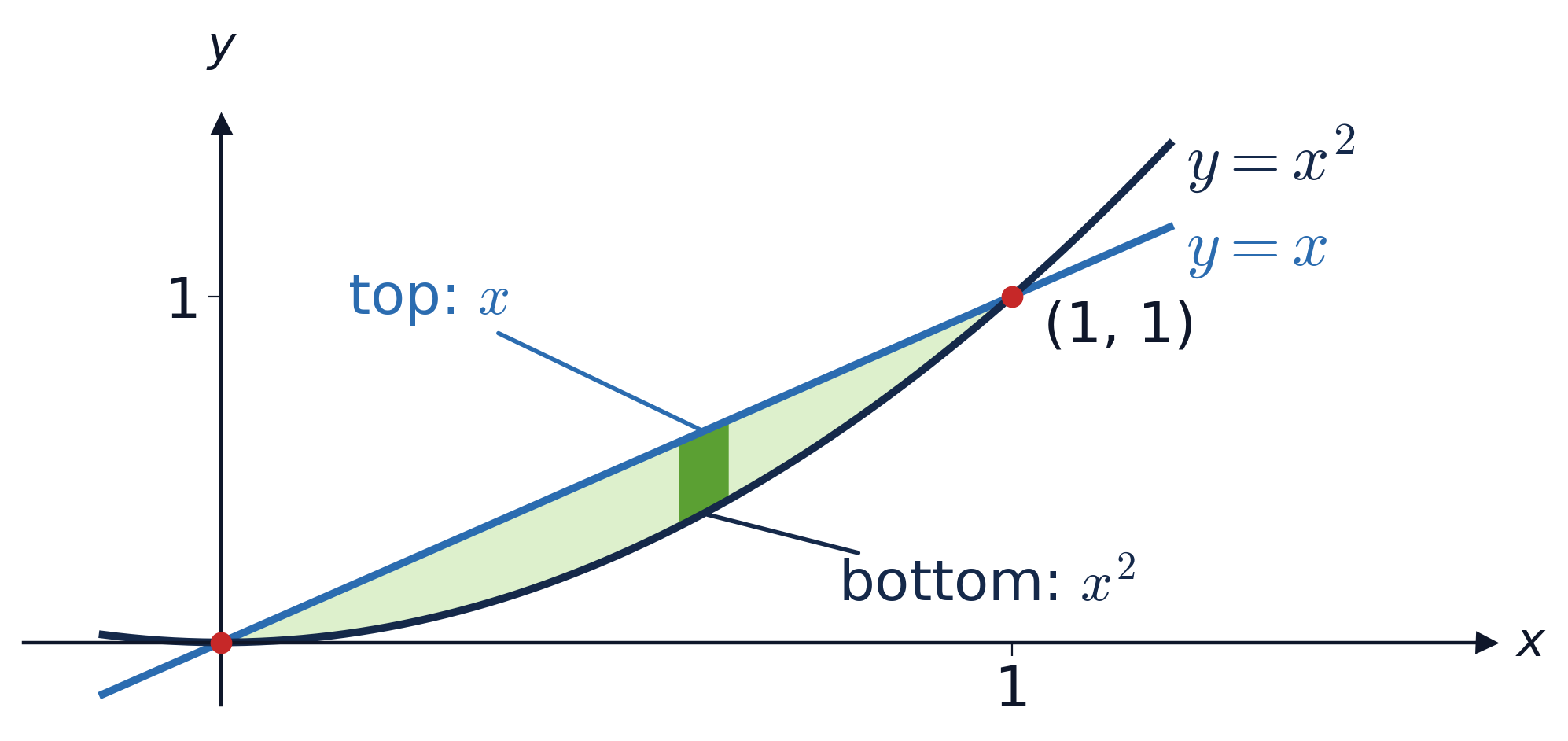
Example 6. Find the area enclosed between the line y = x and the parabola y = x^2.
They meet where x^2 = x, that is at x = 0 and x = 1. Between these, the line is above the parabola (at x = \tfrac{1}{2}: \tfrac{1}{2} > \tfrac{1}{4}). Area = \int_0^1 (x - x^2)\,dx = \Big[\dfrac{x^2}{2} - \dfrac{x^3}{3}\Big]_0^1 = \dfrac{1}{2} - \dfrac{1}{3} = \dfrac{1}{6} square unit.
10. From the real papers
Try each question for 75 seconds before reading the solution.
NDA I 2024, Q78. What is \int_0^{\frac{\pi}{2}} \frac{a + \sin x}{2a + \sin x + \cos x}dx equal to?
(a) \frac{\pi}{4} (b) \frac{\pi}{2} (c) 1 (d) 0
Solution. Call the integral I. Replace x by \dfrac{\pi}{2} - x (property 4): I = \int_0^{\pi/2} \dfrac{a + \cos x}{2a + \cos x + \sin x}\,dx. Add the two forms: the numerators add up to the denominator, so 2I = \int_0^{\pi/2} 1\,dx = \dfrac{\pi}{2} and I = \dfrac{\pi}{4}. Answer (a).
NDA I 2024, Q74. What is \int_{-1}^{1}(3\sin x - \sin 3x)\cos^2 x\,dx equal to?
(a) -\frac{1}{4} (b) 0 (c) \frac{1}{2} (d) \frac{1}{4}
Solution. \sin x and \sin 3x are odd, so the bracket is odd. \cos^2 x is even. Odd × even is odd, and the limits are -1 to 1. By property 5 the integral is 0. Answer (b).
NDA II 2023, Q67. What is \int_0^{8\pi} |\sin x|\,dx equal to?
(a) 2 (b) 4 (c) 8 (d) 16
Solution. |\sin x| has period \pi, so the range 0 to 8\pi is 8 full periods. Over one period, \int_0^{\pi}|\sin x|\,dx = \int_0^{\pi}\sin x\,dx = \Big[-\cos x\Big]_0^{\pi} = 1 + 1 = 2. By property 7 the total is 8 \times 2 = 16. Answer (d).
NDA I 2025, Q100. Let f(x) = [x^2], where [\cdot] is the greatest integer function. What is \int_{\sqrt{2}}^{2} f(x)\,dx equal to?
(a) 6 - \sqrt{3} - 2\sqrt{2} (b) 6 - \sqrt{3} - \sqrt{2} (c) 6 - \sqrt{3} + 2\sqrt{2} (d) 6 + \sqrt{3} - 2\sqrt{2}
Solution. Split where x^2 reaches a whole number. From \sqrt{2} to \sqrt{3}, x^2 lies between 2 and 3, so [x^2] = 2. From \sqrt{3} to 2, x^2 lies between 3 and 4, so [x^2] = 3. The integral is 2(\sqrt{3} - \sqrt{2}) + 3(2 - \sqrt{3}) = 6 - \sqrt{3} - 2\sqrt{2}. Answer (a).
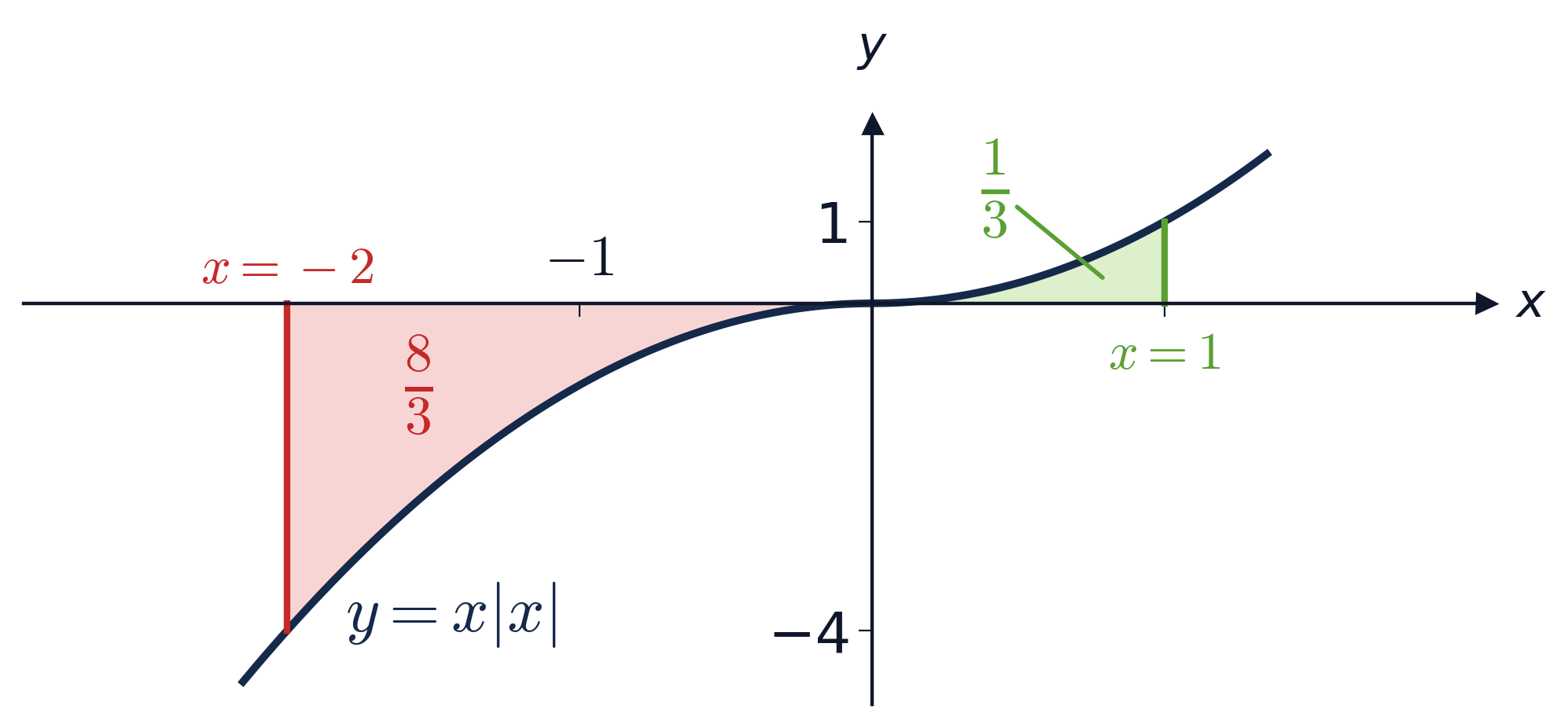
NDA II 2025, Q74. Consider the function f(x) = x|x|. What is the area bounded by the curve f(x), the x-axis and the lines x = -2 and x = 1?
(a) \frac{1}{3} (b) \frac{2}{3} (c) \frac{5}{2} (d) 3
Solution. For x < 0, f(x) = -x^2, which is below the axis. For x \geq 0, f(x) = x^2, which is above it. Area counts both parts as positive: \int_{-2}^{0} x^2\,dx + \int_0^1 x^2\,dx = \dfrac{8}{3} + \dfrac{1}{3} = 3. Answer (d).
NDA I 2026, Q90. Consider the curves y = x^2 and y = 2|x|. What is the area bounded by the curves, the lines x = 0 and x = 1?
(a) 1 square unit (b) \frac{2}{3} square unit (c) \frac{1}{2} square unit (d) \frac{1}{3} square unit
Solution. Between x = 0 and x = 1, |x| = x, so the curves are the line y = 2x and the parabola y = x^2. The line is above (at x = 1: 2 > 1). Area = \int_0^1 (2x - x^2)\,dx = \Big[x^2 - \dfrac{x^3}{3}\Big]_0^1 = 1 - \dfrac{1}{3} = \dfrac{2}{3}. Answer (b).
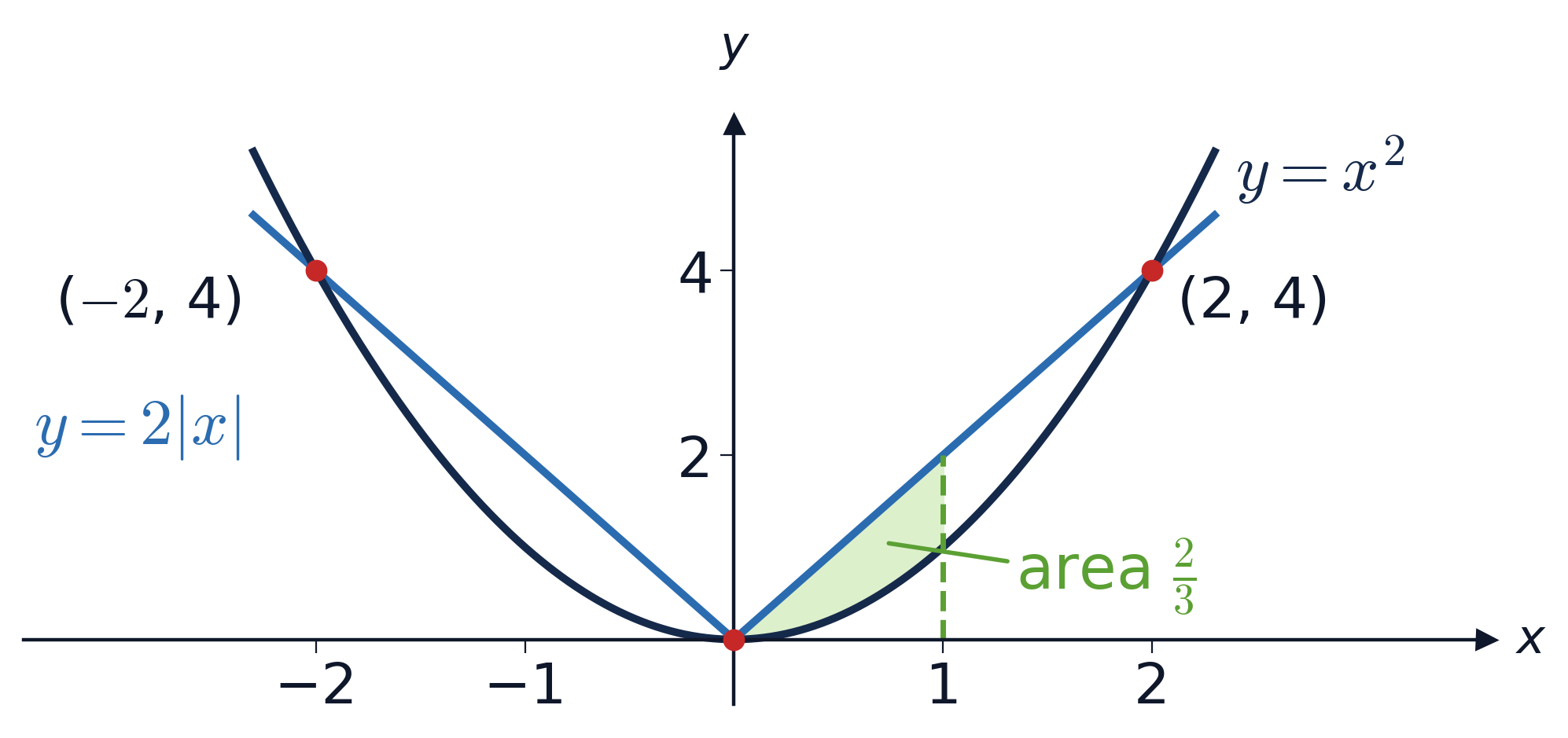
Notice that the first three questions needed no real integration. A property gave the answer.
11. Mistakes that cost marks
- Giving the integral when the question asks for the area. If the curve crosses the axis, the integral lets the parts cancel. \int_0^{2\pi}\sin x\,dx = 0, but the area is 4. For an area, split at the crossing points and add the positive values.
- Substituting but keeping the old limits. After t = g(x) the limits must be values of t. In Example 2 the limits stayed 0 and 1 only by chance; in the example of section 3 they changed from 0 and 1 to 1 and 2.
- Using the odd and even rule when it does not apply. The limits must be -a to a. \int_0^1 x^3\,dx is \dfrac{1}{4}, not 0. And a function such as x^3 + 1 is neither odd nor even: treat each term separately.
- Integrating |f(x)| or [x] without splitting. These change their formula inside the range. Split first, by property 3.
12. Quick check
Do these without help. Answers are at the end.
- Find \int_0^1 (4x^3 + 2x)\,dx.
- Find \int_{-3}^{3} (x^3 + 5)\,dx.
- Find \int_1^5 \dfrac{\sqrt{x}}{\sqrt{x} + \sqrt{6 - x}}\,dx.
- Find \int_0^4 |x - 2|\,dx.
- Find the area bounded by the curve y = 4 - x^2 and the x-axis.
13. Read and watch more, free
| What | Where | Language |
|---|---|---|
| Textbook, definite integrals | NCERT Class 12 Mathematics, Chapter 7 Integrals (the last sections) · Hindi edition | English, Hindi |
| Textbook, areas | NCERT Class 12 Mathematics, Chapter 8 Application of Integrals · Hindi edition | English, Hindi |
| Self-study notes | NIOS Mathematics, Lesson 31 Definite Integrals · Hindi edition | English, Hindi |
| Video, the whole topic for NDA | Defence Wallah: SHAKTI 2026 playlist (the video "Definite Integrals", about 3 hours) | Hinglish |
| Video, every textbook problem | Magnet Brains: Class 12 Maths, Chapters 7 and 8 | Hinglish |
| Video, short lessons | Khan Academy India: कक्षा 12 गणित (the lessons on समाकलन and area) | Hindi |
The videos were chosen from their titles, length and views; they have not yet been watched by a teacher.
Answers to the quick check
- \Big[x^4 + x^2\Big]_0^1 = 2.
- 30. The odd part x^3 gives 0, and \int_{-3}^{3} 5\,dx = 5 \times 6 = 30.
- 2. Here a + b = 6, so the integrand has the form \dfrac{f(x)}{f(x) + f(a + b - x)} and the value is \dfrac{5 - 1}{2}.
- 4. Split at x = 2: \int_0^2 (2 - x)\,dx + \int_2^4 (x - 2)\,dx = 2 + 2.
- \dfrac{32}{3} square units. The curve meets the axis at x = -2 and x = 2 and is above it in between: 2\int_0^2 (4 - x^2)\,dx = 2\left(8 - \dfrac{8}{3}\right).
Next chapter: Differential equations: order, degree and formation.