Why this chapter matters. This chapter drew 8 questions in the seven papers from NDA II 2023 to NDA II 2026, about one in each paper. They are of two kinds: read the order and degree of a given equation, or find the differential equation of a given family of curves. Both kinds can be done in under a minute, so these are among the quickest marks in the paper.
What you will be able to do
- Say what a differential equation is, and find its order.
- Find its degree, clearing roots and fractional powers first, and say when the degree is not defined.
- Check whether a given function is a solution, and tell a general solution from a particular one.
- Form the differential equation of a family of curves by removing the arbitrary constants.
Before you start you should know: how to differentiate once and twice, the product rule, and how to differentiate y^2 with respect to x (Chapter M5-6).
1. What a differential equation is
A differential equation is an equation that contains a derivative of an unknown function. For example,
\frac{dy}{dx} = 2x \qquad \text{and} \qquad \frac{d^2y}{dx^2} + y = 0
Here y is an unknown function of x. To solve an ordinary equation is to find a number. To solve a differential equation is to find a function.
For short, y' is written for \dfrac{dy}{dx} and y'' for \dfrac{d^2y}{dx^2}.
2. Order
The order is the order of the highest derivative in the equation.
\dfrac{dy}{dx} = 2x has order 1. \dfrac{d^2y}{dx^2} + y = 0 has order 2. \dfrac{d^3y}{dx^3} + \dfrac{dy}{dx} = x has order 3.
Powers do not matter for the order. Only look for the highest derivative.
3. Degree
First write the equation as a polynomial in its derivatives: no derivative under a root, and no derivative with a fractional power. Then the degree is the power of the highest-order derivative.
If the equation cannot be written as a polynomial in its derivatives, the degree is not defined. The order is always defined.
| Equation | Order | Degree | Why |
|---|---|---|---|
| \dfrac{dy}{dx} = 2x | 1 | 1 | |
| \left(\dfrac{d^2y}{dx^2}\right)^3 + \left(\dfrac{dy}{dx}\right)^4 + y = 0 | 2 | 3 | The power 4 belongs to a lower derivative and does not count |
| \left(\dfrac{dy}{dx}\right)^2 + \dfrac{dy}{dx} - \sin^2 y = 0 | 1 | 2 | \sin^2 y contains y, not a derivative, so it does no harm |
| \dfrac{d^2y}{dx^2} = \sqrt{1 + \left(\dfrac{dy}{dx}\right)^2} | 2 | 2 | Square both sides first: \left(\dfrac{d^2y}{dx^2}\right)^2 = 1 + \left(\dfrac{dy}{dx}\right)^2 |
| \dfrac{d^2y}{dx^2} + \sin\left(\dfrac{dy}{dx}\right) = 0 | 2 | Not defined | \sin of a derivative is not a polynomial in the derivative |
4. Solutions: general and particular
A solution is a function that satisfies the equation. To check, put the function into the equation.
Take \dfrac{dy}{dx} = 2x. Integrating gives y = x^2 + c. This is the general solution: it holds for every value of the arbitrary constant c. It is not one curve but a family of curves. Picture the parabola y = x^2 moved up or down: each position is one member of the family.
If we are also told that y = 1 when x = 0, then c = 1 and y = x^2 + 1. This is a particular solution: one curve of the family, with no arbitrary constant.
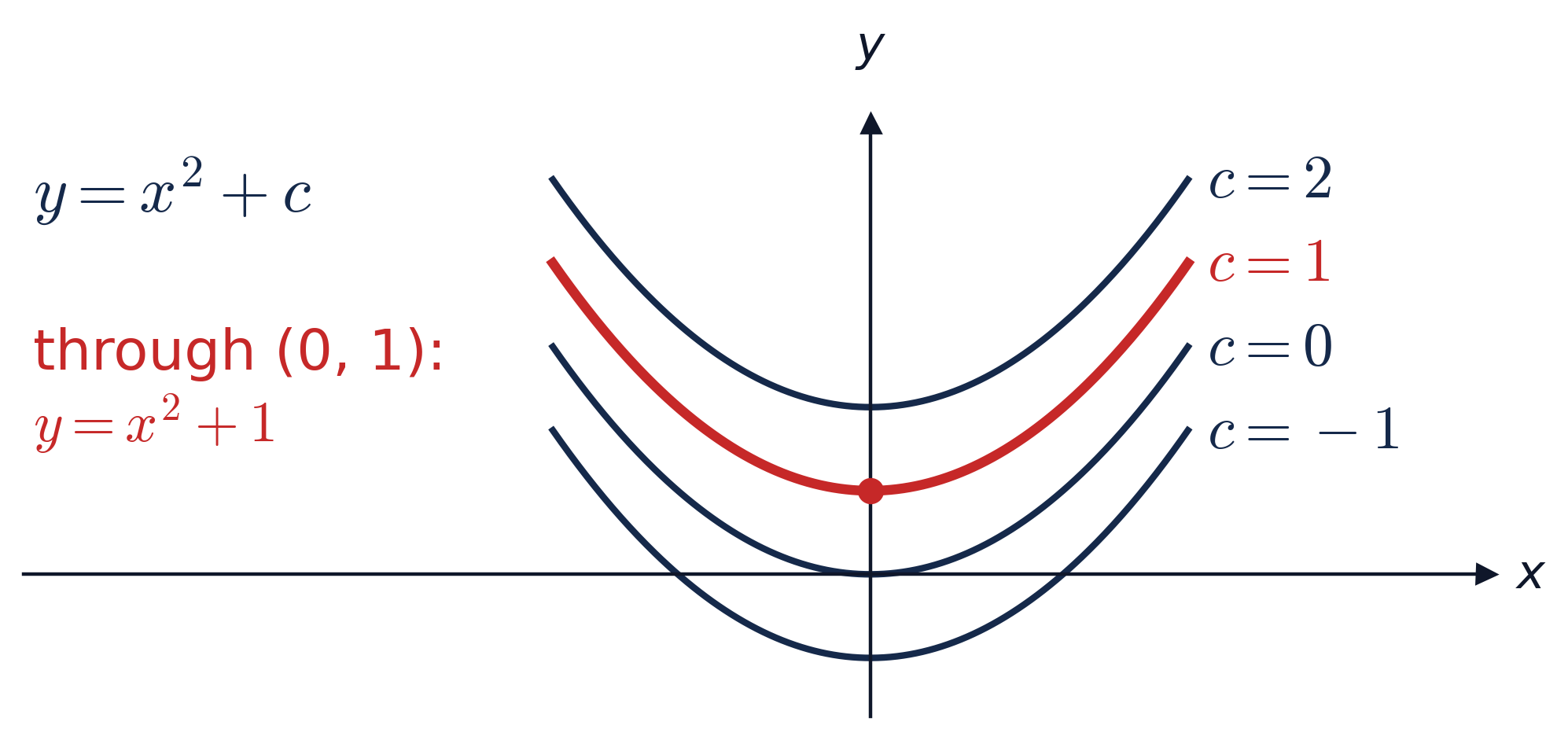
The general solution of an equation of order n contains n arbitrary constants.
5. Forming a differential equation
This is section 4 backwards. We are given a family of curves with arbitrary constants and want the differential equation that the whole family satisfies.
- Count the arbitrary constants. Say there are n.
- Differentiate the equation n times.
- Use these equations to remove all the constants.
The result has order n and contains no arbitrary constant.
One constant. The straight lines through the origin are y = mx. Differentiate once: \dfrac{dy}{dx} = m. Put this m back: y = x\dfrac{dy}{dx}.
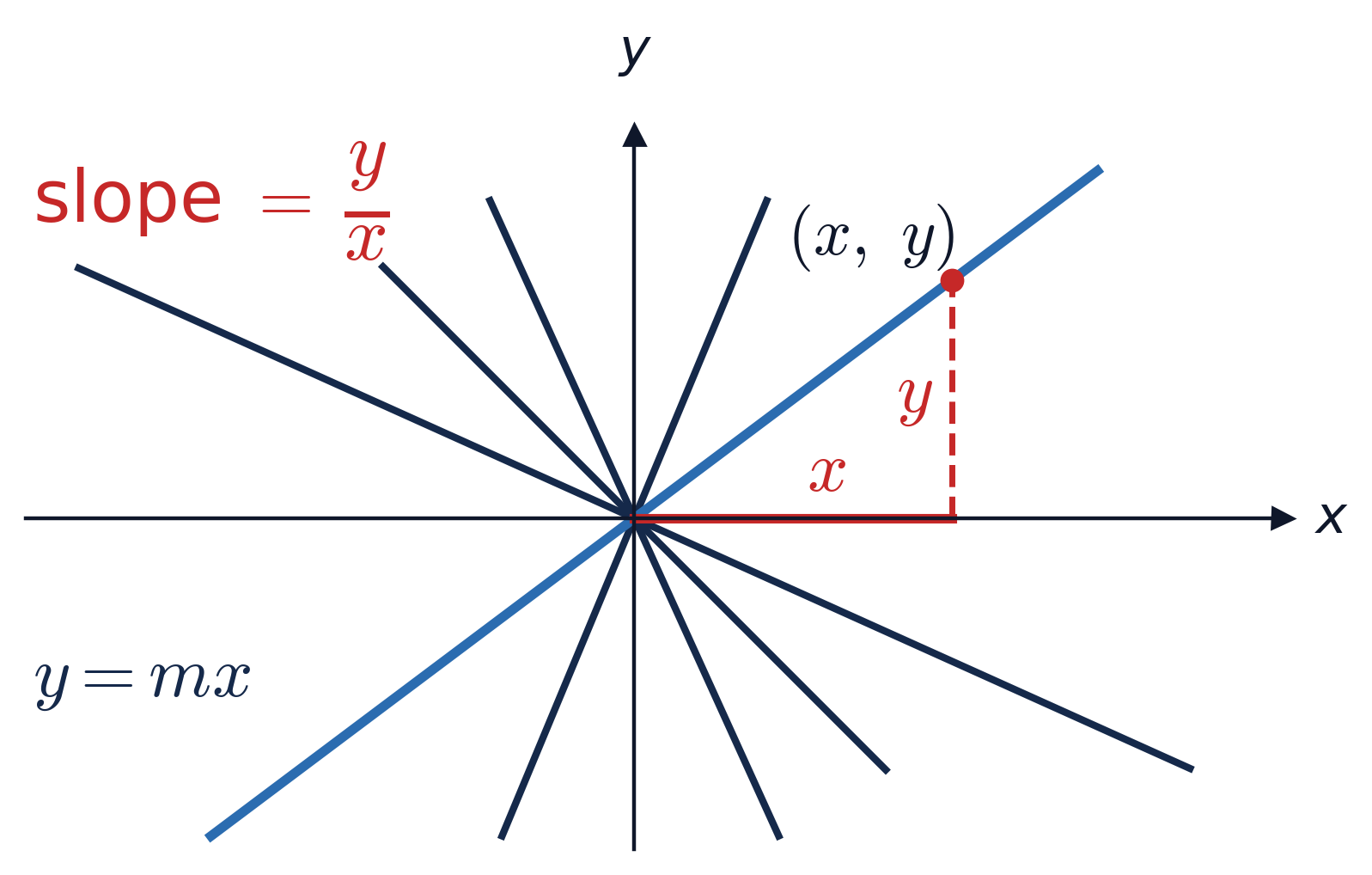
The picture says the same thing: at any point (x, y) on any of these lines, the slope is \dfrac{y}{x}.
Two constants. Take y = A\cos x + B\sin x. Differentiate twice: y' = -A\sin x + B\cos x and y'' = -A\cos x - B\sin x = -y. So \dfrac{d^2y}{dx^2} + y = 0.
| Family | Constants | Differential equation |
|---|---|---|
| y = mx (lines through the origin) | 1 | x\dfrac{dy}{dx} = y |
| x^2 + y^2 = r^2 (circles with centre at the origin) | 1 | x + y\dfrac{dy}{dx} = 0 |
| y = Ae^{kx}, with k a fixed number | 1 | \dfrac{dy}{dx} = ky |
| y = mx + c (all straight lines) | 2 | \dfrac{d^2y}{dx^2} = 0 |
| y = A\cos kx + B\sin kx, with k a fixed number | 2 | \dfrac{d^2y}{dx^2} + k^2 y = 0 |
| y = Ae^x + Be^{-x} | 2 | \dfrac{d^2y}{dx^2} - y = 0 |
Count the constants with care. y = a\,e^{x + b} looks as if it has two constants, but a\,e^{x+b} = (a\,e^b)\,e^x, and a\,e^b is one constant. So the family has one constant and its equation, \dfrac{dy}{dx} = y, has order 1.
6. Worked examples
Example 1. Find the order and degree of \left(\dfrac{d^3y}{dx^3}\right)^2 + 5\left(\dfrac{d^2y}{dx^2}\right)^4 = e^x.
The highest derivative is \dfrac{d^3y}{dx^3}, so the order is 3. Its power is 2, so the degree is 2. The power 4 is on a lower derivative.
Example 2. Find the order and degree of \left[1 + \left(\dfrac{dy}{dx}\right)^2\right]^{3/2} = 5\,\dfrac{d^2y}{dx^2}.
Remove the fractional power by squaring both sides: \left[1 + \left(\dfrac{dy}{dx}\right)^2\right]^3 = 25\left(\dfrac{d^2y}{dx^2}\right)^2. The highest derivative is the second, and its power is 2. Order 2, degree 2.
Example 3. Show that y = e^{2x} is a solution of \dfrac{d^2y}{dx^2} - 3\dfrac{dy}{dx} + 2y = 0.
y' = 2e^{2x} and y'' = 4e^{2x}. So y'' - 3y' + 2y = 4e^{2x} - 6e^{2x} + 2e^{2x} = 0. The equation is satisfied.
Example 4. Form the differential equation of the family y = ax^2.
One constant, so differentiate once: \dfrac{dy}{dx} = 2ax, which gives a = \dfrac{1}{2x}\dfrac{dy}{dx}. Put this into y = ax^2: y = \dfrac{x}{2}\dfrac{dy}{dx}, that is x\dfrac{dy}{dx} = 2y.
Example 5. Form the differential equation of the family y = A\cos 2x + B\sin 2x.
Two constants, so differentiate twice. y' = -2A\sin 2x + 2B\cos 2x and y'' = -4A\cos 2x - 4B\sin 2x = -4y. So \dfrac{d^2y}{dx^2} + 4y = 0.
7. From the real papers
Try each question for one minute before reading the solution.
NDA II 2023, Q69. What are the order and the degree respectively of the differential equation x^2\left(\frac{d^3y}{dx^3}\right)^2 + \left(\frac{dy}{dx}\right)^4 + \sin x = 0?
(a) 3, 4 (b) 1, 4 (c) 2, 2 (d) 3, 2
Solution. The highest derivative is \dfrac{d^3y}{dx^3}, so the order is 3. Its power is 2, so the degree is 2. The power 4 is on the lower derivative \dfrac{dy}{dx}, and \sin x contains no derivative. Answer (d).
NDA II 2025, Q91. What is the degree of the differential equation \left(\frac{d^2y}{dx^2}\right)^{\frac{3}{2}} = \left(\frac{dy}{dx}\right)^{\frac{5}{2}}?
(a) 3 (b) 2 (c) \frac{5}{2} (d) \frac{3}{2}
Solution. Square both sides to remove the fractional powers: \left(\dfrac{d^2y}{dx^2}\right)^3 = \left(\dfrac{dy}{dx}\right)^5. The highest derivative is the second, and its power is 3. Answer (a).
NDA I 2024, Q75. What are the order and degree respectively of the differential equation \left\{2 - \left(\frac{dy}{dx}\right)^2\right\}^{0.6} = \frac{d^2y}{dx^2}?
(a) 2, 2 (b) 2, 3 (c) 5, 2 (d) 2, 5
Solution. The highest derivative is the second, so the order is 2. Since 0.6 = \dfrac{3}{5}, raise both sides to the power 5: \left\{2 - \left(\dfrac{dy}{dx}\right)^2\right\}^3 = \left(\dfrac{d^2y}{dx^2}\right)^5. The power of the highest derivative is now 5. Order 2, degree 5. Answer (d).
NDA II 2026, Q79. What is the differential equation of the family of straight lines passing through the origin?
(a) y\frac{dy}{dx} - x = 0 (b) y\frac{dy}{dx} + x = 0 (c) x\frac{dy}{dx} - y = 0 (d) x\frac{dy}{dx} + y = 0
Solution. The lines are y = mx, with one constant m. Differentiate: \dfrac{dy}{dx} = m. Put back: y = x\dfrac{dy}{dx}, that is x\dfrac{dy}{dx} - y = 0. Answer (c).
NDA II 2023, Q70. What is the differential equation of all parabolas of the type y^2 = 4a(x - b)?
(a) \frac{d^2y}{dx^2} + \left(\frac{dy}{dx}\right)^2 = 0 (b) \frac{d^2y}{dx^2} + x^2\left(\frac{dy}{dx}\right)^2 = 0 (c) y^2\frac{d^2y}{dx^2} + \left(\frac{dy}{dx}\right)^2 = 0 (d) y\frac{d^2y}{dx^2} + \left(\frac{dy}{dx}\right)^2 = 0
Solution. There are two constants, a and b, so differentiate twice. First: 2y\dfrac{dy}{dx} = 4a, so y\dfrac{dy}{dx} = 2a, and b is gone. Differentiate again by the product rule: y\dfrac{d^2y}{dx^2} + \dfrac{dy}{dx} \cdot \dfrac{dy}{dx} = 0, and a is gone. Answer (d).
NDA I 2024, Q72. The differential equation, representing the curve y = e^x(a\cos x + b\sin x) where a and b are arbitrary constants, is
(a) \frac{d^2y}{dx^2} + 2y = 0 (b) \frac{d^2y}{dx^2} + 2\frac{dy}{dx} + 2y = 0 (c) \frac{d^2y}{dx^2} - 2\frac{dy}{dx} + 2y = 0 (d) \frac{d^2y}{dx^2} + y = 0
Solution. Differentiate by the product rule: y' = e^x(a\cos x + b\sin x) + e^x(-a\sin x + b\cos x) = y + e^x(-a\sin x + b\cos x). So e^x(-a\sin x + b\cos x) = y' - y. Differentiate again:
y'' = y' + e^x(-a\sin x + b\cos x) + e^x(-a\cos x - b\sin x) = y' + (y' - y) - y = 2y' - 2y.
So y'' - 2y' + 2y = 0. Answer (c).
8. Mistakes that cost marks
- Taking the biggest power in the equation as the degree. The degree is the power of the highest-order derivative only. In NDA II 2023 Q69 the power 4 is on \dfrac{dy}{dx}, so it does not count; the degree is 2.
- Reading the degree before clearing roots and fractional powers. \left(\dfrac{d^2y}{dx^2}\right)^{3/2} does not give degree \dfrac{3}{2}. A degree is always a positive whole number. Clear the fraction first.
- Giving a degree when there is none. If a derivative sits inside \sin, \cos, \log or an exponential, the degree is not defined. The order still is.
- Leaving a constant in the answer, or counting the constants wrongly. The differential equation of a family must contain no arbitrary constant. And its order equals the number of constants that are really independent: y = a\,e^{x+b} has one, not two.
9. Quick check
Do these without help. Answers are at the end.
- Find the order and degree of \dfrac{d^3y}{dx^3} + 2\left(\dfrac{d^2y}{dx^2}\right)^4 + y = 0.
- Find the order and degree of \left(\dfrac{d^2y}{dx^2}\right)^{2/3} = 1 + \dfrac{dy}{dx}.
- Is y = e^x + 1 a solution of \dfrac{d^2y}{dx^2} - \dfrac{dy}{dx} = 0?
- Form the differential equation of the family y = cx^3.
- How many arbitrary constants does the general solution of \dfrac{d^3y}{dx^3} + \dfrac{dy}{dx} = 0 contain?
10. Read and watch more, free
| What | Where | Language |
|---|---|---|
| Textbook | NCERT Class 12 Mathematics, Chapter 9 Differential Equations · Hindi edition | English, Hindi |
| Self-study notes | NIOS Mathematics, Lesson 32 Differential Equations · Hindi edition | English, Hindi |
| Video, the whole topic for NDA | Defence Wallah: SHAKTI 2026 playlist (the video "Differential Equations", about 2 hours 40 minutes) | Hinglish |
| Video, every textbook problem | Magnet Brains: Class 12 Maths, Chapter 9 Differential Equations | Hinglish |
| Video, the whole topic in one lesson | NDA Vijay by Unacademy: Milestone Batch playlist (the video "Differential Equations in One Shot", about 2 hours 55 minutes) | Hinglish |
The videos were chosen from their titles, length and views; they have not yet been watched by a teacher.
Answers to the quick check
- Order 3, degree 1. The highest derivative is \dfrac{d^3y}{dx^3} and its power is 1.
- Order 2, degree 2. Cube both sides: \left(\dfrac{d^2y}{dx^2}\right)^2 = \left(1 + \dfrac{dy}{dx}\right)^3.
- Yes. y' = e^x and y'' = e^x, so y'' - y' = 0.
- \dfrac{dy}{dx} = 3cx^2, so c = \dfrac{1}{3x^2}\dfrac{dy}{dx}. Putting this into y = cx^3 gives x\dfrac{dy}{dx} = 3y.
- Three, because the order is 3.
Next chapter: Solving differential equations; growth and decay.