Why this chapter matters. This chapter drew 7 questions in the seven papers from NDA II 2023 to NDA II 2026. The usual question gives an integral that must be simplified first and then matched with a standard integral. Unit 6 as a whole drew 74 questions in those seven papers, about ten in each paper, and every one of them uses the table in section 3.
What you will be able to do
- Explain integration as the reverse of differentiation, and say why the answer carries "+\,c".
- Write the standard integrals of powers, trigonometric, exponential and hyperbolic functions from memory.
- Integrate a function of ax + b, and simplify an expression so that a standard integral applies.
- Check any answer, or any option in the exam, by differentiating it.
Before you start you should know: the derivatives of the standard functions and the chain rule (Chapter M5-6), and the identities 1 + \tan^2 x = \sec^2 x and 1 - \cos x = 2\sin^2 \dfrac{x}{2} (Chapters M3-2 and M3-4).
1. Integration undoes differentiation
Differentiation starts with a function and gives its rate of change. Integration goes the other way: it starts with the rate of change and finds the function.
We know that \dfrac{d}{dx}(x^3) = 3x^2. So we write
\int 3x^2\,dx = x^3 + c
and read it as "the integral of 3x^2 with respect to x is x^3 + c". The function being integrated, here 3x^2, is called the integrand. The answer is called an antiderivative or an indefinite integral.
Why "+\,c"? The derivatives of x^3, x^3 + 5 and x^3 - 2 are all 3x^2, because the derivative of a constant is zero. Going backwards, we cannot know which constant was there. So we write c for it and call it the constant of integration. Every indefinite integral ends in +\,c.
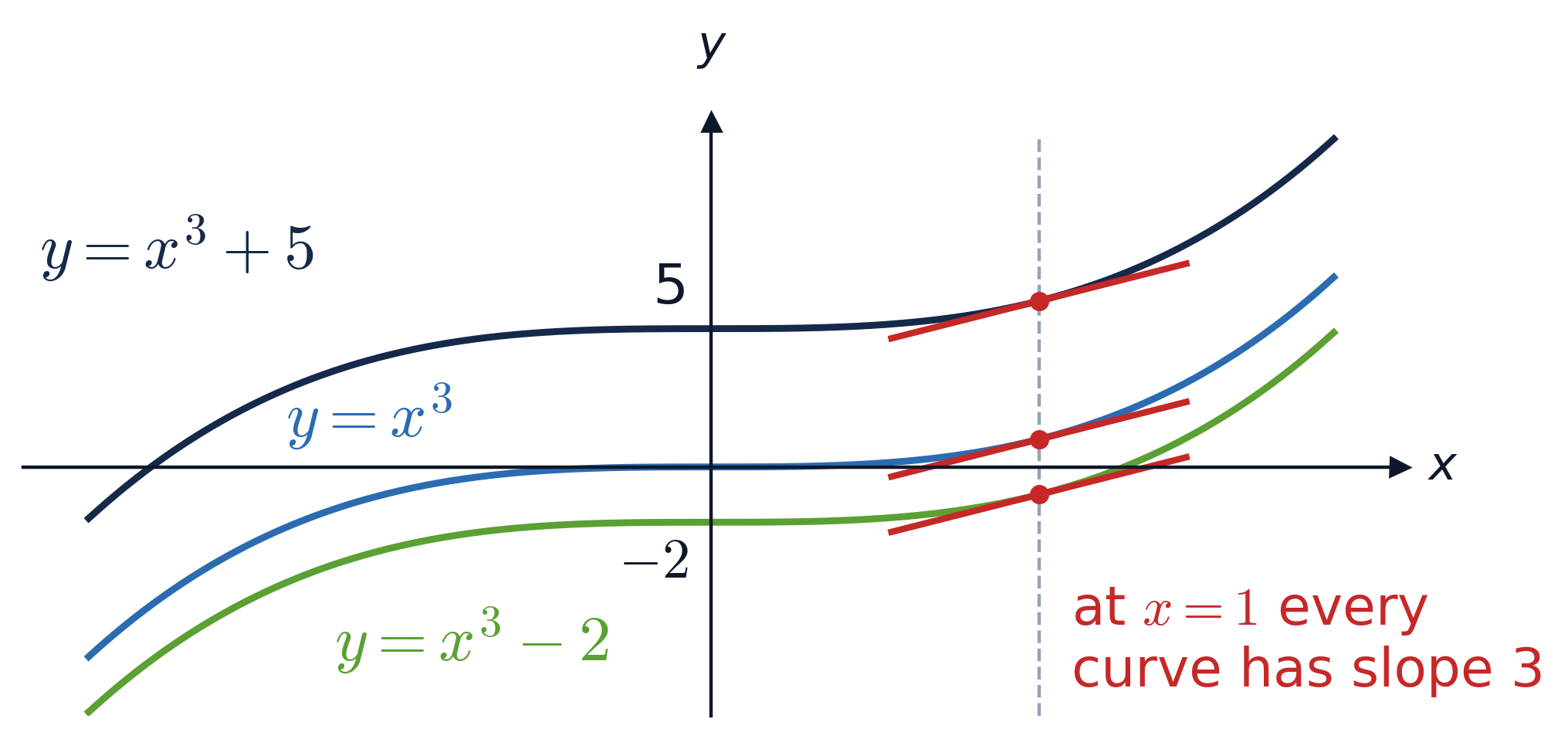
The picture shows the three curves. Each is the same curve moved up or down, so at every x they have the same slope.
In general: if \dfrac{d}{dx}F(x) = f(x), then \int f(x)\,dx = F(x) + c.
2. Two rules that always work
- A sum or difference is integrated term by term: \int [f(x) \pm g(x)]\,dx = \int f(x)\,dx \pm \int g(x)\,dx.
- A constant factor comes outside: \int k\,f(x)\,dx = k\int f(x)\,dx.
For example, \int (6x^2 + 4\cos x)\,dx = 6 \cdot \dfrac{x^3}{3} + 4\sin x + c = 2x^3 + 4\sin x + c.
There is no such rule for a product or a quotient. The integral of a product is not the product of the integrals. Products need the methods of the next chapter.
3. The standard integrals
Each line is a derivative formula read backwards. Learn the table by heart.
| Function | Its integral | Remember |
|---|---|---|
| x^n, where n \neq -1 | \dfrac{x^{n+1}}{n+1} + c | Raise the power by 1, then divide by the new power |
| \dfrac{1}{x} | \ln \lvert x \rvert + c | This is the case n = -1 |
| e^x | e^x + c | |
| a^x, where a > 0, a \neq 1 | \dfrac{a^x}{\ln a} + c | Divide by \ln a |
| \sin x | -\cos x + c | Minus sign |
| \cos x | \sin x + c | |
| \sec^2 x | \tan x + c | |
| \operatorname{cosec}^2 x | -\cot x + c | Minus sign |
| \sec x \tan x | \sec x + c | |
| \operatorname{cosec} x \cot x | -\operatorname{cosec} x + c | Minus sign |
| \dfrac{1}{\sqrt{1 - x^2}} | \sin^{-1} x + c | |
| \dfrac{1}{1 + x^2} | \tan^{-1} x + c | |
| \sinh x | \cosh x + c | No minus sign |
| \cosh x | \sinh x + c |
The power rule in use. \int x^4\,dx = \dfrac{x^5}{5} + c. \int \sqrt{x}\,dx = \int x^{1/2}\,dx = \dfrac{2}{3}x^{3/2} + c. \int \dfrac{1}{x^2}\,dx = \int x^{-2}\,dx = -\dfrac{1}{x} + c. \int 1\,dx = x + c.
The minus signs. When the answer is a "co" function (\cos, \cot or \operatorname{cosec}), it carries a minus sign.
The hyperbolic functions are defined by \sinh x = \dfrac{e^x - e^{-x}}{2} and \cosh x = \dfrac{e^x + e^{-x}}{2}. They behave like \sin and \cos, but neither integral has a minus sign.
4. When ax + b stands in place of x
If x is replaced by ax + b, integrate as usual and then divide by a:
\int f(ax + b)\,dx = \frac{1}{a}\,F(ax + b) + c
For example, \int \cos 3x\,dx = \dfrac{\sin 3x}{3} + c, \int e^{5x}\,dx = \dfrac{e^{5x}}{5} + c and \int (2x + 1)^4\,dx = \dfrac{(2x + 1)^5}{5 \times 2} + c = \dfrac{(2x+1)^5}{10} + c.
This works only when the inside is of the first degree. It does not work for \cos(x^2).
5. Simplify first, then integrate
Most exam integrals are not in the table as they stand. Change them into table forms first.
| If you see | Do this | Result |
|---|---|---|
| A bracket, or a fraction with one term below, such as \dfrac{x^2 + 1}{x} | Expand, or divide each term | \displaystyle\int \left(x + \frac{1}{x}\right) dx = \frac{x^2}{2} + \ln \lvert x \rvert + c |
| \tan^2 x or \cot^2 x | Use \tan^2 x = \sec^2 x - 1 and \cot^2 x = \operatorname{cosec}^2 x - 1 | \displaystyle\int \tan^2 x\,dx = \tan x - x + c |
| \sin^2 x or \cos^2 x | Use \sin^2 x = \dfrac{1 - \cos 2x}{2} and \cos^2 x = \dfrac{1 + \cos 2x}{2} | \displaystyle\int \sin^2 x\,dx = \frac{x}{2} - \frac{\sin 2x}{4} + c |
| 1 + \cos x or 1 - \cos x below | Use 1 + \cos x = 2\cos^2 \dfrac{x}{2} and 1 - \cos x = 2\sin^2 \dfrac{x}{2} | \displaystyle\int \frac{dx}{1 + \cos x} = \tan \frac{x}{2} + c |
| A difference of two square roots below | Rationalise: multiply above and below by the sum of the roots | See NDA I 2024 Q95 in section 8 |
6. Check by differentiating
Differentiate your answer. You must get the integrand back. For example, \dfrac{d}{dx}(\tan x - x) = \sec^2 x - 1 = \tan^2 x, so the second line of the table above is right.
In the exam this is also a method of solving. When the four options are functions, differentiate the options and see which one gives the integrand.
7. Worked examples
Example 1. Find \int (3x^2 - 4x + 5)\,dx.
Integrate term by term: 3 \cdot \dfrac{x^3}{3} - 4 \cdot \dfrac{x^2}{2} + 5x + c = x^3 - 2x^2 + 5x + c.
Example 2. Find \int \left(\sqrt{x} + \dfrac{1}{x^2}\right) dx.
Write both terms as powers: \int (x^{1/2} + x^{-2})\,dx = \dfrac{x^{3/2}}{3/2} + \dfrac{x^{-1}}{-1} + c = \dfrac{2}{3}x^{3/2} - \dfrac{1}{x} + c.
Example 3. Find \int \dfrac{(x + 1)^2}{x}\,dx.
Expand and divide: \dfrac{x^2 + 2x + 1}{x} = x + 2 + \dfrac{1}{x}. So the integral is \dfrac{x^2}{2} + 2x + \ln|x| + c.
Example 4. Find \int \left(2\sin x + 3e^x - \dfrac{4}{x}\right) dx.
Term by term: -2\cos x + 3e^x - 4\ln|x| + c.
Example 5. A function has f'(x) = 6x^2 - 2 and f(1) = 5. Find f(x).
Integrate: f(x) = 2x^3 - 2x + c. Use the given value: f(1) = 2 - 2 + c = 5, so c = 5. Hence f(x) = 2x^3 - 2x + 5.
Here the extra fact f(1) = 5 fixes the constant. Without such a fact, c stays in the answer.
8. From the real papers
Try each question for 75 seconds before reading the solution.
NDA I 2025, Q82. Let the function y = (1 - \cos x)^{-1}, where x \neq 2n\pi and n is an integer. What is \int y\,dx equal to? where c is the constant of integration.
(a) -\tan(x/2) + c (b) -\cot(x/2) + c (c) \tan(x/2) + c (d) \cot(x/2) + c
Solution. Use 1 - \cos x = 2\sin^2 \dfrac{x}{2}. Then y = \dfrac{1}{2}\operatorname{cosec}^2 \dfrac{x}{2}. The integral of \operatorname{cosec}^2 is -\cot, and the inside is \dfrac{x}{2}, so we divide by \dfrac{1}{2}: \int y\,dx = \dfrac{1}{2} \times 2 \times \left(-\cot \dfrac{x}{2}\right) + c = -\cot \dfrac{x}{2} + c. Answer (b).
NDA II 2026, Q73. What is \int e^{x\ln 10}e^x\,dx equal to?
(a) \frac{(10e)^x}{1 + \ln 10} + c (b) \frac{10e^x}{1 + \ln 10} + c (c) \frac{e^{2x}}{2} + c (d) \frac{e^{2x}}{4} + c
Solution. Since e^{\ln 10} = 10, we have e^{x \ln 10} = 10^x. The integrand is 10^x e^x = (10e)^x, which is of the form a^x with a = 10e. So the integral is \dfrac{(10e)^x}{\ln(10e)} + c, and \ln(10e) = \ln 10 + \ln e = \ln 10 + 1. Answer (a).
NDA I 2024, Q95 and Q96. Consider the following for the next two (02) items that follow: Let \int \frac{dx}{\sqrt{x+1} - \sqrt{x-1}} = \alpha(x+1)^{\frac{3}{2}} + \beta(x-1)^{\frac{3}{2}} + c
Q95. What is the value of \alpha?
(a) \frac{1}{3} (b) \frac{2}{3} (c) 1 (d) \frac{4}{3}
Q96. What is the value of \beta?
(a) -\frac{2}{3} (b) -\frac{1}{3} (c) \frac{1}{3} (d) \frac{2}{3}
Solution. Rationalise. Multiply above and below by \sqrt{x+1} + \sqrt{x-1}. The denominator becomes (x + 1) - (x - 1) = 2. So the integral is
\frac{1}{2}\int \left(\sqrt{x+1} + \sqrt{x-1}\right) dx = \frac{1}{2} \cdot \frac{2}{3}\left[(x+1)^{3/2} + (x-1)^{3/2}\right] + c
Each term used the power rule with ax + b in place of x (here a = 1). So \alpha = \dfrac{1}{3} and \beta = \dfrac{1}{3}. Answer (a) for Q95 and Answer (c) for Q96.
NDA II 2025, Q86. Let u = \int e^x\cos x\,dx and v = \int e^x\sin x\,dx. Consider the following: I. \frac{du}{dx} = -v II. \frac{dv}{dx} = -u Which of the above is/are correct?
(a) I only (b) II only (c) Both I and II (d) Neither I nor II
Solution. Differentiation undoes integration, so \dfrac{du}{dx} = e^x \cos x and \dfrac{dv}{dx} = e^x \sin x. Statement I then says v = -e^x \cos x. Test it by differentiating: \dfrac{d}{dx}(-e^x\cos x) = -e^x\cos x + e^x \sin x, which is not e^x \sin x. So I is wrong. Statement II says u = -e^x \sin x. Its derivative is -e^x \sin x - e^x \cos x, which is not e^x\cos x. So II is wrong. Answer (d).
Notice the pattern: every one of these needed one step of simplifying or checking, then one line of the table.
9. Mistakes that cost marks
- Leaving out +\,c. An indefinite integral without the constant is incomplete. In the exam, an option without c is often there as a trap.
- Using the power rule on \dfrac{1}{x}. The rule would give \dfrac{x^0}{0}, which has no meaning. The right answer is \int \dfrac{1}{x}\,dx = \ln|x| + c.
- Integrating a product factor by factor. \int x \cdot x\,dx is \int x^2\,dx = \dfrac{x^3}{3} + c. It is not \dfrac{x^2}{2} \cdot \dfrac{x^2}{2}. Multiply out first, or use the methods of the next chapter.
- Mixing up the signs and the factor a. \int \sin x\,dx = -\cos x + c, but \dfrac{d}{dx}\sin x = +\cos x. And \int \cos 3x\,dx = \dfrac{\sin 3x}{3} + c: in integration you divide by 3, in differentiation you multiply by 3.
10. Quick check
Do these without help. Answers are at the end.
- Find \int (4x^3 + 2x)\,dx.
- Find \int \dfrac{1}{x^3}\,dx.
- Find \int (e^{3x} + \sec^2 x)\,dx.
- Find \int \cot^2 x\,dx.
- A function has f'(x) = 2x + 3 and f(0) = 1. Find f(2).
11. Read and watch more, free
| What | Where | Language |
|---|---|---|
| Textbook | NCERT Class 12 Mathematics, Chapter 7 Integrals · Hindi edition | English, Hindi |
| Self-study notes | NIOS Mathematics, Lesson 30 Integration · Hindi edition | English, Hindi |
| Video, the whole topic for NDA | Defence Wallah: SHAKTI 2026 playlist (the video "Indefinite Integrals", about 3 hours 50 minutes) | Hinglish |
| Video, every textbook problem | Magnet Brains: Class 12 Maths, Chapter 7 Integrals | Hinglish |
| Video, short lessons | Khan Academy India: कक्षा 12 गणित (the lessons on समाकलन) | Hindi |
The videos were chosen from their titles, length and views; they have not yet been watched by a teacher.
Answers to the quick check
- x^4 + x^2 + c.
- \int x^{-3}\,dx = \dfrac{x^{-2}}{-2} + c = -\dfrac{1}{2x^2} + c.
- \dfrac{e^{3x}}{3} + \tan x + c.
- \int (\operatorname{cosec}^2 x - 1)\,dx = -\cot x - x + c.
- f(x) = x^2 + 3x + c and f(0) = 1 gives c = 1. So f(2) = 4 + 6 + 1 = 11.
Next chapter: Integration by substitution and by parts.