Why this lesson matters. This chapter drew 20 questions in the seven papers from NDA II 2023 to NDA II 2026, and at least two in every paper. The exam asks where a function has a local maximum or minimum, what the greatest or least value of an expression is, and which of two or three statements about f' and f'' are correct. Several of these need no calculus at all, only the fact that a square is never negative. Six real questions are solved in section 9.
What you will be able to do
- Find the local maxima and minima of a function with the first or the second derivative test.
- Find the greatest and least values of a function on a closed interval.
- Find a maximum or minimum without calculus, where a shorter way exists.
- Turn a word problem into a function of one variable and find its maximum or minimum.
Before you start you should know: the rules of differentiation and second order derivatives (Chapter M5-6), and the sign line for f'(x) (Chapter M5-7).
1. Local maximum and local minimum
A function has a local maximum at x = c if f(c) is greater than the values at all nearby points. It has a local minimum at x = c if f(c) is less than the values at all nearby points.
On the graph: a local maximum is a hill top and a local minimum is a valley bottom. A graph can have several hills and valleys, so a local maximum need not be the greatest value of the function.
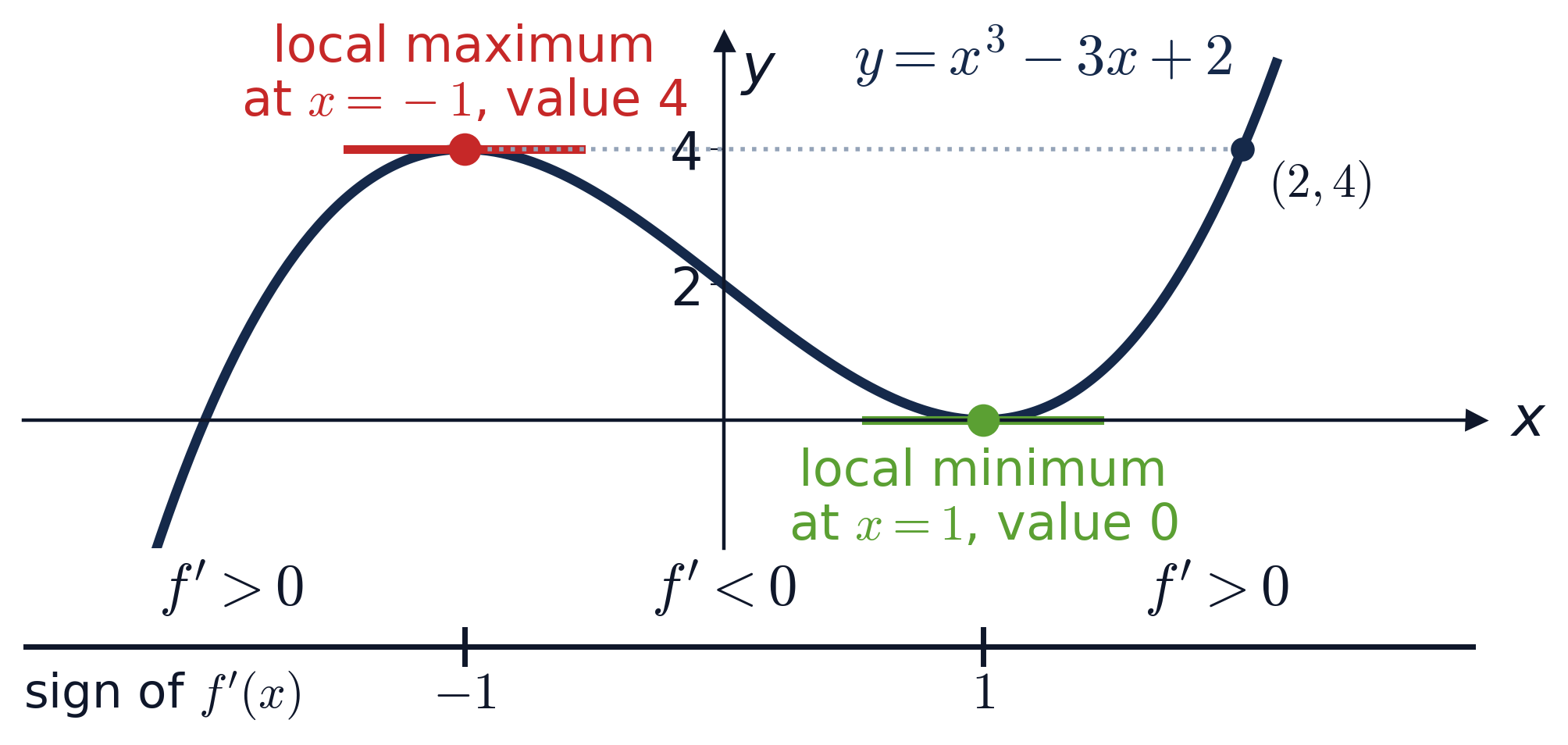
This curve is worked out in Example 1.
Keep two things apart:
- the point of maximum is the value of x, here c;
- the maximum value is the value of the function there, f(c).
Read the question to see which one is asked.
2. Where to look: critical points
At a hill top or a valley bottom of a smooth curve the tangent is flat. So at a local maximum or minimum of a differentiable function,
f'(c) = 0
The points where f'(x) = 0, or where f'(x) does not exist, are called critical points. A maximum or minimum inside an interval can occur only at a critical point. But not every critical point is a maximum or a minimum, so each one must be tested.
A corner can also be a maximum or minimum: |x| has its minimum at x = 0, where it has no derivative.
3. The first derivative test
Look at the sign of f'(x) just to the left and just to the right of the critical point c.
| Sign of f'(x) as x increases through c | At x = c there is |
|---|---|
| Changes from + to - (up, then down) | a local maximum |
| Changes from - to + (down, then up) | a local minimum |
| Does not change | neither |
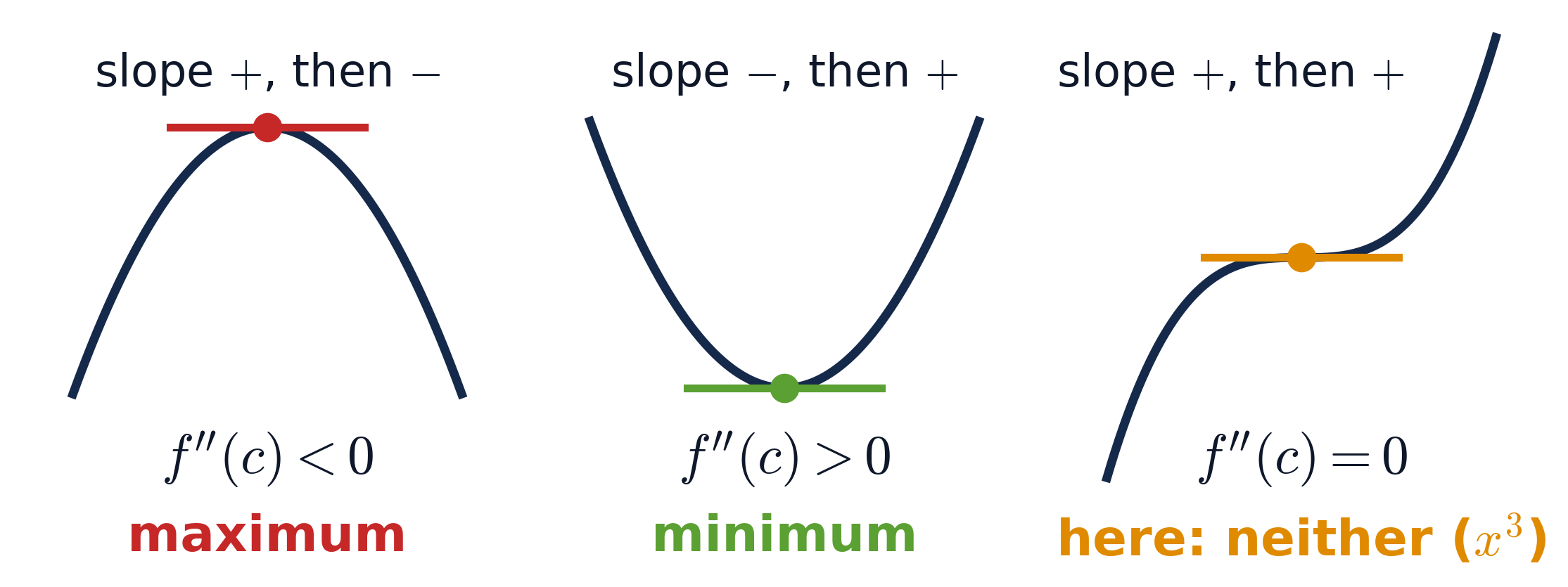
The standard example of "neither" is f(x) = x^3 at x = 0: f'(0) = 0, but f'(x) = 3x^2 is positive on both sides.
4. The second derivative test
This test is usually faster. Let f'(c) = 0.
| If | Then at x = c there is |
|---|---|
| f''(c) < 0 | a local maximum |
| f''(c) > 0 | a local minimum |
| f''(c) = 0 | no conclusion: use the first derivative test |
To remember it: at a hill top the slope is going from positive to negative, so the slope is decreasing and f'' is negative.
5. Greatest and least values on a closed interval
A continuous function on a closed interval [a, b] always has a greatest value and a least value. Each occurs either at a critical point inside the interval or at an end point. So:
- Find the critical points in (a, b).
- Work out f at each critical point and at the two end points a and b.
- The biggest of these numbers is the greatest value. The smallest is the least value.
No second derivative is needed here.
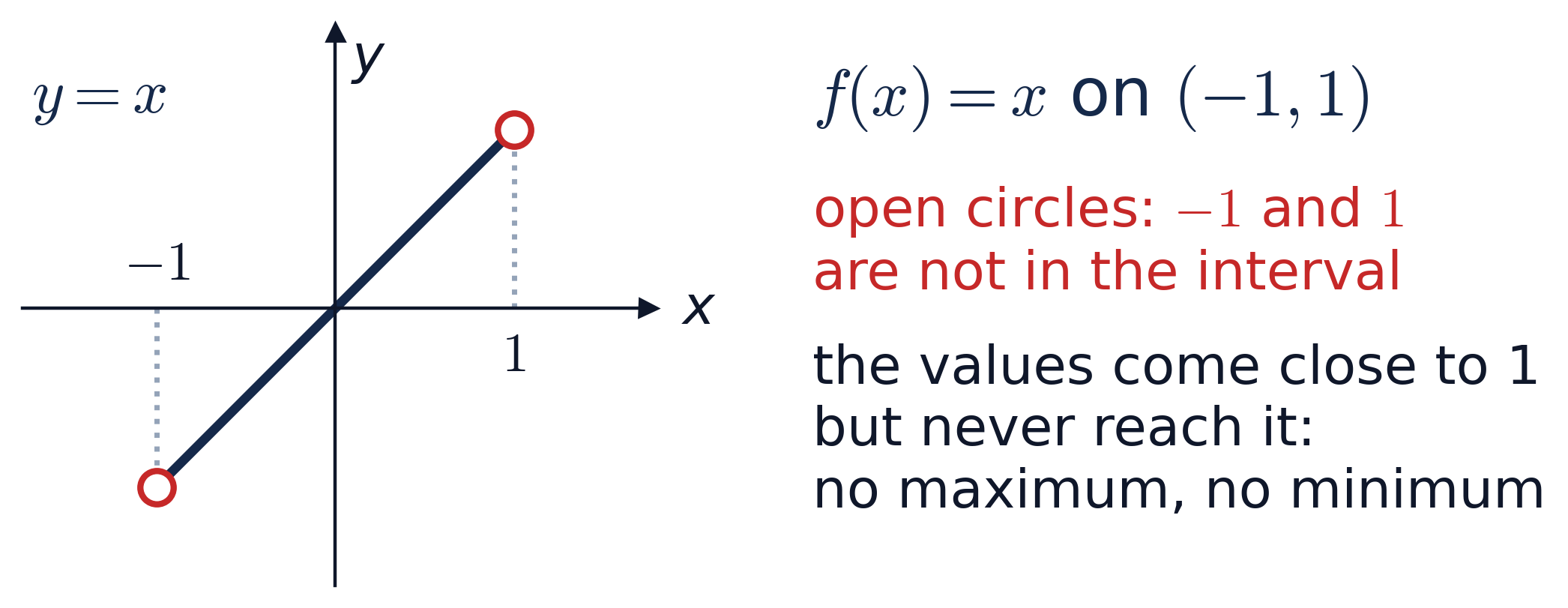
On an open interval a function may have no greatest or least value. For f(x) = x on (-1, 1) the values come as close to 1 as we like but never reach it.
6. Maxima and minima without calculus
Many exam questions are faster without differentiating.
| Tool | What it gives | Example |
|---|---|---|
| Complete the square | (x - h)^2 + k has least value k, at x = h | x^2 - 4x + 7 = (x - 2)^2 + 3: least value 3 |
| Sine and cosine together | a\sin x + b\cos x lies from -\sqrt{a^2 + b^2} to \sqrt{a^2 + b^2} | 3\sin x + 4\cos x: greatest value 5 |
| A square is never negative | (p - q)^2 \ge 0, so 2pq \le p^2 + q^2 | If p^2 + q^2 = 64, then pq \le 32 |
| Two positive numbers with a fixed sum | Their product is greatest when they are equal | Sum 20: greatest product 10 \times 10 = 100 |
| Two positive numbers with a fixed product | Their sum is least when they are equal | Product 36: least sum 6 + 6 = 12 |
7. Word problems in four steps
- Name the quantity to be made greatest or least, and write a formula for it.
- Use the condition in the question to write the formula in one variable.
- Differentiate, put the derivative equal to 0, and solve.
- Check that it is a maximum or a minimum (the sign of the second derivative is enough), and answer what was asked: the point or the value.
8. Worked examples
Example 1 (second derivative test). Find the local maximum and minimum values of f(x) = x^3 - 3x + 2.
f'(x) = 3x^2 - 3 = 3(x - 1)(x + 1), zero at x = -1 and x = 1. f''(x) = 6x.
At x = -1: f'' = -6 < 0, a local maximum. The value is f(-1) = -1 + 3 + 2 = 4.
At x = 1: f'' = 6 > 0, a local minimum. The value is f(1) = 1 - 3 + 2 = 0.
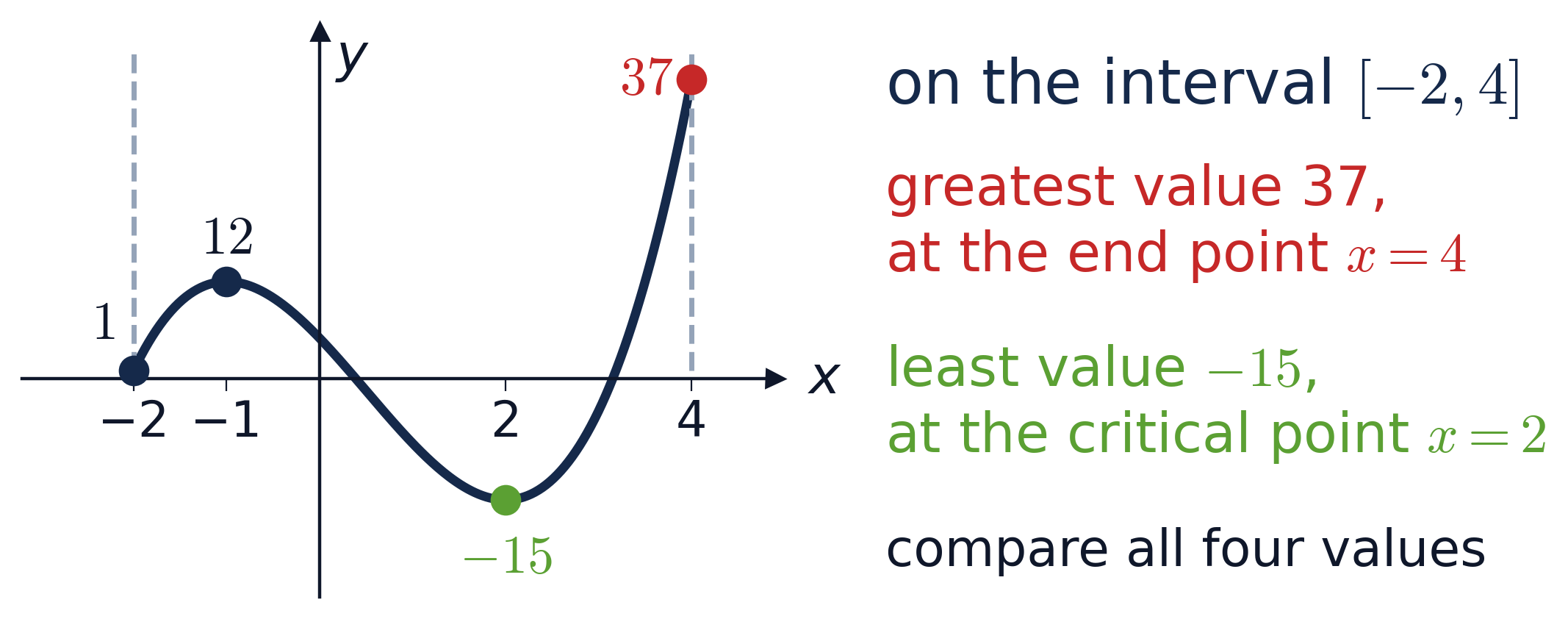
Example 2 (closed interval). Find the greatest and least values of f(x) = 2x^3 - 3x^2 - 12x + 5 on [-2, 4].
f'(x) = 6x^2 - 6x - 12 = 6(x - 2)(x + 1). The critical points are x = -1 and x = 2, both inside the interval.
| x | -2 | -1 | 2 | 4 |
|---|---|---|---|---|
| f(x) | 1 | 12 | -15 | 37 |
The greatest value is 37, at the end point x = 4. The least value is -15, at x = 2.
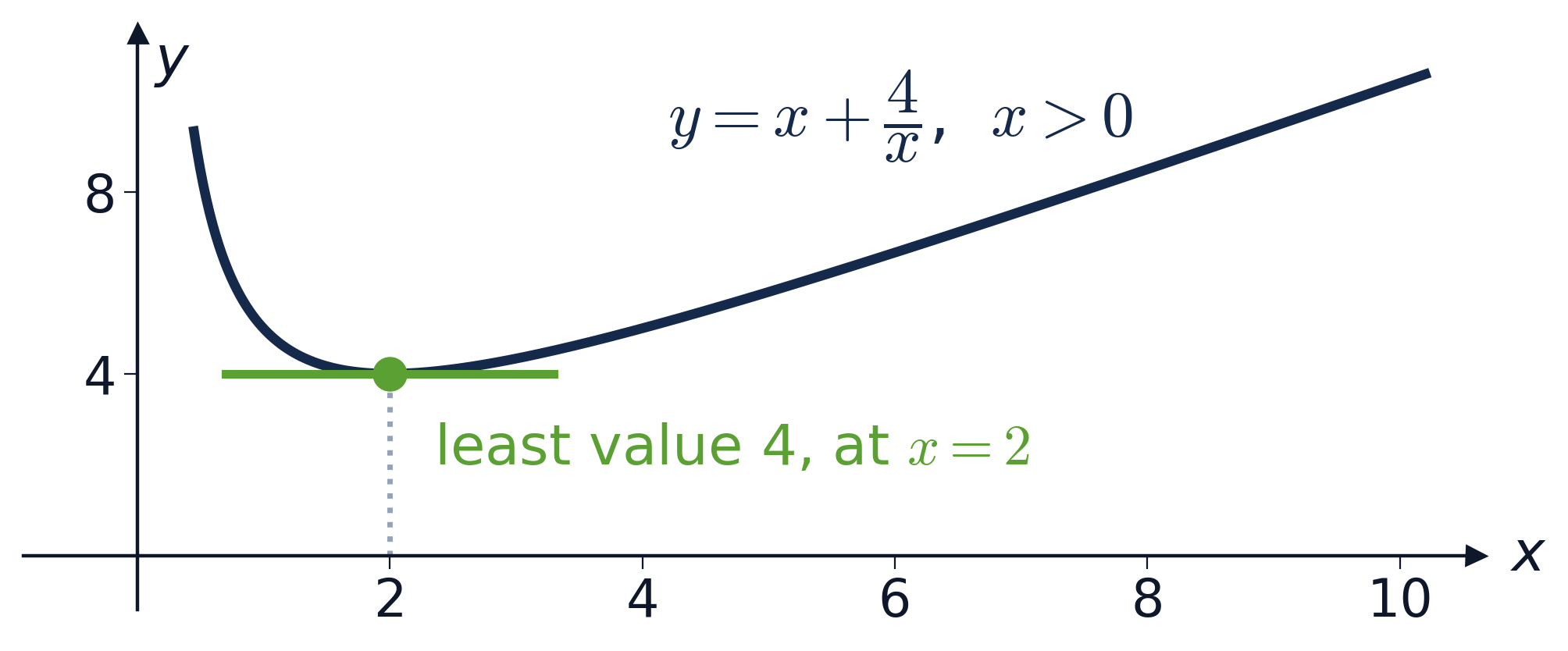
Example 3 (a fraction). Find the least value of f(x) = x + \dfrac{4}{x} for x > 0.
f'(x) = 1 - \dfrac{4}{x^2}, which is zero when x^2 = 4, so x = 2 (as x > 0). f''(x) = \dfrac{8}{x^3}, positive at x = 2: a minimum. The least value is f(2) = 2 + 2 = 4.
Without calculus: x and \dfrac{4}{x} are positive numbers with fixed product 4, so their sum is least when they are equal, x = 2.
Example 4 (word problem). The sum of two positive numbers is 20. Find the numbers if their product is as great as possible.
Let one number be x. The other is 20 - x, and the product is P = x(20 - x) = 20x - x^2.
\dfrac{dP}{dx} = 20 - 2x = 0 gives x = 10. \dfrac{d^2P}{dx^2} = -2 < 0, so it is a maximum.
The numbers are 10 and 10, and the greatest product is 100.
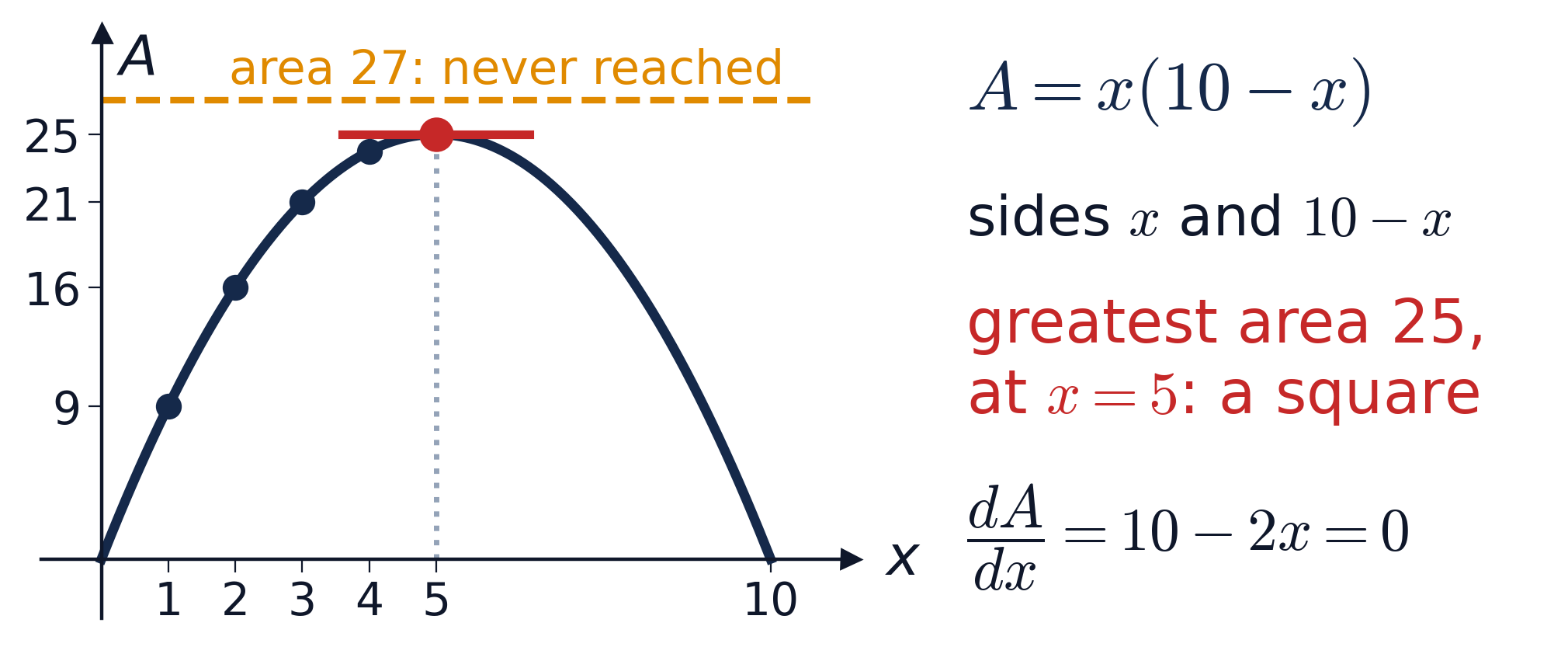
The same method answers a question on area. A wire of length 20 cm is bent into a rectangle with sides x and 10 - x. Its area is A = x(10 - x), and \dfrac{dA}{dx} = 10 - 2x = 0 gives x = 5. The largest rectangle is the square, with area 25 square cm.
Example 5 (no calculus). Find the greatest and least values of 3\sin x + 4\cos x.
\sqrt{3^2 + 4^2} = 5. The greatest value is 5 and the least value is -5.
9. From the real papers
These six questions are from the Mathematics papers of NDA & NAVAC from 2023 to 2026. Try each for 75 seconds before reading the solution.
NDA II 2023, Q48. Given that 4x^2 + y^2 = 9. What is the maximum value of xy?
(a) \frac{9}{4} (b) \frac{3}{2} (c) \frac{4}{9} (d) \frac{2}{3}
Solution. A square is never negative: (2x - y)^2 \ge 0 gives 4xy \le 4x^2 + y^2 = 9. So xy \le \dfrac{9}{4}, and this value is reached when y = 2x. Answer (a).
NDA I 2024, Q84. Let f(x) = \frac{x}{\ln x}; (x > 1) Consider the following statements : 1. f''(e) = \frac{1}{e} 2. f(x) attains local minimum value at x = e 3. A local minimum value of f(x) is e Which of the statements given above are correct?
(a) 1 and 2 only (b) 2 and 3 only (c) 1 and 3 only (d) 1, 2 and 3
Solution. f'(x) = \dfrac{\ln x - 1}{(\ln x)^2} = \dfrac{1}{\ln x} - \dfrac{1}{(\ln x)^2}, zero at x = e. Differentiate again: f''(x) = -\dfrac{1}{x(\ln x)^2} + \dfrac{2}{x(\ln x)^3}. At x = e, \ln e = 1, so f''(e) = -\dfrac{1}{e} + \dfrac{2}{e} = \dfrac{1}{e}: 1 is correct. Since f'(e) = 0 and f''(e) > 0, there is a local minimum at x = e: 2 is correct. Its value is f(e) = \dfrac{e}{1} = e: 3 is correct. Answer (d).
NDA I 2025, Q74. Let ABC be a triangle right-angled at B and AB + AC = 3 units. What is the maximum area of the triangle?
(a) \sqrt{3}/2 square unit (b) \sqrt{3} square units (c) \sqrt{6}/2 square units (d) \sqrt{6} square units
Solution. AC is the hypotenuse. Let AB = c, so AC = 3 - c and BC^2 = (3 - c)^2 - c^2 = 9 - 6c. The area is \dfrac{1}{2} \cdot AB \cdot BC, so its square is \dfrac{1}{4}c^2(9 - 6c) = \dfrac{1}{4}(9c^2 - 6c^3). The area is greatest when its square is greatest. The derivative of 9c^2 - 6c^3 is 18c - 18c^2, zero at c = 1, where it changes from positive to negative: a maximum. Then AB = 1, BC = \sqrt{3} and the area is \dfrac{\sqrt{3}}{2}. Answer (a).
NDA II 2025, Q100. Consider the following statements : Statement–I : The function f(x) = \frac{x^3 + 128}{x} has a minimum value 48 at x = 4. Statement–II : As x increases through 4, f'(x) changes sign from positive to negative. Which one of the following is correct in respect of the above statements?
(a) Both Statement–I and Statement–II are correct and Statement–II explains Statement–I (b) Both Statement–I and Statement–II are correct but Statement–II does not explain Statement–I (c) Statement–I is correct but Statement–II is not correct (d) Statement–I is not correct but Statement–II is correct
Solution. Write f(x) = x^2 + \dfrac{128}{x}. Then f'(x) = 2x - \dfrac{128}{x^2}, zero when x^3 = 64, so x = 4. f''(x) = 2 + \dfrac{256}{x^3} and f''(4) = 6 > 0: a local minimum, with value f(4) = 16 + 32 = 48. Statement I is correct. At a minimum f' changes from negative to positive, not from positive to negative, so Statement II is not correct. Answer (c).
NDA I 2026, Q75. Consider the following statements in respect of the function f(x) = x in the interval (-1, 1) : I. The function attains maximum value. II. The function attains minimum value. Which of the statements given above is/are correct?
(a) I only (b) II only (c) Both I and II (d) Neither I nor II
Solution. The interval is open, so -1 and 1 are not in it. The values of f(x) = x come as close to 1 as we like but never reach 1, so there is no maximum. In the same way there is no minimum. Answer (d).
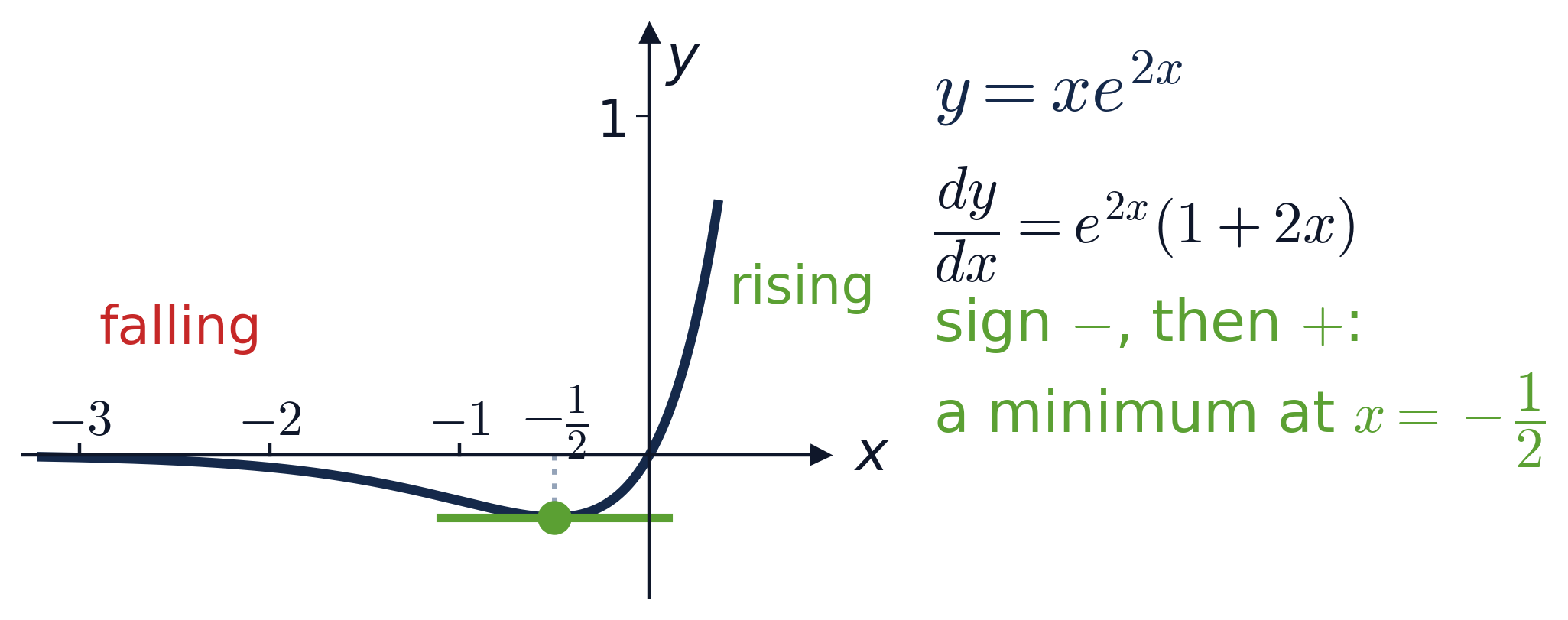
NDA II 2026, Q96. For the curve y = xe^{2x}
(a) minimum occurs at x = -2 (b) minimum occurs at x = -1 (c) minimum occurs at x = -1/2 (d) maximum occurs at x = -1/2
Solution. By the product rule \dfrac{dy}{dx} = e^{2x} + 2xe^{2x} = e^{2x}(1 + 2x). Since e^{2x} is never zero, the only critical point is x = -\dfrac{1}{2}. For x < -\dfrac{1}{2} the factor 1 + 2x is negative and for x > -\dfrac{1}{2} it is positive. The sign changes from - to +: a minimum. Answer (c).
10. Mistakes that cost marks
- Giving the point when the value is asked, or the value when the point is asked. In Example 1 the local maximum is at x = -1, and the maximum value is 4.
- Turning the second derivative test round. f''(c) < 0 means a maximum. f''(c) > 0 means a minimum.
- Forgetting the end points. On a closed interval the greatest or least value is often at an end point, as in Example 2.
- Taking every point with f'(c) = 0 as a maximum or minimum. x^3 has f'(0) = 0 and has neither at x = 0.
11. Quick check
Do these without help. Answers are at the end.
- Find the points of local maximum and local minimum of f(x) = x^3 - 12x, and the values there.
- Find the least value of x^2 - 8x + 20.
- Find the greatest value of 5\sin x + 12\cos x.
- Find the greatest and least values of f(x) = x^2 on [-3, 2].
- The sum of two positive numbers is 12. What is the greatest possible value of their product?
12. Read and watch more, free
| What | Where | Language |
|---|---|---|
| Textbook | NCERT Class 12 Mathematics, Chapter 6 Application of Derivatives · Hindi edition | English, Hindi |
| Self-study notes | NIOS Mathematics, Lesson 29 Application of Derivatives · Hindi edition | English, Hindi |
| Video, the chapter for NDA | Defence Wallah: Fast Track 2021 (the class named APPLICATIONS OF DERIVATIVES, about 1 hour 50 minutes) | Hinglish |
| Video, a longer class for NDA | NDA Vijay by Unacademy: Maths Free Milestone Batch (the class named Applications of Derivatives, about 4 hours 15 minutes) | Hinglish |
| Video, every textbook problem | Magnet Brains: Class 12 Maths complete course (the 37 videos of Chapter 6) | Hinglish |
| Past NDA questions | ExamSIDE: Application of Derivatives | English |
The videos were chosen from their titles, length and views; they have not yet been watched by a teacher.
Answers to the quick check
- f'(x) = 3(x - 2)(x + 2) and f''(x) = 6x. Local maximum at x = -2, value 16. Local minimum at x = 2, value -16.
- x^2 - 8x + 20 = (x - 4)^2 + 4. The least value is 4, at x = 4.
- \sqrt{5^2 + 12^2} = 13.
- The critical point is x = 0. f(-3) = 9, f(0) = 0, f(2) = 4. Greatest value 9, least value 0.
- The product is greatest when the numbers are equal: 6 \times 6 = 36.
Next chapter: Integration: the idea and standard integrals.