Why this lesson matters. This chapter drew 25 questions in the seven papers from NDA II 2023 to NDA II 2026, and at least one in every paper. The exam asks four kinds of question: find the domain, find the range, find f(x) from an equation such as 2f(x) + f(1 - x) = x, and work with the modulus |x| and the greatest integer [x]. Six real questions are solved in section 8.
What you will be able to do
- Say what a function is, and find its domain with three simple rules.
- Find the range of a function built from x^2, \sin x, \cos x or |x|.
- Use the modulus function and the greatest integer function, and describe their graphs.
- Find f(x) when it is given through an equation in f(x) and f\left(\frac{1}{x}\right).
Before you start you should know: sets and intervals (Chapter M1-1), relations (Chapter M1-2), and real numbers on the number line with the modulus |x| (Chapter M1-3).
1. What a function is
A function f is a rule that gives every allowed input x exactly one output f(x). If f(x) = x^2 + 1, then f(3) = 10 and f(-3) = 10. Two inputs may share one output. One input may never have two outputs.
- The domain is the set of all allowed inputs.
- The range is the set of all outputs that really occur.
- In f : A \to B, the set A is the domain and B is the codomain, the set in which the outputs must lie. The range is a part of the codomain.
For f(x) = x^2 + 1 the domain is all real numbers, written \mathbb{R}, and the range is [1, \infty).
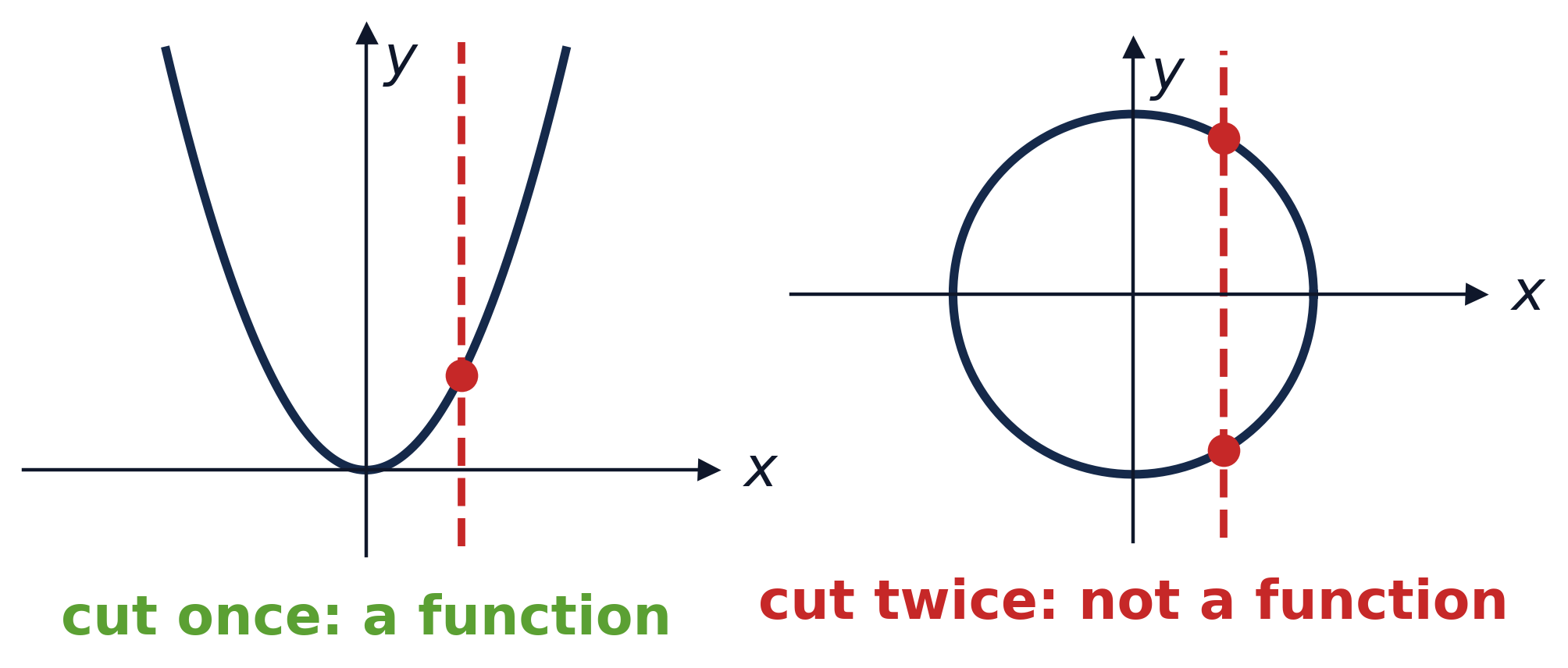
The graph of f is the set of points (x, f(x)). A curve is the graph of a function only if every vertical line cuts it at most once. A circle is not the graph of a function, because a vertical line through its centre cuts it twice.
Two rules that meet. If a function is given by one formula on 0 \le x \le 2 and another on 2 \le x \le 8, the two formulas must give the same value at x = 2. If they do not, the input 2 has two outputs and the rule is not a function.
2. The domain: three rules
Look for three things in the formula.
| The formula has | Condition on x | Example |
|---|---|---|
| A fraction | The denominator is not 0 | \dfrac{1}{x - 2}: all real x except 2 |
| A square root (or any even root) | The quantity under the root is \ge 0 | \sqrt{x - 3}: x \ge 3, that is [3, \infty) |
| A logarithm | The quantity whose log is taken is > 0. The base is positive and not 1 | \log(x - 1): x > 1, that is (1, \infty) |
If a square root is in the denominator, the quantity under it must be strictly positive: \dfrac{1}{\sqrt{x}} has domain (0, \infty).
If the formula has more than one of these, all the conditions must hold together. Polynomials, \sin x, \cos x, e^x, |x| and cube roots have no condition: their domain is \mathbb{R}.
3. The range
Start from a part whose range you know and build the function step by step.
| Function | Range |
|---|---|
| x^2 and \lvert x \rvert | [0, \infty) |
| \sin x and \cos x | [-1, 1] |
| \sin^2 x and \cos^2 x | [0, 1] |
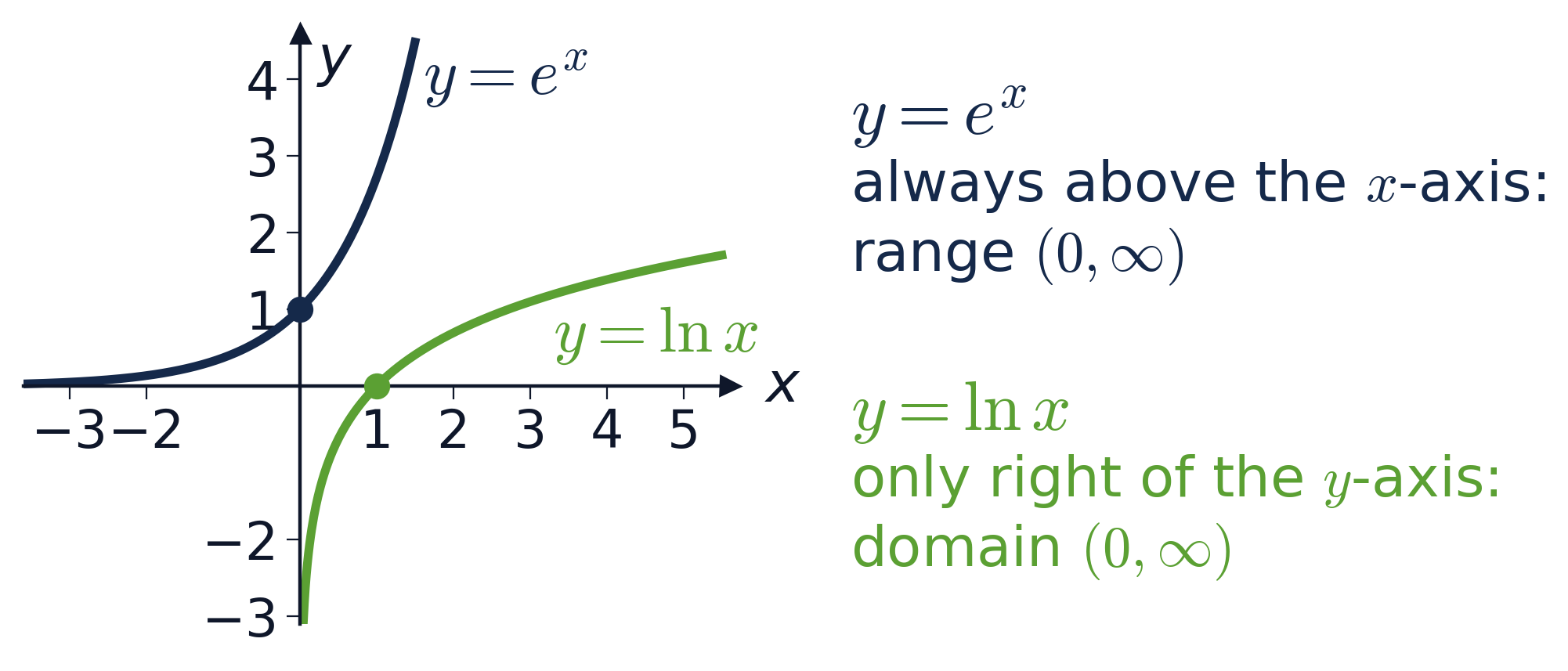
| e^x and a^x (with a > 0, a \ne 1) | (0, \infty) |
| \log x | \mathbb{R} |
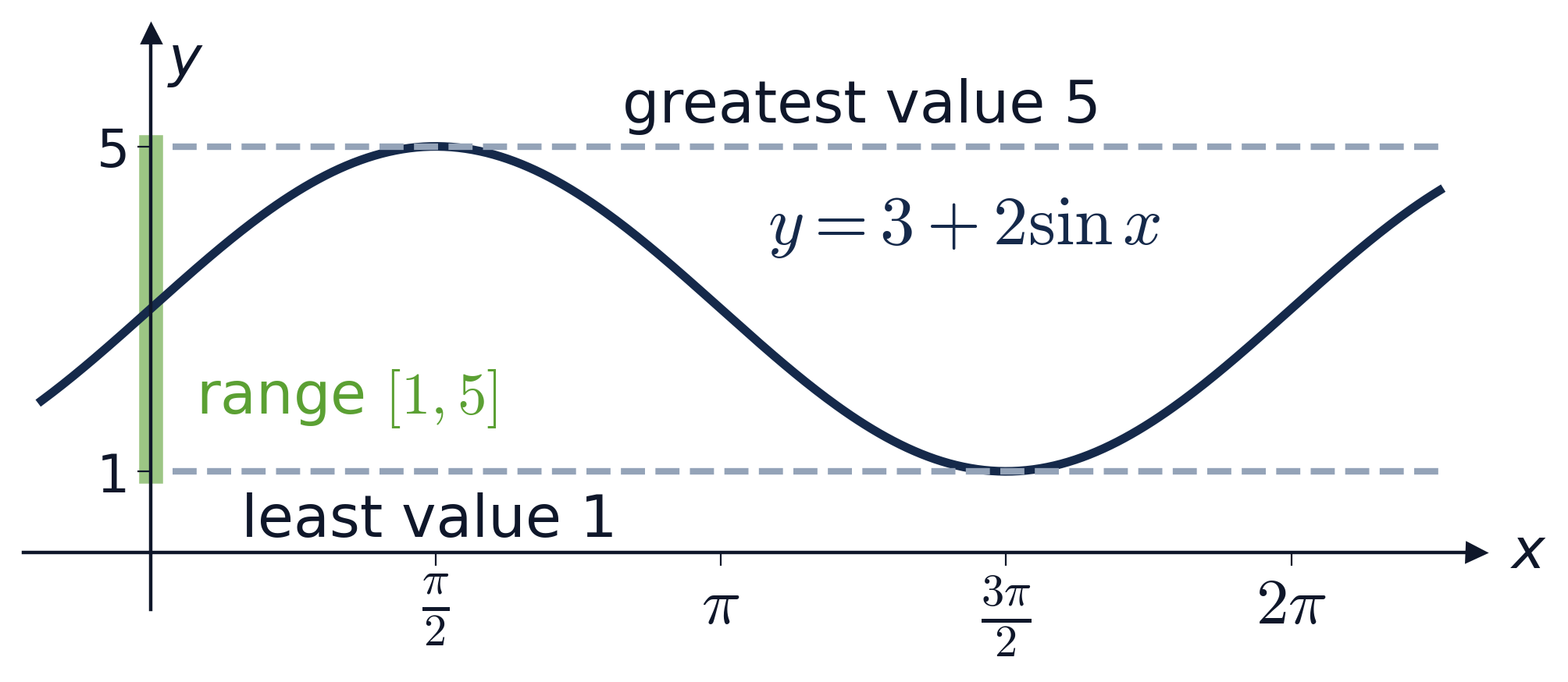
For example, take f(x) = 3 + 2\sin x. Since \sin x goes from -1 to 1, 2\sin x goes from -2 to 2, and 3 + 2\sin x goes from 1 to 5. The range is [1, 5].
For a quadratic, complete the square: x^2 - 4x + 7 = (x - 2)^2 + 3. A square is never negative, so the range is [3, \infty).
The graphs of e^x and \ln x show their domain and range:
4. Four graphs to know
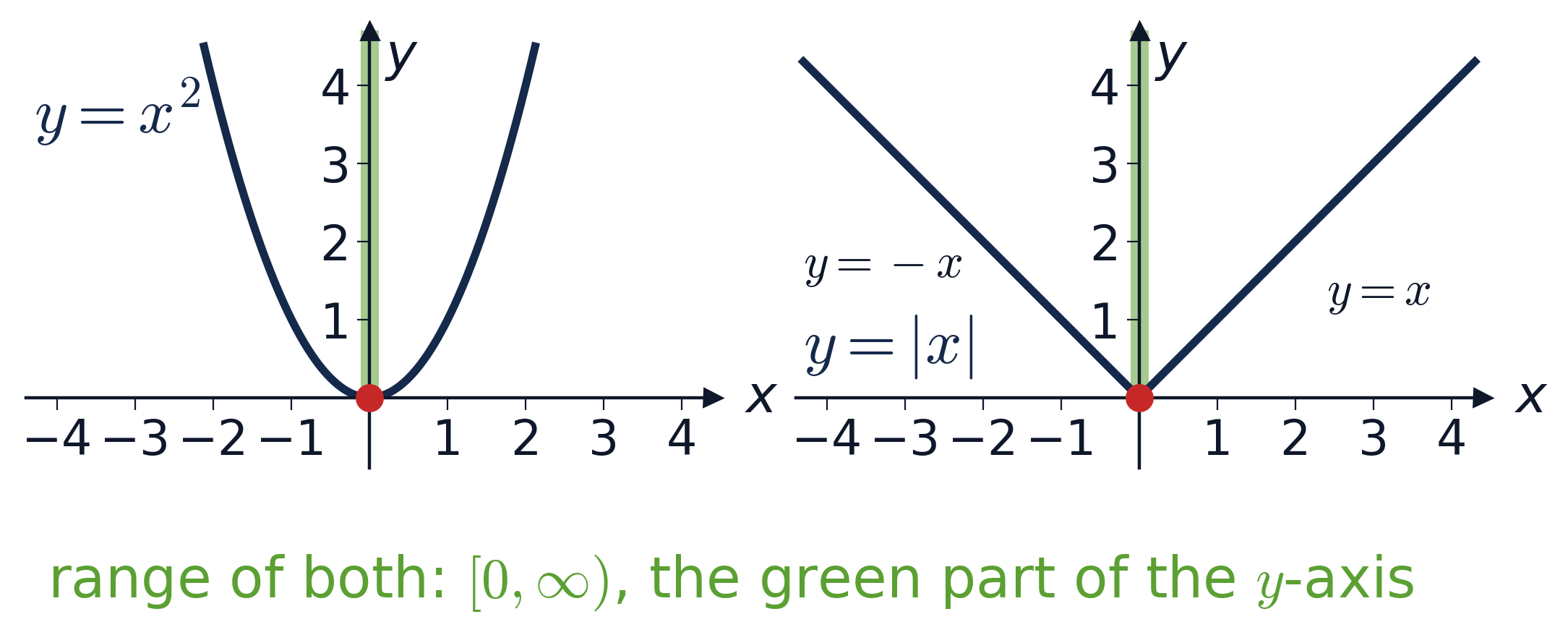
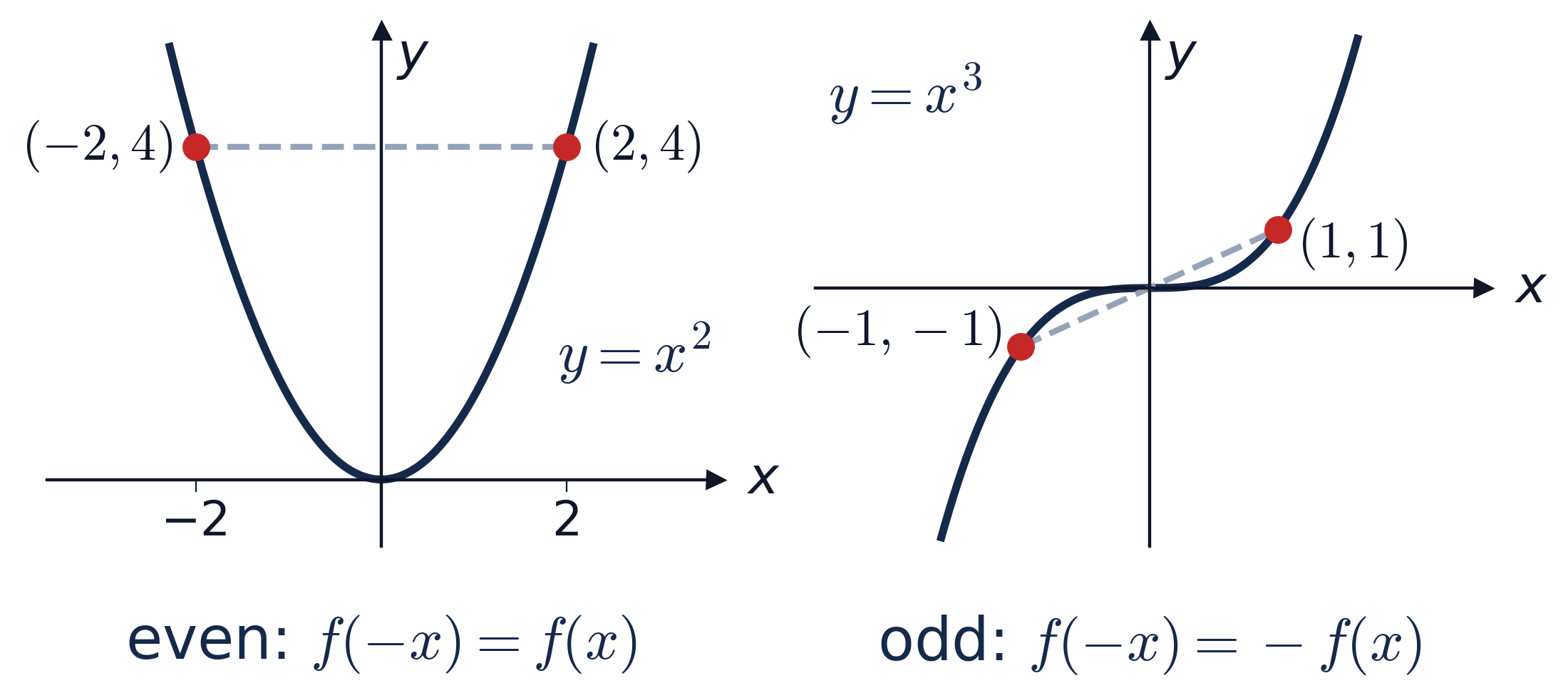
Draw each of these in your notebook. The pictures of three of them are below the table.
| Function | Rule | Its graph | Range |
|---|---|---|---|
| Identity | f(x) = x | A straight line through the origin, rising at 45° | \mathbb{R} |
| Square | f(x) = x^2 | A U-shaped curve with its lowest point at the origin | [0, \infty) |
| Modulus | \lvert x \rvert = x if x \ge 0, and -x if x < 0 | A V with its point at the origin | [0, \infty) |
| Greatest integer | [x] = the greatest integer that is not more than x | Flat steps of length 1. Each step includes its left end and not its right end | All integers |
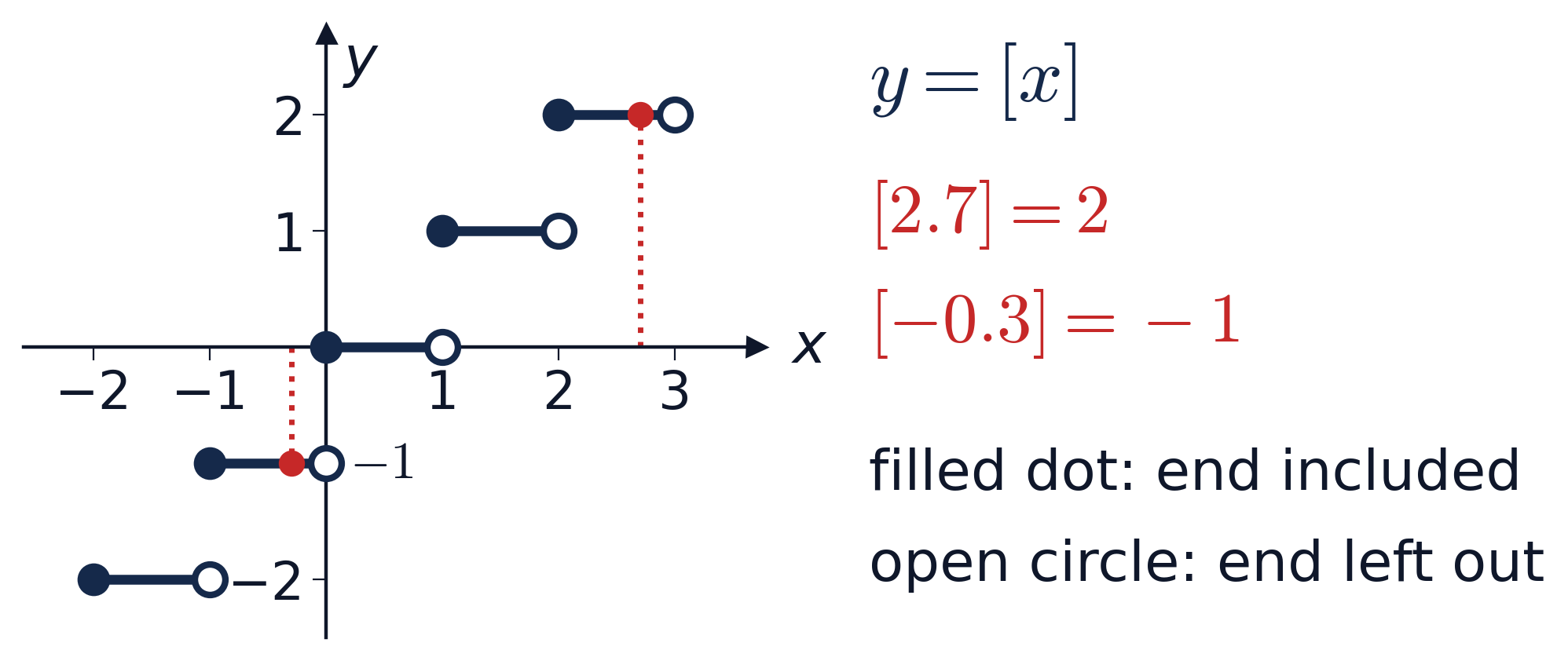
Learn the greatest integer function with numbers: [2.7] = 2, [5] = 5, [0.999] = 0, [-0.3] = -1 and [-3.9] = -4. For a negative number that is not an integer, go down to the next integer.
5. Even, odd and periodic functions
- Even: f(-x) = f(x) for every x. Examples: x^2, \cos x, |x|. The graph is its own mirror image in the y-axis.
- Odd: f(-x) = -f(x) for every x. Examples: x^3, \sin x, \tan x. The graph looks the same after a half turn about the origin.
- Periodic: f(x + T) = f(x) for every x. The smallest positive T is the period.
| Function | Period |
|---|---|
| \sin x, \cos x | 2\pi |
| \tan x | \pi |
| \sin^2 x, \cos^2 x, \lvert \sin x \rvert | \pi |
| \sin kx, \cos kx | \dfrac{2\pi}{\lvert k \rvert} |
Adding a constant to a function does not change its period.
6. Equations that a function satisfies
Some questions do not give the formula for f. They give an equation that f satisfies. Two methods answer almost all of them.
Method 1: swap. If the equation has f(x) and f\left(\frac{1}{x}\right), replace x by \frac{1}{x} everywhere. Now there are two equations in the two unknowns f(x) and f\left(\frac{1}{x}\right). Solve them like simultaneous equations. The same idea works for f(x) with f(1 - x), and for f(x) with f(-x).
Method 2: special values. If the equation holds for all x and y, put simple values such as y = 0, y = 1 or y = x. For example, if f(x + y) = f(x) + f(y) and f(1) = 3, then putting x = y = 0 gives f(0) = 2f(0), so f(0) = 0. Putting x = y = 1 gives f(2) = 6, and then f(3) = f(2) + f(1) = 9.
7. Worked examples
Example 1. Find the domain of f(x) = \dfrac{\sqrt{x + 3}}{x - 1}.
The square root needs x + 3 \ge 0, so x \ge -3. The fraction needs x \ne 1. Both together: the domain is [-3, 1) \cup (1, \infty).
Example 2. Find the range of f(x) = 5 - 3\cos x.
\cos x goes from -1 to 1. So -3\cos x goes from -3 to 3, and 5 - 3\cos x goes from 2 to 8. The range is [2, 8].
Example 3. Let f(x) = x - [x]. Find f(2.3) and f(-2.3).
[2.3] = 2, so f(2.3) = 2.3 - 2 = 0.3.
[-2.3] = -3 (go down), so f(-2.3) = -2.3 - (-3) = 0.7.
The function x - [x] is called the fractional part of x. Its value always lies in [0, 1).
Example 4. If f(x) + 2f\left(\dfrac{1}{x}\right) = 3x for all x \ne 0, find f(x) and f(2).
Replace x by \dfrac{1}{x}: \;f\left(\dfrac{1}{x}\right) + 2f(x) = \dfrac{3}{x}.
Multiply this new equation by 2: \;2f\left(\dfrac{1}{x}\right) + 4f(x) = \dfrac{6}{x}.
Subtract the given equation: \;3f(x) = \dfrac{6}{x} - 3x, so
f(x) = \frac{2}{x} - x
Then f(2) = 1 - 2 = -1. Check: f(2) + 2f\left(\frac{1}{2}\right) = -1 + 2 \times 3.5 = 6 = 3 \times 2. Correct.
8. From the real papers
These six questions are from the Mathematics papers of NDA & NAVAC from 2023 to 2026. Try each for 75 seconds before reading the solution.
NDA II 2023, Q55. Let f(x) = \sqrt{2 - x} + \sqrt{2 + x}. What is the domain of the function?
(a) (-2, 2) (b) [-2, 2] (c) \mathbb{R} - (-2, 2) (d) \mathbb{R} - [-2, 2]
Solution. The first root needs 2 - x \ge 0, so x \le 2. The second needs 2 + x \ge 0, so x \ge -2. Both together give -2 \le x \le 2, with the end points included. Answer (b).
NDA II 2023, Q49. A function is defined by f(x) = \pi + \sin^2 x. What is the range of the function?
(a) [0, 1] (b) [\pi, \pi + 1] (c) [\pi - 1, \pi + 1] (d) [\pi - 1, \pi - 1]
Solution. \sin^2 x takes every value from 0 to 1. Adding \pi moves this to the values from \pi to \pi + 1. Answer (b).
NDA I 2024, Q80. Which one of the following is correct in respect of f(x) = \frac{1}{\sqrt{|x| - x}} and g(x) = \frac{1}{\sqrt{x - |x|}}?
(a) f(x) has some domain and g(x) has no domain (b) f(x) has no domain and g(x) has some domain (c) f(x) and g(x) have the same domain (d) f(x) and g(x) do not have any domain
Solution. A root in the denominator needs a strictly positive quantity. For f: |x| - x > 0 is true exactly when x is negative, so f is defined for x < 0. For g: x - |x| > 0 is never true, because |x| \ge x for every real x. So g is defined nowhere. Answer (a).
NDA I 2025, Q81. Let the function y = (1 - \cos x)^{-1}, where x \neq 2n\pi and n is an integer. What is the range of the function?
(a) [0, \infty) (b) [0.5, \infty) (c) [1, \infty) (d) (-\infty, 0.5]
Solution. \cos x lies from -1 to 1, and the value 1 is excluded. So the denominator 1 - \cos x takes every value in (0, 2]. The reciprocal of a number in (0, 2] is \frac{1}{2} or more, and it can be as large as we like. The range is [0.5, \infty). Answer (b).
NDA I 2026, Q80. If 2f(x) + f(1 - x) = x, then what is f(x) equal to?
(a) x - 1 (b) x - \left(\frac{1}{3}\right) (c) 2x (d) 2x - 1
Solution. Replace x by 1 - x: 2f(1 - x) + f(x) = 1 - x. Multiply the given equation by 2: 4f(x) + 2f(1 - x) = 2x. Subtract: 3f(x) = 2x - (1 - x) = 3x - 1, so f(x) = x - \frac{1}{3}. Answer (b).
NDA II 2026, Q81. What is the domain of the function f(x) = \log_x e?
(a) (0, \infty) (b) (0, \infty) - \{1\} (c) (0, \infty) - \{e\} (d) (0, \infty) - \{10\}
Solution. Here x is the base of the logarithm. A base must be positive and must not be 1. So the domain is all positive numbers except 1. Answer (b).
Notice that five of the six needed only the rules of sections 2 and 3.
9. Mistakes that cost marks
- Writing \ge 0 for a root in the denominator. For \dfrac{1}{\sqrt{x - 1}} the condition is x - 1 > 0, not x - 1 \ge 0. The domain is (1, \infty), and 1 is not in it.
- Taking [-0.3] as 0. The greatest integer not more than -0.3 is -1. For negative numbers go down, not towards zero.
- Giving \sin^2 x the range [-1, 1]. A square is never negative. The range of \sin^2 x is [0, 1].
- Mixing up range and codomain. For f : \mathbb{R} \to \mathbb{R} with f(x) = x^2, the codomain is \mathbb{R} but the range is only [0, \infty).
10. Quick check
Do these without help. Answers are at the end.
- Find the domain of f(x) = \sqrt{5 - x}.
- Find the range of f(x) = 2 + 3\sin x.
- Find [-2.5] + [2.5], where [x] is the greatest integer function.
- Is f(x) = x^3 + x even, odd or neither?
- If 2f(x) + f(-x) = x + 3 for all real x, find f(x) and f(4).
11. Read and watch more, free
| What | Where | Language |
|---|---|---|
| Textbook | NCERT Class 11 Mathematics, Chapter 2 Relations and Functions · Hindi edition | English, Hindi |
| Self-study notes | NIOS Mathematics, Lesson 2 Relations and Functions-I · Hindi edition | English, Hindi |
| Textbook, more detail | OpenStax Calculus Volume 1, Chapter 1 Functions | English |
| Video, the chapter for NDA | NDA Vijay by Unacademy: Maths Free Milestone Batch (the class named Functions, about 3 hours 35 minutes) | Hinglish |
| Video, the chapter for NDA | Maths Jugad Se: NDA 2 2026 Maths Calculus (the class named Function, about 4 hours) | Hinglish |
| Past NDA questions | ExamSIDE: Functions | English |
The videos were chosen from their titles, length and views; they have not yet been watched by a teacher.
Answers to the quick check
- 5 - x \ge 0, so x \le 5. The domain is (-\infty, 5].
- 3\sin x goes from -3 to 3, so the range is [-1, 5].
- [-2.5] = -3 and [2.5] = 2. The sum is -1.
- Odd: f(-x) = -x^3 - x = -f(x).
- Replace x by -x: 2f(-x) + f(x) = -x + 3. Multiply the given equation by 2 and subtract: 3f(x) = 2x + 6 - (-x + 3) = 3x + 3. So f(x) = x + 1 and f(4) = 5.
Next chapter: Composite and inverse functions.