Why this lesson matters. This chapter drew 9 questions in the seven papers from NDA II 2023 to NDA II 2026. Almost every one is done by the same four steps: differentiate, factorise, find the sign, read off the intervals. The exam asks for the interval in which a function increases or decreases, or gives two or three statements to judge. Six real questions are solved in section 7.
What you will be able to do
- Say what "increasing" and "decreasing" mean, in words and on a graph.
- Use the sign of f'(x) to find the intervals in which f increases and decreases.
- Show that a function is increasing or decreasing on the whole real line.
- Use an increasing function to compare two numbers.
Before you start you should know: the derivative as a slope (Chapter M5-5), the rules of differentiation (Chapter M5-6), and how to find where a quadratic is positive or negative (Chapter M1-7).
1. What increasing and decreasing mean
A function f is increasing on an interval if a bigger input never gives a smaller output: for x_1 < x_2 in the interval, f(x_1) \le f(x_2). It is strictly increasing if a bigger input always gives a bigger output: f(x_1) < f(x_2). Decreasing and strictly decreasing are defined in the same way with the signs turned round. Exam questions often say only "increasing" or "decreasing" for the strict kind too.
On the graph: move from left to right. Where the function is increasing the graph goes up. Where it is decreasing the graph goes down.
For example, f(x) = x^2 is decreasing for x < 0 and increasing for x > 0. Its U-shaped graph comes down to the origin and then goes up.
If a question calls a function "increasing" and names no interval, it means increasing on the whole domain.
2. The derivative test
The derivative is the slope of the tangent. Where the graph goes up, the tangent slopes up. So:
| On an interval | Then f is |
|---|---|
| f'(x) > 0 at every point | strictly increasing |
| f'(x) < 0 at every point | strictly decreasing |
| f'(x) = 0 at every point | constant |
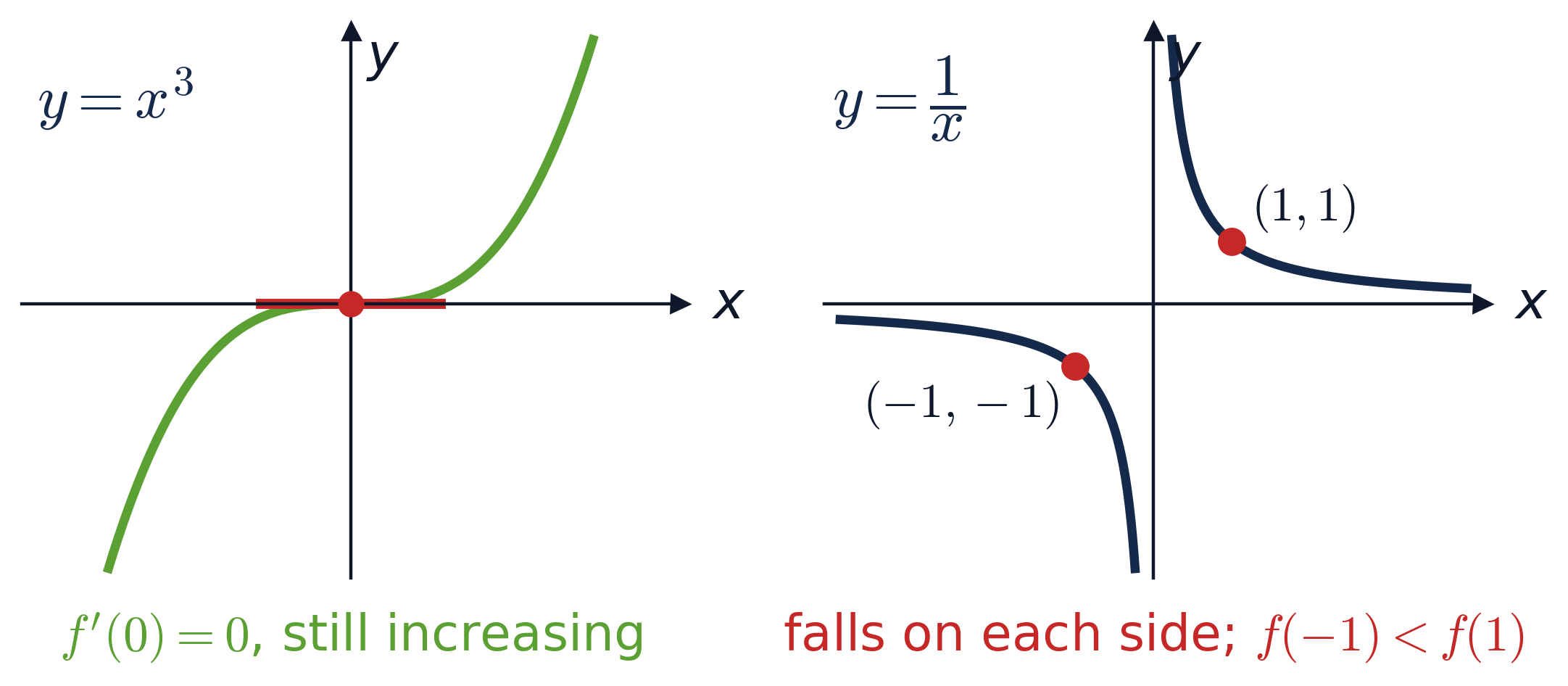
One more fact is needed. If f'(x) \ge 0 and it is zero only at single points, f is still increasing. The standard example is f(x) = x^3: here f'(x) = 3x^2 is zero at x = 0 and positive everywhere else, and x^3 is increasing on the whole real line.
3. The method in four steps
- Find f'(x) and factorise it.
- Solve f'(x) = 0. Mark these points on a number line. Also mark any point where f is not defined. The marks cut the line into intervals.
- Find the sign of f'(x) in each interval. Put in a test number, or use the sign rule below.
- Where the sign is +, f is increasing. Where it is -, f is decreasing.
Sign rule for a product. If a < b, then (x - a)(x - b) is negative between a and b and positive outside them.
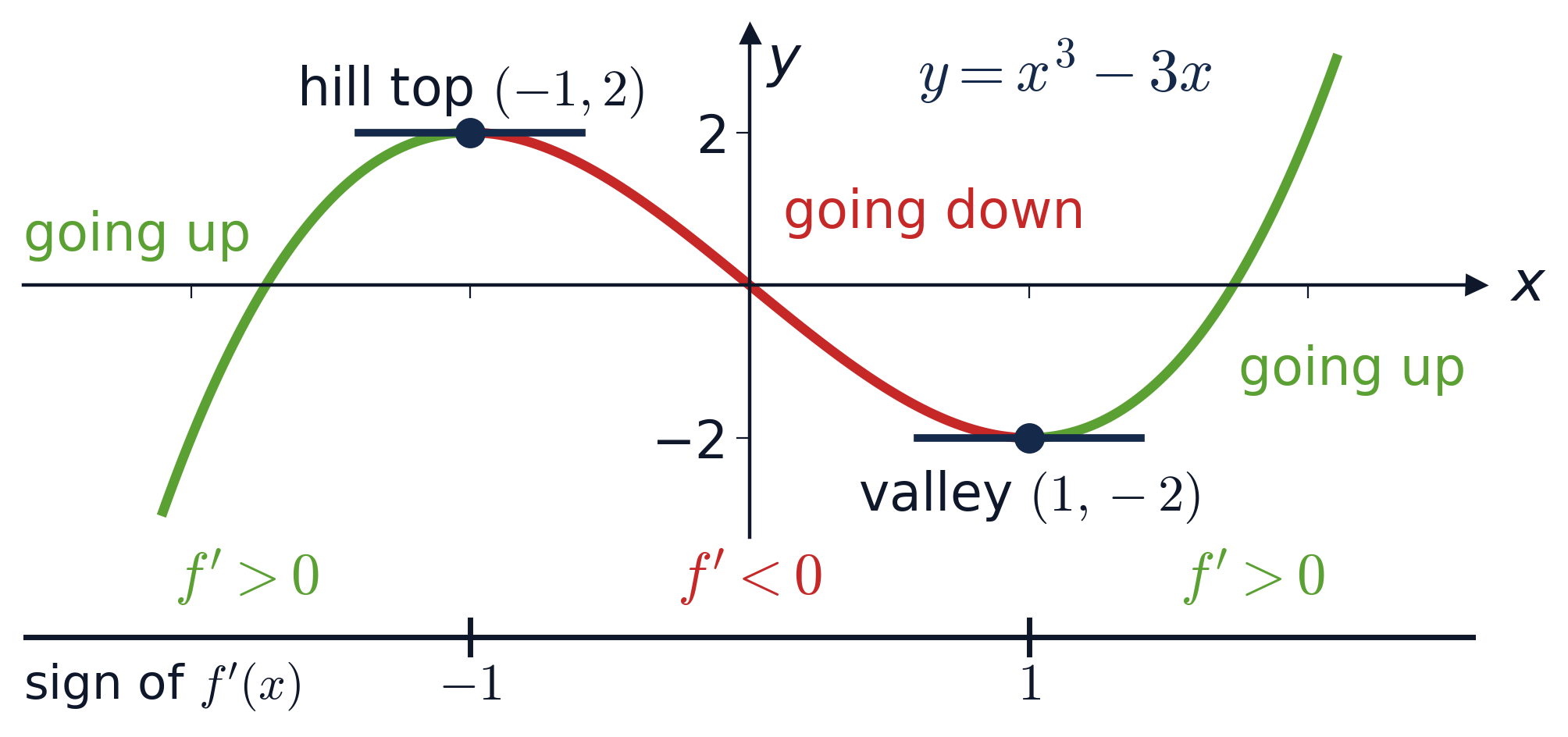
Take f(x) = x^3 - 3x. Then f'(x) = 3x^2 - 3 = 3(x - 1)(x + 1), which is zero at x = -1 and x = 1.
| Interval | x < -1 | -1 < x < 1 | x > 1 |
|---|---|---|---|
| Sign of f'(x) | + | - | + |
| f is | increasing | decreasing | increasing |
In words, the graph rises to a hill top at (-1, 2), falls to a valley at (1, -2), and then rises again.
4. Functions to know
| Function | Behaviour |
|---|---|
| ax + b | Increasing if a > 0, decreasing if a < 0 |
| e^x, and a^x with a > 1 | Increasing on \mathbb{R} |
| e^{-x}, and a^x with 0 < a < 1 | Decreasing on \mathbb{R} |
| \ln x | Increasing on (0, \infty) |
| \sin x | Increasing from -\frac{\pi}{2} to \frac{\pi}{2}, decreasing from \frac{\pi}{2} to \frac{3\pi}{2} |
| \cos x | Decreasing from 0 to \pi, increasing from \pi to 2\pi |
| \dfrac{1}{x} | Decreasing on x < 0 and on x > 0, taken separately |
Look at the last row. \dfrac{1}{x} has derivative -\dfrac{1}{x^2}, which is negative everywhere. But the function is not decreasing on its whole domain, because of the break at 0: f(-1) = -1 is less than f(1) = 1. Say "decreasing on each of the two intervals".
5. Open or closed intervals?
At a turning point f'(x) = 0. Should the turning point be put in the interval? School books usually give open intervals, from f'(x) > 0. Including the end points is also correct for a continuous function.
In the exam, look at the options. If only one form is offered, choose it. If both forms are offered, choose the open intervals, which match the rule f'(x) > 0. In NDA I 2026 (Q85 and Q86) the options had both \{x \le 2\} \cup \{x \ge 3\} and \{x < 2\} \cup \{x > 3\} for the set where \frac{x^3}{3} - \frac{5x^2}{2} + 6x + 7 increases, and the provisional key chose the open form.
6. Worked examples
Example 1. Find where f(x) = x^2 - 6x + 5 increases and where it decreases.
f'(x) = 2x - 6 = 2(x - 3). It is negative for x < 3 and positive for x > 3. So f is decreasing on (-\infty, 3) and increasing on (3, \infty).
Example 2. Find the intervals in which f(x) = 2x^3 - 9x^2 + 12x + 1 is increasing or decreasing.
f'(x) = 6x^2 - 18x + 12 = 6(x - 1)(x - 2). By the sign rule, f'(x) < 0 between 1 and 2 and f'(x) > 0 outside.
Increasing on (-\infty, 1) and on (2, \infty). Decreasing on (1, 2).
Example 3. Show that f(x) = x^3 + 3x + 5 is increasing on the whole real line.
f'(x) = 3x^2 + 3 = 3(x^2 + 1). Since x^2 + 1 \ge 1, f'(x) > 0 for every real x. So f is increasing on \mathbb{R}.
Example 4. Find where f(x) = x e^{-x} increases and decreases.
By the product rule, f'(x) = e^{-x} - x e^{-x} = e^{-x}(1 - x). The factor e^{-x} is always positive, so the sign of f'(x) is the sign of 1 - x.
Increasing on (-\infty, 1). Decreasing on (1, \infty).
Example 5. Find where f(x) = \sin x + \cos x increases on the interval \left(0, \frac{\pi}{2}\right).
f'(x) = \cos x - \sin x. On this interval \cos x > \sin x exactly when x < \frac{\pi}{4}.
Increasing on \left(0, \frac{\pi}{4}\right). Decreasing on \left(\frac{\pi}{4}, \frac{\pi}{2}\right).
7. From the real papers
These six questions are from the Mathematics papers of NDA & NAVAC from 2023 to 2026, one from each of six papers. Try each for 75 seconds before reading the solution.
NDA II 2023, Q45. A function is defined by f(x) = \begin{vmatrix} x + 1 & 2 & 3 \\ 2 & x + 4 & 6 \\ 3 & 6 & x + 9 \end{vmatrix}. The function is decreasing on :
(a) \left[-\frac{28}{3}, 0\right] (b) \left[0, \frac{28}{3}\right] (c) \left[0, \frac{50}{3}\right] (d) \left[0, \frac{56}{3}\right]
Solution. Expand along the first row: f(x) = (x + 1)[(x + 4)(x + 9) - 36] - 2[2(x + 9) - 18] + 3[12 - 3(x + 4)] = (x + 1)(x^2 + 13x) - 4x - 9x = x^3 + 14x^2. Then f'(x) = 3x^2 + 28x = x(3x + 28), which is negative between its zeros -\frac{28}{3} and 0. Only closed intervals are offered, so take the closed one (section 5). Answer (a).
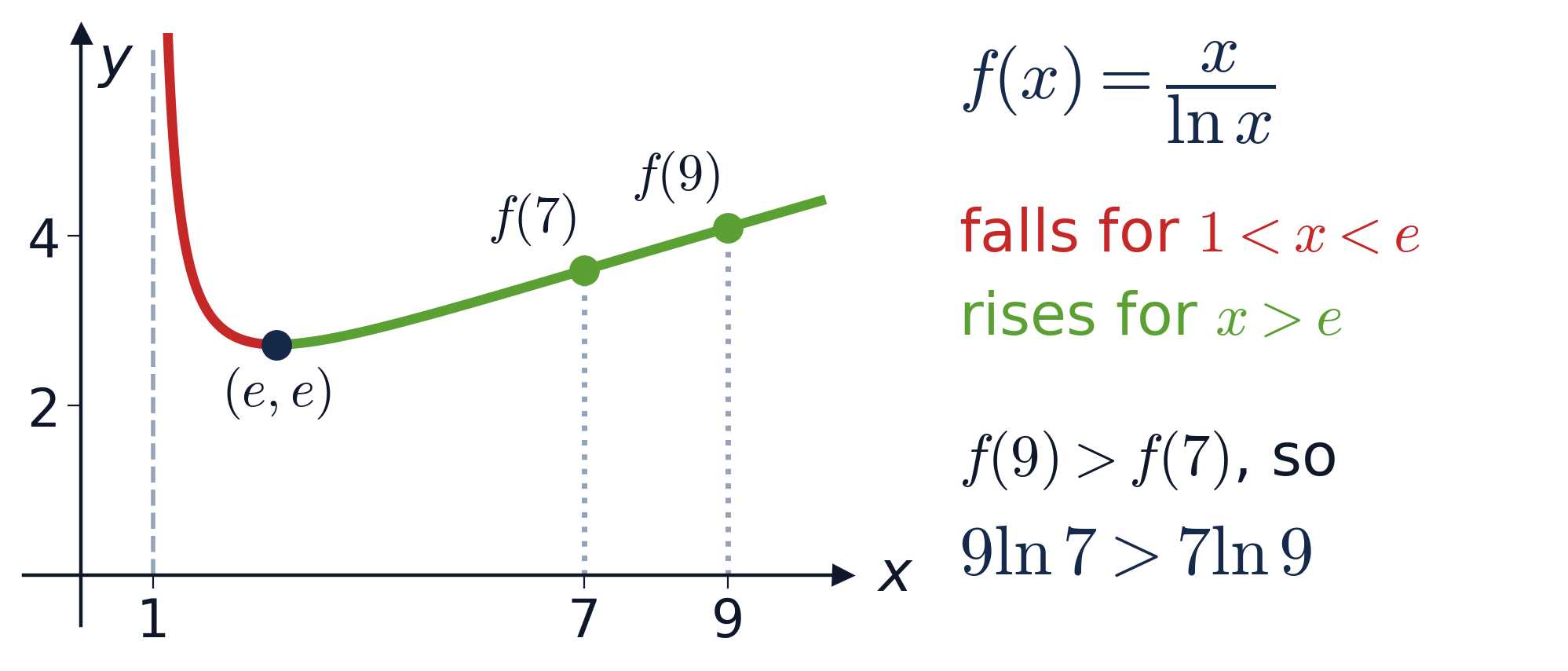
NDA I 2024, Q83. Let f(x) = \frac{x}{\ln x}; (x > 1) Consider the following statements : 1. f(x) is increasing in the interval (e, \infty) 2. f(x) is decreasing in the interval (1, e) 3. 9\ln 7 > 7\ln 9 Which of the statements given above are correct?
(a) 1 and 2 only (b) 2 and 3 only (c) 1 and 3 only (d) 1, 2 and 3
Solution. By the quotient rule f'(x) = \dfrac{\ln x - 1}{(\ln x)^2}. Its sign is the sign of \ln x - 1. For x > e, \ln x > 1: increasing, so 1 is correct. For 1 < x < e, \ln x < 1: decreasing, so 2 is correct. Both 7 and 9 are more than e, where f is increasing, so f(9) > f(7): \dfrac{9}{\ln 9} > \dfrac{7}{\ln 7}, which gives 9\ln 7 > 7\ln 9. So 3 is correct. Answer (d).
NDA I 2025, Q94. Let the function f(x) = x^2 + 9. Consider the following statements : I. f(x) is an increasing function. II. f(x) has local maximum at x = 0. Which of the statements given above is/are correct?
(a) I only (b) II only (c) Both I and II (d) Neither I nor II
Solution. f'(x) = 2x, negative for x < 0 and positive for x > 0. So f decreases and then increases: it is not an increasing function, and I is wrong. A function that goes down and then up has a lowest point at x = 0, a minimum and not a maximum, so II is wrong. Answer (d).
NDA II 2025, Q99. Consider the following statements regarding the function f(x) = \frac{1}{x - 5} : Statement–I : f(x) is decreasing on the intervals x < 5 and x > 5. Statement–II : f'(x) > 0 for all x \ne 5. Which one of the following is correct in respect of the above statements?
(a) Both Statement–I and Statement–II are correct and Statement–II explains Statement–I (b) Both Statement–I and Statement–II are correct but Statement–II does not explain Statement–I (c) Statement–I is correct but Statement–II is not correct (d) Statement–I is not correct but Statement–II is correct
Solution. f'(x) = -\dfrac{1}{(x - 5)^2}, which is negative for every x \ne 5. So f is decreasing on x < 5 and on x > 5: Statement I is correct. Statement II says f'(x) > 0, the opposite of the truth. Answer (c).
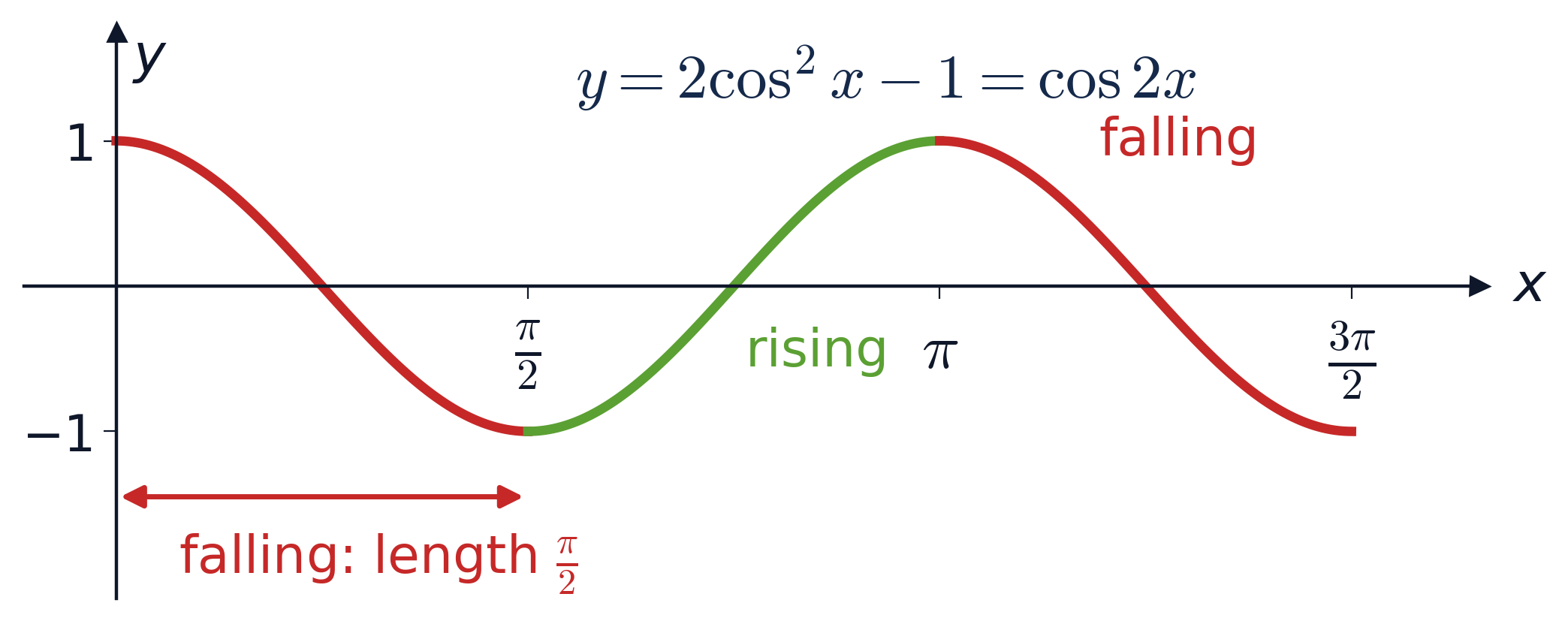
NDA I 2026, Q77. What is the length of the longest interval in which the function f(x) = 2\cos^2 x - 1 is decreasing?
(a) 2\pi (b) \pi (c) \frac{\pi}{2} (d) \frac{\pi}{4}
Solution. f(x) = 2\cos^2 x - 1 = \cos 2x, so f'(x) = -2\sin 2x. This is negative when \sin 2x > 0, that is when 2x goes from 0 to \pi, so x goes from 0 to \frac{\pi}{2}. After that f increases until x = \pi, and the pattern repeats. Each decreasing stretch has length \frac{\pi}{2}. Answer (c).
NDA II 2026, Q97. Let f(x) = \int xe^x\,dx. Then f(x) decreases in the interval
(a) (-\infty, 0) (b) (0, \infty) (c) (-\infty, -1) (d) (-1, \infty)
Solution. The integral sign belongs to the next unit. All that is needed here is its meaning: f is a function whose derivative is x e^x. So f'(x) = x e^x. Since e^x is always positive, f'(x) < 0 exactly when x < 0. Answer (a).
8. Mistakes that cost marks
- Looking at the sign of f and not of f'. "Increasing" is about f'(x) > 0. The function f(x) = x - 10 is negative at x = 1, but it is increasing everywhere.
- Taking the wrong side of a quadratic inequality. (x - 2)(x - 3) < 0 holds between 2 and 3. (x - 2)(x - 3) > 0 holds outside, for x < 2 or x > 3.
- Calling \dfrac{1}{x} decreasing on the whole real line. It is decreasing on x < 0 and on x > 0 separately. Across the break at 0 it jumps up.
- Thinking that f'(c) = 0 stops a function from being increasing. x^3 has f'(0) = 0 and is increasing on \mathbb{R}.
9. Quick check
Do these without help. Answers are at the end.
- In which interval is f(x) = x^2 - 4x increasing?
- In which interval is f(x) = x^3 - 12x decreasing?
- Is f(x) = -x^3 - x increasing or decreasing on \mathbb{R}?
- In which interval is f(x) = \ln x - x (for x > 0) increasing?
- True or false: f(x) = e^{-x} is a decreasing function.
10. Read and watch more, free
| What | Where | Language |
|---|---|---|
| Textbook | NCERT Class 12 Mathematics, Chapter 6 Application of Derivatives · Hindi edition | English, Hindi |
| Self-study notes | NIOS Mathematics, Lesson 29 Application of Derivatives · Hindi edition | English, Hindi |
| Video, the chapter for NDA | Defence Wallah: Fast Track 2021 (the class named APPLICATIONS OF DERIVATIVES, about 1 hour 50 minutes) | Hinglish |
| Video, a longer class for NDA | NDA Vijay by Unacademy: Maths Free Milestone Batch (the class named Applications of Derivatives, about 4 hours 15 minutes) | Hinglish |
| Video, every textbook problem | Magnet Brains: Class 12 Maths complete course (the 37 videos of Chapter 6) | Hinglish |
| Past NDA questions | ExamSIDE: Application of Derivatives | English |
The videos were chosen from their titles, length and views; they have not yet been watched by a teacher.
Answers to the quick check
- f'(x) = 2x - 4 > 0 when x > 2. Increasing on (2, \infty).
- f'(x) = 3x^2 - 12 = 3(x - 2)(x + 2) < 0 between -2 and 2. Decreasing on (-2, 2).
- f'(x) = -3x^2 - 1, which is negative for every x. Decreasing on \mathbb{R}.
- f'(x) = \dfrac{1}{x} - 1 > 0 when x < 1. Increasing on (0, 1).
- True. f'(x) = -e^{-x} < 0 for every x.
Next chapter: Maxima and minima.