Why this lesson matters. This chapter drew 21 questions in the seven papers from NDA II 2023 to NDA II 2026, and at least one in every paper. Most of them use the chain rule in one form or another: a function of a function, an equation in which x and y are mixed, a pair of equations in a third letter, or a second derivative. Six real questions are solved in section 9. This is a long chapter. Take it in two sittings: sections 1 to 3 first, then sections 4 to 7.
What you will be able to do
- Write the derivative of every standard function from memory.
- Differentiate sums, products, quotients and composite functions.
- Find \dfrac{dy}{dx} when y is given implicitly, in parametric form, or with a variable in the power.
- Find the derivative of one function with respect to another, and second order derivatives.
Before you start you should know: the derivative and the small table of Chapter M5-5, inverse trigonometric functions (Chapter M3-5) and logarithms (Chapter M1-11).
1. The standard derivatives
Learn this table by heart. Here c, n and a are constants, with a > 0.
| f(x) | f'(x) | f(x) | f'(x) |
|---|---|---|---|
| c | 0 | e^x | e^x |
| x^n | n x^{n-1} | a^x | a^x \ln a |
| \sqrt{x} | \dfrac{1}{2\sqrt{x}} | \ln x | \dfrac{1}{x} |
| \sin x | \cos x | \log_a x | \dfrac{1}{x \ln a} |
| \cos x | -\sin x | \sin^{-1} x | \dfrac{1}{\sqrt{1 - x^2}} |
| \tan x | \sec^2 x | \cos^{-1} x | -\dfrac{1}{\sqrt{1 - x^2}} |
| \cot x | -\operatorname{cosec}^2 x | \tan^{-1} x | \dfrac{1}{1 + x^2} |
| \sec x | \sec x \tan x | \operatorname{cosec} x | -\operatorname{cosec} x \cot x |
A help for memory: the derivative of every function whose name begins with "co" (\cos, \cot, \operatorname{cosec}, \cos^{-1}) carries a minus sign.
2. Sum, product and quotient
Let u and v be functions of x, and write u' and v' for their derivatives.
| Rule | Formula |
|---|---|
| Sum or difference | (u \pm v)' = u' \pm v' |
| Constant multiple | (cu)' = c\,u' |
| Product | (uv)' = u'v + uv' |
| Quotient | \left(\dfrac{u}{v}\right)' = \dfrac{u'v - uv'}{v^2} |
For example, \dfrac{d}{dx}(x e^x) = 1 \cdot e^x + x \cdot e^x = e^x(1 + x).
In the quotient rule the order matters: the derivative of the top comes first, and the sign in the middle is minus.
3. The chain rule (composite functions)
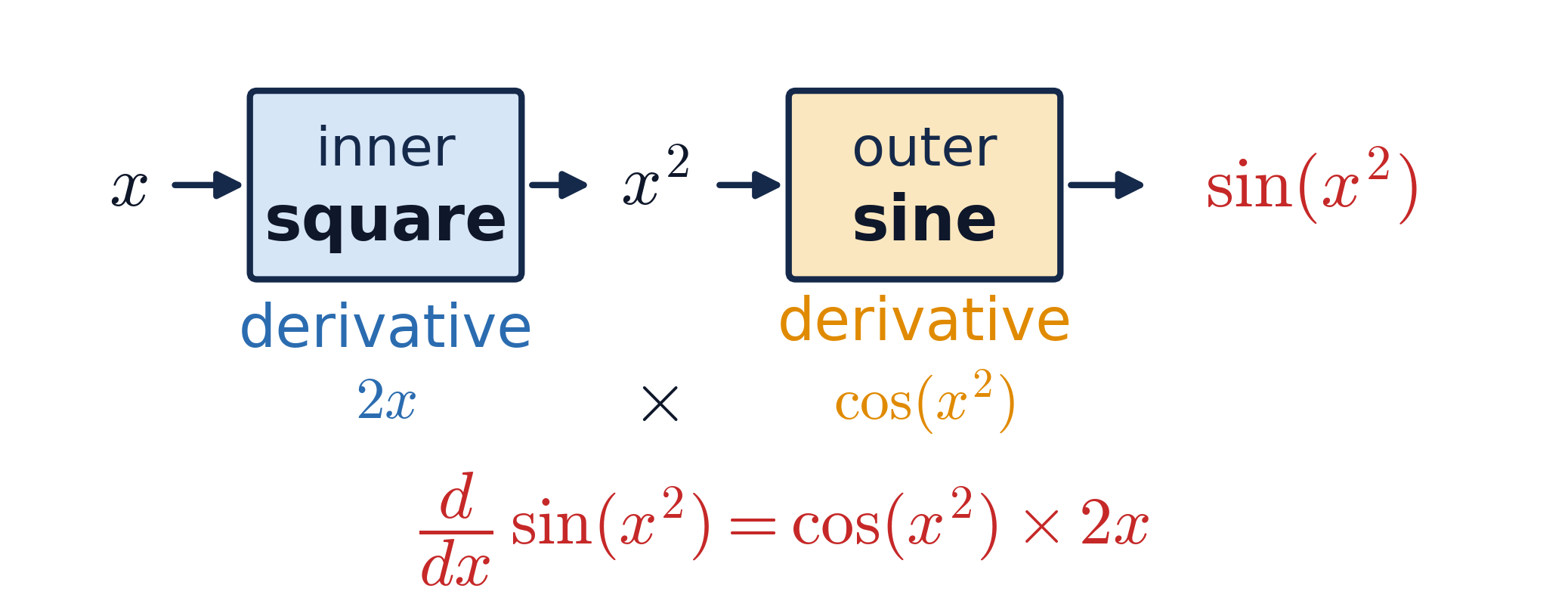
A composite function is a function of a function, such as \sin(x^2). The outer function is \sin and the inner function is x^2. If y = f(u) and u = g(x), then
\frac{dy}{dx} = \frac{dy}{du} \times \frac{du}{dx}
In words: differentiate the outer function and leave the inner function as it is; then multiply by the derivative of the inner function.
| y | Outer and inner | \dfrac{dy}{dx} |
|---|---|---|
| \sin(x^2) | \sin u, u = x^2 | \cos(x^2) \times 2x |
| (3x + 1)^5 | u^5, u = 3x + 1 | 5(3x + 1)^4 \times 3 = 15(3x + 1)^4 |
| e^{2x} | e^u, u = 2x | 2e^{2x} |
| \ln(x^2 + 1) | \ln u, u = x^2 + 1 | \dfrac{2x}{x^2 + 1} |
The exam also uses the rule with a function whose formula is not given:
\frac{d}{dx} f(g(x)) = f'(g(x)) \times g'(x)
4. Implicit functions
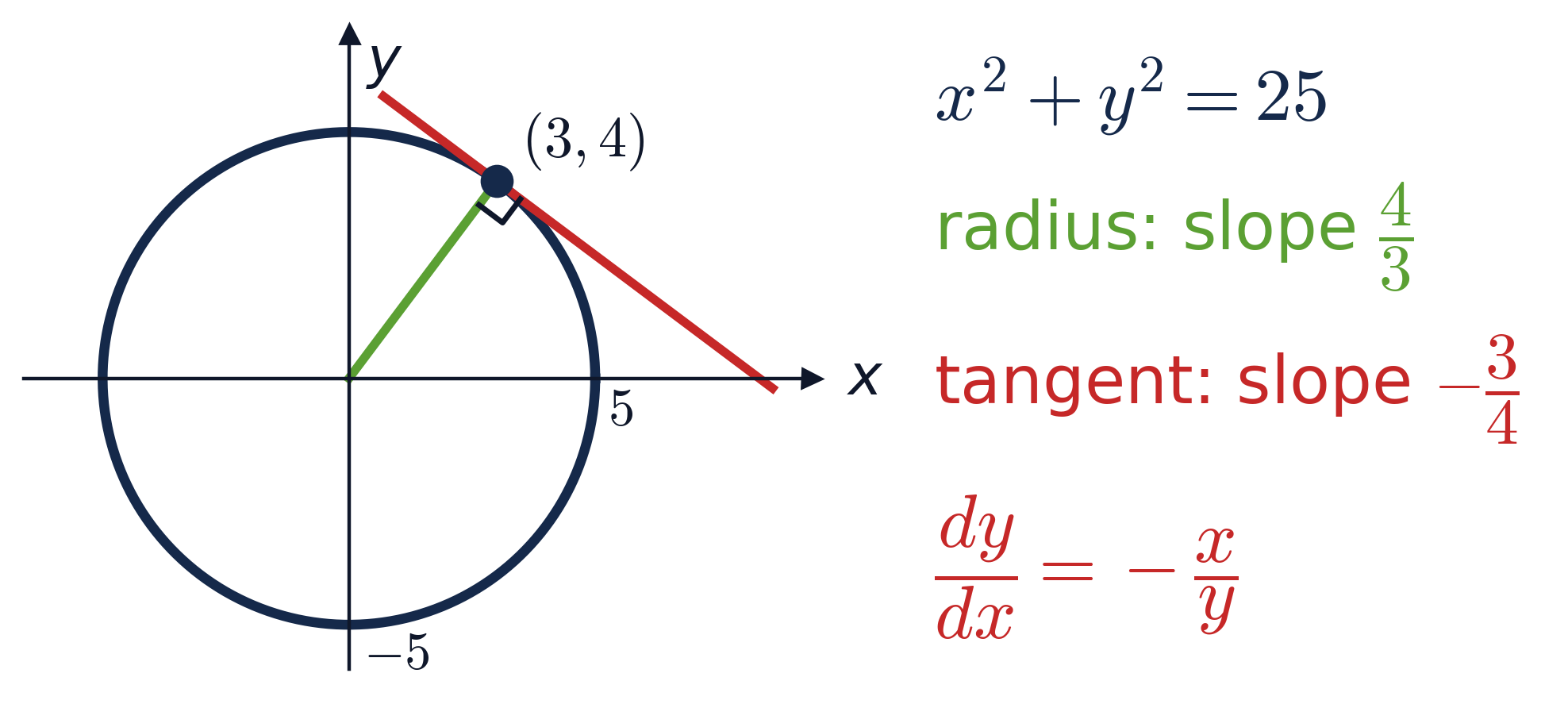
Sometimes x and y are mixed in one equation and y is not given alone, as in x^2 + y^2 = 25. Then:
- Differentiate both sides with respect to x.
- Each time you differentiate a term in y, multiply by \dfrac{dy}{dx} (this is the chain rule, because y is a function of x).
- Solve for \dfrac{dy}{dx}.
For x^2 + y^2 = 25: \;2x + 2y\dfrac{dy}{dx} = 0, so \dfrac{dy}{dx} = -\dfrac{x}{y}.
At the point (3, 4) of this circle the slope of the tangent is -\dfrac{3}{4}. The radius to that point has slope \dfrac{4}{3}, and the two are at right angles:
5. Logarithmic differentiation
When the variable is in the power, as in y = x^x, take the logarithm of both sides first.
\ln y = x \ln x. Differentiate: \dfrac{1}{y}\dfrac{dy}{dx} = \ln x + x \cdot \dfrac{1}{x} = \ln x + 1. So
\frac{dy}{dx} = x^x(1 + \ln x)
The same method helps when y is a product of many factors or powers.
6. Parametric form, and one function with respect to another
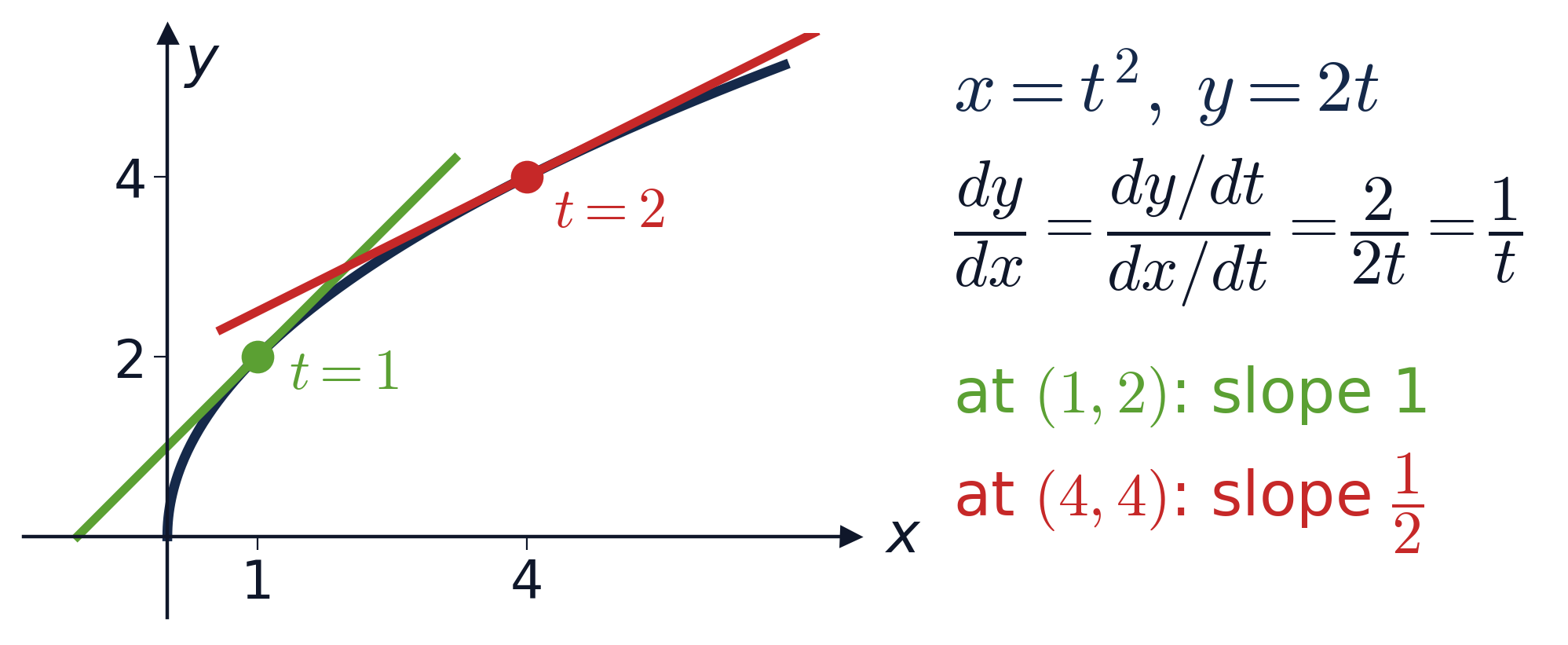
Parametric form. If x and y are both given in terms of a third letter t (the parameter), then
\frac{dy}{dx} = \frac{dy/dt}{dx/dt}
For x = at^2, y = 2at: \;\dfrac{dy}{dx} = \dfrac{2a}{2at} = \dfrac{1}{t}.
With a = 1 the curve and two of its tangents look like this:
One function with respect to another. To differentiate u with respect to v, where both are functions of x, differentiate each with respect to x and divide:
\frac{du}{dv} = \frac{du/dx}{dv/dx}
For example, the derivative of \sin x with respect to \cos x is \dfrac{\cos x}{-\sin x} = -\cot x.
7. Second order derivatives
The derivative of the derivative is the second order derivative:
\frac{d^2y}{dx^2} = \frac{d}{dx}\left(\frac{dy}{dx}\right), \quad \text{also written } y'' \text{ or } f''(x)
| y | \dfrac{dy}{dx} | \dfrac{d^2y}{dx^2} |
|---|---|---|
| x^3 | 3x^2 | 6x |
| \sin x | \cos x | -\sin x |
| e^{2x} | 2e^{2x} | 4e^{2x} |
| \ln x | \dfrac{1}{x} | -\dfrac{1}{x^2} |
In parametric form, differentiate \dfrac{dy}{dx} with respect to t and divide by \dfrac{dx}{dt} again. For x = at^2, y = 2at we found \dfrac{dy}{dx} = \dfrac{1}{t}, so
\frac{d^2y}{dx^2} = \frac{-1/t^2}{2at} = -\frac{1}{2at^3}
8. Worked examples
Example 1 (product and quotient). Differentiate (i) y = x^2 \sin x and (ii) y = \dfrac{x^2 + 1}{x - 1}.
(i) \dfrac{dy}{dx} = 2x \sin x + x^2 \cos x.
(ii) \dfrac{dy}{dx} = \dfrac{2x(x - 1) - (x^2 + 1)(1)}{(x - 1)^2} = \dfrac{x^2 - 2x - 1}{(x - 1)^2}.
Example 2 (chain rule). Differentiate (i) y = \sqrt{1 + x^2} and (ii) y = \ln(\sin x).
(i) Outer \sqrt{u}, inner u = 1 + x^2: \;\dfrac{dy}{dx} = \dfrac{1}{2\sqrt{1 + x^2}} \times 2x = \dfrac{x}{\sqrt{1 + x^2}}.
(ii) Outer \ln u, inner u = \sin x: \;\dfrac{dy}{dx} = \dfrac{1}{\sin x} \times \cos x = \cot x.
Example 3 (implicit). Find \dfrac{dy}{dx} at the point (1, 2) on the curve x^2 + xy + y^2 = 7.
Differentiate each term. The middle term is a product:
2x + \left(y + x\dfrac{dy}{dx}\right) + 2y\dfrac{dy}{dx} = 0, so \dfrac{dy}{dx} = -\dfrac{2x + y}{x + 2y}.
At (1, 2): \dfrac{dy}{dx} = -\dfrac{4}{5}.
Example 4 (a substitution first). Find \dfrac{dy}{dx} if y = \tan^{-1}\left(\dfrac{2x}{1 - x^2}\right), where -1 < x < 1.
Do not use the chain rule at once. Put x = \tan\theta. Then \dfrac{2x}{1 - x^2} = \dfrac{2\tan\theta}{1 - \tan^2\theta} = \tan 2\theta, so y = 2\theta = 2\tan^{-1} x.
Now \dfrac{dy}{dx} = \dfrac{2}{1 + x^2}.
Look for such a substitution whenever an inverse trigonometric function has a complicated quantity inside it.
Example 5 (second order). If y = 3\sin 2x + 4\cos 2x, show that \dfrac{d^2y}{dx^2} + 4y = 0.
\dfrac{dy}{dx} = 6\cos 2x - 8\sin 2x.
\dfrac{d^2y}{dx^2} = -12\sin 2x - 16\cos 2x = -4(3\sin 2x + 4\cos 2x) = -4y.
So \dfrac{d^2y}{dx^2} + 4y = 0.
9. From the real papers
These six questions are from the Mathematics papers of NDA & NAVAC from 2023 to 2026. Try each for 75 seconds before reading the solution.
NDA II 2023, Q66. If f'(x) = \cos(\ln x) and y = f\left(\frac{2x - 3}{x}\right), then what is \frac{dy}{dx} equal to?
(a) \cos\left(\ln\left(\frac{2x - 3}{x}\right)\right) (b) -\frac{3}{x^2}\sin\left(\ln\left(\frac{2x - 3}{x}\right)\right) (c) \frac{3}{x^2}\cos\left(\ln\left(\frac{2x - 3}{x}\right)\right) (d) -\frac{3}{x^2}\cos\left(\ln\left(\frac{2x - 3}{x}\right)\right)
Solution. Let u = \dfrac{2x - 3}{x} = 2 - \dfrac{3}{x}. Then \dfrac{du}{dx} = \dfrac{3}{x^2}. By the chain rule \dfrac{dy}{dx} = f'(u) \times \dfrac{du}{dx} = \dfrac{3}{x^2}\cos(\ln u). Answer (c).
NDA I 2024, Q86. Let f(x) and g(x) be two functions such that g(x) = x - \frac{1}{x} and f \circ g(x) = x^3 - \frac{1}{x^3}. What is f''(x) equal to?
(a) -\frac{2}{x^3} (b) 2x + \frac{2}{x^3} (c) 6x + 3 (d) 6x
Solution. First find f. Since \left(x - \dfrac{1}{x}\right)^3 = x^3 - \dfrac{1}{x^3} - 3\left(x - \dfrac{1}{x}\right), we have x^3 - \dfrac{1}{x^3} = g^3 + 3g. So f(x) = x^3 + 3x. Then f'(x) = 3x^2 + 3 and f''(x) = 6x. Answer (d).
NDA I 2025, Q92. Let y = \sin^{-1}\left(x - \frac{4x^3}{27}\right). What is \frac{dy}{dx} equal to?
(a) \frac{1}{\sqrt{9-x^2}} (b) \frac{1}{\sqrt{3-x^2}} (c) \frac{3}{\sqrt{9-x^2}} (d) \frac{9}{\sqrt{9-x^2}}
Solution. Put x = 3\sin\theta. The bracket becomes 3\sin\theta - 4\sin^3\theta = \sin 3\theta, so y = 3\theta = 3\sin^{-1}\left(\dfrac{x}{3}\right). Then \dfrac{dy}{dx} = 3 \times \dfrac{1}{\sqrt{1 - x^2/9}} \times \dfrac{1}{3} = \dfrac{3}{\sqrt{9 - x^2}}. Answer (c).
NDA II 2025, Q84. Consider the function f(x) = \begin{cases} 4(5^x), & x < 0 \\ 8k + x, & x \ge 0 \end{cases} What is f'(-1) equal to?
(a) \frac{2}{5}\ln 5 (b) \frac{3}{5}\ln 5 (c) \frac{4}{5}\ln 5 (d) 20\ln 5
Solution. At x = -1 the first formula applies. The derivative of a^x is a^x \ln a, so f'(x) = 4 \times 5^x \ln 5 and f'(-1) = 4 \times \dfrac{1}{5} \times \ln 5 = \dfrac{4}{5}\ln 5. Answer (c).
NDA I 2026, Q97. Consider the differential equation e^{x+y}\,\frac{dy}{dx} = e^{x-y} : What is \frac{d^2y}{dx^2}\left(\frac{dx}{dy}\right)^2 equal to?
(a) -2 (b) -1 (c) 0 (d) 2
Solution. Divide by e^{x+y}: \dfrac{dy}{dx} = e^{-2y}. Differentiate again with respect to x, remembering that y depends on x: \dfrac{d^2y}{dx^2} = -2e^{-2y}\dfrac{dy}{dx} = -2\left(\dfrac{dy}{dx}\right)^2. Since \dfrac{dx}{dy} = \dfrac{1}{dy/dx}, multiplying by \left(\dfrac{dx}{dy}\right)^2 leaves -2. Answer (a).
NDA II 2026, Q91. Consider the following statements : I. \frac{d}{dx}\ln|x| = -\frac{1}{x} if x < 0 II. \frac{d}{dx}\ln|x| = \frac{1}{x} if x > 0 Which of the statements given above is/are correct?
(a) I only (b) II only (c) Both I and II (d) Neither I nor II
Solution. For x > 0, \ln|x| = \ln x, with derivative \dfrac{1}{x}: II is correct. For x < 0, \ln|x| = \ln(-x). By the chain rule its derivative is \dfrac{1}{-x} \times (-1) = \dfrac{1}{x}, not -\dfrac{1}{x}: I is wrong. Answer (b).
10. Mistakes that cost marks
- Differentiating a product factor by factor. (uv)' is not u'v'. Test it on x \cdot x = x^2: the derivative is 2x, not 1 \times 1.
- Forgetting the inner derivative. \dfrac{d}{dx}\sin 3x = 3\cos 3x, not \cos 3x.
- Using the power rule on a^x. \dfrac{d}{dx} 2^x = 2^x \ln 2, not x\,2^{x-1}. The power rule is for x^n, where the power is a constant.
- Forgetting \dfrac{dy}{dx} in implicit differentiation. \dfrac{d}{dx}(y^2) = 2y\dfrac{dy}{dx}, not 2y.
11. Quick check
Do these without help. Answers are at the end.
- Differentiate y = x^3 e^x.
- Differentiate y = \sin(5x + 2).
- Find \dfrac{dy}{dx} at the point (1, 3) on the circle x^2 + y^2 = 10.
- Find the derivative of x^3 with respect to x^2.
- Find \dfrac{d^2y}{dx^2} if y = \ln x.
12. Read and watch more, free
| What | Where | Language |
|---|---|---|
| Textbook | NCERT Class 12 Mathematics, Chapter 5 Continuity and Differentiability · Hindi edition | English, Hindi |
| Self-study notes, algebraic functions | NIOS Mathematics, Lesson 26 Differentiation · Hindi edition | English, Hindi |
| Self-study notes, trigonometric functions | NIOS Mathematics, Lesson 27 Differentiation of Trigonometric Functions · Hindi edition | English, Hindi |
| Self-study notes, exponential and logarithmic functions | NIOS Mathematics, Lesson 28 Differentiation of Exponential and Logarithmic Functions · Hindi edition | English, Hindi |
| Video, the chapter for NDA | Defence Wallah: Fast Track 2021 (the class named DERIVATIVES, about 1 hour) | Hinglish |
| Video, a longer class for NDA | NDA Vijay by Unacademy: Maths Free Milestone Batch (the class named Methods of Differentiation, about 2 hours 40 minutes) | Hinglish |
| Video, every textbook problem | Magnet Brains: Class 12 Maths complete course (the 30 videos of Chapter 5) | Hinglish |
| Past NDA questions | ExamSIDE: Differentiation | English |
The videos were chosen from their titles, length and views; they have not yet been watched by a teacher.
Answers to the quick check
- \dfrac{dy}{dx} = 3x^2 e^x + x^3 e^x = x^2 e^x(3 + x).
- \dfrac{dy}{dx} = 5\cos(5x + 2).
- 2x + 2y\dfrac{dy}{dx} = 0, so \dfrac{dy}{dx} = -\dfrac{x}{y} = -\dfrac{1}{3}.
- \dfrac{3x^2}{2x} = \dfrac{3x}{2}.
- \dfrac{dy}{dx} = \dfrac{1}{x}, so \dfrac{d^2y}{dx^2} = -\dfrac{1}{x^2}.
Next chapter: Increasing and decreasing functions.