Why this lesson matters. This chapter drew 17 questions in the seven papers from NDA II 2023 to NDA II 2026. The exam asks four kinds of question: is the function one-to-one or onto, how many functions or onto functions are there between two small sets, what is f(g(x)), and what is the inverse of f. Six real questions are solved in section 7.
What you will be able to do
- Test whether a function is one-to-one, onto, or both (bijective).
- Count the functions, the one-to-one functions and the onto functions between two small sets.
- Find the composite functions f \circ g and g \circ f, and find g when g \circ f is given.
- Find the inverse of a bijective function in three steps.
Before you start you should know: what a function, its domain, its codomain and its range are (Chapter M5-1), and how to count choices by multiplying (Chapter M1-9).
1. One-to-one functions
A function is one-to-one (also written one-one, or injective) if different inputs always give different outputs. No output is used twice.
Test. Suppose f(a) = f(b). If this forces a = b, the function is one-to-one.
- f(x) = 2x + 3 is one-to-one: 2a + 3 = 2b + 3 gives a = b.
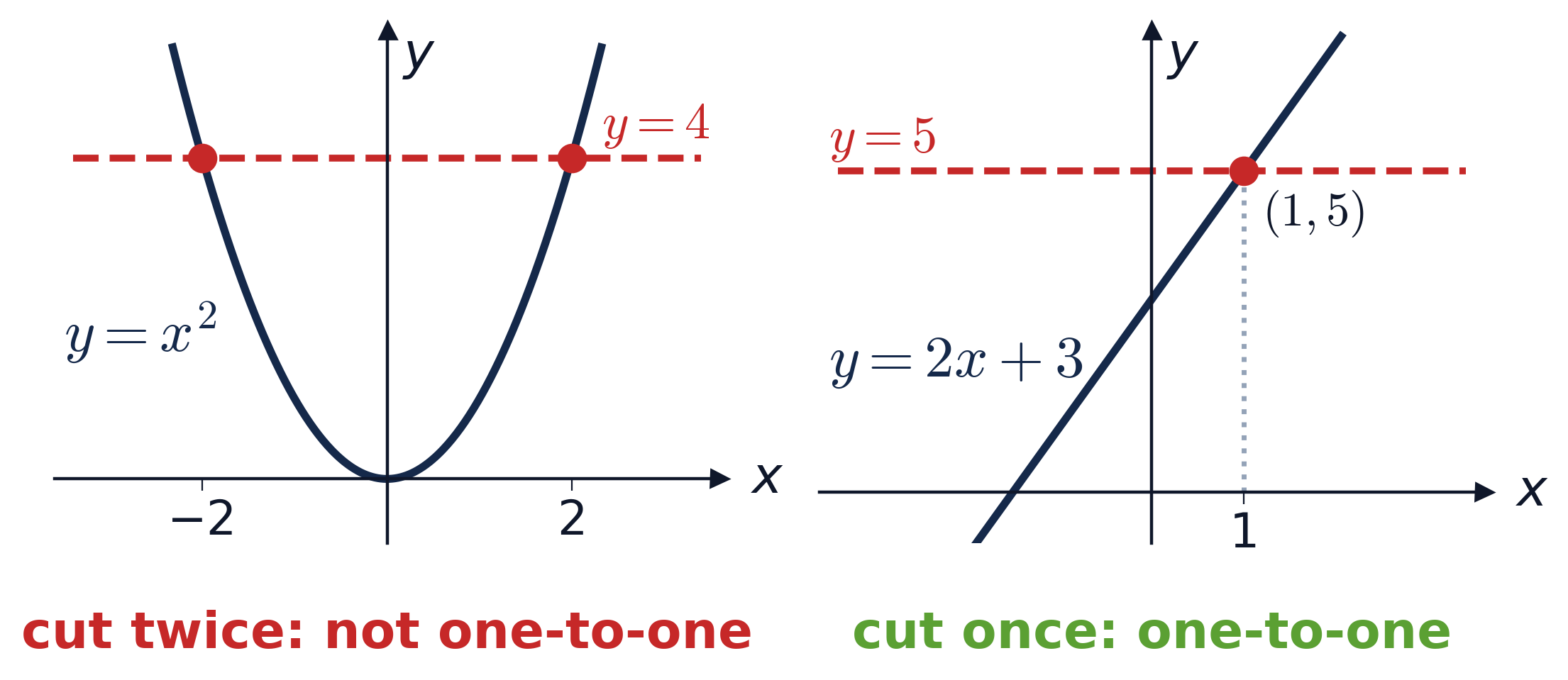
- f(x) = x^2 on \mathbb{R} is not one-to-one: f(2) = f(-2) = 4.
On the graph: a function is one-to-one if every horizontal line cuts the graph at most once. A horizontal line at height 4 cuts the U-shaped graph of x^2 at two points, so x^2 fails.
A function that is always increasing, or always decreasing, is one-to-one.
2. Onto functions, and bijective functions
A function f : A \to B is onto (surjective) if every element of the codomain B is the output of some input. In other words, the range is the whole of B.
- f : \mathbb{R} \to \mathbb{R}, f(x) = 2x + 3 is onto: any y is reached by x = \dfrac{y - 3}{2}.
- f : \mathbb{R} \to \mathbb{R}, f(x) = x^2 is not onto: -1 is never an output.
Whether a function is onto depends on the codomain. The same rule f(x) = x^2 from \mathbb{R} to [0, \infty) is onto.
A function that is both one-to-one and onto is called bijective. Only bijective functions have an inverse.
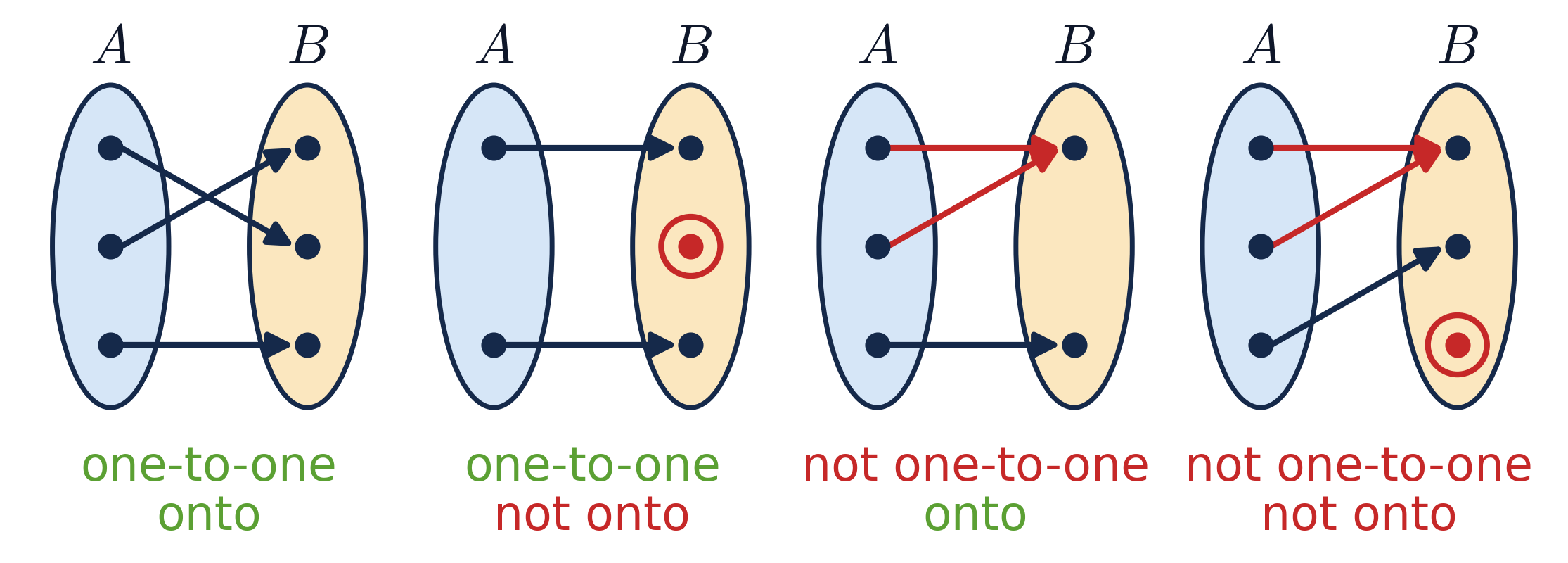
The four possible cases, drawn as arrow diagrams from A to B:
3. Counting functions between two small sets
Let A have m elements and B have n elements. To make a function from A to B, choose an image for each element of A.
| What is counted | Number | Example |
|---|---|---|
| All functions from A to B | n^m | A has 2 elements, B has 3: 3^2 = 9 |
| One-to-one functions (possible only if m \le n) | n(n-1)(n-2)\dots with m factors | A has 2, B has 3: 3 \times 2 = 6 |
| Onto functions when B has exactly 2 elements | 2^m - 2 | A has 3, B has 2: 8 - 2 = 6 |
| Bijective functions (possible only if m = n) | n! | Both have 3: 3! = 6 |
Why 2^m - 2? There are 2^m functions in all. Only two of them are not onto: the one that sends everything to the first element of B, and the one that sends everything to the second.
4. Composite functions
To form a composite, put one function inside another.
(g \circ f)(x) = g(f(x)) \qquad (f \circ g)(x) = f(g(x))
In g \circ f, the function f acts first and g acts second. Read it from the right. The paper also writes gof(x) for g \circ f(x).
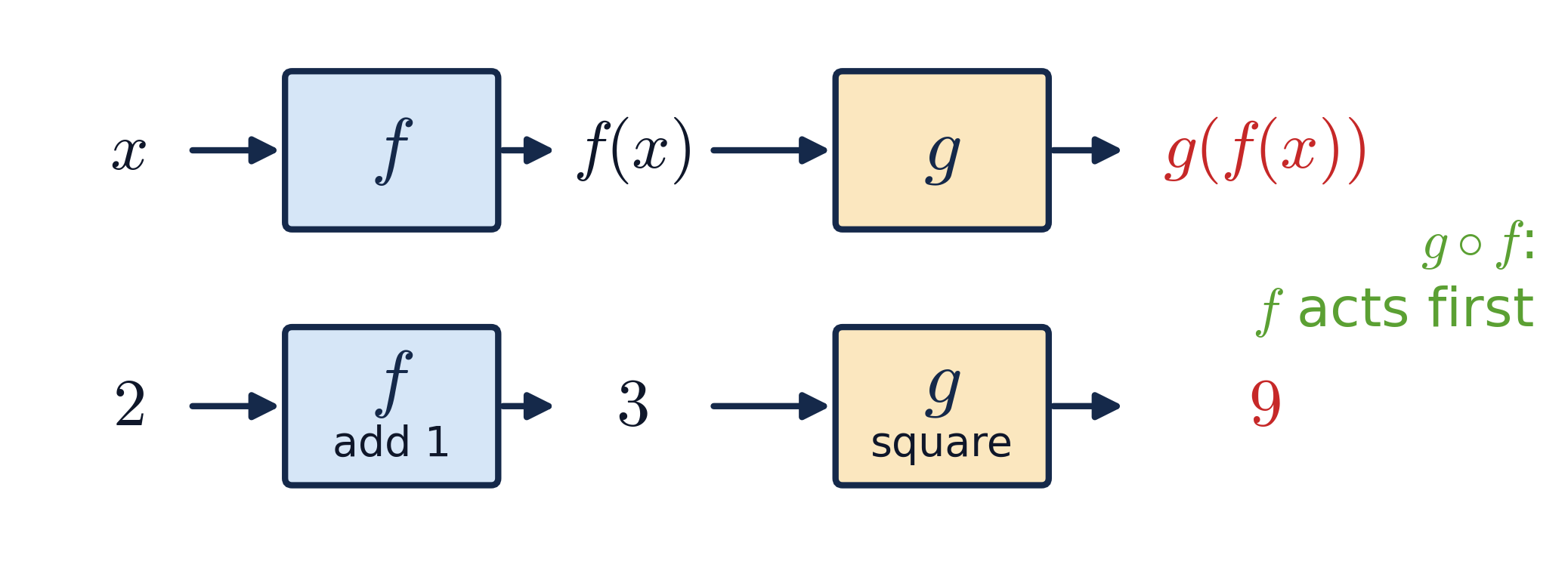
Take f(x) = x + 1 and g(x) = x^2. Then
- g \circ f(x) = g(x + 1) = (x + 1)^2,
- f \circ g(x) = f(x^2) = x^2 + 1.
These are different. In general f \circ g \ne g \circ f.
5. The inverse function
If f is bijective, its inverse f^{-1} undoes it: if f(x) = y then f^{-1}(y) = x. So
f^{-1}(f(x)) = x \quad \text{and} \quad f(f^{-1}(x)) = x
Three steps to find the inverse.
- Write y = f(x).
- Solve this equation for x in terms of y.
- Swap the letters: write x in place of y. The result is f^{-1}(x).
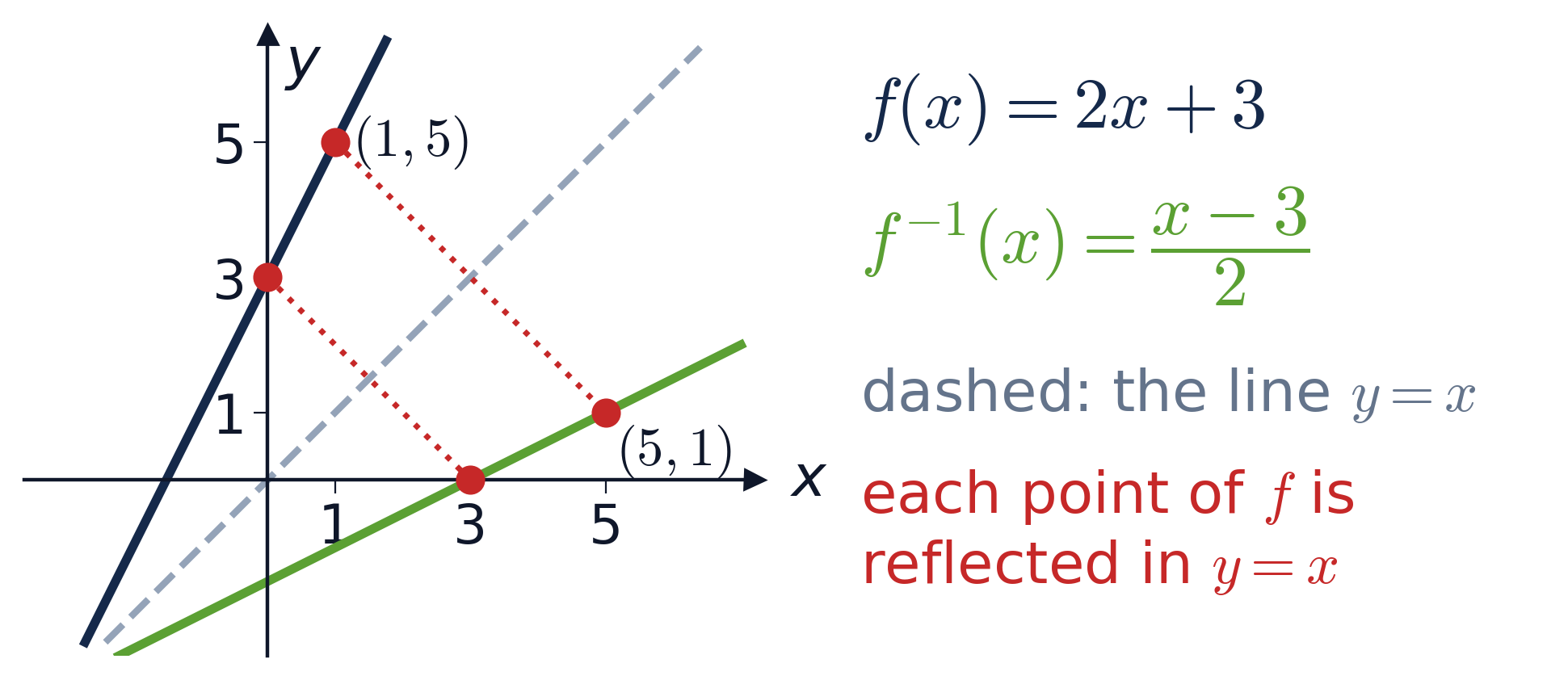
For f(x) = 2x + 3: y = 2x + 3 gives x = \dfrac{y - 3}{2}, so f^{-1}(x) = \dfrac{x - 3}{2}. Check: f^{-1}(f(1)) = f^{-1}(5) = 1.
On the graph: the graph of f^{-1} is the mirror image of the graph of f in the line y = x.
A useful fact. A function of the form f(x) = \dfrac{ax + b}{cx - a} is its own inverse: f(f(x)) = x. Look at the first and last coefficients: they are a and -a.
6. Worked examples
Example 1. Let f(x) = 3x - 2 and g(x) = x^2 + 1. Find f \circ g(2) and g \circ f(2).
f \circ g(2) = f(g(2)) = f(5) = 13.
g \circ f(2) = g(f(2)) = g(4) = 17.
Example 2. A has 3 elements and B has 2 elements. How many functions are there from A to B? How many are onto? How many are one-to-one?
All functions: 2^3 = 8. Onto: 2^3 - 2 = 6. One-to-one: none, because 3 inputs cannot have 3 different outputs when only 2 outputs exist.
Example 3. Let f(x) = \dfrac{2x + 1}{x - 3} for x \ne 3. Show that f is one-to-one and find f^{-1}.
One-to-one: suppose \dfrac{2a + 1}{a - 3} = \dfrac{2b + 1}{b - 3}. Cross-multiply: 2ab - 6a + b - 3 = 2ab - 6b + a - 3, so -7a = -7b and a = b.
Inverse: write y = \dfrac{2x + 1}{x - 3}. Then y(x - 3) = 2x + 1, so xy - 2x = 3y + 1 and x = \dfrac{3y + 1}{y - 2}. Swap the letters:
f^{-1}(x) = \frac{3x + 1}{x - 2}
Check with x = 4: f(4) = 9 and f^{-1}(9) = \dfrac{28}{7} = 4. Correct.
Example 4. If f(x) = x + 2 and g \circ f(x) = x^2 + 4x + 7, find g(x).
We know g(x + 2) = x^2 + 4x + 7. Let u = x + 2, so x = u - 2. Then
g(u) = (u - 2)^2 + 4(u - 2) + 7 = u^2 - 4u + 4 + 4u - 8 + 7 = u^2 + 3.
So g(x) = x^2 + 3. Check: g(f(x)) = (x + 2)^2 + 3 = x^2 + 4x + 7. Correct.
7. From the real papers
These six questions are from the Mathematics papers of NDA & NAVAC from 2023 to 2026. Try each for 75 seconds before reading the solution.
NDA II 2023, Q42. Let f(x) = x^2 - 1 and gof(x) = x - \sqrt{x} + 1. What is g(15) equal to?
(a) 1 (b) 2 (c) 3 (d) 4
Solution. We need an x with f(x) = 15: x^2 - 1 = 15 gives x = 4 (the positive value, because \sqrt{x} must exist). Then g(15) = g(f(4)) = 4 - \sqrt{4} + 1 = 3. Answer (c).
NDA I 2024, Q35. Let A = \{1, 2, 3, 4, 5\} and B = \{6, 7\}. What is the number of onto functions from A to B?
(a) 10 (b) 20 (c) 30 (d) 32
Solution. Each of the 5 elements of A goes to 6 or to 7, so there are 2^5 = 32 functions. Two of them are not onto: all to 6, and all to 7. So 32 - 2 = 30. Answer (c).
NDA I 2025, Q88. Let f = \{(1, 1), (2, 4), (3, 7), (4, 10)\}. Consider the following statements : I. f is one-one function. II. f is onto function if the codomain is the set of natural numbers. Which of the statements given above is/are correct?
(a) I only (b) II only (c) Both I and II (d) Neither I nor II
Solution. I: the four inputs give four different outputs 1, 4, 7, 10, so f is one-one. II: the natural numbers 2, 3, 5 and many others are never outputs, so f is not onto. Answer (a).
NDA II 2025, Q90. Consider the function f(x) = \frac{10^x - 10^{-x}}{10^x + 10^{-x}}. What is the inverse of the function?
(a) \log_{10}(2x - 1) (b) \frac{1}{2}\log_{10}(2x - 1) (c) \frac{1}{4}\log_{10}\left(\frac{2x}{2 - x}\right) (d) \frac{1}{2}\log_{10}\left(\frac{1 + x}{1 - x}\right)
Solution. Write y = f(x) and multiply top and bottom by 10^x: y = \dfrac{10^{2x} - 1}{10^{2x} + 1}. Then y \cdot 10^{2x} + y = 10^{2x} - 1, so 10^{2x} = \dfrac{1 + y}{1 - y} and x = \dfrac{1}{2}\log_{10}\left(\dfrac{1 + y}{1 - y}\right). Swap the letters. Answer (d).
NDA II 2026, Q99. Consider the following statements in respect of the function f : R - \left\{\frac{3}{5}\right\} \to R - \left\{\frac{3}{5}\right\} such that f(x) = \frac{3x + 2}{5x - 3} : I. f(x) is a bijective function. II. f^{-1}(x) = f(x) Which of the statements given above is/are correct?
(a) I only (b) II only (c) Both I and II (d) Neither I nor II
Solution. Write y = \dfrac{3x + 2}{5x - 3}. Then y(5x - 3) = 3x + 2, so x = \dfrac{3y + 2}{5y - 3}. Every y \ne \frac{3}{5} comes from exactly one x, so f is bijective. The inverse has the same formula as f. This is the useful fact of section 5 with a = 3. Answer (c).
NDA II 2026, Q100. Let A and B be the sets having only 2 and 3 elements respectively. What is the total number of mappings from A to B?
(a) 4 (b) 6 (c) 8 (d) 9
Solution. Each of the 2 elements of A can go to any of the 3 elements of B: 3 \times 3 = 3^2 = 9. Answer (d).
8. Mistakes that cost marks
- Reading g \circ f in the wrong order. In g \circ f(x) = g(f(x)) the function f acts first. With f(x) = x + 1 and g(x) = x^2, g \circ f(2) = g(3) = 9, not f(4) = 5.
- Taking f^{-1}(x) as \dfrac{1}{f(x)}. The inverse function undoes f. For f(x) = 2x, f^{-1}(x) = \dfrac{x}{2}, not \dfrac{1}{2x}.
- Writing m^n for the number of functions. From a set of m elements to a set of n elements there are n^m functions: the number of choices, raised to the number of inputs.
- Calling a function onto without looking at the codomain. f(x) = x^2 is not onto \mathbb{R}, but it is onto [0, \infty).
9. Quick check
Do these without help. Answers are at the end.
- Let f(x) = 2x + 1 and g(x) = x^2. Find g \circ f(3) and f \circ g(3).
- Find the inverse of f(x) = 5x - 4.
- A has 3 elements and B has 4 elements. How many functions are there from A to B? How many of them are one-to-one?
- Is f : \mathbb{R} \to \mathbb{R}, f(x) = x^3 bijective?
- Let f(x) = \dfrac{x + 1}{x - 1} for x \ne 1. Find f(f(x)).
10. Read and watch more, free
| What | Where | Language |
|---|---|---|
| Textbook | NCERT Class 12 Mathematics, Chapter 1 Relations and Functions · Hindi edition | English, Hindi |
| Self-study notes | NIOS Mathematics, Lesson 23 Relations and Functions-II · Hindi edition | English, Hindi |
| Video, the chapter for NDA | NDA Vijay by Unacademy: Maths Free Milestone Batch (the class named Functions, about 3 hours 35 minutes) | Hinglish |
| Video, the chapter for NDA | Maths Jugad Se: NDA 2 2026 Maths Calculus (the class named Function, about 4 hours) | Hinglish |
| Past NDA questions | ExamSIDE: Functions | English |
The videos were chosen from their titles, length and views; they have not yet been watched by a teacher.
Answers to the quick check
- g \circ f(3) = g(7) = 49 and f \circ g(3) = f(9) = 19.
- y = 5x - 4 gives x = \dfrac{y + 4}{5}, so f^{-1}(x) = \dfrac{x + 4}{5}.
- All functions: 4^3 = 64. One-to-one: 4 \times 3 \times 2 = 24.
- Yes. It is always increasing, so it is one-to-one, and every real number y is the cube of \sqrt[3]{y}, so it is onto.
- f(f(x)) = x. The function has the form \dfrac{ax + b}{cx - a} with a = 1, so it is its own inverse.
Next chapter: Limits.