Why this lesson matters. This chapter drew 22 questions in the seven papers from NDA II 2023 to NDA II 2026, and at least one in every paper. The exam asks three kinds of question: a limit that needs one of eight standard limits, a left-hand and a right-hand limit of a function that has |x| or the greatest integer [x] in it, and a limit of the form \frac{0}{0} that must be simplified first. Six real questions are solved in section 8.
What you will be able to do
- Say what \lim_{x \to a} f(x) means, and find it by putting x = a when that works.
- Find left-hand and right-hand limits, and decide whether a limit exists.
- Remove the form \frac{0}{0} by factorising, by rationalising, or with a standard limit.
- Find limits as x \to \infty.
Before you start you should know: functions, the modulus |x| and the greatest integer [x] (Chapter M5-1), the trigonometric identities 1 - \cos 2x = 2\sin^2 x and \tan x = \dfrac{\sin x}{\cos x} (Chapters M3-2 and M3-4), and logarithms (Chapter M1-11). In this unit \ln a means \log_e a.
1. The idea of a limit
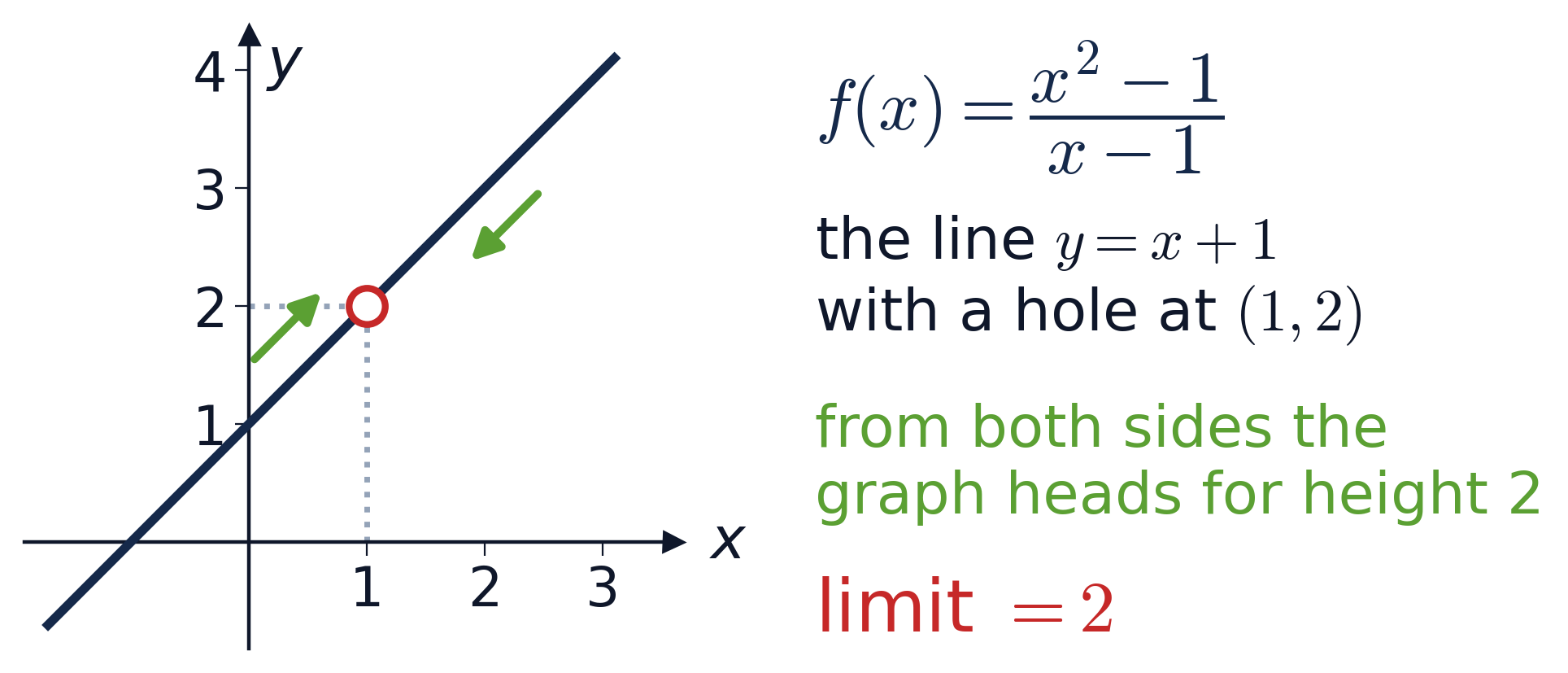
Take f(x) = \dfrac{x^2 - 1}{x - 1}. At x = 1 it has no value, because it becomes \frac{0}{0}. But look at values of x close to 1.
| x | 0.9 | 0.99 | 1.01 | 1.1 |
|---|---|---|---|---|
| f(x) | 1.9 | 1.99 | 2.01 | 2.1 |
As x comes close to 1 from either side, f(x) comes close to 2. We write
\lim_{x \to 1} \frac{x^2 - 1}{x - 1} = 2
The limit is the value that f(x) approaches as x approaches a. It does not matter what happens at x = a itself.
On the graph: for x \ne 1 this function equals x + 1. Its graph is the straight line y = x + 1 with one point missing, a small hole at (1, 2). The limit is the height of the hole.
2. Left-hand and right-hand limits
- The left-hand limit, written \lim_{x \to a-} f(x), uses only values of x a little less than a.
- The right-hand limit, written \lim_{x \to a+} f(x), uses only values of x a little more than a.
The limit exists only if these two are equal (and finite). Then the limit is their common value.
Two functions need this check every time.
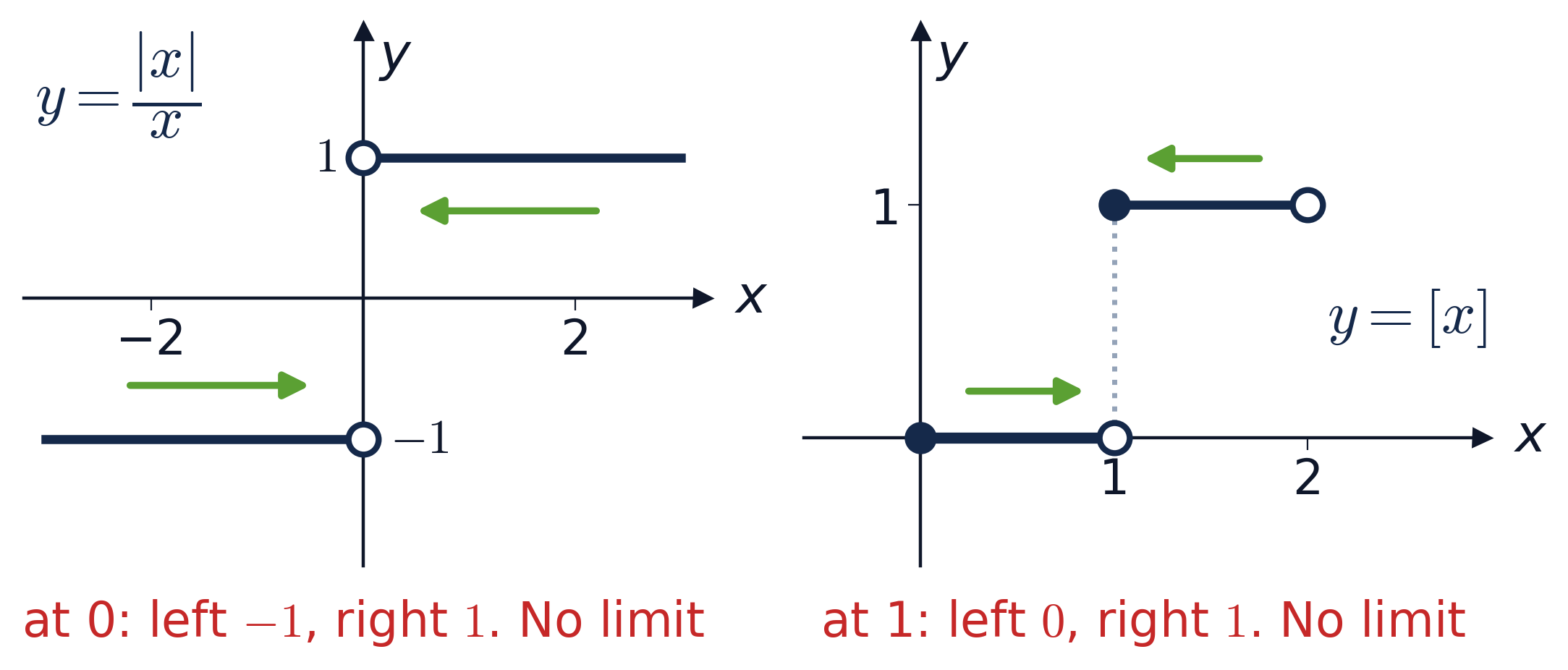
- Modulus. Take \dfrac{|x|}{x} at 0. For x > 0 it is \dfrac{x}{x} = 1. For x < 0 it is \dfrac{-x}{x} = -1. Right-hand limit 1, left-hand limit -1: the limit does not exist.
- Greatest integer. Take [x] at 1. Just left of 1, [x] = 0. Just right of 1, [x] = 1. The limit does not exist. The same happens at every integer.
3. How to find a limit
Work in this order.
- Put x = a. If you get a number, that is the limit. For example \lim_{x \to 2} (x^2 + 3x) = 4 + 6 = 10.
- If you get \frac{0}{0}, the work is not finished. Change the form of the expression: factorise and cancel the common factor; or rationalise if there is a square root; or use a standard limit from section 4.
- If the function has |x| or [x], or is given by different formulas on the two sides of a, find the two one-sided limits.
4. The standard limits
Learn these eight. In the trigonometric limits x is in radians.
| Limit | Value | |
|---|---|---|
| 1 | \displaystyle\lim_{x \to a} \frac{x^n - a^n}{x - a} | n\,a^{n-1} |
| 2 | \displaystyle\lim_{x \to 0} \frac{\sin x}{x} | 1 |
| 3 | \displaystyle\lim_{x \to 0} \frac{\tan x}{x} | 1 |
| 4 | \displaystyle\lim_{x \to 0} \frac{1 - \cos x}{x^2} | \dfrac{1}{2} |
| 5 | \displaystyle\lim_{x \to 0} \frac{e^x - 1}{x} | 1 |
| 6 | \displaystyle\lim_{x \to 0} \frac{a^x - 1}{x}, where a > 0 | \ln a |
| 7 | \displaystyle\lim_{x \to 0} \frac{\ln(1 + x)}{x} | 1 |
| 8 | \displaystyle\lim_{x \to 0} (1 + x)^{1/x} and \displaystyle\lim_{x \to \infty} \left(1 + \frac{1}{x}\right)^x | e |
How to use them. The x in limits 2 to 7 can be any quantity that tends to 0, if the same quantity stands in both places. So \dfrac{\sin 3x}{3x} \to 1, and therefore
\lim_{x \to 0} \frac{\sin 3x}{x} = \lim_{x \to 0} 3 \times \frac{\sin 3x}{3x} = 3
In the same way \lim_{x \to 0} \dfrac{\sin kx}{x} = k and \lim_{x \to 0} \dfrac{e^{kx} - 1}{x} = k.
A numeric check of limit 1: \lim_{x \to 2} \dfrac{x^5 - 32}{x - 2} = 5 \times 2^4 = 80.
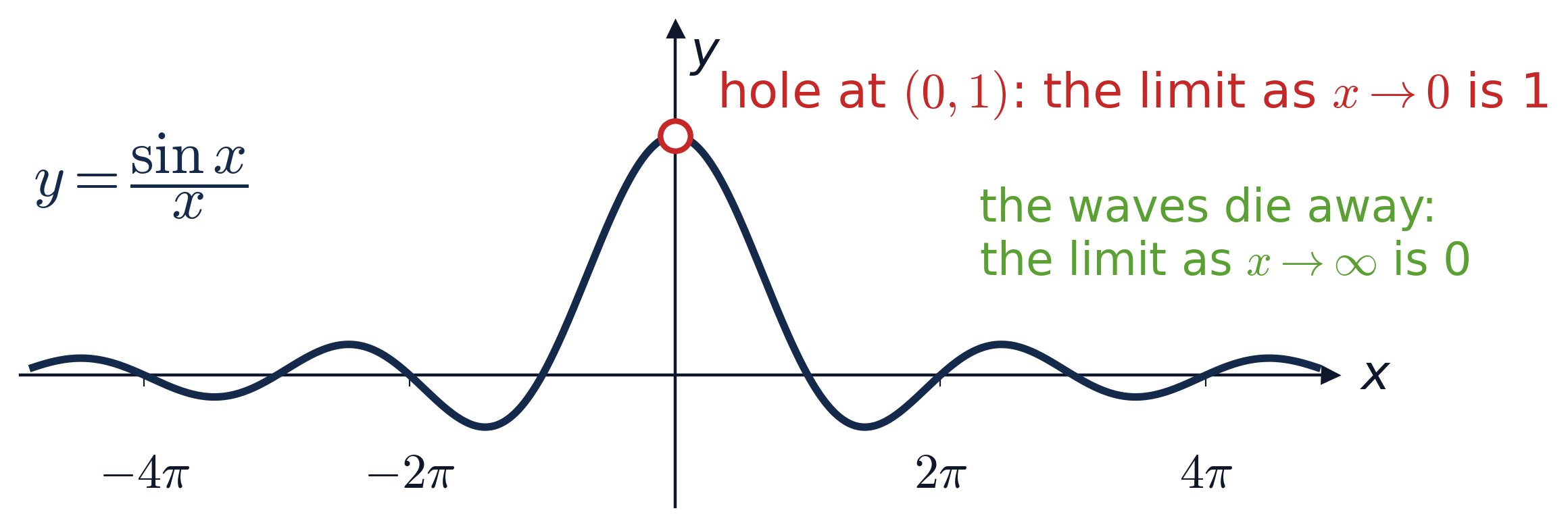
The graph of \dfrac{\sin x}{x} shows limit 2. The curve heads for height 1 at x = 0, and far from 0 the waves die away:
5. Limits as x \to \infty
As x becomes very large, \dfrac{1}{x}, \dfrac{1}{x^2} and \dfrac{1}{\sqrt{x}} all tend to 0.
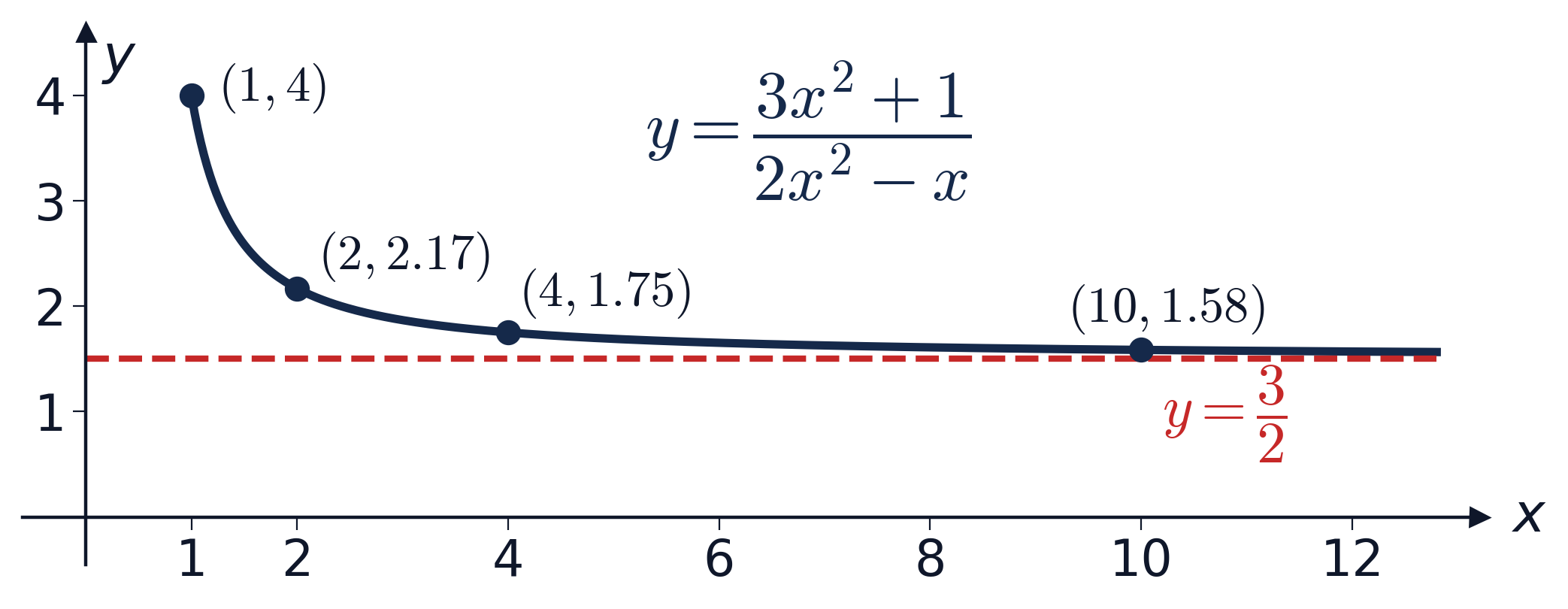
For a fraction of two polynomials, divide the top and the bottom by the highest power of x:
\lim_{x \to \infty} \frac{3x^2 + 1}{2x^2 - x} = \lim_{x \to \infty} \frac{3 + \frac{1}{x^2}}{2 - \frac{1}{x}} = \frac{3}{2}
For a difference of two square roots, rationalise first (Example 5).
6. The form 1^\infty
If f(x) \to 1 and g(x) \to \infty, the limit of f(x)^{g(x)} is not 1. It is
e^{L}, \quad \text{where } L = \lim\, (f(x) - 1)\,g(x)
For example, \lim_{x \to 0} (1 + 2x)^{1/x}: here L = \lim 2x \times \dfrac{1}{x} = 2, so the limit is e^2.
7. Worked examples
Example 1 (factorise). Find \lim_{x \to 2} \dfrac{x^3 - 8}{x^2 - 4}.
Putting x = 2 gives \frac{0}{0}. Factorise: \dfrac{(x - 2)(x^2 + 2x + 4)}{(x - 2)(x + 2)} = \dfrac{x^2 + 2x + 4}{x + 2}. Now put x = 2: \dfrac{12}{4} = 3.
Example 2 (rationalise). Find \lim_{x \to 0} \dfrac{\sqrt{1 + x} - 1}{x}.
Multiply the top and the bottom by \sqrt{1 + x} + 1. The top becomes (1 + x) - 1 = x, which cancels:
\dfrac{\sqrt{1 + x} - 1}{x} = \dfrac{1}{\sqrt{1 + x} + 1}, and at x = 0 this is \dfrac{1}{2}.
Example 3 (sine). Find \lim_{x \to 0} \dfrac{\sin 3x}{\sin 5x}.
Write it as \dfrac{\sin 3x}{3x} \times \dfrac{5x}{\sin 5x} \times \dfrac{3}{5}. The first two factors tend to 1. The limit is \dfrac{3}{5}.
Example 4 (exponential). Find \lim_{x \to 0} \dfrac{3^x - 2^x}{x}.
Add and subtract 1 on the top: \dfrac{(3^x - 1) - (2^x - 1)}{x} = \dfrac{3^x - 1}{x} - \dfrac{2^x - 1}{x}. By standard limit 6 this tends to \ln 3 - \ln 2 = \ln \dfrac{3}{2}.
Example 5 (infinity). Find \lim_{x \to \infty} \left(\sqrt{x^2 + x} - x\right).
Multiply and divide by \sqrt{x^2 + x} + x: the expression becomes \dfrac{(x^2 + x) - x^2}{\sqrt{x^2 + x} + x} = \dfrac{x}{\sqrt{x^2 + x} + x}.
Divide the top and the bottom by x: \dfrac{1}{\sqrt{1 + \frac{1}{x}} + 1}. As x \to \infty this tends to \dfrac{1}{1 + 1} = \dfrac{1}{2}.
8. From the real papers
These six questions are from the Mathematics papers of NDA & NAVAC from 2023 to 2026. Try each for 75 seconds before reading the solution.
NDA II 2023, Q53. Let f(x) = \frac{a^{x-1} + b^{x-1}}{2} and g(x) = x - 1. What is \lim_{x \to 1} \frac{f(x) - 1}{g(x)} equal to?
(a) \frac{\ln(ab)}{4} (b) \frac{\ln(ab)}{2} (c) \ln(ab) (d) 2\ln(ab)
Solution. Put h = x - 1, so h \to 0. The expression is \dfrac{a^h + b^h - 2}{2h} = \dfrac{1}{2}\left(\dfrac{a^h - 1}{h} + \dfrac{b^h - 1}{h}\right). By standard limit 6 this tends to \dfrac{1}{2}(\ln a + \ln b) = \dfrac{\ln(ab)}{2}. Answer (b).
NDA I 2024, Q88. Let f(x) = |x| + 1 and g(x) = [x] - 1, where [.] is the greatest integer function. Let h(x) = \frac{f(x)}{g(x)}. What is \lim_{x \to 0-} h(x) + \lim_{x \to 0+} h(x) equal to?
(a) -\frac{3}{2} (b) -\frac{1}{2} (c) \frac{1}{2} (d) \frac{3}{2}
Solution. From either side f(x) = |x| + 1 \to 1. Just left of 0, [x] = -1, so g(x) = -2 and h(x) \to -\frac{1}{2}. Just right of 0, [x] = 0, so g(x) = -1 and h(x) \to -1. The sum is -\frac{1}{2} - 1 = -\frac{3}{2}. Answer (a).
NDA I 2025, Q93. Let the function f(x) = x^2 + 9. What is \lim_{x \to 0} \frac{\sqrt{f(x)} - 3}{\sqrt{f(x) + 7} - 4} equal to?
(a) 2/3 (b) 1 (c) 4/3 (d) 2
Solution. The limit is \lim_{x \to 0} \dfrac{\sqrt{x^2 + 9} - 3}{\sqrt{x^2 + 16} - 4}, of the form \frac{0}{0}. Rationalise both: the top is \dfrac{x^2}{\sqrt{x^2 + 9} + 3} and the bottom is \dfrac{x^2}{\sqrt{x^2 + 16} + 4}. The x^2 cancels, leaving \dfrac{\sqrt{x^2 + 16} + 4}{\sqrt{x^2 + 9} + 3}. At x = 0 this is \dfrac{8}{6} = \dfrac{4}{3}. Answer (c).
NDA II 2025, Q71. Let f(x) = \begin{cases} \frac{1 - \cos 2x}{x^2}, & x < 0 \\ 9, & x = 0 \\ \frac{\sqrt{x}}{\sqrt{(16 + \sqrt{x})} - 4}, & x > 0 \end{cases} What is \lim_{x \to 0-} f(x) equal to?
(a) 2 (b) 4 (c) 6 (d) 8
Solution. For x < 0 use the first formula. Since 1 - \cos 2x = 2\sin^2 x, f(x) = 2\left(\dfrac{\sin x}{x}\right)^2, which tends to 2 \times 1 = 2. The value 9 at x = 0 plays no part. Answer (a).
NDA I 2026, Q72. What is \lim_{x \to 1} \frac{x^{(n^2 - 1)} - 1}{x^{(n+1)} - 1} equal to, where n > 1 is a natural number?
(a) 0 (b) 1 (c) n - 1 (d) n + 1
Solution. Divide the top and the bottom by x - 1 and use standard limit 1 with a = 1: \dfrac{x^m - 1}{x - 1} \to m. The top tends to n^2 - 1 and the bottom to n + 1. The limit is \dfrac{n^2 - 1}{n + 1} = n - 1. Answer (c).
NDA II 2026, Q84. What is \lim_{x \to 0} \frac{\sin^2 x}{x|x|} equal to?
(a) -1 (b) 0 (c) 1 (d) Limit does not exist
Solution. For x > 0, |x| = x and the expression is \left(\dfrac{\sin x}{x}\right)^2 \to 1. For x < 0, |x| = -x and the expression is -\left(\dfrac{\sin x}{x}\right)^2 \to -1. The two one-sided limits differ. Answer (d).
9. Mistakes that cost marks
- Stopping at \frac{0}{0}. The form \frac{0}{0} does not mean "the limit is 0" or "the limit does not exist". It means the expression must be simplified first.
- Not checking both sides. When the function has |x| or [x], find the left-hand and the right-hand limit separately. If they differ, the answer is "limit does not exist".
- Using \dfrac{\sin x}{x} \to 1 when x \to \infty. That limit is for x \to 0 only. As x \to \infty, \sin x stays between -1 and 1 while x grows, so \dfrac{\sin x}{x} \to 0.
- Taking \dfrac{1 - \cos x}{x^2} \to 1. The value is \dfrac{1}{2}.
10. Quick check
Do these without help. Answers are at the end.
- Find \lim_{x \to 3} \dfrac{x^2 - 9}{x - 3}.
- Find \lim_{x \to 0} \dfrac{\sin 7x}{2x}.
- Find \lim_{x \to 0} \dfrac{e^{3x} - 1}{x}.
- Find \lim_{x \to \infty} \dfrac{5x^2 + 3}{2x^2 + x}.
- Does \lim_{x \to 2}\, [x] exist, where [x] is the greatest integer function?
11. Read and watch more, free
| What | Where | Language |
|---|---|---|
| Textbook | NCERT Class 11 Mathematics, Chapter 12 Limits and Derivatives · Hindi edition | English, Hindi |
| Textbook, limits with e^x and \log x | NCERT Class 11 Supplementary material · Hindi edition | English, Hindi |
| Self-study notes | NIOS Mathematics, Lesson 25 Limits and Continuity · Hindi edition | English, Hindi |
| Video, the chapter for NDA | Defence Wallah: Fast Track 2021 (the class named LIMITS, about 1 hour 40 minutes) | Hinglish |
| Video, short lessons from the beginning | Khan Academy India: Limits, Class 11 (39 short lessons) | Hindi |
| Video, a longer class for NDA | NDA Vijay by Unacademy: Maths Free Milestone Batch (the class named Limits and Continuity, about 4 hours 45 minutes) | Hinglish |
| Past NDA questions | ExamSIDE: Limit, Continuity and Differentiability | English |
The videos were chosen from their titles, length and views; they have not yet been watched by a teacher.
Answers to the quick check
- \dfrac{(x - 3)(x + 3)}{x - 3} = x + 3 \to 6.
- \dfrac{7}{2} \times \dfrac{\sin 7x}{7x} \to \dfrac{7}{2}.
- 3.
- Divide by x^2: \dfrac{5 + \frac{3}{x^2}}{2 + \frac{1}{x}} \to \dfrac{5}{2}.
- No. The left-hand limit is 1 and the right-hand limit is 2.
Next chapter: Continuity.