Why this lesson matters. This chapter drew 6 questions in the seven papers from NDA II 2023 to NDA II 2026, all of them in 2025 and 2026. The number is small, but the idea of this chapter is used in every question of the next three chapters. The exam asks for the slope of a tangent, for the derivative at a point of a function that has a modulus, and for the definition of the derivative as a limit. Five real questions are solved in section 8.
What you will be able to do
- Find a derivative at a point from the definition (from first principles).
- Use the derivative as the slope of the tangent, and write the equations of the tangent and the normal.
- Use the derivative as a rate of change, such as velocity and acceleration.
- Say at which points a function with a modulus has no derivative.
Before you start you should know: limits (Chapter M5-3), continuity and corners (Chapter M5-4), and the slope and equation of a straight line (Chapter M4-2).
1. From average rate to the derivative
Take a function f and two inputs, a and a + h. The average rate of change of f between them is
\frac{f(a + h) - f(a)}{h}
On the graph this is the slope of the straight line joining the two points. Now let h shrink to 0. The limit, if it exists, is the derivative of f at a:
f'(a) = \lim_{h \to 0} \frac{f(a + h) - f(a)}{h}
For f(x) = x^2 at a = 3:
\dfrac{(3 + h)^2 - 9}{h} = \dfrac{6h + h^2}{h} = 6 + h, which tends to 6. So f'(3) = 6.
Do the same with x in place of 3: \dfrac{(x + h)^2 - x^2}{h} = 2x + h, which tends to 2x. So the derivative of x^2 is 2x at every point. Finding a derivative in this way is called differentiation from first principles.
2. Notation
If y = f(x), the derivative is written in any of these ways:
f'(x), \qquad \frac{dy}{dx}, \qquad y', \qquad \frac{d}{dx} f(x)
Its value at the point x = a is written f'(a) or \left.\dfrac{dy}{dx}\right|_{x = a}.
3. Derivatives to use now
Each of these comes from the definition in section 1. Learn them. The other rules are in the next chapter.
| f(x) | f'(x) |
|---|---|
| A constant c | 0 |
| x^n | n x^{n-1} |
| \sin x | \cos x |
| \cos x | -\sin x |
| e^x | e^x |
| \ln x | \dfrac{1}{x} |
Two rules let you differentiate a polynomial term by term: the derivative of a sum is the sum of the derivatives, and a constant multiplier stays in front. For example,
\frac{d}{dx}\left(x^3 - 6x^2 + 9x\right) = 3x^2 - 12x + 9
4. The geometrical meaning: slope of the tangent
Take a point P on a curve and a second point Q on the curve near it. The line PQ is a chord. As Q slides along the curve towards P, the chord turns and settles on one line. That line is the tangent at P. The slope of the chord is the average rate, so the slope of the tangent is the derivative.
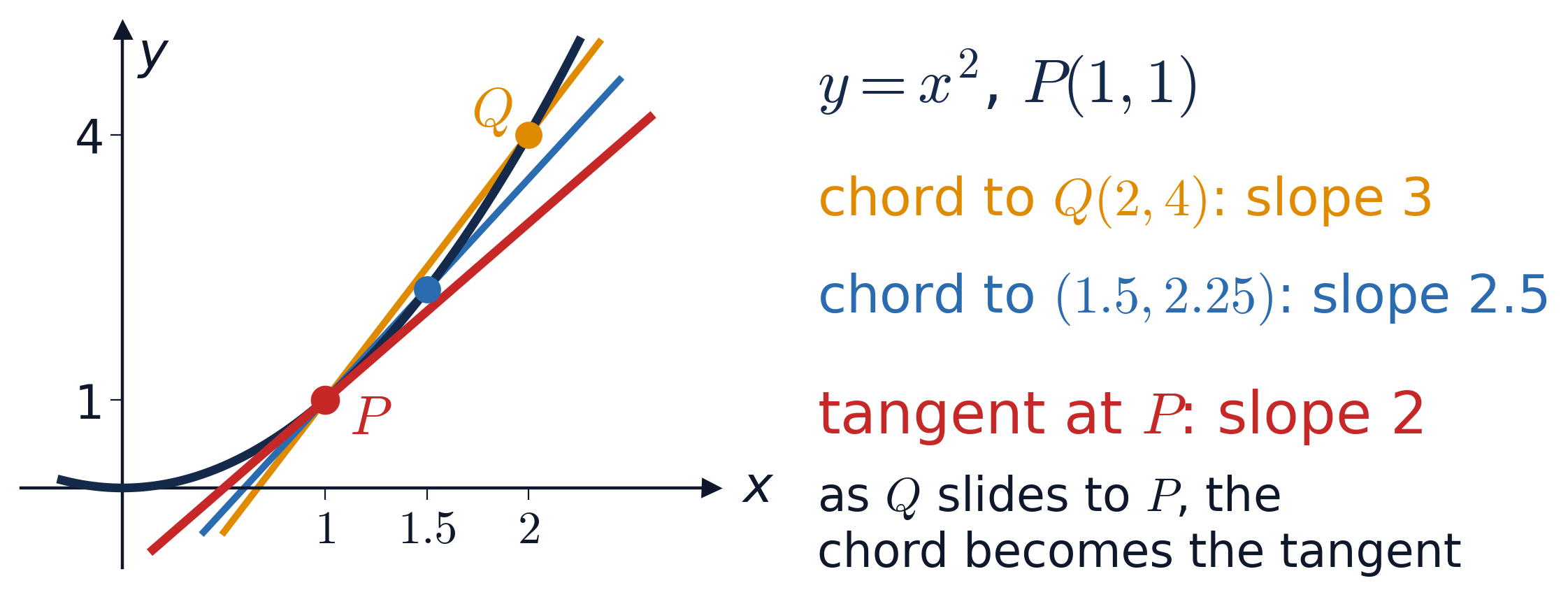
f'(a) is the slope of the tangent to y = f(x) at the point (a, f(a)). If the tangent makes an angle \theta with the positive x-axis, then f'(a) = \tan\theta.
From this:
- Tangent at (x_1, y_1): \;y - y_1 = m(x - x_1), where m = f'(x_1).
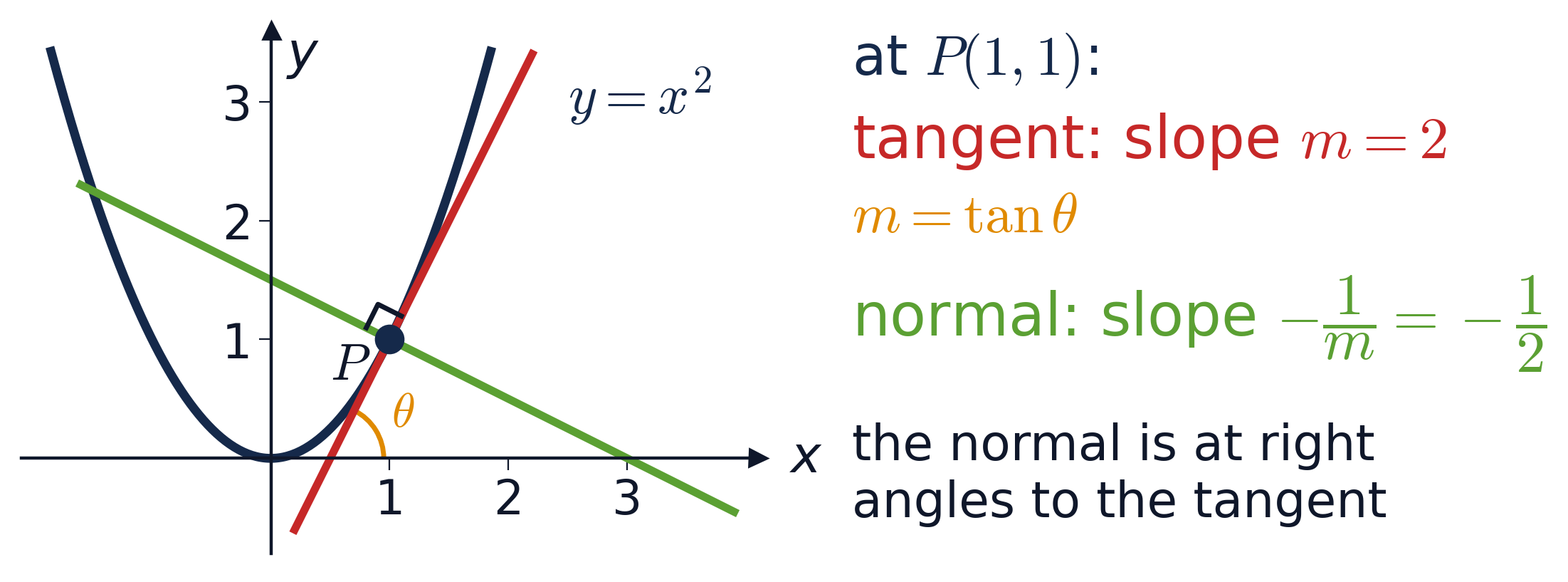
- Normal at (x_1, y_1): the line through the point at right angles to the tangent. Its slope is -\dfrac{1}{m} (when m \ne 0).
- The tangent is parallel to the x-axis exactly where f'(x) = 0.
- If the slope is the same number m at every point, the curve is a straight line y = mx + c.
For example, on y = x^2 at the point P(1, 1) the tangent has slope 2 and the normal has slope -\dfrac{1}{2}:
5. The physical meaning: rate of change
\dfrac{dy}{dx} is the rate at which y changes when x changes. A positive value means y is increasing. A negative value means y is decreasing.
If a body moves along a line and its distance from a fixed point at time t is s, then
\text{velocity } v = \frac{ds}{dt}, \qquad \text{acceleration } a = \frac{dv}{dt}
For example, if s = 5t^2 metres, then v = 10t. At t = 2 seconds the velocity is 20 metres per second.
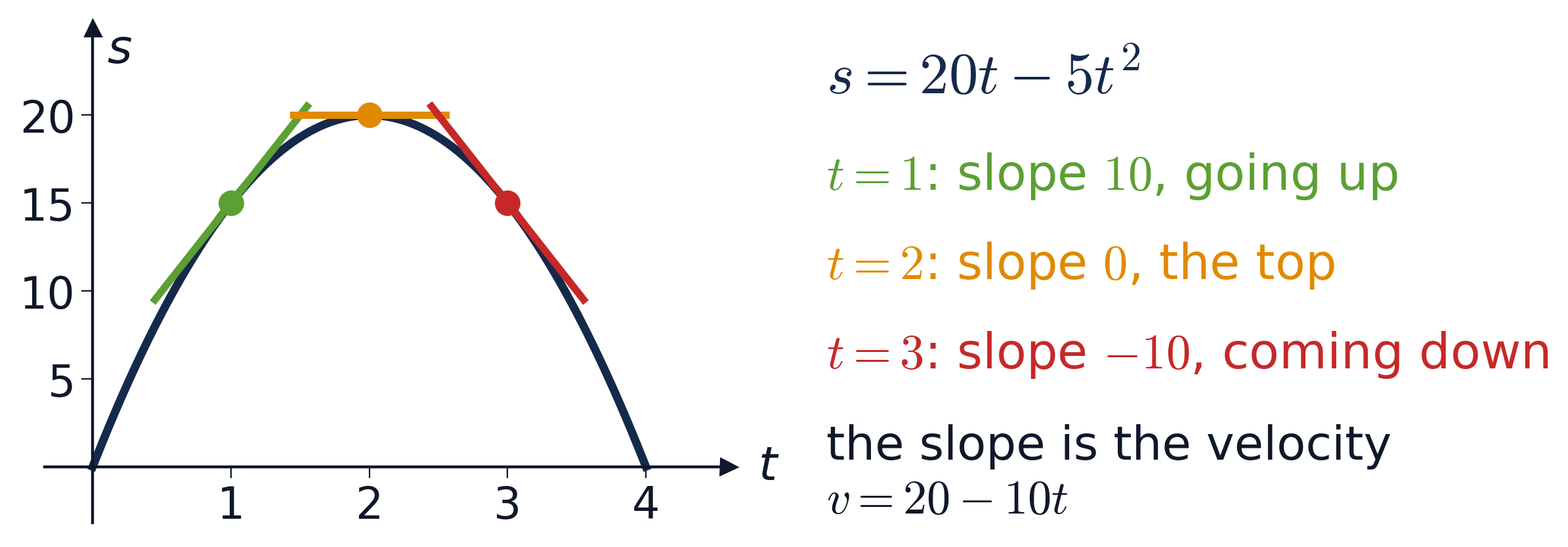
A ball thrown straight up has height s = 20t - 5t^2 metres after t seconds, so its velocity is v = 20 - 10t. The slope of the graph of s shows this velocity: positive on the way up, zero at the top, negative on the way down.
The same idea works for any two quantities. The area of a circle is A = \pi r^2, so \dfrac{dA}{dr} = 2\pi r. When r = 5 cm, the area grows by 10\pi square cm for each cm of radius.
6. Where the derivative does not exist
The limit in section 1 must be the same from the left (h < 0) and from the right (h > 0). So there is no derivative at a corner, where the slope on the left differs from the slope on the right, and no derivative at a point where the function is not continuous.
For a function with a modulus, write it without the modulus on each side of the point.
- If the quantity inside the modulus is not zero at the point, it keeps one sign near the point. Remove the modulus with that sign and differentiate.
- If the quantity inside is zero at the point and changes sign there, find the slope on each side. If the two slopes differ, the derivative does not exist.
For example, |x - 3| has slope -1 for x < 3 and slope 1 for x > 3. It has no derivative at x = 3. At x = 5 its derivative is 1.
7. Worked examples
Example 1 (first principles). Find the derivative of f(x) = x^2 + 3x at x = 1 from the definition.
f(1) = 4 and f(1 + h) = (1 + h)^2 + 3(1 + h) = 4 + 5h + h^2.
\dfrac{f(1 + h) - f(1)}{h} = \dfrac{5h + h^2}{h} = 5 + h, which tends to 5. So f'(1) = 5.
Check with the table: f'(x) = 2x + 3, and f'(1) = 5.
Example 2 (tangent and normal). Find the equations of the tangent and the normal to y = x^3 at the point (2, 8).
\dfrac{dy}{dx} = 3x^2. At x = 2 the slope is m = 12.
Tangent: y - 8 = 12(x - 2), that is y = 12x - 16.
Normal: slope -\dfrac{1}{12}, so y - 8 = -\dfrac{1}{12}(x - 2), that is x + 12y = 98.
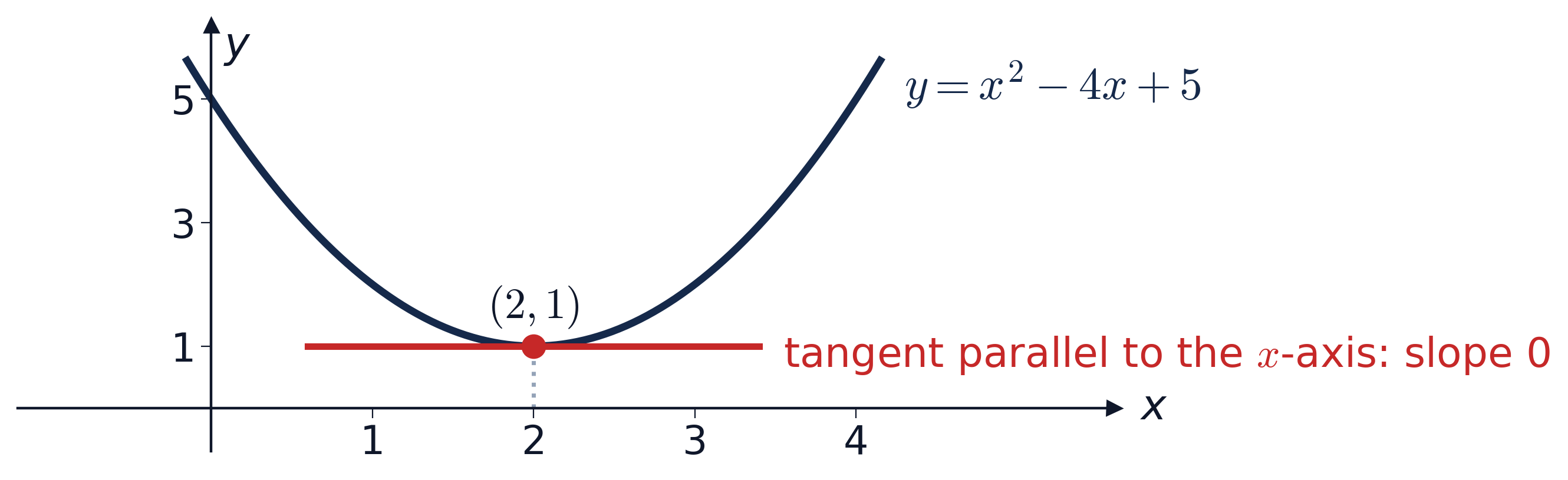
Example 3 (horizontal tangent). At which point of the curve y = x^2 - 4x + 5 is the tangent parallel to the x-axis?
\dfrac{dy}{dx} = 2x - 4. This is 0 when x = 2. Then y = 4 - 8 + 5 = 1. The point is (2, 1).
Example 4 (motion). A particle moves along a line so that s = t^3 - 6t^2 + 9t, with s in metres and t in seconds. Find its velocity and acceleration at t = 2. When is it at rest?
v = \dfrac{ds}{dt} = 3t^2 - 12t + 9. At t = 2: v = 12 - 24 + 9 = -3 metres per second. The minus sign means it is moving backwards.
a = \dfrac{dv}{dt} = 6t - 12. At t = 2: a = 0.
At rest means v = 0: 3(t - 1)(t - 3) = 0, so t = 1 and t = 3 seconds.
8. From the real papers
These five questions are from the Mathematics papers of NDA & NAVAC of 2025 and 2026. Try each for 75 seconds before reading the solution.
NDA I 2025, Q77. The slope of the tangent to the curve y = f(x) at (x, f(x)) is 4 for every real number x and the curve passes through the origin. What is the nature of the curve?
(a) A straight line passing through (1, 4) (b) A straight line passing through (-1, 4) (c) A parabola with vertex at origin and focus at (2, 0) (d) A parabola with vertex at origin and focus at (1, 0)
Solution. The slope is the same number, 4, at every point, so the curve is a straight line y = 4x + c. It passes through the origin, so c = 0 and y = 4x. At x = 1, y = 4. Answer (a).
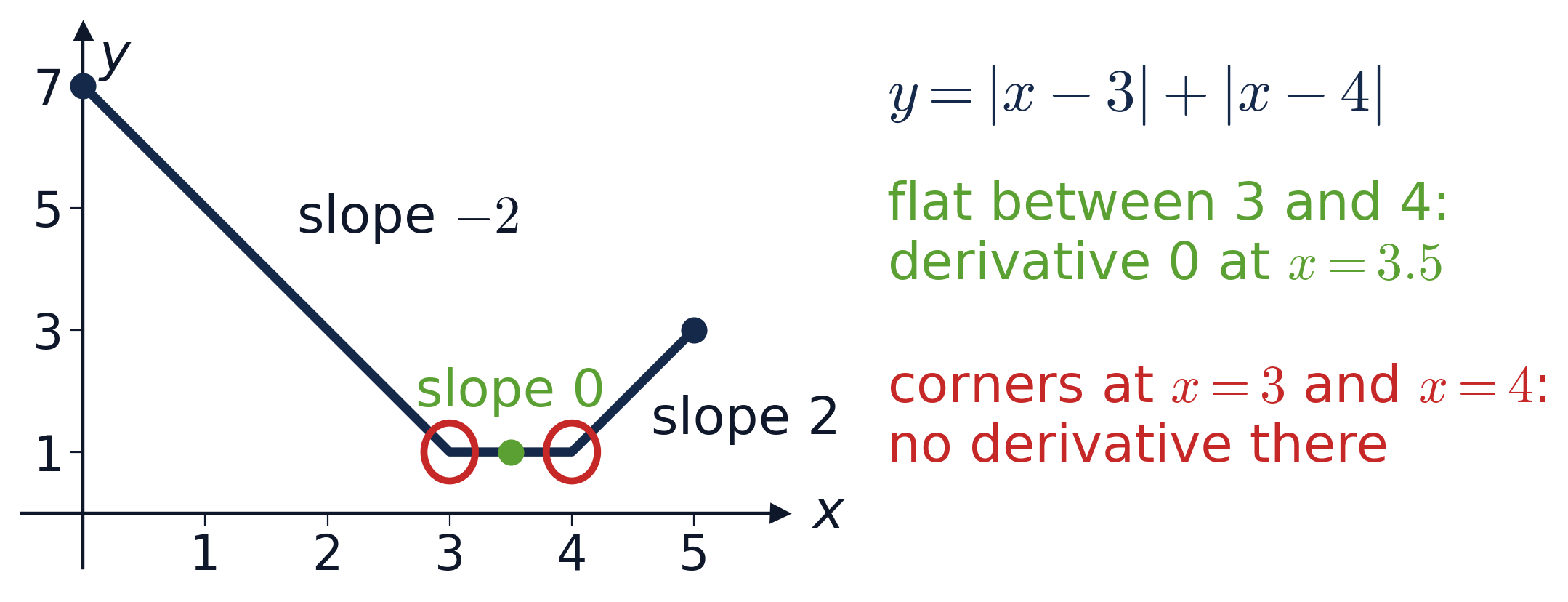
NDA II 2025, Q87. Let the function f(x) = |x - 3| + |x - 4| be defined on the interval [0, 5]. What is \frac{dy}{dx} at x = 3.5 equal to?
(a) 0 (b) 1 (c) 2 (d) 3.5
Solution. Here y means f(x). Between 3 and 4, x - 3 is positive and x - 4 is negative. So f(x) = (x - 3) + (4 - x) = 1, a constant. Its derivative is 0. Answer (a).
NDA II 2025, Q88. Let the function f(x) = |x - 3| + |x - 4| be defined on the interval [0, 5]. Consider the following statements : I. The function is differentiable at x = 3. II. The function is differentiable at x = 4. Which of the statements given above is/are correct?
(a) I only (b) II only (c) Both I and II (d) Neither I nor II
Solution. In pieces: for x < 3, f(x) = 7 - 2x (slope -2); for 3 \le x \le 4, f(x) = 1 (slope 0); for x > 4, f(x) = 2x - 7 (slope 2). At x = 3 the slopes are -2 and 0. At x = 4 they are 0 and 2. The graph has a corner at both points. Answer (d).
NDA II 2026, Q92. If y = \left|\sin\left(\frac{\pi}{4} - x\right)\right|, then what is \frac{dy}{dx} at x = \frac{\pi}{4} equal to?
(a) -1 (b) 0 (c) 1 (d) It does not exist
Solution. At x = \frac{\pi}{4} the quantity inside the modulus is \sin 0 = 0, and it changes sign there. Take x = \frac{\pi}{4} + h: then y = |\sin(-h)| = |\sin h| and y = 0 at h = 0. So the limit to study is \dfrac{|\sin h|}{h}. For h > 0 it is \dfrac{\sin h}{h} \to 1. For h < 0 it is -\dfrac{\sin h}{h} \to -1. The two sides differ. Answer (d).
NDA II 2026, Q93. Let f be a differentiable function such that f(x + y) = f(x) + f(y) for all x, y \in R. Which of the following statements is/are correct? I. If f(x) = x\,g(x), then the derivative of f(x) with respect to x is equal to g(0). II. If f(x) = x^2 g(x), then the derivative of f(x) with respect to x is equal to 0. (Here g is a continuous function) Select the answer using the code given below.
(a) I only (b) II only (c) Both I and II (d) Neither I nor II
Solution. Use the definition. From the given rule, f(x + h) - f(x) = f(h). So f'(x) = \lim_{h \to 0} \dfrac{f(h)}{h}, the same for every x. I: if f(h) = h\,g(h), then \dfrac{f(h)}{h} = g(h) \to g(0), because g is continuous. Correct. II: if f(h) = h^2 g(h), then \dfrac{f(h)}{h} = h\,g(h) \to 0. Correct. Answer (c).
9. Mistakes that cost marks
- Putting the number in before differentiating. To find f'(3) for f(x) = x^2, first find f'(x) = 2x, then put x = 3 to get 6. If you first write f(3) = 9 and differentiate the constant 9, you get 0, which is wrong.
- The slope of the normal. It is -\dfrac{1}{m}, not -m and not \dfrac{1}{m}. For a tangent of slope 12 the normal has slope -\dfrac{1}{12}.
- Giving 0 as the derivative at a corner. At a corner the slopes on the two sides differ, and the derivative does not exist. Do not take the average of the two slopes.
- Mixing up f(a) and f'(a). "The curve passes through (2, 8)" is a statement about f. "The slope at x = 2 is 12" is a statement about f'.
10. Quick check
Do these without help. Answers are at the end.
- Find the derivative of f(x) = x^2 at x = -3 from the definition.
- Find the slope of the tangent to y = x^3 - x at x = 1.
- A particle moves so that s = 4t^2 + 3t (metres, seconds). Find its velocity at t = 2.
- At which point of y = x^2 - 6x is the tangent parallel to the x-axis?
- Let f(x) = |x - 1|. Does f'(1) exist? What is f'(4)?
11. Read and watch more, free
| What | Where | Language |
|---|---|---|
| Textbook | NCERT Class 11 Mathematics, Chapter 12 Limits and Derivatives · Hindi edition | English, Hindi |
| Textbook, rate of change and tangents | NCERT Class 12 Mathematics, Chapter 6 Application of Derivatives · Hindi edition | English, Hindi |
| Self-study notes | NIOS Mathematics, Lesson 26 Differentiation · Hindi edition | English, Hindi |
| Video, the idea in pictures | 3Blue1Brown: Essence of calculus (12 videos) | English |
| Video, the chapter for NDA | Defence Wallah: Fast Track 2021 (the class named DERIVATIVES, about 1 hour) | Hinglish |
| Video, short lessons from the beginning | Khan Academy India: channel playlists (the playlist named Derivatives, 28 lessons) | Hindi |
The videos were chosen from their titles, length and views; they have not yet been watched by a teacher.
Answers to the quick check
- \dfrac{(-3 + h)^2 - 9}{h} = \dfrac{-6h + h^2}{h} = -6 + h, which tends to -6.
- \dfrac{dy}{dx} = 3x^2 - 1. At x = 1 the slope is 2.
- v = 8t + 3. At t = 2, v = 19 metres per second.
- 2x - 6 = 0 gives x = 3, and y = 9 - 18 = -9. The point is (3, -9).
- f'(1) does not exist (slopes -1 and 1). Near x = 4, f(x) = x - 1, so f'(4) = 1.
Next chapter: Rules of differentiation.