Why this lesson matters. This chapter drew 15 questions in the seven papers from NDA II 2023 to NDA II 2026, and at least one in every paper. The exam asks about differentiability under the same heading, so both are taught here. There are three kinds of question: find the constant that makes a function continuous, decide whether a function with |x| or [x] is continuous or differentiable at a point, and use the fact that a differentiable function is continuous. Six real questions are solved in section 8.
What you will be able to do
- Test whether a function is continuous at a point with three checks.
- Find the unknown constant that makes a two-piece function continuous.
- Test whether a function is differentiable at a point by comparing the slope on the two sides.
- Use the link: differentiable means continuous, but continuous does not mean differentiable.
Before you start you should know: left-hand and right-hand limits and the standard limits (Chapter M5-3), and the functions |x| and [x] (Chapter M5-1). Sections 4 to 6 use the slope of a curve. It is enough for now to know that the slope of the line y = mx + c is m and that the slope of y = x^2 at the point x is 2x. The full rules come in Chapters M5-5 and M5-6.
1. Continuity at a point
A function f is continuous at x = a if
\lim_{x \to a-} f(x) = \lim_{x \to a+} f(x) = f(a)
This is three checks in one line:
- f(a) has a value.
- The left-hand limit and the right-hand limit are equal, so the limit exists.
- The limit is equal to f(a).
If any check fails, f is discontinuous at a.
On the graph: a function is continuous at a if the graph passes through the point above a without a break. You can draw it without lifting the pen. A break can be a jump (the two sides arrive at different heights) or a hole (the two sides arrive at the same height, but the point itself is missing or is placed somewhere else).
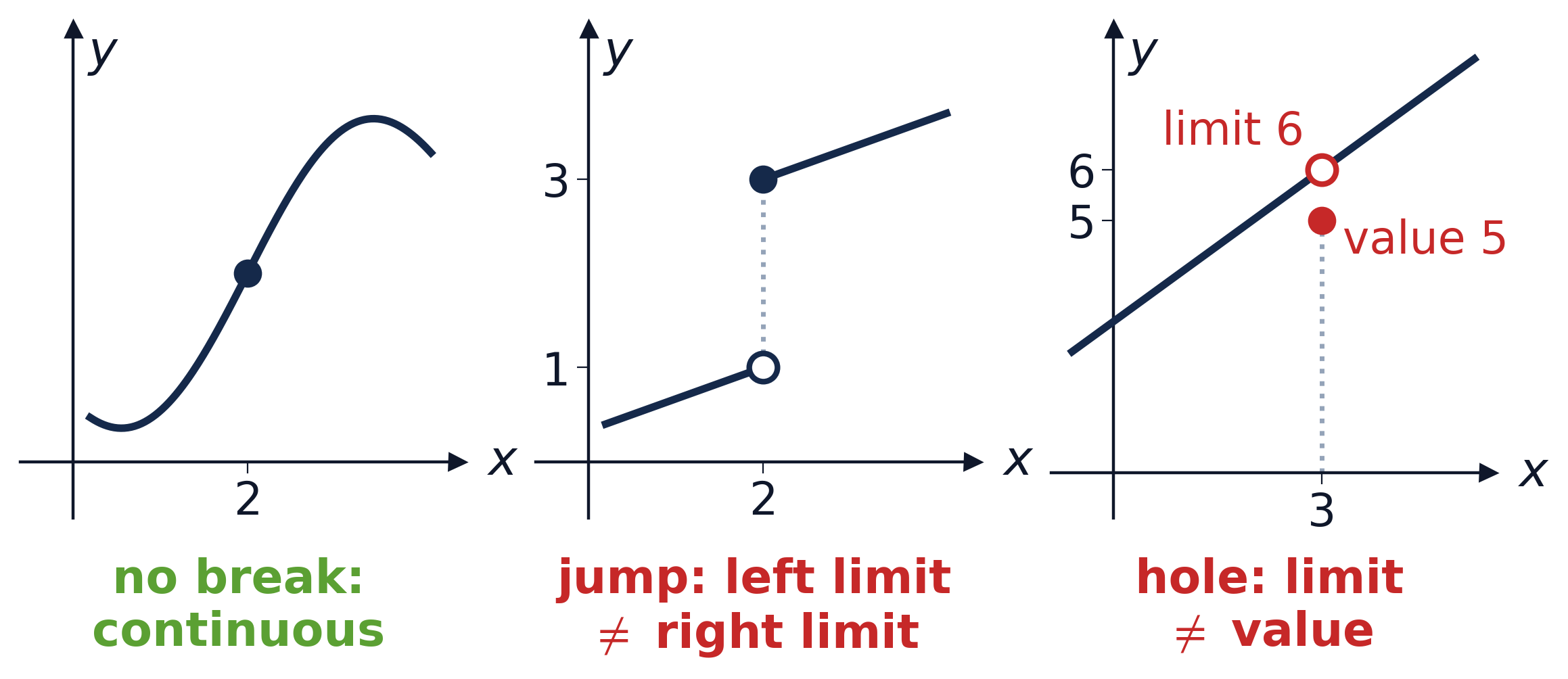
The third graph is Example 1 below.
For example, [x] at x = 1: the left-hand limit is 0 and the right-hand limit is 1. Check 2 fails. There is a jump.
A function is called continuous (with no point named) if it is continuous at every point of its domain.
2. Which functions are continuous
- Polynomials, \sin x, \cos x, e^x and |x| are continuous at every real x.
- \log x is continuous for x > 0.
- A fraction \dfrac{p(x)}{q(x)} of continuous functions is continuous wherever q(x) \ne 0. So \tan x is continuous except where \cos x = 0.
- Sums, differences, products and composites of continuous functions are continuous.
- The greatest integer function [x] is discontinuous at every integer and continuous everywhere else.
So a function given by one ordinary formula needs no test. The only points to test are the points where the formula changes, and the points where [\;] has an integer inside it.
3. Finding the unknown constant
This is the most common question. The function has two formulas that meet at a point, and one formula has an unknown constant k. Make the two sides agree at the meeting point.
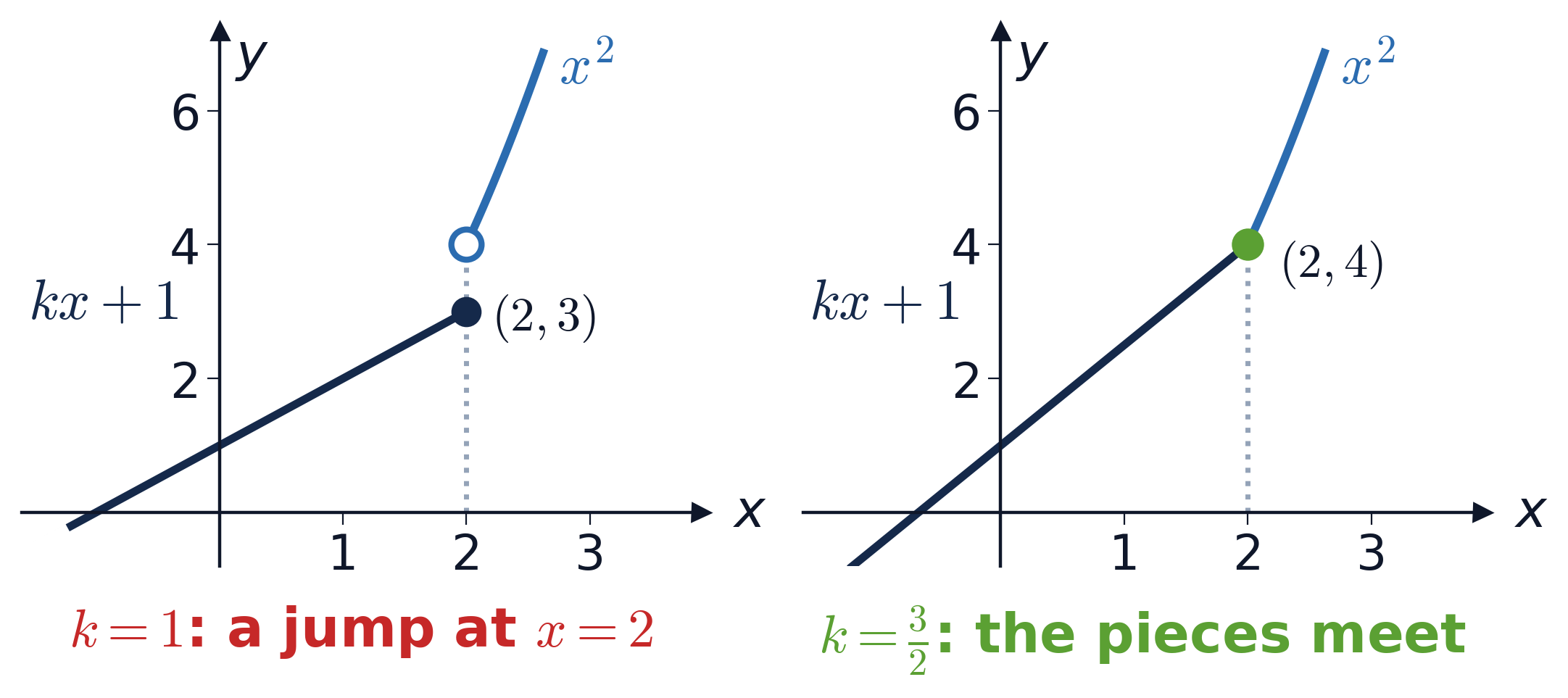
Take f(x) = \begin{cases} kx + 1, & x \le 2 \\ x^2, & x > 2 \end{cases}.
At x = 2: the left-hand limit and the value are both 2k + 1. The right-hand limit is 2^2 = 4. For continuity 2k + 1 = 4, so k = \dfrac{3}{2}.
4. Differentiability at a point
The slope of the graph of f at x = a is found from a limit:
f'(a) = \lim_{h \to 0} \frac{f(a + h) - f(a)}{h}
If h is taken only negative, the limit is the left-hand derivative, the slope of the graph just to the left of a. If h is taken only positive, it is the right-hand derivative, the slope just to the right.
f is differentiable at a if the left-hand derivative and the right-hand derivative are equal (and finite). Their common value is f'(a).
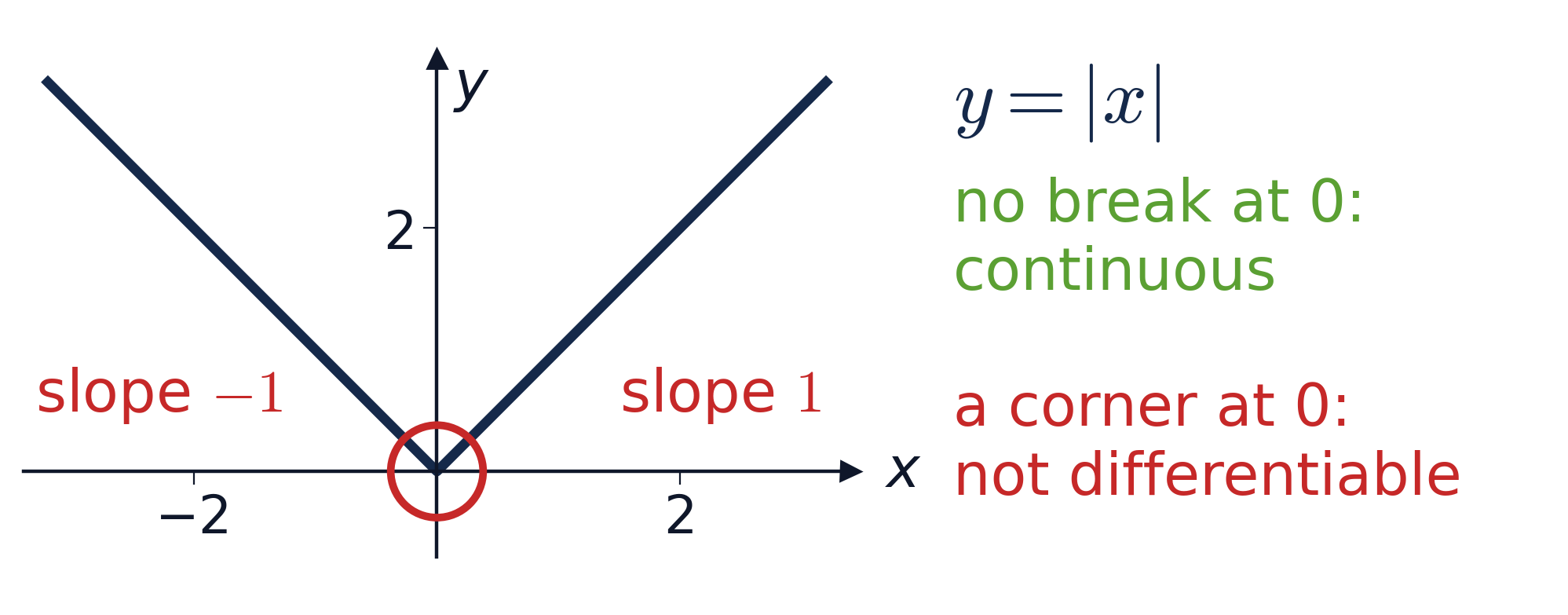
On the graph: differentiable means smooth. A sharp corner is a point where the graph is continuous but the slope changes suddenly, so the function is not differentiable there.
The standard example is f(x) = |x| at x = 0. The graph is a V. For h > 0, \dfrac{|h| - 0}{h} = 1. For h < 0, \dfrac{|h| - 0}{h} = -1. The right-hand derivative is 1 and the left-hand derivative is -1. So |x| is not differentiable at 0, although it is continuous there.
5. The link between the two
| Statement | True or false |
|---|---|
| If f is differentiable at a, then f is continuous at a | True, always |
| If f is continuous at a, then f is differentiable at a | False. Example: \lvert x \rvert at 0 |
| If f is not continuous at a, then f is not differentiable at a | True. Example: [x] at any integer |
Three facts are asked again and again.
- |x - a| is continuous everywhere and is not differentiable at x = a (a corner).
- [x] is constant between two integers. So at any point that is not an integer it is continuous and differentiable, with derivative 0.
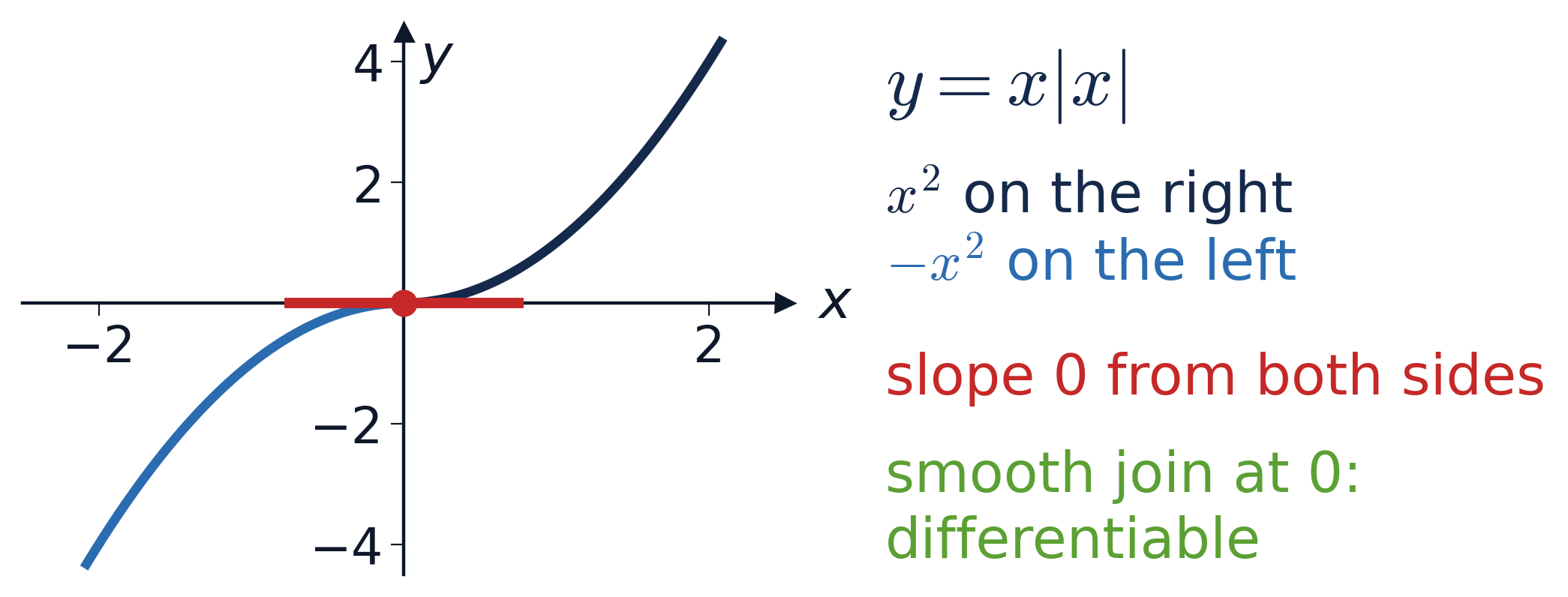
- x|x| is differentiable everywhere, also at 0. It equals x^2 on the right and -x^2 on the left, and both have slope 0 at x = 0.
6. Making a two-piece function differentiable
For a function with two formulas that meet at x = a to be differentiable at a, two conditions are needed:
- The values match at a (continuity).
- The slopes match at a (left-hand derivative = right-hand derivative).
Two conditions give two equations, so two unknown constants can be found. See Example 5.
7. Worked examples
Example 1. Let f(x) = \dfrac{x^2 - 9}{x - 3} for x \ne 3 and f(3) = 5. Is f continuous at x = 3?
For x \ne 3, f(x) = x + 3, so \lim_{x \to 3} f(x) = 6. But f(3) = 5. The limit exists and is not equal to the value: check 3 fails. f is not continuous at 3. (If f(3) were 6, it would be continuous.)
Example 2. Find k if f(x) = \begin{cases} kx + 1, & x \le 3 \\ x^2 - 2, & x > 3 \end{cases} is continuous at x = 3.
Left side and value: 3k + 1. Right side: 9 - 2 = 7. So 3k + 1 = 7 and k = 2.
Example 3. Find k if f(x) = \dfrac{\sin 3x}{x} for x \ne 0 and f(0) = k is continuous at x = 0.
\lim_{x \to 0} \dfrac{\sin 3x}{x} = 3 (a standard limit). For continuity the value must equal the limit, so k = 3.
Example 4. Show that f(x) = |x - 2| is continuous at x = 2 but not differentiable there.
For x \ge 2, f(x) = x - 2, a line of slope 1. For x < 2, f(x) = 2 - x, a line of slope -1.
Continuity: both formulas give 0 at x = 2, and f(2) = 0. Continuous.
Differentiability: the left-hand derivative is -1 and the right-hand derivative is 1. They differ. Not differentiable.
Example 5. Find a and b if f(x) = \begin{cases} x^2, & x \le 1 \\ ax + b, & x > 1 \end{cases} is differentiable at x = 1.
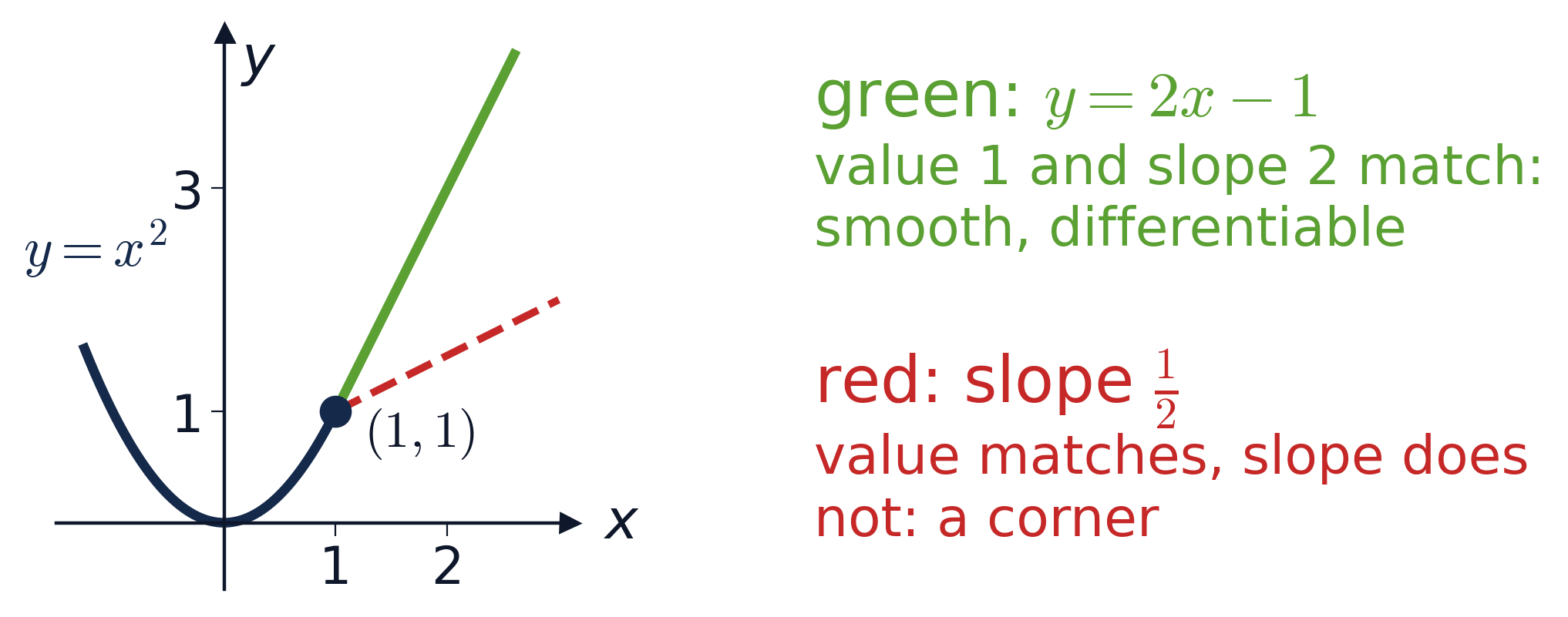
Values match: 1^2 = a + b, so a + b = 1.
Slopes match: the slope of x^2 at x = 1 is 2 \times 1 = 2, and the slope of ax + b is a. So a = 2.
Then b = 1 - 2 = -1. The line y = 2x - 1 is the tangent to y = x^2 at (1, 1).
8. From the real papers
These six questions are from the Mathematics papers of NDA & NAVAC from 2023 to 2026. Try each for 75 seconds before reading the solution.
NDA II 2023, Q63. Let f(x) = \begin{cases} ax(x + 1) + b, & x < 1 \\ x - 1, & 1 \le x \le 2 \end{cases} If the function f(x) is differentiable at x = 1, then what is the value of (a + b)?
(a) -\frac{1}{3} (b) -1 (c) 0 (d) 1
Solution. Values match at x = 1: a(1)(2) + b = 1 - 1, so 2a + b = 0. Slopes match: for x < 1, f(x) = ax^2 + ax + b has slope 2ax + a, which is 3a at x = 1; the slope of x - 1 is 1. So 3a = 1, a = \frac{1}{3} and b = -\frac{2}{3}. Then a + b = -\frac{1}{3}. Answer (a).
NDA I 2024, Q87. Let f(x) = |x| + 1 and g(x) = [x] - 1, where [.] is the greatest integer function. Let h(x) = \frac{f(x)}{g(x)}. Consider the following statements : 1. f(x) is differentiable for all x < 0 2. g(x) is continuous at x = 0.0001 3. The derivative of g(x) at x = 2.5 is 1 Which of the statements given above are correct?
(a) 1 and 2 only (b) 2 and 3 only (c) 1 and 3 only (d) 1, 2 and 3
Solution. Statement 1: for x < 0, f(x) = -x + 1, a straight line, so it is differentiable there. Correct. Statement 2: [x] jumps only at integers, and 0.0001 is not an integer. Correct. Statement 3: near x = 2.5, g(x) = 2 - 1 = 1, a constant, so its derivative is 0, not 1. Wrong. Answer (a).
NDA II 2025, Q83. Consider the function f(x) = \begin{cases} 4(5^x), & x < 0 \\ 8k + x, & x \ge 0 \end{cases} If the function is continuous, then what is the value of k?
(a) 0.5 (b) 1 (c) 1.5 (d) 2
Solution. The formula changes only at x = 0. Left-hand limit: 4 \times 5^0 = 4. Value and right-hand limit: 8k + 0 = 8k. So 8k = 4 and k = 0.5. Answer (a).
NDA I 2026, Q71. If f(x) is differentiable at x = a, then consider the following statements : I. f(x) is continuous at x = a II. \lim_{x \to a} f(x) = f(a) Which of the statements given above is/are correct?
(a) I only (b) II only (c) Both I and II (d) Neither I nor II
Solution. A differentiable function is continuous (section 5), so I is correct. Statement II is the definition of continuity at x = a, so it says the same thing as I. Answer (c).
NDA II 2026, Q83. Consider the following statements in respect of the function f(x) = [3x], where [\cdot] is the greatest integer function : I. f(x) is continuous at x = 1/3. II. f(x) is differentiable at x = 1/4. Which of the statements given above is/are correct?
(a) I only (b) II only (c) Both I and II (d) Neither I nor II
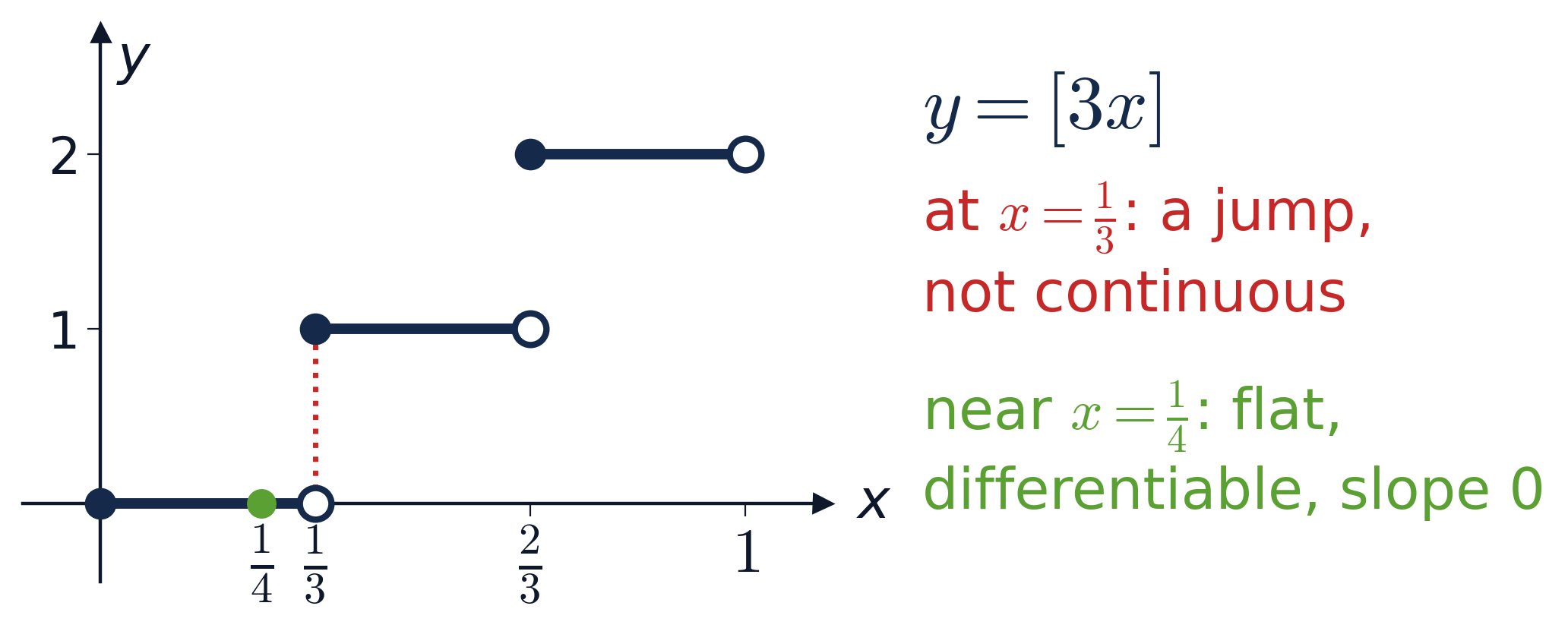
Solution. I: at x = \frac{1}{3} the quantity inside is 3x = 1, an integer. Just to the left f = 0; at the point and just to the right f = 1. A jump, so not continuous. II: at x = \frac{1}{4}, 3x = \frac{3}{4} is not an integer. Near this point f(x) = 0, a constant, which is differentiable. Only II is correct. Answer (b).
NDA II 2026, Q85. Let f(x) = p|x| + q, where p and q are real constants. If f'(x) exists at x = 0, then what is the value of p?
(a) -1 (b) 0 (c) 1 (d) q
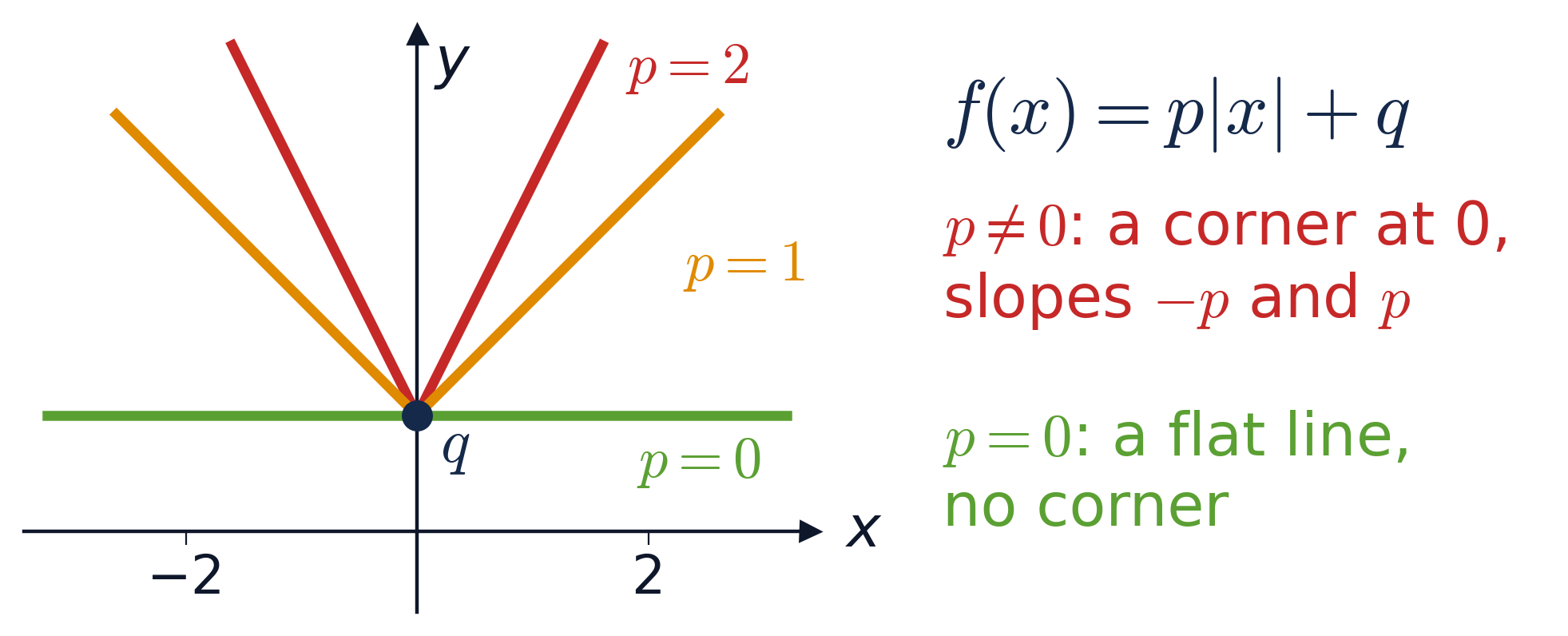
Solution. For x > 0, f(x) = px + q, with slope p. For x < 0, f(x) = -px + q, with slope -p. The derivative at 0 exists only if p = -p, so p = 0. Answer (b).
9. Mistakes that cost marks
- Checking the two sides and forgetting the value. The limit can exist and still differ from f(a), as in Example 1. Continuity needs all three equal.
- "Continuous, so differentiable." This is the wrong way round. |x| is continuous at 0 and not differentiable there. The true statement is: differentiable, so continuous.
- Matching the slopes without matching the values. To make a two-piece function differentiable, use both conditions. Slopes alone are not enough.
- Thinking [x] is discontinuous everywhere. It jumps only at integers. For [3x] the jumps are where 3x is an integer.
10. Quick check
Do these without help. Answers are at the end.
- Find k if f(x) = \begin{cases} 3x + k, & x < 1 \\ x^2 + 4, & x \ge 1 \end{cases} is continuous at x = 1.
- At which points is the greatest integer function [x] discontinuous?
- Is |x| differentiable at x = 0? At x = 5?
- Find k if f(x) = \dfrac{1 - \cos x}{x^2} for x \ne 0 and f(0) = k is continuous at x = 0.
- True or false: every continuous function is differentiable.
11. Read and watch more, free
| What | Where | Language |
|---|---|---|
| Textbook | NCERT Class 12 Mathematics, Chapter 5 Continuity and Differentiability · Hindi edition | English, Hindi |
| Self-study notes | NIOS Mathematics, Lesson 25 Limits and Continuity · Hindi edition | English, Hindi |
| Video, the chapter for NDA | Defence Wallah: Fast Track 2021 (the class named CONTINUITY AND DIFFERENTIABILITY, about 1 hour 50 minutes) | Hinglish |
| Video, every textbook problem | Magnet Brains: Class 12 Maths complete course (the 30 videos of Chapter 5) | Hinglish |
| Video, a longer class for NDA | NDA Vijay by Unacademy: Maths Free Milestone Batch (the class named Limits and Continuity, about 4 hours 45 minutes) | Hinglish |
| Past NDA questions | ExamSIDE: Limit, Continuity and Differentiability | English |
The videos were chosen from their titles, length and views; they have not yet been watched by a teacher.
Answers to the quick check
- Left-hand limit: 3 + k. Value: 1 + 4 = 5. So k = 2.
- At every integer, and nowhere else.
- Not at 0 (a corner: slopes -1 and 1). Yes at 5: near 5, |x| = x, with slope 1.
- The limit is \dfrac{1}{2}, so k = \dfrac{1}{2}.
- False. |x| is continuous at 0 but not differentiable there.
Next chapter: The derivative and its meaning.