Why this chapter matters. This chapter drew 9 questions in the seven papers from NDA II 2023 to NDA II 2026, about one in each paper. Most are solved by separating the variables, sometimes after a simple substitution. A few ask you to check a given solution. None of the captured questions was a word problem on growth and decay, but the topic is in the syllabus, and section 6 gives the one result it needs.
What you will be able to do
- Solve an equation of the first order and first degree by separating the variables, and use a given condition to find the constant.
- Recognise a homogeneous equation and solve it with y = vx.
- Recognise a linear equation and solve it with an integrating factor.
- Use N = N_0 e^{kt} for growth and decay.
Before you start you should know: the standard integrals and substitution (Chapters M6-1 and M6-2), order, degree and the general solution (Chapter M6-4), and the laws of logarithms (Chapter M1-11).
1. What solving means
All equations in this chapter have order 1 and degree 1, so they can be written as \dfrac{dy}{dx} = (some expression in x and y).
To solve is to find y as a function of x, or a relation between x and y with no derivative in it. The general solution has one arbitrary constant c. A condition such as y(0) = 2, which means "y = 2 when x = 0", fixes c and gives a particular solution.
2. Variables separable
If the right side is a product of a function of x and a function of y, bring everything in y to the side of dy and everything in x to the side of dx. Then integrate both sides and add one constant.
\frac{dy}{dx} = f(x)\,g(y) \quad\Longrightarrow\quad \int \frac{dy}{g(y)} = \int f(x)\,dx + c
For example, take \dfrac{dy}{dx} = 2xy. Separate: \dfrac{dy}{y} = 2x\,dx. Integrate: \ln|y| = x^2 + c. So y = A\,e^{x^2}, where A is an arbitrary constant.
3. Homogeneous equations
An equation is homogeneous if it can be written as \dfrac{dy}{dx} = F\left(\dfrac{y}{x}\right). You can recognise it because every term on the top and on the bottom has the same total degree in x and y, as in \dfrac{x^2 + y^2}{2xy}, where every term has degree 2.
Put y = vx, where v is a new unknown function of x. By the product rule,
\frac{dy}{dx} = v + x\frac{dv}{dx}
The equation then becomes separable in v and x. Solve it and put v = \dfrac{y}{x} back.
For example, take \dfrac{dy}{dx} = \dfrac{x + y}{x} = 1 + \dfrac{y}{x}. With y = vx: v + x\dfrac{dv}{dx} = 1 + v, so x\dfrac{dv}{dx} = 1 and dv = \dfrac{dx}{x}. Integrate: v = \ln|x| + c. Put back: y = x\ln|x| + cx.
4. Linear equations
An equation is linear if y and \dfrac{dy}{dx} appear only to the first power and are not multiplied together. Its standard form is
\frac{dy}{dx} + Py = Q
where P and Q are functions of x only (or constants). The coefficient of \dfrac{dy}{dx} must be 1.
Find the integrating factor, written IF:
\text{IF} = e^{\int P\,dx}
Then the solution is
y \times \text{IF} = \int Q \times \text{IF}\,dx + c
It works because multiplying the equation by the IF turns its left side into the derivative of y \times \text{IF}.
For example, take \dfrac{dy}{dx} + \dfrac{y}{x} = 3x with x > 0. Here P = \dfrac{1}{x}, so \text{IF} = e^{\ln x} = x. Then y \cdot x = \int 3x \cdot x\,dx = x^3 + c, and y = x^2 + \dfrac{c}{x}.
5. Which method?
| Look for | Type | Method |
|---|---|---|
| \dfrac{dy}{dx} = f(x)\,g(y) | Variables separable | Separate, integrate both sides |
| \dfrac{dy}{dx} = f(ax + by + c) | Becomes separable | Put v = ax + by + c |
| Every term of the same degree in x and y | Homogeneous | Put y = vx |
| \dfrac{dy}{dx} + Py = Q | Linear | Multiply by \text{IF} = e^{\int P\,dx} |
Try them in this order. And remember that in the exam the options are solutions. Any option can be tested: differentiate it and see whether it satisfies the equation and the given condition.
6. Growth and decay
In many situations a quantity N changes at a rate proportional to the amount present: a population, bacteria in a dish, a radioactive substance. The equation is
\frac{dN}{dt} = kN
Separate: \dfrac{dN}{N} = k\,dt. Integrate: \ln N = kt + c. If N = N_0 at time t = 0, the solution is
N = N_0\,e^{kt}
- If k > 0 the quantity grows. Its graph starts at N_0 and rises, slowly at first and then more and more steeply.
- If k < 0 the quantity decays. Its graph starts at N_0 and falls, steeply at first, then flattens towards the t-axis without touching it.
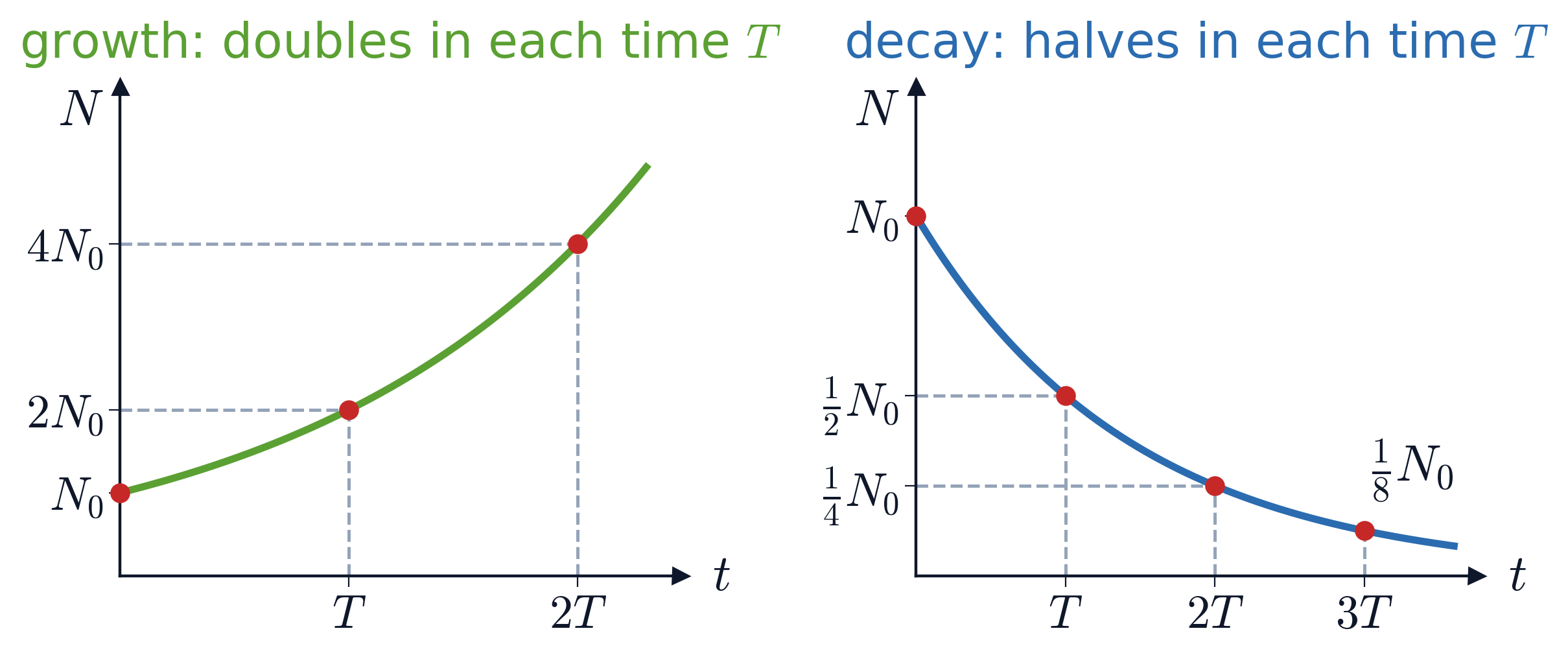
The key fact is that in equal times the quantity is multiplied by equal factors. If it doubles in time T, it doubles again in the next time T. So
N = N_0 \cdot 2^{t/T} \ \text{(doubling time } T\text{)} \qquad N = N_0 \left(\tfrac{1}{2}\right)^{t/T} \ \text{(half-life } T\text{)}
The doubling time, or the half-life, is T = \dfrac{\ln 2}{|k|}.
7. Worked examples
Example 1. Solve \dfrac{dy}{dx} = x\,e^{-y}, given y(0) = 0.
Separate: e^y\,dy = x\,dx. Integrate: e^y = \dfrac{x^2}{2} + c. Put x = 0, y = 0: 1 = 0 + c, so c = 1. Hence e^y = 1 + \dfrac{x^2}{2}, that is y = \ln\left(1 + \dfrac{x^2}{2}\right).
Example 2. Solve \dfrac{dy}{dx} = \dfrac{x^2 + y^2}{2xy}.
Every term has degree 2, so the equation is homogeneous. Put y = vx:
v + x\dfrac{dv}{dx} = \dfrac{x^2 + v^2x^2}{2vx^2} = \dfrac{1 + v^2}{2v}, so x\dfrac{dv}{dx} = \dfrac{1 + v^2}{2v} - v = \dfrac{1 - v^2}{2v}.
Separate: \dfrac{2v\,dv}{1 - v^2} = \dfrac{dx}{x}. Integrate: -\ln|1 - v^2| = \ln|x| + c_1, which gives x(1 - v^2) = C. Put v = \dfrac{y}{x}: x\left(1 - \dfrac{y^2}{x^2}\right) = C, that is x^2 - y^2 = Cx.
Example 3. Solve x\dfrac{dy}{dx} + 2y = x^2, where x > 0.
First make the coefficient of \dfrac{dy}{dx} equal to 1: \dfrac{dy}{dx} + \dfrac{2}{x}\,y = x. So P = \dfrac{2}{x} and \text{IF} = e^{2\ln x} = x^2. Then y \cdot x^2 = \int x \cdot x^2\,dx = \dfrac{x^4}{4} + c, so y = \dfrac{x^2}{4} + \dfrac{c}{x^2}.
Example 4. Solve \dfrac{dy}{dx} = (x + y)^2.
Put v = x + y. Then \dfrac{dv}{dx} = 1 + \dfrac{dy}{dx} = 1 + v^2. Separate: \dfrac{dv}{1 + v^2} = dx. Integrate: \tan^{-1} v = x + c. So x + y = \tan(x + c).
Example 5. (a) The number of bacteria in a dish grows at a rate proportional to the number present. It rises from 1000 to 2000 in 5 hours. When will it reach 8000? (b) A radioactive substance has a half-life of 10 years. What fraction of it remains after 30 years?
Part (a). The number doubles every 5 hours. From 1000 to 8000 is a factor of 8 = 2^3, which is three doublings. So it takes 3 \times 5 = 15 hours.
Part (b). 30 years is three half-lives. The fraction left is \left(\dfrac{1}{2}\right)^3 = \dfrac{1}{8}.
8. From the real papers
Try each question for 75 seconds before reading the solution.
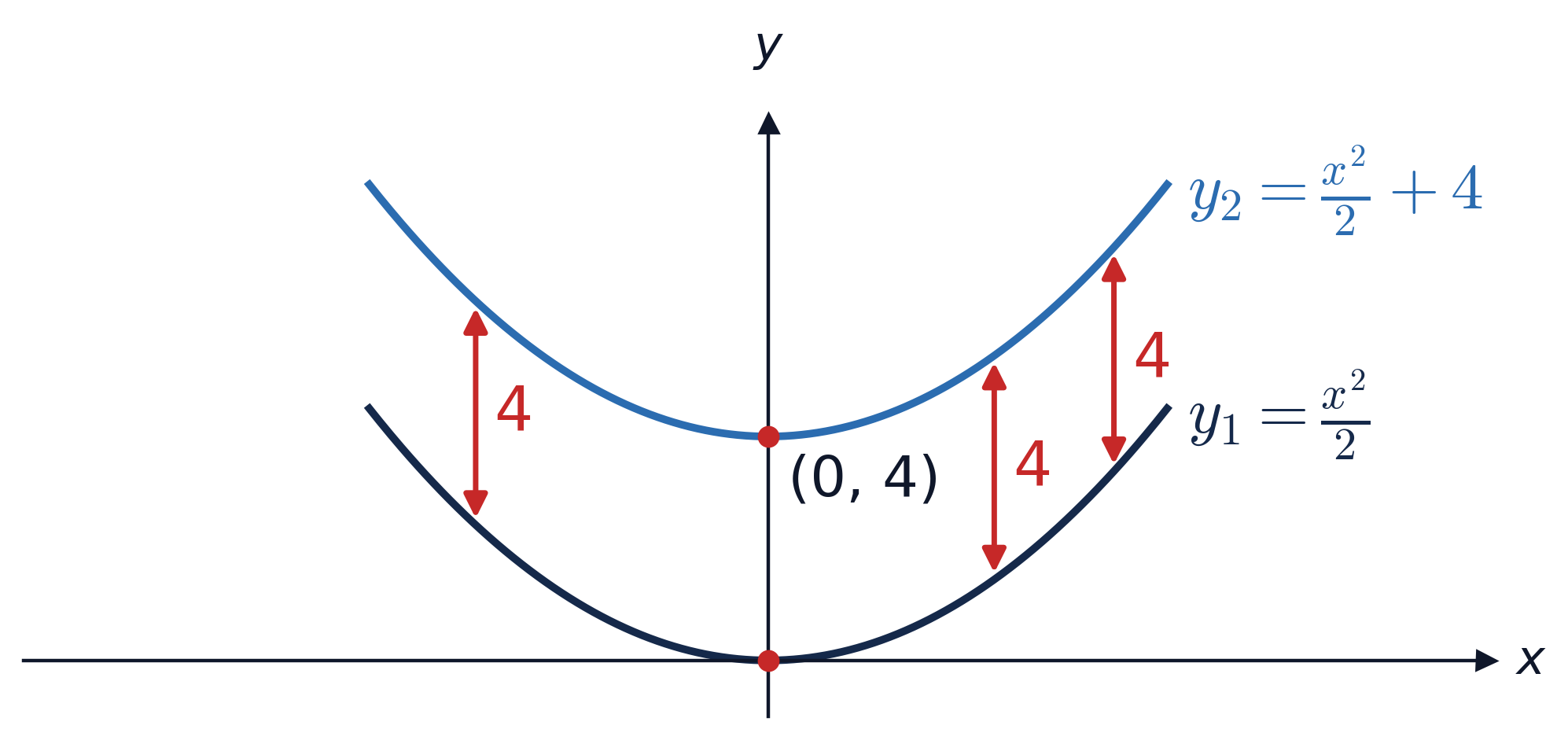
NDA I 2024, Q71. Let y_1(x) and y_2(x) be two solutions of the differential equation \frac{dy}{dx} = x. If y_1(0) = 0 and y_2(0) = 4, then what is the number of points of intersection of the curves y_1(x) and y_2(x)?
(a) No point (b) One point (c) Two points (d) More than two points
Solution. Integrate: y = \dfrac{x^2}{2} + c. The conditions give y_1 = \dfrac{x^2}{2} and y_2 = \dfrac{x^2}{2} + 4. The second curve is the first moved up by 4 units, so y_2 - y_1 = 4 for every x and the curves never meet. Answer (a).
NDA I 2026, Q98. Consider the differential equation e^{x+y}\,\frac{dy}{dx} = e^{x-y}. What is the solution of the differential equation with y(0) = 0?
(a) y = \ln(2x + 1) (b) y = \ln(2x - 1) (c) 2y = \ln(2x + 1) (d) 2y = \ln(2x - 1)
Solution. Divide both sides by e^{x+y}: \dfrac{dy}{dx} = e^{-2y}. Separate: e^{2y}\,dy = dx. Integrate: \dfrac{e^{2y}}{2} = x + c. Put x = 0, y = 0: c = \dfrac{1}{2}. So e^{2y} = 2x + 1 and 2y = \ln(2x + 1). Answer (c).
NDA I 2024, Q76. If \frac{dy}{dx} = 2e^x y^3, y(0) = \frac{1}{2} then what is 4y^2(2 - e^x) equal to?
(a) 1 (b) 2 (c) 3 (d) 4
Solution. Separate: \dfrac{dy}{y^3} = 2e^x\,dx. Integrate: -\dfrac{1}{2y^2} = 2e^x + c. Put x = 0, y = \dfrac{1}{2}: -2 = 2 + c, so c = -4. Then \dfrac{1}{2y^2} = 4 - 2e^x = 2(2 - e^x), which gives 4y^2(2 - e^x) = 1. Answer (a).
NDA II 2025, Q93. Consider the following statements: I. y = xe^{2x} is the solution of \frac{dy}{dx} = y\left(2 + \frac{1}{x}\right). II. y = x\ln|x| + cx is the solution of \frac{dy}{dx} = \frac{x + y}{x}. Which of the statements given above is/are correct?
(a) I only (b) II only (c) Both I and II (d) Neither I nor II
Solution. Test each by differentiating. For I: \dfrac{dy}{dx} = e^{2x} + 2xe^{2x} = e^{2x}(1 + 2x), and the right side is xe^{2x}\left(2 + \dfrac{1}{x}\right) = e^{2x}(2x + 1). They are equal, so I is correct. For II: \dfrac{dy}{dx} = \ln|x| + 1 + c, and the right side is 1 + \dfrac{y}{x} = 1 + \ln|x| + c. They are equal, so II is correct. (Statement II is the homogeneous equation solved in section 3.) Answer (c).
NDA II 2026, Q98. What is the solution of the differential equation \frac{dy}{dx} = 1 + x\cot(y - x)?
(a) \sec(y - x) = ce^{\frac{x^2}{2}} (b) \cos(y - x) = ce^{\frac{x^2}{2}} (c) \text{cosec}(y - x) = ce^{\frac{x^2}{2}} (d) \sin(y - x) = ce^{\frac{x^2}{2}}
Solution. The expression y - x suggests the substitution u = y - x. Then \dfrac{du}{dx} = \dfrac{dy}{dx} - 1 = x\cot u. Separate: \tan u\,du = x\,dx. Integrate: \ln|\sec u| = \dfrac{x^2}{2} + c_1. So \sec u = c\,e^{x^2/2}, that is \sec(y - x) = c\,e^{\frac{x^2}{2}}. Answer (a).
Notice that all five questions came down to separating the variables or to checking by differentiation.
9. Mistakes that cost marks
- Adding the constant too late. The constant enters at the moment of integration. From \ln|y| = x^2 + c we get y = A\,e^{x^2}. Writing y = e^{x^2} + c is wrong.
- Finding the integrating factor before the equation is in standard form. In x\dfrac{dy}{dx} + 2y = x^2, P is not 2. Divide by x first; then P = \dfrac{2}{x}.
- Losing the sign of P, or forgetting to multiply Q by the IF. In \dfrac{dy}{dx} - \dfrac{2}{x}\,y = x, P = -\dfrac{2}{x} and the IF is \dfrac{1}{x^2}, not x^2. And the right side of the solution is \int Q \times \text{IF}\,dx, not \int Q\,dx.
- Treating growth as equal amounts in equal times. If 1000 becomes 2000 in 5 hours, it does not become 4000 in 15 hours. It doubles every 5 hours, so it becomes 8000.
10. Quick check
Do these without help. Answers are at the end.
- Solve \dfrac{dy}{dx} = 2x, given y(1) = 3.
- Solve \dfrac{dy}{dx} = -\dfrac{x}{y}, given y(0) = 2.
- Find the integrating factor of \dfrac{dy}{dx} - \dfrac{2}{x}\,y = x, where x > 0.
- Which substitution solves \dfrac{dy}{dx} = \dfrac{x - y}{x + y}, and why?
- A quantity doubles every 4 hours. It is 50 units now. How much will there be after 12 hours?
11. Read and watch more, free
| What | Where | Language |
|---|---|---|
| Textbook | NCERT Class 12 Mathematics, Chapter 9 Differential Equations · Hindi edition | English, Hindi |
| Self-study notes | NIOS Mathematics, Lesson 32 Differential Equations · Hindi edition | English, Hindi |
| Video, the whole topic for NDA | Defence Wallah: SHAKTI 2026 playlist (the video "Differential Equations", about 2 hours 40 minutes) | Hinglish |
| Video, every textbook problem | Magnet Brains: Class 12 Maths, Chapter 9 Differential Equations | Hinglish |
| Video, short lessons | Khan Academy India: कक्षा 12 गणित (the lessons on अवकल समीकरण) | Hindi |
The videos were chosen from their titles, length and views; they have not yet been watched by a teacher.
Answers to the quick check
- y = x^2 + c, and 3 = 1 + c gives c = 2. So y = x^2 + 2.
- Separate: y\,dy = -x\,dx, so \dfrac{y^2}{2} = -\dfrac{x^2}{2} + c. The condition gives c = 2. So x^2 + y^2 = 4, a circle of radius 2.
- P = -\dfrac{2}{x}, so \text{IF} = e^{-2\ln x} = \dfrac{1}{x^2}.
- y = vx. Every term on the top and on the bottom has degree 1, so the equation is homogeneous.
- 12 hours is three doublings: 50 \times 2^3 = 400 units.
Next chapter: Vectors: magnitude, direction and addition.