Why this chapter matters. We found about 4 questions on this chapter in the 12 papers we hold, from 2017 to 2026, and all four came in the last two years (NDA I 2024 and NDA I 2026). That is a small number, so learn this chapter for understanding, not for volume. The questions are short calculations (the resultant of two forces, the force on each support of a beam) and one-line conditions (when is a floating body stable). Learn first the table of special cases in section 2 and the table of the three kinds of equilibrium in section 6.
What you will be able to do
- Find the resultant of two forces that act at a point, for any angle between them.
- Use the principle of moments to balance a see-saw or to find the force on each support of a beam.
- Say where the centre of gravity of a simple body lies.
- Tell stable, unstable and neutral equilibrium apart, and say what makes a body hard to topple.
Before you start you should know: what a force is and its unit, the newton (Chapter P1-4), and that weight is the force of gravity on a body, W = mg (Chapter P1-1).
1. A force has a size and a direction
A force is a vector. To describe it fully you must give its size (magnitude) and its direction. Because of this, forces do not add like ordinary numbers.
The single force that has the same effect as two or more forces acting together is called their resultant.
Two easy cases come first. They need no formula.
- Two forces along the same line, in the same direction: add them. Two men push a jeep from behind with 300 N and 200 N. The resultant is 500 N forward.
- Two forces along the same line, in opposite directions: subtract them. The resultant points the way of the larger force. In a tug of war, 900 N to the left and 850 N to the right leave a resultant of 50 N to the left.
2. The parallelogram law of forces
Often two forces act at a point with an angle between them. Two soldiers pull a boat to the bank with two ropes. The boat does not move along either rope. It moves along a line between them.
The law. If two forces acting at a point are drawn, in size and direction, as the two adjacent sides of a parallelogram starting from that point, then their resultant is given, in size and direction, by the diagonal of the parallelogram that starts from the same point.
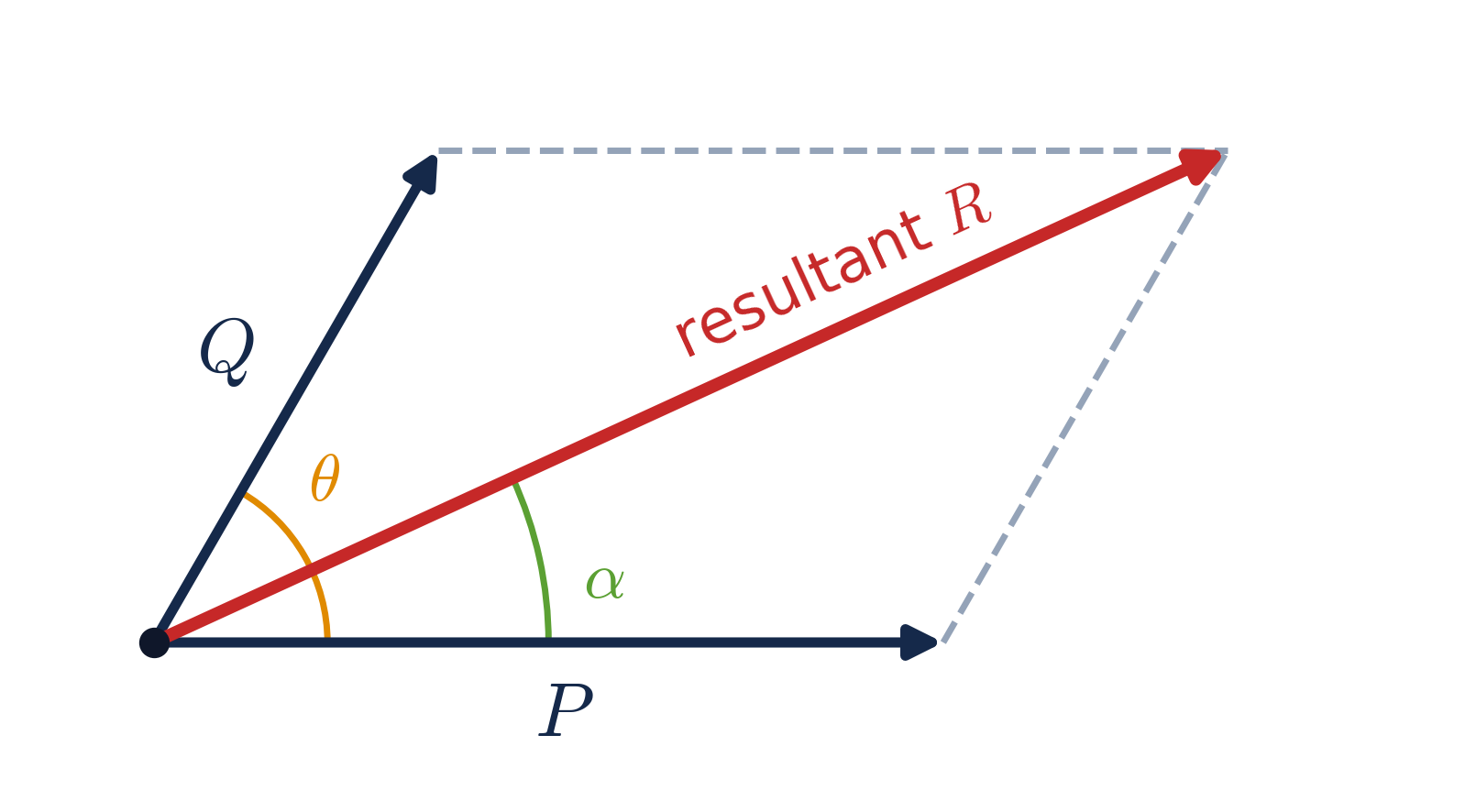
Let the forces be P and Q and let the angle between them be \theta. The size of the resultant R is
R = \sqrt{P^2 + Q^2 + 2PQ\cos\theta}
The resultant makes an angle \alpha with the force P, where
\tan\alpha = \frac{Q\sin\theta}{P + Q\cos\theta}
Learn these special cases. Most exam questions are one of them.
| Angle between the forces | Resultant | Remember |
|---|---|---|
| 0^\circ (same direction) | R = P + Q | The largest possible resultant |
| 90^\circ | R = \sqrt{P^2 + Q^2} | Pythagoras: 3 N and 4 N give 5 N |
| 180^\circ (opposite) | R = P - Q (the difference) | The smallest possible resultant |
| 60^\circ, two equal forces F | R = \sqrt{3}\,F | About 1.73F |
| 120^\circ, two equal forces F | R = F | The resultant is equal to each force |
Three facts follow from the formula.
- As the angle between two forces grows from 0^\circ to 180^\circ, the resultant becomes smaller.
- The resultant always lies between the difference and the sum: P - Q \le R \le P + Q (taking P as the larger). Forces of 5 N and 9 N can give any resultant from 4 N to 14 N, but never 15 N and never 3 N.
- When the two forces are equal, the resultant lies exactly midway between them. It bisects the angle.
3. Forces in balance at a point
A body is in equilibrium when the resultant of all the forces on it is zero. Then its velocity does not change. It stays at rest, or it keeps moving in a straight line at a steady speed. Both are equilibrium.
- Two forces balance only if they are equal in size, opposite in direction and along the same line. A lamp hanging at rest from a wire: the pull of the wire up equals the weight down.
- Three forces balance only if the resultant of any two is equal and opposite to the third. The force that balances a resultant is called the equilibrant. If 6 N acts east and 8 N acts north, the resultant is 10 N. A third force of 10 N in the opposite direction gives equilibrium.
A useful check: three forces of 3 N, 4 N and 5 N can keep a body in equilibrium, because the 3 N and 4 N forces at right angles give exactly 5 N. Three forces of 1 N, 2 N and 5 N can never balance, because 1 N and 2 N together can give at most 3 N.
4. The turning effect of a force: moment
A force can also turn a body about a fixed point, called the pivot or fulcrum. A door turns about its hinges. A spanner turns a nut.
The turning effect is called the moment of the force, or torque.
\text{moment} = \text{force} \times \text{perpendicular distance from the pivot to the line of the force}
| Quantity | Symbol or formula | SI unit |
|---|---|---|
| Force | F | newton (N) |
| Moment of a force (torque) | F \times d | newton metre (N m) |
| Moment of a couple | one force \times the perpendicular distance between the two forces | newton metre (N m) |
The same force gives a larger moment when it acts farther from the pivot. This is why a door handle is fixed far from the hinges, and why a long spanner opens a tight nut that a short one cannot.
A moment turns a body either clockwise or anticlockwise.
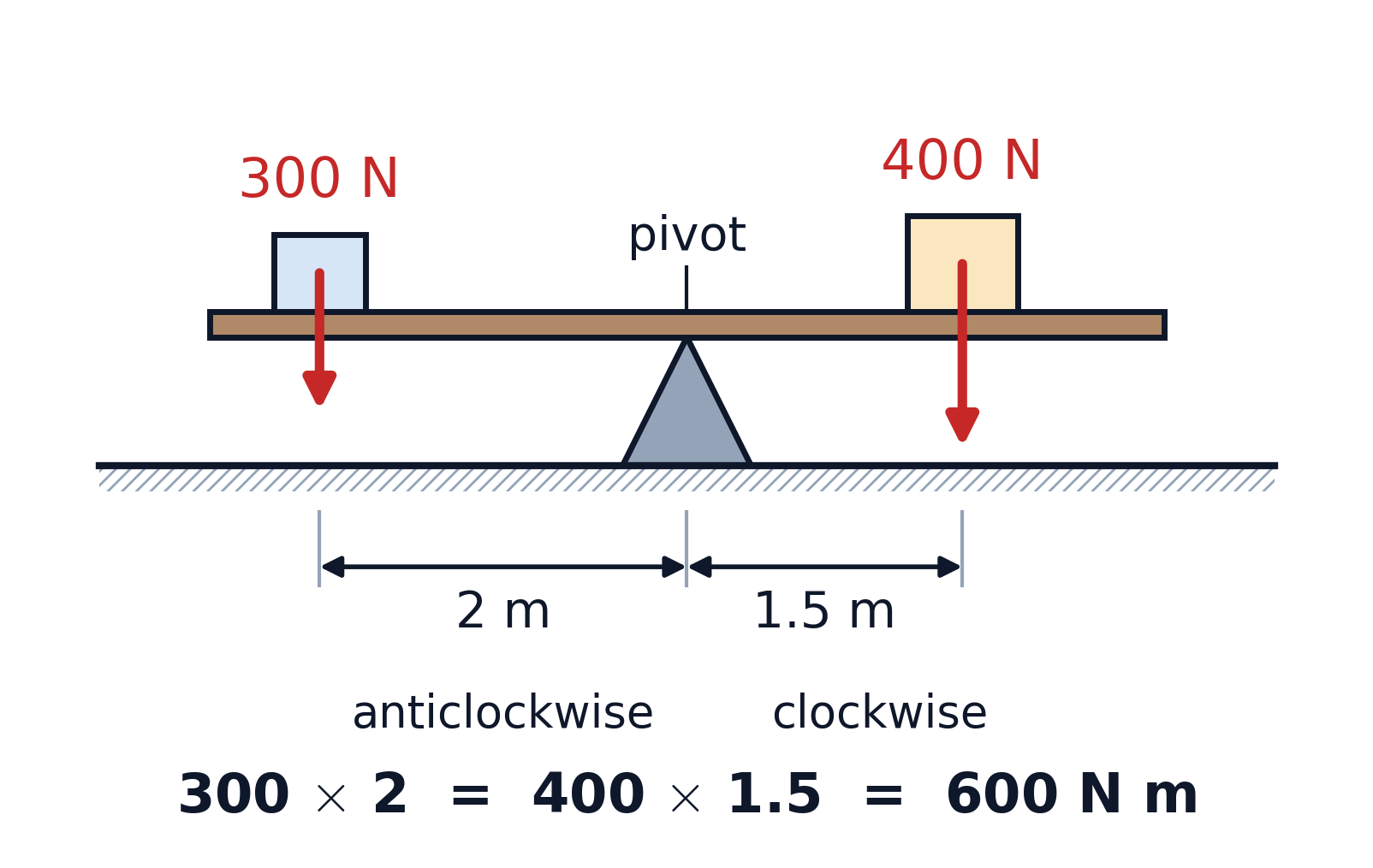
Principle of moments. When a body is balanced, the sum of the clockwise moments about any point equals the sum of the anticlockwise moments about the same point.
A couple is a pair of equal and opposite forces whose lines of action are not the same. The two hands turning a steering wheel form a couple. The resultant force of a couple is zero, yet it turns the body.
So a rigid body, such as a beam or a bridge, needs two conditions for equilibrium:
- the resultant force on it is zero (it does not start to move along a line);
- the resultant moment about any point is zero (it does not start to turn).
5. Centre of gravity
Every small part of a body has weight. The centre of gravity (CG) is the one point through which the whole weight of the body can be taken to act, however the body is placed. In problems we draw a single weight arrow from the CG.
| Body (uniform) | Where the centre of gravity is |
|---|---|
| Thin rod, or a metre scale | Its middle point |
| Rectangular or square sheet | Where the diagonals cross |
| Circular disc, sphere | Its centre |
| Ring | The centre of the ring, where there is no material |
| Triangular sheet | Where the three medians meet (the centroid), one-third of the way up each median from the side |
Two points are asked. First, the CG need not lie inside the material of the body: for a ring or a hollow ball it lies in empty space. Second, a body hung freely from a point comes to rest with its CG vertically below that point.
For bodies of ordinary size on the Earth, the centre of gravity and the centre of mass are the same point.
6. Stable, unstable and neutral equilibrium
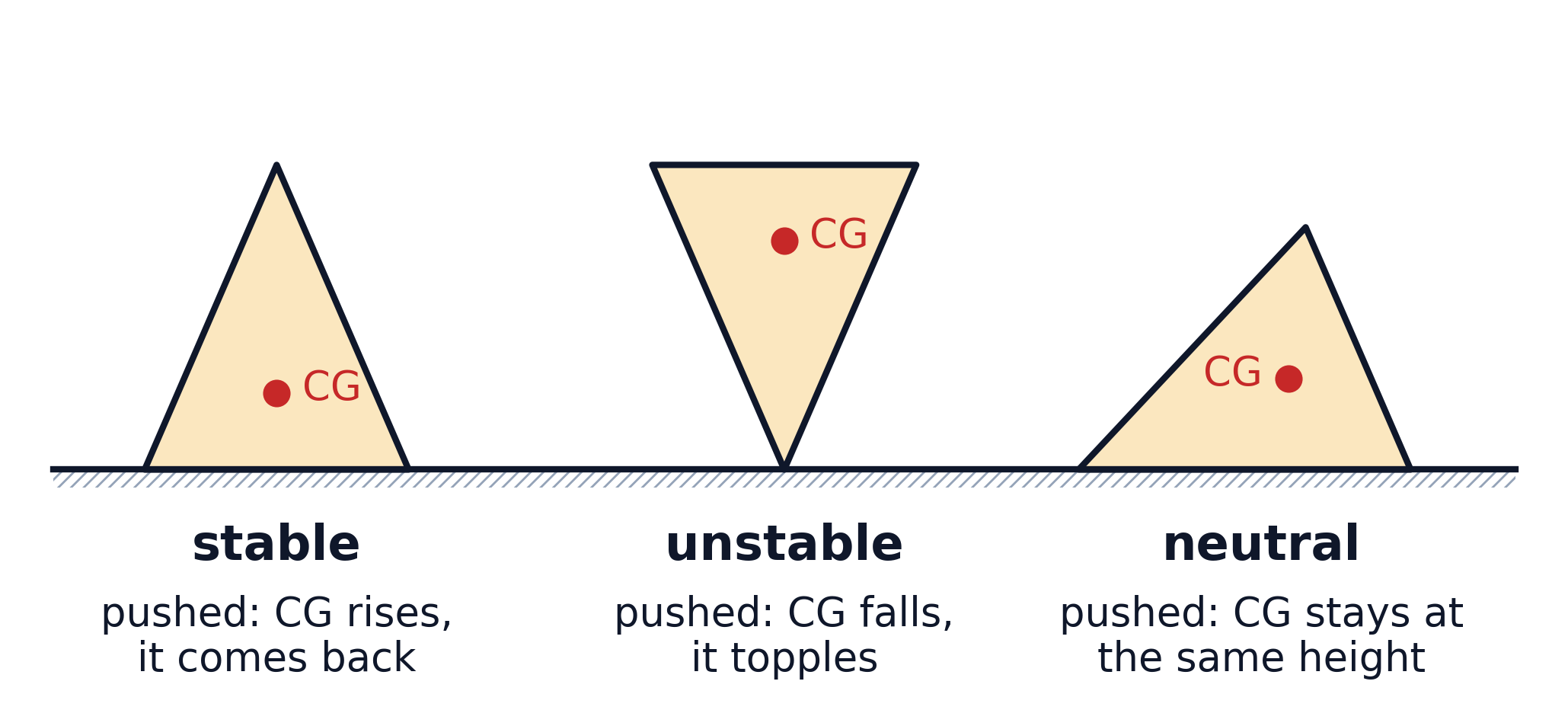
Push a body in equilibrium a little and let go. What it does next gives the kind of equilibrium.
| Kind | After a small push | Height of the CG when pushed | Potential energy at the rest position | Example |
|---|---|---|---|---|
| Stable | It comes back | Rises | Least (a minimum) | A cone standing on its base; a book lying flat |
| Unstable | It moves farther away and falls over | Falls | Greatest (a maximum) | A cone balanced on its tip; a pencil standing on its point |
| Neutral | It stays in the new position | Stays the same | Does not change | A ball on a level floor; a cone lying on its side |
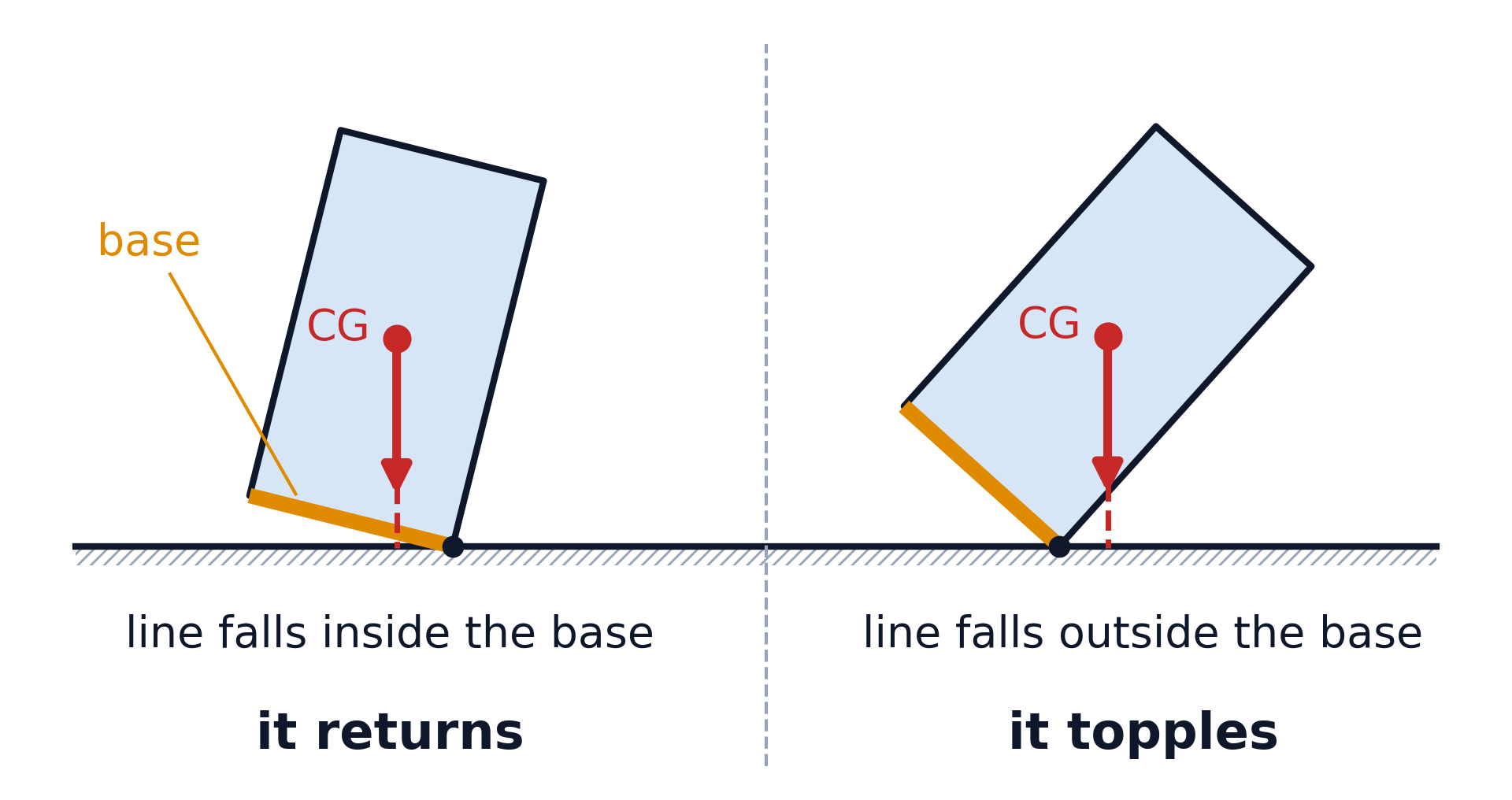
When does a body topple? Draw a vertical line down from the CG. If the line falls inside the base, the weight turns the body back and it does not topple. If the line falls outside the base, the weight turns the body over.
Two rules for stability. A body is more stable when
- its centre of gravity is low, and
- its base is wide.
Examples you have seen:
- A battle tank and a racing car are built low and wide.
- In a double-decker bus the lower deck is filled first. Passengers standing upstairs raise the CG and make the bus easier to overturn.
- A ship carries its heaviest cargo at the bottom of the hold.
- A man carrying a heavy bucket in one hand leans to the other side, so that the vertical line through the CG of the man and bucket together stays between his feet.
- The Leaning Tower of Pisa does not fall because the vertical line through its CG still falls inside its base.
7. Stability of a floating body (asked in NDA I 2026)
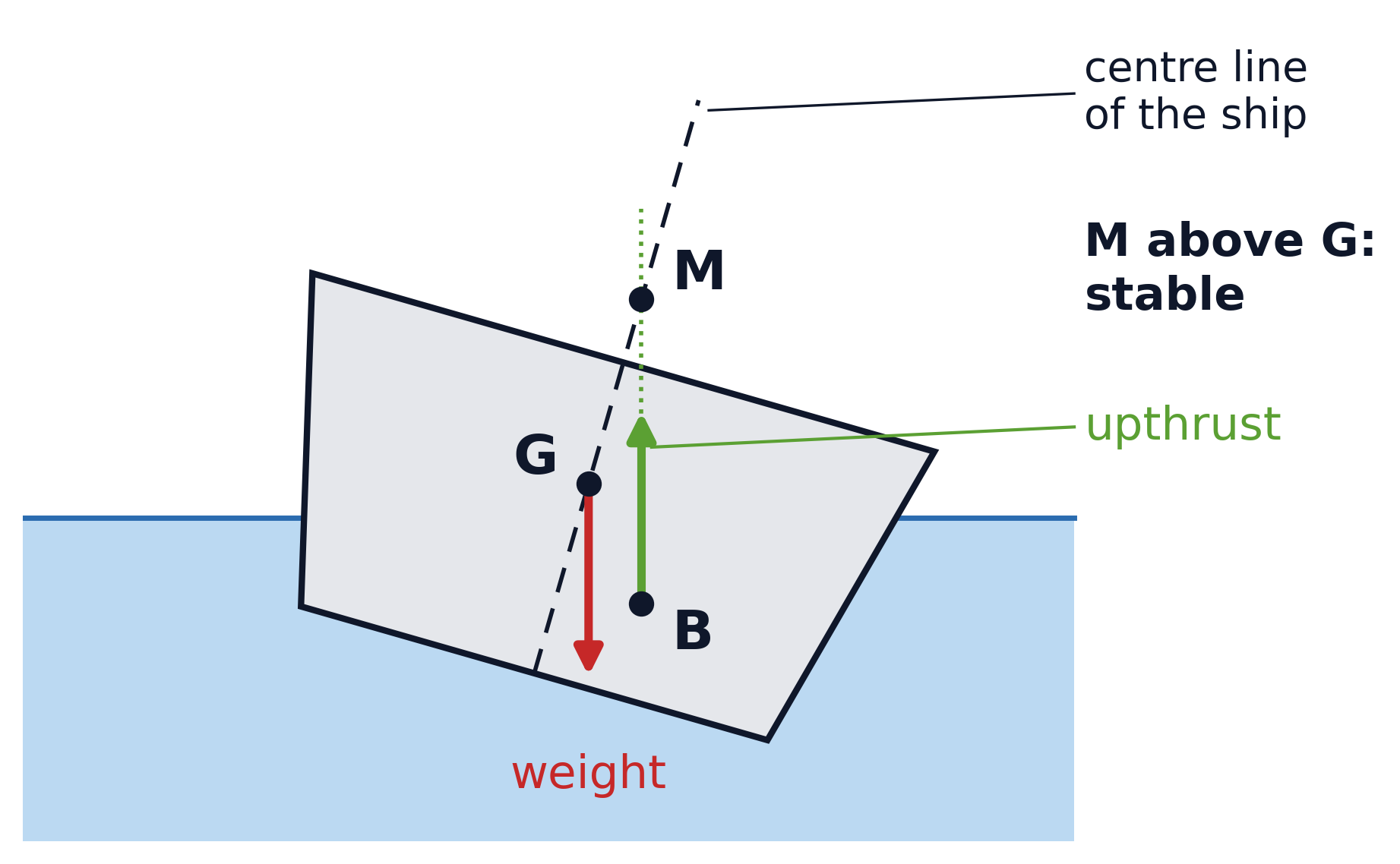
A floating ship has two important points.
- The centre of gravity G, where its weight acts downward.
- The centre of buoyancy B, which is the centre of gravity of the water it displaces. The upward push of the water (the buoyant force, Chapter P1-1) acts through B.
When the ship tilts a little, the shape of the displaced water changes and B moves towards the lower side. Draw a vertical line up through the new B. The point where this line cuts the ship's own centre line is called the metacentre M.
| Position | Result |
|---|---|
| M above G | Stable. Weight and buoyant force together turn the ship upright again |
| M below G | Unstable. They turn the ship farther over |
| M at G | Neutral |
So the condition for a floating body to be stable is: the centre of gravity must be below the metacentre. G does not have to be below B. In most ships G is in fact above B, and the ship is still stable because M is higher than G.
What the papers have asked
| Paper | The idea asked | The answer in one line |
|---|---|---|
| NDA I 2026 | Two equal forces act at a point and the resultant is as large as each of them. What are the angles? | The forces are at 120^\circ (2\pi/3) to each other, and the resultant makes 60^\circ (\pi/3) with each |
| NDA I 2026 | The condition for a floating body to be in a stable state | The centre of gravity is below the metacentre |
| NDA I 2024 | A uniform metre scale rests on two wedges at different distances from its middle. Find the force on each wedge | Take moments about one wedge. The wedge nearer the middle carries more of the weight |
| NDA I 2024 | A block is at rest under several forces drawn in a figure. Find the unknown force | For a body at rest the forces to the left equal the forces to the right (the figure cannot be read in our copy) |
| NDA I 2026 (counted in Chapter P1-4) | The upward force on a skydiver who falls at a steady speed | Steady speed means equilibrium, so the upward force equals the weight |
| NDA II 2024 (counted in Chapter P7-1) | The sketch that shows a lever of the second class | The load is between the fulcrum and the effort. Levers use the principle of moments |
Worked examples
Example 1. Forces of 5 N and 12 N act at a point at right angles to each other. What is the size of their resultant?
(a) 7 N (b) 13 N (c) 17 N (d) 60 N
Solution. At 90^\circ, R = \sqrt{5^2 + 12^2} = \sqrt{169} = 13 N. The tempting wrong answer is 17 N, which is the plain sum. The plain sum is right only when the forces act in the same direction. Answer (b).
Example 2. Consider the following statements about two forces of 8 N each acting at a point:
- If the angle between them is 120^\circ, their resultant is 8 N.
- If the angle between them is 180^\circ, their resultant is 16 N.
Which of the statements given above is/are correct?
(a) 1 only (b) 2 only (c) Both 1 and 2 (d) Neither 1 nor 2
Solution. Statement 1: R = \sqrt{64 + 64 + 2 \times 64 \times \cos 120^\circ} = \sqrt{128 - 64} = 8 N. Correct. Statement 2: at 180^\circ the forces are opposite, so the resultant is 8 - 8 = 0. It is 16 N only at 0^\circ. Wrong. Answer (a).
Example 3. On a see-saw, a child of weight 300 N sits 2 m from the pivot. How far from the pivot, on the other side, must a child of weight 400 N sit to balance it?
(a) 1.5 m (b) 2 m (c) 2.67 m (d) 3 m
Solution. By the principle of moments, 300 \times 2 = 400 \times d, so d = 1.5 m. The heavier child sits nearer the pivot. Option (c) comes from turning the ratio upside down; check it with common sense: the heavier child cannot sit farther away. Answer (a).
Example 4. A uniform plank 2 m long weighs 60 N. It rests on two supports, A and B, one at each end. A load of 40 N is placed on the plank 0.5 m from A. What is the upward force at each support?
(a) A: 50 N, B: 50 N (b) A: 40 N, B: 60 N (c) A: 60 N, B: 40 N (d) A: 70 N, B: 30 N
Solution. The plank's own weight acts at its middle, 1 m from A. Take moments about A, so that the force at A has no moment: R_B \times 2 = 60 \times 1 + 40 \times 0.5 = 80, so R_B = 40 N. The two upward forces must add up to the total weight, 100 N, so R_A = 60 N. The support nearer the load carries more. Option (a) forgets where the load is placed. Answer (c).
Example 5. Match List I with List II.
| List I (equilibrium) | List II (what is true at the rest position) |
|---|---|
| A. Stable | 1. Potential energy is the greatest |
| B. Unstable | 2. Potential energy does not change when the body is moved |
| C. Neutral | 3. Potential energy is the least |
(a) A-1, B-3, C-2 (b) A-3, B-1, C-2 (c) A-3, B-2, C-1 (d) A-2, B-1, C-3
Solution. In stable equilibrium the CG is at its lowest, so the potential energy is least (A-3). In unstable equilibrium the CG is at its highest (B-1). In neutral equilibrium the CG keeps the same height (C-2). Option (a) swaps the first two; remember that a body left to itself moves to lower potential energy, so the lowest point is the stable one. Answer (b).
Example 6. Which one of the following changes makes a loaded truck less stable?
(a) Putting the heavy boxes on the floor of the truck and the light ones on top (b) Fitting the wheels wider apart (c) Piling the load high above the floor (d) Lowering the floor of the truck
Solution. Stability needs a low centre of gravity and a wide base. Options (a) and (d) lower the CG and (b) widens the base, so all three help. Piling the load high raises the CG, and then a smaller tilt takes the vertical line through the CG outside the wheels. Answer (c).
Mistakes that cost marks
- Adding two forces as plain numbers. 3 N and 4 N give 7 N only in the same direction. At right angles they give 5 N, and in opposite directions 1 N. Always ask for the angle first.
- Using the wrong distance in a moment. The distance is the perpendicular distance from the pivot to the line of the force. For the weight of a uniform beam, measure from the pivot to the middle of the beam, not to its end.
- Thinking equilibrium means "at rest". A body moving in a straight line at a steady speed is also in equilibrium, because the resultant force on it is zero.
- Saying a floating body is stable only if its centre of gravity is below its centre of buoyancy. The condition is that the centre of gravity is below the metacentre.
Quick check
Do these without help. Answers are at the end.
- Two forces of 9 N and 12 N act at a point at right angles. What is their resultant?
- What is the greatest and the least resultant that forces of 7 N and 10 N can give?
- A force of 20 N acts at right angles to a spanner, 0.3 m from the nut. What is its moment about the nut?
- Where is the centre of gravity of a uniform ring?
- A ball rests on a level floor. Which kind of equilibrium is this, and why?
Read and watch more, free
| What | Where | Language |
|---|---|---|
| Textbook | NCERT Class 11 Physics Part I: Chapter 3 Motion in a Plane (adding vectors), Chapter 6 Systems of Particles and Rotational Motion (moments, centre of gravity, equilibrium). The Hindi edition is on the same site under the book code khph1 | English, Hindi |
| Self-study notes | NIOS Physics (312), Lesson 1 (vectors) | English, Hindi |
| Short reference | Wikipedia: Parallelogram of force | English |
| Video, school lessons | Magnet Brains: Class 11 Physics (choose the videos on vectors and on rotational motion) | Hinglish |
| Video, school lessons | Magnet Brains Hindi Medium: Class 11 Physics | Hindi |
| Video, for NDA | Defence Wallah: Complete Physics, NDA Fast Track Series (one video for each chapter, 1 to 2 hours each) | Hinglish |
The videos were chosen from their titles, length and views; they have not yet been watched by a teacher.
Answers to the quick check
- \sqrt{9^2 + 12^2} = \sqrt{225} = 15 N.
- Greatest 7 + 10 = 17 N (same direction); least 10 - 7 = 3 N (opposite directions).
- 20 \times 0.3 = 6 N m.
- At the centre of the ring, a point where there is no material.
- Neutral equilibrium. When the ball is rolled a little, its centre of gravity stays at the same height, so it neither returns nor moves farther away.
Next chapter: Gravitation.