Why this chapter matters. We found about 4 questions on this chapter in the 12 papers we hold, from 2017 to 2026. Four more questions in those papers use pressure but belong to other chapters, mostly the boiling of water at high altitude. So this is a small chapter in the count. The questions are single facts and short reasoning: what the pressure of a liquid depends on, which unit is used, on which face a block presses hardest. Learn first the two formulas, pressure = force ÷ area and pressure in a liquid = h\rho g. The rest of the chapter is built from them.
What you will be able to do
- Calculate the pressure under a solid body and at a depth in a liquid.
- State Pascal's law and use it for a hydraulic lift.
- Give the value of atmospheric pressure in pascals, in millibars and in centimetres of mercury.
- Explain how a mercury barometer and an aneroid barometer work and what a change in the reading tells us.
Before you start you should know: force and weight in newtons, and density (Chapter P1-1).
1. Thrust and pressure
Push a drawing pin into a board. The same push acts on your thumb and on the board, yet the pin goes into the board and not into your thumb. The point of the pin has a very small area. What matters is how much force acts on each unit of area.
A force that acts at right angles to a surface is called thrust. Pressure is the thrust on unit area:
P = \frac{F}{A}
| Quantity | SI unit | Notes |
|---|---|---|
| Thrust | newton (N) | It is a force |
| Pressure | pascal (Pa) | 1\ \text{Pa} = 1\ \text{N/m}^2. Pressure is a scalar: it has size but no direction of its own |
For the same force, a smaller area gives a larger pressure. This one idea explains many things.
| To make the pressure large, use a small area | To make the pressure small, use a large area |
|---|---|
| The sharp edge of a knife or a bayonet | The wide tracks of a tank, so that it does not sink in soft ground |
| The point of a nail or a needle | The broad shoulder straps of a soldier's pack |
| The wide base of a building or a dam; the broad feet of a camel on sand |
A brick lying on its largest face presses least on the ground. Standing on its smallest face it presses most. Its weight is the same each time; only the area changes.
2. Pressure inside a liquid
A liquid has weight, so it presses on the bottom and the walls of its vessel and on anything placed in it. At a depth h below the surface of a liquid of density \rho, the pressure due to the liquid is
P = h\rho g
Read the formula carefully, because the papers test exactly what is in it and what is not.
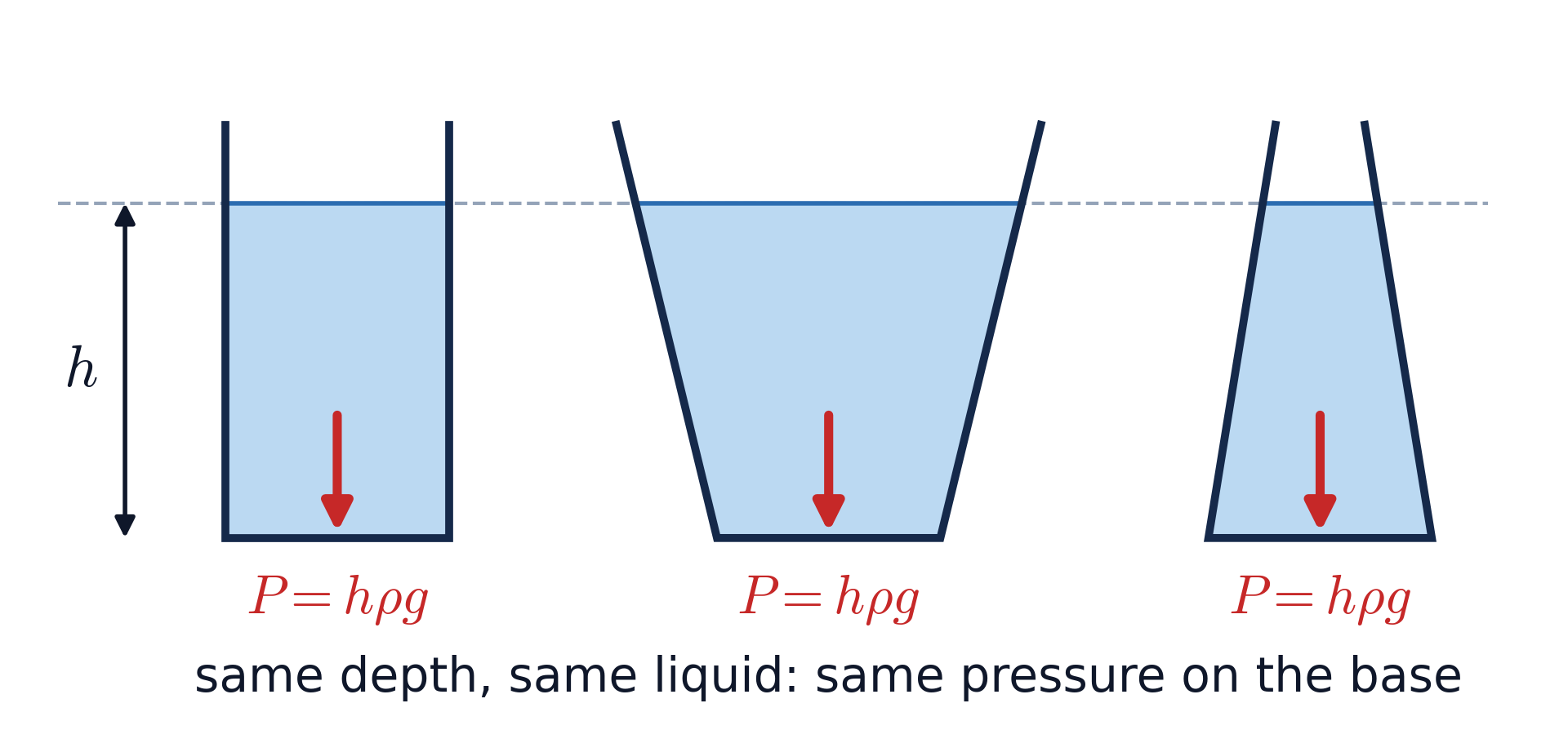
| Liquid pressure depends on | Liquid pressure does not depend on |
|---|---|
| The depth h below the surface | The area of the base of the vessel |
| The density \rho of the liquid | The shape or the width of the vessel |
| The value of g | The total quantity of liquid |
Three more facts follow.
- At any point the liquid presses equally in all directions: down, up and sideways.
- Pressure is the same at all points at the same level in a liquid at rest.
- Pressure rises with depth. This is why the wall of a dam is made much thicker at the bottom than at the top, and why a deep-sea diver needs a specially strong suit.
If the surface of the liquid is open to the air, the total pressure at depth h is the atmospheric pressure plus h\rho g.
3. Pascal's law and the hydraulic lift
Pascal's law. Pressure applied to a liquid enclosed in a vessel is passed on, without loss, to every part of the liquid and to the walls of the vessel.
A hydraulic lift uses this. Two cylinders, one narrow and one wide, are joined by a pipe and filled with oil. Each has a piston.
- A small force F_1 pushes the small piston of area A_1. The pressure in the oil becomes F_1 / A_1.
- By Pascal's law the same pressure acts under the large piston of area A_2.
- So the force on the large piston is F_2 = F_1 \times \dfrac{A_2}{A_1}, which is much larger than F_1.
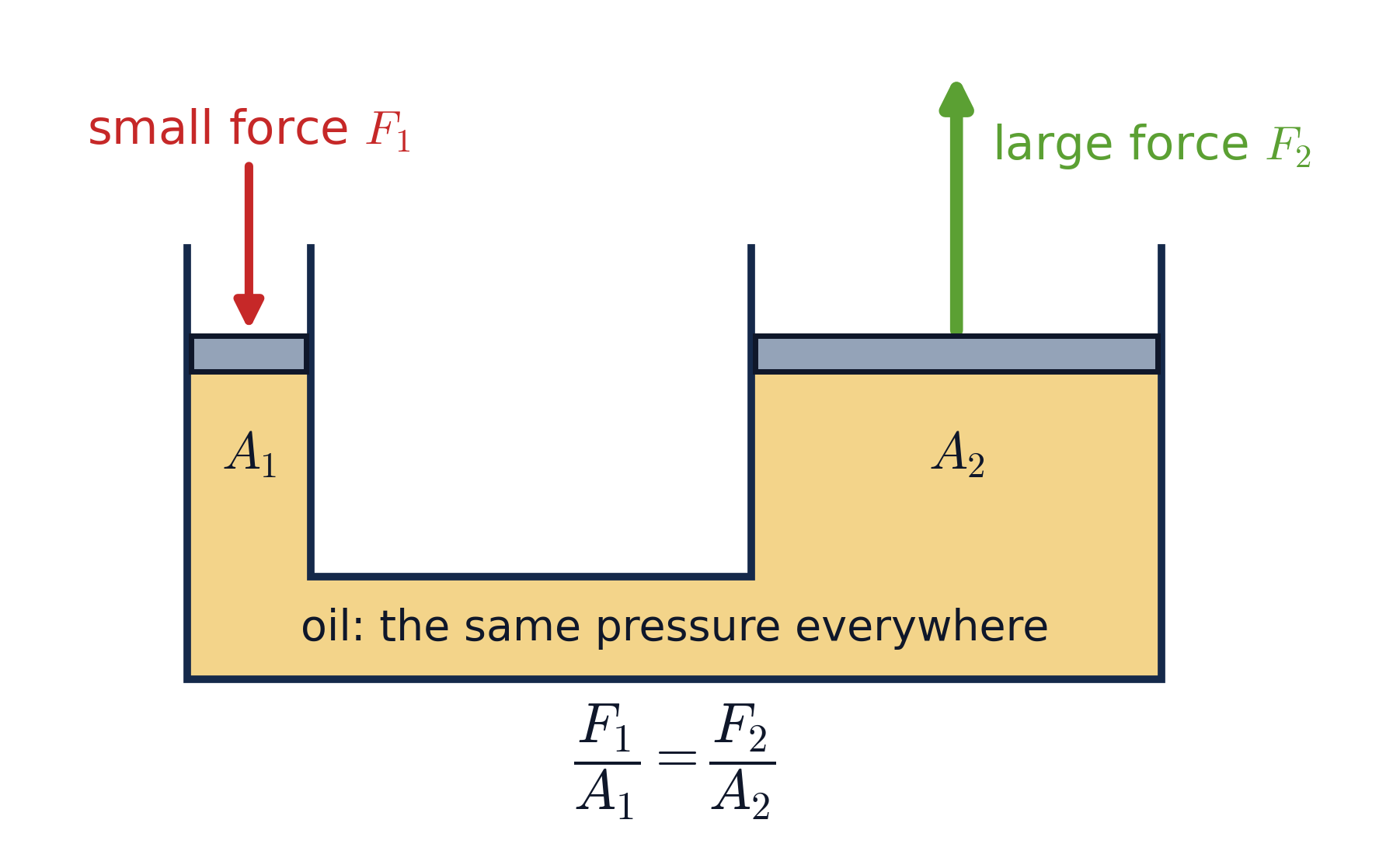
The hydraulic brakes of a truck, the hydraulic jack used to change a wheel and the hydraulic press all work on Pascal's law. The force is multiplied, but the small piston must move a long way to move the large piston a little.
4. Atmospheric pressure
The Earth is wrapped in a layer of air hundreds of kilometres deep. Air has weight, so it presses on everything at the bottom of this layer. This is atmospheric pressure. We do not feel it, because the fluids inside our body press outward equally.
The value at sea level, called one standard atmosphere, must be known in all its forms.
| Unit | Value of 1 standard atmosphere |
|---|---|
| pascal | 1.013 \times 10^5 Pa |
| height of a mercury column | 76 cm, which is 760 mm |
| bar | 1.013 bar (1\ \text{bar} = 10^5 Pa) |
| millibar | 1013 millibar (1\ \text{millibar} = 100 Pa) |
| torr | 760 torr (1 torr is the pressure of 1 mm of mercury) |
Weather reports and weather maps give air pressure in millibars. The lines on a weather map that join places of equal pressure are called isobars.
Atmospheric pressure falls as we go higher, because less air is left above us. Two effects are asked often.
- Water boils at a lower temperature on a high mountain, because the air pressure on it is less. Food cooks slowly in an open pan at a high-altitude post. A pressure cooker raises the pressure inside it, so water boils above 100 °C and the food cooks faster.
- Some people get a nosebleed at great heights, because the pressure of the blood is then well above the pressure of the air outside.
Everyday proofs that the air presses: a drinking straw (you lower the pressure in the straw and the atmosphere pushes the drink up), a syringe filling with liquid, and a rubber sucker that sticks to a smooth wall.
5. The mercury barometer
What it is for. A barometer measures atmospheric pressure. The mercury barometer was made by the Italian scientist Evangelista Torricelli in 1643.
The principle. The atmosphere, pressing on the open surface of mercury in a dish, holds up a column of mercury in a tube. The pressure of this column, h\rho g, equals the atmospheric pressure.
The parts.
| Part | What it does |
|---|---|
| A glass tube about 1 m long, closed at one end | Holds the mercury column |
| A trough (dish) of mercury | Its open surface is where the atmosphere presses |
| The empty space at the top of the tube | It is almost a vacuum, called the Torricellian vacuum, so nothing presses down on the top of the column |
| A scale beside the tube | Reads the height of the column above the mercury in the trough |
How it works.
- The tube is filled completely with mercury, closed with a finger and turned upside down with its open end under the mercury in the trough.
- When the finger is removed, the mercury in the tube falls a little and then stops.
- At sea level it stops when the column stands about 76 cm above the mercury in the trough. The atmosphere is holding up this column.
- If the air pressure rises, the column rises. If the air pressure falls, the column falls.
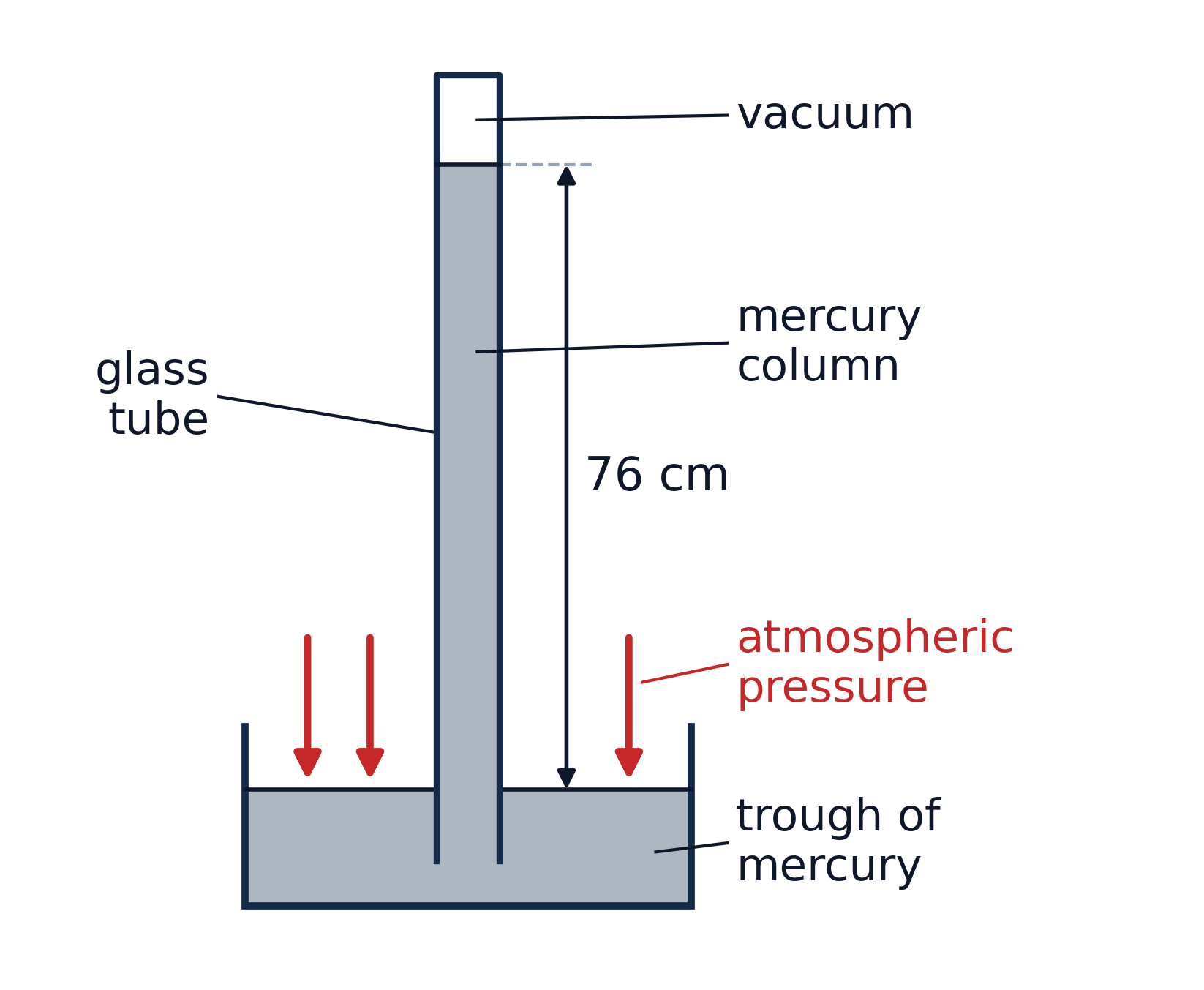
Check with the formula: P = h\rho g = 0.76 \times 13600 \times 9.8 \approx 1.013 \times 10^5 Pa.
Facts the exam can use.
- The vertical height of the column does not depend on the width of the tube or on a small tilt of the tube. If the tube is tilted, the mercury moves further along it, but the vertical height stays 76 cm.
- Why mercury? It is very dense, so the column is short enough to handle. A water barometer would need a tube more than 10 m tall, because water is 13.6 times less dense: 0.76 \times 13.6 \approx 10.3 m. Mercury also does not stick to glass, is easy to see, and gives off very little vapour into the space above it.
- The barometer reading falls as it is carried up a mountain.
- Weather. A sudden fall of the barometer warns of a storm. A slow, steady rise usually means fair weather is coming.
6. The aneroid barometer
"Aneroid" means "without liquid". Its main part is a sealed, flat metal box with a thin, wavy lid, from which most of the air has been removed. When the air pressure outside rises, the lid is pushed in a little. When the pressure falls, the lid springs out. Levers magnify this small movement and turn a pointer over a dial.
It is small and has no liquid to spill, so it is easy to carry. Because pressure falls with height in a known way, an aneroid barometer marked in metres or feet works as an altimeter, the instrument that tells a pilot the height of the aircraft.
What the papers have asked
| Paper | The idea asked | The answer in one line |
|---|---|---|
| NDA 2020 | What the pressure of a liquid at the base of a beaker depends on | The height of the liquid column (and its density), not the area of the base |
| NDA II 2023 | The usual unit for air pressure in India | Millibar |
| NDA II 2023 | A block resting in turn on three faces of different area | Smallest face, greatest pressure; largest face, least pressure |
| NDA II 2025 | Pick the true statement about pressure | Pascal and N/m² are the same unit. Pressure has no direction and it increases with depth |
| NDA I 2025 (counted in P1-1) | Match pressure, weight, mass and temperature with SI units | Pressure: pascal |
| NDA II 2017 (counted under Heat) | Why water boils at a lower temperature at high altitude | The air pressure is less there |
| NDA II 2023 and NDA II 2025 (counted under Heat) | When does a liquid boil? | When its vapour pressure becomes equal to the atmospheric pressure |
No paper we hold has asked about the parts of the barometer. But "Pressure Barometer" is printed in the syllabus, so sections 5 and 6 must still be learnt.
Worked examples
Example 1 (a short calculation). A soldier of mass 60 kg stands at attention on both boots. The sole of each boot has an area of 150 cm². What pressure does he put on the ground? (Take g = 10\ \text{m/s}^2.)
(a) 2000 Pa (b) 20,000 Pa (c) 40,000 Pa (d) 4 Pa
Solution. Weight = 60 \times 10 = 600 N. Area of two soles = 300\ \text{cm}^2 = 0.03\ \text{m}^2. Pressure = 600 \div 0.03 = 20{,}000 Pa. Option (c) is the pressure when he stands on one foot. Option (d) comes from dividing by 150 without changing cm² into m². Answer (b).
Example 2 (liquid pressure). A water tank is filled to a depth of 3 m. What is the pressure due to the water at the bottom? (Density of water = 1000 kg/m³, g = 10\ \text{m/s}^2.)
(a) 300 Pa (b) 3000 Pa (c) 30,000 Pa (d) It cannot be found without the area of the base
Solution. P = h\rho g = 3 \times 1000 \times 10 = 30{,}000 Pa. Option (d) is the trap: liquid pressure does not depend on the area of the base. Answer (c).
Example 3 (Pascal's law). In a hydraulic jack the small piston has an area of 0.004 m² and the large piston 0.2 m². A force of 50 N is applied to the small piston. What load can the large piston lift?
(a) 1 N (b) 50 N (c) 250 N (d) 2500 N
Solution. The pressure is the same under both pistons: \dfrac{50}{0.004} = \dfrac{F_2}{0.2}, so F_2 = 50 \times \dfrac{0.2}{0.004} = 50 \times 50 = 2500 N. Option (a) divides by the ratio of the areas instead of multiplying. Answer (d).
Example 4 (consider the following statements).
- In a mercury barometer the space above the mercury in the tube contains air at atmospheric pressure.
- The height of the mercury column in a barometer becomes less as the barometer is carried up a hill.
Which of the statements given above is/are correct?
(a) 1 only (b) 2 only (c) Both 1 and 2 (d) Neither 1 nor 2
Solution. Statement 1 is wrong. The space is almost a vacuum. If it held air at atmospheric pressure, that air would push the mercury down to the level in the trough and there would be no column at all. Statement 2 is correct: air pressure falls with height, so it holds up a shorter column. Answer (b).
Example 5 (reasoning). Three vessels have bases of the same area. One is a straight cylinder, one widens towards the top and one narrows towards the top. All are filled with water to the same height. The pressure of the water on the base is
(a) greatest in the vessel that widens (b) greatest in the vessel that narrows (c) greatest in the cylinder (d) the same in all three
Solution. The pressure at the base is h\rho g. The height and the liquid are the same, so the pressure is the same. The vessel that widens holds more water, which makes (a) tempting, but the quantity of water does not enter the formula. Answer (d).
Mistakes that cost marks
- Mixing up force and pressure. A block has the same weight on any face. Its pressure changes with the face it rests on. Read whether the question asks for the force or the pressure.
- Leaving area in cm². 1\ \text{cm}^2 = 10^{-4}\ \text{m}^2. Convert before dividing, or the answer is wrong by a factor of 10,000.
- Thinking a wider vessel gives more pressure at the bottom. Only depth and density matter.
- Mixing 76 and 760. The standard column is 76 cm, which is 760 mm. And 1 bar is 10^5 Pa, while 1 millibar is only 100 Pa.
Quick check
Do these without help. Answers are at the end.
- A force of 500 N acts at right angles on an area of 0.25 m². What is the pressure?
- What is the pressure due to water at a depth of 20 m in a lake? (Density 1000 kg/m³, g = 10\ \text{m/s}^2.)
- Express 1000 millibar in pascals.
- Name the instrument, based on the aneroid barometer, that measures the height of an aircraft.
- A mercury barometer tube is tilted a little from the vertical. Does the vertical height of the mercury column change?
Read and watch more, free
| What | Where | Language |
|---|---|---|
| Textbook, first read | NCERT Class 8 Curiosity, Chapter 6 "Pressure, Winds, Storms and Cyclones" | English (the Hindi edition is on the same NCERT site) |
| Textbook, older and fuller | Old NCERT Class 8 Science, Chapter 8 "Force and Pressure" | English |
| Textbook, higher level | NCERT Class 11 Physics Part II, Chapter 9 (Pascal's law, atmospheric pressure, the barometer) | English |
| Self-study lesson | NIOS Science and Technology (212), Lesson 11 (thrust and pressure) | English, Hindi |
| Open textbook | OpenStax College Physics: pressure measurement and the barometer | English |
| Reference | Wikipedia: Barometer | English |
| Video, short lessons | Khan Academy India: Gravity (includes pressure and floating) | English |
| Video, short playlist | LearnoHub: Gravitation, Class 9 (video 4 "Thrust and Pressure", video 5 "Pressure in Fluids") | Hinglish / English |
| Video, the whole NDA Physics course | Defence Wallah: Complete Physics, Fast Track Series | Hinglish |
The videos were chosen from their titles, length and views; they have not yet been watched by a teacher.
Answers to the quick check
- P = 500 \div 0.25 = 2000 Pa.
- P = h\rho g = 20 \times 1000 \times 10 = 200{,}000 Pa, which is 2 \times 10^5 Pa.
- 1000 \times 100 = 100{,}000 Pa, which is 10^5 Pa or 1 bar.
- The altimeter.
- No. The mercury moves further along the tube, but the vertical height stays the same.
Next chapter: Motion: speed, velocity and acceleration.