Why this chapter matters. We found about 15 questions on this chapter in the 12 papers we hold, from 2017 to 2026. That is more than one in every paper. About half are short calculations with the equations of motion: a car braking, a ball thrown up, an average speed. The rest ask you to read a graph or to reason about a body moving in a circle. Learn first the difference between distance and displacement, and then the three equations of motion with their signs. The exam's favourite trap is a body that returns to its starting point.
What you will be able to do
- Tell distance from displacement and speed from velocity, and find an average speed or an average velocity.
- Use the three equations of motion for a body with uniform acceleration, including a body falling or thrown up.
- Read a distance-time graph and a velocity-time graph.
- Explain why a body moving in a circle at constant speed is still accelerating.
Before you start you should know: how to solve a simple equation, and how to find the slope of a straight-line graph. No earlier chapter is needed.
1. Distance and displacement
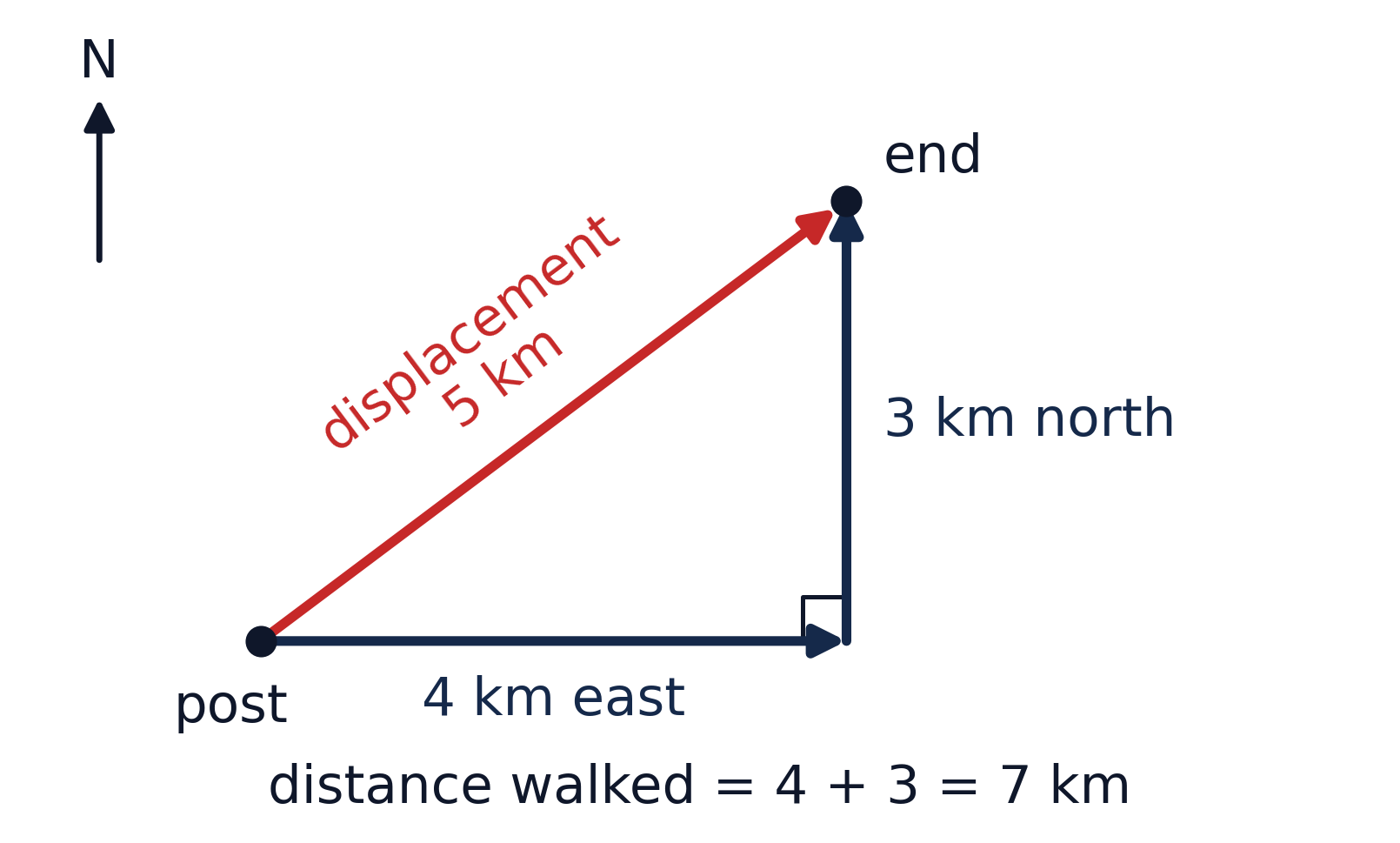
A patrol leaves its post, walks 4 km east and then 3 km north. It has walked 7 km. But it is only 5 km from the post in a straight line. These are two different quantities.
| Distance | Displacement | |
|---|---|---|
| What it is | The length of the path actually travelled | The straight line from the starting point to the end point, with its direction |
| Kind of quantity | Scalar (size only) | Vector (size and direction) |
| Can it be zero after a journey? | No | Yes, if the body returns to where it started |
| Which is larger? | Never smaller than the displacement | Never larger than the distance |
For the patrol, the distance is 4 + 3 = 7 km and the displacement is \sqrt{4^2 + 3^2} = 5 km, pointing north of east. The two are equal only when a body moves along a straight line without turning back.
2. Speed and velocity
| Speed | Velocity | |
|---|---|---|
| Meaning | Distance covered in unit time | Displacement in unit time |
| Kind of quantity | Scalar | Vector |
| Average value | \dfrac{\text{total distance}}{\text{total time}} | \dfrac{\text{total displacement}}{\text{total time}} |
| SI unit | m/s | m/s |
Changing units. 1\ \text{km/h} = \dfrac{1000\ \text{m}}{3600\ \text{s}} = \dfrac{5}{18} m/s. So multiply km/h by \tfrac{5}{18} to get m/s, and multiply m/s by \tfrac{18}{5} to get km/h. For example, 72 km/h is 72 \times \tfrac{5}{18} = 20 m/s.
The round trip. A truck drives 60 km to a depot and comes back by the same road, taking 3 hours in all. Its average speed is 120 \div 3 = 40 km/h. Its average velocity is zero, because its displacement is zero. NDA II 2019 asked exactly this idea.
Two speeds over equal distances. If a body covers the first half of a distance at speed v_1 and the second half at v_2, its average speed is not the simple average. It is
\text{average speed} = \frac{2 v_1 v_2}{v_1 + v_2}
because the body spends a longer time at the lower speed.
A body has uniform velocity when it covers equal displacements in equal times, however small the times. That means a steady speed along a straight line. Otherwise the motion is non-uniform.
3. Acceleration
Acceleration is the rate at which velocity changes:
a = \frac{v - u}{t}
Here u is the initial velocity, v the final velocity and t the time taken. The SI unit is \text{m/s}^2, and acceleration is a vector.
| Case | Acceleration |
|---|---|
| Velocity increasing | Positive |
| Velocity decreasing | Negative. This is called retardation or deceleration |
| Uniform velocity (steady speed in a straight line) | Zero |
| Steady speed round a curve | Not zero, because the direction of the velocity is changing (section 7) |
A body can have zero velocity and still be accelerating. A ball thrown up stops for an instant at the top, yet gravity is still pulling it down at that instant.
4. The three equations of motion
These are true only when the acceleration is uniform (constant) and the motion is along a straight line.
| Equation | Use it when the question does not involve | |
|---|---|---|
| 1 | v = u + at | the distance s |
| 2 | s = ut + \tfrac{1}{2}at^2 | the final velocity v |
| 3 | v^2 = u^2 + 2as | the time t |
Three more results come from them.
| Result | Formula |
|---|---|
| Average velocity under uniform acceleration | \dfrac{u + v}{2} |
| Distance covered in the nth second | u + \dfrac{a}{2}(2n - 1) |
| Stopping distance of a vehicle that brakes from speed u with retardation a | \dfrac{u^2}{2a} |
Equation 2 shows that the distance covered depends on the initial velocity u as well as on the acceleration. The last formula shows that doubling the speed makes the stopping distance four times as long, a fact every driver of a military vehicle should know.
Signs. Choose one direction as positive and keep to it. For a braking vehicle, a is negative. "Starts from rest" means u = 0. "Comes to rest" means v = 0.
5. Graphs of motion
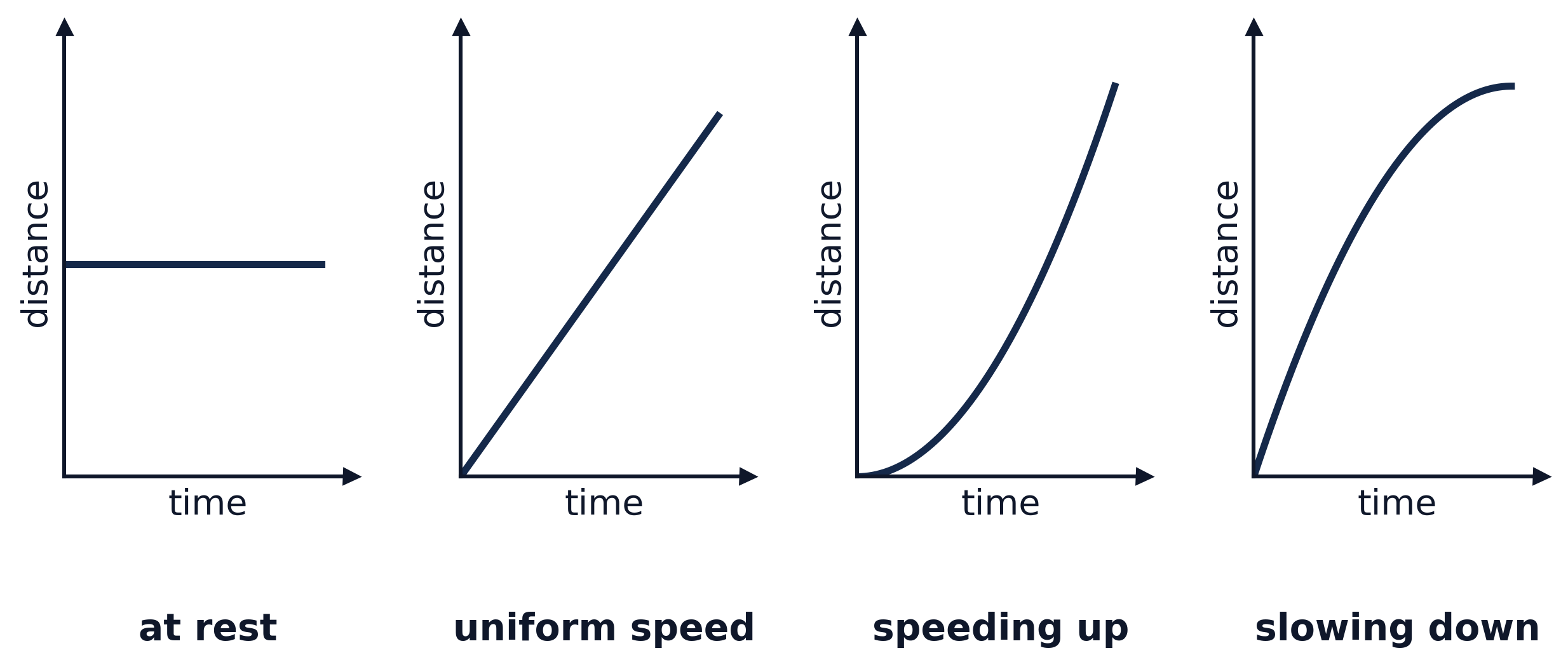
Learn the shapes from the two tables and the figure under each.
Distance-time graph (time along the horizontal axis). Its slope is the speed.
| Shape of the line | What the body is doing |
|---|---|
| Straight line parallel to the time axis | At rest |
| Straight line sloping upward | Moving with uniform speed. A steeper line means a greater speed |
| Curve that becomes steeper | Speeding up |
| Curve that becomes flatter | Slowing down |
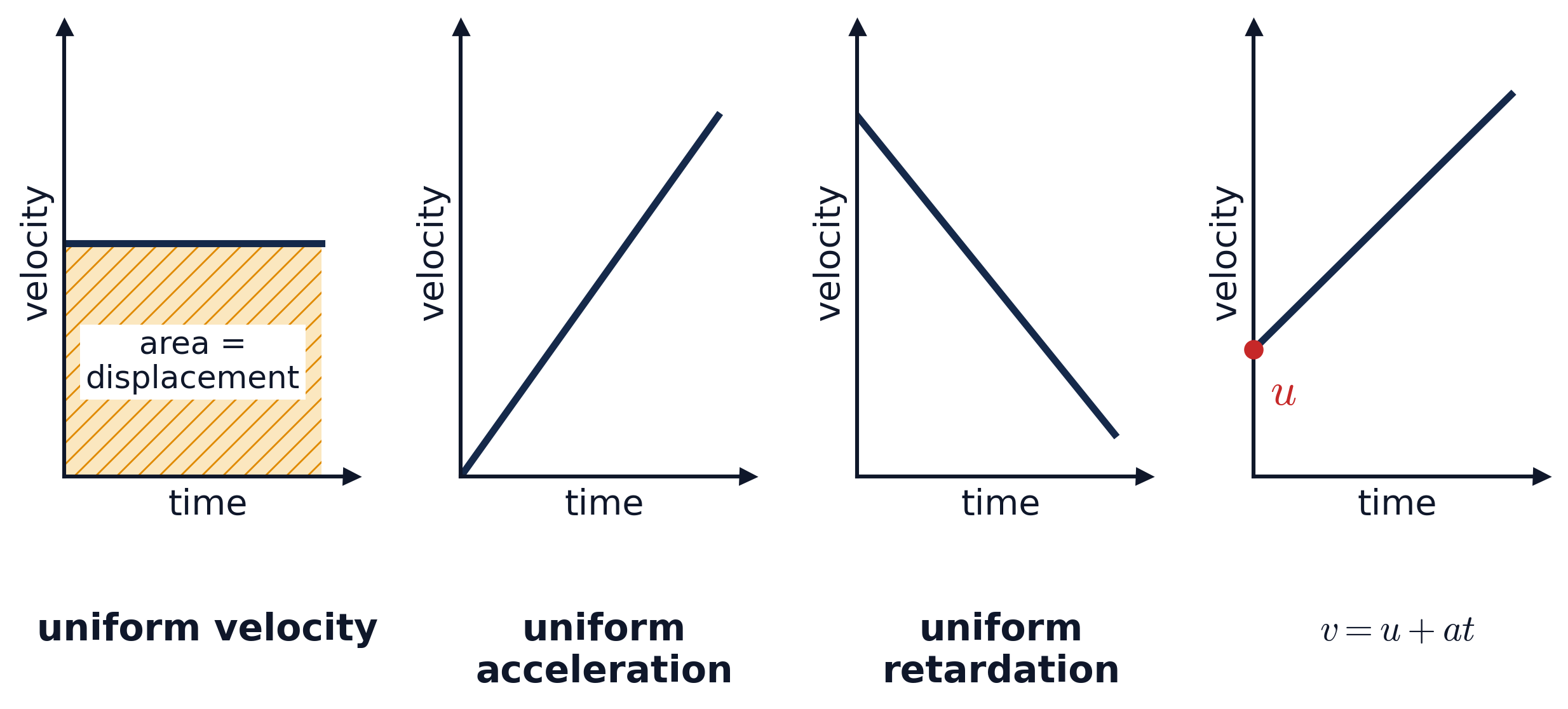
Velocity-time graph. Its slope is the acceleration. The area between the line and the time axis is the displacement.
| Shape of the line | What the body is doing |
|---|---|
| Straight line parallel to the time axis | Uniform velocity, zero acceleration |
| Straight line sloping upward | Uniform acceleration |
| Straight line sloping downward | Uniform retardation |
| Straight line sloping upward that starts above zero on the velocity axis | The equation v = u + at with u not zero |
The speed-time graph of a skydiver, asked in NDA II 2024, is a good test of reading. The speed rises quickly at first. The resistance of the air grows as the speed grows, so the line becomes flatter and at last level: the skydiver is falling at a steady speed. When the parachute opens the speed drops sharply to a new, much lower steady value.
6. Falling bodies and bodies thrown upward
A body falling freely near the Earth has a uniform acceleration g downward, about 9.8\ \text{m/s}^2 (many questions say take g = 10\ \text{m/s}^2). It is the same for all bodies when air resistance is left out. So the three equations apply with a = g for a falling body and a = -g for a body moving upward.
| Situation | Result |
|---|---|
| Dropped from rest, after time t | Speed v = gt; distance fallen h = \tfrac{1}{2}gt^2 |
| Dropped from height h | Speed on reaching the ground v = \sqrt{2gh} |
| Thrown up with speed u | Time to reach the top = \dfrac{u}{g}; greatest height = \dfrac{u^2}{2g} |
| Thrown up and caught at the same level | Time up = time down. It returns with the same speed u |
At the highest point the velocity is zero for an instant, but the acceleration is still g downward.
7. Motion in a circle
A car goes round a circular track at a steady 40 km/h. Its speed is constant. Its velocity is not, because the direction of motion changes at every point. A changing velocity means an acceleration. So uniform circular motion is accelerated motion.
This acceleration points towards the centre of the circle and is called centripetal acceleration. For speed v on a circle of radius r,
a = \frac{v^2}{r}
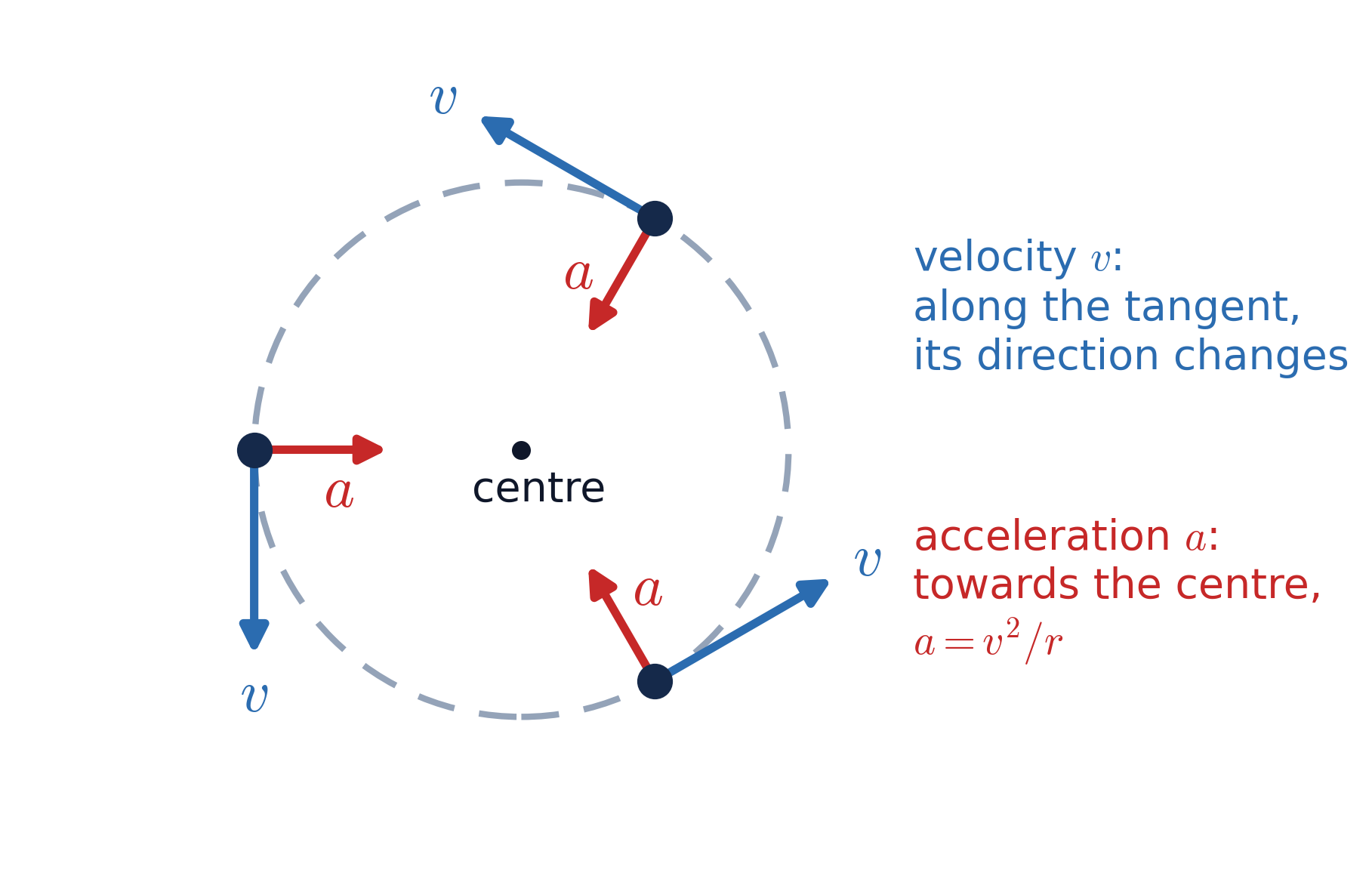
At the same speed, a gentle curve (large r) needs a smaller acceleration than a sharp curve (small r). The acceleration changes only the direction of the velocity. It does not make the body faster or slower.
What the papers have asked
| Paper | The idea asked | The answer in one line |
|---|---|---|
| NDA II 2017 | Centripetal acceleration on a gentle and on a sharp curve | Smaller on the gentle curve, since a = v^2/r |
| NDA I 2019 | Comparing speeds from a position and time graph | Speed is the slope of the distance-time graph |
| NDA I 2019 | Accelerated and decelerated parts of a velocity-time graph | Line sloping up: accelerated. Line sloping down: decelerated |
| NDA II 2019 | Does the distance under constant acceleration depend on the initial velocity? | Yes: s = ut + \tfrac{1}{2}at^2 |
| NDA II 2019 | Average velocity for a trip out and back | Zero, because the displacement is zero |
| NDA II 2021 | A car in uniform circular motion | Its velocity changes because its direction changes |
| NDA II 2021 | Speed needed to throw a ball to a height of 20 m | u = \sqrt{2gh} = \sqrt{2 \times 10 \times 20} = 20 m/s |
| NDA II 2023 | Average speed from odometer readings | Distance ÷ time: 400 km in 8 h is 50 km/h |
| NDA II 2023 | The graph for v = u + at | Velocity against time is a straight line starting at u; distance against time is then a curve that gets steeper |
| NDA II 2024 | Speed-time graph of a skydiver | Speed rises, then levels off at a steady value |
| NDA II 2024 | Two stages of acceleration, total distance given | Apply s = ut + \tfrac{1}{2}at^2 to each stage; the final speed of stage one is the u of stage two |
| NDA II 2024 | Net displacement after moving east and then south | Add the two displacements at right angles by Pythagoras |
| NDA I 2025 | Acceleration of a car stopped from 12 m/s in 45 m | a = \dfrac{v^2 - u^2}{2s} = \dfrac{0 - 144}{90} = -1.6\ \text{m/s}^2 |
| NDA I 2025 | Which equation of motion is written wrongly | Know all three, and the nth-second formula, exactly |
| NDA I 2025 | Acceleration at uniform speed | Zero (for motion in a straight line) |
Worked examples
Example 1 (the round trip). An athlete runs once round a 400 m track in 50 s and stops where she started. Her average speed and average velocity are
(a) 8 m/s and 8 m/s (b) 8 m/s and 0 (c) 0 and 8 m/s (d) 0 and 0
Solution. Distance = 400 m, so average speed = 400 \div 50 = 8 m/s. She ends where she began, so the displacement is zero and the average velocity is zero. Option (a) forgets that velocity uses displacement. Answer (b).
Example 2 (equations of motion). A jeep starts from rest and accelerates uniformly at 2\ \text{m/s}^2 for 10 s. How far does it travel in this time?
(a) 20 m (b) 100 m (c) 200 m (d) 400 m
Solution. u = 0, so s = ut + \tfrac{1}{2}at^2 = 0 + \tfrac{1}{2} \times 2 \times 10^2 = 100 m. Option (a), 20, is the final speed in m/s from v = u + at. Option (c) forgets the half. Answer (b).
Example 3 (braking). A truck moving at 72 km/h is brought to rest in 50 m by its brakes. What is its acceleration, taken as uniform?
(a) -4\ \text{m/s}^2 (b) -2\ \text{m/s}^2 (c) -0.4\ \text{m/s}^2 (d) -51.8\ \text{m/s}^2
Solution. First change the unit: 72 km/h = 20 m/s. Then v^2 = u^2 + 2as gives 0 = 20^2 + 2a \times 50, so a = -400 \div 100 = -4\ \text{m/s}^2. Option (d) comes from using 72 without changing it to m/s. Answer (a).
Example 4 (matching lists). Match List I with List II.
| List I (graph) | List II (motion) |
|---|---|
| A. Distance-time graph, straight line parallel to the time axis | 1. Uniform acceleration |
| B. Distance-time graph, straight line sloping upward | 2. Body at rest |
| C. Velocity-time graph, straight line sloping upward | 3. Uniform speed |
(a) A-2, B-3, C-1 (b) A-3, B-2, C-1 (c) A-2, B-1, C-3 (d) A-1, B-3, C-2
Solution. If the distance does not change with time, the body is at rest: A-2. A distance that grows steadily means uniform speed: B-3. A velocity that grows steadily means uniform acceleration: C-1. Option (c) is the trap: a sloping straight line means uniform speed on a distance-time graph but uniform acceleration on a velocity-time graph. Answer (a).
Example 5 (thrown upward). A ball is thrown vertically upward at 30 m/s. Taking g = 10\ \text{m/s}^2, the greatest height it reaches and the time it takes to reach it are
(a) 45 m and 3 s (b) 90 m and 3 s (c) 45 m and 6 s (d) 90 m and 6 s
Solution. At the top v = 0. Time = u \div g = 30 \div 10 = 3 s. Height = u^2 \div 2g = 900 \div 20 = 45 m. Six seconds is the time for the whole flight, up and down. Answer (a).
Example 6 (consider the following statements). A stone tied to a string is whirled in a horizontal circle at a constant speed.
- The velocity of the stone is constant.
- The acceleration of the stone points towards the centre of the circle.
Which of the statements given above is/are correct?
(a) 1 only (b) 2 only (c) Both 1 and 2 (d) Neither 1 nor 2
Solution. The speed is constant but the direction of motion keeps changing, so the velocity is not constant: statement 1 is wrong. The acceleration in uniform circular motion is centripetal, towards the centre: statement 2 is correct. Answer (b).
Mistakes that cost marks
- Using distance where displacement is needed. Average velocity uses displacement. For any journey that ends where it began, the average velocity is zero.
- Not changing km/h to m/s. If the acceleration is in \text{m/s}^2 or the distance in metres, change the speed first: multiply by \tfrac{5}{18}.
- Averaging two speeds. For equal distances at 40 km/h and 60 km/h the average speed is 48 km/h, not 50 km/h.
- Saying the acceleration is zero at the top of the flight. The velocity is zero there. The acceleration is still g, downward.
Quick check
Do these without help. Answers are at the end.
- Change 90 km/h into m/s.
- A cyclist rides 3 km north and then 4 km east. What are the distance and the size of the displacement?
- A car moving at 10 m/s accelerates at 2\ \text{m/s}^2 for 5 s. What is its final velocity?
- A stone is dropped from rest. How far does it fall in 2 s? (Take g = 10\ \text{m/s}^2.)
- What does the area under a velocity-time graph give?
Read and watch more, free
| What | Where | Language |
|---|---|---|
| Textbook | NCERT Class 9 Exploration, Chapter 4 "Describing Motion Around Us" | English (the Hindi edition is on the same NCERT site) |
| Textbook, the older Class 9 chapter | Old NCERT Class 9 "Motion", from the Internet Archive (the chapter most videos follow) | English |
| Textbook, higher level | NCERT Class 11 Physics Part I, Chapter 2 "Motion in a Straight Line" and Chapter 3 "Motion in a Plane" | English |
| Self-study lesson | NIOS Science and Technology (212), Lesson 9 | English, Hindi |
| Practice questions | NCERT Exemplar Problems, Class 9 Science, the unit on Motion | English, Hindi |
| Video, short lessons | Khan Academy India: Motion | English |
| Video, short lessons | Khan Academy India: Motion (Hindi) | Hindi |
| Video, clear teaching | Manocha Academy: Motion, Class 9 Physics | English |
| Video, the whole NDA Physics course | Defence Wallah: Complete Physics, Fast Track Series (the video on motion) | Hinglish |
The videos were chosen from their titles, length and views; they have not yet been watched by a teacher.
Answers to the quick check
- 90 \times \tfrac{5}{18} = 25 m/s.
- Distance = 3 + 4 = 7 km. Displacement = \sqrt{3^2 + 4^2} = 5 km.
- v = u + at = 10 + 2 \times 5 = 20 m/s.
- h = \tfrac{1}{2}gt^2 = \tfrac{1}{2} \times 10 \times 2^2 = 20 m.
- The displacement of the body (the distance travelled, if it does not turn back).
Next chapter: Newton's laws of motion, force and momentum.