Why this chapter matters. We found about 17 questions on this chapter in the 12 papers we hold, from 2017 to 2026. That is more than one question in every paper. Most are single facts or short reasoning questions: why a ship floats, what the upward force on an immersed body equals, which quantity has which unit. A few are short calculations with density. Learn first the difference between mass and weight, and then the rule "upthrust equals the weight of the liquid displaced". Almost every question here grows from these two ideas.
What you will be able to do
- Describe the three states of matter and name the changes between them.
- Tell mass from weight, and density from relative density, with the correct unit for each.
- Use the principle of Archimedes to find the upward force on a body in a liquid.
- Decide whether a body floats or sinks, and how much of a floating body stays under the surface.
Before you start you should know: how to multiply and divide decimals, and that the SI units of length, mass and time are the metre, the kilogram and the second. No earlier chapter is needed.
1. The three states of matter
Matter is anything that has mass and takes up space. It is made of very small particles that are always moving. How closely the particles are packed decides the state.
| Solid | Liquid | Gas | |
|---|---|---|---|
| Shape | Fixed | Takes the shape of the vessel | Fills the whole vessel |
| Volume | Fixed | Fixed | Not fixed |
| Can it be compressed? | Almost not | Almost not | Easily |
| Particles | Closely packed, they only vibrate | Close, but free to slide past each other | Far apart, moving fast in all directions |
| Example | Iron, ice | Water, diesel | Air, steam |
Liquids and gases can flow, so both are called fluids. A fourth state, plasma, is a gas so hot that its atoms have broken into charged particles. The Sun and the stars are made of plasma.
The names of the changes of state are asked directly.
| Change | Name | Example |
|---|---|---|
| Solid to liquid | Melting (fusion) | Ice to water |
| Liquid to solid | Freezing | Water to ice |
| Liquid to gas | Vaporisation (boiling or evaporation) | Water to steam |
| Gas to liquid | Condensation | Drops on a cold glass |
| Solid to gas directly | Sublimation | Camphor, naphthalene balls, dry ice |
Boiling and evaporation are not the same. Evaporation happens only at the surface of a liquid, and at any temperature. Wet clothes dry at 25 °C. Boiling happens through the whole body of the liquid, with bubbles of vapour forming inside it, and only at one fixed temperature for a given pressure. So evaporation is called a surface phenomenon and boiling a bulk phenomenon.
Diffusion is the mixing of the particles of two substances on their own, without stirring. The smell of cooking reaches the next room by diffusion. It is fastest in gases and slowest in solids.
2. Three properties of matter the papers ask about
| Property | What it means | Facts to remember |
|---|---|---|
| Surface tension | The surface of a liquid behaves like a stretched skin and tries to take the smallest area | Small drops are round. An insect can walk on water. Soap and detergent lower the surface tension of water, so the water spreads and wets cloth better. Surface tension falls when the temperature rises. |
| Viscosity | The friction inside a flowing liquid | Honey is more viscous than water. A liquid becomes less viscous when it is heated. |
| Elasticity | A body returns to its shape when the deforming force is removed | Stress = force ÷ area, in N/m². Strain = change in length ÷ original length. Strain is a ratio, so it has no unit. |
In everyday speech rubber is "more elastic". In physics steel is more elastic than rubber, because a much larger stress is needed to produce the same strain in steel.
3. Mass, weight and volume
A soldier's pack has the same amount of matter in Delhi, on a high mountain post and on the Moon. But it does not pull down on his shoulders equally in the three places. The amount of matter is the mass. The pull of gravity on it is the weight.
| Mass | Weight | |
|---|---|---|
| What it is | The quantity of matter in a body | The force with which the Earth (or a planet) pulls the body |
| Formula | W = mg | |
| SI unit | kilogram (kg) | newton (N) |
| Kind of quantity | Scalar (size only) | Vector (it points towards the centre of the Earth) |
| Does it change from place to place? | No | Yes, because g changes |
| Measured with | A beam balance | A spring balance |
Here g is the acceleration due to gravity, about 9.8\ \text{m/s}^2 near the Earth's surface. Many questions tell you to take g = 10\ \text{m/s}^2. A body of mass 5 kg then weighs 5 \times 10 = 50 N. On the Moon, g is about one-sixth of its value on the Earth, so the same body weighs about one-sixth as much. Its mass is still 5 kg.
Volume is the space a body takes up. The SI unit is the cubic metre. The units used most often are:
| Unit | Equal to |
|---|---|
| 1 litre (L) | 1000\ \text{cm}^3 = 10^{-3}\ \text{m}^3 |
| 1 millilitre (mL) | 1\ \text{cm}^3 |
| 1\ \text{m}^3 | 1000 L |
4. Density and relative density
A bucket of sand is heavier than the same bucket full of sawdust. Sand has more mass packed into each unit of volume. This is density:
\rho = \frac{m}{V}
The SI unit is \text{kg/m}^3. In the laboratory \text{g/cm}^3 is used, and 1\ \text{g/cm}^3 = 1000\ \text{kg/m}^3.
Relative density (the older name is specific gravity) compares a substance with water:
\text{relative density} = \frac{\text{density of the substance}}{\text{density of water}}
It is a ratio of two densities, so it has no unit. The relative density of mercury is 13.6. This means mercury is 13.6 times as dense as water.
| Substance | Density in kg/m³ | Relative density |
|---|---|---|
| Air (at sea level, 0 °C) | about 1.29 | |
| Ice | about 917 | 0.917 |
| Water (at 4 °C) | 1000 | 1 |
| Sea water | about 1030 | 1.03 |
| Aluminium | 2700 | 2.7 |
| Iron | about 7800 | 7.8 |
| Mercury | 13,600 | 13.6 |
| Gold | 19,300 | 19.3 |
Two facts about water are asked again and again. Water is densest at 4 °C, which is 277 K. And ice is less dense than water, which is why ice floats.
Mixtures. When two liquids are mixed and the total volume does not change, the density of the mixture is total mass ÷ total volume. Two results follow:
| How they are mixed | Density of the mixture |
|---|---|
| Equal volumes | \dfrac{\rho_1 + \rho_2}{2} |
| Equal masses | \dfrac{2\rho_1\rho_2}{\rho_1 + \rho_2} |
5. Buoyancy and the principle of Archimedes
Push an empty, closed bottle under water and you feel the water pushing it up. Every liquid and every gas pushes up on a body placed in it. This upward force is called the buoyant force or upthrust. Buoyancy is a force, not a pressure, and it always acts upward.
The principle of Archimedes. When a body is fully or partly immersed in a fluid, the fluid pushes it up with a force equal to the weight of the fluid that the body displaces.
\text{upthrust} = \rho_{\text{fluid}} \times V_{\text{displaced}} \times g
Notice what is in the formula: the density of the fluid and the volume of fluid pushed aside. The mass of the body is not in it. A steel ball and a wooden ball of the same size, both held fully under water, feel the same upthrust.
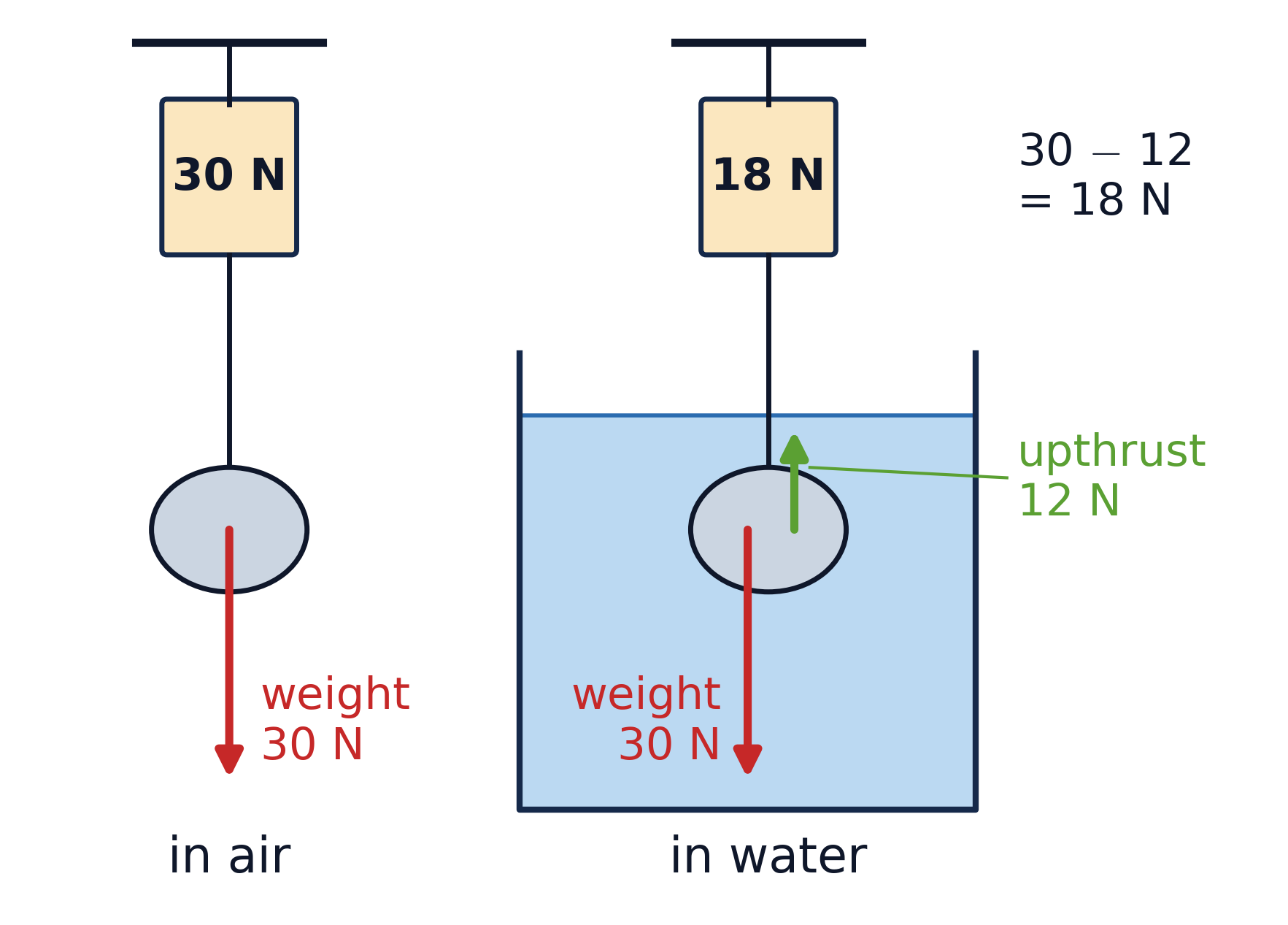
Because of the upthrust, a body seems lighter in a liquid:
\text{apparent weight} = \text{weight in air} - \text{upthrust}
The principle also gives a quick way to find relative density. A body fully under water displaces its own volume of water, so
\text{relative density of a solid} = \frac{\text{weight in air}}{\text{loss of weight in water}}
For example, a stone weighs 30 N in air and 18 N in water. The loss is 12 N, so its relative density is 30 \div 12 = 2.5.
6. Floating and sinking
Compare the weight of the body with the largest upthrust it can get, which is the upthrust when it is fully under the liquid.
| Density of the body compared with the liquid | What happens |
|---|---|
| Greater | It sinks |
| Equal | It stays wherever it is placed inside the liquid |
| Less | It rises and floats, partly above the surface |
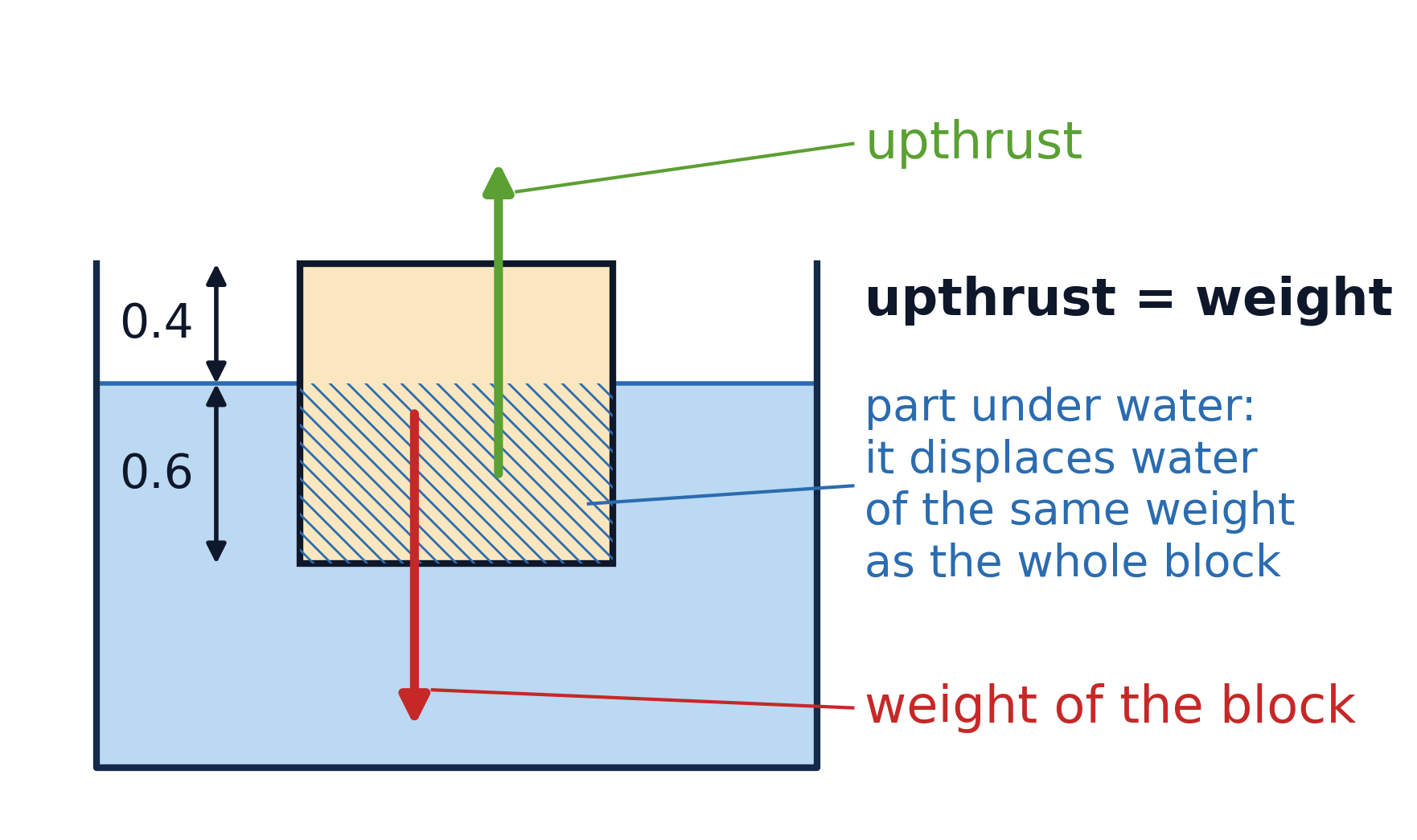
The law of floatation. A floating body displaces its own weight of liquid. From this,
\text{fraction of the body under the surface} = \frac{\text{density of the body}}{\text{density of the liquid}}
Ice has relative density 0.917, so about nine-tenths of an iceberg is under fresh water and only one-tenth shows.
Why a steel ship floats. A solid nail is steel all through, so its density is about 7800 kg/m³ and it sinks. A ship is a hollow steel shell full of air. Its average density, total mass ÷ total volume, is less than that of water, so it floats.
More facts of the same kind:
- A ship floats a little higher in the sea than in a river, because sea water is denser. The upthrust is the same in both, equal to the ship's weight. Only the volume under water changes.
- A submarine takes water into its ballast tanks to dive and blows it out with compressed air to rise. It changes its average density.
- A hydrometer is a weighted glass tube that floats upright. It sinks less in a denser liquid, so the reading on its stem gives the relative density. A lactometer is a hydrometer for milk.
- A hot-air balloon rises because the hot air inside is less dense than the cold air outside. Archimedes' principle works for gases too.
7. When is a floating body stable?
This is a Class 11 idea, asked in NDA I 2026. Three points are needed.
| Point | Meaning |
|---|---|
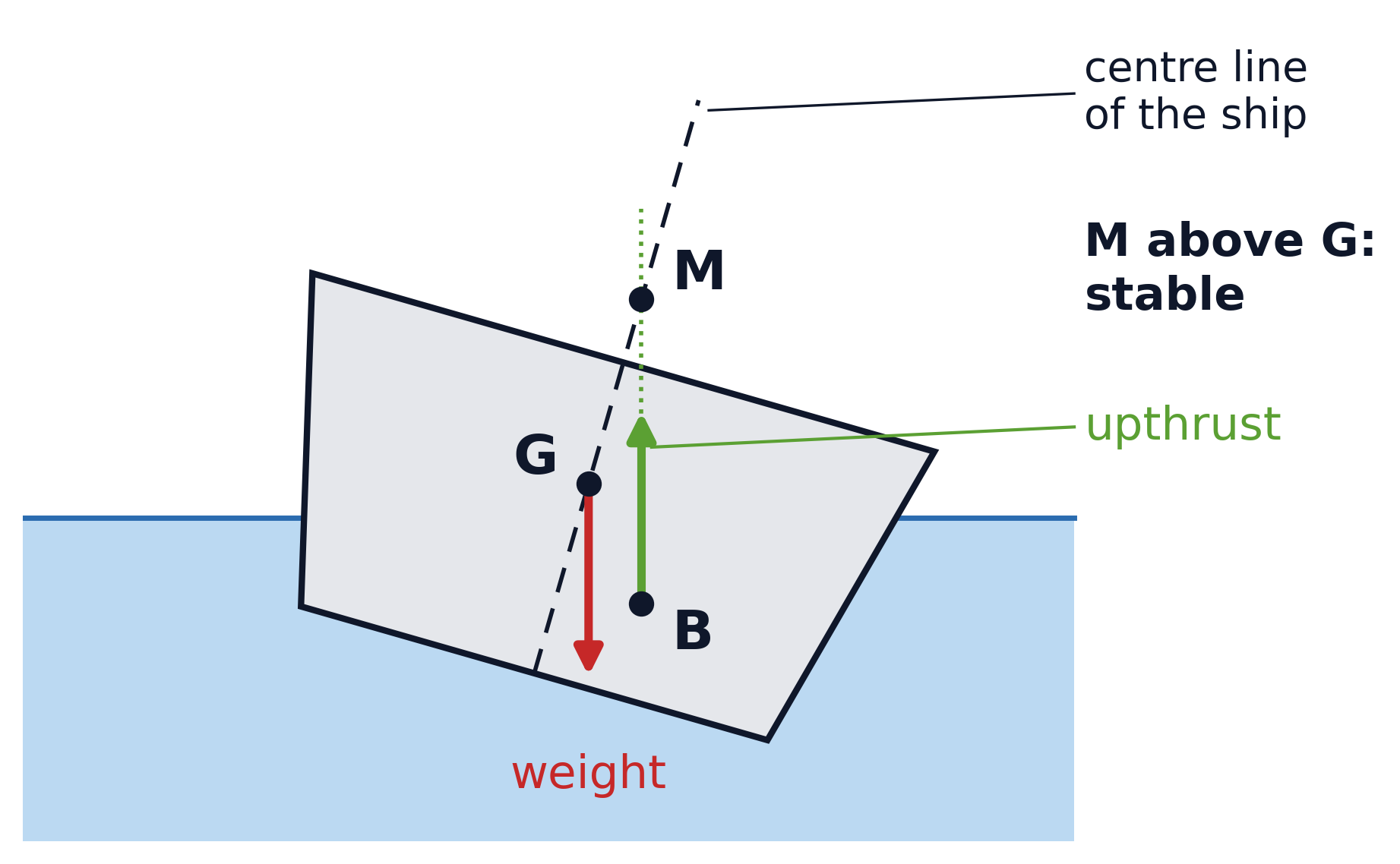
| Centre of gravity (G) | The point where the weight of the body acts |
| Centre of buoyancy (B) | The centre of gravity of the displaced liquid. The upthrust acts here. |
| Metacentre (M) | When the body tilts a little, the vertical line through the new centre of buoyancy cuts the body's original centre line at M |
A floating body is stable if the metacentre is above the centre of gravity. Then, when the ship rolls, weight and upthrust together turn it back upright. If G is above M the body turns over. This is why heavy cargo is loaded low in a ship: it lowers G.
What the papers have asked
| Paper | The idea asked | The answer in one line |
|---|---|---|
| NDA II 2017 | A body weighed under water, compared with its weight in air | It weighs less, because of the upthrust |
| NDA II 2019 | Is boiling or evaporation a surface phenomenon? | Evaporation is at the surface; boiling is in the bulk |
| NDA II 2019 | The property behind the cleaning action of soap | Surface tension |
| NDA II 2019 | Two densities from an equal-volume and an equal-mass mixture | Use the two mixture formulas of section 4 |
| NDA II 2021 | What kind of quantity buoyancy is | An upward force |
| NDA II 2023 | An iron nail sinks, an iron ship floats | The ship's average density is less than water's; the nail's is more |
| NDA I 2024 | Average density of a sphere with a core and a shell | Total mass ÷ total volume |
| NDA II 2024 | Particles of two substances mixing on their own | Diffusion |
| NDA II 2024 | Density of a body from its weight and the water it displaces | Mass = weight ÷ g; volume = volume displaced; then \rho = m/V |
| NDA II 2024 | Temperature at which water is densest | 277 K (4 °C) |
| NDA I 2025 | The size of the upward force on an immersed body | The weight of the fluid displaced, not the mass of the body |
| NDA I 2025 | Match quantity and SI unit | Weight: newton. Mass: kilogram. Pressure: pascal. Temperature: kelvin |
| NDA I 2025 | Which quantity has no dimensions | Strain |
| NDA II 2025 | Surface tension and temperature | It decreases as the temperature rises |
| NDA I 2026 | Stability of a floating body | The centre of gravity must be below the metacentre |
Worked examples
Example 1 (a single fact). Which one of the following is measured in newtons?
(a) Mass (b) Density (c) Weight (d) Relative density
Solution. Weight is a force, so its unit is the newton. Mass is the tempting option, because in daily life we say "my weight is 60 kg". In physics 60 kg is the mass, and the weight is about 600 N. Answer (c).
Example 2 (a short calculation). A metal cube of side 10 cm has a mass of 2.7 kg. What is its density?
(a) 0.27 kg/m³ (b) 27 kg/m³ (c) 270 kg/m³ (d) 2700 kg/m³
Solution. The side is 0.1 m, so the volume is 0.1^3 = 0.001\ \text{m}^3. Then \rho = 2.7 \div 0.001 = 2700\ \text{kg/m}^3. The wrong options come from leaving the side in centimetres or from misplacing the decimal point. Answer (d).
Example 3 (Archimedes). A block of volume 0.004\ \text{m}^3 weighs 100 N in air. What does it appear to weigh when fully immersed in water? (Density of water = 1000 kg/m³, g = 10\ \text{m/s}^2.)
(a) 40 N (b) 60 N (c) 96 N (d) 140 N
Solution. Upthrust = 1000 \times 0.004 \times 10 = 40 N. Apparent weight = 100 - 40 = 60 N. Option (a) is the upthrust itself, not the apparent weight. Answer (b).
Example 4 (floating). A piece of ice of density 917 kg/m³ floats in sea water of density 1030 kg/m³. About what fraction of the ice is below the surface?
(a) 0.11 (b) 0.50 (c) 0.89 (d) 0.92
Solution. Fraction under the surface = 917 \div 1030 \approx 0.89. Option (d), 0.917, is the answer for fresh water. In denser sea water the ice floats a little higher. Answer (c).
Example 5 (consider the following statements).
- The upthrust on a body fully immersed in a liquid depends on the volume of the body.
- The upthrust on a body fully immersed in a liquid depends on the density of the body.
Which of the statements given above is/are correct?
(a) 1 only (b) 2 only (c) Both 1 and 2 (d) Neither 1 nor 2
Solution. Upthrust = \rho_{\text{fluid}} V g. The volume of the body decides how much liquid is pushed aside, so statement 1 is correct. The density in the formula is that of the liquid, not of the body, so statement 2 is wrong. The density of the body decides only whether it sinks or floats. Answer (a).
Example 6 (reasoning). An ice cube floats in a glass of water. When the ice has melted completely, the level of water in the glass
(a) rises (b) falls (c) stays the same (d) rises first and then falls
Solution. The floating ice displaces water equal to its own weight. When it melts it becomes water of exactly that weight, which fills exactly the space the ice had pushed aside. So the level does not change. "Rises" is tempting because part of the ice was above the surface. Answer (c).
Mistakes that cost marks
- Giving weight in kilograms. Mass is in kilograms and weight is in newtons. If a question gives "a body of weight 50 N", divide by g to get the mass before you find density.
- Using the density of the body in the upthrust formula. Upthrust uses the density of the liquid. The body's density is used only to decide floating or sinking.
- Saying the upthrust on a ship is greater in the sea. A floating ship always has upthrust equal to its own weight. In the sea it only needs to displace a smaller volume, so it rides higher.
- Giving relative density a unit. It is a pure number. A relative density of 2.5 means a density of 2500 kg/m³, or 2.5 g/cm³.
Quick check
Do these without help. Answers are at the end.
- Name the change of state when naphthalene balls slowly disappear in a cupboard.
- A body has mass 8 kg. What is its weight where g = 10\ \text{m/s}^2?
- A liquid has relative density 0.8. What is the mass of 5 litres of it?
- A stone weighs 45 N in air and 30 N when fully immersed in water. What is its relative density?
- A block of wood of density 600 kg/m³ floats in water. What fraction of its volume is above the surface?
Read and watch more, free
The present NCERT Class 9 book no longer has this chapter, so the best free texts are the open-school lesson and the older Class 9 chapter.
| What | Where | Language |
|---|---|---|
| Self-study lesson | NIOS Science and Technology (212), Lesson 11 "Gravitation" (buoyancy, Archimedes, density) and Lesson 2 (states of matter) | English, Hindi |
| Textbook, first read | NCERT Class 8 Curiosity, Chapter 5 (weight; floating and sinking) and Chapter 9 (density) | English (the Hindi edition is on the same NCERT site) |
| Textbook, the older Class 9 chapter | NCERT Class 9 "Gravitation", 2022 printing, from the Internet Archive (thrust, pressure, buoyancy, Archimedes, relative density) | English |
| Textbook, higher level | NCERT Class 11 Physics Part II, Chapter 9 "Mechanical Properties of Fluids" | English |
| Open textbook | OpenStax College Physics: Archimedes' Principle | English |
| Practice questions | NCERT Exemplar, Class 9, Gravitation | English |
| Video, short lessons | Khan Academy India: Gravity (includes pressure and floating) | English |
| Video, short playlist | LearnoHub: Gravitation, Class 9 (videos 4 and 5 cover thrust, pressure and Archimedes' principle) | Hinglish / English |
| Video, the whole NDA Physics course | Defence Wallah: Complete Physics, Fast Track Series (the video on states of matter) | Hinglish |
| Video, Hindi medium | Magnet Brains Hindi Medium: Class 9 Physics | Hindi |
The videos were chosen from their titles, length and views; they have not yet been watched by a teacher.
Answers to the quick check
- Sublimation: the solid changes directly into vapour.
- W = mg = 8 \times 10 = 80 N.
- Density = 0.8 \times 1000 = 800\ \text{kg/m}^3. Five litres is 0.005\ \text{m}^3. Mass = 800 \times 0.005 = 4 kg.
- Loss of weight = 45 - 30 = 15 N. Relative density = 45 \div 15 = 3.
- Fraction under water = 600 \div 1000 = 0.6, so the fraction above is 0.4, which is two-fifths.
Next chapter: Pressure and the barometer.