Why this chapter matters. This chapter gave 12 questions in the 6 papers from CDS I 2024 to CDS II 2026. That is two questions in every paper. Seven of the 12 are on mixtures and alloys: two liquids or two metals are mixed, and the question asks for a ratio, a percentage or a quantity. Five are on averages: the greatest value a number can take, how many values an unknown can take, or the average of a list of even or odd numbers. One of the 12 is an "is the statement enough" question. The syllabus does not name this topic. The papers ask it every time.
What you will be able to do
- Move between an average and a total, and find the effect of a number joining, leaving or being replaced.
- Find the average of an evenly spaced list at sight, and the greatest or least value a number in a group can take.
- Follow one ingredient through a mixture or an alloy, and find the new ratio after mixing or adding.
- Use the rule of alligation to find the ratio in which two things must be mixed.
Before you start you should know: fractions (Chapter A1-2), percentages (Chapter A2-1), and how to turn a ratio such as 3 : 2 into the fractions \frac35 and \frac25 (Chapter A2-5).
1. Average and total
The average of a group of numbers is their total divided by how many there are.
\text{Average} = \frac{\text{Total}}{\text{Number of items}} \qquad \text{so} \qquad \text{Total} = \text{Average} \times \text{Number of items}
The average of 12, 15 and 21 is \frac{12 + 15 + 21}{3} = \frac{48}{3} = 16.
The second form is the one that solves questions. When a question gives an average, turn it into a total at once. Averages cannot be added or subtracted. Totals can.
2. When the group changes
A number joins. Nine players have an average weight of 60 kg. A tenth player joins and the average becomes 61 kg. The old total is 60 \times 9 = 540. The new total is 61 \times 10 = 610. The tenth player weighs 610 - 540 = 70 kg.
A number is replaced. In a group of 8, one person of 56 kg is replaced. The average rises by 2.5 kg. The total has risen by 8 \times 2.5 = 20 kg, so the new person weighs 56 + 20 = 76 kg.
Two groups are joined. 30 students have an average mark of 60. Another 20 students have an average mark of 70. The average of all 50 is
\frac{30 \times 60 + 20 \times 70}{30 + 20} = \frac{3200}{50} = 64
It is not 65. The bigger group pulls the average towards itself. This is called a weighted average. The plain average of the two averages is right only when the two groups are equal in size.
3. The average of an evenly spaced list
A list is evenly spaced when each number is the same amount more than the one before it: 7, 12, 17, ..., 47. For such a list
\text{Average} = \frac{\text{first} + \text{last}}{2}
Here the average is \frac{7 + 47}{2} = 27. The reason: pair the first with the last, the second with the second last, and so on. Every pair has the same total.
| List | Average |
|---|---|
| First n natural numbers: 1, 2, 3, ..., n | \dfrac{n + 1}{2} |
| First n even numbers: 2, 4, 6, ..., 2n | n + 1 |
| First n odd numbers: 1, 3, 5, ..., 2n - 1 | n |
The first 50 even numbers run from 2 to 100, so their average is \frac{2 + 100}{2} = 51. The first 50 odd numbers run from 1 to 99, so their average is 50.
4. The greatest and the least possible value
A question may fix the average and ask how large one number can be. The total is fixed, so to make one number as large as possible, make all the others as small as the question allows.
Five numbers have an average of 20, and none is less than 12. The total is 100. Let four of them be 12 each: that uses 48. The fifth can be at most 100 - 48 = 52.
Read the conditions with care. If the five must be different whole numbers with 12 the least, the other three small ones are 13, 14 and 15. Then the largest is 100 - (12 + 13 + 14 + 15) = 46.
The same idea works the other way. If the average of some numbers must lie between two limits, multiply through by the number of items. The total then lies between two limits, and so does the unknown.
5. The average of two rates
A man spends ₹120 on apples at ₹40 per kg and another ₹120 on apples at ₹60 per kg. He buys 3 + 2 = 5 kg for ₹240. The average price is \frac{240}{5} = ₹48 per kg, not ₹50. To average two rates, divide the total of one quantity by the total of the other. The same care is needed for average speed (Chapter A2-9).
6. Mixtures and alloys: follow one ingredient
A mixture is two or more things mixed together, such as milk and water. An alloy is a mixture of metals, such as copper and zinc. The mathematics is the same for both.
Step 1. Turn each ratio into fractions of the whole. Milk and water in the ratio 3 : 1 means 4 parts in all. Milk is \frac34 of the mixture and water is \frac14. It does not mean that milk is \frac31 or that water is \frac13.
Step 2. Follow the amount of one ingredient. Choose the ingredient that is easiest to follow, often the one that is not added.
40 litres of a mixture has milk and water in the ratio 3 : 1. So milk is 30 litres and water is 10 litres. Now 5 litres of water is added. Milk is still 30 litres. Water is 15 litres. The new ratio is 30 : 15 = 2 : 1.
Step 3. When two mixtures are joined, add the amounts of each ingredient. If the question says "equal quantities" and gives no amount, choose an amount that every ratio total divides. For ratios 2 : 1 and 3 : 2 the totals are 3 and 5, so take 15 litres of each.
Check the direction before you calculate. Adding an ingredient can only raise its share. Adding water can only lower the share of milk. A question that asks for the opposite has the answer "not possible".
7. The rule of alligation
Two kinds of rice cost ₹30 and ₹50 per kg. In what ratio must they be mixed so that the mixture costs ₹36 per kg?
The rule of alligation gives the ratio in one line.
\frac{\text{quantity of cheaper}}{\text{quantity of dearer}} = \frac{\text{dearer} - \text{mean}}{\text{mean} - \text{cheaper}}
Here "mean" is the value of the mixture. So cheaper : dearer = (50 - 36) : (36 - 30) = 14 : 6 = 7 : 3.
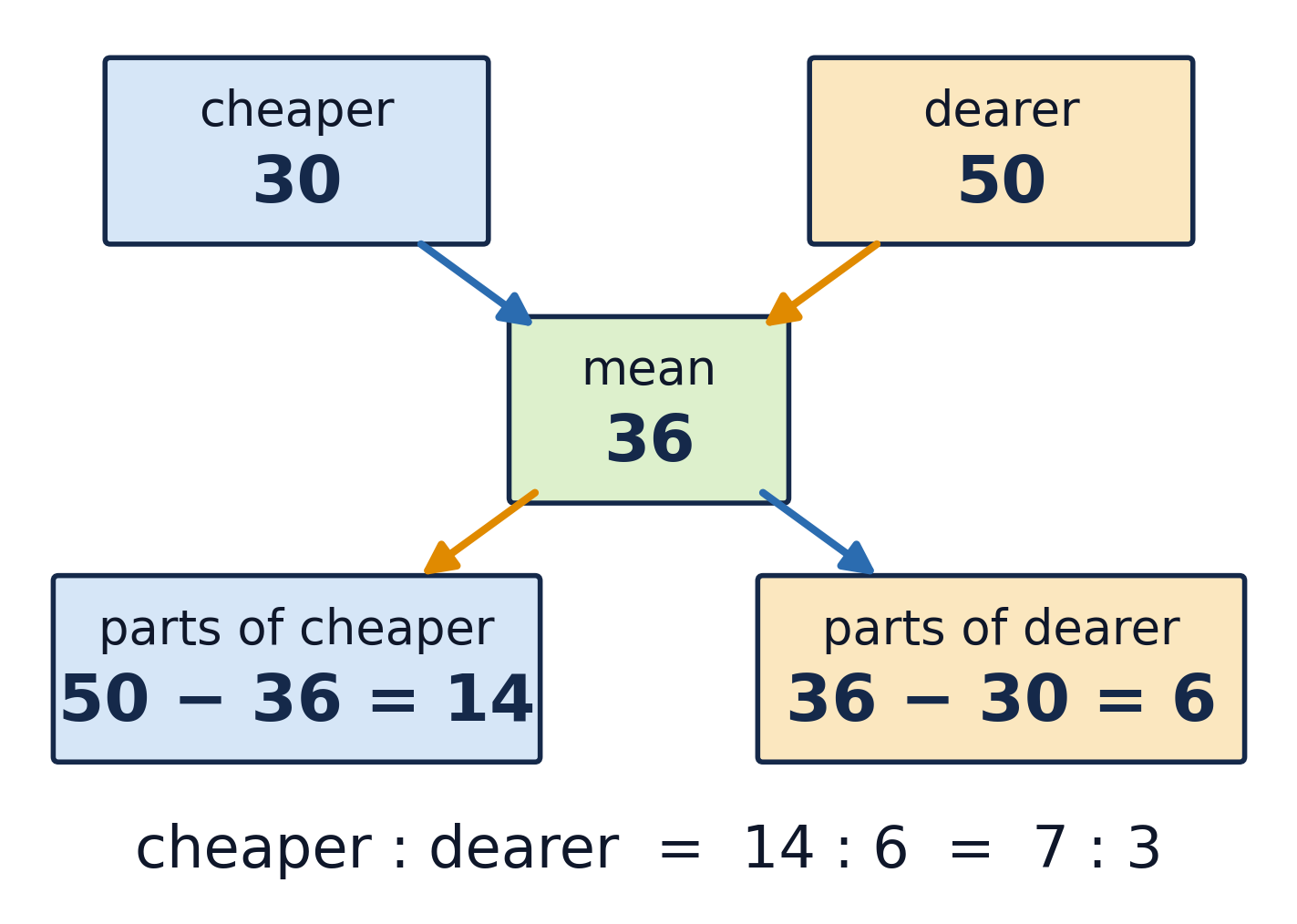
Why it works. Each kilogram of the cheaper rice is ₹6 below the mean. Each kilogram of the dearer rice is ₹14 above it. The amounts below and above must balance: 7 \times 6 = 42 and 3 \times 14 = 42. Check the answer: \frac{7 \times 30 + 3 \times 50}{10} = \frac{360}{10} = 36.
Notice that the differences cross over. The mean, 36, is nearer to 30, so more of the ₹30 rice is needed.
The rule works for any value "per unit": price per kg, the fraction of spirit in a liquid, the percentage of copper in an alloy, the average mark of two groups. Two conditions must hold.
- The three values must measure the same thing in the same way. With liquids, use the fraction of one ingredient in the whole for all three.
- The answer is the ratio of the quantities mixed (litres, kilograms, number of students).
Worked examples
Example 1. A batsman has an average of 42 runs in 5 innings. After the 6th innings his average is 45. How many runs did he score in the 6th innings?
Turn the averages into totals. After 5 innings: 42 \times 5 = 210. After 6 innings: 45 \times 6 = 270. He scored 270 - 210 = 60 runs.
Example 2. A class of 40 students has an average mark of 52. The boys have an average of 50 and the girls have an average of 55. How many girls are there?
Use alligation on the averages. Boys : girls = (55 - 52) : (52 - 50) = 3 : 2. Of 40 students, the boys are \frac35 \times 40 = 24 and the girls are 16. Check: 24 \times 50 + 16 \times 55 = 1200 + 880 = 2080 = 40 \times 52.
Example 3. 60 litres of a mixture has milk and water in the ratio 7 : 3. How much water must be added to make the ratio 3 : 2?
Milk is \frac{7}{10} \times 60 = 42 litres and water is 18 litres. Only water is added, so follow the milk: it stays at 42 litres. In the new mixture, milk is 3 parts, so one part is 14 litres and water is 2 \times 14 = 28 litres. Water to add: 28 - 18 = 10 litres.
From the real papers
These five questions are from the Elementary Mathematics papers (Series A). The first four are from CDS I 2024, CDS I 2025 and CDS II 2025, and the answers agree with the final official key. Try each for 72 seconds before reading the solution.
CDS I 2024, Q31. A bottle contains spirit and water in the ratio 1 : 4 and another identical bottle contains spirit and water in the ratio 4 : 1. In what ratio should the mixtures in the two bottles be mixed to get a new mixture in which the ratio of spirit to water is 1 : 3?
(a) 5 : 1 (b) 6 : 1 (c) 10 : 1 (d) 11 : 1
Solution. Use the fraction of spirit in the whole. First bottle \frac15, second bottle \frac45, new mixture \frac14. By alligation, first : second = \left(\frac45 - \frac14\right) : \left(\frac14 - \frac15\right) = \frac{11}{20} : \frac{1}{20} = 11 : 1. Check: 11 litres of the first has 2.2 litres of spirit and 1 litre of the second has 0.8. That is 3 litres of spirit in 12, which is \frac14. Answer (d).
CDS I 2025, Q3. If the average of 64, 69, 72, 75, x lies between 62 and 76 (excluding 62 and 76), then what is the number of possible integer values of x?
(a) 68 (b) 69 (c) 70 (d) 71
Solution. Turn the average into a total. The four known numbers add to 280, so 62 < \frac{280 + x}{5} < 76. Multiply by 5: 310 < 280 + x < 380, so 30 < x < 100. The whole numbers from 31 to 99 number 99 - 31 + 1 = 69. Answer (b).
CDS I 2025, Q10. A mixture of 100 L contains kerosene and turpentine oil in the ratio 3 : 2. What is the minimum quantity of kerosene in litres (whole number) that should be mixed in the mixture so that the resulting mixture has 20% of kerosene?
(a) 10 L (b) 20 L (c) 25 L (d) Not possible
Solution. Check the direction first. Kerosene is \frac35 \times 100 = 60 litres, which is 60% of the mixture. Adding kerosene can only raise its share above 60%. It can never fall to 20%. Answer (d).
CDS II 2025, Q55. X and Y are two alloys of copper (Cu) and zinc (Zn). Alloy X is prepared by mixing Cu and Zn in the ratio 5 : 4, and alloy Y is prepared by mixing Cu and Zn in the ratio 5 : 13 respectively. If equal quantities of alloys X and Y are melted to form a third alloy Z, then what is the ratio of Cu to Zn in Z?
(a) 5 : 8 (b) 5 : 7 (c) 6 : 7 (d) 7 : 8
Solution. The ratio totals are 9 and 18, so take 18 kg of each alloy. X has copper 10 kg and zinc 8 kg. Y has copper 5 kg and zinc 13 kg. Together: copper 15 kg and zinc 21 kg. The ratio is 15 : 21 = 5 : 7. Answer (b).
From CDS II 2024: no official key was published; the answer is our own working.
CDS II 2024, Q67. A question is given followed by two statements I and II. Consider the Question and the Statements and mark the correct option.
Question: The largest of five different integers is 8 and least is 2. What is the average of these integers?
Statement-I: The sum of all the 5 integers is a multiple of 5
Statement-II: The number of odd integers is odd
Which one of the following is correct in respect of the above Question and the Statements?
(a) The Question can be answered by using one of the Statements alone, but cannot be answered using the other Statement alone (b) The Question can be answered by using either Statement alone (c) The Question can be answered by using both the Statements together, but cannot be answered using either Statement alone (d) The Question cannot be answered even by using both the Statements together
Solution. Two of the numbers are 2 and 8. The other three are different numbers from 3, 4, 5, 6, 7. Their sum is at least 3 + 4 + 5 = 12 and at most 5 + 6 + 7 = 18, so the total of all five lies from 22 to 28. Statement I: the only multiple of 5 in that range is 25, so the average is 5. It is enough. Statement II: the three numbers 3, 4, 6 give one odd number and a total of 23. The three numbers 4, 5, 6 also give one odd number, but a total of 25. The average is not fixed. It is not enough. One statement alone answers the question and the other does not. Answer (a).
In all five, the first step was the same: turn the ratio or the average into amounts.
Mistakes that cost marks
- Taking the plain average of two averages. 30 students at 60 and 20 students at 70 do not average 65. Use totals: the answer is 64. The plain average is right only for equal groups.
- Reading the ratio 1 : 4 as one quarter. Spirit and water in the ratio 1 : 4 means spirit is \frac15 of the mixture. Add the two terms to get the whole.
- Writing the alligation ratio the wrong way round. The differences cross over. Check with common sense: the mixture's value is nearer to the thing there is more of.
- Averaging two rates directly. ₹120 spent at ₹40 per kg and ₹120 at ₹60 per kg gives ₹48 per kg, not ₹50. Divide the total money by the total weight.
Quick check
Do these without help. Answers are at the end.
- The average of 7 numbers is 15. One of them, 21, is removed. What is the average of the remaining 6?
- What is the average of the first 40 odd natural numbers?
- 15 kg of tea at ₹200 per kg is mixed with 10 kg of tea at ₹250 per kg. What is the price of the mixture per kg?
- Milk costs ₹60 per litre. In what ratio must water (which costs nothing) be mixed with it so that the mixture is worth ₹48 per litre?
- Alloy X has copper and zinc in the ratio 2 : 1. Alloy Y has them in the ratio 1 : 1. Equal weights of X and Y are melted together. What is the ratio of copper to zinc in the new alloy?
Read and watch more, free
The NCERT books teach the average. They do not teach mixtures or the rule of alligation; for that, this lesson, the practice site below and the past papers are the material.
| What | Where | Language |
|---|---|---|
| Textbook, the average | NCERT Class 7 Ganita Prakash Part II, Chapter 5 Connecting the Dots, section 5.2 Representative Values · Hindi edition | English, Hindi |
| Textbook, ratios and sharing in a ratio | NCERT Class 8 Ganita Prakash Part I, Chapter 7 Proportional Reasoning-1 · Hindi edition | English, Hindi |
| Solved practice | IndiaBIX aptitude (open "Average" and "Alligation or Mixture") | English |
| The real papers | UPSC previous question papers | English, Hindi |
| Video, a full CDS course | R.S SIR: Maths Playlist for CDS 2025 (the average and mixture lessons, about 55 minutes each) | Hindi and Hinglish |
| Video, with past questions | The Journey Extraordinary: Maths For CDS 2 2026 (the mixture lesson) | Hinglish |
| Video, arithmetic in three parts | Defence Wallah CDS / AFCAT: Maths for CDS 1, 2025 (the arithmetic lessons, 2 to 3 hours each) | Hinglish |
The videos were chosen from their titles, length and views; they have not yet been watched by a teacher.
Answers to the quick check
- The total is 7 \times 15 = 105. After removing 21 it is 84. The average is \frac{84}{6} = 14.
- The average of the first n odd numbers is n. So it is 40.
- Total cost = 15 \times 200 + 10 \times 250 = 5500 for 25 kg. The price is ₹220 per kg.
- Water : milk = (60 - 48) : (48 - 0) = 12 : 48 = 1 : 4.
- Take 6 kg of each. X has copper 4 kg and zinc 2 kg. Y has copper 3 kg and zinc 3 kg. Together: copper 7 kg and zinc 5 kg. The ratio is 7 : 5.
Next chapter: Time and work; pipes and cisterns.