Why this chapter matters. This chapter gave 7 questions in the 6 papers from CDS I 2024 to CDS II 2026. That is about one question in every paper. Two of the 7 ask where a faster person catches a slower one who left earlier. Two use the fact that, over the same distance, time goes down as speed goes up. One asks for an average speed, one for the minutes a train stands still in each hour, and one gives a saving of time and asks for the speed. "Time and distance" is named in the syllabus. The next chapter (trains, boats and streams) is built on this one.
What you will be able to do
- Use distance = speed × time in any of its three forms, and change km/h to m/s and back.
- Use the inverse relation between speed and time over a fixed distance.
- Find an average speed correctly, and the time lost in stoppages.
- Use relative speed to find when and where two moving people meet or catch up.
Before you start you should know: fractions (Chapter A1-2), ratio and inverse proportion (Chapters A2-5 and A2-6), and how to solve a simple equation.
1. One formula, three forms
Speed is the distance covered in one unit of time.
\text{Distance} = \text{Speed} \times \text{Time} \qquad \text{Speed} = \frac{\text{Distance}}{\text{Time}} \qquad \text{Time} = \frac{\text{Distance}}{\text{Speed}}
A car that covers 150 km in 2\frac12 hours has a speed of 150 \div 2.5 = 60 km/h.
Keep the units the same. If the speed is in km/h, the time must be in hours. 45 minutes is \frac{45}{60} = \frac34 hour, so a bus at 48 km/h covers 48 \times \frac34 = 36 km in 45 minutes.
km/h and m/s. 1 km/h is 1000 metres in 3600 seconds, which is \frac{5}{18} m/s.
| To change | Multiply by | Example |
|---|---|---|
| km/h to m/s | \dfrac{5}{18} | 72 km/h = 72 \times \dfrac{5}{18} = 20 m/s |
| m/s to km/h | \dfrac{18}{5} | 15 m/s = 15 \times \dfrac{18}{5} = 54 km/h |
To remember which is which: the number in m/s is always the smaller one.
2. Same distance: speed up, time down
When the distance is fixed, speed and time are in inverse proportion. If the speed is multiplied by a fraction, the time is multiplied by the fraction turned upside down.
| Speed becomes | Time becomes |
|---|---|
| \frac34 of the usual | \frac43 of the usual |
| \frac35 of the usual | \frac53 of the usual |
| twice the usual | half the usual |
If two speeds are in the ratio a : b, the times for the same distance are in the ratio b : a.
This solves "late" and "early" questions in one line. A man walks at \frac34 of his usual speed and is 10 minutes late. His time is \frac43 of the usual time T. The extra time is \frac43 T - T = \frac13 T, and this is 10 minutes. So T = 30 minutes.
3. Average speed
\text{Average speed} = \frac{\text{Total distance}}{\text{Total time}}
It is not the average of the speeds, unless the times are equal.
Equal distances at two speeds. A man goes 120 km at 30 km/h and comes back at 60 km/h. The times are 4 hours and 2 hours. Average speed = \frac{240}{6} = 40 km/h, not 45. For two equal distances at speeds a and b the result is always
\text{Average speed} = \frac{2ab}{a + b}
Check: \frac{2 \times 30 \times 60}{30 + 60} = \frac{3600}{90} = 40. The distance itself does not matter. The average is nearer to the slower speed, because more time is spent at that speed.
Equal times at two speeds. If he drives for 2 hours at 30 km/h and 2 hours at 60 km/h, the average is the plain one: \frac{30 + 60}{2} = 45 km/h.
Stoppages. A bus runs at 54 km/h when it is moving. With stops, it covers only 45 km in each hour. To cover 45 km at 54 km/h takes \frac{45}{54} hour, which is 50 minutes. So the bus stands still for 10 minutes in each hour.
4. Relative speed: catching up and meeting
When two bodies move, think about the gap between them and how fast the gap changes.
| The two move | The gap changes at | Called |
|---|---|---|
| in the same direction | the difference of the speeds | relative speed, same direction |
| towards each other | the sum of the speeds | relative speed, opposite directions |
\text{Time to catch up or to meet} = \frac{\text{gap}}{\text{relative speed}}
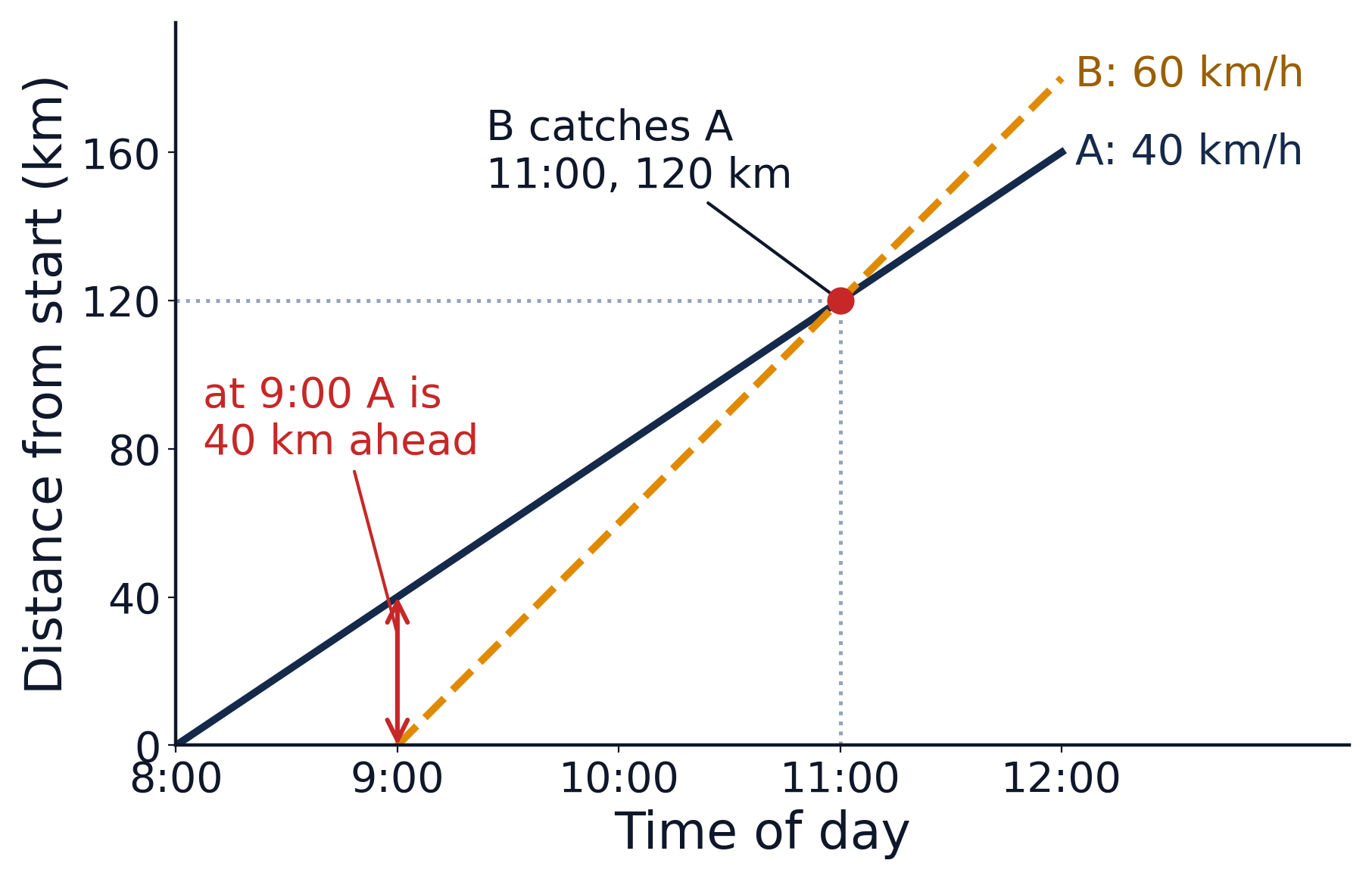
Catching up. A leaves a town at 8:00 at 40 km/h. B leaves the same town at 9:00 at 60 km/h on the same road. At 9:00, A is 40 km ahead. The gap closes at 60 - 40 = 20 km/h, so B needs \frac{40}{20} = 2 hours. B catches A at 11:00. The place is 60 \times 2 = 120 km from the town. Check with A: 3 hours at 40 km/h is also 120 km.
Meeting. Two towns are 300 km apart. Two cars start at the same time, one from each town, at 50 km/h and 70 km/h towards each other. The gap closes at 50 + 70 = 120 km/h. They meet after \frac{300}{120} = 2\frac12 hours, at 50 \times 2.5 = 125 km from the first town.
If one starts earlier, first find the gap at the moment the second one starts. Then use the rule.
5. When the question gives a saving of time
Some questions say: "at a higher speed the journey would take so much less time". Write the two times and subtract.
\frac{d}{v} - \frac{d}{v + k} = \text{time saved}
Here d is the distance, v the first speed and k the extra speed. This becomes a quadratic equation. In the exam, do not solve it. Put the options into the left side and see which one gives the saving.
Worked examples
Example 1. A cyclist covers 450 metres in 1 minute 30 seconds. What is her speed in km/h?
The time is 90 seconds. Speed = \frac{450}{90} = 5 m/s. In km/h this is 5 \times \frac{18}{5} = 18 km/h.
Example 2. If a man walks at 4 km/h he reaches his office 10 minutes late. If he walks at 5 km/h he reaches 5 minutes early. How far is the office?
The two times differ by 10 + 5 = 15 minutes, which is \frac14 hour. Let the distance be d km. Then \frac{d}{4} - \frac{d}{5} = \frac14, so \frac{d}{20} = \frac14 and d = 5 km. Check: 5 km takes 75 minutes at 4 km/h and 60 minutes at 5 km/h. The difference is 15 minutes.
Example 3. A car covers the first 60 km of a journey at 30 km/h and the next 60 km at 20 km/h. What is its average speed?
The times are 2 hours and 3 hours. Average speed = \frac{120}{5} = 24 km/h. By the formula for equal distances: \frac{2 \times 30 \times 20}{30 + 20} = 24. It is not 25.
Example 4. Towns P and Q are 300 km apart. A car leaves P for Q at 8:00 at 50 km/h. Another car leaves Q for P at 9:00 at 75 km/h. When and where do they meet?
By 9:00 the first car has covered 50 km, so the gap is 250 km. Now the gap closes at 50 + 75 = 125 km/h. They meet after \frac{250}{125} = 2 hours, at 11:00. The first car has then driven 3 hours: the place is 150 km from P. Check from the other side: 75 \times 2 = 150 km from Q, and 150 + 150 = 300.
Example 5. A train covers 300 km at a steady speed. If its speed were 10 km/h more, it would take 1 hour less. What is its speed? The options are 40, 50, 60 and 75 km/h.
Test the options in \frac{300}{v} - \frac{300}{v + 10}. For v = 50: \frac{300}{50} - \frac{300}{60} = 6 - 5 = 1 hour. That fits. (For v = 40 the saving is 7.5 - 6 = 1.5 hours, which is too much.) The speed is 50 km/h.
From the real papers
These six questions are from the Elementary Mathematics papers (Series A). The first four are from CDS I 2024, CDS I 2025 and CDS II 2025, and the answers agree with the final official key. The last two are from CDS II 2026, whose key is still provisional; our answers agree with it. Try each for 72 seconds before reading the solution.
CDS I 2024, Q2. The speeds of four cars are 2u, 3u, 4u and xu and the time taken by them to cover the same distance is xt, 4t, 3t and 2t respectively, where x, u, t are real numbers. What is the value of x?
(a) 8 (b) 6 (c) 5 (d) 2
Solution. Distance is speed multiplied by time, and it is the same for all four. The second car gives 3u \times 4t = 12ut. The first car gives 2u \times xt = 2x\,ut. So 2x = 12 and x = 6. Check with the fourth car: 6u \times 2t = 12ut. Answer (b).
CDS I 2025, Q46. Travelling at 3/5^{th} of his usual speed, a man is late by 20 minutes. What is the usual time if he travels with his usual speed?
(a) 25 minutes (b) 30 minutes (c) 32 minutes (d) 35 minutes
Solution. At \frac35 of the speed, the time is \frac53 of the usual time T. The extra time is \frac53 T - T = \frac23 T = 20 minutes. So T = 30 minutes. Check: the slow journey takes 50 minutes, which is 20 minutes late. Answer (b).
CDS I 2024, Q55. Two trains A and B leave Delhi for Hyderabad at 7:00 a.m. and 7:50 a.m. on the same day and travel at 80 kmph and 100 kmph respectively. After how many kilometers from Delhi will the two trains be together?
(a) \frac{200}{3} km (b) 100 km (c) \frac{400}{3} km (d) \frac{1000}{3} km
Solution. In 50 minutes, which is \frac56 hour, A covers 80 \times \frac56 = \frac{200}{3} km. This is the gap when B starts. The gap closes at 100 - 80 = 20 km/h, so B needs \frac{200}{3} \div 20 = \frac{10}{3} hours. In that time B travels 100 \times \frac{10}{3} = \frac{1000}{3} km. Answer (d). (Option (a) is only the head start.)
CDS II 2025, Q52. Two persons X and Y leave place P for place Q at 7:00 a.m. and 7:10 a.m. respectively along the same path. X walks at a speed of 4 \cdot 8 km/hr and Y walks at a speed of 6 km/hr. How many kilometres from place P will X meet Y?
(a) 3 km (b) 3 \cdot 5 km (c) 4 km (d) 4 \cdot 5 km
Solution. The same question as the last one, with new numbers. In 10 minutes X walks 4.8 \times \frac{10}{60} = 0.8 km. The gap closes at 6 - 4.8 = 1.2 km/h, so Y needs \frac{0.8}{1.2} = \frac23 hour, which is 40 minutes. In that time Y walks 6 \times \frac23 = 4 km. Check: X has walked 50 minutes at 4.8 km/h, which is also 4 km. Answer (c).
CDS II 2026, Q94. A cyclist pedals from her house to her office at a speed of 3 kmph and back from the office to her house at 6 kmph. What is the average speed?
(a) 5 kmph (b) 4·5 kmph (c) 4 kmph (d) 3·5 kmph
Solution. The two distances are equal, so the average speed is \frac{2 \times 3 \times 6}{3 + 6} = \frac{36}{9} = 4 km/h. Check with a distance of 6 km each way: 2 hours out and 1 hour back, so 12 km in 3 hours. Answer (c). (Option (b) is the plain average of 3 and 6, which is the trap.)
CDS II 2026, Q14. Had I walked 0·5 km/hr faster, I would have taken 8 minutes less to walk 2 km. What is my original speed?
(a) 2·5 km/hr (b) 2·75 km/hr (c) 3 km/hr (d) 3·25 km/hr
Solution. Test the options. At 2.5 km/h, 2 km takes \frac{2}{2.5} hour, which is 48 minutes. At 2.5 + 0.5 = 3 km/h it takes \frac23 hour, which is 40 minutes. The saving is 8 minutes. That fits. Answer (a).
Two of the six are the same catching-up question, set in two different years. The types in this chapter repeat.
Mistakes that cost marks
- Averaging the speeds. Out at 3 km/h and back at 6 km/h does not give 4.5 km/h. Use total distance over total time, or \frac{2ab}{a + b} for equal distances. The answer is 4 km/h.
- Mixing minutes with km/h. A head start of 50 minutes at 80 km/h is 80 \times \frac{50}{60} km, not 80 \times 50. Change minutes to hours first.
- Stopping at the head start, or at the time. "How many kilometres from the start will they be together?" asks for the place. After finding the time, multiply by the speed of the one who started later.
- Slower speed, less time. At \frac35 of the speed the time is \frac53 of the usual, not \frac35 of it. Turn the fraction upside down.
Quick check
Do these without help. Answers are at the end.
- Change 72 km/h to m/s.
- Walking at \frac45 of his usual speed, a man is 15 minutes late. What is his usual time?
- A man drives to a town at 40 km/h and comes back at 60 km/h. What is his average speed?
- A leaves a place at 6:00 at 30 km/h. B leaves the same place at 6:30 at 40 km/h on the same road. When does B catch A, and how far from the start?
- A train runs at 80 km/h without stoppages. With stoppages it covers the same distance at an average of 60 km/h. For how many minutes does it stop in each hour?
Read and watch more, free
NCERT has no chapter on time and distance. Speed problems appear as word problems in the Class 10 chapters on equations. For the rest, this lesson, the practice site below and the past papers are the material.
| What | Where | Language |
|---|---|---|
| Textbook, speed problems with two unknowns | NCERT Class 10 Mathematics, Chapter 3 Pair of Linear Equations in Two Variables · Hindi edition | English, Hindi |
| Textbook, speed problems that give a quadratic | NCERT Class 10 Mathematics, Chapter 4 Quadratic Equations · Hindi edition | English, Hindi |
| Textbook, inverse proportion | NCERT Class 8 Ganita Prakash Part II, Chapter 3 Proportional Reasoning-2, section 3.6 Inverse Proportions · Hindi edition | English, Hindi |
| Solved practice | IndiaBIX aptitude (open "Time and Distance") | English |
| The real papers | UPSC previous question papers | English, Hindi |
| Video, a full CDS course | R.S SIR: Maths Playlist for CDS 2025 (the time, speed and distance lessons, about 55 minutes each) | Hindi and Hinglish |
| Video, one long lesson | Defence Wallah CDS / AFCAT: Quantitative Aptitude CDS 2024 (the speed, time and distance lesson, about 2 hours) | Hinglish |
| Video, classes of about 80 minutes | Learn with Sumit: FREE CDS Math 2024, Abhyaas 4.0 (the time and distance classes) | Hindi and Hinglish |
The videos were chosen from their titles, length and views; they have not yet been watched by a teacher.
Answers to the quick check
- 72 \times \frac{5}{18} = 20 m/s.
- The time becomes \frac54 T. The extra \frac14 T is 15 minutes, so T = 60 minutes.
- \frac{2 \times 40 \times 60}{40 + 60} = \frac{4800}{100} = 48 km/h.
- At 6:30, A is 15 km ahead. The gap closes at 10 km/h, so B needs 1\frac12 hours. B catches A at 8:00, at 40 \times 1.5 = 60 km from the start.
- With stoppages it covers 60 km in an hour. At 80 km/h that needs \frac{60}{80} hour, which is 45 minutes. It stops for 15 minutes.
Next chapter: Trains, boats and streams.