Why this chapter matters. This chapter gave only 2 questions in the 6 papers from CDS I 2024 to CDS II 2026. One was about a man who walks East, South, West and North, and it needed the theorem of Pythagoras. The other was about the hands of a clock. No calendar question was asked in these six papers. The syllabus does not name clocks, calendars or directions; such questions come in under "time and distance". So this is a short chapter. Learn the few rules, and do not spend long on it.
What you will be able to do
- Find the angle between the hands of a clock at a given time, and the time at which the hands meet.
- Count how many times two hands of a clock meet in a given period.
- Find the day of the week for a date by counting odd days.
- Follow a walk with turns and find how far the end is from the start.
Before you start you should know: relative speed (Chapter A2-9), remainders on division by 7 (Chapter A1-4), and the theorem of Pythagoras for a right triangle, a^2 + b^2 = c^2 (it is taught in full in Chapter A5-3).
1. The clock: two hands with two speeds
A full turn is 360^\circ. The dial has 12 hour marks, so two neighbouring hour marks are 30^\circ apart.
| Hand | One full turn in | Speed |
|---|---|---|
| Hour hand | 12 hours | \frac12^\circ a minute (30^\circ an hour) |
| Minute hand | 60 minutes | 6^\circ a minute |
| Second hand | 60 seconds | 6^\circ a second |
Both hands move the same way. So the minute hand gains on the hour hand at the relative speed of 6 - \frac12 = 5\frac12 degrees a minute. This one number solves most clock questions.
The angle at a given time. At H hours M minutes, the hour hand is at 30H + \frac12 M degrees from the 12 mark and the minute hand is at 6M degrees. So
\text{Angle between the hands} = \left| 30H - \frac{11}{2} M \right| \text{ degrees}
If the result is more than 180^\circ, subtract it from 360^\circ.
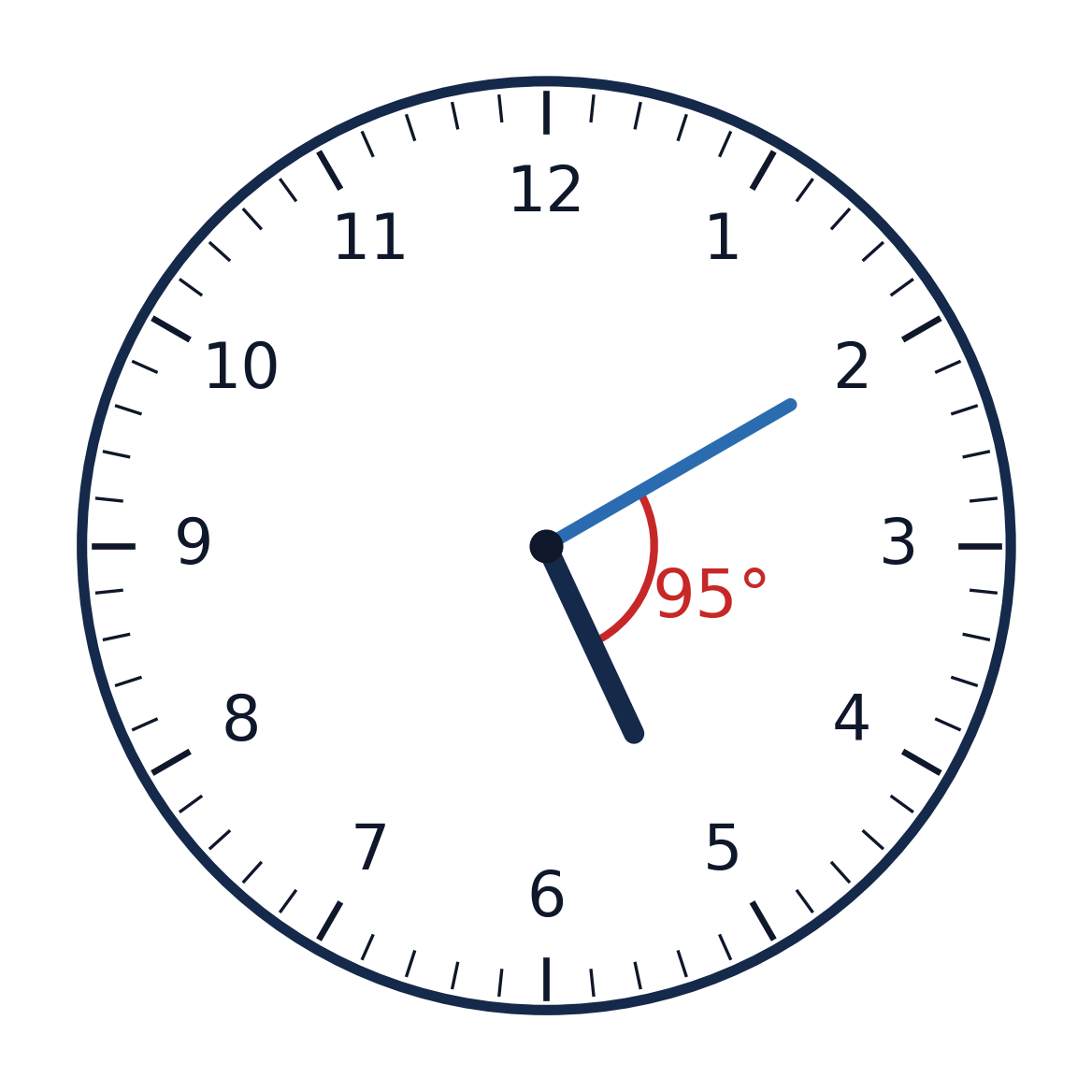
At 5:10 the angle is \left| 150 - 55 \right| = 95^\circ. At 1:50 the formula gives \left| 30 - 275 \right| = 245^\circ, so the angle is 360^\circ - 245^\circ = 115^\circ.
The time for a given angle. At 4 o'clock the hour hand is 120^\circ ahead of the minute hand. The hands are together when the minute hand has gained 120^\circ. That takes 120 \div 5\frac12 = \frac{240}{11} = 21\frac{9}{11} minutes. So the hands meet at 21\frac{9}{11} minutes past 4.
2. How many times do the hands meet?
Count laps, as for two runners on a round track. In 12 hours the minute hand goes round 12 times and the hour hand once. So the minute hand passes the hour hand 12 - 1 = 11 times.
| Hour hand and minute hand | In 12 hours | In a day |
|---|---|---|
| are together | 11 times | 22 times |
| are opposite (in a straight line, 180^\circ apart) | 11 times | 22 times |
| are at right angles | 22 times | 44 times |
The hands are together once in every \frac{12 \times 60}{11} = 65\frac{5}{11} minutes, not once in every hour.
The same counting works for any two hands. In one hour the second hand goes round 60 times and the minute hand once, so the second hand passes the minute hand 60 - 1 = 59 times in an hour.
3. The calendar: odd days
A week has 7 days. So only the remainder on division by 7 matters. This remainder is called the number of odd days.
- 100 days after a Monday: 100 = 7 \times 14 + 2, so it is 2 days after Monday, a Wednesday.
- An ordinary year has 365 days = 52 weeks + 1 day: 1 odd day.
- A leap year has 366 days: 2 odd days.
So a date moves forward by one day of the week each year, and by two days if a 29 February lies in between. 1 January 2026 is a Thursday. So 1 January 2027 is a Friday and 1 January 2028 is a Saturday. The year 2028 is a leap year, so 1 January 2029 is a Monday.
Leap years. A year is a leap year if it is divisible by 4. A century year (one ending in 00) is a leap year only if it is divisible by 400. So 2024 and 2000 are leap years; 1900 and 2100 are not.
Odd days of the months. A month of 31 days has 3 odd days, a month of 30 days has 2, and February has 0 (or 1 in a leap year).
4. Directions
Draw the four directions as on a map: North up, South down, East to the right and West to the left. A right turn is a turn clockwise: a man facing North who turns right faces East.
To find where a walk ends, keep two separate totals.
- East minus West gives how far East of the start he is.
- North minus South gives how far North of the start he is.
These two distances are at right angles. The straight distance from the start is given by Pythagoras:
\text{Distance from the start} = \sqrt{(\text{East} - \text{West})^2 + (\text{North} - \text{South})^2}
Worked examples
Example 1. At what times between 4 and 5 o'clock are the hands of a clock at right angles?
At 4:00 the hour hand is 120^\circ ahead. The gap is 90^\circ for the first time when the minute hand has gained 30^\circ: that takes 30 \div 5\frac12 = \frac{60}{11} = 5\frac{5}{11} minutes. The gap is 90^\circ again when the minute hand has passed the hour hand and is 90^\circ ahead. It has then gained 120 + 90 = 210^\circ: that takes 210 \div 5\frac12 = \frac{420}{11} = 38\frac{2}{11} minutes. The times are 5\frac{5}{11} and 38\frac{2}{11} minutes past 4.
Example 2. 26 January 2026 is a Monday. What day of the week is 15 August 2026?
Count the days from 26 January to 15 August. January has 5 days left. Then February 28, March 31, April 30, May 31, June 30, July 31, and 15 days of August. The total is 5 + 28 + 31 + 30 + 31 + 30 + 31 + 15 = 201 days. Now 201 = 7 \times 28 + 5, so there are 5 odd days. Five days after Monday is Saturday.
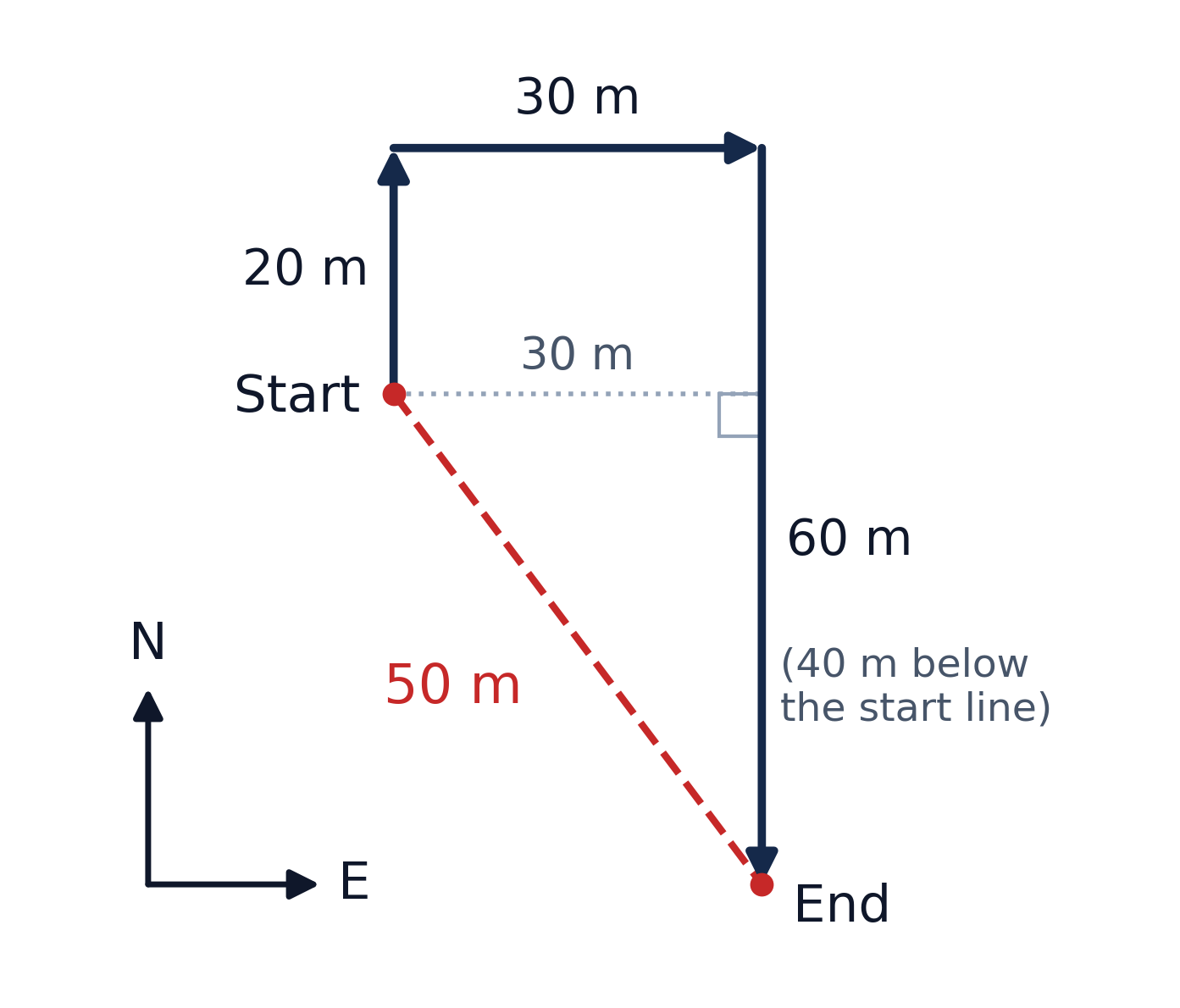
Example 3. A man walks 20 m North. He turns right and walks 30 m. He turns right again and walks 60 m. How far is he from the starting point, and in which direction?
Facing North, a right turn makes him face East. Another right turn makes him face South. So he has walked 20 m North, 30 m East and 60 m South. East minus West is 30 m. North minus South is 20 - 60 = -40, so he is 40 m South of the start. Distance = \sqrt{30^2 + 40^2} = \sqrt{2500} = 50 m. He is to the south-east of the start.
From the real papers
The six papers have two questions on this chapter. Both are given here. The first is from CDS I 2025 (Series A), and the answer agrees with the final official key. Try each for 72 seconds before reading the solution.
CDS I 2025, Q38. A man starting from a place P went x metre (x > 120 m) East before turning South. He went 40 m straight before turning to West. He went 60 m to reach a place Q. From Q he went 200 m North and reached a place R. If PR = 200 m, then what is x equal to?
(a) 150 m (b) 180 m (c) 200 m (d) 240 m
Solution. Keep the two totals. East minus West is x - 60. North minus South is 200 - 40 = 160. So R is (x - 60) m East and 160 m North of P. By Pythagoras, (x - 60)^2 + 160^2 = 200^2. Then (x - 60)^2 = 40000 - 25600 = 14400, so x - 60 = 120 or -120. Since x > 120, we take x - 60 = 120 and x = 180. Answer (b). (The sides 120, 160, 200 are 40 times 3, 4, 5.)
From CDS II 2024: no official key was published; the answer is our own working.
CDS II 2024, Q90. How many times does the minute hand of a clock coincide with the second hand between 2.01 pm and 4.01 pm on the same day?
(a) 121 (b) 120 (c) 119 (d) None of the above
Solution. Count laps. In one hour the second hand passes the minute hand 60 - 1 = 59 times (section 2). The period from 2.01 pm to 4.01 pm is exactly 2 hours, so it holds 2 \times 59 = 118 meetings. Check the two ends. Starting from 2.00 pm, when both hands are on the 12, the meetings come once every \frac{3600}{59} seconds, which is a little more than 61 seconds. So the first meeting is just after 2.01 pm, and no meeting falls exactly on 2.01 pm or on 4.01 pm. The count is 118, which is not among (a), (b) and (c). Answer (d). (The tempting answer is 120, "once a minute for 120 minutes". The hands meet a little less often than once a minute.)
Practice questions in the exam style
These two are our own questions, not from a real paper.
Practice 1. What is the angle between the hour hand and the minute hand of a clock at 7:20?
(a) 90^\circ (b) 100^\circ (c) 110^\circ (d) 120^\circ
Solution. \left| 30 \times 7 - \frac{11}{2} \times 20 \right| = \left| 210 - 110 \right| = 100^\circ. Answer (b).
Practice 2. 15 August 2025 was a Friday. What day of the week will 15 August 2028 be?
(a) Monday (b) Tuesday (c) Wednesday (d) Thursday
Solution. From August 2025 to August 2026 there is no 29 February: 1 odd day. The same for 2026 to 2027: 1 odd day. Between August 2027 and August 2028 lies 29 February 2028: 2 odd days. The total is 4 odd days. Four days after Friday is Tuesday. Answer (b).
Mistakes that cost marks
- Thinking the hour hand stands still. At 5:10 the hour hand is not on the 5. It has moved 5^\circ past it. Use 30H - \frac{11}{2}M, which allows for this.
- Saying the hands meet once every hour. They meet 11 times in 12 hours, once in every 65\frac{5}{11} minutes. In the same way the second hand meets the minute hand 59 times an hour, not 60.
- Treating every fourth year as a leap year. 1900 and 2100 are not leap years. A century year must be divisible by 400.
- Adding all the distances of a walk. The distance walked is not the distance from the start. Find East minus West and North minus South, then use Pythagoras.
Quick check
Do these without help. Answers are at the end.
- What is the angle between the hands of a clock at 9:30?
- At what time between 2 and 3 o'clock are the two hands together?
- Which of these are leap years: 1900, 2000, 2024, 2100?
- 1 January 2026 is a Thursday. What day of the week is 1 March 2026?
- A man walks 12 km North and then 5 km East. How far is he from where he started?
Read and watch more, free
NCERT touches the clock and the calendar lightly, in Class 6. The theorem of Pythagoras, which the direction questions need, is in Class 8.
| What | Where | Language |
|---|---|---|
| Textbook, clock and calendar numbers | NCERT Class 6 Ganita Prakash, Chapter 3 Number Play, section 3.7 Clock and Calendar Numbers · Hindi edition | English, Hindi |
| Textbook, Pythagoras | NCERT Class 8 Ganita Prakash Part II, Chapter 2 The Baudhayana-Pythagoras Theorem · Hindi edition | English, Hindi |
| Solved practice | IndiaBIX aptitude (open "Clock" and "Calendar") | English |
| The real papers | UPSC previous question papers | English, Hindi |
| Video, a full CDS course | R.S SIR: Maths Playlist for CDS 2025 (the time, speed and distance lessons, for relative speed) | Hindi and Hinglish |
| Video, arithmetic in three parts | Defence Wallah CDS / AFCAT: Maths for CDS 1, 2025 (the arithmetic lessons, 2 to 3 hours each) | Hinglish |
None of the CDS playlists we listed has a lesson named for clocks, calendars or directions. The two above teach relative speed, which is the idea behind the clock. The videos were chosen from their titles, length and views; they have not yet been watched by a teacher.
Answers to the quick check
- \left| 30 \times 9 - \frac{11}{2} \times 30 \right| = \left| 270 - 165 \right| = 105^\circ.
- At 2:00 the hour hand is 60^\circ ahead. 60 \div 5\frac12 = \frac{120}{11} = 10\frac{10}{11} minutes past 2.
- 2000 and 2024. The years 1900 and 2100 are century years not divisible by 400.
- January has 31 days and February 2026 has 28. That is 59 days = 7 \times 8 + 3. Three days after Thursday is Sunday.
- \sqrt{12^2 + 5^2} = \sqrt{169} = 13 km.
Next chapter: Algebraic expressions, basic operations and identities.