Why this chapter matters. This chapter gave 10 questions in the 6 papers from CDS I 2024 to CDS II 2026. Every one of the six papers had at least one. Eight of the 10 are about trains: a train passing a man, a station or another train, and two trains that start from two stations and meet. Two are about a boat going with a stream and against it. One paper, CDS I 2024, set three questions on a single pair of trains. The syllabus names "time and distance", and these are its favourite questions.
What you will be able to do
- Say what distance a train must cover to pass a man, a platform or another train.
- Choose the right relative speed, and change km/h to m/s when the time is in seconds.
- Find when and where two trains from two stations meet, and use the short rule for their journeys after they meet.
- Find the speed of a boat in still water and the speed of the stream from the speeds downstream and upstream.
Before you start you should know: Chapter A2-9, above all the change from km/h to m/s (multiply by \frac{5}{18}) and the rule "time = gap ÷ relative speed".
1. A train has length
A man or a pole is a point. A train is not: it is 100 metres long or more. To pass or cross something completely, the train starts when its front reaches the thing and ends when its last coach leaves it.
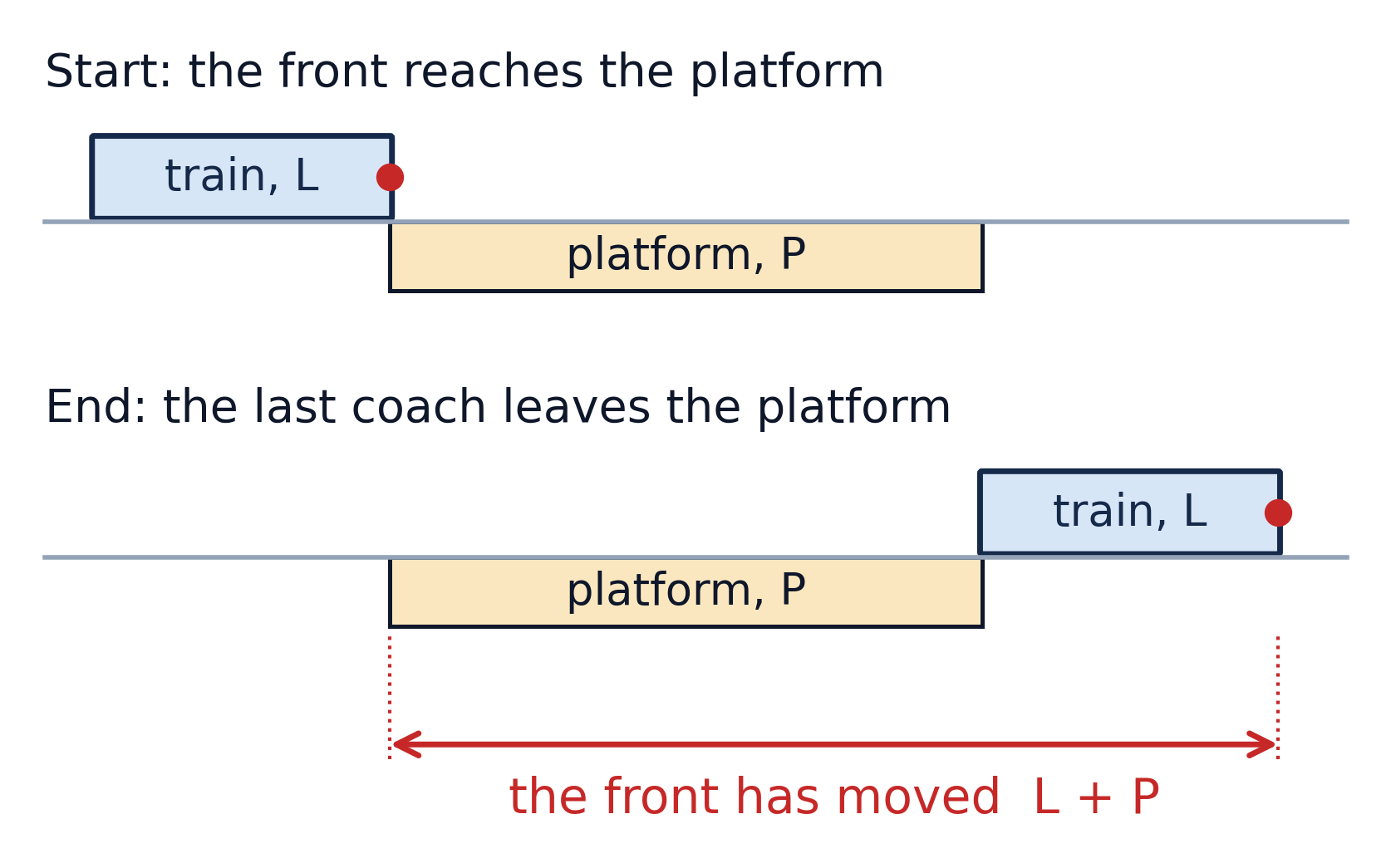
| The train passes | Distance it must cover |
|---|---|
| a pole, a signal, or a man (standing or moving) | its own length L |
| a platform, a bridge, a tunnel or a station of length P | L + P |
| another train of length L_2 | L + L_2 |
A train 100 m long runs at 36 km/h, which is 36 \times \frac{5}{18} = 10 m/s. It passes a pole in \frac{100}{10} = 10 seconds. It crosses a bridge 150 m long in \frac{100 + 150}{10} = 25 seconds.
2. Which speed to use
If the thing being passed stands still, use the speed of the train. If it moves, use the relative speed (Chapter A2-9).
| The other body moves | Relative speed |
|---|---|
| in the same direction as the train | difference of the two speeds |
| in the opposite direction | sum of the two speeds |
So every question on passing has one formula:
\text{Time to pass} = \frac{\text{distance from the table in section 1}}{\text{speed, or relative speed}}
A man sitting in another train is a moving point. His speed is the speed of his train, and the length of his train does not matter.
Units. Lengths are in metres and times in seconds, but speeds are given in km/h. Change the speed to m/s first. Subtract or add the speeds while they are still in km/h, and then change the result once.
3. Two trains from two stations
Here the lengths do not matter. The trains are treated as points, as in Chapter A2-9.
Meeting. Find the gap between the trains at the moment the second one starts. They close the gap at the sum of their speeds.
After the meeting. Two trains start at the same time from stations X and Y towards each other. After they meet, the first takes t_1 hours to reach Y and the second takes t_2 hours to reach X. Then
\frac{\text{speed of the first}}{\text{speed of the second}} = \sqrt{\frac{t_2}{t_1}}
The times are swapped and a square root is taken. The train that needs less time after the meeting is the faster one.
Why. Let the speeds be p and q and let them meet after t hours. The stretch the first train still has to cover is the stretch the second has already covered, so p\,t_1 = q\,t. In the same way q\,t_2 = p\,t. Divide the first by the second: \frac{p\,t_1}{q\,t_2} = \frac{q}{p}, so \frac{p^2}{q^2} = \frac{t_2}{t_1}.
4. Boats and streams
A river flows. A boat going downstream (with the flow) is carried along, so the speeds add. A boat going upstream (against the flow) is held back, so they subtract.
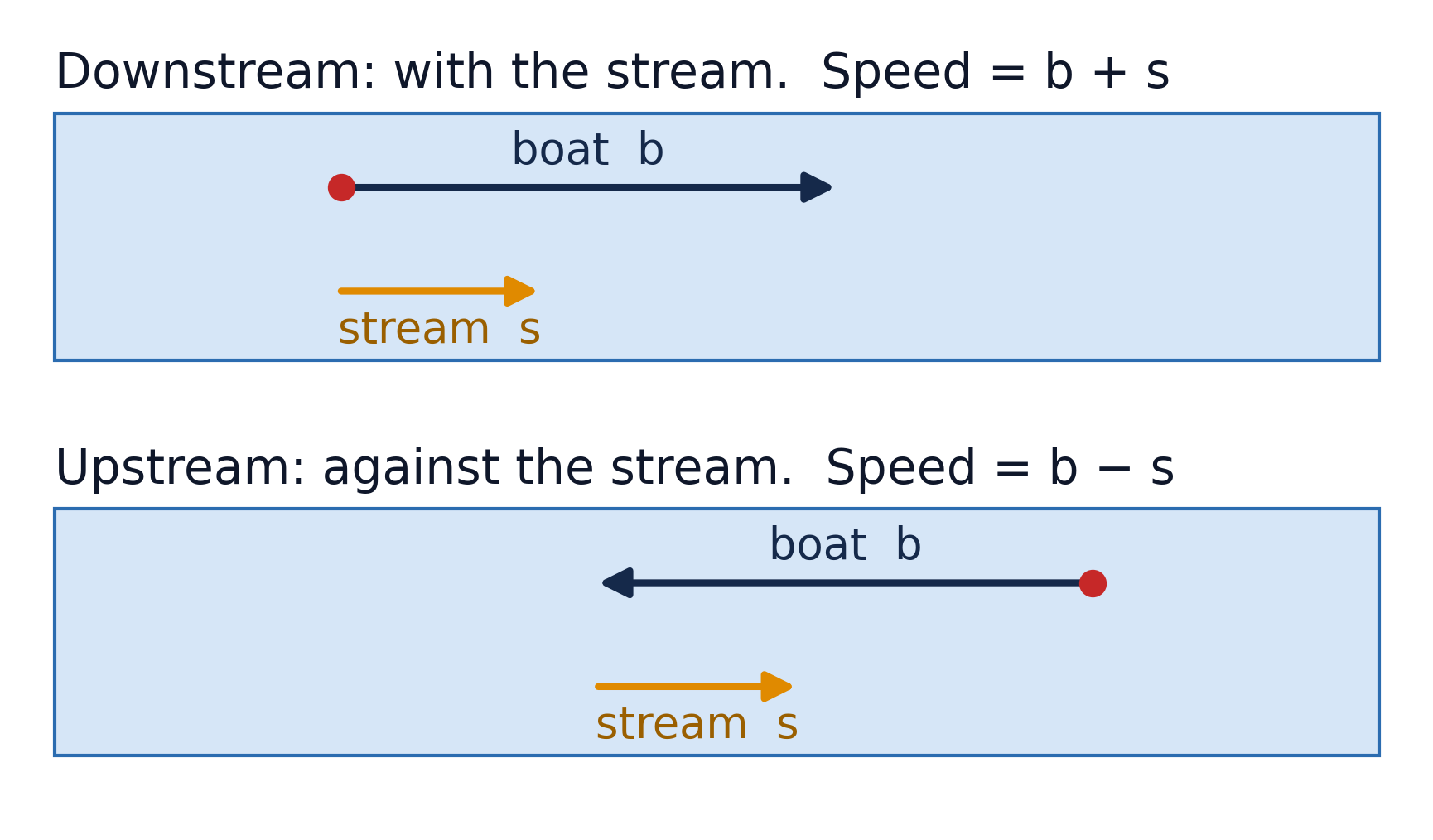
Let b be the speed of the boat in still water and s the speed of the stream.
| Formula | |
|---|---|
| Speed downstream | d = b + s |
| Speed upstream | u = b - s |
| Speed of the boat in still water | b = \dfrac{d + u}{2} |
| Speed of the stream | s = \dfrac{d - u}{2} |
The last two lines come from adding and subtracting the first two. A boat that goes 12 km/h downstream and 8 km/h upstream has b = 10 km/h and s = 2 km/h.
For a journey to a place and back, the two times are different. Work them out one by one: time down = \frac{\text{distance}}{d} and time up = \frac{\text{distance}}{u}.
Worked examples
Example 1. A train 150 m long runs at 54 km/h. How long does it take to pass a pole? How long to cross a platform 300 m long?
Speed = 54 \times \frac{5}{18} = 15 m/s. For the pole the distance is 150 m: time = \frac{150}{15} = 10 seconds. For the platform the distance is 150 + 300 = 450 m: time = \frac{450}{15} = 30 seconds.
Example 2. Two trains are 120 m and 180 m long. They run at 50 km/h and 40 km/h on parallel tracks. How long do they take to cross each other if they run (i) in opposite directions, (ii) in the same direction?
The distance is 120 + 180 = 300 m in both cases.
(i) Relative speed = 50 + 40 = 90 km/h = 25 m/s. Time = \frac{300}{25} = 12 seconds.
(ii) Relative speed = 50 - 40 = 10 km/h = \frac{25}{9} m/s. Time = 300 \div \frac{25}{9} = 108 seconds.
The same two trains take nine times as long when one overtakes the other.
Example 3. A train 125 m long passes a man who is running at 5 km/h in the same direction as the train. It takes 10 seconds. What is the speed of the train?
The train covers its own length at the relative speed. Relative speed = \frac{125}{10} = 12.5 m/s = 12.5 \times \frac{18}{5} = 45 km/h. The man moves the same way, so the relative speed is the train's speed minus 5. The train runs at 45 + 5 = 50 km/h.
Example 4. Two trains start at the same time, one from A towards B and one from B towards A. After they meet, the first takes 9 hours to reach B and the second takes 4 hours to reach A. The first runs at 40 km/h. Find the speed of the second.
\frac{\text{first}}{\text{second}} = \sqrt{\frac{4}{9}} = \frac{2}{3}. So the second runs at 40 \times \frac32 = 60 km/h. Check: they meet after \sqrt{9 \times 4} = 6 hours. By then the first has covered 240 km and the second 360 km. After the meeting the first needs \frac{360}{40} = 9 hours and the second needs \frac{240}{60} = 4 hours.
Example 5. A man can row at 6 km/h in still water. The stream flows at 2 km/h. He rows to a place and back in 3 hours. How far is the place?
Downstream he moves at 6 + 2 = 8 km/h and upstream at 6 - 2 = 4 km/h. Let the distance be x km. Then \frac{x}{8} + \frac{x}{4} = 3, so \frac{3x}{8} = 3 and x = 8 km. Check: 1 hour down and 2 hours up.
From the real papers
These five questions are from the Elementary Mathematics papers (Series A). The first four are from CDS I 2024, CDS II 2025 and CDS I 2025, and the answers agree with the final official key. The fifth is from CDS II 2026, whose key is still provisional; our answer agrees with it. Try each for 72 seconds before reading the solution.
The first two belong to a set of three questions in CDS I 2024, which begins: "Consider the following for the next three (03) items that follow : Two trains A and B started from stations P and Q respectively towards each other. Train A started at 7 p.m. at a speed of 60 km/hr and train B started at 4 a.m. (next day) at a speed of 90 km/hr. The distance between the two stations P and Q is 800 km."
CDS I 2024, Q73. How far from station Q will the two trains meet?
(a) 104 km (b) 144 km (c) 156 km (d) 504 km
Solution. From 7 p.m. to 4 a.m. is 9 hours. In that time A covers 60 \times 9 = 540 km, so the gap at 4 a.m. is 800 - 540 = 260 km. The gap closes at 60 + 90 = 150 km/h. They meet after \frac{260}{150} = \frac{26}{15} hours. In that time B, which starts from Q, covers 90 \times \frac{26}{15} = 156 km. Answer (c). (The next question, Q74, asks for the time of meeting. \frac{26}{15} hours is 1 hour 44 minutes, so it is 5:44 a.m.)
CDS I 2024, Q75. If the lengths of the two trains A and B are 400 m and 500 m respectively, then what is the time taken by them to cross each other?
(a) 21·6 seconds (b) 18·2 seconds (c) 17·4 seconds (d) 15·4 seconds
Solution. The distance is 400 + 500 = 900 m. The trains run in opposite directions, so the relative speed is 60 + 90 = 150 km/h = 150 \times \frac{5}{18} = \frac{125}{3} m/s. Time = 900 \div \frac{125}{3} = \frac{2700}{125} = 21.6 seconds. Answer (a).
CDS II 2025, Q51. Two trains X and Y are travelling in the same direction at 100 km/hr and 60 km/hr respectively. Train X crosses a man in train Y in 9 seconds. What is the length of train X?
(a) 80 m (b) 100 m (c) 120 m (d) 150 m
Solution. The man is a moving point with the speed of train Y. The two move the same way, so the relative speed is 100 - 60 = 40 km/h = 40 \times \frac{5}{18} = \frac{100}{9} m/s. To pass a point, train X covers its own length: \frac{100}{9} \times 9 = 100 m. Answer (b).
CDS I 2025, Q50. A train of certain length takes time t to pass completely through a station of length x. The same train with same speed takes time 2t to pass completely through another station of length y. What is the time taken by the train to pass completely through a station of length (x + y)?
(a) (2yt + xt) / (y - x) (b) (yt + xt) / (y - x) (c) (3yt - xt) / (2y - x) (d) (2yt - xt) / (y - x)
Solution. Let the train have length L and speed v. To pass a station it covers its own length and the station: L + x = vt and L + y = 2vt. Subtract: y - x = vt, so v = \frac{y - x}{t}. From the first equation, L = vt - x = y - 2x. For a station of length x + y the distance is L + x + y = 2y - x. The time is
\frac{2y - x}{v} = \frac{(2y - x)\,t}{y - x}
Answer (d). A quicker way in the exam: choose numbers. Take x = 100, y = 300 and t = 1. Then vt = 200 and L = 100. The long station needs \frac{100 + 400}{200} = 2.5. Only option (d) gives \frac{600 - 100}{200} = 2.5.
CDS II 2026, Q24. A boatman can row to a place (Y) at a distance of 24 km from the starting point (X) and back in 14 hours. If he can row 4 km with the stream in the same time as 3 km against it, what is the speed of the stream?
(a) 0·5 km/hr (b) 1 km/hr (c) 2 km/hr (d) 2·5 km/hr
Solution. Distances covered in the same time are in the ratio of the speeds. So the speeds downstream and upstream are 4k and 3k. The whole journey takes \frac{24}{4k} + \frac{24}{3k} = \frac{6 + 8}{k} = \frac{14}{k} hours, and this is 14. So k = 1: he rows at 4 km/h downstream and 3 km/h upstream. Speed of the stream = \frac{4 - 3}{2} = 0.5 km/h. Answer (a).
In each train question, two things had to be chosen: the distance and the speed. Write both down before you divide.
Mistakes that cost marks
- Forgetting the length of the train. To cross a platform the train covers its own length plus the platform, not the platform alone. To pass a man it covers only its own length.
- Dividing metres by km/h. 900 m at 150 km/h is not 6 seconds. Change 150 km/h to \frac{125}{3} m/s first. The time is 21.6 seconds.
- Adding the speeds when both move the same way. Same direction: subtract. Opposite directions: add. A train that overtakes takes much longer than a train that comes from the front.
- Taking the stream's speed as d - u. The difference of the downstream and upstream speeds is twice the speed of the stream. Halve it.
Quick check
Do these without help. Answers are at the end.
- A train 200 m long runs at 72 km/h. How long does it take to pass a signal post?
- How long does the same train take to cross a bridge 300 m long?
- Two trains, 150 m and 250 m long, run in opposite directions at 60 km/h and 84 km/h. How long do they take to cross each other?
- A boat goes 18 km/h downstream and 12 km/h upstream. Find the speed of the boat in still water and the speed of the stream.
- A train 180 m long passes a man walking at 6 km/h in the same direction in 12 seconds. What is the speed of the train?
Read and watch more, free
NCERT has no chapter on trains or boats. Boat and train problems appear as word problems in the Class 10 chapters on equations. For the rest, this lesson, the practice site below and the past papers are the material.
| What | Where | Language |
|---|---|---|
| Textbook, boat problems with two unknowns | NCERT Class 10 Mathematics, Chapter 3 Pair of Linear Equations in Two Variables · Hindi edition | English, Hindi |
| Textbook, train and boat problems that give a quadratic | NCERT Class 10 Mathematics, Chapter 4 Quadratic Equations · Hindi edition | English, Hindi |
| Solved practice | IndiaBIX aptitude (open "Problems on Trains" and "Boats and Streams") | English |
| The real papers | UPSC previous question papers | English, Hindi |
| Video, a full CDS course | R.S SIR: Maths Playlist for CDS 2025 (the trains and the boats lessons, about 55 minutes each) | Hindi and Hinglish |
| Video, one long lesson | Defence Wallah CDS / AFCAT: Quantitative Aptitude CDS 2024 (the speed, time and distance lesson, about 2 hours) | Hinglish |
| Video, a revision marathon | CDS Wallah (PW): Maths CDS 2026 (time and work, with ratio and speed) | Hinglish |
The videos were chosen from their titles, length and views; they have not yet been watched by a teacher.
Answers to the quick check
- 72 km/h = 20 m/s. Time = \frac{200}{20} = 10 seconds.
- Distance = 200 + 300 = 500 m. Time = \frac{500}{20} = 25 seconds.
- Distance = 400 m. Relative speed = 60 + 84 = 144 km/h = 40 m/s. Time = 10 seconds.
- Boat = \frac{18 + 12}{2} = 15 km/h. Stream = \frac{18 - 12}{2} = 3 km/h.
- Relative speed = \frac{180}{12} = 15 m/s = 54 km/h. The train runs at 54 + 6 = 60 km/h.
Next chapter: Clocks, calendars and directions.