Why this chapter matters. The circle drew 12 questions in the 7 papers from 2023 to 2026, one to three in every paper. Nearly all of them begin the same way: read the centre and the radius from the equation. After that the question is about a diameter, a chord, or a circle that touches the axes. Six real questions are solved in section 7.
What you will be able to do
- Write the equation of a circle from its centre and radius, or from the ends of a diameter.
- Read the centre and radius from the general equation in a few seconds.
- Decide whether a point is inside, on or outside a circle, and whether a line cuts, touches or misses it.
- Handle circles that touch one axis or both axes.
Before you start you should know: the distance formula and the mid-point (Chapter M4-1), and the distance of a point from a line (Chapter M4-2).
1. The standard form
A circle is the set of all points that are at a fixed distance (the radius r) from a fixed point (the centre).
Let the centre be (h, k) and let (x, y) be any point of the circle. The distance formula gives \sqrt{(x - h)^2 + (y - k)^2} = r. Squaring:
(x - h)^2 + (y - k)^2 = r^2
This is the standard form. If the centre is the origin it becomes x^2 + y^2 = r^2.
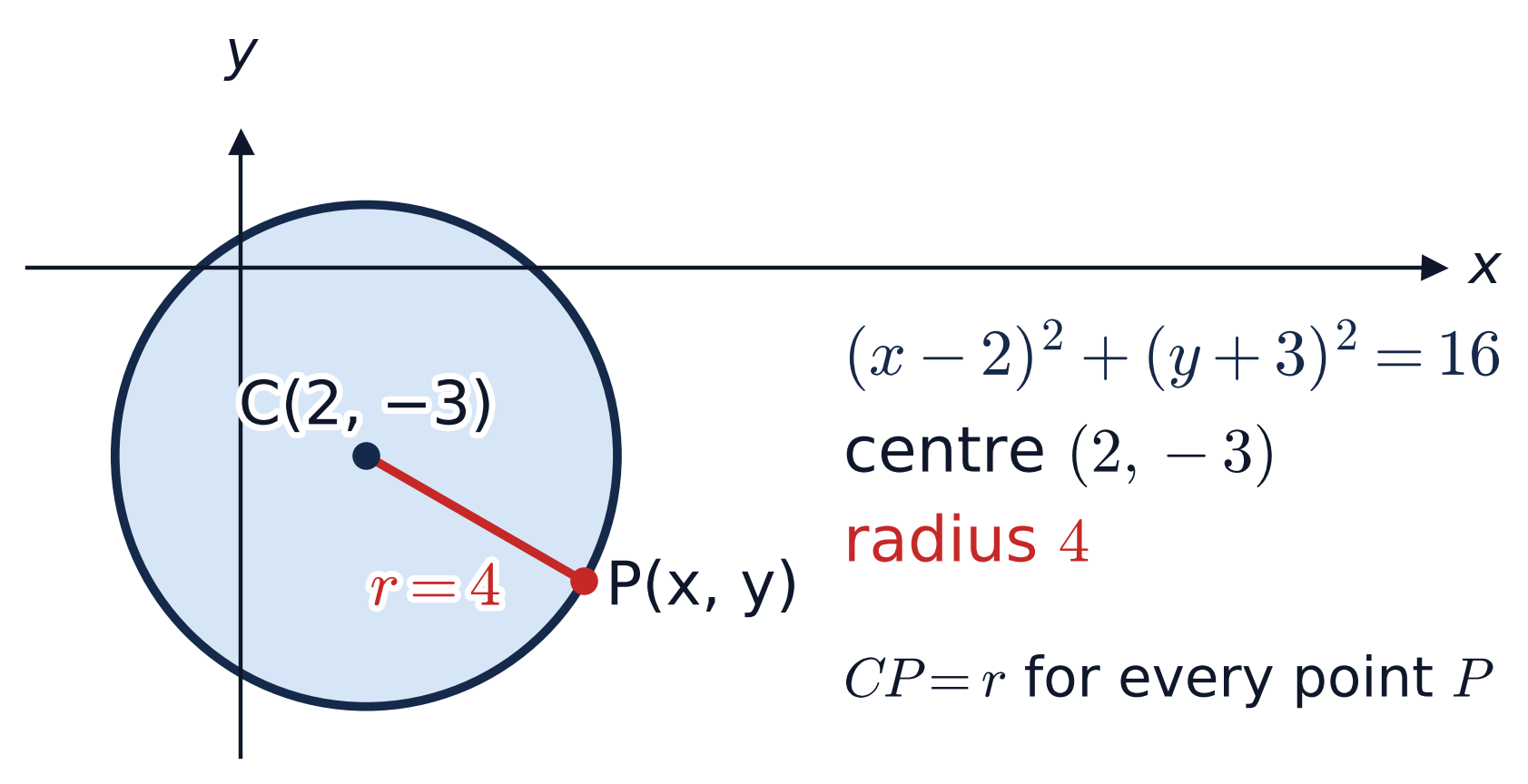
For example, the circle with centre (2, -3) and radius 4 is (x - 2)^2 + (y + 3)^2 = 16. Notice the signs: the centre (2, -3) appears as x - 2 and y + 3.
2. The general form
Multiply out the standard form and collect the terms. Every circle can be written as
x^2 + y^2 + 2gx + 2fy + c = 0
This is the general form. From it:
| Rule | |
|---|---|
| Centre | (-g, -f): half the coefficient of x and half the coefficient of y, each with its sign changed |
| Radius | \sqrt{g^2 + f^2 - c} |
For example, in x^2 + y^2 - 4x + 6y - 12 = 0 we have 2g = -4 and 2f = 6, so g = -2, f = 3, c = -12. The centre is (2, -3) and the radius is \sqrt{4 + 9 + 12} = 5.
Three things to check before using the rule:
- The coefficients of x^2 and y^2 must both be 1. If they are both 2 or both 4, divide the whole equation by that number first.
- There is no xy term in the equation of a circle.
- g^2 + f^2 - c must be positive. If it is zero the "circle" is a single point; if it is negative there is no real circle.
Another way. You can also complete the squares: x^2 - 4x = (x - 2)^2 - 4 and y^2 + 6y = (y + 3)^2 - 9. The equation becomes (x - 2)^2 + (y + 3)^2 = 25, the standard form again.
3. The diameter form
If (x_1, y_1) and (x_2, y_2) are the ends of a diameter, the circle is
(x - x_1)(x - x_2) + (y - y_1)(y - y_2) = 0
The centre is the mid-point of the diameter, and the radius is half its length.
4. A point, a line and a circle
A point. Find the distance of the point from the centre and compare it with r. Less than r: inside. Equal to r: on the circle. More than r: outside.
A quicker test: put the point into the left side of the general form. A negative value means inside, zero means on the circle, a positive value means outside.
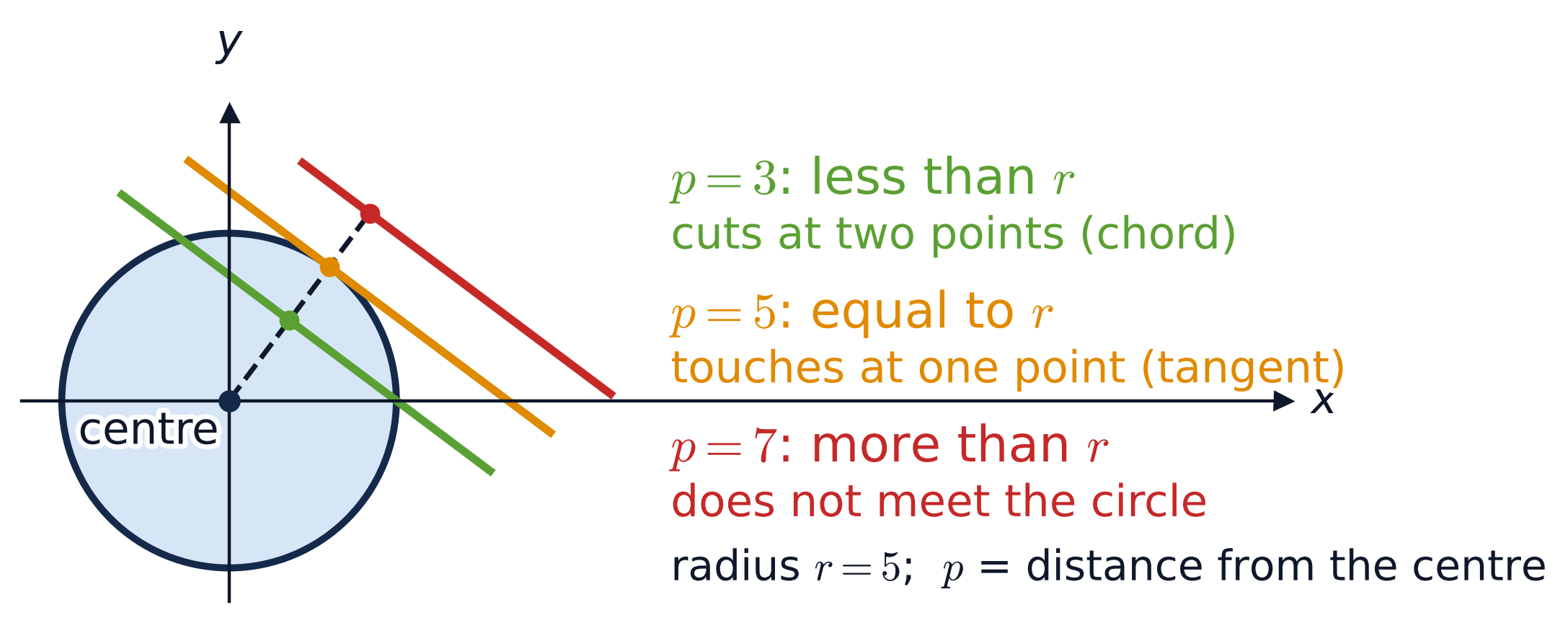
A line. Find the perpendicular distance p of the centre from the line (Chapter M4-2) and compare it with r.
| Compare | What the line does |
|---|---|
| p < r | Cuts the circle at two points. The part inside is a chord of length 2\sqrt{r^2 - p^2} |
| p = r | Touches the circle at one point. It is a tangent |
| p > r | Does not meet the circle |
Two facts from school geometry are used again and again:
- The perpendicular from the centre to a chord passes through the mid-point of the chord.
- A tangent is perpendicular to the radius at the point where it touches.
5. Circles that touch the axes
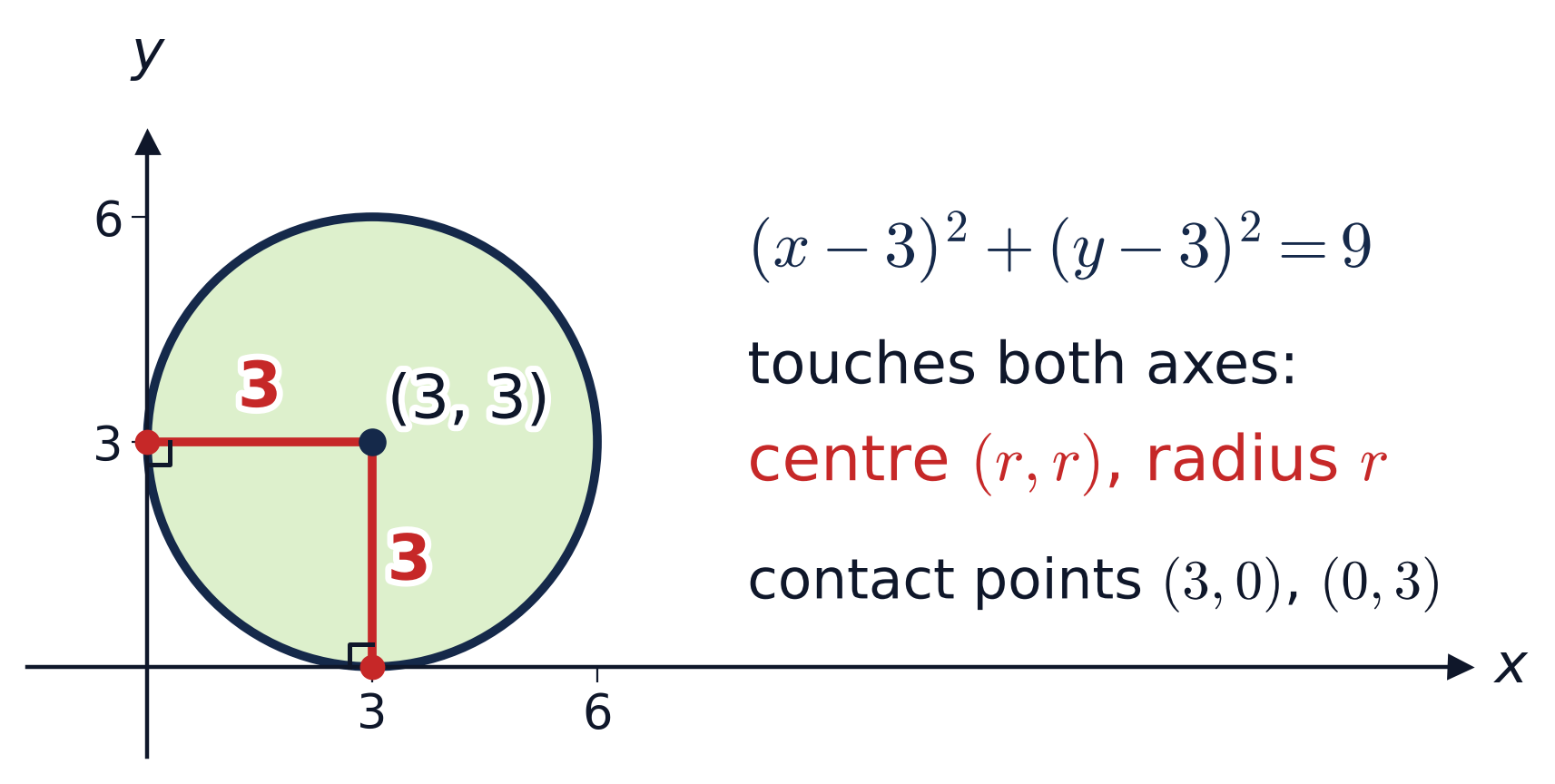
Picture a coin lying flat against a wall: the distance from its centre to the wall is exactly its radius. In the same way, for a circle with centre (h, k) and radius r:
- it touches the x-axis when |k| = r, and the point of contact is (h, 0);
- it touches the y-axis when |h| = r, and the point of contact is (0, k);
- it touches both axes when |h| = |k| = r. In the first quadrant this is (x - r)^2 + (y - r)^2 = r^2.
6. Worked examples
Example 1. Find the centre and radius of 2x^2 + 2y^2 - 8x + 12y - 6 = 0.
Divide by 2: x^2 + y^2 - 4x + 6y - 3 = 0. So g = -2, f = 3, c = -3. Centre (2, -3), radius \sqrt{4 + 9 + 3} = 4.
Example 2. Find the circle with (1, 2) and (3, 4) as the ends of a diameter.
(x - 1)(x - 3) + (y - 2)(y - 4) = 0 gives x^2 + y^2 - 4x - 6y + 11 = 0.
Check: the centre is (2, 3), the mid-point of the diameter. The radius is \sqrt{4 + 9 - 11} = \sqrt{2}, half of the diameter \sqrt{8}.
Example 3. Show that the line 3x + 4y - 25 = 0 touches the circle x^2 + y^2 = 25.
The centre is (0, 0) and r = 5. The distance of the centre from the line is p = \dfrac{|-25|}{\sqrt{9 + 16}} = 5. Since p = r, the line is a tangent. (It touches the circle at (3, 4).)
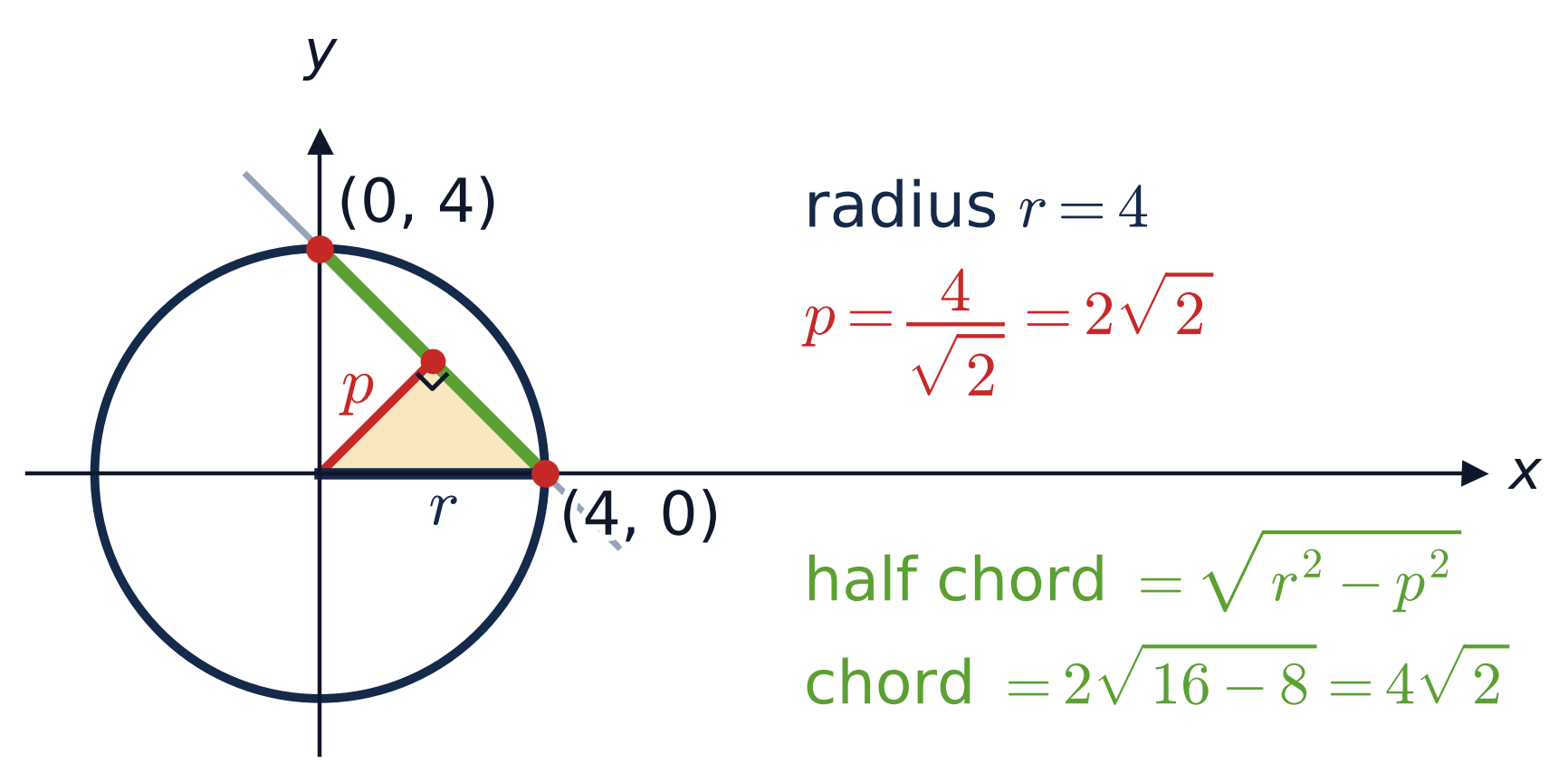
Example 4. Find the length of the chord that the line x + y = 4 cuts from the circle x^2 + y^2 = 16.
r = 4 and p = \dfrac{|-4|}{\sqrt{2}} = 2\sqrt{2}. Chord = 2\sqrt{16 - 8} = 2\sqrt{8} = 4\sqrt{2}.
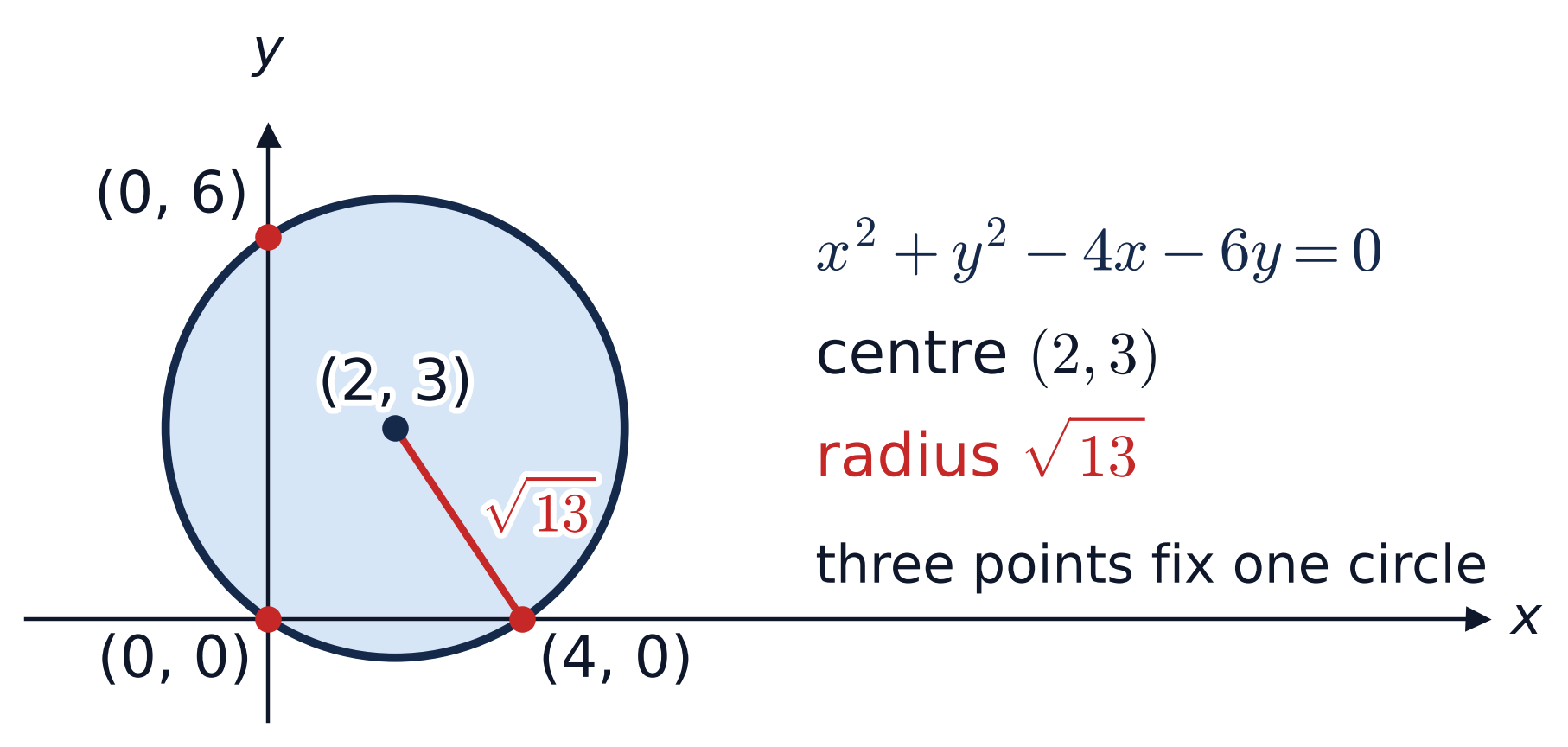
Example 5. Find the circle through (0, 0), (4, 0) and (0, 6).
Put each point into x^2 + y^2 + 2gx + 2fy + c = 0. The origin gives c = 0. The point (4, 0) gives 16 + 8g = 0, so g = -2. The point (0, 6) gives 36 + 12f = 0, so f = -3.
The circle is x^2 + y^2 - 4x - 6y = 0, with centre (2, 3) and radius \sqrt{13}. Three points that are not on one line always fix one circle.
7. From the real papers
Try each question for 75 seconds before reading the solution.
NDA I 2024, Q51. If (a, b) is the centre and c is the radius of the circle x^2 + y^2 + 2x + 6y + 1 = 0, then what is the value of a^2 + b^2 + c^2?
(a) 19 (b) 18 (c) 17 (d) 11
Solution. Here g = 1, f = 3 and the constant is 1. The centre is (-1, -3) and the radius squared is 1 + 9 - 1 = 9. So a^2 + b^2 + c^2 = 1 + 9 + 9 = 19. Answer (a).
NDA I 2025, Q56. What is the equation of the circle whose diameter is 10 cm and the equations of two of its diameters are x + y = 0 and x - y = 0?
(a) x^2 + y^2 = 1 (b) x^2 + y^2 = 25 (c) x^2 + y^2 = 100 (d) x^2 + y^2 - 2x - 2y - 23 = 0
Solution. Every diameter passes through the centre, so the centre is where the two lines meet: the origin. The diameter is 10, so the radius is 5. The circle is x^2 + y^2 = 25. Option (c) is the trap for a student who uses the diameter as the radius. Answer (b).
NDA II 2023, Q84. If 3x + y - 5 = 0 is the equation of a chord of the circle x^2 + y^2 - 25 = 0, then what are the coordinates of the mid-point of the chord?
(a) \left(\frac{3}{4}, \frac{1}{4}\right) (b) \left(\frac{3}{2}, \frac{1}{2}\right) (c) \left(\frac{3}{4}, -\frac{1}{4}\right) (d) \left(\frac{3}{2}, -\frac{1}{2}\right)
Solution. The perpendicular from the centre (0, 0) meets the chord at its mid-point. The chord has slope -3, so the perpendicular has slope \frac{1}{3} and is y = \frac{x}{3}. Put this into the chord: 3x + \frac{x}{3} = 5, so x = \frac{3}{2} and y = \frac{1}{2}. Answer (b).
NDA II 2025, Q64. The circle x^2 + y^2 - 2kx - 2ky + k^2 = 0 touches the x-axis at P and y-axis at Q. What is PQ equal to?
(a) \sqrt{2}k (b) 2k (c) 2\sqrt{2}k (d) 4k
Solution. The centre is (k, k) and the radius squared is k^2 + k^2 - k^2 = k^2, so the radius is k (taking k positive). The circle touches the x-axis at P(k, 0) and the y-axis at Q(0, k). Then PQ = \sqrt{k^2 + k^2} = \sqrt{2}k. Answer (a).
NDA II 2023, Q87. Consider the following in respect of the circle 4x^2 + 4y^2 - 4ax - 4ay + a^2 = 0 : 1. The circle touches both the axes. 2. The diameter of the circle is 2a. 3. The centre of the circle lies on the line x + y = a. How many of the statements given above are correct?
(a) Only one (b) Only two (c) All three (d) None
Solution. Divide by 4: x^2 + y^2 - ax - ay + \frac{a^2}{4} = 0. The centre is \left(\frac{a}{2}, \frac{a}{2}\right) and the radius squared is \frac{a^2}{4} + \frac{a^2}{4} - \frac{a^2}{4} = \frac{a^2}{4}, so the radius is \frac{a}{2}. The centre is at distance \frac{a}{2} from each axis, so statement 1 is correct. The diameter is a, not 2a, so statement 2 is wrong. \frac{a}{2} + \frac{a}{2} = a, so statement 3 is correct. Answer (b).
NDA I 2026, Q59. Consider the points A(0, 2), B(2, 3), C(4, 5) and D(0, k). If the points lie on a circle, then what is/are the possible value(s) of k?
(a) 2 only (b) 5 only (c) 2, 17 (d) 5, 17
Solution. Find the circle through A, B, C as in Example 5. A gives 4 + 4f + c = 0. B gives 13 + 4g + 6f + c = 0. C gives 41 + 8g + 10f + c = 0. Solving, g = \frac{5}{2}, f = -\frac{19}{2}, c = 34, so the circle is x^2 + y^2 + 5x - 19y + 34 = 0. On the y-axis x = 0: y^2 - 19y + 34 = 0, so (y - 2)(y - 17) = 0. Hence k = 2 or 17. Answer (c).
Only the last question needed long working. The other five were finished as soon as the centre and radius were known.
8. Mistakes that cost marks
- Wrong signs for the centre. The centre of x^2 + y^2 + 2x + 6y + 1 = 0 is (-1, -3), not (1, 3). The signs are opposite to those in the equation.
- Forgetting to halve. The coefficient of x is 2g, not g. In x^2 + y^2 - 4x + 6y - 12 = 0 the centre is (2, -3), not (4, -6).
- Not dividing first. In 2x^2 + 2y^2 - 8x + 12y - 6 = 0 divide by 2 before reading g, f and c.
- Radius and diameter mixed up. Read the question again before choosing the option. The examiner usually offers both.
9. Quick check
Do these without help. Answers are at the end.
- Write the centre and radius of (x + 1)^2 + (y - 4)^2 = 9.
- Find the centre and radius of x^2 + y^2 + 6x - 8y = 0.
- Find the equation of the circle with centre (1, -2) that passes through (4, 2).
- Is the point (1, 1) inside, on or outside the circle x^2 + y^2 - 4x - 6y + 4 = 0?
- For what values of c does the line y = x + c touch the circle x^2 + y^2 = 8?
10. Read and watch more, free
| What | Where | Language |
|---|---|---|
| Textbook | NCERT Class 11 Mathematics, Chapter 10 Conic Sections (the circle is the first curve in it) · Hindi edition | English, Hindi |
| Self-study notes | NIOS Mathematics, Lesson 15 Circles · Hindi edition | English, Hindi |
| Video, this chapter for NDA | Defence Wallah: Fast Track series (the video "CIRCLES", about 1 hour 30 minutes) | Hinglish |
| Video, a longer class for NDA | Chandigarh Career Group: NDA Maths one shots (Class 3, "Circle", about 3 hours 40 minutes) | Hinglish |
| Video, in depth (harder than NDA needs) | Mohit Tyagi: Circles (19 short lectures) | Hinglish |
| Past questions with answers | ExamSIDE: Circle | English |
The videos were chosen from their titles, length and views; they have not yet been watched by a teacher.
Answers to the quick check
- Centre (-1, 4), radius 3.
- g = 3, f = -4, c = 0. Centre (-3, 4), radius \sqrt{9 + 16} = 5.
- The radius is the distance from (1, -2) to (4, 2), which is \sqrt{9 + 16} = 5. The circle is (x - 1)^2 + (y + 2)^2 = 25.
- Put the point in: 1 + 1 - 4 - 6 + 4 = -4, which is negative. The point is inside.
- The line is x - y + c = 0. Its distance from the origin must equal the radius \sqrt{8} = 2\sqrt{2}: \dfrac{|c|}{\sqrt{2}} = 2\sqrt{2}, so c = 4 or c = -4.
Next chapter: Parabola, ellipse and hyperbola.