Why this chapter matters. This chapter drew 14 questions in the 7 papers from 2023 to 2026, between one and four in every paper. Most of them are the formulas of Chapter M4-1 with a third coordinate added: distance, mid-point, the fourth vertex of a parallelogram. The rest use direction cosines and the one fact l^2 + m^2 + n^2 = 1. Six real questions are solved in section 7.
What you will be able to do
- Locate a point in space by three coordinates and find its distance from the origin, the axes and the coordinate planes.
- Use the distance, section, mid-point and centroid formulas in three dimensions.
- Find the direction cosines of a line from its direction ratios, and use l^2 + m^2 + n^2 = 1.
- Find the angle between two lines, and test whether they are parallel or perpendicular.
Before you start you should know: the distance and section formulas in the plane (Chapter M4-1) and the values of \cos\theta for 30^\circ, 45^\circ and 60^\circ (Chapter M3-2).
1. Three axes
A point on a flat page needs two coordinates. A point in space needs three.
The picture. Stand in a corner of a room and look at the floor. Two edges of the floor meet at the corner: call one the x-axis and the other the y-axis. The edge that goes up the wall from the same corner is the z-axis. The corner itself is the origin O(0, 0, 0). The three axes are at right angles to each other.
A point P(x, y, z) is reached from the origin by going x along the x-axis, then y parallel to the y-axis, then z straight up.
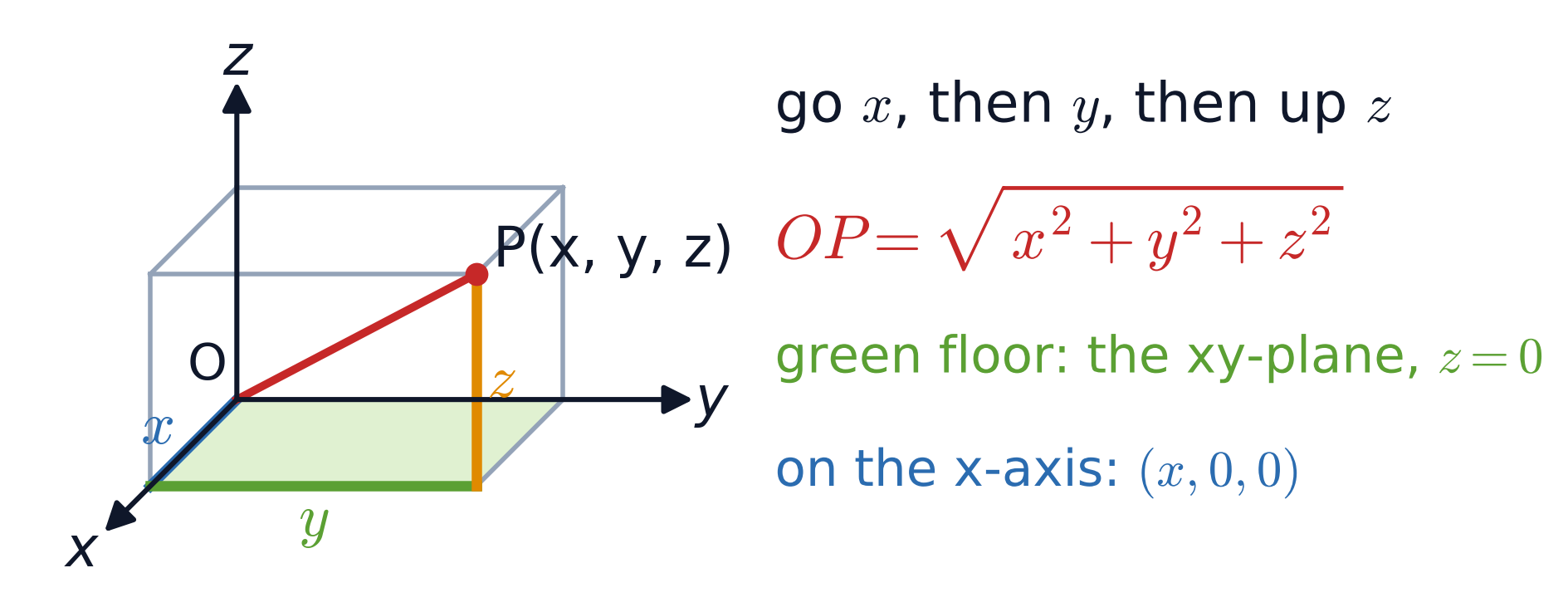
- The floor is the xy-plane. Every point on it has z = 0. The two walls are the yz-plane (x = 0) and the zx-plane (y = 0).
- A point on the x-axis has the form (x, 0, 0). A point on the z-axis has the form (0, 0, z).
- The three planes cut space into eight parts called octants. In the first octant all three coordinates are positive.
For the point P(3, 4, 12): its height above the xy-plane is 12, its distance from the z-axis is \sqrt{3^2 + 4^2} = 5, and its distance from the origin is \sqrt{9 + 16 + 144} = 13.
2. The formulas of Chapter M4-1 with one more coordinate
For A(x_1, y_1, z_1) and B(x_2, y_2, z_2):
| What | Formula |
|---|---|
| Distance AB | \sqrt{(x_2 - x_1)^2 + (y_2 - y_1)^2 + (z_2 - z_1)^2} |
| Point dividing AB internally in m : n | \left( \dfrac{m x_2 + n x_1}{m + n}, \dfrac{m y_2 + n y_1}{m + n}, \dfrac{m z_2 + n z_1}{m + n} \right) |
| Mid-point of AB | \left( \dfrac{x_1 + x_2}{2}, \dfrac{y_1 + y_2}{2}, \dfrac{z_1 + z_2}{2} \right) |
| Centroid of a triangle | the average of the three vertices, coordinate by coordinate |
| Fourth vertex of a parallelogram ABCD | D = A + C - B |
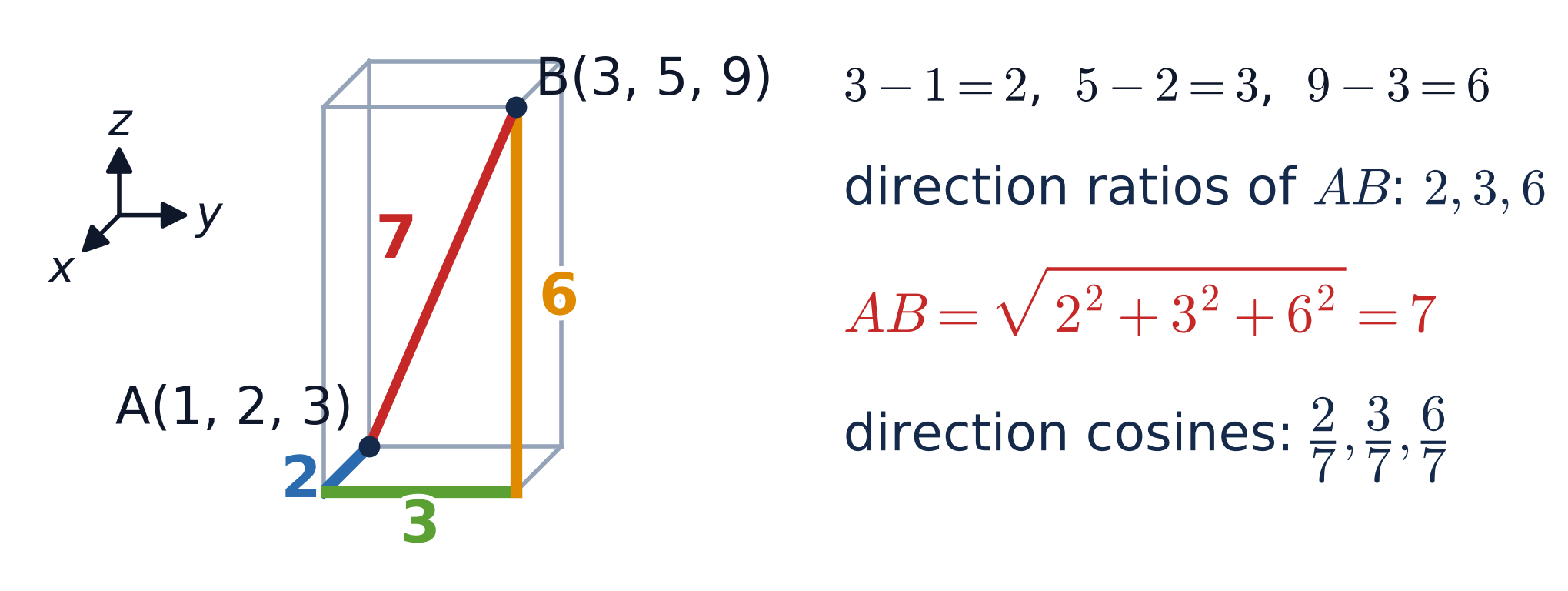
For example, the distance between (1, 2, 3) and (3, 5, 9) is \sqrt{2^2 + 3^2 + 6^2} = \sqrt{49} = 7.
3. Direction cosines
A line in the plane has a slope. A line in space has no single slope; its direction is given by the angles it makes with the three axes.
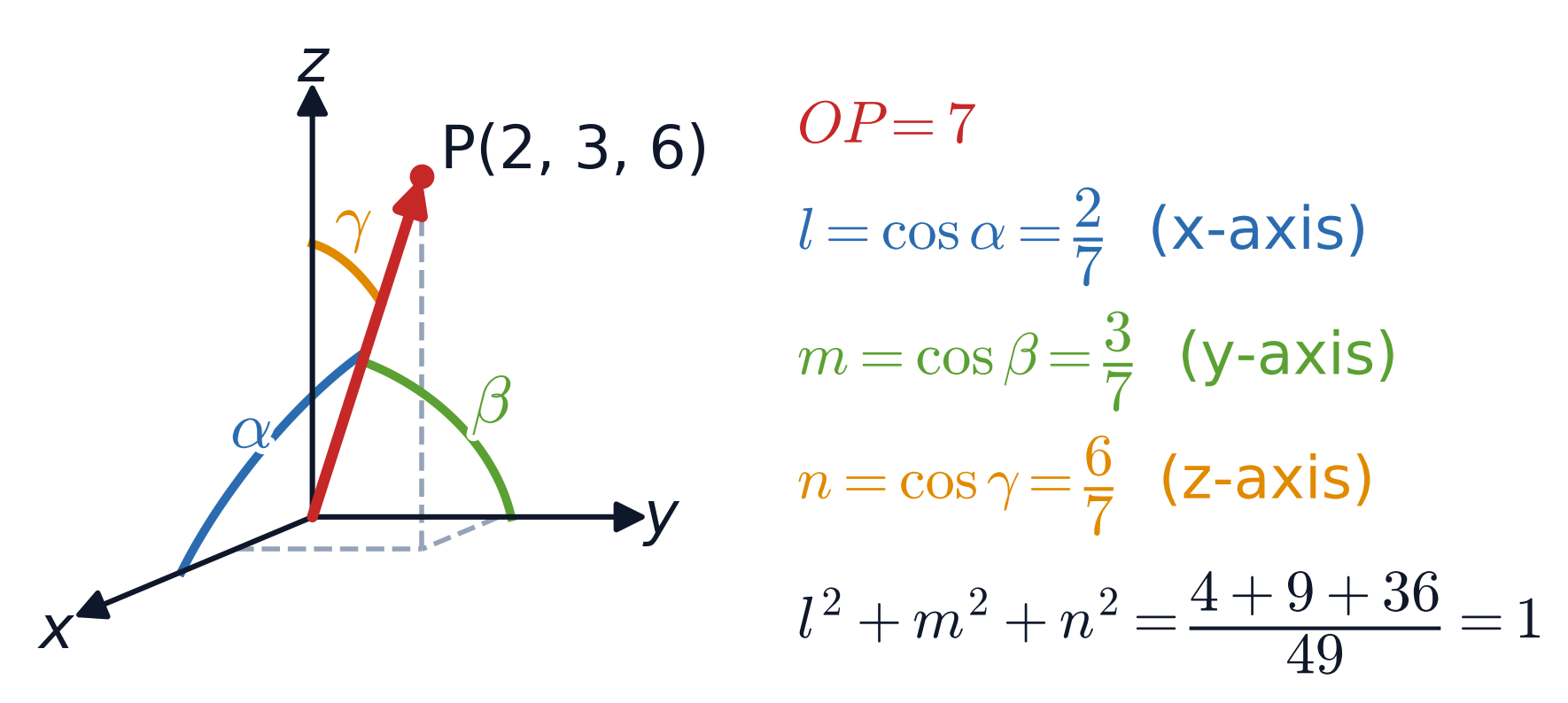
Let a line make angles \alpha, \beta and \gamma with the positive directions of the x-axis, the y-axis and the z-axis. The direction cosines of the line are
l = \cos\alpha, \qquad m = \cos\beta, \qquad n = \cos\gamma
They always satisfy
l^2 + m^2 + n^2 = 1
This one fact answers many questions. For example, a line cannot make 45^\circ with all three axes, because \frac{1}{2} + \frac{1}{2} + \frac{1}{2} is not 1. A line that makes equal angles with the three axes has 3l^2 = 1, so l = m = n = \dfrac{1}{\sqrt{3}}.
The x-axis itself has direction cosines 1, 0, 0. The y-axis has 0, 1, 0 and the z-axis has 0, 0, 1.
If the direction of the line is reversed, all three direction cosines change sign. So a line has two sets: l, m, n and -l, -m, -n.
4. Direction ratios
Any three numbers a, b, c that are proportional to l, m, n are called direction ratios of the line. They are easier to find, and one line has many sets of them.
The line through A(x_1, y_1, z_1) and B(x_2, y_2, z_2) has direction ratios
x_2 - x_1, \qquad y_2 - y_1, \qquad z_2 - z_1
To turn direction ratios into direction cosines, divide each by \sqrt{a^2 + b^2 + c^2}:
l = \frac{a}{\sqrt{a^2 + b^2 + c^2}}, \qquad m = \frac{b}{\sqrt{a^2 + b^2 + c^2}}, \qquad n = \frac{c}{\sqrt{a^2 + b^2 + c^2}}
For direction ratios 2, 3, 6: \sqrt{4 + 9 + 36} = 7, so the direction cosines are \dfrac{2}{7}, \dfrac{3}{7}, \dfrac{6}{7}. The exam papers write direction ratios as \langle 2, 3, 6 \rangle.
5. The angle between two lines
Let two lines have direction ratios a_1, b_1, c_1 and a_2, b_2, c_2. The acute angle \theta between them is given by
\cos\theta = \frac{|a_1 a_2 + b_1 b_2 + c_1 c_2|}{\sqrt{a_1^2 + b_1^2 + c_1^2}\,\sqrt{a_2^2 + b_2^2 + c_2^2}}
Two special cases are asked most often:
| The lines are | Condition |
|---|---|
| perpendicular | a_1 a_2 + b_1 b_2 + c_1 c_2 = 0 |
| parallel | \dfrac{a_1}{a_2} = \dfrac{b_1}{b_2} = \dfrac{c_1}{c_2} |
You will meet the expression a_1 a_2 + b_1 b_2 + c_1 c_2 again in Chapter M7-2 as the dot product of two vectors.
6. Worked examples
Example 1. Find the distance between P(2, -1, 3) and Q(-2, 1, 7), and the mid-point of PQ.
PQ = \sqrt{(-4)^2 + 2^2 + 4^2} = \sqrt{36} = 6. The mid-point is \left( \frac{2 - 2}{2}, \frac{-1 + 1}{2}, \frac{3 + 7}{2} \right) = (0, 0, 5).
Example 2. Find the point that divides the join of A(1, -2, 3) and B(4, 4, -3) in the ratio 2 : 1.
\left( \dfrac{2 \times 4 + 1 \times 1}{3}, \dfrac{2 \times 4 + 1 \times (-2)}{3}, \dfrac{2 \times (-3) + 1 \times 3}{3} \right) = (3, 2, -1).
Example 3. A line makes 60^\circ with the x-axis and 45^\circ with the y-axis. What angle does it make with the z-axis?
\cos^2\gamma = 1 - \cos^2 60^\circ - \cos^2 45^\circ = 1 - \dfrac{1}{4} - \dfrac{1}{2} = \dfrac{1}{4}. So \cos\gamma = \pm\dfrac{1}{2}, and \gamma = 60^\circ or 120^\circ.
Example 4. Find the direction cosines of the line joining A(1, 2, 3) and B(3, 5, 9).
Direction ratios: 3 - 1, \; 5 - 2, \; 9 - 3, that is 2, 3, 6. Divide by \sqrt{4 + 9 + 36} = 7: the direction cosines are \dfrac{2}{7}, \dfrac{3}{7}, \dfrac{6}{7}.
Example 5. Find the angle between the lines with direction ratios 1, 1, 0 and 0, 1, 1.
\cos\theta = \dfrac{|0 + 1 + 0|}{\sqrt{2}\,\sqrt{2}} = \dfrac{1}{2}, so \theta = 60^\circ.
7. From the real papers
Try each question for 75 seconds before reading the solution.
NDA II 2025, Q55. Let A(1, -1, 0), B(-2, 1, 8) and C(-1, 2, 7) are three consecutive vertices of a parallelogram ABCD. What is the fourth vertex D?
(a) (0, -2, 1) (b) (2, 0, -1) (c) (1, 0, 1) (d) (1, 2, 0)
Solution. The diagonals of a parallelogram have the same mid-point, so D = A + C - B. That gives x = 1 - 1 + 2 = 2, y = -1 + 2 - 1 = 0, z = 0 + 7 - 8 = -1. Answer (b).
NDA I 2026, Q54. P(-2, -3, 5), Q(4, -1, 5), R(6, -4, 8) and S(2, -6, 10) are four points. What is (PQ^2 + 2QS^2 - 2PR^2) equal to?
(a) -1 (b) 0 (c) 1 (d) 2
Solution. PQ^2 = 6^2 + 2^2 + 0^2 = 40. QS^2 = (-2)^2 + (-5)^2 + 5^2 = 54. PR^2 = 8^2 + (-1)^2 + 3^2 = 74. So the value is 40 + 108 - 148 = 0. Answer (b).
NDA II 2026, Q61. The vertices of a triangle are A(2, 0, 0), B(0, 6, 0) and C(0, 0, 4). If AD, BE and CF are the medians of the triangle, then what is AD^2 + BE^2 + CF^2 equal to?
(a) 81 (b) 84 (c) 87 (d) 90
Solution. A median joins a vertex to the mid-point of the opposite side. The mid-points are D(0, 3, 2), E(1, 0, 2) and F(1, 3, 0). Then AD^2 = 4 + 9 + 4 = 17, BE^2 = 1 + 36 + 4 = 41 and CF^2 = 1 + 9 + 16 = 26. The sum is 84. Answer (b).
NDA II 2023, Q100. A point P lies on the line joining A(1, 2, 3) and B(2, 10, 1). If z-coordinate of P is 7, what is the sum of other two coordinates?
(a) -15 (b) -13 (c) -11 (d) -9
Solution. The direction ratios of AB are 1, 8, -2. Starting from A and moving t steps along the line, P = (1 + t, \; 2 + 8t, \; 3 - 2t). The z-coordinate is 7, so 3 - 2t = 7 and t = -2. Then x = -1 and y = -14, and their sum is -15. Answer (a).
NDA I 2025, Q63. ABC is a triangle right-angled at B. If A(k, 1, -1), B(2k, 0, 2) and C(2 + 2k, k, 1) are the vertices of the triangle, then what is the value of k?
(a) -3 (b) -1 (c) 1 (d) 3
Solution. BA and BC are perpendicular. Direction ratios of BA: k - 2k, \; 1 - 0, \; -1 - 2, that is -k, 1, -3. Direction ratios of BC: 2, k, -1. The condition is (-k)(2) + (1)(k) + (-3)(-1) = 0, so 3 - k = 0 and k = 3. Answer (d).
NDA I 2025, Q61. If a line in 3 dimensions makes angles \alpha, \beta and \gamma with the positive directions of the coordinate axes, then what is \cos(\alpha + \beta)\cos(\alpha - \beta) equal to?
(a) \cos^2\gamma (b) -\cos^2\gamma (c) \sin^2\gamma (d) -\sin^2\gamma
Solution. Use the identity \cos(\alpha + \beta)\cos(\alpha - \beta) = \cos^2\alpha - \sin^2\beta (Chapter M3-3). Write \sin^2\beta = 1 - \cos^2\beta: the expression is \cos^2\alpha + \cos^2\beta - 1. Since \cos^2\alpha + \cos^2\beta + \cos^2\gamma = 1, this equals -\cos^2\gamma. Answer (b).
The first three needed only the distance and mid-point formulas. The last three used direction ratios and direction cosines.
8. Mistakes that cost marks
- Treating direction ratios as direction cosines. The numbers 2, 3, 6 are direction ratios. They do not satisfy l^2 + m^2 + n^2 = 1 until each is divided by 7.
- Thinking the three angles add up to a fixed number. They do not. What is fixed is \cos^2\alpha + \cos^2\beta + \cos^2\gamma = 1. From it, \sin^2\alpha + \sin^2\beta + \sin^2\gamma = 2.
- Sign slips when subtracting. -1 - 2 = -3 and 1 - (-2) = 3. Write each difference in full before squaring or multiplying.
- Parallel and perpendicular mixed up. Perpendicular: the sum of products is zero. Parallel: the ratios are equal.
9. Quick check
Do these without help. Answers are at the end.
- Find the distance between (1, -2, 3) and (4, 2, 15).
- Find the centroid of the triangle with vertices (1, 2, 3), (3, -2, 1) and (2, 3, -1).
- Find the direction cosines of a line whose direction ratios are 1, -2, 2.
- A line makes angles \alpha, \beta, \gamma with the axes. Find \sin^2\alpha + \sin^2\beta + \sin^2\gamma.
- For what value of k are the lines with direction ratios 2, k, 3 and 1, -4, 2 perpendicular?
10. Read and watch more, free
| What | Where | Language |
|---|---|---|
| Textbook, coordinates and distance in space | NCERT Class 11 Mathematics, Chapter 11 Introduction to Three Dimensional Geometry · Hindi edition | English, Hindi |
| Textbook, direction cosines | NCERT Class 12 Mathematics, Chapter 11 Three Dimensional Geometry · Hindi edition | English, Hindi |
| Self-study notes | NIOS Mathematics, Lesson 33 Introduction to 3-D · Hindi edition | English, Hindi |
| Video, three-dimensional geometry for NDA | Defence Wallah: 3D for NDA 2 2026 (one class, about 5 hours 40 minutes) | Hinglish |
| Video, another class for NDA | Chandigarh Career Group: NDA Maths one shots (Class 6, "Three dimensional geometry", about 6 hours) | Hinglish |
| Video, the Class 11 textbook chapter | Magnet Brains: Class 11 one-shot revision (the video "Introduction to 3D", about 1 hour 15 minutes) | Hinglish |
| Past questions with answers | ExamSIDE: Three Dimensional Geometry | English |
The videos were chosen from their titles, length and views; they have not yet been watched by a teacher.
Answers to the quick check
- \sqrt{3^2 + 4^2 + 12^2} = \sqrt{169} = 13.
- \left( \frac{1 + 3 + 2}{3}, \frac{2 - 2 + 3}{3}, \frac{3 + 1 - 1}{3} \right) = (2, 1, 1).
- \sqrt{1 + 4 + 4} = 3, so the direction cosines are \dfrac{1}{3}, -\dfrac{2}{3}, \dfrac{2}{3}.
- 3 - (\cos^2\alpha + \cos^2\beta + \cos^2\gamma) = 3 - 1 = 2.
- 2 \times 1 + k \times (-4) + 3 \times 2 = 0, so 8 - 4k = 0 and k = 2.
Next chapter: Line and plane in three dimensions.