Why this chapter matters. Lines and planes in space drew 16 questions in the 7 papers from 2023 to 2026, two or three in almost every paper. The questions repeat a few patterns: write the plane through a point with a given normal, find where a line meets a plane, find the direction of the line in which two planes meet, test whether a line is parallel to a plane. Six real questions are solved in section 7.
What you will be able to do
- Write the equation of a line in space and read its direction ratios from the equation.
- Write the equation of a plane from a point and a normal, or from its intercepts, and read the normal from the equation.
- Find angles between lines and planes, and test for parallel and perpendicular.
- Find the distance of a point from a plane, the point where a line meets a plane, and the direction of the line where two planes meet.
Before you start you should know: direction ratios, direction cosines and the perpendicular condition a_1 a_2 + b_1 b_2 + c_1 c_2 = 0 (Chapter M4-5), and the distance of a point from a line in the plane (Chapter M4-2).
1. The equation of a line
A line in space is fixed by one point on it and its direction. The line through (x_1, y_1, z_1) with direction ratios a, b, c is
\frac{x - x_1}{a} = \frac{y - y_1}{b} = \frac{z - z_1}{c}
Call the common value of the three fractions t. Then every point of the line can be written as
(x_1 + at, \; y_1 + bt, \; z_1 + ct)
This "general point" is the most useful tool of the chapter. For the line through (1, 2, 3) with direction ratios 2, -1, 4, the value t = 1 gives the point (3, 1, 7).
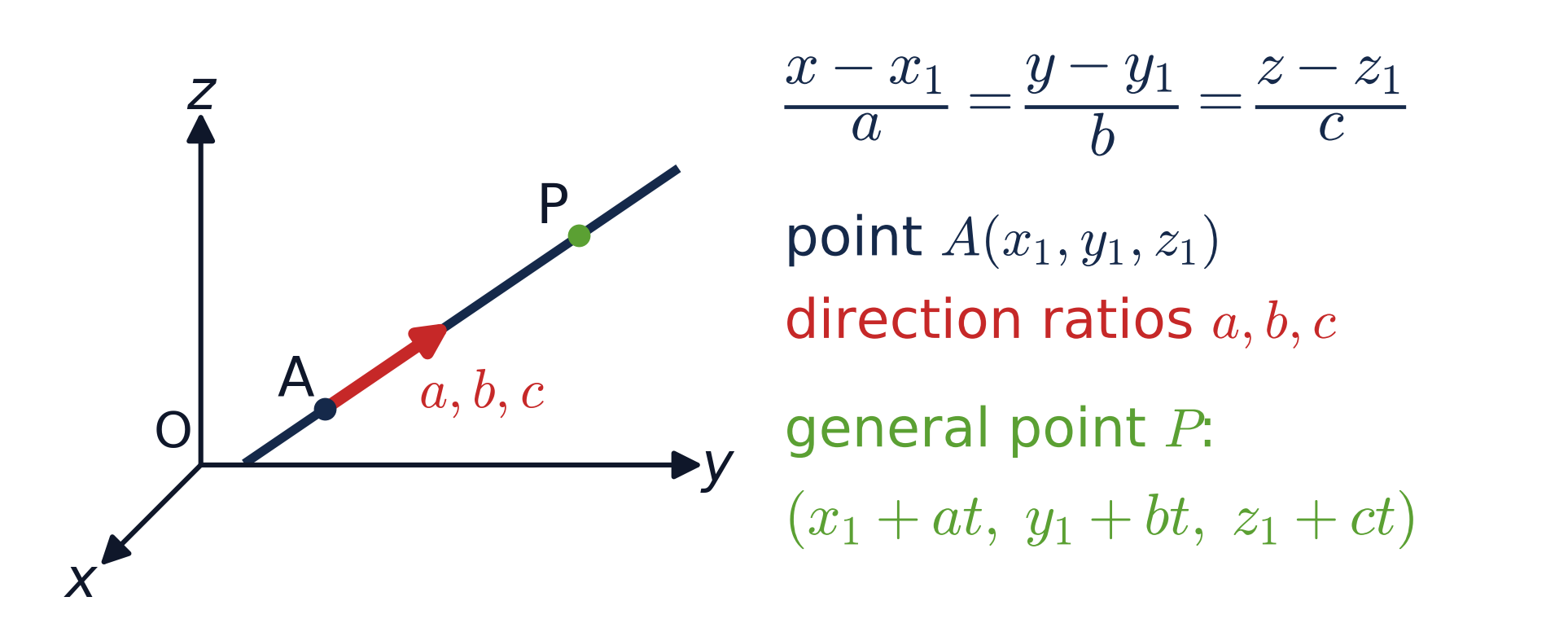
For the line through two points, first subtract the coordinates to get the direction ratios (Chapter M4-5).
Reading the direction ratios. The equation must be in the form above, with x, y and z each having coefficient 1 in the numerator. The line 2x = 3y = -z is not in that form. Write it as \dfrac{x}{1/2} = \dfrac{y}{1/3} = \dfrac{z}{-1}. The direction ratios are \dfrac{1}{2}, \dfrac{1}{3}, -1, or, multiplying by 6, 3, 2, -6.
2. The equation of a plane
The picture. A plane is a flat surface that goes on for ever, like a table top with no edges. Stand a pencil upright on the table. The pencil is at right angles to every line drawn on the table. Its direction is called the normal to the plane. A plane is fixed by one point on it and its normal.
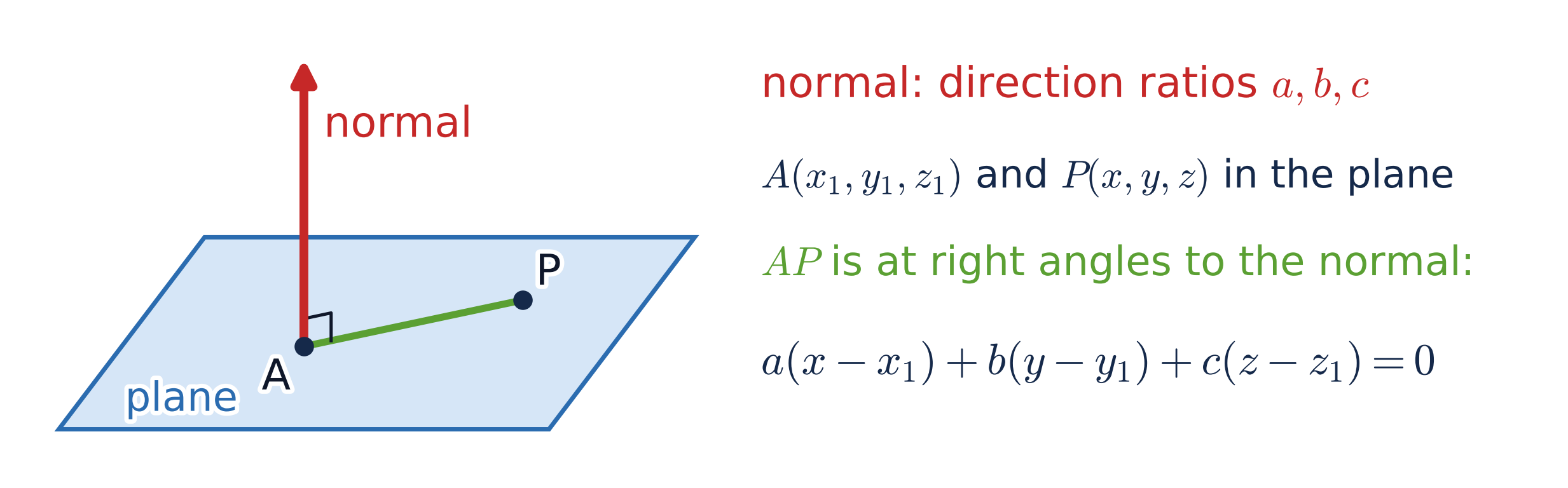
Every plane has an equation of the first degree:
ax + by + cz + d = 0
The coefficients a, b, c are the direction ratios of the normal. So the normal to 2x - 3y + 6z + 4 = 0 has direction ratios 2, -3, 6.
| Form | Equation | Use it when you know |
|---|---|---|
| Point and normal | a(x - x_1) + b(y - y_1) + c(z - z_1) = 0 | a point (x_1, y_1, z_1) on the plane and the normal a, b, c |
| Intercept | \dfrac{x}{p} + \dfrac{y}{q} + \dfrac{z}{r} = 1 | the cuts p, q, r on the three axes |
| General | ax + by + cz + d = 0 | every plane can be written this way |
For example, the plane through (1, 2, 3) with normal 2, -1, 2 is 2(x - 1) - (y - 2) + 2(z - 3) = 0, that is 2x - y + 2z = 6.
A quicker way: write 2x - y + 2z = k and put in the point to get k = 2 - 2 + 6 = 6.
3. Angles, parallel and perpendicular
For two directions a_1, b_1, c_1 and a_2, b_2, c_2, Chapter M4-5 gave
\cos\theta = \frac{|a_1 a_2 + b_1 b_2 + c_1 c_2|}{\sqrt{a_1^2 + b_1^2 + c_1^2}\,\sqrt{a_2^2 + b_2^2 + c_2^2}}
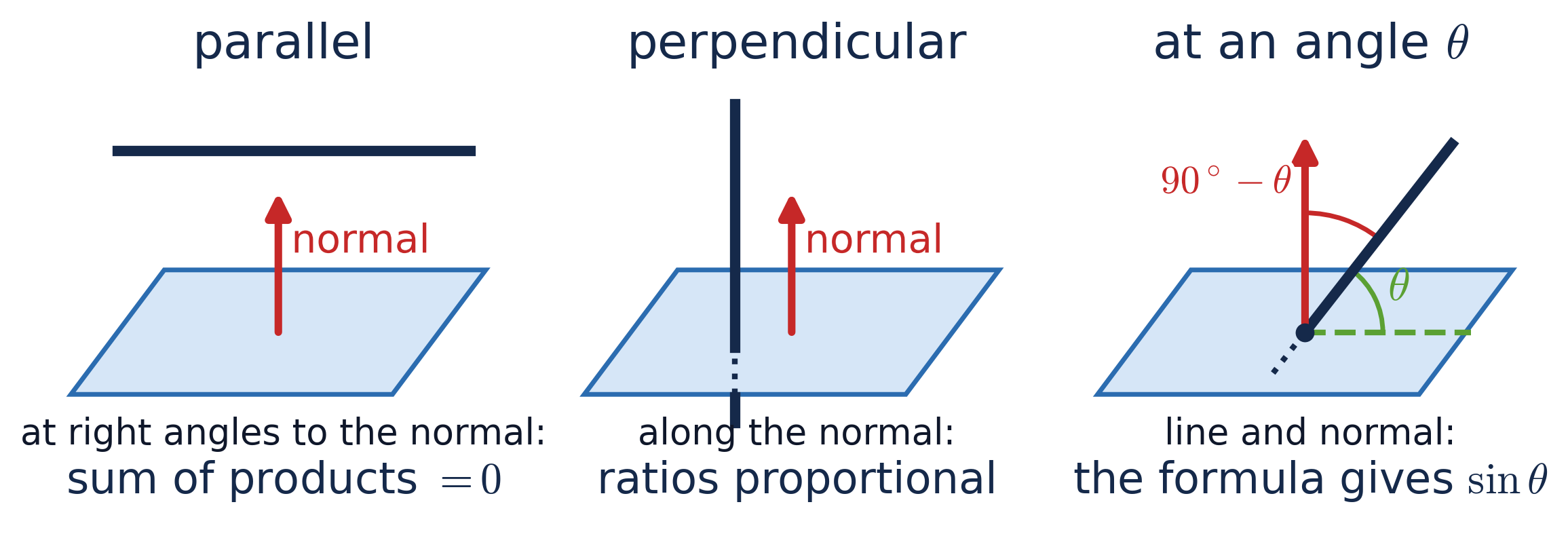
A plane has no direction of its own; its normal speaks for it. That gives three cases.
| Between | How to find the angle | Parallel when | Perpendicular when |
|---|---|---|---|
| Two lines | Use the formula with their direction ratios | the direction ratios are proportional | a_1 a_2 + b_1 b_2 + c_1 c_2 = 0 |
| Two planes | Use the formula with their normals | the normals are proportional | a_1 a_2 + b_1 b_2 + c_1 c_2 = 0 |
| A line and a plane | Use the formula with the line's direction and the plane's normal, but the right side is \sin\theta, not \cos\theta | direction and normal give sum of products = 0 | direction and normal are proportional |
Read the last row with care. A line parallel to a plane is perpendicular to the normal. A line perpendicular to a plane runs along the normal. Think of the table: a pencil lying on the table is at right angles to the upright pencil.
4. Distances
The perpendicular distance of the point (x_1, y_1, z_1) from the plane ax + by + cz + d = 0 is
\frac{|a x_1 + b y_1 + c z_1 + d|}{\sqrt{a^2 + b^2 + c^2}}
It is the formula of Chapter M4-2 with one more term. The distance between the parallel planes ax + by + cz + d_1 = 0 and ax + by + cz + d_2 = 0 is \dfrac{|d_1 - d_2|}{\sqrt{a^2 + b^2 + c^2}}.
5. Where things meet
A line and a plane. Put the general point (x_1 + at, y_1 + bt, z_1 + ct) into the equation of the plane, solve for t, and put t back.
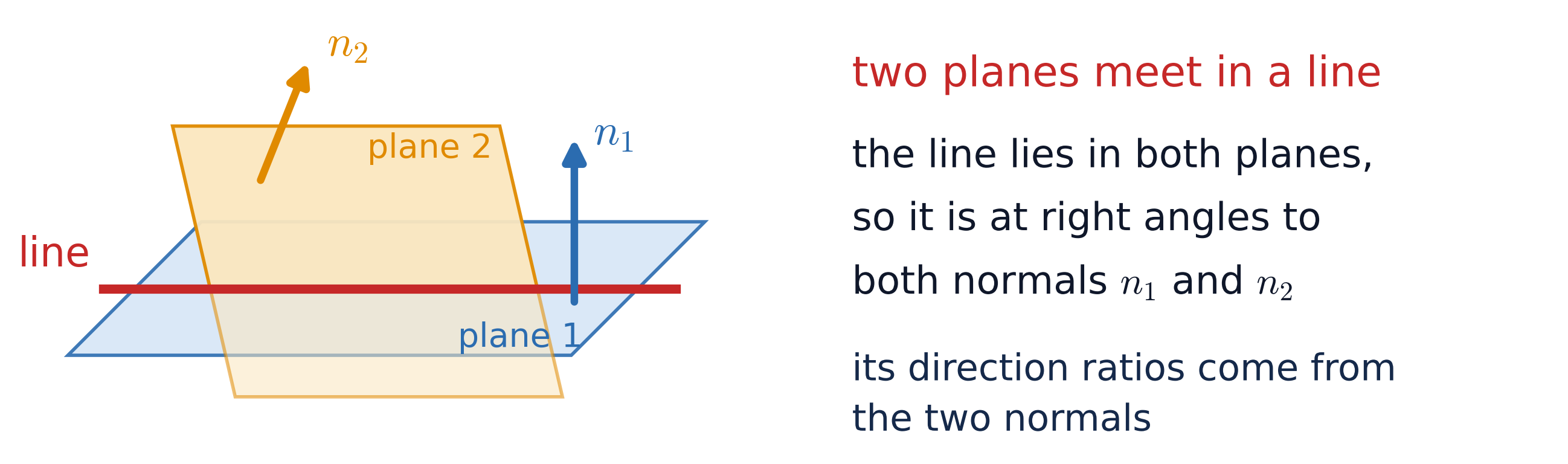
Two planes. Two planes that are not parallel meet in a line. That line lies in both planes, so it is perpendicular to both normals. If the normals are a_1, b_1, c_1 and a_2, b_2, c_2, the direction ratios of the line are
b_1 c_2 - b_2 c_1, \qquad c_1 a_2 - c_2 a_1, \qquad a_1 b_2 - a_2 b_1
For the planes x + y + z = 1 and x - y + 2z = 3 the normals are 1, 1, 1 and 1, -1, 2. The direction ratios are 1 \times 2 - (-1) \times 1 = 3, then 1 \times 1 - 2 \times 1 = -1, then 1 \times (-1) - 1 \times 1 = -2. Check: 3 - 1 - 2 = 0 and 3 + 1 - 4 = 0, so 3, -1, -2 is perpendicular to both normals.
(In Chapter M7-3 you will see that this is the cross product of the two normals.)
6. Worked examples
Example 1. Find the equation of the line through A(1, -1, 2) and B(3, 2, 8).
Direction ratios: 3 - 1, \; 2 - (-1), \; 8 - 2, that is 2, 3, 6. The line is \dfrac{x - 1}{2} = \dfrac{y + 1}{3} = \dfrac{z - 2}{6}.
Example 2. Find the plane through (2, 1, -1) that is perpendicular to a line with direction ratios 1, -2, 3.
The line is the normal, so the plane is x - 2y + 3z = k. Put in the point: k = 2 - 2 - 3 = -3. The plane is x - 2y + 3z + 3 = 0.
Example 3. Find the angle between the planes 2x - y + z = 6 and x + y + 2z = 7.
The normals are 2, -1, 1 and 1, 1, 2. Then \cos\theta = \dfrac{|2 - 1 + 2|}{\sqrt{6}\,\sqrt{6}} = \dfrac{3}{6} = \dfrac{1}{2}, so \theta = 60^\circ.
Example 4. Find the distance of the point (2, 3, -5) from the plane x + 2y - 2z = 9.
Write the plane as x + 2y - 2z - 9 = 0. Distance = \dfrac{|2 + 6 + 10 - 9|}{\sqrt{1 + 4 + 4}} = \dfrac{9}{3} = 3.
Example 5. Where does the line of Example 1 meet the plane x + y + z = 13?
The general point of the line is (1 + 2t, \; -1 + 3t, \; 2 + 6t). Put it into the plane: (1 + 2t) + (-1 + 3t) + (2 + 6t) = 13, so 2 + 11t = 13 and t = 1. The point is (3, 2, 8).
7. From the real papers
Try each question for 75 seconds before reading the solution.
NDA I 2025, Q65. What is the equation of the plane passing through the point (1, 1, 1) and perpendicular to the line whose direction ratios are \langle 3, 2, 1 \rangle?
(a) x + 2y + 3z = 6 (b) 3x + 2y + z = 6 (c) x + y + z = 3 (d) 3x + 2y + z = 0
Solution. The line is the normal, so the plane is 3x + 2y + z = k. The point (1, 1, 1) gives k = 6. Answer (b).
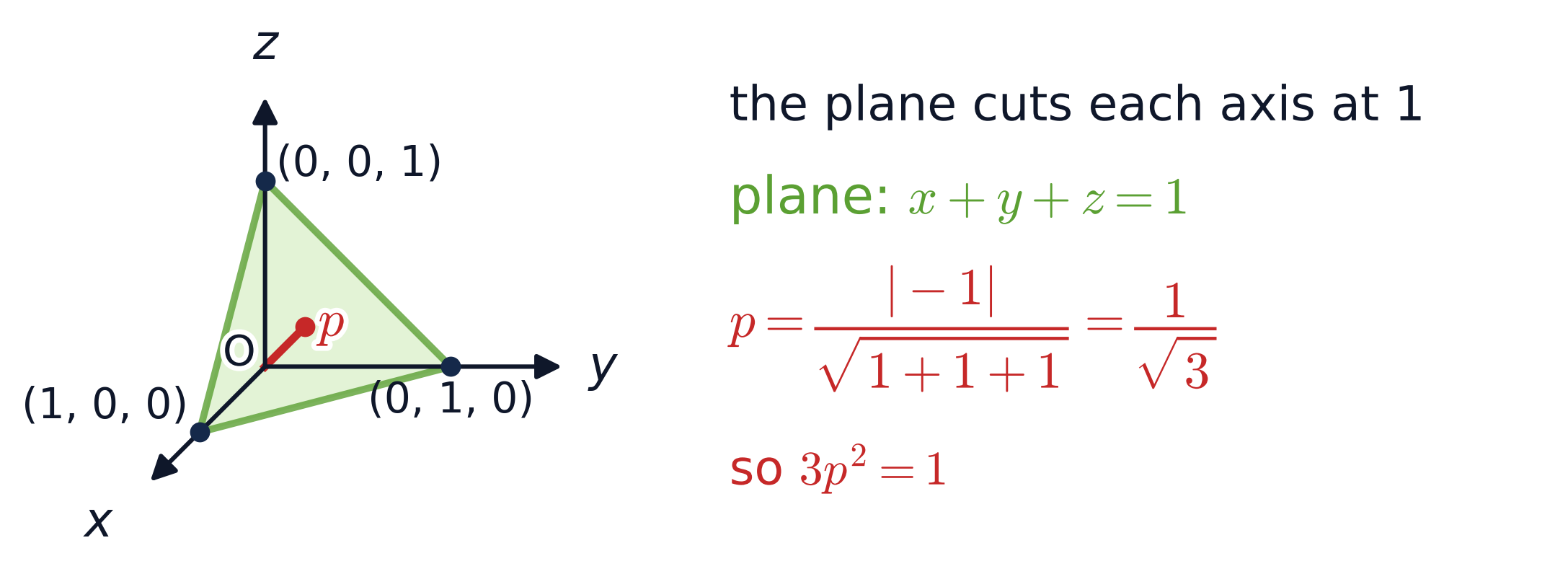
NDA I 2024, Q56. If p is the perpendicular distance from origin to the plane passing through (1, 0, 0), (0, 1, 0) and (0, 0, 1), then what is 3p^2 equal to?
(a) 4 (b) 3 (c) 2 (d) 1
Solution. The plane cuts each axis at 1, so by the intercept form it is x + y + z = 1. The distance of the origin from x + y + z - 1 = 0 is p = \dfrac{|-1|}{\sqrt{3}} = \dfrac{1}{\sqrt{3}}. So 3p^2 = 1. Answer (d).
NDA II 2023, Q98. What is the angle between the lines 2x = 3y = -z and 6x = -y = -4z?
(a) 0^\circ (b) 30^\circ (c) 60^\circ (d) 90^\circ
Solution. The first line has direction ratios 3, 2, -6 (section 1). For the second, divide 6x = -y = -4z by 12: \dfrac{x}{2} = \dfrac{y}{-12} = \dfrac{z}{-3}, direction ratios 2, -12, -3. Sum of products: 6 - 24 + 18 = 0. The lines are perpendicular. Answer (d).
NDA I 2024, Q55. A line through (1, -1, 2) with direction ratios < 3, 2, 2 > meets the plane x + 2y + 3z = 18. What is the point of intersection of line and plane?
(a) (4, 4, 1) (b) (2, 4, 1) (c) (4, 1, 4) (d) (3, 4, 7)
Solution. The general point is (1 + 3t, \; -1 + 2t, \; 2 + 2t). In the plane: (1 + 3t) + 2(-1 + 2t) + 3(2 + 2t) = 18, so 5 + 13t = 18 and t = 1. The point is (4, 1, 4). Answer (c).
NDA I 2026, Q56. A line L passing through the point (-1, 2, -3) is perpendicular to the plane P given by 2x + 3y + z + 5 = 0. What are the direction ratios of a line M parallel to the plane P?
(a) \langle -3, 2, 1 \rangle (b) \langle 3, 2, -6 \rangle (c) \langle 1, 3, 2 \rangle (d) \langle 2, 2, -10 \rangle
Solution. A line parallel to a plane is perpendicular to its normal 2, 3, 1. Test each option with the sum of products: (a) -6 + 6 + 1 = 1; (b) 6 + 6 - 6 = 6; (c) 2 + 9 + 2 = 13; (d) 4 + 6 - 10 = 0. Only (d) gives zero. Answer (d).
NDA II 2025, Q51. A plane P is parallel to the line having direction ratios \langle 1, 3, 2 \rangle and contains the line of intersection of the planes 6x + 4y - 5z = 2 and x - 2y + 3z = 0. Which of the following are the direction ratios of the line of intersection of the given planes?
(a) \langle 2, 23, 16 \rangle (b) \langle 2, -23, -16 \rangle (c) \langle 2, 3, 2 \rangle (d) \langle -1, 3, -2 \rangle
Solution. The normals are 6, 4, -5 and 1, -2, 3. By the rule of section 5 the direction ratios are 4 \times 3 - (-2)(-5) = 2, then (-5) \times 1 - 3 \times 6 = -23, then 6 \times (-2) - 1 \times 4 = -16. Check with the first normal: 12 - 92 + 80 = 0. Answer (b).
Notice how often the first step is simply "read the normal from the equation of the plane".
8. Mistakes that cost marks
- Parallel and perpendicular exchanged for a line and a plane. Line parallel to the plane: sum of products with the normal is zero. Line perpendicular to the plane: direction ratios proportional to the normal. Students often use the two-lines rule and get it the wrong way round.
- Cosine used for a line and a plane. The formula with the line's direction and the plane's normal gives \sin\theta for the angle between the line and the plane.
- Reading direction ratios from an equation that is not in standard form. 2x = 3y = -z has direction ratios 3, 2, -6, not 2, 3, -1. Also, \dfrac{1 - x}{2} must be rewritten as \dfrac{x - 1}{-2}.
- Leaving out the constant in the distance formula. For x + 2y - 2z = 9, move the 9 to the left first.
9. Quick check
Do these without help. Answers are at the end.
- Write the direction ratios of the line \dfrac{x - 2}{3} = \dfrac{y + 1}{-2} = \dfrac{z}{6} and one point on it.
- Find the equation of the plane that cuts the axes at 2, 3 and 6.
- Find the distance of the origin from the plane 2x - 3y + 6z = 14.
- For what value of k is a line with direction ratios 1, k, 2 parallel to the plane 2x + y - 3z = 5?
- Find the distance between the planes x + 2y + 2z = 3 and x + 2y + 2z = 12.
10. Read and watch more, free
| What | Where | Language |
|---|---|---|
| Textbook, the line in space | NCERT Class 12 Mathematics, Chapter 11 Three Dimensional Geometry · Hindi edition. The present edition covers lines only, not planes | English, Hindi |
| Self-study notes, the plane | NIOS Mathematics, Lesson 35 Plane · Hindi edition | English, Hindi |
| Self-study notes, the line | NIOS Mathematics, Lesson 36 Straight Line · Hindi edition | English, Hindi |
| Textbook, university style | OpenStax Calculus Volume 3, section 2.5 Equations of Lines and Planes in Space | English |
| Video, three-dimensional geometry for NDA | Defence Wallah: 3D for NDA 2 2026 (one class, about 5 hours 40 minutes) | Hinglish |
| Video, another class for NDA | Chandigarh Career Group: NDA Maths one shots (Class 6, "Three dimensional geometry", about 6 hours) | Hinglish |
| Video, in depth (harder than NDA needs) | Mohit Tyagi: Vector and Three Dimensional Geometry (12 lectures) | Hinglish |
| Past questions with answers | ExamSIDE: Three Dimensional Geometry | English |
The videos were chosen from their titles, length and views; they have not yet been watched by a teacher.
Answers to the quick check
- Direction ratios 3, -2, 6. One point is (2, -1, 0).
- \dfrac{x}{2} + \dfrac{y}{3} + \dfrac{z}{6} = 1. Multiply by 6: 3x + 2y + z = 6.
- \dfrac{|-14|}{\sqrt{4 + 9 + 36}} = \dfrac{14}{7} = 2.
- The line must be perpendicular to the normal 2, 1, -3: 2 + k - 6 = 0, so k = 4.
- \dfrac{|3 - 12|}{\sqrt{1 + 4 + 4}} = \dfrac{9}{3} = 3.
Next chapter: The sphere.