Why this chapter matters. These three curves drew 18 questions in the 7 papers from 2023 to 2026, at least two in every paper. The questions are almost always about the standard form: put the equation into it, then read off the focus, the directrix, the eccentricity or the length of an axis. A student who knows the two tables of this chapter can answer most of them in under a minute. Six real questions are solved in section 7.
What you will be able to do
- Say what the focus, the directrix and the eccentricity of a curve are.
- Read the focus, directrix, axis and latus rectum of a parabola from its equation.
- Find the eccentricity, the foci and the axes of an ellipse and of a hyperbola.
- Tell from an equation which of the curves it represents.
Before you start you should know: the distance formula (Chapter M4-1), the equation of a line parallel to an axis (Chapter M4-2) and the circle (Chapter M4-3).
1. One idea behind all three curves
Take a fixed point, called the focus, and a fixed straight line, called the directrix. Let a point move so that
\frac{\text{its distance from the focus}}{\text{its distance from the directrix}} = e
where e is a fixed positive number. The path of the point is a conic, and e is its eccentricity.
| Value of e | Curve |
|---|---|
| e = 1 | Parabola |
| 0 < e < 1 | Ellipse |
| e > 1 | Hyperbola |
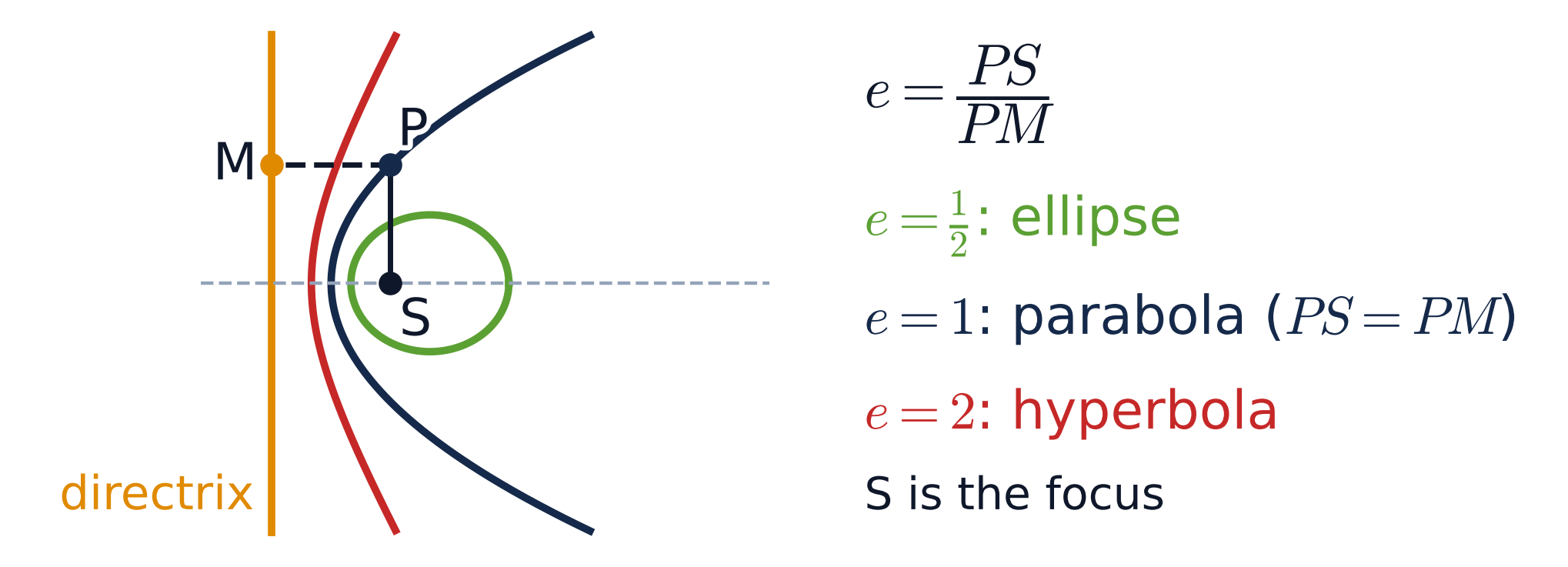
A circle is the limiting case e = 0. The eccentricity of every parabola is exactly 1, whatever its equation.
Each curve is described in words and shown in a picture. Draw each one in your notebook as you read.
2. The parabola
The picture. A parabola is an open curve shaped like the letter U. The vertex is the turning point at the bottom of the U. The axis is the line that cuts the U into two equal halves. The focus lies on the axis inside the U, at a distance a from the vertex. The directrix is a straight line outside the U, at right angles to the axis, also at a distance a from the vertex.
Every point of a parabola is at the same distance from the focus as from the directrix.
With the vertex at the origin there are four standard forms. In all of them a > 0.
| Equation | Opens | Focus | Directrix | Axis |
|---|---|---|---|---|
| y^2 = 4ax | to the right | (a, 0) | x = -a | the x-axis, y = 0 |
| y^2 = -4ax | to the left | (-a, 0) | x = a | the x-axis, y = 0 |
| x^2 = 4ay | upwards | (0, a) | y = -a | the y-axis, x = 0 |
| x^2 = -4ay | downwards | (0, -a) | y = a | the y-axis, x = 0 |
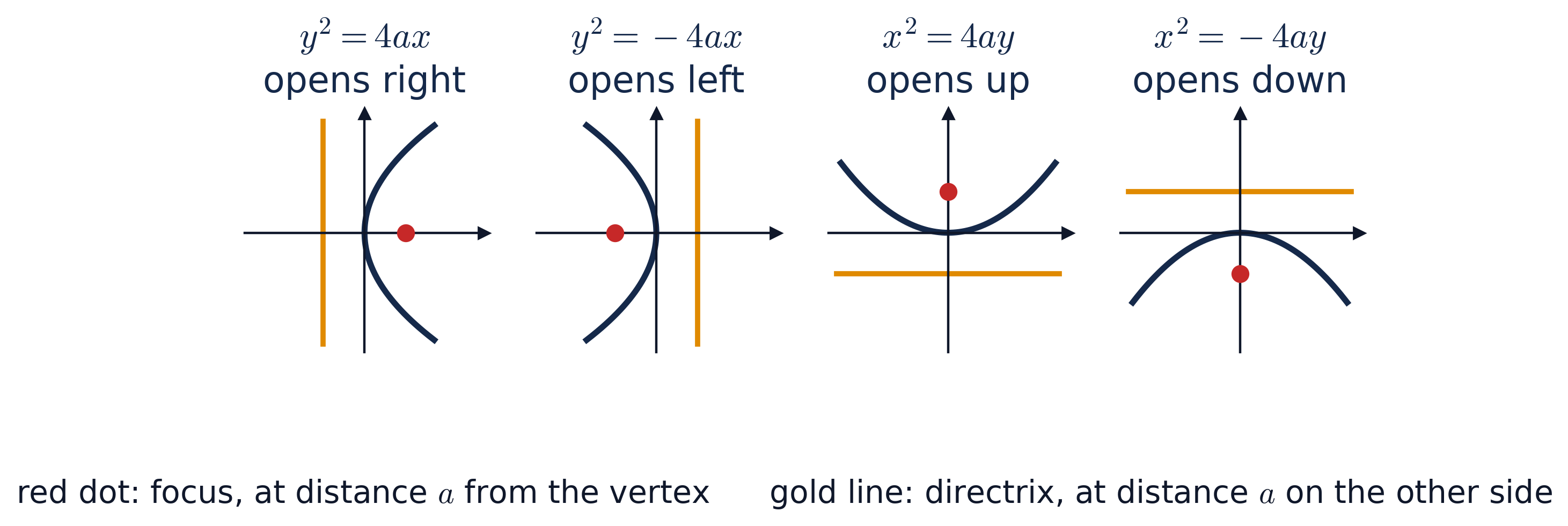
How to remember it: the variable that is not squared gives the axis, and its sign gives the direction in which the curve opens. The focus is inside the curve; the directrix is on the other side of the vertex.
The latus rectum is the chord through the focus at right angles to the axis. Its length is 4a for every parabola.
For example, in y^2 = 12x we have 4a = 12, so a = 3. The parabola opens to the right, the focus is (3, 0), the directrix is x = -3 and the latus rectum is 12.
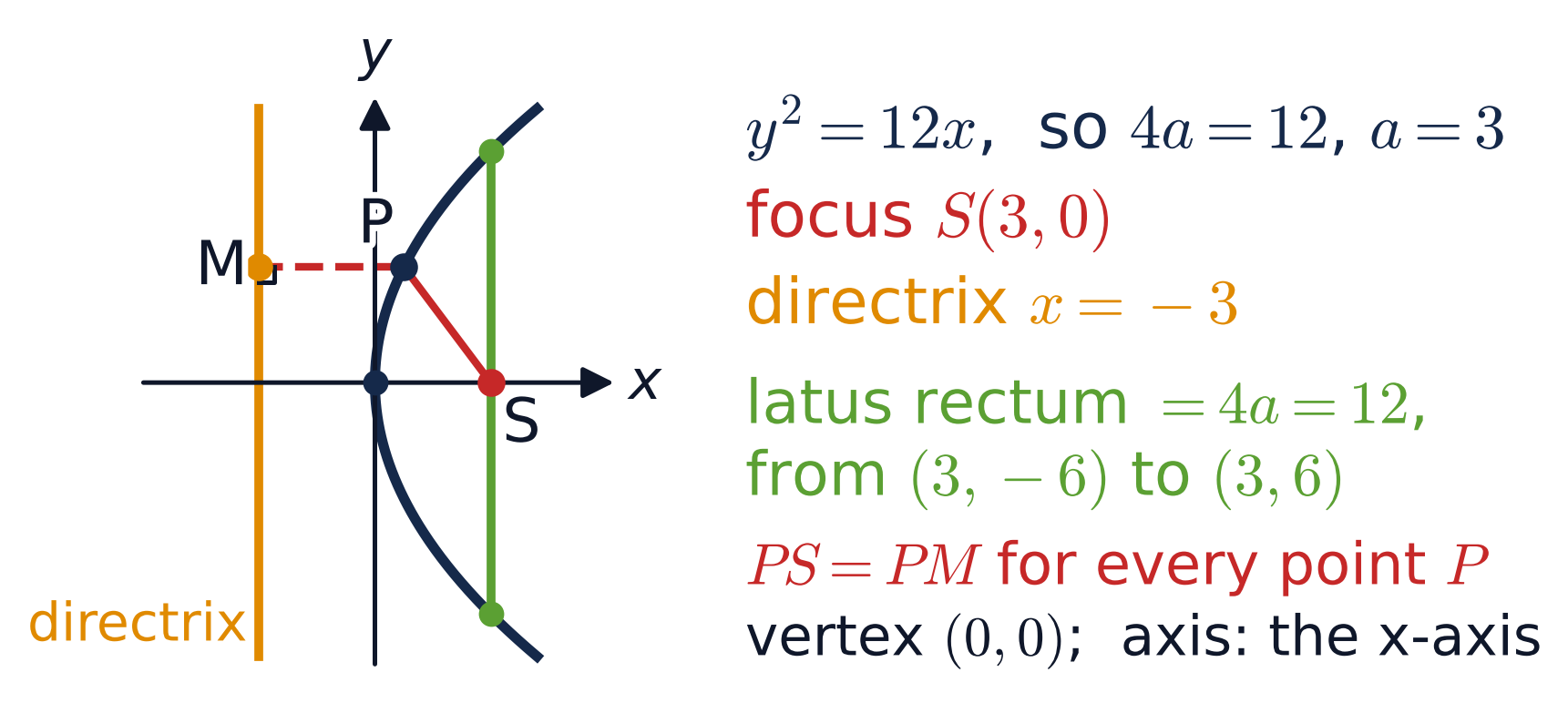
For a point (x, y) on y^2 = 4ax, the distance from the focus (the focal distance) is x + a.
3. The ellipse
The picture. An ellipse is a closed curve like a flattened circle. Its longest diameter is the major axis and its shortest diameter is the minor axis. They cross at the centre. There are two foci, on the major axis, at equal distances on either side of the centre.
The standard form, with the centre at the origin and the major axis along the x-axis, is
\frac{x^2}{a^2} + \frac{y^2}{b^2} = 1 \qquad (a > b > 0)
For every point of an ellipse, the sum of its distances from the two foci is 2a, the length of the major axis.
4. The hyperbola
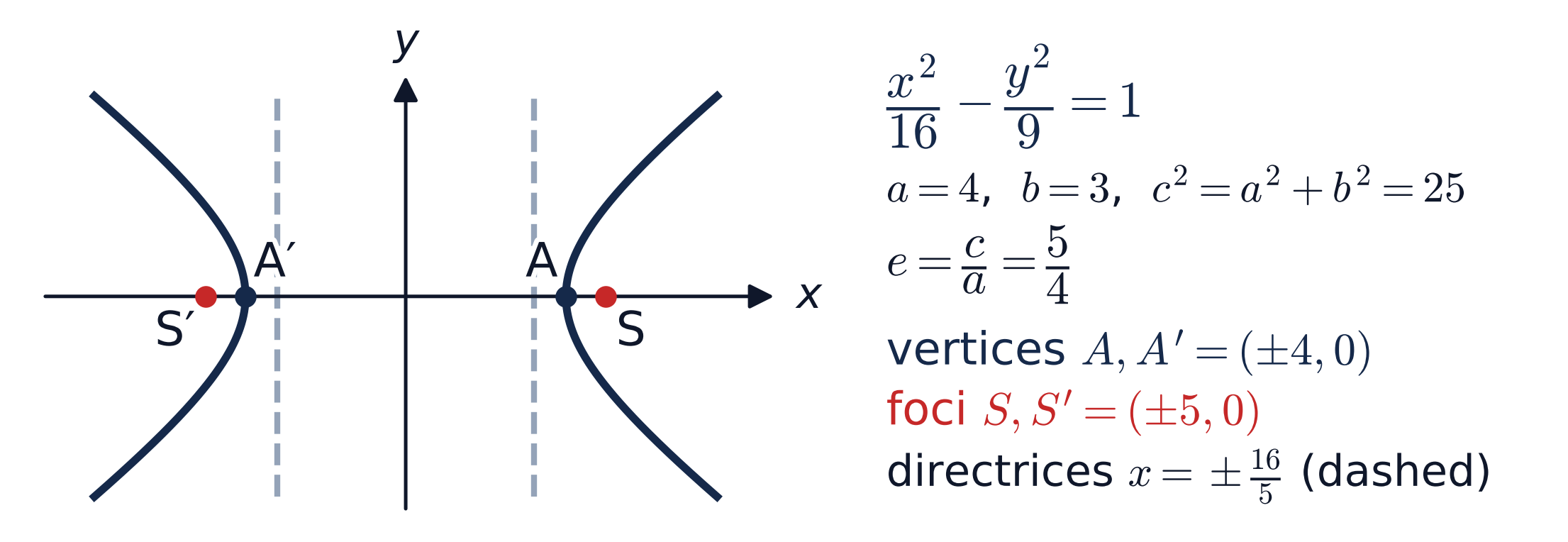
The picture. A hyperbola has two separate branches, each like an open bowl, facing away from each other. The two points where the branches come closest are the vertices. The line through them is the transverse axis, and the mid-point between them is the centre. There are two foci, one inside each branch.
The standard form, with the centre at the origin and the transverse axis along the x-axis, is
\frac{x^2}{a^2} - \frac{y^2}{b^2} = 1
For every point of a hyperbola, the difference of its distances from the two foci is 2a.
The facts for the two curves side by side. In both, c is the distance of each focus from the centre.
| Ellipse \dfrac{x^2}{a^2} + \dfrac{y^2}{b^2} = 1, a > b | Hyperbola \dfrac{x^2}{a^2} - \dfrac{y^2}{b^2} = 1 | |
|---|---|---|
| Finding c | c^2 = a^2 - b^2 | c^2 = a^2 + b^2 |
| Eccentricity | e = \dfrac{c}{a}, less than 1 | e = \dfrac{c}{a}, more than 1 |
| Foci | (\pm c, 0), that is (\pm ae, 0) | (\pm c, 0), that is (\pm ae, 0) |
| Vertices | (\pm a, 0) | (\pm a, 0) |
| Axes | major axis 2a, minor axis 2b | transverse axis 2a, conjugate axis 2b |
| Directrices | x = \pm \dfrac{a}{e} | x = \pm \dfrac{a}{e} |
| Latus rectum | \dfrac{2b^2}{a} | \dfrac{2b^2}{a} |
| Focal distances of a point | sum = 2a | difference = 2a |
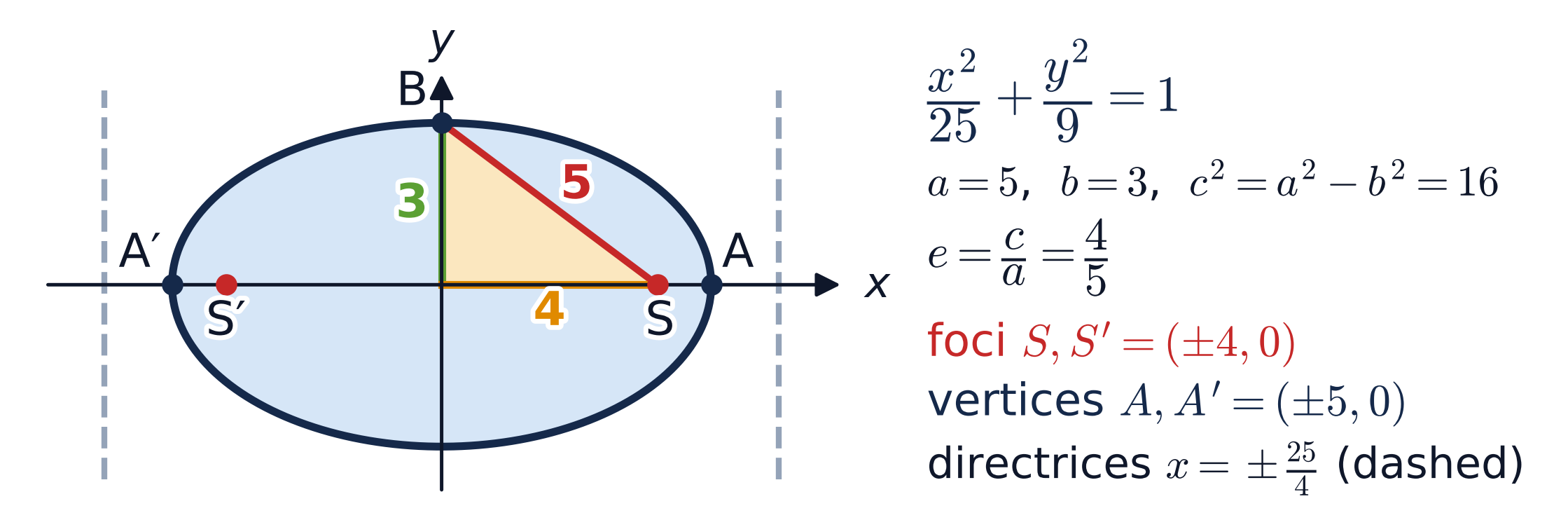
For example, the ellipse \dfrac{x^2}{25} + \dfrac{y^2}{9} = 1 has a = 5, b = 3, c^2 = 25 - 9 = 16. So c = 4, e = \dfrac{4}{5}, the foci are (\pm 4, 0) and the latus rectum is \dfrac{18}{5}.
The hyperbola \dfrac{x^2}{16} - \dfrac{y^2}{9} = 1 has a = 4, b = 3, c^2 = 16 + 9 = 25. So c = 5, e = \dfrac{5}{4}, the foci are (\pm 5, 0) and the latus rectum is \dfrac{9}{2}.
When the ellipse stands upright. In an ellipse, a^2 is always the larger denominator. If the larger denominator is under y^2, the major axis lies along the y-axis and the foci are (0, \pm c). Everything else in the table stays the same with x and y exchanged.
In a hyperbola, a^2 is the denominator of the positive term, whether it is the larger one or not. If a = b the hyperbola is called rectangular and e = \sqrt{2}.
5. Which curve is it?
Look at the squared terms of the equation.
| The equation has | Curve | Example |
|---|---|---|
| only one squared term | Parabola | y^2 + 6x = 0 |
| x^2 and y^2 with the same sign and equal coefficients | Circle | 3x^2 + 3y^2 = 12 |
| x^2 and y^2 with the same sign and unequal coefficients | Ellipse | 2x^2 + 5y^2 = 10 |
| x^2 and y^2 with opposite signs | Hyperbola | x^2 - 2y^2 = 4 |
6. Worked examples
Example 1. Describe the parabola x^2 = -8y.
Compare with x^2 = -4ay: 4a = 8, so a = 2. It opens downwards. Focus (0, -2), directrix y = 2, axis x = 0, latus rectum 8.
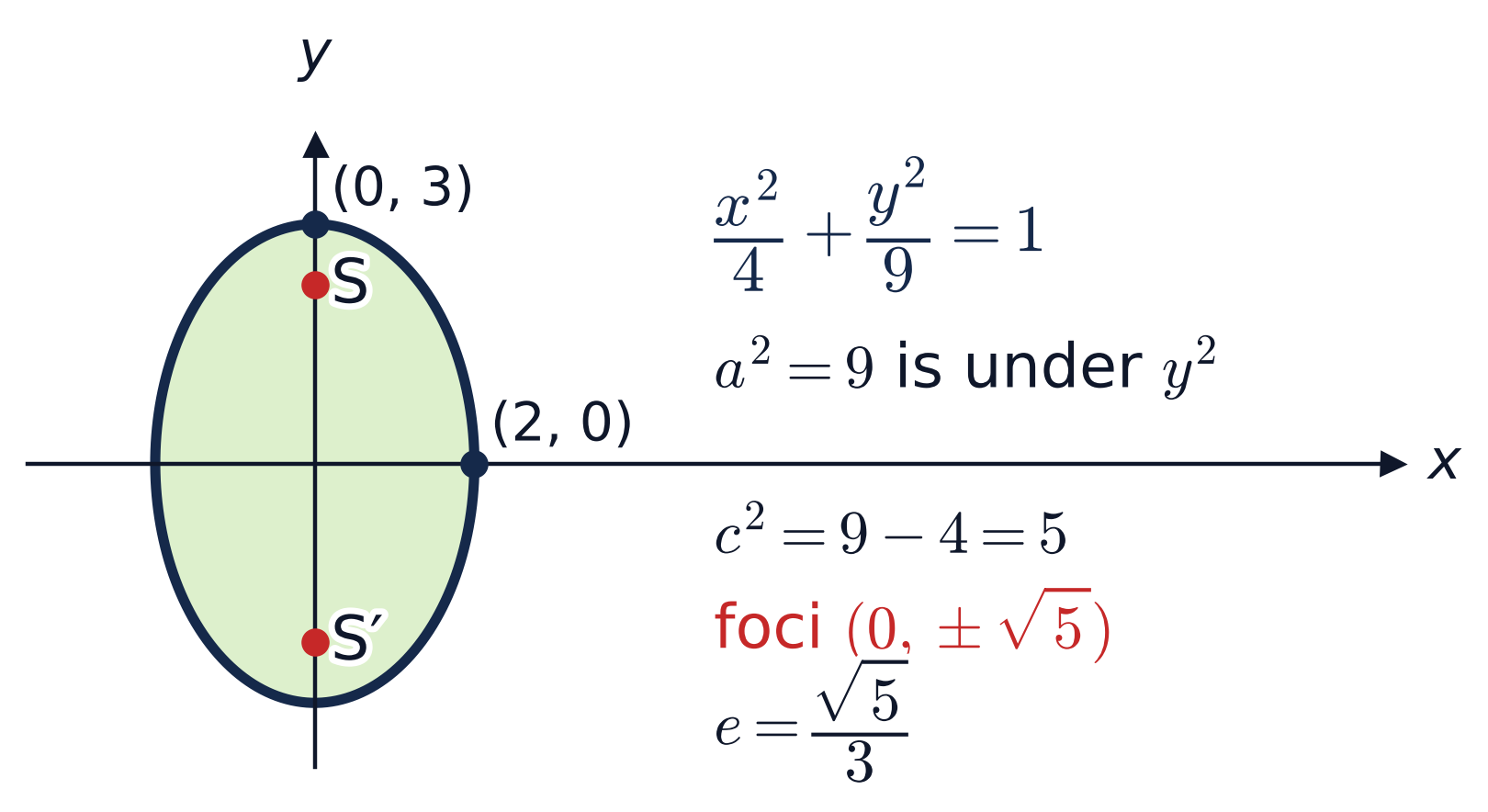
Example 2. Find the eccentricity and the foci of 9x^2 + 4y^2 = 36.
Divide by 36 to make the right side 1: \dfrac{x^2}{4} + \dfrac{y^2}{9} = 1. The larger denominator, 9, is under y^2, so a^2 = 9, b^2 = 4 and the major axis is along the y-axis.
c^2 = 9 - 4 = 5, so e = \dfrac{\sqrt{5}}{3} and the foci are (0, \pm\sqrt{5}).
Example 3. Find the eccentricity, the foci and the latus rectum of 4x^2 - 9y^2 = 36.
Divide by 36: \dfrac{x^2}{9} - \dfrac{y^2}{4} = 1. So a^2 = 9, b^2 = 4 and c^2 = 9 + 4 = 13.
e = \dfrac{\sqrt{13}}{3}, the foci are (\pm\sqrt{13}, 0) and the latus rectum is \dfrac{2 \times 4}{3} = \dfrac{8}{3}.
Example 4. Find the ellipse with foci (\pm 3, 0) and eccentricity \dfrac{3}{5}.
c = 3 and e = \dfrac{c}{a}, so a = 5. Then b^2 = a^2 - c^2 = 25 - 9 = 16. The ellipse is \dfrac{x^2}{25} + \dfrac{y^2}{16} = 1.
Example 5. A point on the parabola y^2 = 16x is at a distance 13 from the focus. Find the point.
Here a = 4, and the focal distance is x + a. So x + 4 = 13 and x = 9. Then y^2 = 144 and y = \pm 12. The point is (9, 12) or (9, -12).
7. From the real papers
Try each question for 75 seconds before reading the solution.
NDA II 2026, Q60. What is the eccentricity (e) of the parabola 4x^2 + y = 0?
(a) e < 0 (b) 0 < e < 1 (c) e = 1 (d) e > 1
Solution. The equation has only one squared term, so it is a parabola, and every parabola has e = 1. No calculation is needed. Answer (c).
NDA II 2023, Q81. What is the equation of directrix of parabola y^2 = 4bx, where b < 0 and b^2 + b - 2 = 0?
(a) x + 1 = 0 (b) x - 2 = 0 (c) x - 1 = 0 (d) x + 2 = 0
Solution. (b + 2)(b - 1) = 0 and b < 0, so b = -2. The parabola is y^2 = -8x: it opens to the left with a = 2. Its directrix is on the right, x = 2. Answer (b).
NDA II 2025, Q59. Consider the following statements in respect of the equation x^2 + 3y = 0 : I. The equation represents the equation to parabola that opens upwards. II. The axis of the parabola is x = 0. III. The equation of the latus rectum is 4y - 3 = 0. How many of the statements given above are correct?
(a) None (b) One (c) Two (d) All three
Solution. Write it as x^2 = -3y. This is x^2 = -4ay with a = \frac{3}{4}: it opens downwards, so I is wrong. The axis is the y-axis, x = 0, so II is correct. The focus is \left(0, -\frac{3}{4}\right), so the latus rectum lies on y = -\frac{3}{4}, that is 4y + 3 = 0, and III is wrong. Answer (b).
NDA I 2025, Q60. If any point on an ellipse is (3\sin\alpha, 5\cos\alpha), then what is the eccentricity of the ellipse?
(a) 4/3 (b) 4/5 (c) 3/4 (d) 1/2
Solution. With x = 3\sin\alpha and y = 5\cos\alpha we get \dfrac{x^2}{9} + \dfrac{y^2}{25} = \sin^2\alpha + \cos^2\alpha = 1. The larger denominator is 25, so a = 5, b = 3 and c^2 = 25 - 9 = 16. Then e = \dfrac{c}{a} = \dfrac{4}{5}. Answer (b).
NDA I 2024, Q65. What is the eccentricity of the ellipse if the angle between the straight lines joining the foci to an extremity of the minor axis is 90^\circ?
(a) \frac{1}{3} (b) \frac{1}{2} (c) \frac{1}{\sqrt{3}} (d) \frac{1}{\sqrt{2}}
Solution. Take the end B(0, b) of the minor axis and the foci (\pm c, 0). The two lines from B are placed equally on either side of the y-axis, so each makes 45^\circ with it. That needs b = c. Then c^2 = a^2 - b^2 = a^2 - c^2, so 2c^2 = a^2 and e = \dfrac{c}{a} = \dfrac{1}{\sqrt{2}}. Answer (d).
NDA I 2025, Q59. What is the distance between the two foci of the hyperbola 25x^2 - 75y^2 = 225?
(a) 2\sqrt{3} units (b) 4\sqrt{3} units (c) \sqrt{6} units (d) 2\sqrt{6} units
Solution. Divide by 225: \dfrac{x^2}{9} - \dfrac{y^2}{3} = 1. So c^2 = 9 + 3 = 12 and c = 2\sqrt{3}. The distance between the foci is 2c = 4\sqrt{3}. A student who subtracts, as for an ellipse, gets 2\sqrt{6}, which is option (d). Answer (b).
In every one of these the first step was the same: put the equation into standard form.
8. Mistakes that cost marks
- Using the wrong rule for c. Ellipse: c^2 = a^2 - b^2. Hyperbola: c^2 = a^2 + b^2. The examiner puts the other answer among the options.
- Choosing a^2 wrongly. In an ellipse a^2 is the larger denominator, wherever it stands. In a hyperbola a^2 is under the positive term.
- Reading a from a parabola. In y^2 = 12x the number 12 is 4a, so a = 3, not 12. The directrix is on the side opposite to the focus.
- Not making the right side 1. 9x^2 + 4y^2 = 36 must be divided by 36 before you read a^2 and b^2.
9. Quick check
Do these without help. Answers are at the end.
- Write the focus and the directrix of y^2 = 20x.
- Find the eccentricity of the ellipse \dfrac{x^2}{16} + \dfrac{y^2}{7} = 1.
- Find the eccentricity of the hyperbola \dfrac{x^2}{9} - \dfrac{y^2}{16} = 1.
- Find the length of the latus rectum of the ellipse \dfrac{x^2}{36} + \dfrac{y^2}{20} = 1.
- Name the curve: (i) 3x^2 + 3y^2 = 12, (ii) x^2 - 2y^2 = 4, (iii) y^2 + 6x = 0, (iv) 2x^2 + 5y^2 = 10.
10. Read and watch more, free
| What | Where | Language |
|---|---|---|
| Textbook | NCERT Class 11 Mathematics, Chapter 10 Conic Sections · Hindi edition | English, Hindi |
| Self-study notes | NIOS Mathematics, Lesson 16 Conic Sections · Hindi edition | English, Hindi |
| Textbook with clear diagrams of all three curves | OpenStax Precalculus 2e, Chapter 10 Analytic Geometry | English |
| Video, this chapter for NDA | Chandigarh Career Group: NDA Maths one shots (Class 4, "Parabola", and Class 5, "Ellipse and hyperbola", under 3 hours each) | Hinglish |
| Video, a short class for NDA | Defence Wallah: Fast Track series (the video "CONIC SECTION", about 1 hour) | Hinglish |
| Video, the textbook chapter in one class | Magnet Brains: Class 11 one-shot revision (the video "Conic Sections", about 3 hours 15 minutes) | Hinglish |
| Past questions with answers | ExamSIDE: Parabola · Ellipse · Hyperbola | English |
The videos were chosen from their titles, length and views; they have not yet been watched by a teacher.
Answers to the quick check
- 4a = 20, so a = 5. Focus (5, 0), directrix x = -5.
- c^2 = 16 - 7 = 9, so e = \dfrac{3}{4}.
- c^2 = 9 + 16 = 25, so e = \dfrac{5}{3}.
- \dfrac{2b^2}{a} = \dfrac{2 \times 20}{6} = \dfrac{20}{3}.
- (i) circle, (ii) hyperbola, (iii) parabola, (iv) ellipse.
Next chapter: Points in space and direction cosines.