Why this chapter matters. The straight line drew 29 questions in the 7 papers from 2023 to 2026, about four in every paper. That is more than any other chapter of this unit. The questions ask for the equation of a line from given facts, for the condition that two lines are parallel or perpendicular, for the angle between two lines, and for a distance from a line. Six real questions are solved in section 8.
What you will be able to do
- Find the slope of a line and write its equation in any of the six forms.
- Tell at once whether two lines are parallel or perpendicular, and find the angle between them.
- Find the distance of a point from a line and the distance between two parallel lines.
- Change one form of the equation into another, which is what many exam questions really ask.
Before you start you should know: the distance, mid-point and section formulas (Chapter M4-1), and the values of \tan\theta for 30^\circ, 45^\circ and 60^\circ (Chapter M3-2).
1. Slope
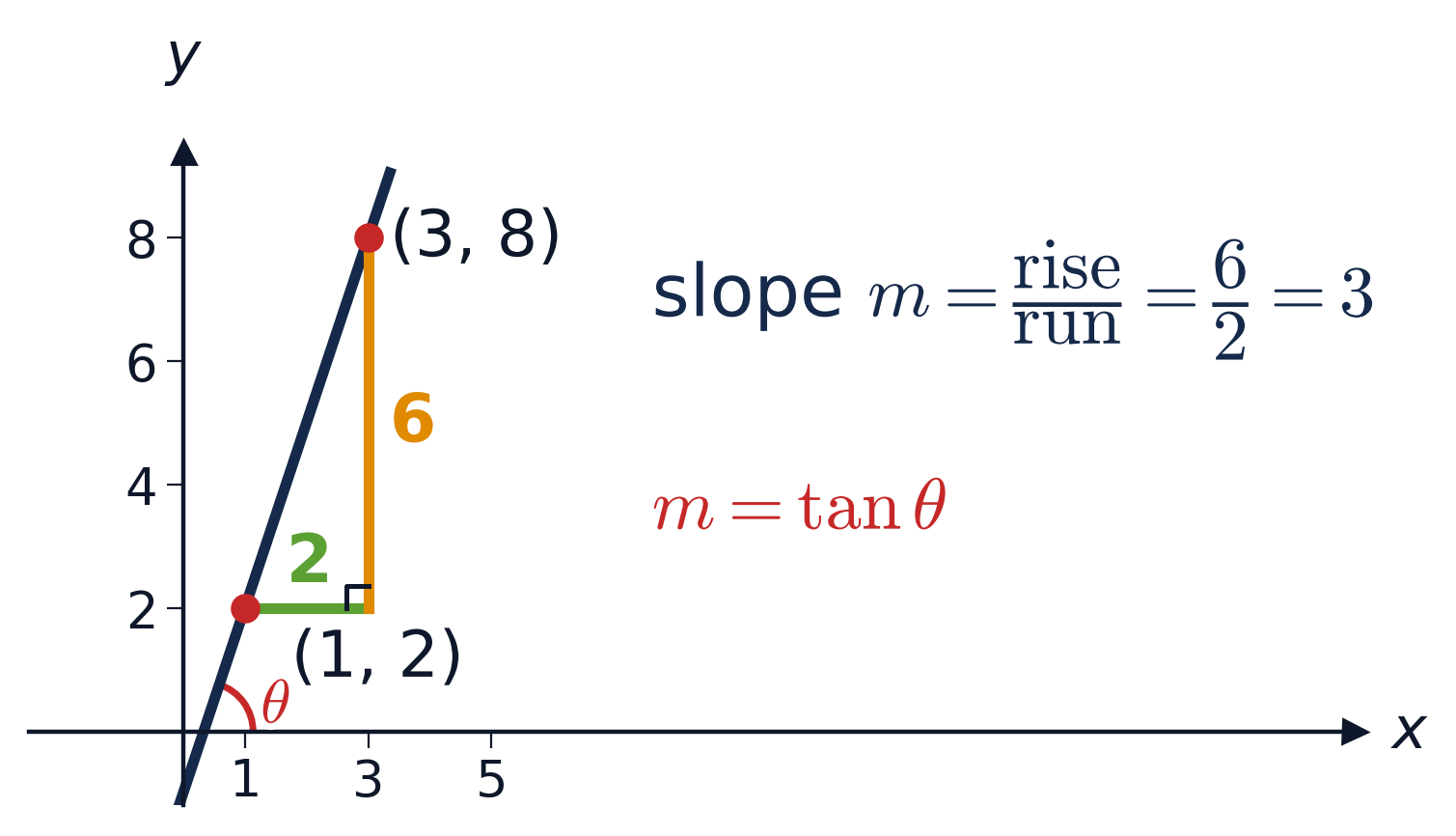
The slope of a line measures how steep it is. If the line makes an angle \theta with the positive direction of the x-axis, its slope is m = \tan\theta. For the line through (x_1, y_1) and (x_2, y_2),
m = \frac{y_2 - y_1}{x_2 - x_1}
For example, the line through (1, 2) and (3, 8) has slope \frac{8 - 2}{3 - 1} = 3.
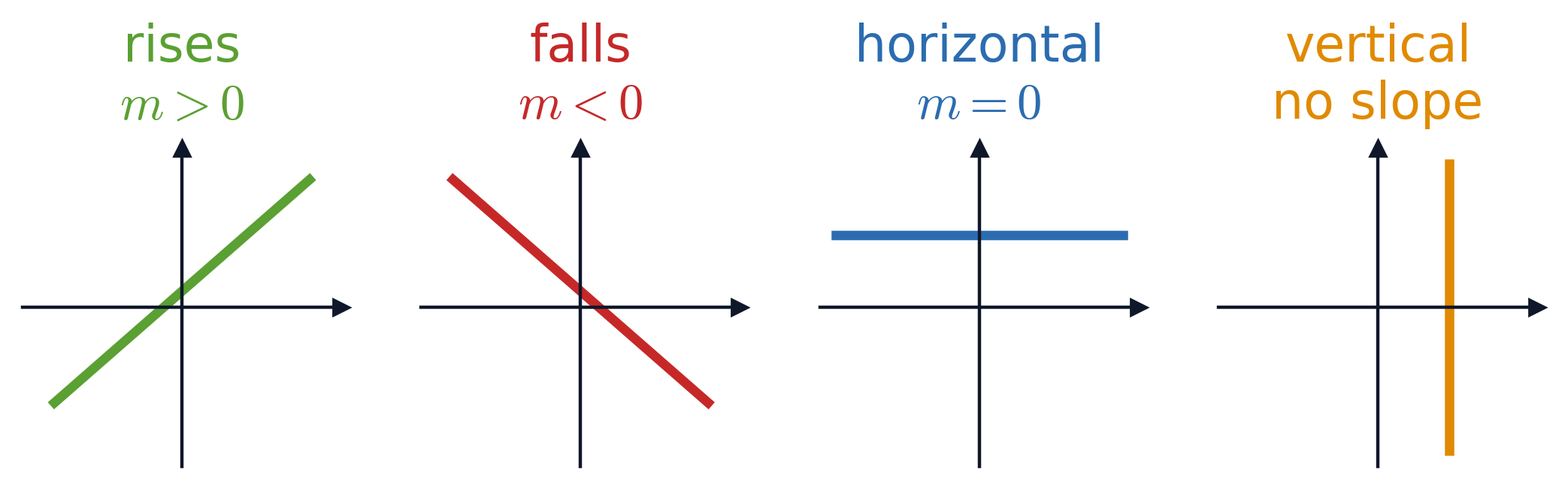
A line that rises to the right has a positive slope. A line that falls to the right has a negative slope. A horizontal line has slope 0. A vertical line has no slope (the formula would divide by zero).
2. The six forms of the equation
The same line can be written in different ways. Choose the form that fits the facts you are given.
| Form | Equation | Use it when you know |
|---|---|---|
| Slope-intercept | y = mx + c | the slope m and the cut c on the y-axis |
| Point-slope | y - y_1 = m(x - x_1) | one point and the slope |
| Two-point | y - y_1 = \dfrac{y_2 - y_1}{x_2 - x_1}(x - x_1) | two points |
| Intercept | \dfrac{x}{a} + \dfrac{y}{b} = 1 | the cuts a and b on the x-axis and the y-axis |
| Normal (perpendicular) | x\cos\alpha + y\sin\alpha = p | the length p of the perpendicular from the origin, and the angle \alpha it makes with the x-axis |
| General | ax + by + c = 0 | every line can be written this way |
Lines parallel to the axes are the simplest: x = a is vertical and y = b is horizontal.
Reading the general form. For ax + by + c = 0:
- the slope is -\dfrac{a}{b};
- the x-intercept is -\dfrac{c}{a} (put y = 0) and the y-intercept is -\dfrac{c}{b} (put x = 0);
- to get the normal form, take the constant to the right side, make it positive, and divide by \sqrt{a^2 + b^2}.
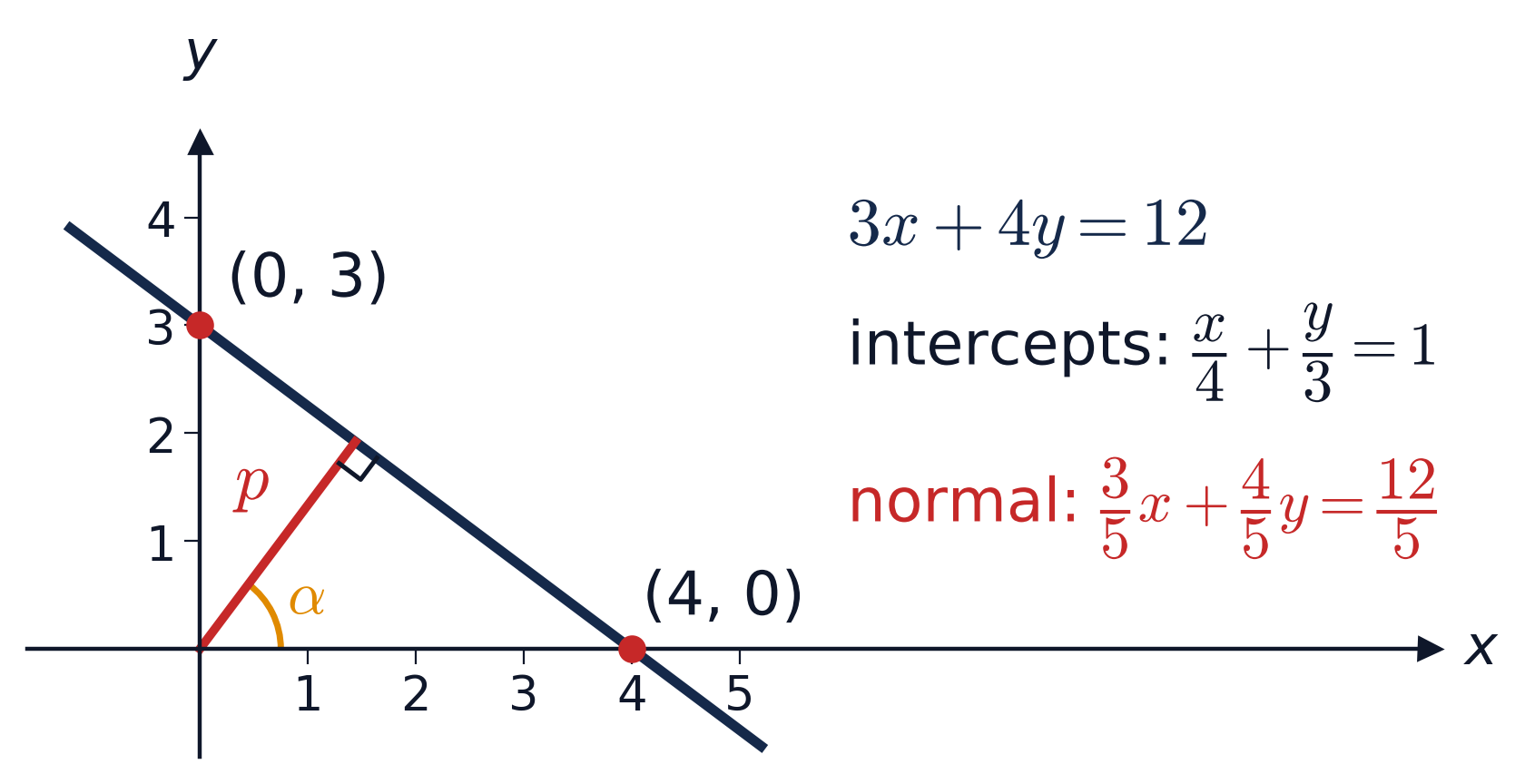
The picture for the normal form. Draw a line that does not pass through the origin. Drop a perpendicular from the origin to it. The length of that perpendicular is p, and \alpha is the angle it makes with the positive x-axis. The picture shows the line 3x + 4y = 12 in three forms.
3. Parallel and perpendicular lines
Let two lines have slopes m_1 and m_2.
- They are parallel when m_1 = m_2.
- They are perpendicular when m_1 m_2 = -1.
In the general form this becomes a quick rule:
| Line | Any parallel line | Any perpendicular line |
|---|---|---|
| ax + by + c = 0 | ax + by + k = 0 | bx - ay + k = 0 |
For a perpendicular line, swap the coefficients of x and y and change one sign. Then find k from the point the line passes through.
Two lines a_1 x + b_1 y + c_1 = 0 and a_2 x + b_2 y + c_2 = 0 are perpendicular when a_1 a_2 + b_1 b_2 = 0.
4. The angle between two lines
If \theta is the acute angle between lines of slopes m_1 and m_2, then
\tan\theta = \left| \frac{m_1 - m_2}{1 + m_1 m_2} \right|
For slopes 3 and \frac{1}{2}: \tan\theta = \left| \dfrac{3 - \frac{1}{2}}{1 + \frac{3}{2}} \right| = 1, so \theta = 45^\circ.
If 1 + m_1 m_2 = 0 the formula cannot be used, and it does not need to be: the lines are perpendicular.
5. Distances
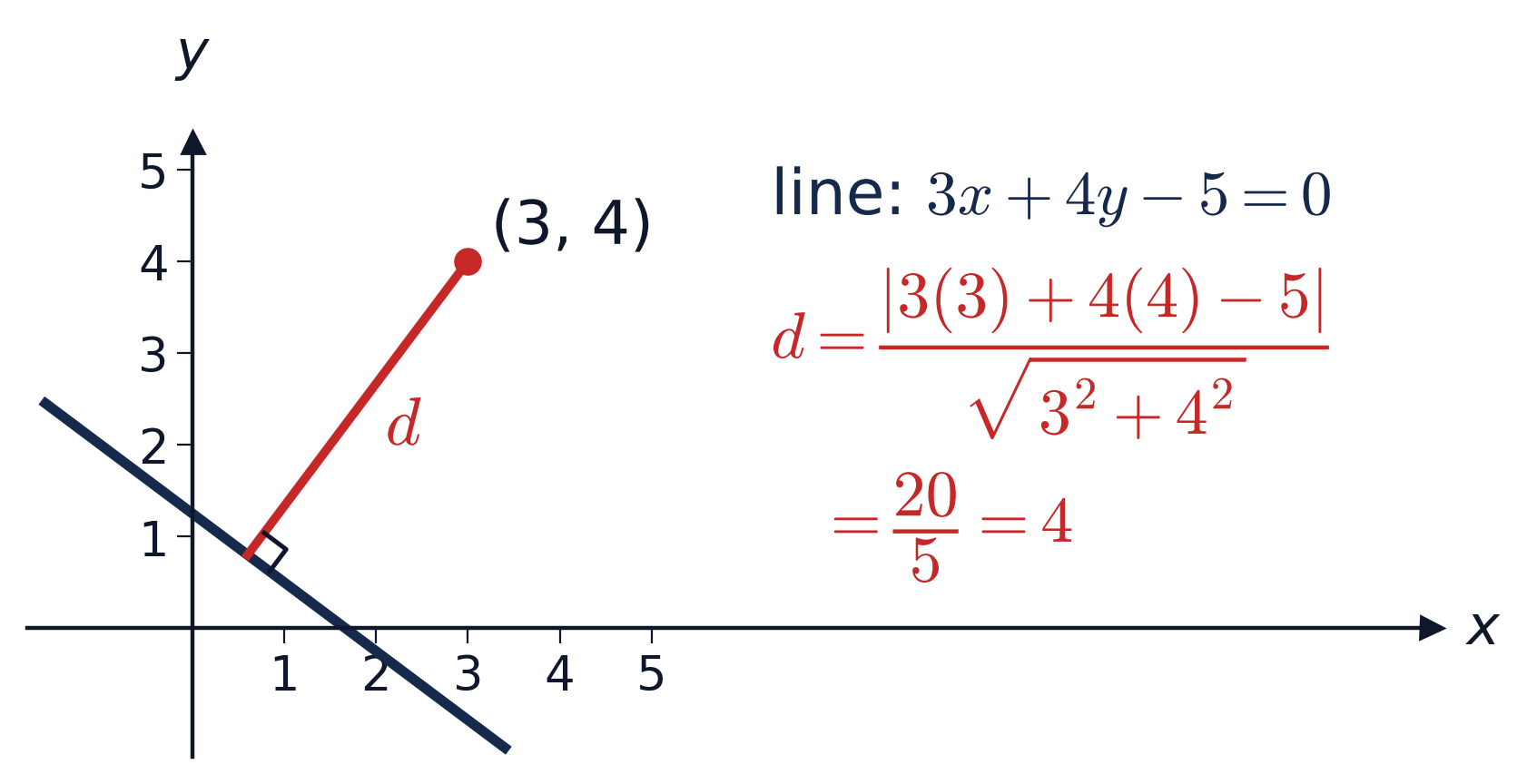
The perpendicular distance of the point (x_1, y_1) from the line ax + by + c = 0 is
d = \frac{|a x_1 + b y_1 + c|}{\sqrt{a^2 + b^2}}
For the point (3, 4) and the line 3x + 4y - 5 = 0: d = \dfrac{|9 + 16 - 5|}{5} = 4.
The distance between the parallel lines ax + by + c_1 = 0 and ax + by + c_2 = 0 is
d = \frac{|c_1 - c_2|}{\sqrt{a^2 + b^2}}
The coefficients of x and y must be the same in both equations before you use it.
6. Where two lines meet, and lines through one point
Two lines meet at the point whose coordinates satisfy both equations. Solve them together. The lines x + y = 5 and 2x - y = 1 meet at (2, 3).
Three or more lines that pass through one point are called concurrent. The equation y - y_1 = m(x - x_1) gives a different line for each value of m, but every one of them passes through (x_1, y_1).
7. Worked examples
Example 1. Find the equation of the line through (1, 2) and (3, 8).
The slope is 3 (section 1). Point-slope form: y - 2 = 3(x - 1), so y = 3x - 1, or 3x - y - 1 = 0.
Example 2. For the line 3x + 4y - 12 = 0, find the slope, the intercepts and the distance from the origin.
Slope = -\frac{3}{4}. Put y = 0: x = 4. Put x = 0: y = 3. So the intercept form is \frac{x}{4} + \frac{y}{3} = 1.
For the normal form write 3x + 4y = 12 and divide by \sqrt{9 + 16} = 5: \frac{3}{5}x + \frac{4}{5}y = \frac{12}{5}. The distance of the line from the origin is p = \frac{12}{5}.
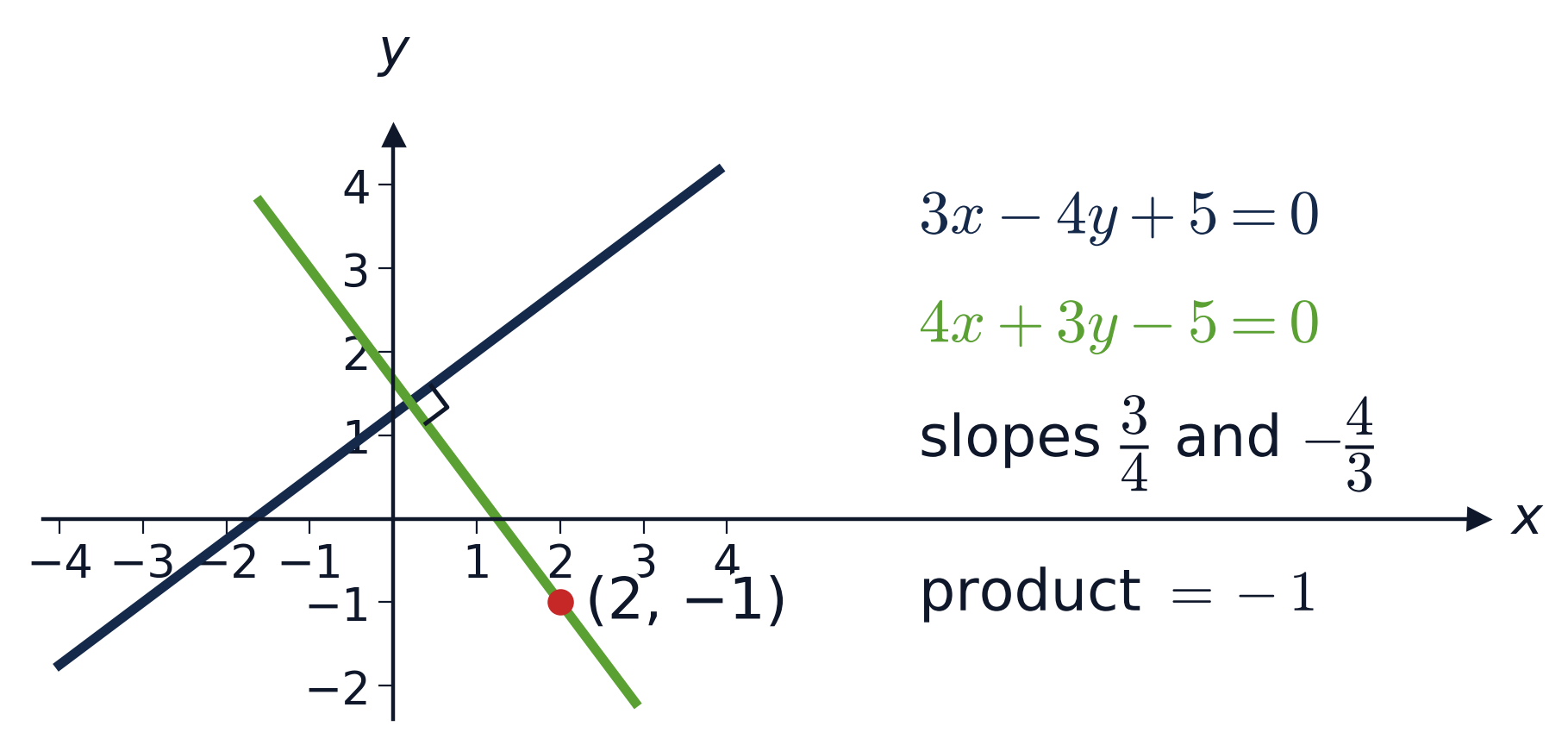
Example 3. Find the line through (2, -1) perpendicular to 3x - 4y + 5 = 0.
Swap the coefficients and change one sign: 4x + 3y + k = 0. Put in the point: 8 - 3 + k = 0, so k = -5. The line is 4x + 3y - 5 = 0.
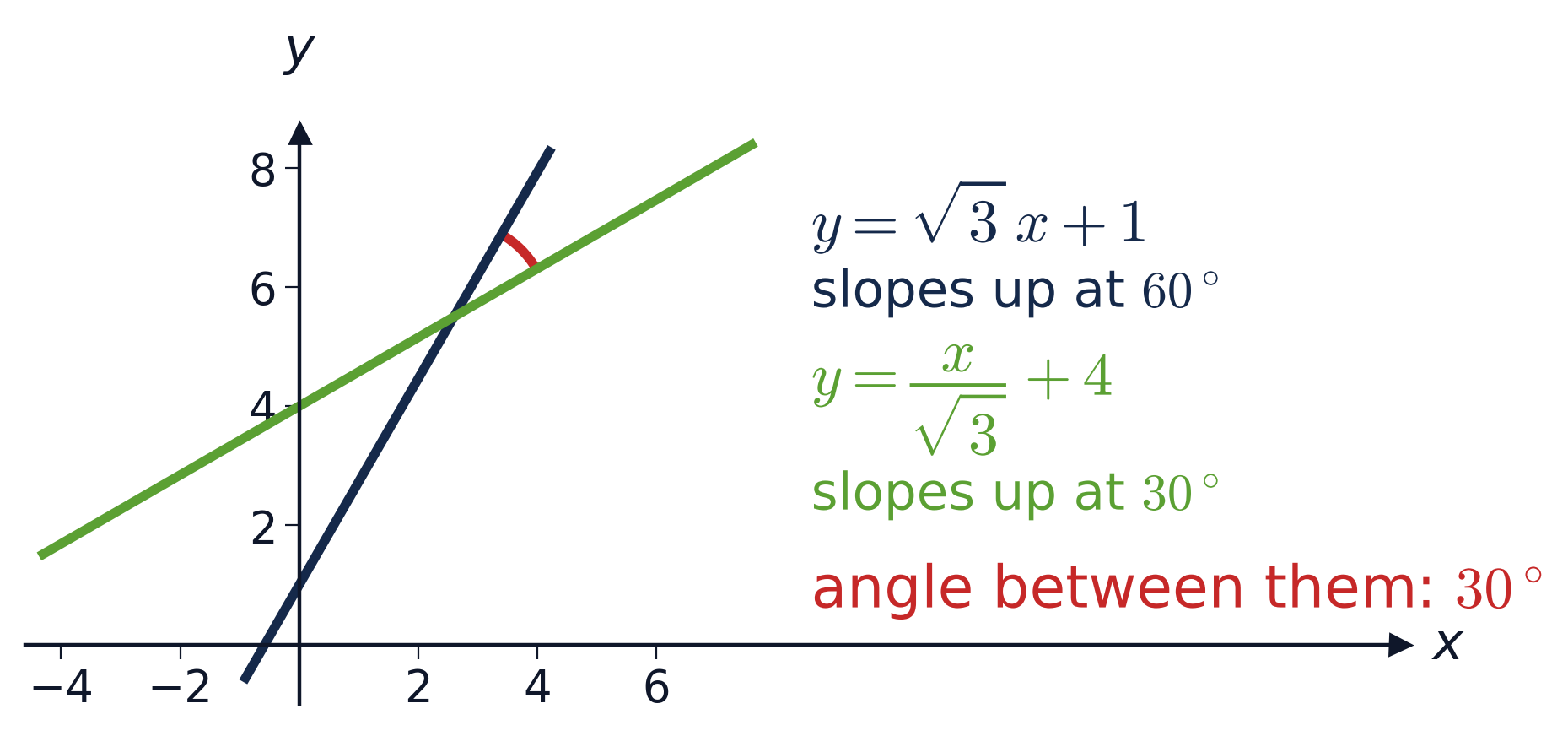
Example 4. Find the acute angle between the lines y = \sqrt{3}\,x + 1 and y = \dfrac{x}{\sqrt{3}} + 4.
m_1 = \sqrt{3} and m_2 = \dfrac{1}{\sqrt{3}}, so m_1 m_2 = 1. The numerator is \sqrt{3} - \dfrac{1}{\sqrt{3}} = \dfrac{2}{\sqrt{3}}. Then \tan\theta = \dfrac{2/\sqrt{3}}{2} = \dfrac{1}{\sqrt{3}} and \theta = 30^\circ.
This agrees with the picture: the lines slope at 60^\circ and 30^\circ to the x-axis.
Example 5. Find the distance between the lines 3x + 4y - 6 = 0 and 6x + 8y + 3 = 0.
Divide the second by 2 so that the coefficients match: 3x + 4y + \frac{3}{2} = 0. Then d = \dfrac{\left| -6 - \frac{3}{2} \right|}{5} = \dfrac{7.5}{5} = 1.5.
8. From the real papers
Try each question for 75 seconds before reading the solution.
NDA II 2025, Q61. Which one of the following is the perpendicular form of the straight line \sqrt{3}x + 2y = 7?
(a) y = -\frac{\sqrt{3}}{2}x + \frac{7}{2} (b) \frac{x}{\left(\frac{7}{\sqrt{3}}\right)} + \frac{y}{\left(\frac{7}{2}\right)} = 1 (c) \frac{\sqrt{3}}{\sqrt{7}}x + \frac{2}{\sqrt{7}}y = \sqrt{7} (d) \frac{\sqrt{3}}{\sqrt{7}}x + \frac{2}{\sqrt{7}}y = 7
Solution. Divide by \sqrt{(\sqrt{3})^2 + 2^2} = \sqrt{7}. The right side becomes \frac{7}{\sqrt{7}} = \sqrt{7}. Option (a) is the slope-intercept form and (b) is the intercept form of the same line. Answer (c).
NDA II 2023, Q88. For what values of k is the line (k - 3)x - (5 - k^2)y + k^2 - 7k + 6 = 0 parallel to the line x + y = 1?
(a) -1, 1 (b) -1, 2 (c) 1, -2 (d) 2, -2
Solution. The line x + y = 1 has equal coefficients of x and y, so a parallel line must have them equal too: k - 3 = -(5 - k^2). This gives k^2 - k - 2 = 0, so (k - 2)(k + 1) = 0 and k = 2 or -1. Answer (b).
NDA I 2025, Q55. ABC is an equilateral triangle and AD is the altitude on BC. If the coordinates of A are (1, 2) and that of D are (-2, 6), then what is the equation of BC?
(a) 3x + 4y - 18 = 0 (b) 4x + 3y - 1 = 0 (c) 4x - 3y + 26 = 0 (d) 3x - 4y + 30 = 0
Solution. BC passes through D and is perpendicular to AD. Slope of AD = \dfrac{6 - 2}{-2 - 1} = -\dfrac{4}{3}, so the slope of BC is \dfrac{3}{4}. Then y - 6 = \frac{3}{4}(x + 2), which gives 3x - 4y + 30 = 0. Answer (d).
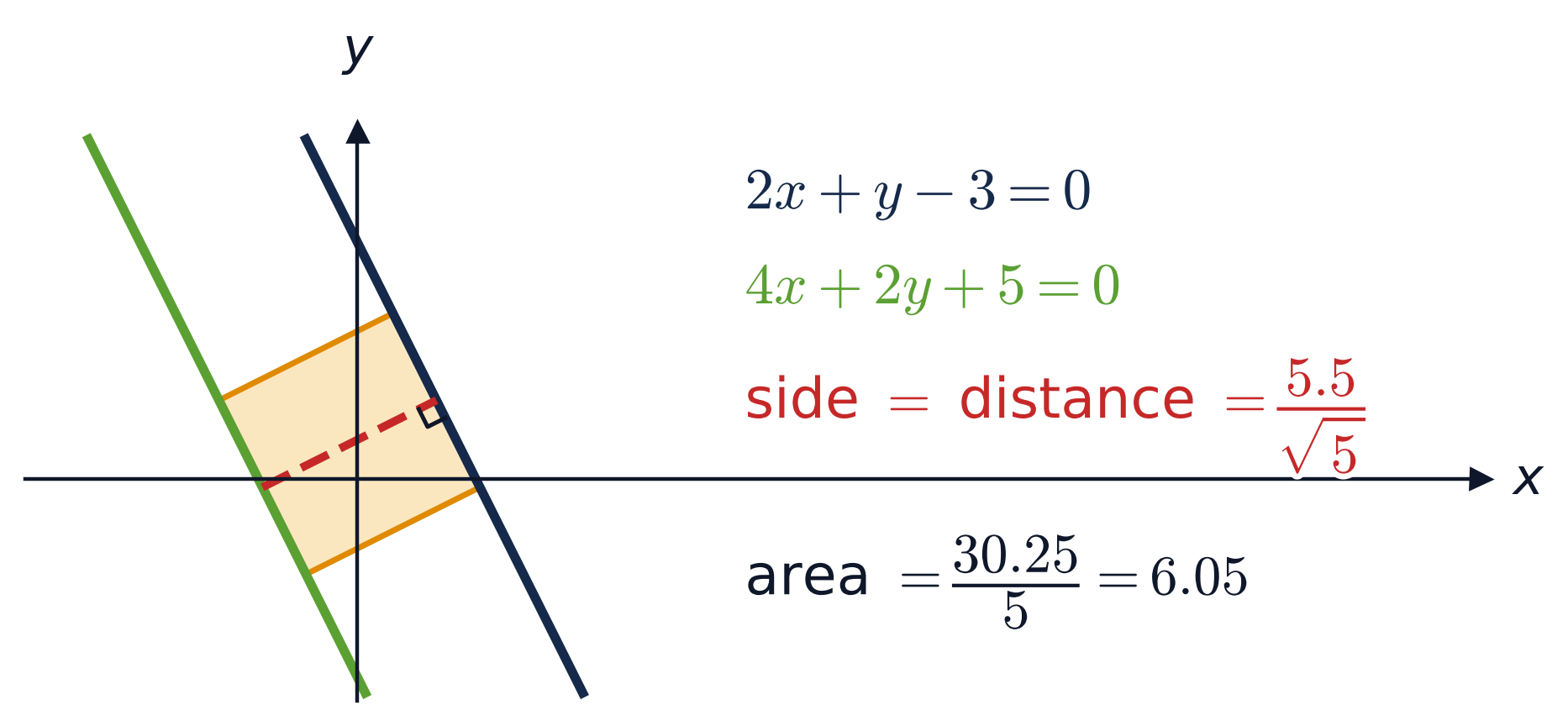
NDA I 2024, Q61. If two sides of a square lie on the lines 2x + y - 3 = 0 and 4x + 2y + 5 = 0, then what is the area of the square in square units?
(a) 6.05 (b) 6.15 (c) 6.25 (d) 6.35
Solution. The lines are parallel, so they carry opposite sides, and the distance between them is the side of the square. Write the second as 2x + y + \frac{5}{2} = 0. Side = \dfrac{\left| -3 - \frac{5}{2} \right|}{\sqrt{5}} = \dfrac{5.5}{\sqrt{5}}. Area = \dfrac{30.25}{5} = 6.05. Answer (a).
NDA I 2026, Q51. The equation of a straight line which passes through the origin and makes an angle \alpha (0 \leq \alpha \leq 90°) with the line L : x + \sqrt{3}y + 3\sqrt{3} = 0 is x - \sqrt{3}y = 0. What is the value of \alpha?
(a) 30° (b) 45° (c) 60° (d) 90°
Solution. The slope of L is m_1 = -\dfrac{1}{\sqrt{3}} and the slope of the other line is m_2 = \dfrac{1}{\sqrt{3}}. Then \tan\alpha = \left| \dfrac{-\frac{2}{\sqrt{3}}}{1 - \frac{1}{3}} \right| = \dfrac{2}{\sqrt{3}} \times \dfrac{3}{2} = \sqrt{3}, so \alpha = 60^\circ. Answer (c).
NDA II 2026, Q56. A line cuts off intercept p on the x-axis and intercept q on the y-axis, where p > q. The sum of the intercepts is 2 and the product of the intercepts is -15. What is the equation of the line?
(a) 3x - 5y - 15 = 0 (b) 3x - 5y + 15 = 0 (c) 5x - 3y - 15 = 0 (d) 5x + 3y - 15 = 0
Solution. p + q = 2 and pq = -15, so p and q are the roots of t^2 - 2t - 15 = 0, that is 5 and -3. Since p > q, p = 5 and q = -3. Intercept form: \dfrac{x}{5} - \dfrac{y}{3} = 1. Multiply by 15: 3x - 5y - 15 = 0. Answer (a).
Notice that each question is answered by one form or one formula of this chapter. The skill is to see which one.
9. Mistakes that cost marks
- The slope of ax + by + c = 0 is -\frac{a}{b}. It is not \frac{a}{b} and not -\frac{b}{a}. For 2x + 3y - 6 = 0 the slope is -\frac{2}{3}.
- Perpendicular slopes multiply to -1. If one slope is \frac{2}{3}, the other is -\frac{3}{2}: turn it over and change the sign. Doing only one of the two is wrong.
- Distance between parallel lines with unequal coefficients. For 2x + y - 3 = 0 and 4x + 2y + 5 = 0, first halve the second equation. Using |-3 - 5| is wrong.
- The constant in the normal form. In x\cos\alpha + y\sin\alpha = p the number p is a length, so it must be positive, and the squares of the two coefficients must add up to 1.
10. Quick check
Do these without help. Answers are at the end.
- Find the slope of the line joining (-1, 4) and (3, -4).
- Write the equation of the line with x-intercept 3 and y-intercept -2 in general form.
- Find the distance of the point (1, -2) from the line 5x - 12y + 10 = 0.
- For what value of k are the lines 2x + ky - 7 = 0 and 3x - 2y + 1 = 0 perpendicular?
- Find the acute angle between two lines whose slopes are 2 and -3.
11. Read and watch more, free
| What | Where | Language |
|---|---|---|
| Textbook | NCERT Class 11 Mathematics, Chapter 9 Straight Lines · Hindi edition | English, Hindi |
| Self-study notes | NIOS Mathematics, Lesson 14 Straight Lines · Hindi edition | English, Hindi |
| Video, this chapter for NDA | Defence Wallah: Fast Track series (the video "STRAIGHT LINES", about 2 hours) | Hinglish |
| Video, a longer class for NDA | Chandigarh Career Group: NDA Maths one shots (Class 2, "Straight line", about 4 hours 30 minutes) | Hinglish |
| Video, short lessons | Khan Academy India: Straight Lines, Class 11 (30 short lessons on slope and the forms of a line) | Hindi |
| Past questions with answers | ExamSIDE: Coordinate System and Straight Line | English |
The videos were chosen from their titles, length and views; they have not yet been watched by a teacher.
Answers to the quick check
- \dfrac{-4 - 4}{3 - (-1)} = \dfrac{-8}{4} = -2.
- \dfrac{x}{3} + \dfrac{y}{-2} = 1. Multiply by 6: 2x - 3y - 6 = 0.
- \dfrac{|5 + 24 + 10|}{\sqrt{25 + 144}} = \dfrac{39}{13} = 3.
- 2 \times 3 + k \times (-2) = 0, so k = 3.
- \tan\theta = \left| \dfrac{2 - (-3)}{1 + 2 \times (-3)} \right| = \left| \dfrac{5}{-5} \right| = 1, so \theta = 45^\circ.
Next chapter: The circle.