Why this chapter matters. This chapter drew 17 questions in the seven papers from NDA II 2023 to NDA II 2026, at least one in every paper. The favourite question gives the mean and the variance (or standard deviation) of a binomial distribution and asks for n, p or P(X = 0): it came in five of the seven papers and takes three lines. The others ask for P(X = r) from the formula, for p when two probabilities are compared, or for the conditions under which the distribution may be used.
What you will be able to do
- Write the probability distribution of a random variable and find its mean and variance.
- Say when the binomial distribution applies, and use P(X = r) = {}^nC_r\,p^r q^{n-r}.
- Find n and p from the mean np and the variance npq.
- Find "at least one" and "at least two" probabilities through the complement.
Before you start you should know: independent events (Chapter M8-6), {}^nC_r (Chapter M1-9), the binomial theorem (Chapter M1-10), and mean and variance (Chapters M8-2 and M8-3).
1. Random variable and its distribution
A random variable is a number decided by the outcome of a random experiment. It is written with a capital letter such as X.
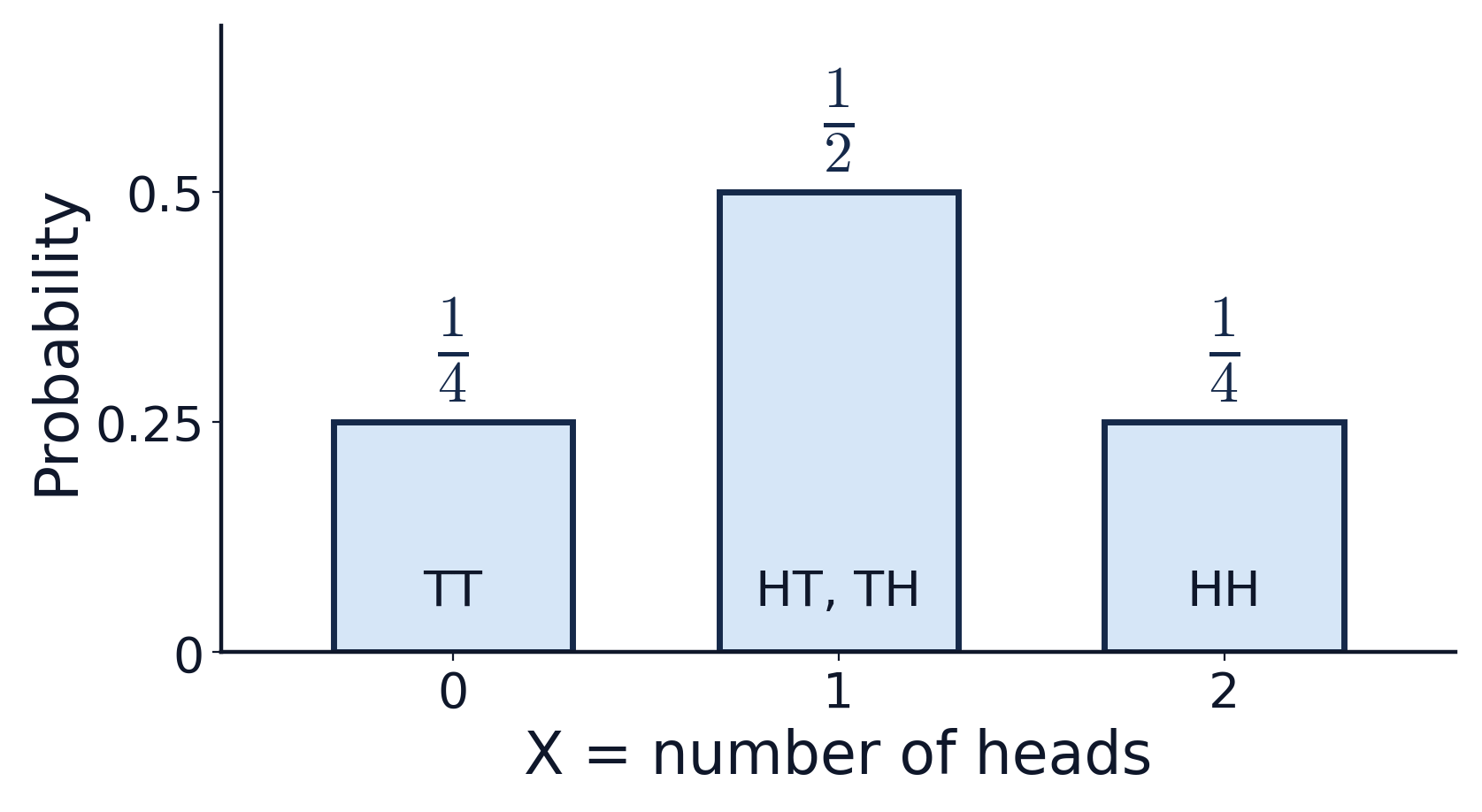
Toss two coins and let X be the number of heads. The outcomes TT, HT, TH, HH give X = 0, 1, 1, 2. The table of the values of X with their probabilities is the probability distribution of X:
| X | 0 | 1 | 2 |
|---|---|---|---|
| P(X) | \dfrac{1}{4} | \dfrac{1}{2} | \dfrac{1}{4} |
In every probability distribution, each probability lies from 0 to 1 and the probabilities add up to 1.
2. Mean and variance of a random variable
If X takes the values x_1, x_2, \ldots with probabilities p_1, p_2, \ldots, then
\text{Mean } E(X) = \sum x_i p_i \qquad \text{Variance } \text{Var}(X) = \sum x_i^2 p_i - \left[E(X)\right]^2
The standard deviation is the square root of the variance. These are the formulas of Chapter M8-3 with probabilities in place of \dfrac{f_i}{N}.
For the two coins: E(X) = 0 \times \dfrac{1}{4} + 1 \times \dfrac{1}{2} + 2 \times \dfrac{1}{4} = 1. \sum x_i^2 p_i = 0 + \dfrac{1}{2} + 1 = \dfrac{3}{2}. Variance = \dfrac{3}{2} - 1^2 = \dfrac{1}{2}.
A new variable Y = aX + b. The rules of Chapter M8-3 hold again:
E(aX + b) = a\,E(X) + b \qquad \text{Var}(aX + b) = a^2\,\text{Var}(X)
3. The binomial distribution
Many experiments are the same simple trial repeated: toss a coin 6 times, fire 7 shots, test 5 patients. The binomial distribution gives the probability of each number of successes. It may be used when all four conditions hold:
- The number of trials n is fixed and finite.
- The trials are independent.
- Each trial has only two outcomes, called success and failure.
- The probability of success, p, is the same in every trial.
Such trials are called Bernoulli trials. Write q = 1 - p for the probability of failure, and let X be the number of successes in the n trials. Then
P(X = r) = {}^nC_r\,p^r\,q^{n-r}, \qquad r = 0, 1, 2, \ldots, n
Why. One particular order with r successes and n - r failures has probability p^r q^{n-r}, because the trials are independent. The r successes can be placed among the n trials in {}^nC_r ways. For 3 trials and 2 successes the orders are SSF, SFS, FSS: three orders, each with probability p^2 q.
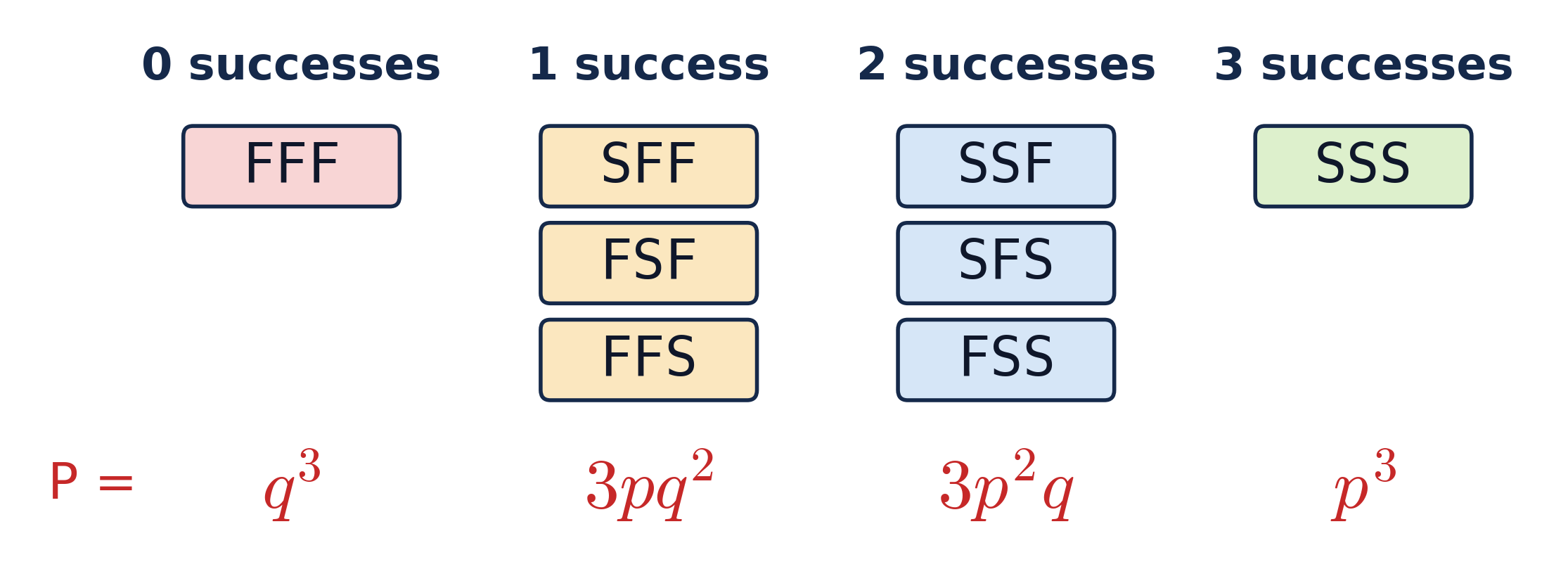
The probabilities are the terms of the expansion of (q + p)^n, which is why the distribution is called binomial, and why they add up to 1. We write X \sim B(n, p); n and p are the parameters.
Two special cases are used all the time: P(X = 0) = q^n (no success) and P(X = n) = p^n (all successes).
4. Mean and variance of the binomial distribution
| Quantity | Formula |
|---|---|
| Mean | np |
| Variance | npq |
| Standard deviation | \sqrt{npq} |
Since q is less than 1, the variance of a binomial distribution is always less than its mean.
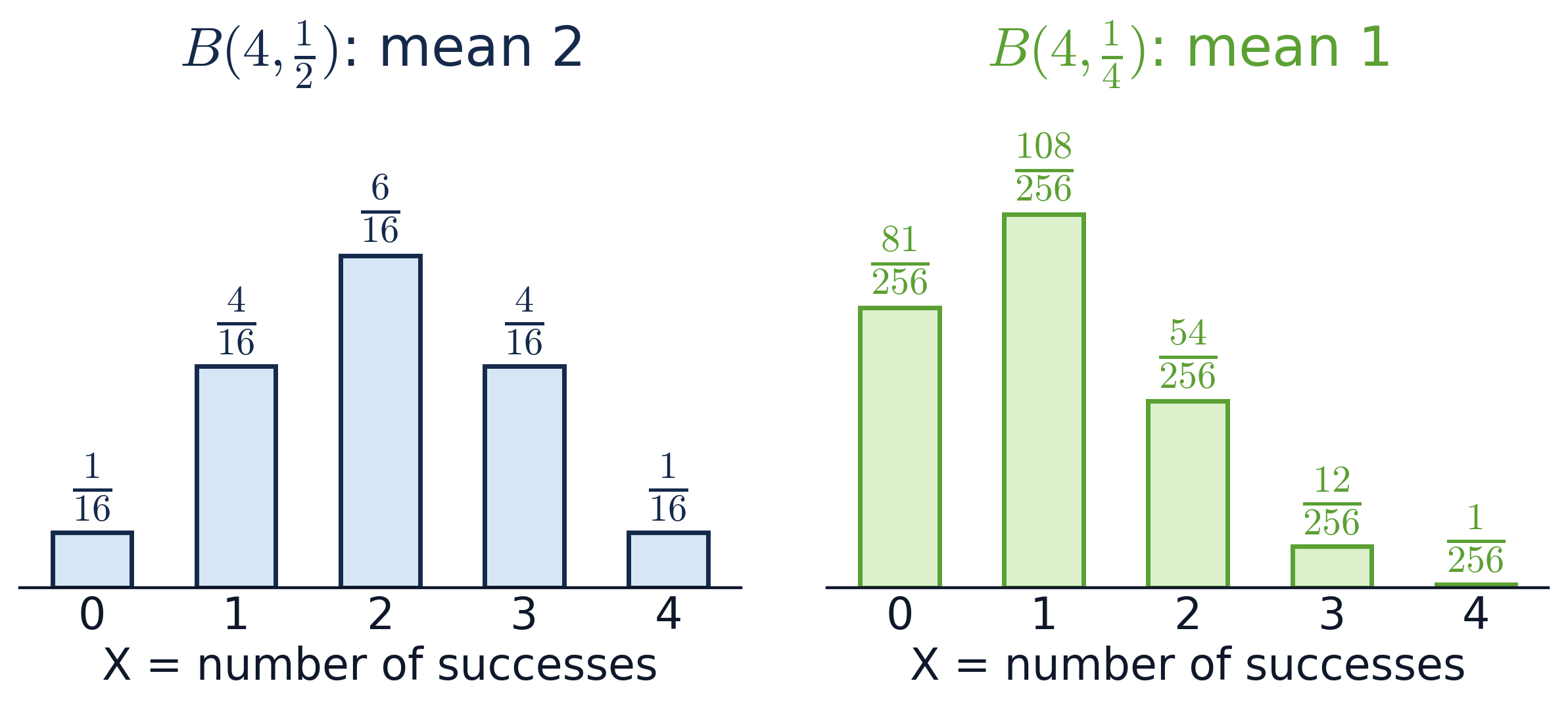
The picture shows two binomial distributions with n = 4. With p = \dfrac{1}{2} the shape is symmetric. With p = \dfrac{1}{4} the peak moves to the left. In both, the peak is at the mean np.
To find n and p from the mean and the variance:
q = \frac{\text{variance}}{\text{mean}}, \qquad p = 1 - q, \qquad n = \frac{\text{mean}}{p}
If the standard deviation is given, square it first to get the variance.
5. Worked examples
Example 1. A random variable X has this distribution. Find k, the mean and the variance.
| X | 1 | 2 | 3 | 4 |
|---|---|---|---|---|
| P(X) | k | 2k | 3k | 4k |
The probabilities add up to 1: 10k = 1, so k = \dfrac{1}{10}. Mean = \dfrac{1 \times 1 + 2 \times 2 + 3 \times 3 + 4 \times 4}{10} = \dfrac{30}{10} = 3. \sum x_i^2 p_i = \dfrac{1 + 8 + 27 + 64}{10} = 10. Variance = 10 - 3^2 = 1.
Example 2. A die is thrown 4 times. Find the probability of getting exactly two sixes.
Here n = 4, p = \dfrac{1}{6}, q = \dfrac{5}{6}. P(X = 2) = {}^4C_2 \left(\dfrac{1}{6}\right)^2 \left(\dfrac{5}{6}\right)^2 = 6 \times \dfrac{25}{1296} = \dfrac{150}{1296} = \dfrac{25}{216}.
Example 3. A fair coin is tossed 6 times. Find the probability of at least 2 heads.
n = 6, p = q = \dfrac{1}{2}. Use the complement: P(X = 0) = \dfrac{1}{64} and P(X = 1) = \dfrac{6}{64}. So P(X \ge 2) = 1 - \dfrac{7}{64} = \dfrac{57}{64}.
Example 4. A binomial distribution has mean 3 and variance 2. Find n, p and P(X = 0).
q = \dfrac{2}{3}, so p = \dfrac{1}{3} and n = \dfrac{3}{1/3} = 9. P(X = 0) = q^9 = \left(\dfrac{2}{3}\right)^9.
Example 5. A random variable X has standard deviation 2. Find the variance of Y = 3X - 2.
\text{Var}(X) = 2^2 = 4. \text{Var}(Y) = 3^2 \times 4 = 36. Subtracting 2 has no effect on the variance.
6. From the real papers
Try each for 75 seconds before reading the solution.
NDA II 2023, Q109. The probability that a person recovers from a disease is 0.8. What is the probability that exactly 2 persons out of 5 will recover from the disease?
(a) 0.00512 (b) 0.02048 (c) 0.2048 (d) 0.0512
Solution. n = 5, p = 0.8, q = 0.2. P(X = 2) = {}^5C_2\,(0.8)^2 (0.2)^3 = 10 \times 0.64 \times 0.008 = 0.0512. Answer (d).
NDA I 2024, Q115. An unbiased coin is tossed n times. The probability of getting at least one tail is p and the probability of at least two tails is q and p - q = \frac{5}{32}. What is the value of n?
(a) 4 (b) 5 (c) 6 (d) 7
Solution. "At least one" minus "at least two" leaves "exactly one". P(\text{exactly one tail}) = {}^nC_1 \left(\dfrac{1}{2}\right)^n = \dfrac{n}{2^n}. So \dfrac{n}{2^n} = \dfrac{5}{32} = \dfrac{5}{2^5}, which gives n = 5. (In this question p and q are not the usual success and failure probabilities.) Answer (b).
NDA I 2025, Q107. Let X be a random variable following binomial distribution with parameters n = 6 and p = k. Further, 9P(X = 4) = P(X = 2). What is the value of k?
(a) 1/2 (b) 1/3 (c) 1/4 (d) 1/5
Solution. 9 \times {}^6C_4\,k^4 (1 - k)^2 = {}^6C_2\,k^2 (1 - k)^4. Since {}^6C_4 = {}^6C_2 = 15, cancel 15 and k^2 (1 - k)^2: 9k^2 = (1 - k)^2. Both k and 1 - k are positive, so 3k = 1 - k and k = \dfrac{1}{4}. Answer (c).
NDA I 2025, Q118. The probability of a man hitting a target is 1/5. If the man fires 7 times, then what is the probability that he hits the target at least twice?
(a) 1 - \left(\frac{3}{5}\right)\left(\frac{4}{5}\right)^6 (b) 1 - \left(\frac{3}{5}\right)\left(\frac{4}{5}\right)^7 (c) 1 - \left(\frac{11}{5}\right)\left(\frac{4}{5}\right)^6 (d) 1 - \left(\frac{11}{5}\right)\left(\frac{4}{5}\right)^7
Solution. n = 7, p = \dfrac{1}{5}, q = \dfrac{4}{5}. P(X = 0) = \left(\dfrac{4}{5}\right)^7 and P(X = 1) = 7 \times \dfrac{1}{5} \times \left(\dfrac{4}{5}\right)^6. Their sum is \left(\dfrac{4}{5}\right)^6 \left[\dfrac{4}{5} + \dfrac{7}{5}\right] = \dfrac{11}{5}\left(\dfrac{4}{5}\right)^6. So P(X \ge 2) = 1 - \dfrac{11}{5}\left(\dfrac{4}{5}\right)^6. Answer (c).
NDA II 2025, Q106. Under which of the following conditions may binomial distribution be used? I. The number of trials is infinite and not fixed. II. The trials are independent. III. Each trial has two possible outcomes. Select the correct answer using the code given below.
(a) II only (b) III only (c) I and II (d) II and III
Solution. The number of trials must be fixed and finite, so I is wrong. II and III are two of the four conditions of section 3. Answer (d).
NDA I 2026, Q116. For a Binomial distribution with mean 6 and standard deviation \sqrt{2}, what is the value of P(X = 0)?
(a) \left(\frac{1}{3}\right)^9 (b) \left(\frac{2}{3}\right)^9 (c) \frac{1}{3}\left(\frac{2}{3}\right)^8 (d) \frac{2}{3}\left(\frac{1}{3}\right)^8
Solution. Variance = (\sqrt{2})^2 = 2. q = \dfrac{2}{6} = \dfrac{1}{3}, p = \dfrac{2}{3}, n = \dfrac{6}{2/3} = 9. P(X = 0) = q^9 = \left(\dfrac{1}{3}\right)^9. Answer (a).
NDA I 2025, Q119. Let X be a random variable following binomial distribution whose mean and variance are 200 and 160 respectively. What is the value of the number of trials (n)?
(a) 500 (b) 1000 (c) 1500 (d) 2000
Solution. Mean = np = 200 and variance = npq = 160. Dividing, q = \dfrac{160}{200} = 0.8, so p = 0.2. Then n = \dfrac{200}{0.2} = 1000. Answer (b).
7. Mistakes that cost marks
- Leaving out {}^nC_r. p^r q^{n-r} is the probability of one order only. There are {}^nC_r orders.
- Taking \dfrac{\text{variance}}{\text{mean}} as p. It is q. Then p = 1 - q. In P(X = 0) = q^n the base is q, not p.
- Using the standard deviation as the variance. If the question gives a standard deviation of \sqrt{2}, the variance is 2.
- Adding many terms for "at least". "At least two" is 1 - P(X = 0) - P(X = 1): two terms, not n - 1 terms.
8. Quick check
Do these without help. Answers are at the end.
- X takes the values 0, 1, 2 with probabilities 0.3, 0.5, 0.2. Find the mean and the variance of X.
- X \sim B(10, 0.4). Find the mean and the variance.
- A binomial distribution has mean 10 and variance 6. Find p and n.
- A fair coin is tossed 5 times. Find the probability of exactly 3 heads.
- In each of 4 independent trials the probability of success is \dfrac{1}{3}. Find the probability of at least one success.
9. Read and watch more, free
| What | Where | Language |
|---|---|---|
| Self-study notes, with random variables and the binomial distribution | NIOS Mathematics, Lesson 19 Probability · Hindi edition | English, Hindi |
| Textbook, the probability behind this chapter (the binomial distribution itself is only mentioned) | NCERT Class 12 Mathematics, Chapter 13 Probability · Hindi edition | English, Hindi |
| Video, topic by topic | Mohit Tyagi: Probability (16 lessons, up to distributions) | Hinglish |
| Video, the whole of Probability for NDA | Chandigarh Career Group: NDA Maths one shots (the Probability class, about 8 hours 30 minutes) | Hinglish |
| Video and practice, random variables | Khan Academy: Statistics and Probability course (Unit 9) | English |
The videos were chosen from their titles, length and views; they have not yet been watched by a teacher.
Answers to the quick check
- Mean = 0 + 0.5 + 0.4 = 0.9. \sum x_i^2 p_i = 0.5 + 0.8 = 1.3. Variance = 1.3 - 0.81 = 0.49.
- Mean = 10 \times 0.4 = 4. Variance = 10 \times 0.4 \times 0.6 = 2.4.
- q = \dfrac{6}{10} = 0.6, so p = 0.4 and n = \dfrac{10}{0.4} = 25.
- {}^5C_3 \left(\dfrac{1}{2}\right)^5 = \dfrac{10}{32} = \dfrac{5}{16}.
- 1 - \left(\dfrac{2}{3}\right)^4 = 1 - \dfrac{16}{81} = \dfrac{65}{81}.
Next chapter: none. This is the last chapter of the Mathematics course.