Why this chapter matters. This is the most-asked chapter of the whole Mathematics paper. It drew 67 questions in the seven papers from NDA II 2023 to NDA II 2026: never fewer than 4 in a paper, and 13 in one of them. The questions are of a few fixed kinds: dice and coins, balls drawn from a bag, numbers chosen at random, people or letters arranged in a row, the addition theorem with P(A \cup B), mutually exclusive and exhaustive events, and independent events. This lesson is longer than the others and is meant for two sittings: sections 1 to 4 first, then sections 5 and 6.
What you will be able to do
- Find a probability by counting favourable and total outcomes, for dice, coins, cards, selections and arrangements.
- Change odds into probability.
- Use the addition theorem and its relatives: "neither", "only A", "exactly one".
- Use the multiplication rule for independent events, and the shortcut for "at least one".
Before you start you should know: sample space and the language of events (Chapter M8-5), {}^nC_r and n! (Chapter M1-9), and union, intersection and complement of sets (Chapter M1-1).
1. The classical definition
If an experiment has n(S) outcomes, all equally likely, and n(A) of them are favourable to the event A, then
P(A) = \frac{n(A)}{n(S)} = \frac{\text{number of favourable outcomes}}{\text{total number of outcomes}}
For one die, P(\text{even number}) = \dfrac{3}{6} = \dfrac{1}{2}.
Three facts follow at once:
- 0 \le P(A) \le 1. The impossible event has probability 0 and the sure event has probability 1.
- P(A') = 1 - P(A). "Not A" takes whatever A leaves.
- The probabilities of all the outcomes of the sample space add up to 1.
2. The statistical definition
The classical definition works only when the outcomes are equally likely. For a bent coin, or for the chance that a farmer is in debt, we cannot count equally likely outcomes. Then probability is found from experience.
If an experiment is repeated n times and the event A occurs m times, the relative frequency of A is \dfrac{m}{n}. As n becomes very large, the relative frequency settles down near one number. That number is the statistical (or empirical) probability of A.
For example, if a coin shows head 512 times in 1000 tosses, the statistical probability of head is about 0.512. When a question says "the probability that a farmer is in debt is 0.60", it is giving a statistical probability. The rules of sections 5 and 6 hold for both kinds.
3. Tools for counting
Most of the work in a probability question is counting. Four tools cover nearly all questions.
Two dice. There are 36 outcomes. The number of ways of getting each sum is worth learning by heart:
| Sum | 2 | 3 | 4 | 5 | 6 | 7 | 8 | 9 | 10 | 11 | 12 |
|---|---|---|---|---|---|---|---|---|---|---|---|
| Number of ways | 1 | 2 | 3 | 4 | 5 | 6 | 5 | 4 | 3 | 2 | 1 |
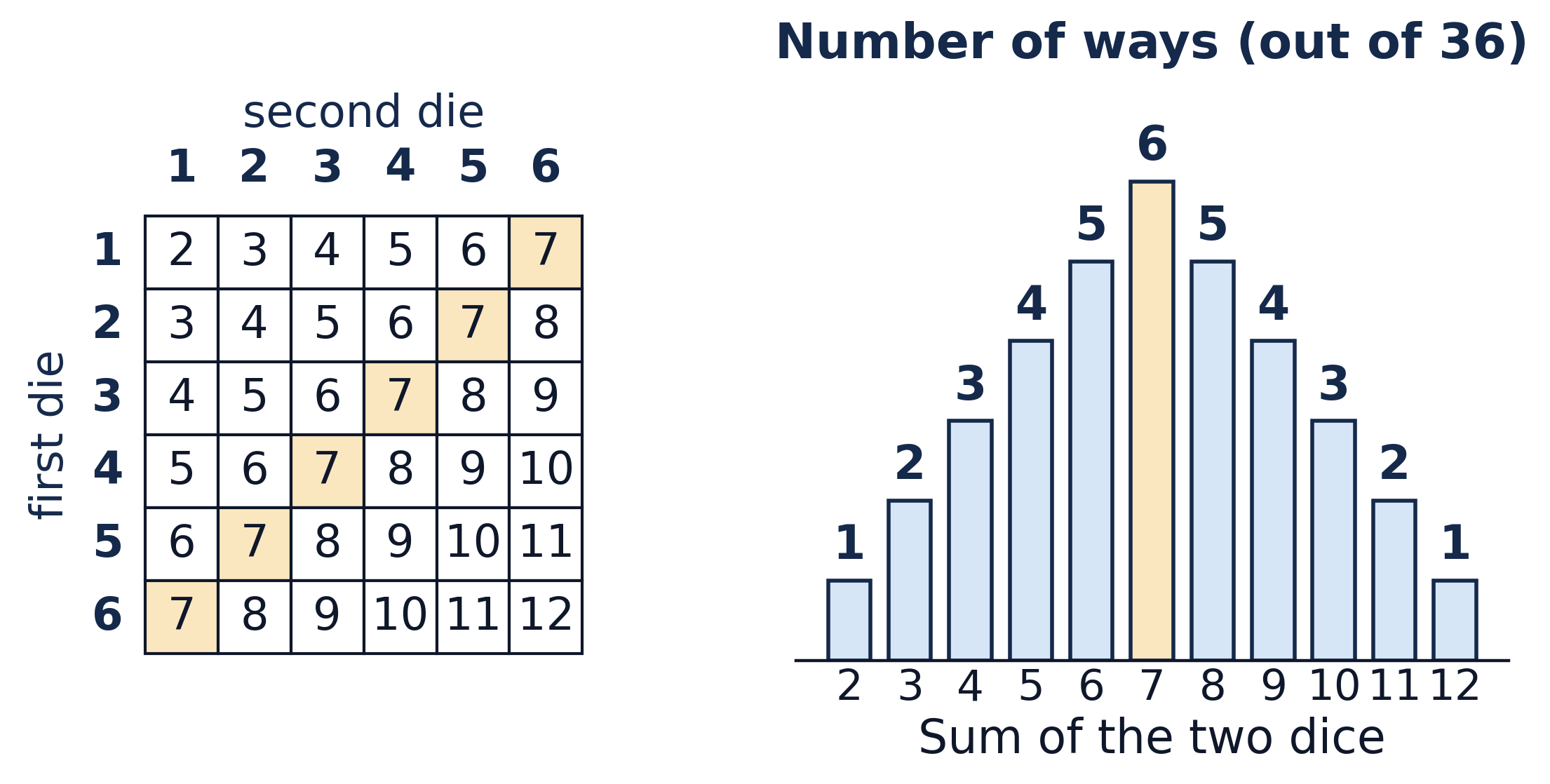
The ways rise by one up to the sum 7 and then fall by one. For three dice there are 6^3 = 216 outcomes and for four dice 6^4 = 1296; there you list the possible sets of faces and count the orders of each.
Selections. When r things are drawn "at random" from n, the total number of outcomes is {}^nC_r. Count the favourable selections with {}^nC_r as well.
Arrangements. When people or letters are arranged in a row at random, the total is n! (divide by the factorials of repeated letters). To keep some of them together, tie them into one block, arrange the blocks, then arrange inside the block.
The complement. For "at least one", find the probability of "none" and subtract it from 1.
4. Odds
Odds compare the chances for and against an event.
- Odds in favour of A are a : b means P(A) = \dfrac{a}{a + b}.
- Odds against A are a : b means P(A) = \dfrac{b}{a + b}.
If the odds in favour of rain are 2 : 3, the probability of rain is \dfrac{2}{5}.
5. The addition theorem
For any two events A and B:
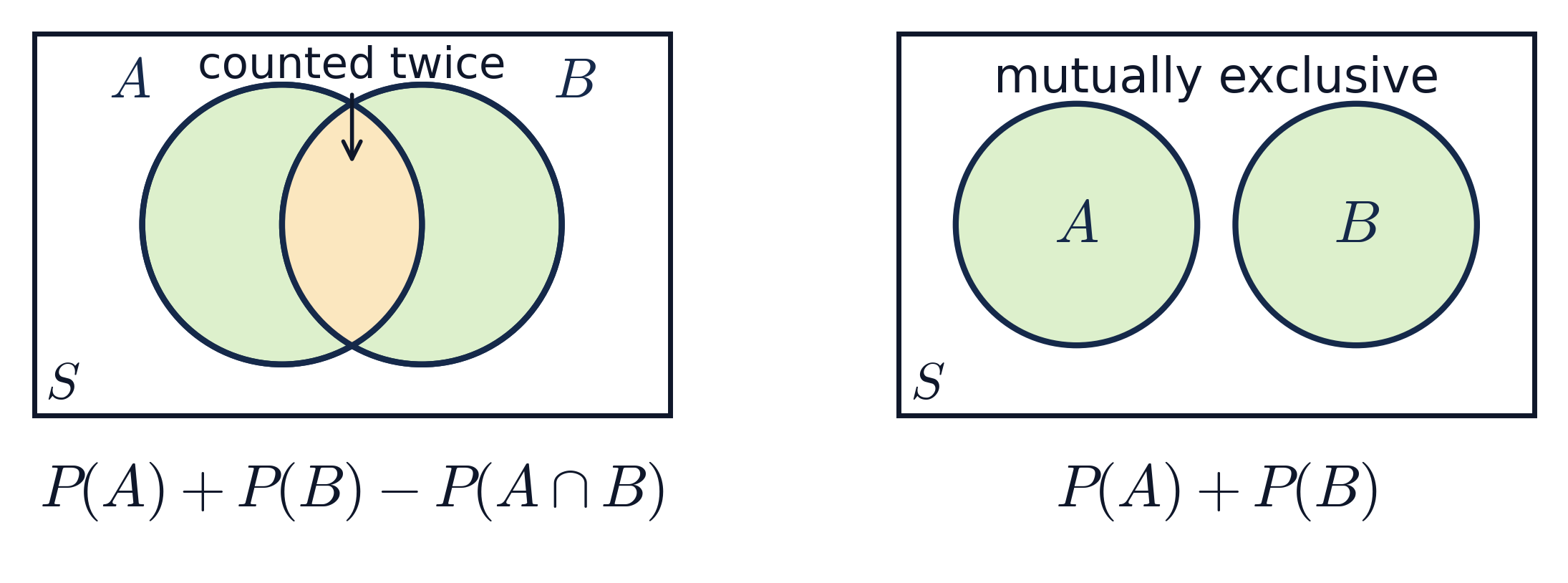
P(A \cup B) = P(A) + P(B) - P(A \cap B)
The outcomes in both A and B are counted twice in P(A) + P(B), so P(A \cap B) is subtracted once. If A and B are mutually exclusive, P(A \cap B) = 0 and the theorem becomes P(A \cup B) = P(A) + P(B).
| Wanted | Formula |
|---|---|
| A or B (at least one) | P(A \cup B) = P(A) + P(B) - P(A \cap B) |
| Neither A nor B | P(A' \cap B') = 1 - P(A \cup B) |
| Not both | P(A' \cup B') = 1 - P(A \cap B) |
| A but not B | P(A \cap B') = P(A) - P(A \cap B) |
| Exactly one of A, B | P(A) + P(B) - 2P(A \cap B) |
| At least one of A, B, C | P(A) + P(B) + P(C) - P(A \cap B) - P(B \cap C) - P(A \cap C) + P(A \cap B \cap C) |
Mutually exclusive and exhaustive events. If A, B, C, ... are mutually exclusive and exhaustive, exactly one of them occurs, so
P(A) + P(B) + P(C) + \dots = 1
6. Independent events
Two events are independent when the occurrence of one does not change the probability of the other. Two tosses of a coin, two different marksmen firing, or two draws with replacement are independent. For independent events:
P(A \cap B) = P(A) \times P(B)
The same holds for three or more independent events: multiply all the probabilities.
| Wanted, for independent events with P(A) = p and P(B) = q | Formula |
|---|---|
| Both occur | pq |
| Neither occurs | (1 - p)(1 - q) |
| At least one occurs | 1 - (1 - p)(1 - q) = p + q - pq |
| Exactly one occurs | p(1 - q) + q(1 - p) = p + q - 2pq |
If A and B are independent, so are A and B', A' and B, and A' and B'.
Independent is not the same as mutually exclusive. Mutually exclusive events cannot occur together: P(A \cap B) = 0. Independent events can occur together, with probability P(A)P(B). Two events with non-zero probabilities cannot be both.
7. Worked examples
Example 1. Two dice are thrown. Find the probability that the sum is (i) 9, (ii) at least 10.
(i) From the table, 9 comes in 4 ways: \dfrac{4}{36} = \dfrac{1}{9}. (ii) Sums 10, 11, 12 come in 3 + 2 + 1 = 6 ways: \dfrac{6}{36} = \dfrac{1}{6}.
Example 2. One card is drawn from a pack of 52. Find the probability that it is a king or a heart.
P(\text{king}) = \dfrac{4}{52}, P(\text{heart}) = \dfrac{13}{52}, and the king of hearts is both: \dfrac{1}{52}. So P(\text{king or heart}) = \dfrac{4 + 13 - 1}{52} = \dfrac{16}{52} = \dfrac{4}{13}.
Example 3. A bag has 4 red and 5 blue balls. Two balls are drawn at random. Find the probability that they are (i) of the same colour, (ii) of different colours.
Total selections: {}^9C_2 = 36. (i) Both red {}^4C_2 = 6, both blue {}^5C_2 = 10: \dfrac{16}{36} = \dfrac{4}{9}. (ii) One of each: 4 \times 5 = 20, so \dfrac{20}{36} = \dfrac{5}{9}. Check: \dfrac{4}{9} + \dfrac{5}{9} = 1.
Example 4. Five persons, two of whom are P and Q, sit in a row at random. Find the probability that P and Q sit together.
Total arrangements: 5! = 120. Tie P and Q into one block: 4 blocks in 4! = 24 ways, and 2 ways inside the block. Favourable = 48. Probability = \dfrac{48}{120} = \dfrac{2}{5}.
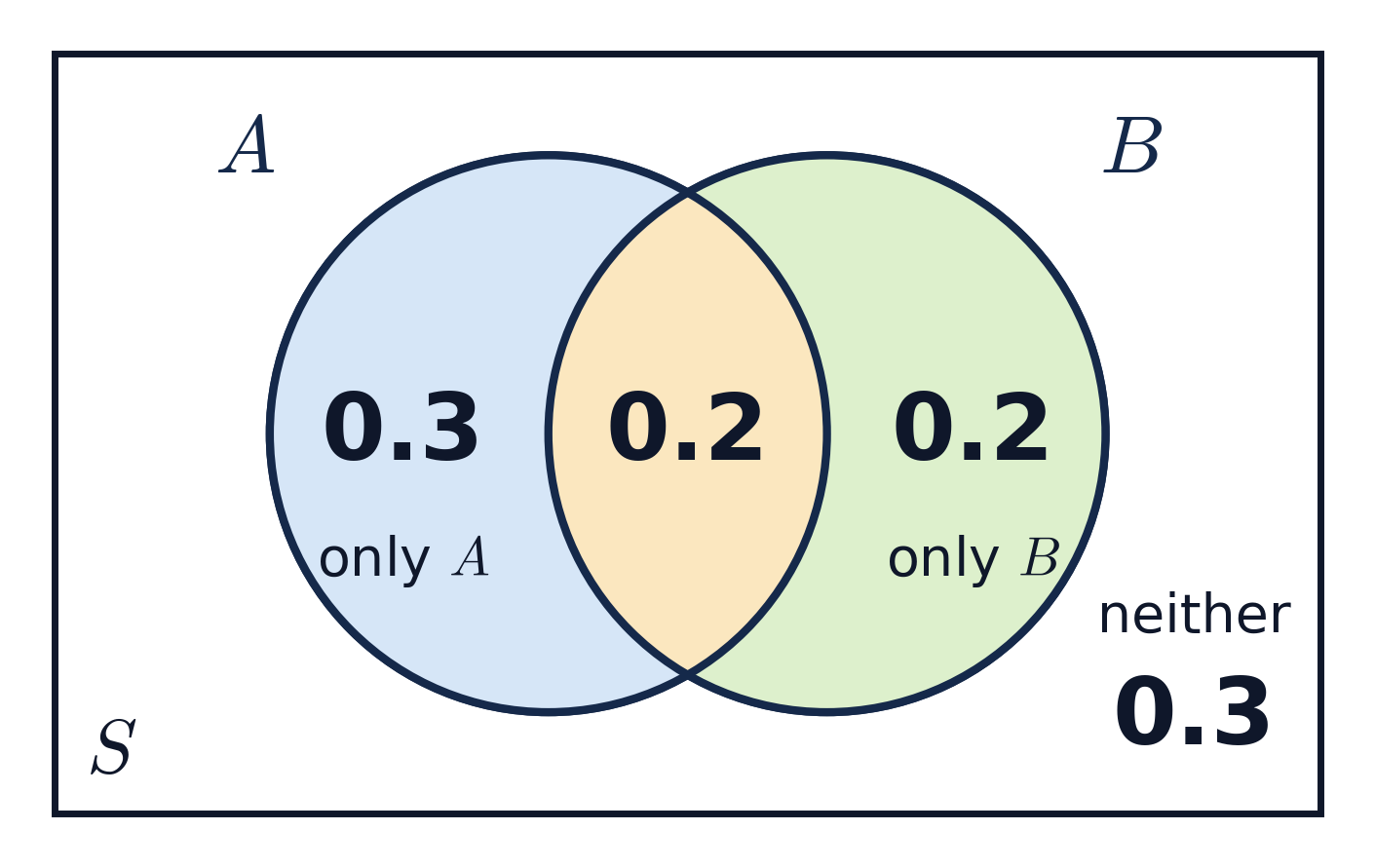
Example 5. P(A) = 0.5, P(B) = 0.4 and P(A \cap B) = 0.2. Find the probability of (i) A or B, (ii) neither, (iii) A only, (iv) exactly one of them.
(i) 0.5 + 0.4 - 0.2 = 0.7. (ii) 1 - 0.7 = 0.3. (iii) 0.5 - 0.2 = 0.3. (iv) 0.5 + 0.4 - 2(0.2) = 0.5.
All four answers can be read from a Venn diagram. Write 0.2 in the overlap first, then 0.3 in the rest of A, 0.2 in the rest of B and 0.3 outside both.
Example 6. Three students try a problem independently. Their probabilities of solving it are \dfrac{1}{2}, \dfrac{1}{3} and \dfrac{1}{4}. Find the probability that (i) the problem is solved, (ii) exactly one of them solves it.
(i) The problem is not solved only if all three fail: \dfrac{1}{2} \times \dfrac{2}{3} \times \dfrac{3}{4} = \dfrac{1}{4}. So P(\text{solved}) = 1 - \dfrac{1}{4} = \dfrac{3}{4}.
(ii) One solves and the other two fail, in three ways: \dfrac{1}{2} \cdot \dfrac{2}{3} \cdot \dfrac{3}{4} + \dfrac{1}{2} \cdot \dfrac{1}{3} \cdot \dfrac{3}{4} + \dfrac{1}{2} \cdot \dfrac{2}{3} \cdot \dfrac{1}{4} = \dfrac{6 + 3 + 2}{24} = \dfrac{11}{24}.
8. From the real papers
Six questions, one of each main kind. Try each for 75 seconds before reading the solution.
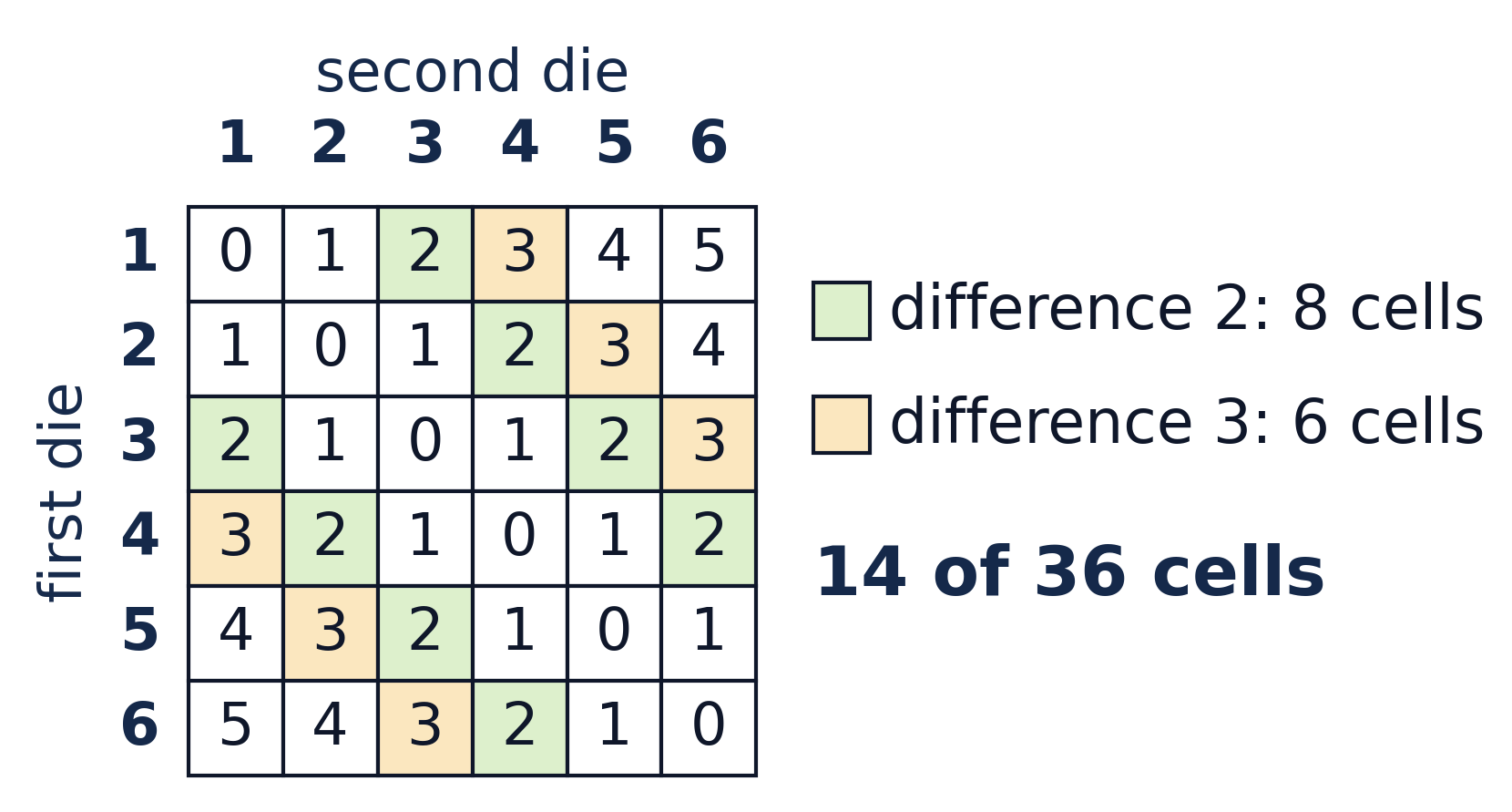
NDA II 2023, Q107. Two dice are thrown. What is the probability that difference of numbers on them is 2 or 3?
(a) \frac{7}{36} (b) \frac{7}{18} (c) \frac{5}{18} (d) \frac{11}{36}
Solution. Difference 2: (1,3), (2,4), (3,5), (4,6) and their reverses, 8 outcomes. Difference 3: (1,4), (2,5), (3,6) and their reverses, 6 outcomes. Favourable = 14. Probability = \dfrac{14}{36} = \dfrac{7}{18}. Answer (b).
NDA I 2024, Q101. A bag contains 5 black and 4 white balls. A man selects two balls at random. What is the probability that both of these are of the same colour?
(a) \frac{1}{6} (b) \frac{5}{108} (c) \frac{4}{9} (d) \frac{5}{18}
Solution. Total: {}^9C_2 = 36. Both black: {}^5C_2 = 10. Both white: {}^4C_2 = 6. Probability = \dfrac{16}{36} = \dfrac{4}{9}. Answer (c).
NDA I 2025, Q116. If P(A) = 1/3, P(B) = 1/2 and P(A \cap B) = 1/4, then what is the value of P(A^c \cap B^c)?
(a) 1/4 (b) 5/12 (c) 7/12 (d) 11/12
Solution. A^c \cap B^c is "neither". P(A \cup B) = \dfrac{1}{3} + \dfrac{1}{2} - \dfrac{1}{4} = \dfrac{7}{12}. So P(A^c \cap B^c) = 1 - \dfrac{7}{12} = \dfrac{5}{12}. Answer (b).
NDA II 2025, Q109. An event X can happen with probability p and event Y can happen with probability q. Further, X and Y are independent events. Which of the following statements is/are correct? I. The probability that exactly one of the events happens is p + q - pq. II. The probability that at least one of the events happens is p + q - 2pq. Select the answer using the code given below.
(a) I only (b) II only (c) Both I and II (d) Neither I nor II
Solution. From the table of section 6: at least one is p + q - pq, and exactly one is p + q - 2pq. The two statements have the formulas interchanged, so both are wrong. Answer (d).
NDA I 2026, Q106. Let A, B, C and D be mutually exclusive and exhaustive events and \frac{P(A)}{2} = \frac{P(B)}{3} = \frac{P(C)}{5} = \frac{P(D)}{8}. What is P(A) + P(B) + P(C) equal to?
(a) \frac{5}{9} (b) \frac{1}{18} (c) \frac{2}{21} (d) \frac{7}{13}
Solution. Let each ratio be t: the probabilities are 2t, 3t, 5t, 8t. They add up to 1, so 18t = 1 and t = \dfrac{1}{18}. Then P(A) + P(B) + P(C) = 10t = \dfrac{10}{18} = \dfrac{5}{9}. Answer (a).
NDA II 2026, Q113. A Mathematics problem is given to two students X and Y to solve. The odds in favour of X solving the problem are 6 to 9 and the odds against Y in solving the problem are 6 to 5. What is the probability that the problem will be solved if both X and Y try to solve the problem?
(a) 27/55 (b) 31/55 (c) 37/55 (d) 39/55
Solution. P(X \text{ solves}) = \dfrac{6}{15} = \dfrac{2}{5}, so P(X \text{ fails}) = \dfrac{3}{5}. Odds against Y are 6 to 5, so P(Y \text{ fails}) = \dfrac{6}{11}. They work independently: P(\text{both fail}) = \dfrac{3}{5} \times \dfrac{6}{11} = \dfrac{18}{55}. P(\text{solved}) = 1 - \dfrac{18}{55} = \dfrac{37}{55}. Answer (c).
9. Mistakes that cost marks
- Adding without subtracting the overlap. P(A \cup B) = P(A) + P(B) only when A and B are mutually exclusive. Otherwise subtract P(A \cap B).
- Mixing up "exclusive" and "independent". Mutually exclusive: P(A \cap B) = 0. Independent: P(A \cap B) = P(A)P(B). Read which word the question uses.
- Mixing up "at least one" and "exactly one". For independent events these are p + q - pq and p + q - 2pq. A real question (NDA II 2025, Q109) was built on this slip.
- Counting the top and the bottom in different ways. If the total is counted with {}^nC_r (order ignored), count the favourable cases with {}^nC_r too. If the total is n!, count favourable arrangements.
- Reading odds as a probability. Odds of 6 to 9 in favour mean \dfrac{6}{15}, not \dfrac{6}{9}.
10. Quick check
Do these without help. Answers are at the end.
- Two dice are thrown. Find the probability that the sum is 7 or 11.
- One card is drawn from a pack of 52. Find the probability that it is a face card (jack, queen or king).
- A bag has 3 red and 2 black balls. Two balls are drawn at random. Find the probability that both are red.
- A and B are independent with P(A) = 0.6 and P(B) = 0.3. Find P(A \cup B).
- A hits a target with probability \dfrac{3}{4} and B with probability \dfrac{2}{3}, independently. Find the probability that (i) at least one hits, (ii) exactly one hits.
11. Read and watch more, free
| What | Where | Language |
|---|---|---|
| Textbook, classical probability and the addition theorem | NCERT Class 11 Mathematics, Chapter 14 Probability · Hindi edition | English, Hindi |
| Textbook, independent events | NCERT Class 12 Mathematics, Chapter 13 Probability · Hindi edition | English, Hindi |
| Self-study notes | NIOS Mathematics, Lesson 19 Probability · Hindi edition | English, Hindi |
| Video, the whole of Probability for NDA | Chandigarh Career Group: NDA Maths one shots (the Probability class, about 8 hours 30 minutes) | Hinglish |
| Video, topic by topic | Mohit Tyagi: Probability (16 lessons) | Hinglish |
| Video, short lessons | Khan Academy: Probability playlist | English |
| Practice, past NDA questions | ExamSIDE: NDA Mathematics, Probability | English |
The videos were chosen from their titles, length and views; they have not yet been watched by a teacher.
Answers to the quick check
- Sum 7 in 6 ways, sum 11 in 2 ways: \dfrac{8}{36} = \dfrac{2}{9}.
- \dfrac{12}{52} = \dfrac{3}{13}.
- \dfrac{{}^3C_2}{{}^5C_2} = \dfrac{3}{10}.
- 0.6 + 0.3 - 0.6 \times 0.3 = 0.72.
- (i) 1 - \dfrac{1}{4} \times \dfrac{1}{3} = \dfrac{11}{12}. (ii) \dfrac{3}{4} \times \dfrac{1}{3} + \dfrac{1}{4} \times \dfrac{2}{3} = \dfrac{5}{12}.
Next chapter: Conditional probability and Bayes' theorem.