Why this chapter matters. This chapter drew 2 questions of its own in the seven papers from NDA II 2023 to NDA II 2026: one asked for the number of outcomes of a dice experiment, the other tested the language of events. That is a small number. But the next chapter, Probability, drew 67 questions, and every one of them begins with the two skills taught here: count the sample space, and put the words of the question into the symbols \cup, \cap and "not".
What you will be able to do
- Write the sample space of an experiment with coins, dice, cards or balls, and count it.
- Write an event as a set of outcomes.
- Turn "at least one", "both", "neither", "exactly one" into set symbols, and use De Morgan's laws.
- Say whether events are mutually exclusive, exhaustive, or both.
Before you start you should know: union, intersection, complement and De Morgan's laws for sets (Chapter M1-1), and the counting rules {}^nC_r and n! (Chapter M1-9).
1. Random experiment and sample space
A random experiment is an action whose result cannot be told in advance, though all the possible results are known. Tossing a coin and throwing a die are random experiments.
Each possible result is an outcome. The set of all outcomes is the sample space, written S. The number of outcomes is written n(S).
| Experiment | Sample space | n(S) |
|---|---|---|
| One coin | \{H, T\} | 2 |
| Two coins | \{HH, HT, TH, TT\} | 4 |
| n coins, or one coin tossed n times | All strings of H and T of length n | 2^n |
| One die | \{1, 2, 3, 4, 5, 6\} | 6 |
| Two dice | All pairs (a, b) with a, b from 1 to 6 | 36 |
| n dice | All ordered lists of n numbers from 1 to 6 | 6^n |
| One card from a pack | The 52 cards | 52 |
| 2 balls drawn together from 5 different balls | All pairs of balls | {}^5C_2 = 10 |
For two dice, (2, 5) and (5, 2) are different outcomes: the first number is for the first die.
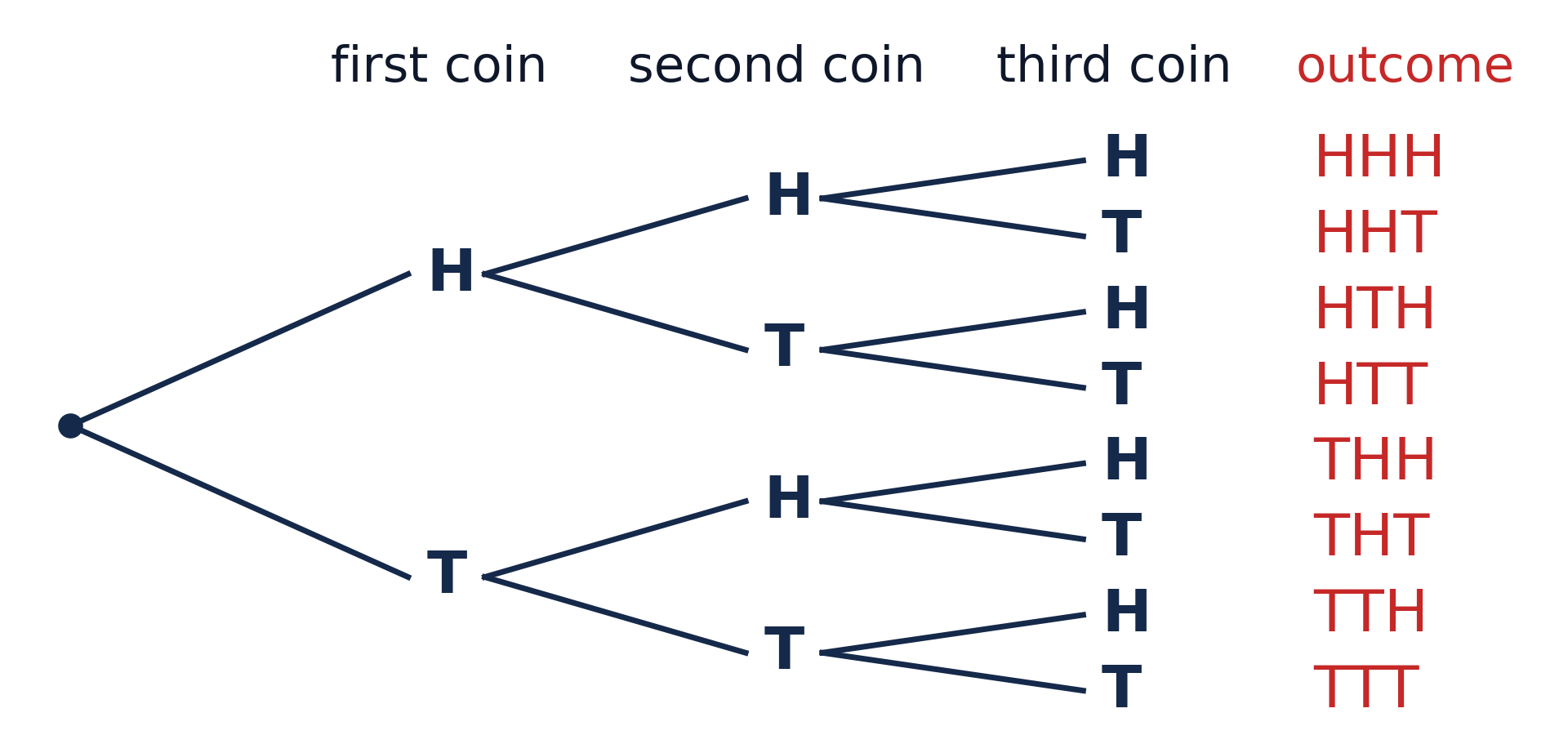
For several coins, a tree finds every outcome: draw two branches, H and T, for each coin in turn. Three coins give 2 \times 2 \times 2 = 8 outcomes.
The pack of cards. A pack has 52 cards in 4 suits of 13 cards each. Spades and clubs are black; hearts and diamonds are red. So there are 26 black and 26 red cards. Each suit has an ace, the numbers 2 to 10, and three face cards: jack, queen and king. So there are 4 aces, 4 kings and 12 face cards in the pack.
2. Events
An event is any subset of the sample space. We say the event occurs when the outcome of the experiment is one of its members.
For one die, "an even number" is the event A = \{2, 4, 6\}. If the die shows 4, A has occurred.
| Kind of event | Meaning | Example for one die |
|---|---|---|
| Simple (elementary) event | Has exactly one outcome | \{5\} |
| Compound event | Has more than one outcome | \{2, 4, 6\} |
| Sure (certain) event | The whole sample space S | "a number less than 7" |
| Impossible event | The empty set \phi | "a number more than 6" |
A sample space with n outcomes has 2^n subsets, so it has 2^n events. For one die that is 2^6 = 64 events.
3. New events from old
Events are sets, so they are joined by the operations of sets. The complement of A is written A', \bar{A} or A^c; the papers use all three.
| In words | In symbols |
|---|---|
| A or B (at least one of them occurs) | A \cup B |
| A and B (both occur) | A \cap B |
| Not A | A' |
| A occurs but B does not | A \cap B' |
| Neither A nor B occurs | A' \cap B' |
| Exactly one of A, B occurs | (A \cap B') \cup (A' \cap B) |
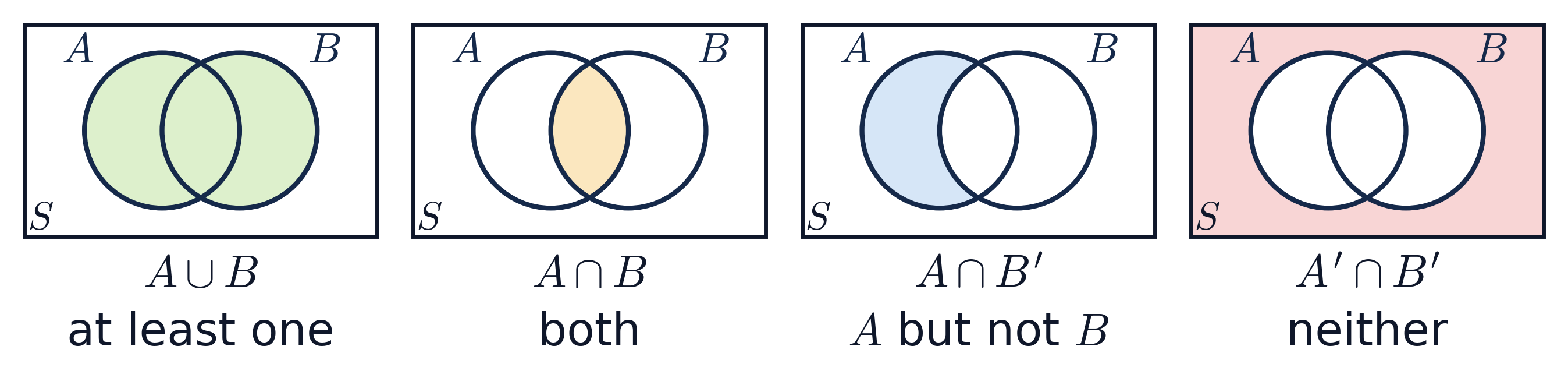
De Morgan's laws link the last rows to the first ones:
(A \cup B)' = A' \cap B' \qquad (A \cap B)' = A' \cup B'
In words: "not (at least one)" is "none", and "not (all)" is "at least one fails". The same laws hold for three or more events.
An event and its complement can never occur together, and one of them always occurs: A \cap A' = \phi and A \cup A' = S.
4. Four words about events
- Mutually exclusive events cannot occur together: A \cap B = \phi. On one die, "even" and "odd" are mutually exclusive.
- Exhaustive events cover the whole sample space: A \cup B = S. At least one of them must occur.
- Events that are both mutually exclusive and exhaustive cut the sample space into separate parts with nothing left over. Exactly one of them occurs. A and A' are always such a pair.
- Equally likely outcomes are outcomes none of which is expected more than another, as with a fair coin or an unbiased die.
5. Worked examples
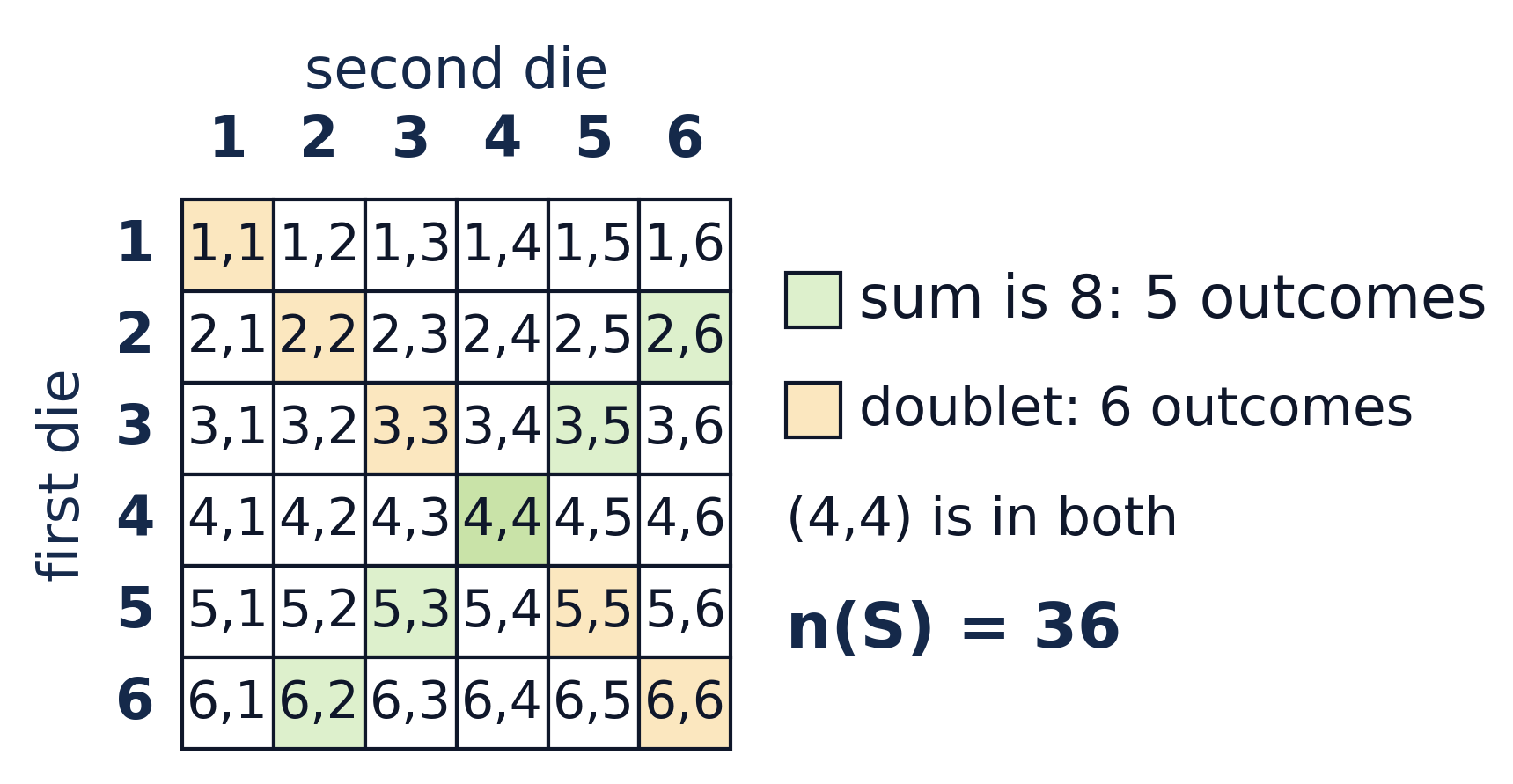
Example 1. Two dice are thrown. Write the event "the sum is 8" and count it. How many outcomes are doublets (the same number on both)?
Sum 8: \{(2, 6), (3, 5), (4, 4), (5, 3), (6, 2)\}, 5 outcomes out of 36. Doublets: (1, 1), (2, 2), \ldots, (6, 6), 6 outcomes.
Example 2. Three coins are tossed. A is "at least two heads" and B is "the first coin shows tail". Find A \cap B and A'. Are A and B mutually exclusive?
n(S) = 2^3 = 8. A = \{HHH, HHT, HTH, THH\} and B = \{THH, THT, TTH, TTT\}. A \cap B = \{THH\}. It is not empty, so A and B are not mutually exclusive. A' is "at most one head": \{HTT, THT, TTH, TTT\}.
Example 3. A die is thrown. A: an even number. B: an odd number. C: a multiple of 3. Which pairs are mutually exclusive? Which are exhaustive? Describe A' \cap C'.
A = \{2, 4, 6\}, B = \{1, 3, 5\}, C = \{3, 6\}. A \cap B = \phi and A \cup B = S: A and B are mutually exclusive and exhaustive. A \cap C = \{6\} and B \cap C = \{3\}: these pairs are not mutually exclusive. A' \cap C' = (A \cup C)' = \{2, 3, 4, 6\}' = \{1, 5\}: "neither even nor a multiple of 3".
Example 4. A bag has 5 balls of different colours. Find n(S) when two balls are drawn (i) together, (ii) one after the other without putting the first back, (iii) one after the other, putting the first back.
(i) Order does not matter: {}^5C_2 = 10. (ii) Order matters: 5 \times 4 = 20. (iii) 5 \times 5 = 25.
Example 5. A, B, C are three events. Write in symbols: (i) only A occurs, (ii) at least one occurs, (iii) none occurs, (iv) all three occur.
(i) A \cap B' \cap C'. (ii) A \cup B \cup C. (iii) A' \cap B' \cap C', which by De Morgan's law is (A \cup B \cup C)'. (iv) A \cap B \cap C.
6. From the real papers
Only two questions on this chapter are in the seven papers captured so far.
NDA I 2026, Q114. Consider the following statements in respect of the events A, B, C : I. (A \cup B \cup C) \cap (\bar{A} \cap \bar{B} \cap \bar{C}) is an impossible event. II. (A \cap B \cap C) \cap (\bar{A} \cup \bar{B} \cup \bar{C}) is a possible event. Which of the statements given above is/are correct?
(a) I only (b) II only (c) Both I and II (d) Neither I nor II
Solution. By De Morgan's law, \bar{A} \cap \bar{B} \cap \bar{C} is the complement of A \cup B \cup C. An event and its complement have nothing in common, so the event in I is \phi, an impossible event. I is correct. In the same way \bar{A} \cup \bar{B} \cup \bar{C} is the complement of A \cap B \cap C, so the event in II is also \phi. It is impossible, not possible. II is wrong. Answer (a).
NDA II 2024, Q119. Three perfect dice D_1, D_2 and D_3 are rolled. Let x, y and z represent the numbers on D_1, D_2 and D_3 respectively. What is the number of possible outcomes such that x < y < z?
(a) 20 (b) 18 (c) 14 (d) 10
Solution. The three numbers must all be different. Choose any 3 different numbers from 1 to 6: {}^6C_3 = 20 ways. Once chosen, there is only one way to give them to the dice so that x < y < z. So there are 20 outcomes. Answer (a). (No official answer key is recorded for this paper; this answer is from our own working, checked by counting all 216 outcomes.)
Practice questions in the exam style
These four are our own questions, written in the style of the paper. They are not from a real paper.
P1. A coin is tossed. If it shows head, a die is thrown. If it shows tail, the coin is tossed once more. How many outcomes are there in the sample space?
(a) 6 (b) 7 (c) 8 (d) 12
Solution. After a head: H1, H2, H3, H4, H5, H6, 6 outcomes. After a tail: TH, TT, 2 outcomes. Total 8. Answer (c).
P2. Two dice are thrown. In how many outcomes is the product of the two numbers odd?
(a) 6 (b) 9 (c) 18 (d) 27
Solution. A product is odd only when both numbers are odd. Each die has 3 odd numbers: 3 \times 3 = 9. Answer (b).
P3. The sample space of an experiment has 5 outcomes. How many events are there in all, counting the sure event and the impossible event?
(a) 5 (b) 10 (c) 25 (d) 32
Solution. Every subset is an event, and a set of 5 elements has 2^5 = 32 subsets. Answer (d).
P4. A die is thrown. Let A be the event "an even number" and B the event "a prime number". Consider the following statements: I. A and B are mutually exclusive. II. A and B are exhaustive. Which of the statements given above is/are correct?
(a) I only (b) II only (c) Both I and II (d) Neither I nor II
Solution. A = \{2, 4, 6\} and B = \{2, 3, 5\}. A \cap B = \{2\}, not empty, so I is wrong. A \cup B = \{2, 3, 4, 5, 6\} does not contain 1, so II is wrong. Answer (d).
7. Mistakes that cost marks
- Counting (2, 5) and (5, 2) as one outcome. Two dice have 36 outcomes, not 21. Treat the dice as a first die and a second die.
- Confusing mutually exclusive with exhaustive. Mutually exclusive: A \cap B = \phi (never together). Exhaustive: A \cup B = S (nothing left out). A pair can be one without the other.
- Taking "neither A nor B" as A' \cup B'. "Neither" is A' \cap B', which equals (A \cup B)'. The event A' \cup B' means "not both".
- Forgetting that 1 is not a prime number. On a die the primes are 2, 3, 5. The number 2 is both even and prime.
8. Quick check
Do these without help. Answers are at the end.
- A coin is tossed 4 times. Find n(S).
- Two dice are thrown. How many outcomes have a sum of at least 10?
- Three coins are tossed. Write the event "exactly one head".
- A die is thrown. A = \{1, 2, 3\} and B = \{3, 4\}. Find A \cup B, A \cap B and A'. Are A and B mutually exclusive?
- Write in symbols: (i) A occurs but B does not, (ii) neither A nor B occurs.
9. Read and watch more, free
| What | Where | Language |
|---|---|---|
| Textbook | NCERT Class 11 Mathematics, Chapter 14 Probability · Hindi edition | English, Hindi |
| Self-study notes | NIOS Mathematics, Lesson 18 Random Experiments and Events · Hindi edition | English, Hindi |
| Video, short lessons on the NCERT chapter | Khan Academy India: Probability, Grade 11 (28 lessons) | English |
| Video, topic by topic | Mohit Tyagi: Probability (16 lessons) | Hinglish |
| Video, the whole of Probability for NDA | Chandigarh Career Group: NDA Maths one shots (the Probability class, about 8 hours 30 minutes) | Hinglish |
The videos were chosen from their titles, length and views; they have not yet been watched by a teacher.
Answers to the quick check
- 2^4 = 16.
- Sum 10: (4, 6), (5, 5), (6, 4). Sum 11: (5, 6), (6, 5). Sum 12: (6, 6). Total 6.
- \{HTT, THT, TTH\}.
- A \cup B = \{1, 2, 3, 4\}, A \cap B = \{3\}, A' = \{4, 5, 6\}. Not mutually exclusive, because A \cap B is not empty.
- (i) A \cap B'. (ii) A' \cap B'.
Next chapter: Probability and its theorems.