Why this chapter matters. This chapter drew 13 questions in the seven papers from NDA II 2023 to NDA II 2026. Most of them are one-line questions on the mean: "the mean is given, find a sum" or "each observation is changed, find the new mean". The others ask for the median or the mode of a grouped table, where the formula must be known by heart. Six real questions are solved in section 7.
What you will be able to do
- Find the mean, median and mode of raw data and of a grouped frequency table.
- Say at once what happens to the mean when every observation is changed in the same way.
- Use \sum x_i = n\bar{x} to answer "find the sum" questions in one line.
- Know when the average needed is the harmonic mean, not the ordinary mean.
Before you start you should know: class mark and cumulative frequency (Chapter M8-1), and the sums 1 + 2 + \dots + n and 1^2 + 2^2 + \dots + n^2 (Chapter M1-6).
1. The arithmetic mean
The mean of n observations is their sum divided by n:
\bar{x} = \frac{x_1 + x_2 + \dots + x_n}{n} = \frac{\sum x_i}{n}
For example, the mean of 4, 7, 10 is \dfrac{21}{3} = 7.
Read the formula the other way and you get the most useful line of this chapter:
\sum x_i = n\bar{x}
If the mean of 10 observations is 20, their sum is 200. Nothing more needs to be known about them.
With frequencies. If the value x_i occurs f_i times,
\bar{x} = \frac{\sum f_i x_i}{\sum f_i}
For a grouped table, x_i is the class mark (mid-point) of each class.
Deviations. The deviation of an observation from a number a is x_i - a. The sum of deviations from a is \sum (x_i - a) = \sum x_i - na. Taken from the mean itself, this sum is always zero.
2. Shortcuts for the mean
| Change | What happens to the mean |
|---|---|
| Add b to every observation | Mean increases by b |
| Multiply every observation by a | Mean is multiplied by a |
| Every x_i becomes ax_i + b | New mean = a\bar{x} + b |
| Two groups of sizes n_1, n_2 with means \bar{x}_1, \bar{x}_2 are joined | Combined mean = \dfrac{n_1\bar{x}_1 + n_2\bar{x}_2}{n_1 + n_2} |
| One observation is removed, added or corrected | Find the old sum n\bar{x}, correct the sum, divide by the new number |
Two results to remember: the mean of the first n natural numbers is \dfrac{n + 1}{2}, and the mean of their squares is \dfrac{(n + 1)(2n + 1)}{6}.
3. The median
The median is the middle value when the observations are arranged in order. Half the observations lie below it and half above it.
- If n is odd, the median is the observation at position \dfrac{n + 1}{2}.
- If n is even, it is the mean of the observations at positions \dfrac{n}{2} and \dfrac{n}{2} + 1.
For 3, 5, 8, 9, 12 the median is 8. For 3, 5, 8, 9 it is \dfrac{5 + 8}{2} = 6.5.
Grouped data. Let N be the total frequency. The median class is the first class whose cumulative frequency reaches \dfrac{N}{2}. Then
\text{Median} = l + \frac{\dfrac{N}{2} - cf}{f} \times h
where l is the lower limit of the median class, f its frequency, cf the cumulative frequency of the class before it, and h the class width.
4. The mode
The mode is the value that occurs most often. In 2, 3, 3, 5, 3, 7 the mode is 3.
Grouped data. The modal class is the class with the highest frequency f_1. Let f_0 be the frequency of the class before it and f_2 of the class after it. Then
\text{Mode} = l + \frac{f_1 - f_0}{2f_1 - f_0 - f_2} \times h
For a distribution that is not far from symmetric, the three averages are linked by the rule \text{Mode} \approx 3\,\text{Median} - 2\,\text{Mean}. If the distribution is exactly symmetric with one peak, all three are equal.
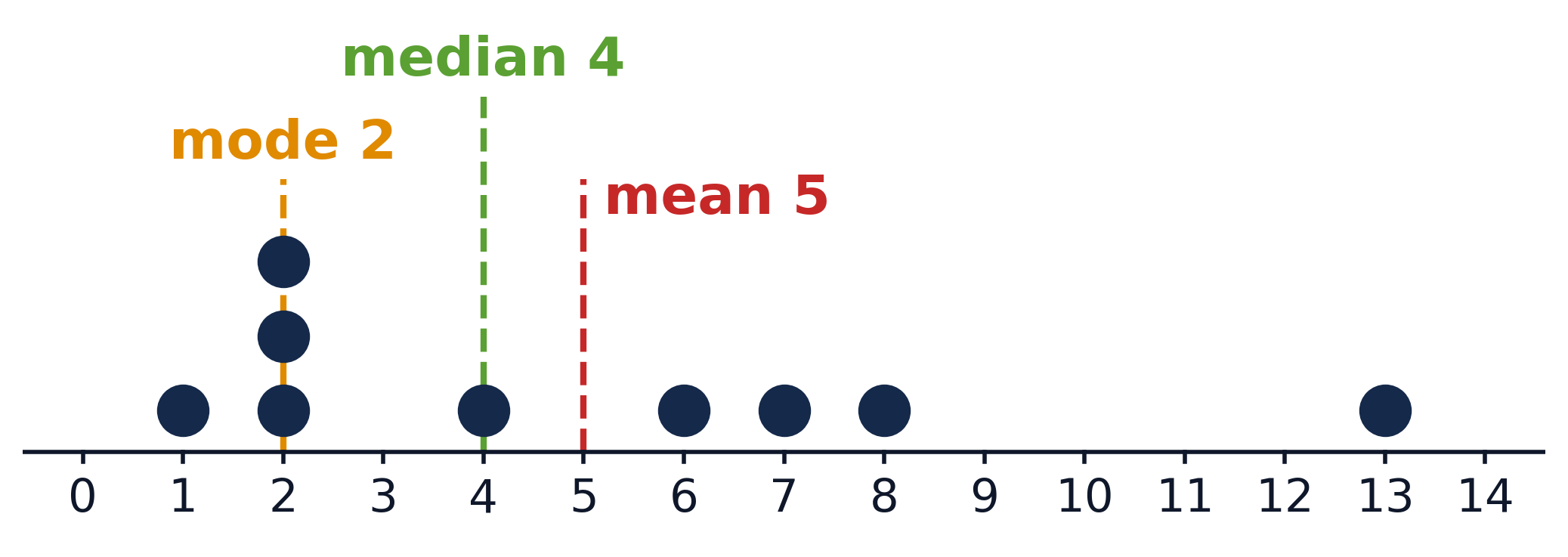
The picture shows the three averages of the nine observations 1, 2, 2, 2, 4, 6, 7, 8, 13. The mode is 2, the median (the fifth value) is 4, and the mean is \dfrac{45}{9} = 5. The one large value 13 pulls the mean to the right but does not move the median or the mode.
5. Geometric mean and harmonic mean
For n positive numbers:
| Average | Formula | For 4 and 9 |
|---|---|---|
| Arithmetic mean (AM) | \dfrac{x_1 + x_2 + \dots + x_n}{n} | 6.5 |
| Geometric mean (GM) | (x_1 x_2 \cdots x_n)^{1/n} | \sqrt{36} = 6 |
| Harmonic mean (HM) | \dfrac{n}{\dfrac{1}{x_1} + \dfrac{1}{x_2} + \dots + \dfrac{1}{x_n}} | \dfrac{2}{\frac{1}{4} + \frac{1}{9}} = \dfrac{72}{13} \approx 5.54 |
Always \text{AM} \ge \text{GM} \ge \text{HM}, with equality only when all the numbers are equal.
When to use the harmonic mean. Use it for an average rate when the same distance is covered at different speeds, or the same money is spent at different prices. Average speed is total distance divided by total time, and this comes out as the harmonic mean of the speeds.
6. Worked examples
Example 1. Find the mean of this distribution.
| x | 2 | 4 | 6 | 8 |
|---|---|---|---|---|
| f | 3 | 5 | 8 | 4 |
\sum f_i = 20 and \sum f_i x_i = 6 + 20 + 48 + 32 = 106. Mean = \dfrac{106}{20} = 5.3.
Example 2. The mean of 25 observations is 36. Later it is found that an observation 46 was wrongly read as 64. Find the correct mean.
Old sum = 25 \times 36 = 900. Correct sum = 900 - 64 + 46 = 882. Correct mean = \dfrac{882}{25} = 35.28.
Example 3. A group of 30 boys has mean mark 60 and a group of 20 girls has mean mark 70. Find the mean of all 50.
Combined mean = \dfrac{30 \times 60 + 20 \times 70}{50} = \dfrac{3200}{50} = 64. It is not 65: the larger group pulls the mean towards itself.
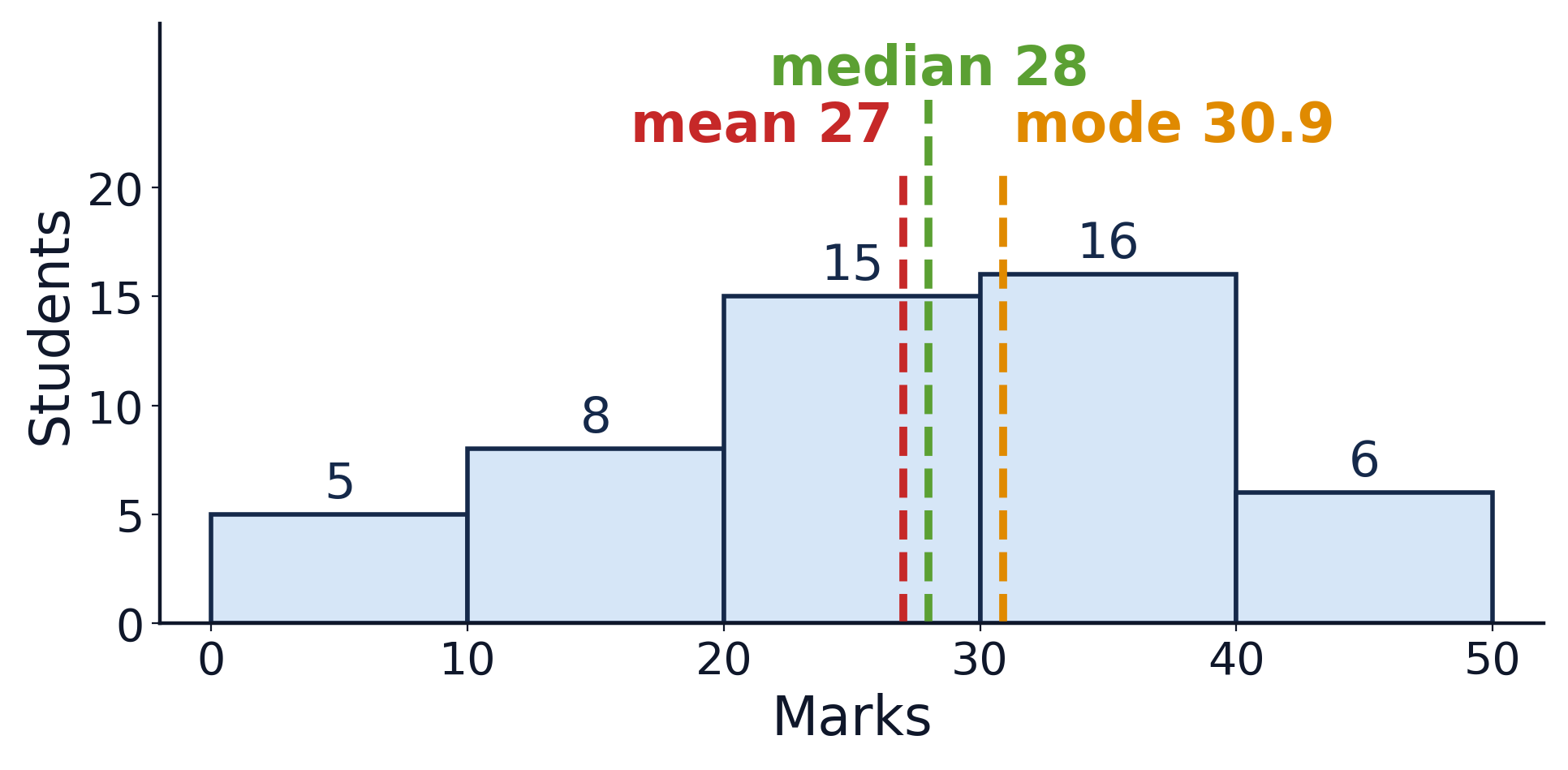
Example 4. Find the mean, median and mode of this table.
| Marks | 0–10 | 10–20 | 20–30 | 30–40 | 40–50 |
|---|---|---|---|---|---|
| Frequency | 5 | 8 | 15 | 16 | 6 |
| Cumulative frequency | 5 | 13 | 28 | 44 | 50 |
Mean. Class marks 5, 15, 25, 35, 45. \sum f_i x_i = 25 + 120 + 375 + 560 + 270 = 1350. Mean = \dfrac{1350}{50} = 27.
Median. \dfrac{N}{2} = 25. The cumulative frequency first reaches 25 in the class 20–30, so l = 20, cf = 13, f = 15, h = 10. Median = 20 + \dfrac{25 - 13}{15} \times 10 = 20 + 8 = 28.
Mode. The highest frequency is 16, in the class 30–40, so l = 30, f_1 = 16, f_0 = 15, f_2 = 6. Mode = 30 + \dfrac{16 - 15}{32 - 15 - 6} \times 10 = 30 + \dfrac{10}{11} \approx 30.9.
Check with the rule of section 4: 3 \times 28 - 2 \times 27 = 30, close to 30.9.
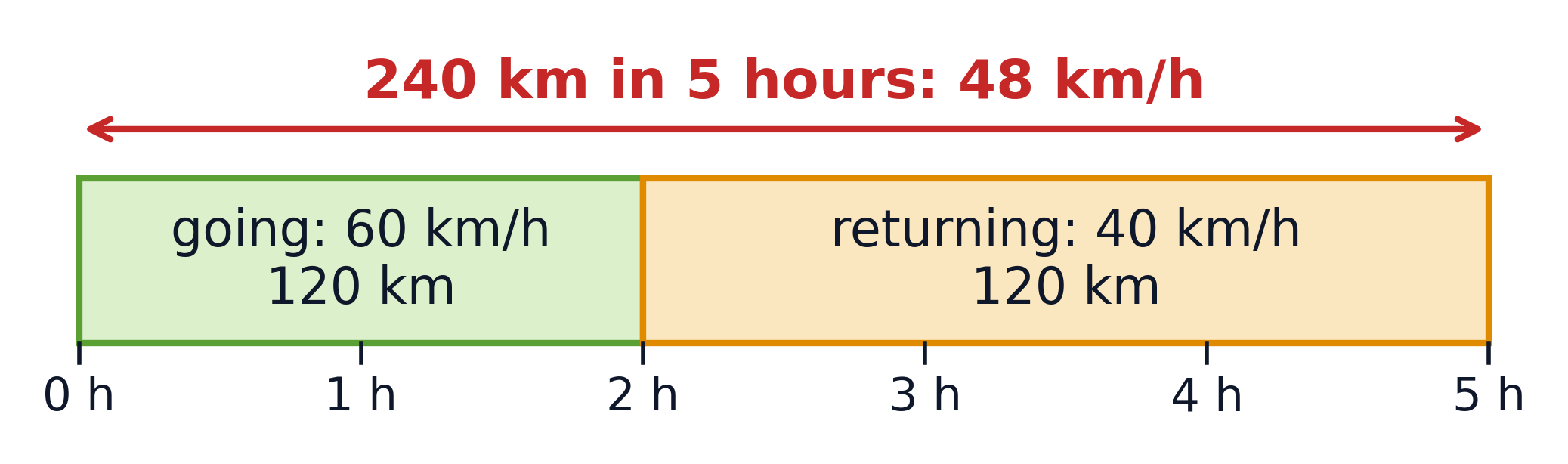
Example 5. A man drives from A to B at 60 km/h and returns at 40 km/h. Find his average speed for the whole journey.
The distance is the same both ways, so use the harmonic mean: \dfrac{2}{\frac{1}{60} + \frac{1}{40}} = \dfrac{2 \times 120}{2 + 3} = 48 km/h. It is not 50.
To see why, take the distance as 120 km each way. Going takes 2 hours and returning takes 3 hours: 240 km in 5 hours. He spends more time at the slower speed.
7. From the real papers
Try each for 75 seconds before reading the solution.
NDA II 2023, Q101. The sum of deviations of n numbers from 10 and 20 are p and q respectively. If (p - q)^2 = 10000, then what is the value of n?
(a) 10 (b) 20 (c) 50 (d) 100
Solution. Let the sum of the numbers be S. Then p = S - 10n and q = S - 20n, so p - q = 10n. Hence (10n)^2 = 10000, n^2 = 100, n = 10. Answer (a).
NDA I 2024, Q107. An edible oil is sold at the rates 150, 200, 250, 300 rupees per litre in four consecutive years. Assuming that an equal amount of money is spent on oil by a family in every year during these years, what is the average price of oil in rupees (approximately) per litre?
(a) 210 (b) 220 (c) 230 (d) 240
Solution. Equal money each year means the harmonic mean. Average price = \dfrac{4}{\frac{1}{150} + \frac{1}{200} + \frac{1}{250} + \frac{1}{300}}. With denominator 3000 the four fractions add to \dfrac{20 + 15 + 12 + 10}{3000} = \dfrac{57}{3000}. So the price is \dfrac{4 \times 3000}{57} = \dfrac{12000}{57} \approx 210.5. Answer (a).
NDA I 2025, Q102 and Q103 use one table. The frequency distribution of height of students of a class is given below:
| Height (in cm) | 160–162 | 162–164 | 164–166 | 166–168 |
|---|---|---|---|---|
| Number of students | 12 | 15 | 24 | 13 |
Q102. What is the median height of the class?
(a) 162.41 cm (b) 163.41 cm (c) 164.41 cm (d) 165.41 cm
Solution. N = 64, so \dfrac{N}{2} = 32. Cumulative frequencies: 12, 27, 51, 64. The median class is 164–166 with l = 164, cf = 27, f = 24, h = 2. Median = 164 + \dfrac{32 - 27}{24} \times 2 = 164 + 0.4167 = 164.4167, printed as 164.41. Answer (c).
Q103. The height which occurs most frequently in the class is
(a) 163.5 cm (b) 163.9 cm (c) 164.5 cm (d) 164.9 cm
Solution. This asks for the mode. Modal class 164–166: f_1 = 24, f_0 = 15, f_2 = 13, h = 2. Mode = 164 + \dfrac{24 - 15}{48 - 15 - 13} \times 2 = 164 + \dfrac{9}{20} \times 2 = 164.9. Answer (d).
NDA II 2025, Q117. The frequency distribution of the marks obtained by students in a Science examination is given below : Marks : 5–15, 15–25, 25–35, 35–45 ; Number of students : 20, 30, 30, 20 (respectively). What is the arithmetic mean?
(a) 20 (b) 25 (c) 30 (d) 35
Solution. Class marks 10, 20, 30, 40. Mean = \dfrac{200 + 600 + 900 + 800}{100} = 25. Faster: the table is symmetric about 25, so the mean is 25. Answer (b).
NDA I 2026, Q112. If the mean of 20 observations, namely x_1, x_2, x_3, \ldots, x_{20} is 1.414, then what is the value of \sum_{i=1}^{20} 100(2x_i + 4)?
(a) 24168 (b) 20828 (c) 15248 (d) 13656
Solution. \sum x_i = 20 \times 1.414 = 28.28. The required sum is 200 \sum x_i + 400 \times 20 = 5656 + 8000 = 13656. The constant 400 is added 20 times. Answer (d).
Notice that four of the six needed only \sum x_i = n\bar{x} or a symmetric table. Only Q102 and Q103 needed a long formula.
8. Mistakes that cost marks
- Forgetting to multiply a constant by n. \sum (2x_i + 4) = 2\sum x_i + 4n, not 2\sum x_i + 4.
- Taking the median without arranging the data. Sort first. For an even number of observations take the mean of the two middle ones.
- Using the wrong cf in the median formula. cf is the cumulative frequency of the class before the median class, not of the median class itself.
- Averaging two speeds or two prices directly. For the same distance or the same money, use the harmonic mean (Example 5).
9. Quick check
Do these without help. Answers are at the end.
- Find the mean, median and mode of 4, 3, 9, 5, 3, 8, 3.
- The mean of 5 observations is 12. Each observation is multiplied by 3 and then 2 is added. Find the new mean.
- The mean of 10 observations is 15. One observation, 24, is removed. Find the mean of the remaining nine.
- Find the median of 20, 4, 12, 16, 8, 10.
- For a table, l = 40, f_1 = 20, f_0 = 12, f_2 = 8 and h = 10 for the modal class. Find the mode.
10. Read and watch more, free
| What | Where | Language |
|---|---|---|
| Textbook, grouped data with many drill questions | NCERT Class 10 Mathematics, Chapter 13 Statistics · Hindi edition | English, Hindi |
| Textbook, all the averages in plain language | NCERT Statistics for Economics, Chapter 5 Measures of Central Tendency · Hindi edition, book page | English, Hindi |
| Video, Statistics for NDA | Defence Wallah: Statistics for NDA 2 2026 (one class, about 4 hours 30 minutes) | Hinglish |
| Video, topic by topic | Mohit Tyagi: Statistics (12 lessons) | Hinglish |
| Video, short lessons | Khan Academy: Statistics playlist | English |
The videos were chosen from their titles, length and views; they have not yet been watched by a teacher.
Answers to the quick check
- Sum = 35, so mean = 5. In order: 3, 3, 3, 4, 5, 8, 9; median = 4. Mode = 3.
- 3 \times 12 + 2 = 38.
- Old sum = 150. New sum = 126. Mean = \dfrac{126}{9} = 14.
- In order: 4, 8, 10, 12, 16, 20. Median = \dfrac{10 + 12}{2} = 11.
- 40 + \dfrac{20 - 12}{40 - 12 - 8} \times 10 = 40 + \dfrac{8}{20} \times 10 = 44.
Next chapter: Variance and standard deviation.