Why this chapter matters. This chapter drew 16 questions in the seven papers from NDA II 2023 to NDA II 2026. The favourite question, asked in four of the last five papers, is: "the standard deviation (or variance) is given; a number is added to, or multiplied with, every observation; what is the new value?" It takes ten seconds if you know the rule in section 4. The other questions use the shortcut formula for variance, the mean deviation, and the coefficient of variation.
What you will be able to do
- Find the mean deviation, variance and standard deviation of raw data and of a frequency table.
- Use the shortcut "mean of the squares minus square of the mean".
- Say at once how the variance and standard deviation change when every observation is changed in the same way.
- Compare two sets of data with the coefficient of variation.
Before you start you should know: the mean and \sum x_i = n\bar{x} (Chapter M8-2), and class marks (Chapter M8-1).
1. Why a mean is not enough
Two batsmen each have a mean score of 50 in three innings. The first scored 48, 50, 52. The second scored 10, 50, 90. The mean is the same, but the second set is far more spread out. A measure of dispersion is a number that tells how spread out the data are.
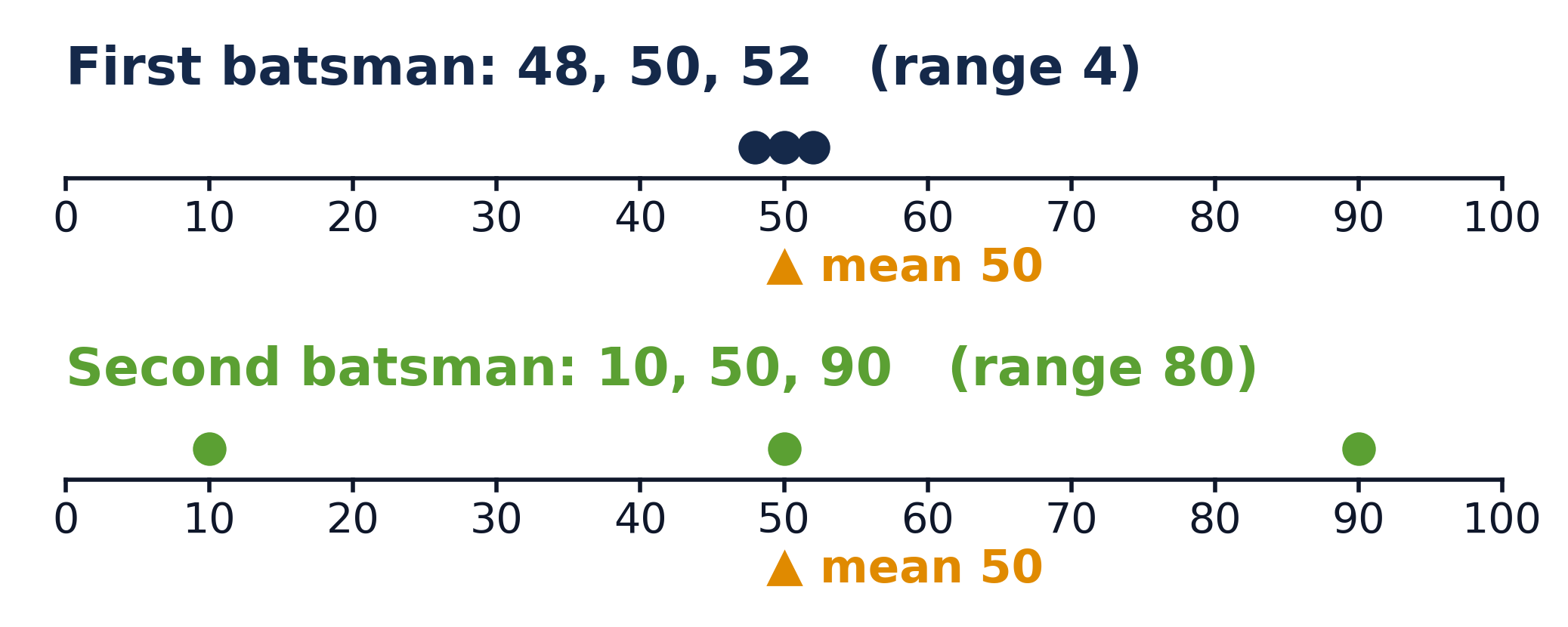
The simplest one is the range: largest value minus smallest value. Here the ranges are 4 and 80. The range uses only two observations, so better measures are needed.
2. Mean deviation
The mean deviation about the mean is the average distance of the observations from the mean. Distances are taken as positive:
\text{M.D.} = \frac{\sum \lvert x_i - \bar{x} \rvert}{n}
For 2, 4, 6, 8, 10 the mean is 6. The distances are 4, 2, 0, 2, 4. So the mean deviation is \dfrac{12}{5} = 2.4.
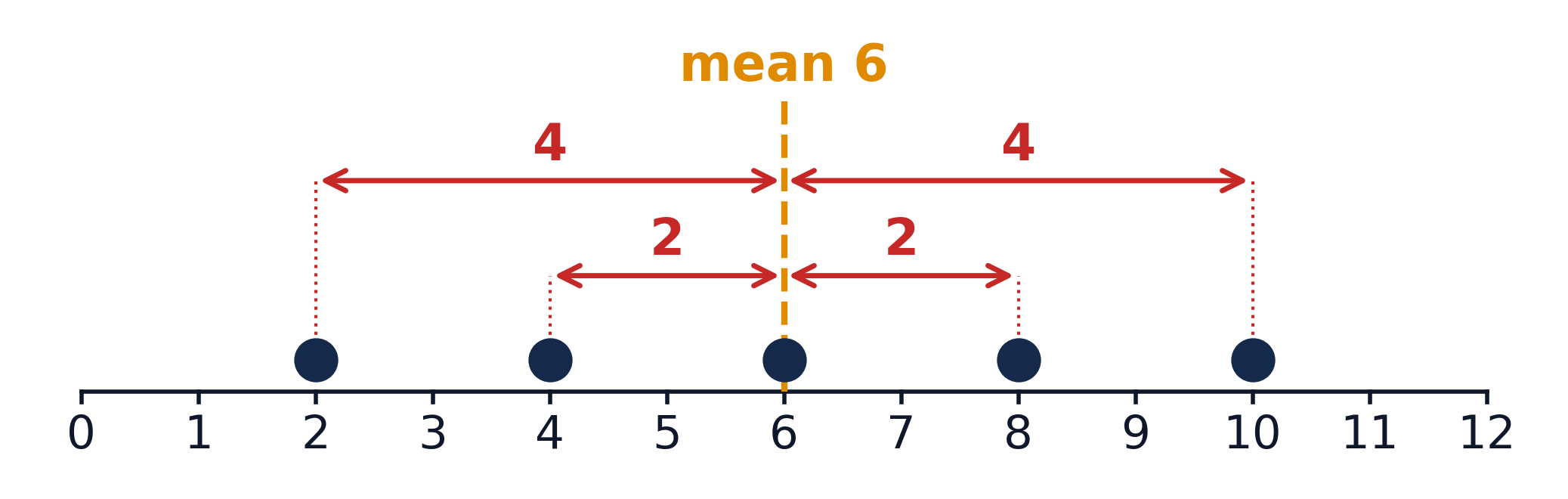
With frequencies, each distance is multiplied by its frequency and the total is divided by N = \sum f_i. The mean deviation can also be taken about the median: use the median in place of \bar{x}.
3. Variance and standard deviation
The variance is the average of the squared deviations from the mean. The standard deviation (SD), written \sigma, is the positive square root of the variance.
\sigma^2 = \frac{\sum (x_i - \bar{x})^2}{n} \qquad \sigma = \sqrt{\sigma^2}
For 2, 4, 6, 8, 10: the squared deviations are 16, 4, 0, 4, 16. Variance = \dfrac{40}{5} = 8 and \sigma = \sqrt{8} = 2\sqrt{2} \approx 2.83.
The shortcut. Expanding the square gives a form that is much quicker in the exam:
\sigma^2 = \frac{\sum x_i^2}{n} - \bar{x}^2
In words: mean of the squares minus square of the mean. Check: \dfrac{4 + 16 + 36 + 64 + 100}{5} - 6^2 = 44 - 36 = 8.
| Data | Variance |
|---|---|
| Raw data | \dfrac{\sum x_i^2}{n} - \left(\dfrac{\sum x_i}{n}\right)^2 |
| Frequency table, N = \sum f_i | \dfrac{\sum f_i x_i^2}{N} - \left(\dfrac{\sum f_i x_i}{N}\right)^2 |
| Grouped table | The same, with x_i the class marks |
| First n natural numbers | \dfrac{n^2 - 1}{12} |
Three facts follow from the definition:
- Variance and SD are never negative. They are zero only when all observations are equal.
- The SD has the same unit as the data (cm). The variance has the square of that unit (cm^2). The mean deviation has the unit of the data.
- Rearranging the shortcut: \bar{x}^2 + \sigma^2 = \dfrac{\sum x_i^2}{n}.
4. When every observation is changed
Adding a number to every observation moves all of them together. The spread does not change. Multiplying every observation by a number stretches the spread by that number.
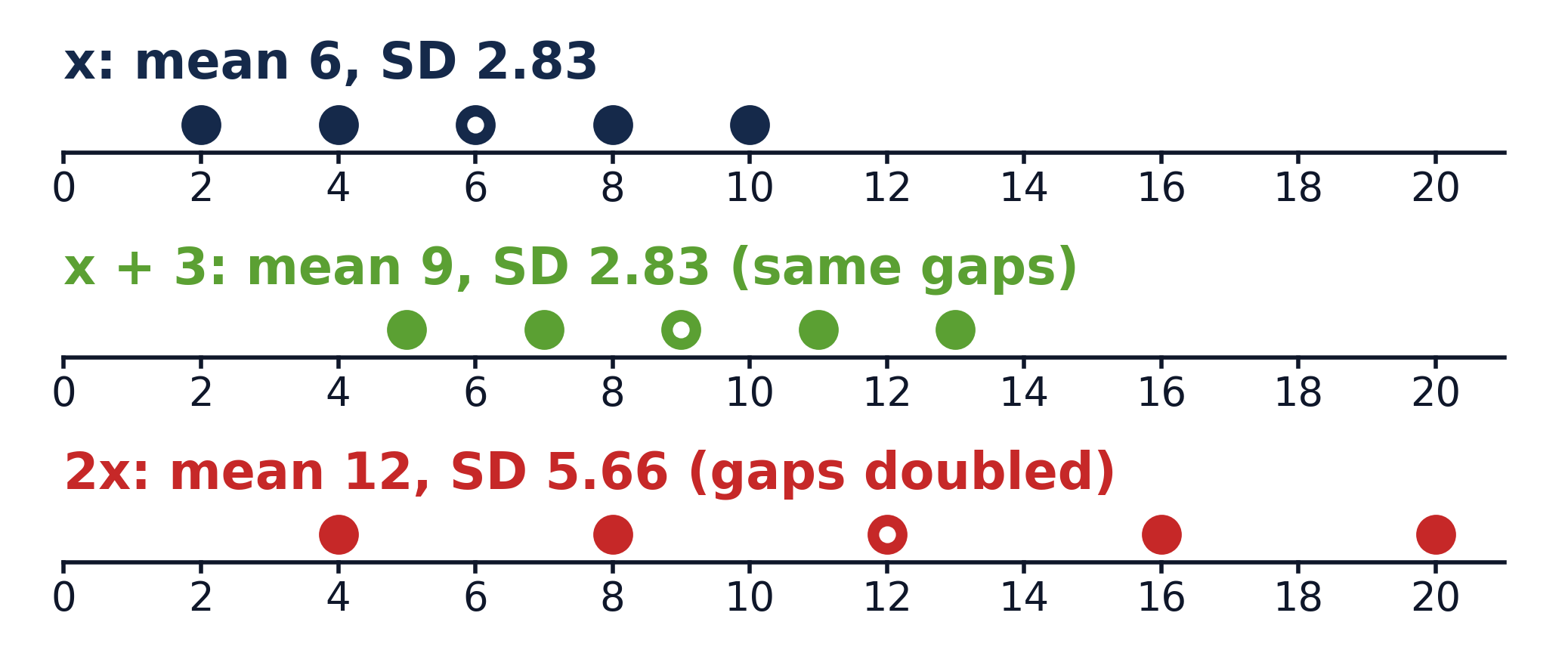
In the picture the hollow dot is the mean. Adding 3 moves the mean from 6 to 9 and leaves the SD at 2.83. Doubling moves the mean to 12 and doubles the SD to 5.66.
| Change | Mean | Standard deviation | Variance |
|---|---|---|---|
| Add b to every observation | Increases by b | No change | No change |
| Multiply every observation by a | Multiplied by a | Multiplied by \lvert a \rvert | Multiplied by a^2 |
| Every x becomes ax + b | a\bar{x} + b | \lvert a \rvert\,\sigma | a^2\sigma^2 |
Dividing by 20 is the same as multiplying by \dfrac{1}{20}. The mean deviation behaves like the SD.
For example, if the SD is 6 and every observation becomes 3x + 5, the new SD is 3 \times 6 = 18 and the new variance is 9 \times 36 = 324.
5. Coefficient of variation
To compare the spread of two sets of data with different means or different units, use the coefficient of variation:
\text{C.V.} = \frac{\sigma}{\bar{x}} \times 100
It is a percentage with no unit. The set with the smaller C.V. is more consistent (less variable).
6. Worked examples
Example 1. Find the variance and standard deviation of this distribution.
| x | 1 | 2 | 3 | 4 | 5 |
|---|---|---|---|---|---|
| f | 1 | 2 | 4 | 2 | 1 |
N = 10. \sum f_i x_i = 1 + 4 + 12 + 8 + 5 = 30, so the mean is 3. \sum f_i x_i^2 = 1 + 8 + 36 + 32 + 25 = 102. Variance = \dfrac{102}{10} - 3^2 = 10.2 - 9 = 1.2. SD = \sqrt{1.2} \approx 1.10.
Example 2. Find the variance of the first 10 natural numbers.
By the result in the table: \dfrac{10^2 - 1}{12} = \dfrac{99}{12} = 8.25. Check by the shortcut: the mean is 5.5 and the mean of the squares is \dfrac{385}{10} = 38.5, so the variance is 38.5 - 30.25 = 8.25.
Example 3. The variance of a set of observations is 9. Each observation is multiplied by -2 and then 7 is added. Find the new variance and the new SD.
Adding 7 changes nothing. Multiplying by -2 multiplies the variance by (-2)^2 = 4. New variance = 36. New SD = 6, which is \lvert -2 \rvert \times 3. A standard deviation is never negative.
Example 4. For 20 observations, \sum x_i = 100 and \sum x_i^2 = 820. Find the SD.
Mean = 5. Variance = \dfrac{820}{20} - 5^2 = 41 - 25 = 16. SD = 4.
Example 5. Batsman A has mean score 50 and SD 10. Batsman B has mean score 40 and SD 6. Who is more consistent?
C.V. of A = \dfrac{10}{50} \times 100 = 20\%. C.V. of B = \dfrac{6}{40} \times 100 = 15\%. B has the smaller C.V., so B is more consistent.
7. From the real papers
Try each for 75 seconds before reading the solution.
NDA II 2023, Q103. If the mean and the sum of squares of 10 observations are 40 and 16160 respectively, then what is the standard deviation?
(a) 16 (b) 6 (c) 5 (d) 4
Solution. Variance = \dfrac{16160}{10} - 40^2 = 1616 - 1600 = 16. SD = 4. Option (a), 16, is the variance, not the SD. Answer (d).
NDA I 2024, Q120. The marks obtained by 10 students in a Statistics test are 24, 47, 18, 32, 19, 15, 21, 35, 50 and 41. What is the variance of the largest five observations?
(a) 14.6 (b) 21.8 (c) 25.2 (d) 46.8
Solution. The largest five are 32, 35, 41, 47, 50. Their mean is \dfrac{205}{5} = 41. Deviations: -9, -6, 0, 6, 9. Squares: 81, 36, 0, 36, 81, total 234. Variance = \dfrac{234}{5} = 46.8. Answer (d).
NDA I 2025, Q106. The sum and the sum of squares of the observations corresponding to length X (in cm) and weight Y (in gm) of 50 tropical tubers are given as \Sigma X = 200, \Sigma Y = 250, \Sigma X^2 = 900 and \Sigma Y^2 = 1400. Which one of the following statements is correct?
(a) Coefficient of variation of X is strictly more than coefficient of variation of Y. (b) Coefficient of variation of X is strictly less than coefficient of variation of Y. (c) Coefficient of variation of X is same as coefficient of variation of Y. (d) Coefficient of variation cannot be determined from the given data.
Solution. For X: mean = 4, variance = \dfrac{900}{50} - 16 = 2. For Y: mean = 5, variance = \dfrac{1400}{50} - 25 = 3. Compare the squares of \dfrac{\sigma}{\bar{x}}: for X it is \dfrac{2}{16} = 0.125, for Y it is \dfrac{3}{25} = 0.12. So the C.V. of X is more. Answer (a).
NDA II 2025, Q120. Consider the following statements : I. Mean and variance have the same unit of measurement. II. Mean deviation and standard deviation have the same unit of measurement. Which of the statements given above is/are correct?
(a) I only (b) II only (c) Both I and II (d) Neither I nor II
Solution. The mean has the unit of the data (say cm). The variance has the squared unit (cm^2). So I is wrong. Mean deviation and SD both have the unit of the data. So II is correct. Answer (b).
NDA I 2026, Q120. The frequency distribution of marks obtained by 100 students in a certain subject is given below : Marks: 0-10, 10-20, 20-30, 30-40; No. of students: 10, 20, f, 40 (respectively). What is the standard deviation?
(a) 8.5 (b) 9 (c) 9.5 (d) 10
Solution. The total is 100, so f = 30. Class marks 5, 15, 25, 35 with frequencies 10, 20, 30, 40. Mean = \dfrac{50 + 300 + 750 + 1400}{100} = 25. Deviations: -20, -10, 0, 10; squares: 400, 100, 0, 100. Variance = \dfrac{4000 + 2000 + 0 + 4000}{100} = 100. SD = 10. Answer (d).
NDA II 2026, Q101. The variance of 10 observations is 25. If 2 is multiplied to each of the observations and subsequently 7 is subtracted from each multiplied observation, then what is the new variance?
(a) 125 (b) 100 (c) 50 (d) 25
Solution. Subtracting 7 changes nothing. Multiplying by 2 multiplies the variance by 2^2 = 4. New variance = 100. The number of observations is not needed. Answer (b).
8. Mistakes that cost marks
- Stopping at the variance when the SD is asked, or the other way round. Read the last line of the question again before marking.
- Multiplying the variance by a. When every observation is multiplied by a, the SD is multiplied by \lvert a \rvert but the variance by a^2.
- Changing the SD when a number is added. Adding or subtracting the same number changes the mean only. The SD and the variance stay the same.
- Writing "square of the mean minus mean of the squares". The order is mean of the squares first. If your variance is negative, you have the order wrong.
9. Quick check
Do these without help. Answers are at the end.
- Find the variance and the SD of 3, 5, 7, 9, 11.
- The mean of 5 observations is 8 and the sum of their squares is 370. Find the variance.
- The SD of a set of observations is 6. Each observation is multiplied by -2 and then 5 is added. Find the new SD.
- A set of data has mean 50 and SD 5. Find its coefficient of variation.
- Find the mean deviation about the mean of 1, 3, 5, 7, 9, 11.
10. Read and watch more, free
| What | Where | Language |
|---|---|---|
| Textbook | NCERT Class 11 Mathematics, Chapter 13 Statistics · Hindi edition | English, Hindi |
| Self-study notes | NIOS Mathematics, Lesson 17 Measures of Dispersion · Hindi edition | English, Hindi |
| Video, the whole of Statistics for NDA | Defence Wallah: Statistics (one class, about 4 hours 40 minutes) | Hinglish |
| Video, topic by topic | Mohit Tyagi: Statistics (12 lessons, up to variance) | Hinglish |
| Video, short lessons on the NCERT chapter | Khan Academy India: Statistics, Grade 11 | English |
The videos were chosen from their titles, length and views; they have not yet been watched by a teacher.
Answers to the quick check
- Mean = 7. Squared deviations 16, 4, 0, 4, 16. Variance = \dfrac{40}{5} = 8; SD = 2\sqrt{2} \approx 2.83.
- \dfrac{370}{5} - 8^2 = 74 - 64 = 10.
- \lvert -2 \rvert \times 6 = 12. Adding 5 has no effect.
- \dfrac{5}{50} \times 100 = 10\%.
- Mean = 6. Distances 5, 3, 1, 1, 3, 5. Mean deviation = \dfrac{18}{6} = 3.
Next chapter: Correlation and regression.