Why this chapter matters. Binary numbers gave 3 questions in the 7 papers from NDA II 2023 to NDA II 2026: one each in NDA I 2025, NDA II 2025 and NDA II 2026. In all three the method was the same. Change the binary numbers to ordinary (decimal) numbers, do the arithmetic, and change the answer back to binary. This is a short chapter with two skills, and when a question comes it is a sure mark. All three real questions are solved in section 7.
What you will be able to do
- Change a binary number to decimal, and a decimal number to binary.
- Do the same for numbers with a fractional part.
- Add two binary numbers in columns.
- Answer an exam question on binary numbers by the route "to decimal, calculate, back to binary".
Before you start you should know: the powers of 2, division with a remainder (Chapter M1-3), and how to find an LCM.
1. Two ways to write a number
Our usual system is the decimal system. It has ten digits, 0 to 9, and each place is worth ten times the place on its right: 345 = 3 \times 100 + 4 \times 10 + 5 \times 1.
The binary system has only two digits, 0 and 1. Each place is worth two times the place on its right. From the right, the places are worth 1, 2, 4, 8, 16, \dots, the powers of 2. A binary digit is called a bit.
To show which system is used, we write the base below the number: (1101)_2 is binary and (13)_{10} is decimal.
Learn the powers of 2 up to 2^{10}:
| 2^0 | 2^1 | 2^2 | 2^3 | 2^4 | 2^5 | 2^6 | 2^7 | 2^8 | 2^9 | 2^{10} |
|---|---|---|---|---|---|---|---|---|---|---|
| 1 | 2 | 4 | 8 | 16 | 32 | 64 | 128 | 256 | 512 | 1024 |
2. Binary to decimal
Write the place value above each digit. Add the place values that have a 1 under them.
For (1101)_2 the place values are 8, 4, 2, 1. So (1101)_2 = 8 + 4 + 0 + 1 = 13.
3. Decimal to binary
Divide the number by 2 again and again, writing the remainder each time, until the quotient is 0. Then read the remainders from the last to the first.
For 25: 25 \div 2 = 12 remainder 1; 12 \div 2 = 6 remainder 0; 6 \div 2 = 3 remainder 0; 3 \div 2 = 1 remainder 1; 1 \div 2 = 0 remainder 1. Reading from the last remainder to the first: 25 = (11001)_2.
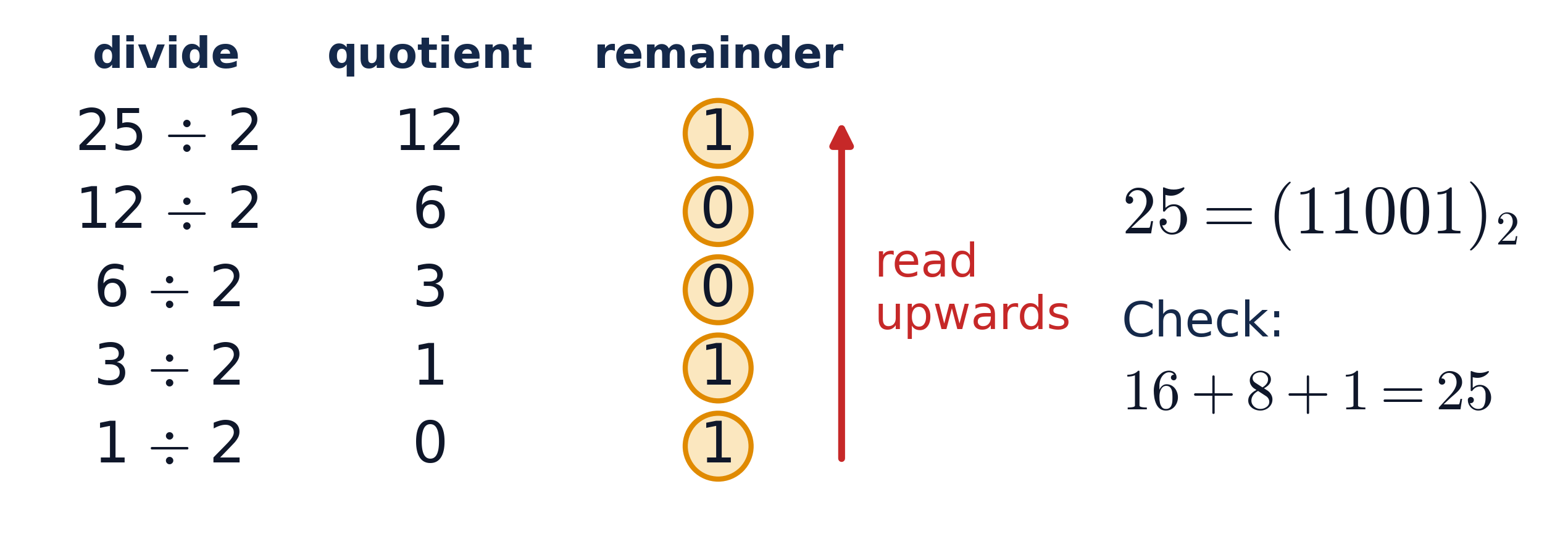
Check: 16 + 8 + 0 + 0 + 1 = 25.
A second way is to take out the largest power of 2 each time: 25 = 16 + 8 + 1, so there is a 1 in the places 16, 8 and 1, and a 0 in the places 4 and 2. This is quick when you know the powers of 2.
4. Numbers with a fractional part
After the binary point, the places are worth \frac{1}{2}, \frac{1}{4}, \frac{1}{8}, \dots
Binary to decimal. (0.101)_2 = \frac{1}{2} + 0 + \frac{1}{8} = 0.625.
Decimal to binary. Multiply the fraction by 2 again and again. Each time, write down the whole-number part (0 or 1) and carry on with the fraction part. Read the digits from the first to the last.
For 0.625: 0.625 \times 2 = 1.25, digit 1; 0.25 \times 2 = 0.5, digit 0; 0.5 \times 2 = 1.0, digit 1. So 0.625 = (0.101)_2.
For a number such as 13.375, change the whole part and the fractional part separately.
5. Arithmetic with binary numbers
Addition goes column by column from the right, as in decimal, with these rules:
| Sum in a column | Write | Carry |
|---|---|---|
| 0 + 0 | 0 | 0 |
| 0 + 1 | 1 | 0 |
| 1 + 1 | 0 | 1 |
| 1 + 1 + 1 | 1 | 1 |
The last two rows say that 1 + 1 = (10)_2 and 1 + 1 + 1 = (11)_2.
The safe route in the exam. For any sum, difference, product, HCF or LCM of binary numbers: change each number to decimal, calculate, and change the answer back. All three real questions in section 7 are done this way.
Four facts that save time:
- (111\ldots1)_2 with n ones is 2^n - 1. So (1111)_2 = 15.
- 1 followed by n zeros is 2^n. So (10000)_2 = 16.
- Writing a 0 at the right end doubles the number: (1011)_2 = 11 and (10110)_2 = 22.
- A binary number is even when its last digit is 0, and odd when it is 1.
6. Worked examples
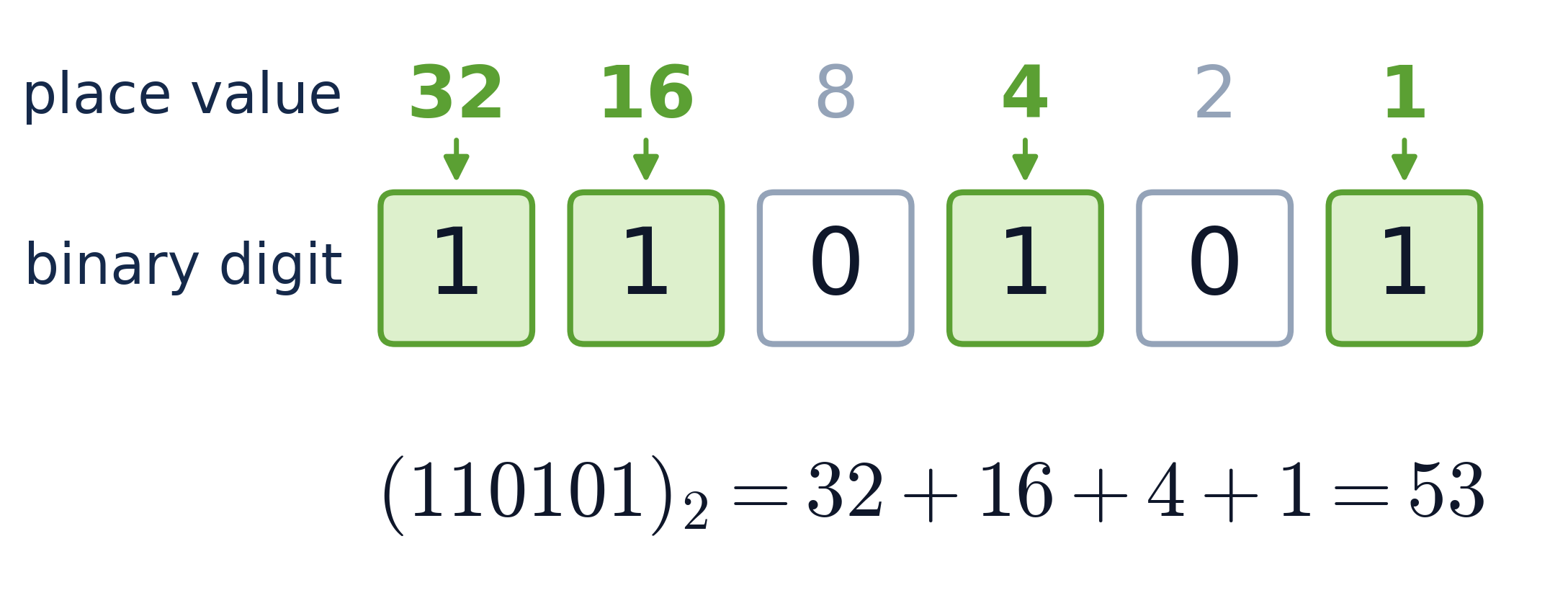
Example 1. Change (110101)_2 to decimal.
| Place value | 32 | 16 | 8 | 4 | 2 | 1 |
|---|---|---|---|---|---|---|
| Digit | 1 | 1 | 0 | 1 | 0 | 1 |
(110101)_2 = 32 + 16 + 4 + 1 = 53.
Example 2. Change 77 to binary.
| Division | Quotient | Remainder |
|---|---|---|
| 77 \div 2 | 38 | 1 |
| 38 \div 2 | 19 | 0 |
| 19 \div 2 | 9 | 1 |
| 9 \div 2 | 4 | 1 |
| 4 \div 2 | 2 | 0 |
| 2 \div 2 | 1 | 0 |
| 1 \div 2 | 0 | 1 |
Read the remainders from the bottom to the top: 77 = (1001101)_2. Check: 64 + 8 + 4 + 1 = 77.
Example 3. Change 13.375 to binary.
Whole part: 13 = 8 + 4 + 1 = (1101)_2. Fractional part: 0.375 \times 2 = 0.75, digit 0; 0.75 \times 2 = 1.5, digit 1; 0.5 \times 2 = 1.0, digit 1. So 0.375 = (0.011)_2 and 13.375 = (1101.011)_2.
Example 4. Add (11011)_2 and (1110)_2.
\begin{array}{r} 11011 \\ +\ \ 1110 \\ \hline 101001 \end{array}
From the right: 1 + 0 = 1. Then 1 + 1 = 10: write 0, carry 1. Then 0 + 1 + 1 = 10: write 0, carry 1. Then 1 + 1 + 1 = 11: write 1, carry 1. Then 1 + 1 = 10: write 0, carry 1. Write the last carry. The sum is (101001)_2.
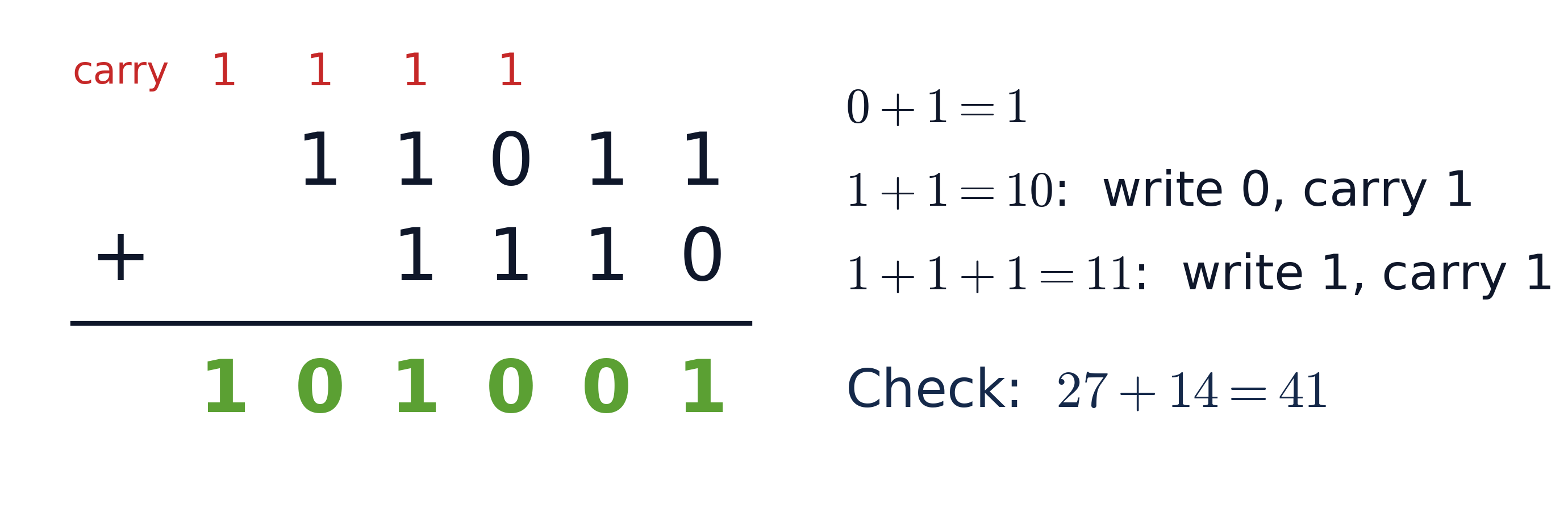
Check in decimal: 27 + 14 = 41, and (101001)_2 = 32 + 8 + 1 = 41.
Example 5. Find the product of (1101)_2 and (101)_2.
(1101)_2 = 13 and (101)_2 = 5. The product is 65 = 64 + 1 = (1000001)_2.
7. From the real papers
Try each question for two minutes before you read the solution. The exam's average is 75 seconds a question, but the conversions here take a little longer.
NDA II 2025, Q41. What is the sum of the binary numbers (101101101)_2 and (100011)_2?
(a) (110010000)_2 (b) (110001000)_2 (c) (110000100)_2 (d) (100100000)_2
Solution. (101101101)_2 = 256 + 64 + 32 + 8 + 4 + 1 = 365 and (100011)_2 = 32 + 2 + 1 = 35. The sum is 400. Now 400 = 256 + 128 + 16, which is (110010000)_2. Answer (a).
NDA II 2026, Q41. What is the LCM of (11110)_2, (10100)_2 and (11011)_2?
(a) (1000001100)_2 (b) (1000011100)_2 (c) (1000111100)_2 (d) (1000011101)_2
Solution. (11110)_2 = 30, (10100)_2 = 20 and (11011)_2 = 27. In prime factors: 30 = 2 \times 3 \times 5, 20 = 2^2 \times 5, 27 = 3^3. LCM = 2^2 \times 3^3 \times 5 = 540. Now 540 = 512 + 16 + 8 + 4, which is (1000011100)_2. Answer (b).
NDA I 2025, Q7. If x = (1111)_2, y = (1001)_2 and z = (110)_2, then what is x^3 - y^3 - z^3 - 3xyz equal to?
(a) (111001)_2 (b) (100111)_2 (c) (1)_2 (d) (0)_2
Solution. x = 15, y = 9, z = 6. Then x^3 - y^3 - z^3 - 3xyz = 3375 - 729 - 216 - 2430 = 0, which is (0)_2. A shorter way: x = y + z, so x + (-y) + (-z) = 0. When three numbers add up to zero, the sum of their cubes is three times their product. That gives x^3 - y^3 - z^3 = 3xyz at once. Answer (d).
Practice questions in the exam style
Only three real questions have been captured for this chapter. The three below are our own questions, not from a real paper.
Practice 1. What is the binary form of the decimal number 0.6875?
(a) (0.1011)_2 (b) (0.1101)_2 (c) (0.1001)_2 (d) (0.1110)_2
Solution. 0.6875 \times 2 = 1.375, digit 1; 0.375 \times 2 = 0.75, digit 0; 0.75 \times 2 = 1.5, digit 1; 0.5 \times 2 = 1.0, digit 1. So 0.6875 = (0.1011)_2. Check: \frac{1}{2} + \frac{1}{8} + \frac{1}{16} = 0.6875. Answer (a).
Practice 2. What is the product of (11011)_2 and (101)_2?
(a) (1000111)_2 (b) (10001011)_2 (c) (10000111)_2 (d) (10010111)_2
Solution. (11011)_2 = 27 and (101)_2 = 5. The product is 135 = 128 + 4 + 2 + 1, which is (10000111)_2. Answer (c).
Practice 3. What is (110010)_2 - (10111)_2 equal to?
(a) (11001)_2 (b) (11011)_2 (c) (11101)_2 (d) (10111)_2
Solution. (110010)_2 = 50 and (10111)_2 = 23. The difference is 27 = 16 + 8 + 2 + 1, which is (11011)_2. Answer (b).
8. Mistakes that cost marks
- Reading the remainders in the wrong order. For 25 the remainders come out as 1, 0, 0, 1, 1. Read from the last to the first: (11001)_2. Reading from the first gives (10011)_2, which is 19.
- Leaving out the place of a 0. In (1001)_2 the places are 8, 4, 2, 1, so the number is 8 + 1 = 9. Write the place values above every digit before adding.
- Reading the places after the point as tenths. (0.1)_2 is \frac{1}{2} = 0.5, not 0.1. And (0.11)_2 = \frac{1}{2} + \frac{1}{4} = 0.75.
- Writing 2 in a column. There is no digit 2 in binary. 1 + 1 is (10)_2: write 0 and carry 1.
9. Quick check
Do these without help. Answers are at the end.
- Change (10110)_2 to decimal.
- Change 37 to binary.
- Change (11.01)_2 to decimal.
- Add (1011)_2 and (111)_2. Give the answer in binary.
- Change 0.25 to binary.
10. Read and watch more, free
The mathematics textbooks of NCERT and NIOS do not teach binary numbers. The one official school text is in the computer science book, and it is in English only.
| What | Where | Language |
|---|---|---|
| Textbook | NCERT Class 11 Computer Science, Chapter 2 Encoding Schemes and Number System (sections 2.2 and 2.3; leave out the parts on octal and hexadecimal numbers, which NDA does not ask) | English |
| Short lesson with notes | Khan Academy: The binary number system | English |
| Video, the two conversions | Neso Academy: Decimal to Binary and Binary to Decimal Conversion (16 minutes) | English |
| Video, the chapter for NDA | Centurion Digital: Binary Number System, Complete Concept, NDA 1 2026 (56 minutes) | Hinglish |
| Video, past NDA questions solved | Chandigarh Career Group: NDA mathematics PYQ (the three videos on binary numbers) | Hinglish (judged from the titles) |
The videos were chosen from their titles, length and views; they have not yet been watched by a teacher.
Answers to the quick check
- 16 + 4 + 2 = 22.
- 37 = 32 + 4 + 1 = (100101)_2.
- 2 + 1 + \frac{1}{4} = 3.25.
- 11 + 7 = 18 = 16 + 2 = (10010)_2.
- 0.25 = \frac{1}{4} = (0.01)_2.
Next chapter: Progressions: AP, GP and HP.