Why this chapter matters. Quadratic equations gave 27 questions in the 7 papers from NDA II 2023 to NDA II 2026, about four in a paper. Very few of them ask you to solve an equation. They ask about the nature of the roots, about the sum and product of the roots, or about the least value of a quadratic expression. Six real questions are solved in section 8.
What you will be able to do
- Solve a quadratic equation by factors or by the formula.
- Tell the nature of the roots from the discriminant without solving.
- Use the sum and the product of the roots to answer questions without finding the roots.
- Find the least or greatest value of a quadratic expression.
Before you start you should know: how to factorise simple expressions, the number i and the conjugate of a complex number (Chapter M1-4), and the tests for AP, GP and HP (Chapter M1-6), which the exam mixes with this chapter.
1. The equation and its roots
A quadratic equation in x is an equation of the form
ax^2 + bx + c = 0 \qquad (a \ne 0)
where a, b, c are real numbers. A root is a value of x that satisfies the equation. A quadratic equation has exactly two roots. They may be equal, and they may not be real.
By factors. x^2 - 5x + 6 = 0 is (x - 2)(x - 3) = 0, so x = 2 or x = 3.
By the formula. When factors are not easy to see:
x = \frac{-b \pm \sqrt{b^2 - 4ac}}{2a}
For x^2 - 4x + 1 = 0: x = \dfrac{4 \pm \sqrt{16 - 4}}{2} = 2 \pm \sqrt{3}.
2. The discriminant and the nature of the roots
The number under the square root is called the discriminant: D = b^2 - 4ac. Its sign tells the nature of the roots at once.
| Discriminant | Roots | Example |
|---|---|---|
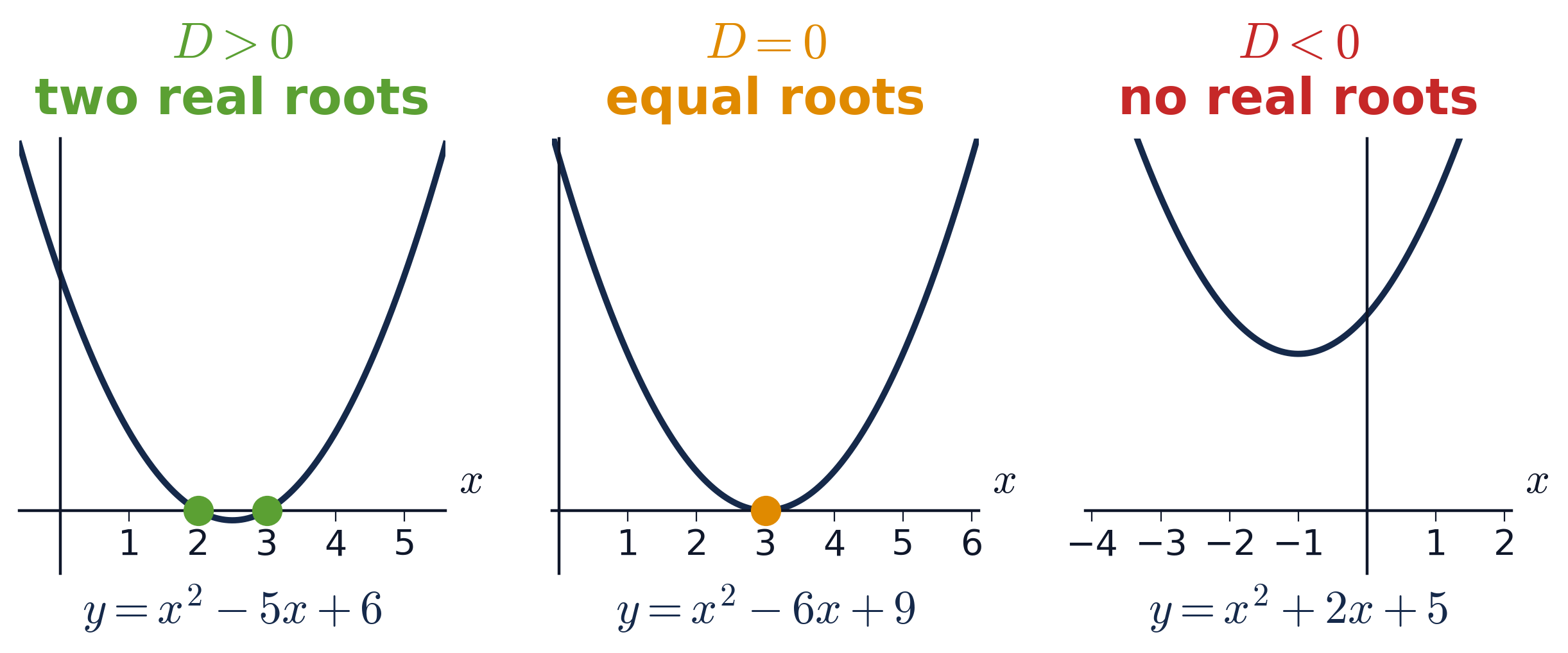
| D > 0 | real and unequal | x^2 - 5x + 6 = 0 has D = 1; roots 2 and 3 |
| D = 0 | real and equal; each root is -\dfrac{b}{2a} | x^2 - 6x + 9 = 0 has D = 0; roots 3 and 3 |
| D < 0 | not real; a pair of complex conjugates | x^2 + 2x + 5 = 0 has D = -16; roots -1 + 2i and -1 - 2i |
On a graph, the real roots are the points where the curve y = ax^2 + bx + c meets the x-axis. The picture shows the three examples of the table.
Three facts that are asked:
- If a, b, c are real and one root is p + iq, the other root is p - iq.
- If a, b, c are rational and one root is p + \sqrt{q} (with \sqrt{q} irrational), the other root is p - \sqrt{q}.
- If a, b, c are rational and D is the square of a rational number, the roots are rational.
3. Sum and product of the roots
Let the roots of ax^2 + bx + c = 0 be \alpha and \beta. Then
\alpha + \beta = -\frac{b}{a} \qquad\qquad \alpha\beta = \frac{c}{a}
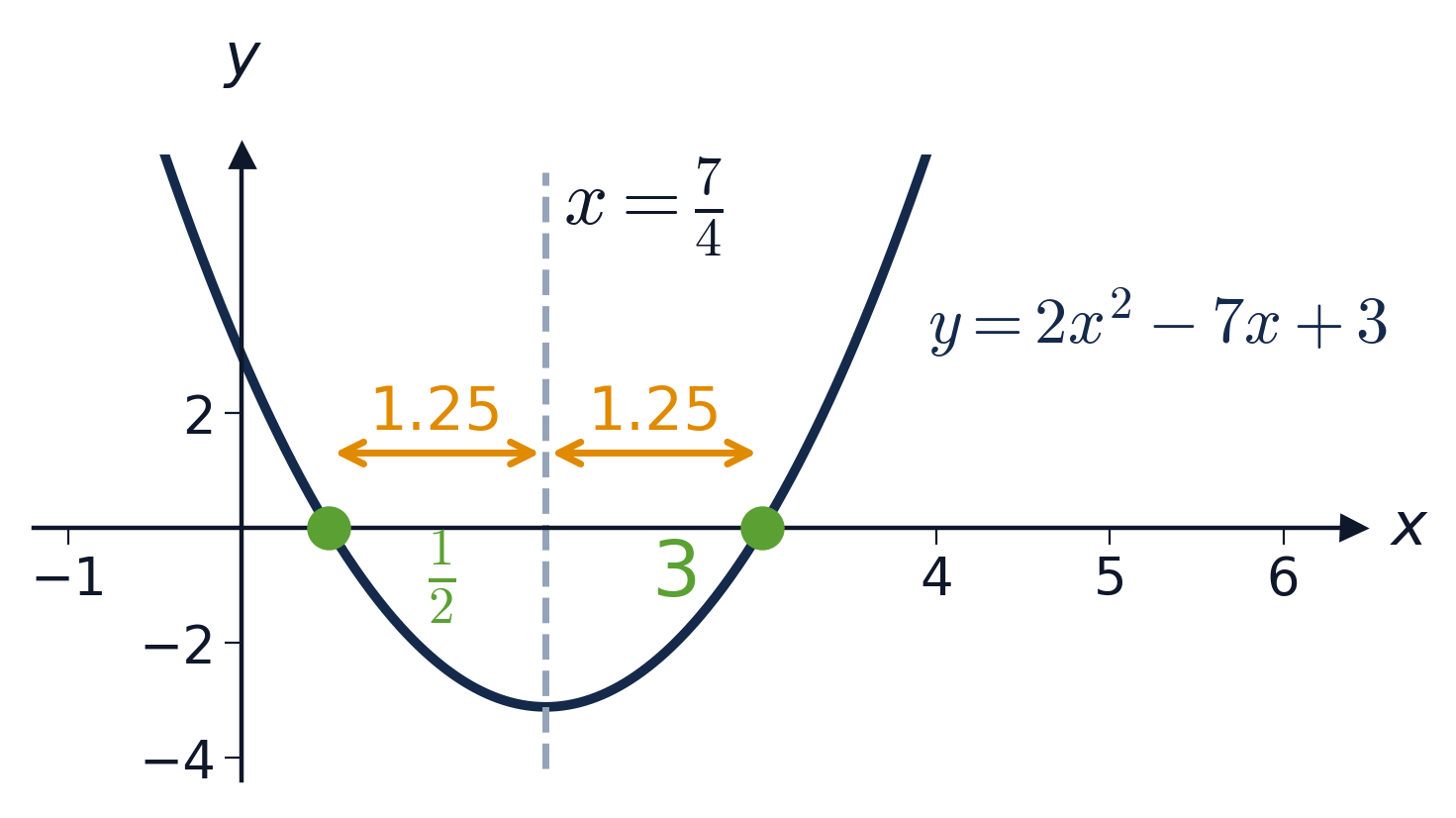
For 2x^2 - 7x + 3 = 0: the sum is \frac{7}{2} and the product is \frac{3}{2}. (The roots are 3 and \frac{1}{2}.)
Making an equation from its roots. If the sum of the roots is S and the product is P, the equation is
x^2 - Sx + P = 0
Other expressions in the roots. Write them with S = \alpha + \beta and P = \alpha\beta:
| Expression | In terms of S and P |
|---|---|
| \alpha^2 + \beta^2 | S^2 - 2P |
| (\alpha - \beta)^2 | S^2 - 4P |
| \alpha^3 + \beta^3 | S^3 - 3PS |
| \dfrac{1}{\alpha} + \dfrac{1}{\beta} | \dfrac{S}{P} |
4. Two tests that take five seconds
Look at the sum of the coefficients before you do anything else.
- If a + b + c = 0, then x = 1 is a root, and the other root is \dfrac{c}{a}. Example: 3x^2 - 5x + 2 = 0 has roots 1 and \frac{2}{3}.
- If a - b + c = 0, then x = -1 is a root, and the other root is -\dfrac{c}{a}. Example: 2x^2 + 5x + 3 = 0 has roots -1 and -\frac{3}{2}.
The first test works because putting x = 1 in ax^2 + bx + c gives a + b + c. The other root comes from the product of the roots.
5. The least or greatest value of a quadratic expression
Complete the square:
ax^2 + bx + c = a\left(x + \frac{b}{2a}\right)^2 - \frac{D}{4a}
A square is never negative. So:
- if a > 0, the expression has a least value -\dfrac{D}{4a}, at x = -\dfrac{b}{2a};
- if a < 0, the expression has a greatest value -\dfrac{D}{4a}, at x = -\dfrac{b}{2a}.
For example, x^2 - 6x + 13 = (x - 3)^2 + 4. Its least value is 4, at x = 3.
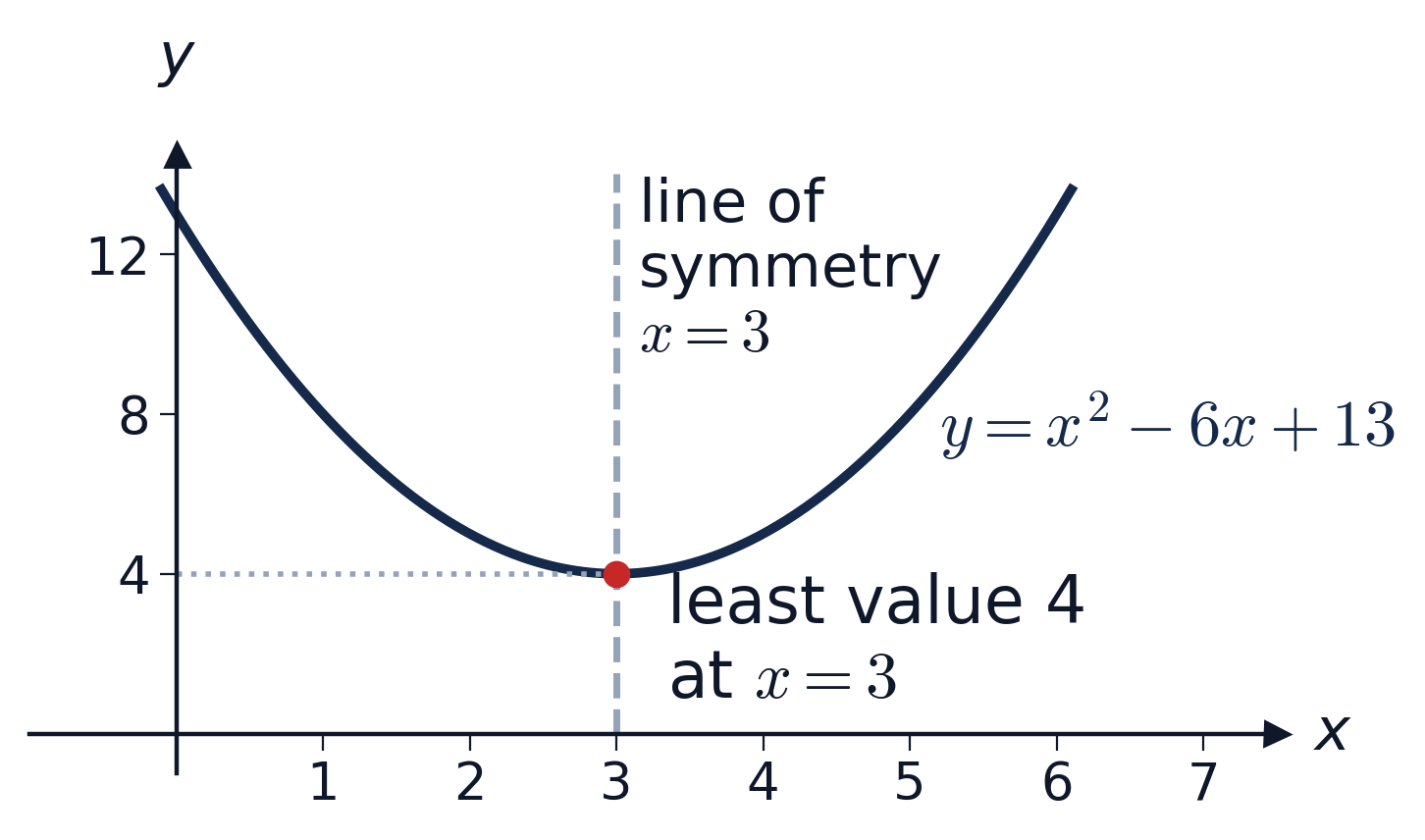
The graph of y = ax^2 + bx + c is a parabola. It is symmetric about the line x = -\dfrac{b}{2a}, so the two roots lie at equal distances on the two sides of this line.
6. Equations that become quadratic
Some equations are quadratic in a different quantity. Give that quantity a new name.
Solve x - 5\sqrt{x} + 6 = 0. Put t = \sqrt{x}, so x = t^2 and t \ge 0. Then t^2 - 5t + 6 = 0, so t = 2 or t = 3, and x = 4 or x = 9.
Always check the condition on t. In x + \sqrt{x} - 6 = 0 we get t^2 + t - 6 = 0, so t = 2 or t = -3. A square root cannot be negative, so only t = 2 is allowed and x = 4 is the only root.
7. Worked examples
Example 1. Solve 2x^2 - 7x + 3 = 0.
D = 49 - 24 = 25. So x = \dfrac{7 \pm 5}{4}, that is x = 3 or x = \dfrac{1}{2}.
Example 2. For what values of k does x^2 + kx + 9 = 0 have equal roots?
Equal roots need D = 0: k^2 - 36 = 0, so k = 6 or k = -6.
Example 3. \alpha and \beta are the roots of x^2 - 5x + 3 = 0. Find \alpha^2 + \beta^2, \alpha^3 + \beta^3 and \dfrac{1}{\alpha} + \dfrac{1}{\beta}.
Here S = 5 and P = 3. Do not find the roots.
- \alpha^2 + \beta^2 = S^2 - 2P = 25 - 6 = 19.
- \alpha^3 + \beta^3 = S^3 - 3PS = 125 - 45 = 80.
- \dfrac{1}{\alpha} + \dfrac{1}{\beta} = \dfrac{S}{P} = \dfrac{5}{3}.
Example 4. One root of a quadratic equation with rational coefficients is 2 + \sqrt{3}. Find the equation.
The other root is 2 - \sqrt{3}. Sum S = 4. Product P = 4 - 3 = 1. The equation is x^2 - 4x + 1 = 0.
Example 5. Find the least value of 2x^2 - 8x + 11.
2x^2 - 8x + 11 = 2(x^2 - 4x + 4) + 3 = 2(x - 2)^2 + 3. The least value is 3, at x = 2.
By the formula: D = 64 - 88 = -24, and -\dfrac{D}{4a} = \dfrac{24}{8} = 3.
8. From the real papers
Try each question for 75 seconds before reading the solution.
NDA II 2023, Q36. A quadratic equation is given by (a + b)x^2 - (a + b + c)x + k = 0, where a, b, c are real. If k = \frac{c}{2}, (c \ne 0), then the roots of the equation are :
(a) Real and equal (b) Real and unequal (c) Real iff a > c (d) Complex but not real
Solution. D = (a + b + c)^2 - 4(a + b) \times \dfrac{c}{2} = (a + b)^2 + 2(a + b)c + c^2 - 2(a + b)c = (a + b)^2 + c^2. This is a sum of squares, and c \ne 0, so D > 0. The roots are real and unequal. Answer (b).
NDA I 2024, Q8. If -\sqrt{2} and \sqrt{3} are roots of the equation a_0 + a_1x + a_2x^2 + a_3x^3 + x^4 = 0 where a_0, a_1, a_2, a_3 are integers, then which one of the following is correct?
(a) a_2 = a_3 = 0 (b) a_2 = 0 and a_3 = -5 (c) a_0 = 6, a_3 = 0 (d) a_1 = 0 and a_2 = 5
Solution. The coefficients are integers, so surd roots come in pairs: \sqrt{2} and -\sqrt{3} are also roots. That makes four roots, so the equation is (x^2 - 2)(x^2 - 3) = 0, that is x^4 - 5x^2 + 6 = 0. So a_0 = 6, a_1 = 0, a_2 = -5, a_3 = 0. Answer (c).
NDA I 2025, Q3. If one root of the equation x^2 - kx + k = 0 exceeds the other by 2\sqrt{3}, then which one of the following is a value of k?
(a) 3 (b) 6 (c) 9 (d) 12
Solution. S = k and P = k. Use (\alpha - \beta)^2 = S^2 - 4P: (2\sqrt{3})^2 = k^2 - 4k, so k^2 - 4k - 12 = 0 and (k - 6)(k + 2) = 0. So k = 6 or k = -2. Of these, 6 is among the options. Answer (b).
NDA II 2025, Q31. Consider the equation abx^2 + bcx + ca = cax^2 + abx + bc. If the roots of the equation are equal, then which one of the following is correct?
(a) ac = b^2 (b) a + c = 2b (c) \frac{1}{a} + \frac{1}{c} = \frac{1}{2b} (d) \frac{1}{a} + \frac{1}{c} = \frac{2}{b}
Solution. Bring everything to one side: a(b - c)x^2 + b(c - a)x + c(a - b) = 0. The coefficients add up to zero, so x = 1 is a root (section 4). The roots are equal, so both are 1 and their product is 1: \dfrac{c(a - b)}{a(b - c)} = 1. Then ca - cb = ab - ac, so 2ac = ab + bc. Divide by abc: \dfrac{2}{b} = \dfrac{1}{c} + \dfrac{1}{a}. Answer (d). (This says that a, b, c are in HP, which was the next question in the paper.)
NDA I 2026, Q42. For a given k, what is the minimum value of x^2 + kx + k^2?
(a) 0 (b) \frac{k^2}{4} (c) \frac{3k^2}{4} (d) \frac{k^2}{2}
Solution. Complete the square: x^2 + kx + k^2 = \left(x + \dfrac{k}{2}\right)^2 + \dfrac{3k^2}{4}. The square is zero at x = -\dfrac{k}{2}, so the least value is \dfrac{3k^2}{4}. Answer (c).
NDA II 2026, Q29. Let \alpha and \beta be the roots of the equation ax^2 + bx + c = 0 and p_n = \alpha^n + \beta^n, where n > 1. What is ap_{n+1} + bp_n + cp_{n-1} equal to?
(a) 0 (b) 1 (c) a + b + c (d) a - b + c
Solution. Collect the \alpha terms and the \beta terms: the expression is \alpha^{n-1}(a\alpha^2 + b\alpha + c) + \beta^{n-1}(a\beta^2 + b\beta + c). A root satisfies its equation, so both brackets are zero. Answer (a).
Notice that none of the six questions needed the formula for the roots.
9. Mistakes that cost marks
- The sign of the sum. The sum of the roots is -\dfrac{b}{a}, with a minus sign. For x^2 - 5x + 3 = 0 the sum is +5, not -5.
- Forgetting to divide by a. For 2x^2 - 6x + 1 = 0 the product of the roots is \dfrac{1}{2}, not 1.
- Keeping a root that is not allowed. After a substitution such as t = \sqrt{x}, throw away any negative value of t. Put each answer back in the first equation.
- Saying "no roots" when D < 0. The equation still has two roots; they are not real. Read whether the question asks for real roots or for all roots.
10. Quick check
Do these without help. Answers are at the end.
- Solve x^2 - 7x + 12 = 0.
- What is the nature of the roots of 3x^2 - 4x + 2 = 0?
- \alpha and \beta are the roots of 2x^2 - 6x + 1 = 0. Find \alpha^2 + \beta^2.
- Write the quadratic equation whose roots are 3 and -5.
- Find the greatest value of 5 + 4x - x^2.
11. Read and watch more, free
| What | Where | Language |
|---|---|---|
| Self-study notes, the main text for this chapter | NIOS Mathematics, Lesson 9 Quadratic Equations and Linear Inequalities · Hindi edition | English, Hindi |
| Textbook | NCERT Class 11 Mathematics, Chapter 4 Complex Numbers and Quadratic Equations · Hindi edition. The present edition teaches complex numbers but has no separate section on quadratic equations, so read the NIOS lesson first | English, Hindi |
| Video, the chapter for NDA | Defence Wallah: Complete Maths, Fast Track Series (the lesson "Quadratic", 1 to 2 hours) | Hinglish |
| Video, with past questions | Doon Defence Dreamers: NDA Maths One Shot (the video "Quadratic"; it is many hours long) | Hinglish |
| Video, one idea at a time | Mohit Tyagi: Quadratic (short lessons of about 10 minutes; they go deeper than NDA needs) | Hinglish |
| Past NDA questions with answers | ExamSIDE: Quadratic Equations and Inequalities | English |
The videos were chosen from their titles, length and views; they have not yet been watched by a teacher.
Answers to the quick check
- (x - 3)(x - 4) = 0, so x = 3 or x = 4.
- D = 16 - 24 = -8 < 0. The roots are not real; they are a pair of complex conjugates.
- S = 3 and P = \frac{1}{2}, so \alpha^2 + \beta^2 = 9 - 1 = 8.
- S = -2 and P = -15, so the equation is x^2 + 2x - 15 = 0.
- 5 + 4x - x^2 = 9 - (x - 2)^2. The greatest value is 9, at x = 2.
Next chapter: Linear inequations in two variables.