Why this chapter matters. This is a small chapter. It gave 1 question in the 7 papers from NDA II 2023 to NDA II 2026 (NDA II 2026, Q50). The question asked in which quadrants the solution of two inequations lies. The chapter is in the syllabus, so a question can come in any paper, and the method is short. The real question is solved in section 7, and four practice questions in the same style follow it.
What you will be able to do
- Solve a linear inequation and know when the sign turns round.
- Show the solution of a linear inequation in two variables as a region of the plane.
- Find the common region of two or more inequations and its corner points.
- Say in which quadrants a solution region lies, without a careful drawing.
Before you start you should know: how to draw a straight line such as x + y = 4 from two points, and the four quadrants of the plane (Class 9 and 10 work). The number line of Chapter M1-3 is also used.
1. Inequations and their rules
An inequation (also called an inequality) is a statement with one of the signs <, >, \le, \ge. A solution is a value that makes the statement true.
You may work on an inequation almost as on an equation:
- You may add the same number to both sides, or take the same number away.
- You may multiply or divide both sides by the same positive number.
- If you multiply or divide both sides by a negative number, the sign turns round.
For example, -3x \ge 12. Divide by -3 and turn the sign: x \le -4.
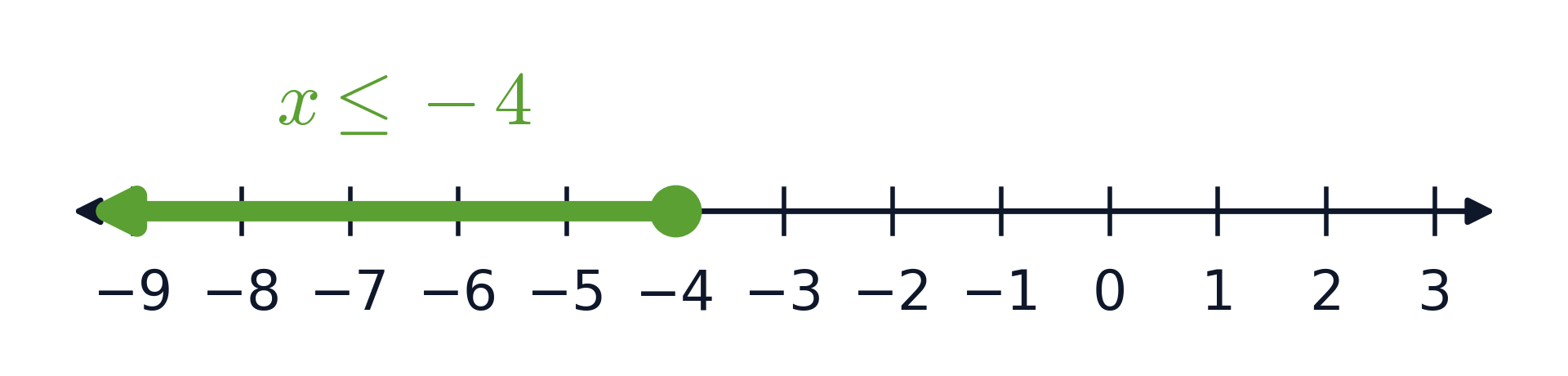
A quick check of the third rule: 2 < 5 is true, but after multiplying by -1 we need -2 > -5.
2. One inequation in two variables
A linear inequation in two variables looks like ax + by \le c (or with <, >, \ge). A solution is a pair (x, y). For example, (1, 2) is a solution of 2x + y \le 6 because 2 + 2 = 4 \le 6.
There are too many solutions to list. We show them on a graph.
The line ax + by = c cuts the plane into two half planes. All the points on one side satisfy ax + by < c. All the points on the other side satisfy ax + by > c. So the solution of the inequation is one whole side of the line.
The four steps.
| Step | What to do |
|---|---|
| 1 | Write the sign as = and draw that line. Two points are enough; the points where it cuts the axes are the easiest |
| 2 | Draw the line solid if the sign is \le or \ge (points on the line are solutions). Draw it dashed if the sign is < or > (points on the line are not solutions) |
| 3 | Take a test point that is not on the line. The origin (0, 0) is the easiest. Put it in the inequation |
| 4 | If the statement is true, shade the side that contains the test point. If it is false, shade the other side |
If the line passes through the origin, the origin cannot be the test point. Use (1, 0) or (0, 1).
3. A system of inequations
A system is two or more inequations that must all be true together. Shade the region for each one. The solution of the system is the part that is shaded every time: the common region.
Two inequations come very often:
- x \ge 0 means "on the y-axis or to its right".
- y \ge 0 means "on the x-axis or above it".
Together, x \ge 0 and y \ge 0 keep only the first quadrant and its edges.
A corner point of the region is a point where two of the boundary lines meet. Find it by solving the two equations together.
A region is bounded if a circle can be drawn round it. If it goes on for ever in some direction, it is unbounded. If no point satisfies all the inequations, the solution is empty.
4. Quadrants
Many questions ask where the region lies. The signs of x and y decide the quadrant.
| Quadrant | Sign of x | Sign of y | A point in it |
|---|---|---|---|
| First | + | + | (2, 3) |
| Second | - | + | (-2, 3) |
| Third | - | - | (-2, -3) |
| Fourth | + | - | (2, -3) |
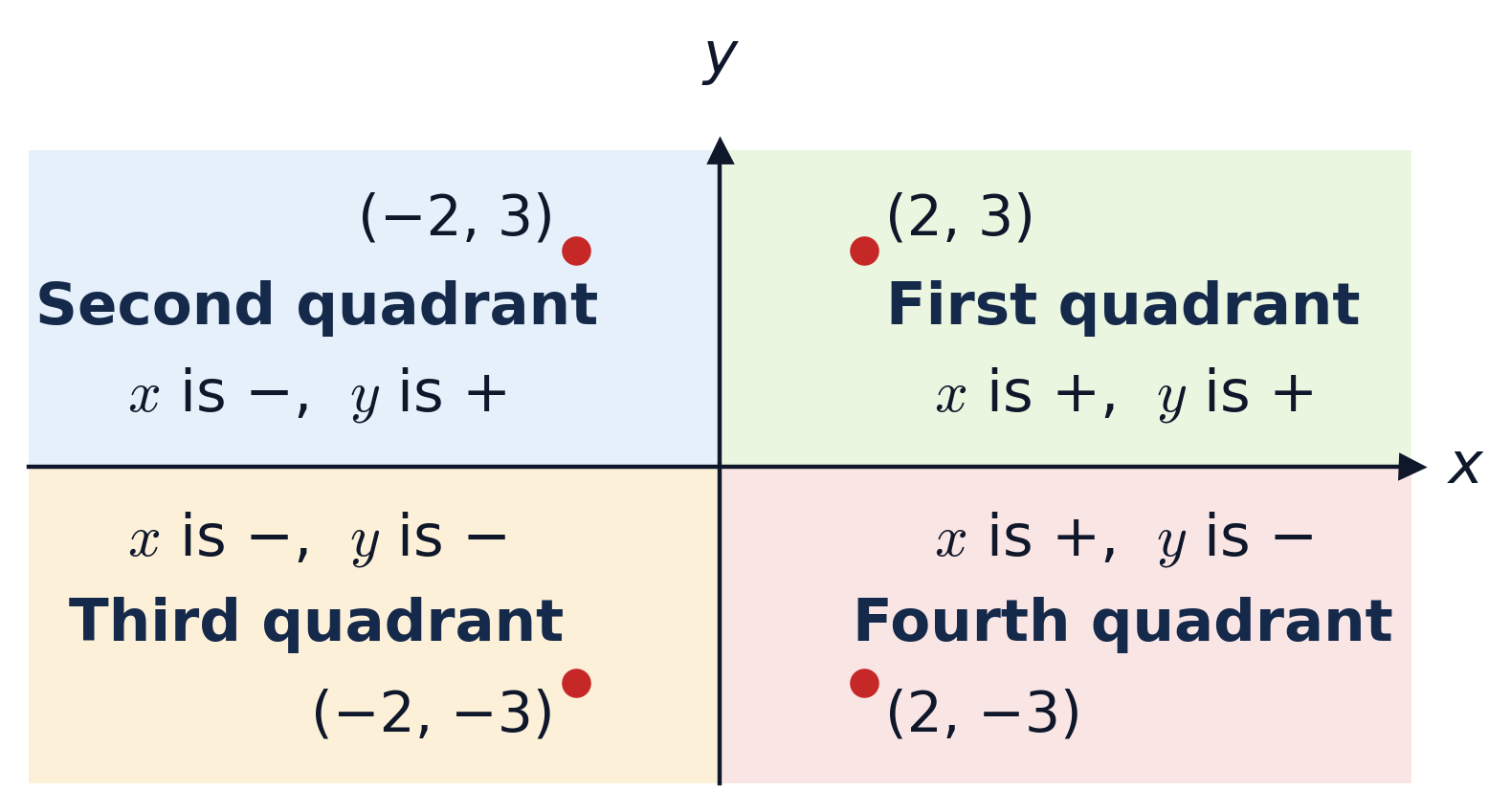
To show that a region reaches a quadrant, find one solution in that quadrant. To show that it does not, show that x or y cannot have the needed sign.
5. Worked examples
Draw each of these on squared paper as you read.
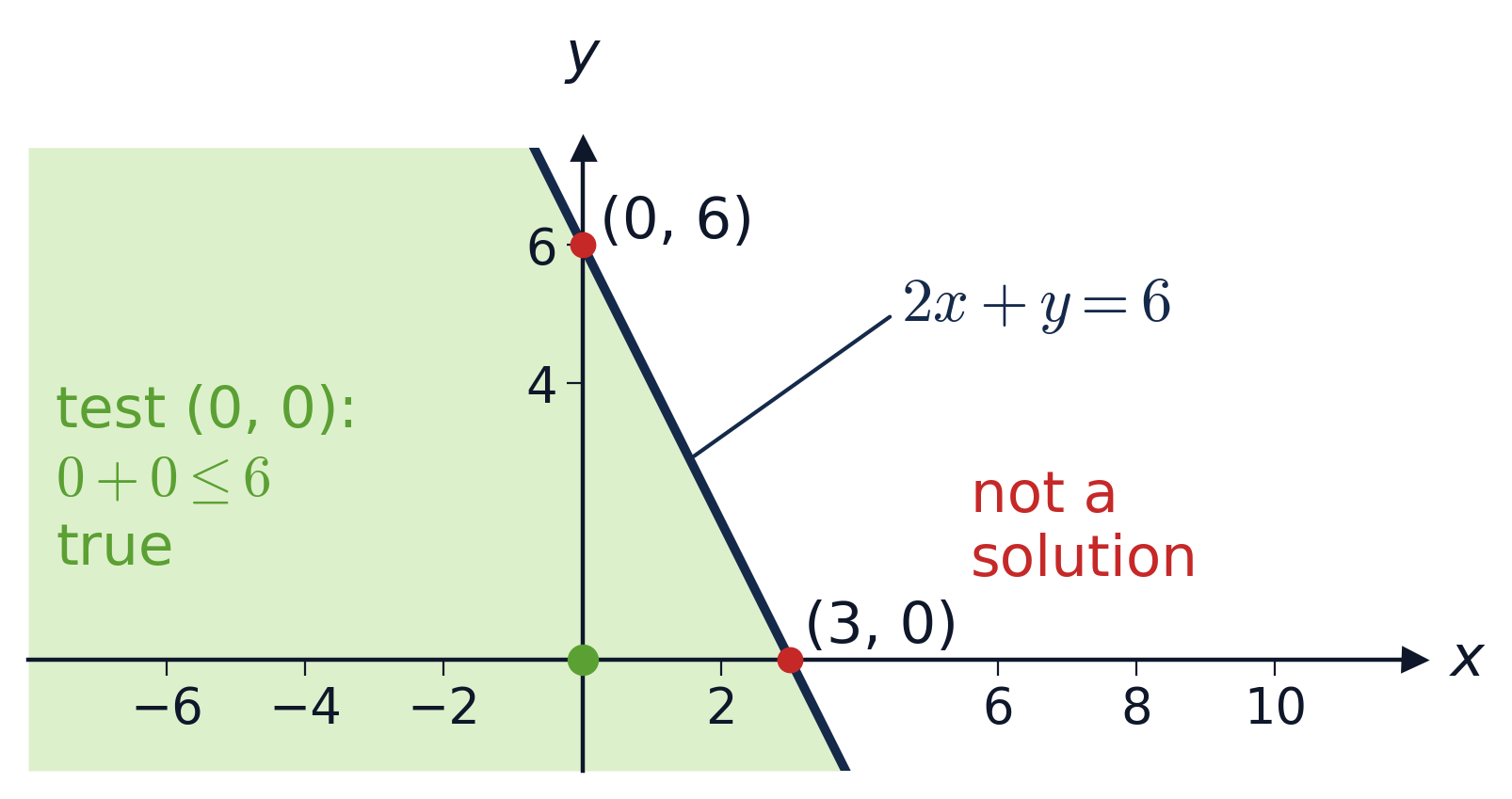
Example 1. Show the solution of 2x + y \le 6.
The line 2x + y = 6 cuts the axes at (3, 0) and (0, 6). The sign is \le, so the line is solid. Test the origin: 0 + 0 \le 6 is true. Shade the side of the line that contains the origin. The solution is that half plane together with the line.
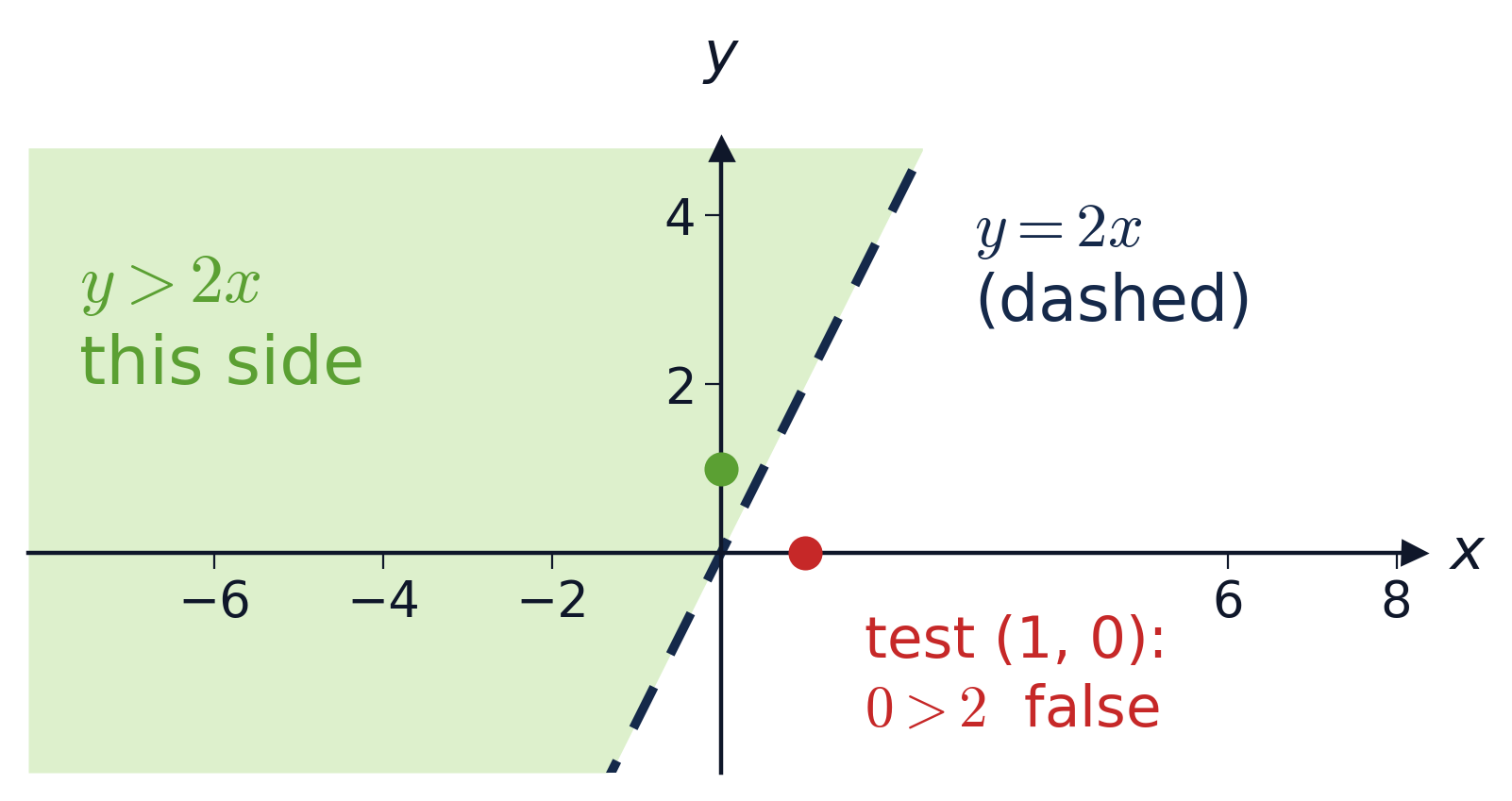
Example 2. Show the solution of y > 2x.
The line y = 2x passes through (0, 0) and (1, 2). The sign is >, so the line is dashed. The origin is on the line, so test (1, 0): 0 > 2 is false. Shade the side that does not contain (1, 0), which is the side containing (0, 1).
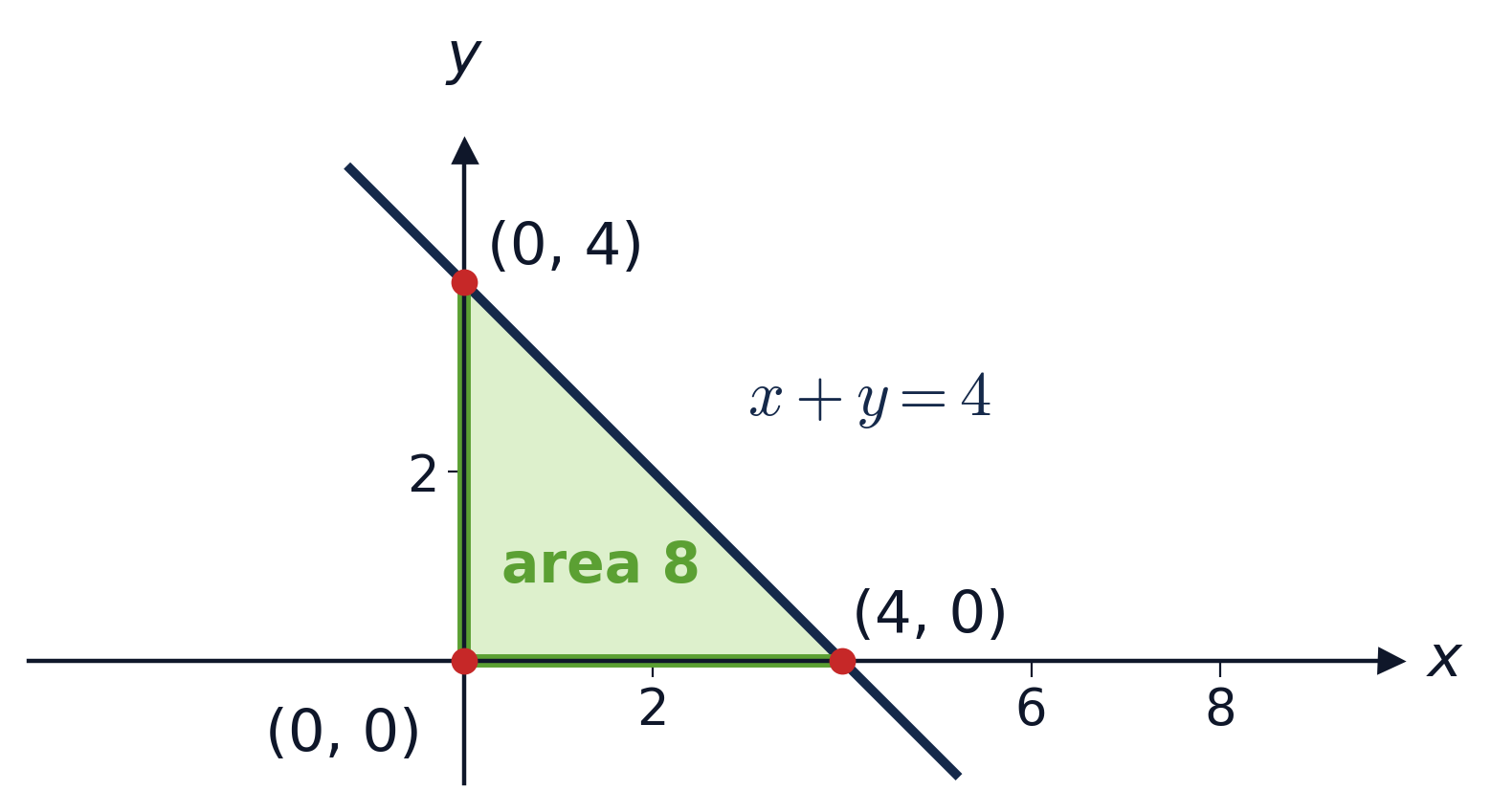
Example 3. Find the region x + y \le 4, x \ge 0, y \ge 0, and its area.
The line x + y = 4 cuts the axes at (4, 0) and (0, 4). The origin satisfies x + y \le 4, so we want the origin side. With x \ge 0 and y \ge 0 the common region is a triangle with corners (0, 0), (4, 0) and (0, 4). It is bounded. Its area is \frac{1}{2} \times 4 \times 4 = 8 square units.
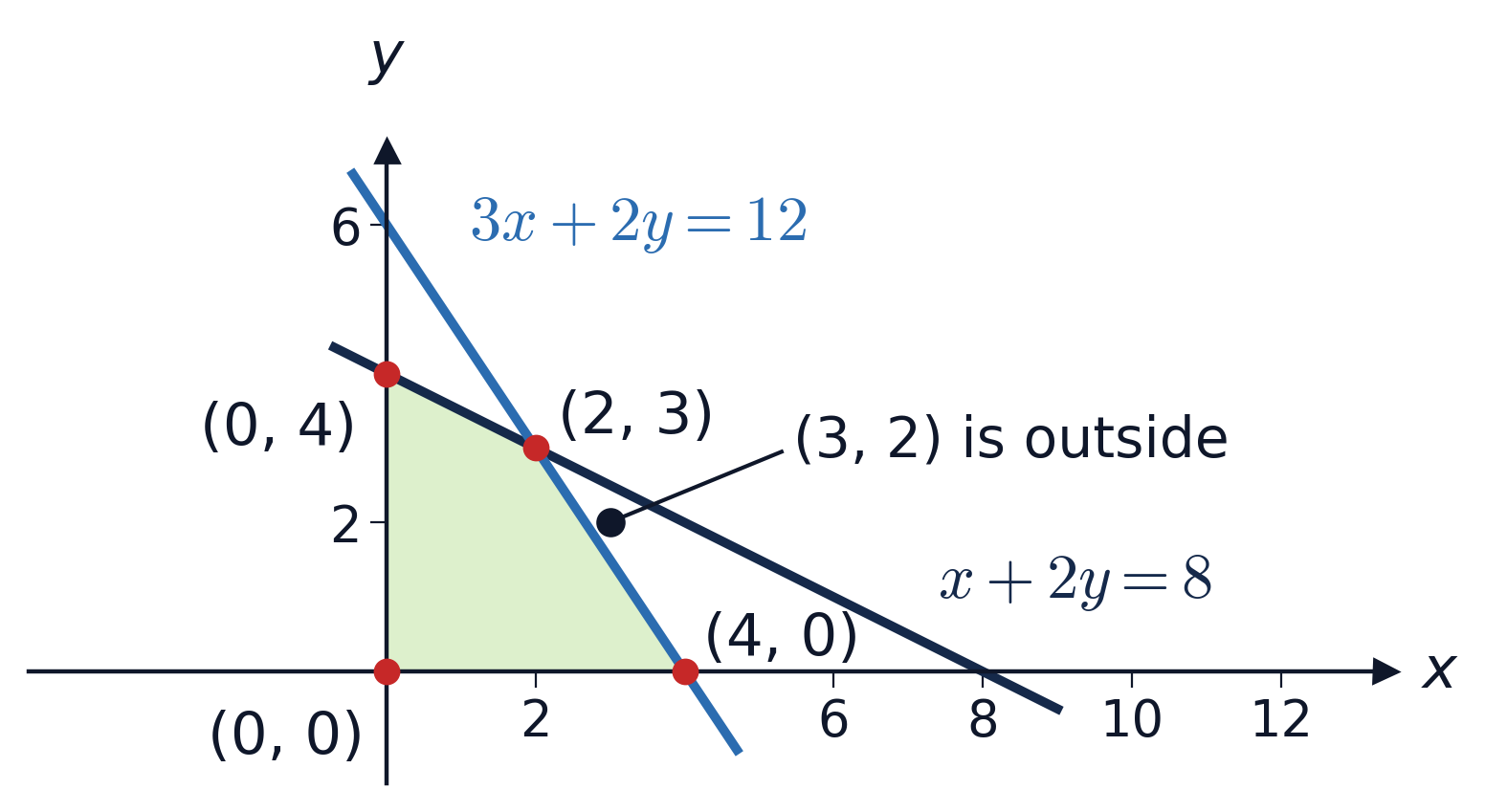
Example 4. Find the corner points of the region x + 2y \le 8, 3x + 2y \le 12, x \ge 0, y \ge 0. Is (3, 2) in the region?
The first line cuts the axes at (8, 0) and (0, 4). The second cuts them at (4, 0) and (0, 6). The origin satisfies both, so the region is on the origin side of both lines, in the first quadrant.
The two lines meet where x + 2y = 8 and 3x + 2y = 12. Subtract: 2x = 4, so x = 2 and y = 3.
The corner points are (0, 0), (4, 0), (2, 3) and (0, 4).
For (3, 2): 3 + 4 = 7 \le 8 is true, but 9 + 4 = 13 \le 12 is false. So (3, 2) is not in the region. A point must satisfy every inequation.
6. A way to answer without a drawing
In the exam there is no time for a careful graph. Two short ways:
- Test the points. If the options are points, put each point in every inequation.
- Make y the subject. x + y \ge 5 is y \ge 5 - x: "on or above the line". x - y \le 3 is y \ge x - 3: again "on or above the line". A rough sketch of the two lines then shows the region.
7. From the real papers
Only one question on this chapter is in the seven papers captured so far.
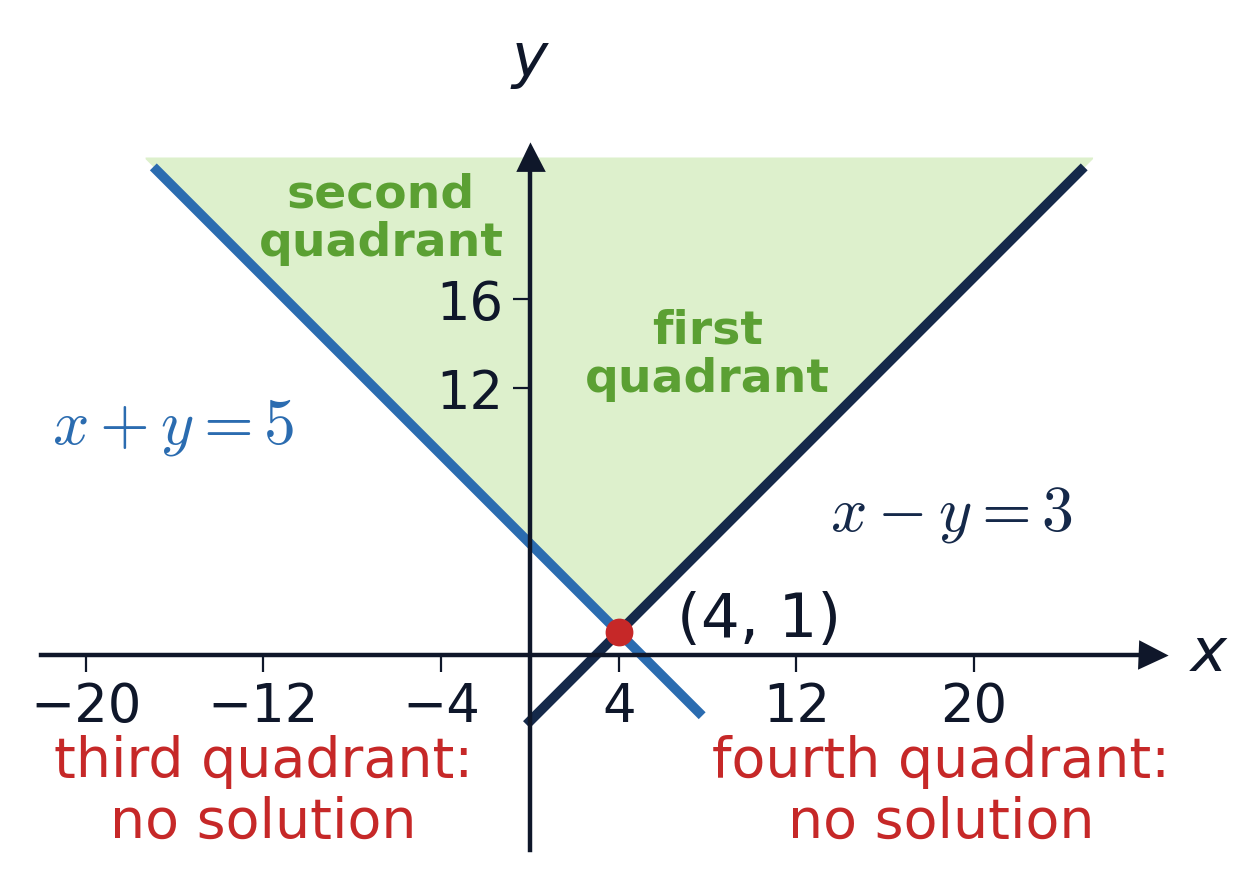
NDA II 2026, Q50. Consider the following system of linear inequalities : x - y \le 3 and x + y \ge 5 The solution of the inequalities lies in
(a) first quadrant only (b) second quadrant only (c) both first quadrant and second quadrant only (d) all the four quadrants
Solution. Write them as y \ge x - 3 and y \ge 5 - x. The two lines meet at (4, 1). For a solution, y must be at least as large as both x - 3 and 5 - x. To the right of x = 4 the first is more than 1. To the left of x = 4 the second is more than 1. So every solution has y \ge 1, and no solution lies in the third or the fourth quadrant. There are solutions with x > 0, such as (4, 2), and with x < 0, such as (-1, 10). So the region lies in the first and second quadrants only. Answer (c).
8. Practice questions in the exam style
These four questions are our own. They are not from a real paper.
Practice 1. Which one of the following points lies in the solution region of 2x + 3y \le 12 and x - y \ge 1?
(a) (1, 3) (b) (3, 1) (c) (0, 0) (d) (4, 2)
Solution. Test each point in both. (1, 3): 1 - 3 = -2, not \ge 1. (3, 1): 6 + 3 = 9 \le 12 and 3 - 1 = 2 \ge 1, both true. (0, 0): 0 \ge 1 is false. (4, 2): 8 + 6 = 14, not \le 12. Answer (b).
Practice 2. What is the area of the region given by x + y \le 6, x \ge 0, y \ge 0?
(a) 12 square units (b) 18 square units (c) 24 square units (d) 36 square units
Solution. The region is a triangle with corners (0, 0), (6, 0) and (0, 6). Area = \frac{1}{2} \times 6 \times 6 = 18. Answer (b).
Practice 3. The solution region of the system x + y \ge 4 and x + y \le 2 is
(a) a bounded region (b) an unbounded region (c) a straight line (d) empty
Solution. No number x + y can be at least 4 and at most 2 at the same time. The two half planes have no common point. Answer (d).
Practice 4. The solution of the inequations y \le x - 2 and y \le -x - 2 lies in
(a) first and second quadrants only (b) third and fourth quadrants only (c) fourth quadrant only (d) all the four quadrants
Solution. The two lines meet at (0, -2). For a solution, y must be no larger than both x - 2 and -x - 2. One of these is always -2 or less, so every solution has y \le -2. There are solutions with x > 0, such as (1, -4), and with x < 0, such as (-1, -4). Answer (b).
9. Mistakes that cost marks
- Not turning the sign. Dividing -2x > 6 by -2 gives x < -3, not x > -3.
- Testing the origin when the line passes through it. For y > 2x the origin is on the line and tells you nothing. Use (1, 0).
- Forgetting whether the line itself is included. With \le or \ge the points on the line are solutions. With < or > they are not.
- Taking a point that satisfies only one inequation. In a system, a solution must satisfy all of them.
10. Quick check
Do these without help. Answers are at the end.
- Solve -3x \ge 12.
- Is (2, 1) a solution of 3x - 2y < 5?
- Is the boundary line of x + y > 3 drawn solid or dashed?
- On which side of the line 2x + 5y = 10 does the solution of 2x + 5y \ge 10 lie: the side with the origin or the other side?
- Write the corner points of the region x + y \le 5, x \ge 0, y \ge 0.
11. Read and watch more, free
| What | Where | Language |
|---|---|---|
| Textbook | NCERT Class 11 Mathematics, Chapter 5 Linear Inequalities · Hindi edition | English, Hindi |
| Self-study notes | NIOS Mathematics, Lesson 9 Quadratic Equations and Linear Inequalities · Hindi edition | English, Hindi |
| Lessons with exercises | Khan Academy, NCERT Math Class 11: English · Hindi (the unit on linear inequalities) | English, Hindi |
| Video, short school lessons | Khan Academy India: कक्षा 11 एनसीईआरटी गणित (the lessons on linear inequalities) | Hindi |
| Video, every textbook problem | Magnet Brains: Class 11 Maths (Chapter 5) | Hinglish |
| Video, Hindi medium | Learn and Share: कक्षा 11 गणित (the chapter on linear inequalities; it follows the older textbook) | Hindi |
The videos were chosen from their titles, length and views; they have not yet been watched by a teacher.
Answers to the quick check
- x \le -4.
- Yes: 6 - 2 = 4 and 4 < 5.
- Dashed, because the sign is > and the points on the line are not solutions.
- The other side. The origin gives 0 \ge 10, which is false.
- (0, 0), (5, 0) and (0, 5).
Next chapter: Permutations and combinations.