Why this chapter matters. Sets gave 10 questions in the 7 papers from NDA II 2023 to NDA II 2026: one or two in six of the seven papers. They are of two kinds. In the first, you simplify an expression such as (A \cup B) - (A - B) or decide which of two or three statements is true. In the second, you count people in a survey ("how many like both?"). Both kinds are quick if you can picture the regions of a Venn diagram. Five real questions are solved in section 8.
What you will be able to do
- Write a set, and tell an element (\in) from a subset (\subset).
- Find the union, intersection, difference and complement of sets, and show them on a Venn diagram.
- Use De Morgan's laws and the other laws to simplify a set expression.
- Solve counting problems on two or three sets with the formula for n(A \cup B).
Before you start you should know: the natural numbers, the integers, and how to read the signs < and \le. This is the first chapter of the course; nothing earlier is needed.
1. What a set is
A set is a well-defined collection of objects, called its elements. "Well-defined" means we can say clearly whether any object is in the set or not. There are two ways to write a set.
- Roster form: list the elements inside braces. A = \{1, 2, 3, 4, 5\}.
- Set-builder form: give the rule. A = \{x : x \text{ is a natural number and } x < 6\}.
We write 3 \in A ("3 belongs to A") and 7 \notin A. The order of the elements does not matter.
The set with no elements is the empty set (or null set), written \phi or \{\ \}. The number of elements of a finite set A is written n(A). Here n(A) = 5.
2. Subsets
A is a subset of B, written A \subset B, if every element of A is also in B. For example, \{1, 2\} \subset \{1, 2, 3\}.
- Every set is a subset of itself, and \phi is a subset of every set.
- A set with n elements has 2^n subsets. The set of all subsets of A is called the power set of A.
For example, \{a, b\} has 2^2 = 4 subsets: \phi, \{a\}, \{b\} and \{a, b\}.
Do not mix the two signs. \in joins an element to a set. \subset joins a set to a set. So 1 \in \{1, 2\} and \{1\} \subset \{1, 2\} are both true, but \{1\} \in \{1, 2\} is false.
3. Operations on sets
All the sets in one problem are taken from a large fixed set called the universal set, U.
Take U = \{1, 2, \dots, 10\}, A = \{1, 2, 3, 4, 5\} and B = \{4, 5, 6, 7\}.
| Operation | Symbol | Meaning | In the example |
|---|---|---|---|
| Union | A \cup B | elements in A or in B (or in both) | \{1, 2, 3, 4, 5, 6, 7\} |
| Intersection | A \cap B | elements in both A and B | \{4, 5\} |
| Difference | A - B | elements in A but not in B | \{1, 2, 3\} |
| Difference | B - A | elements in B but not in A | \{6, 7\} |
| Complement | A' or A^c | elements of U not in A | \{6, 7, 8, 9, 10\} |
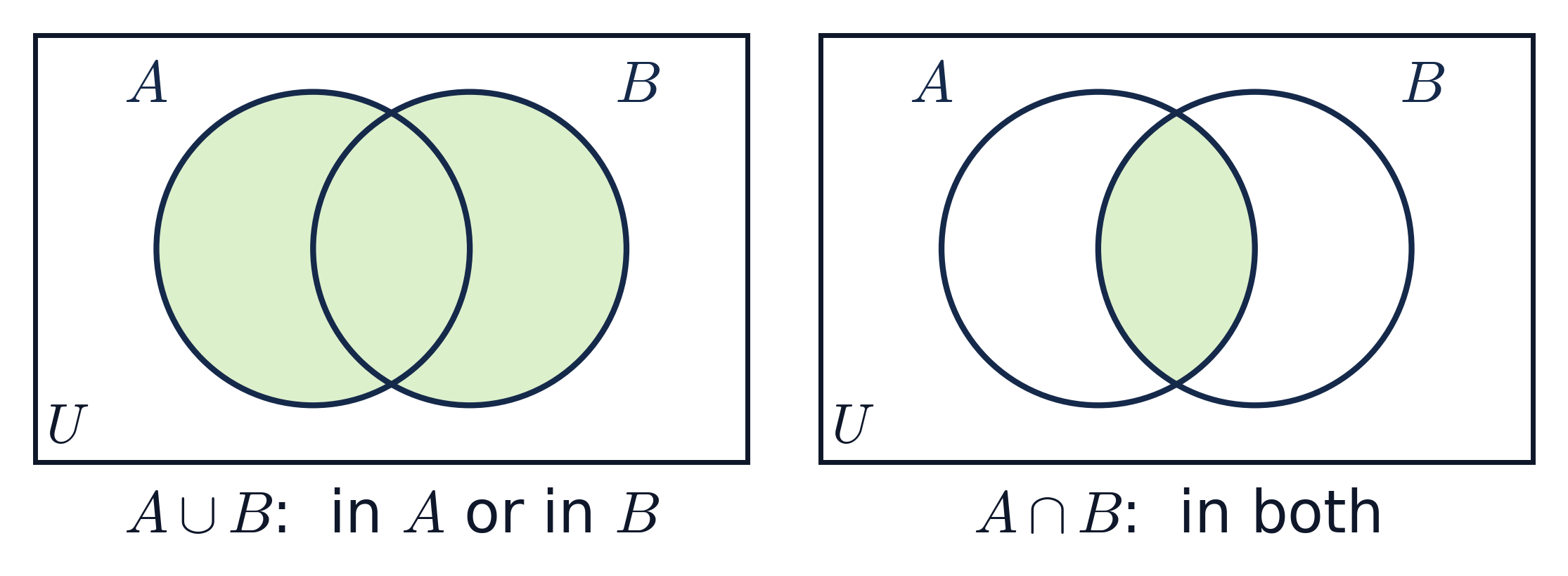
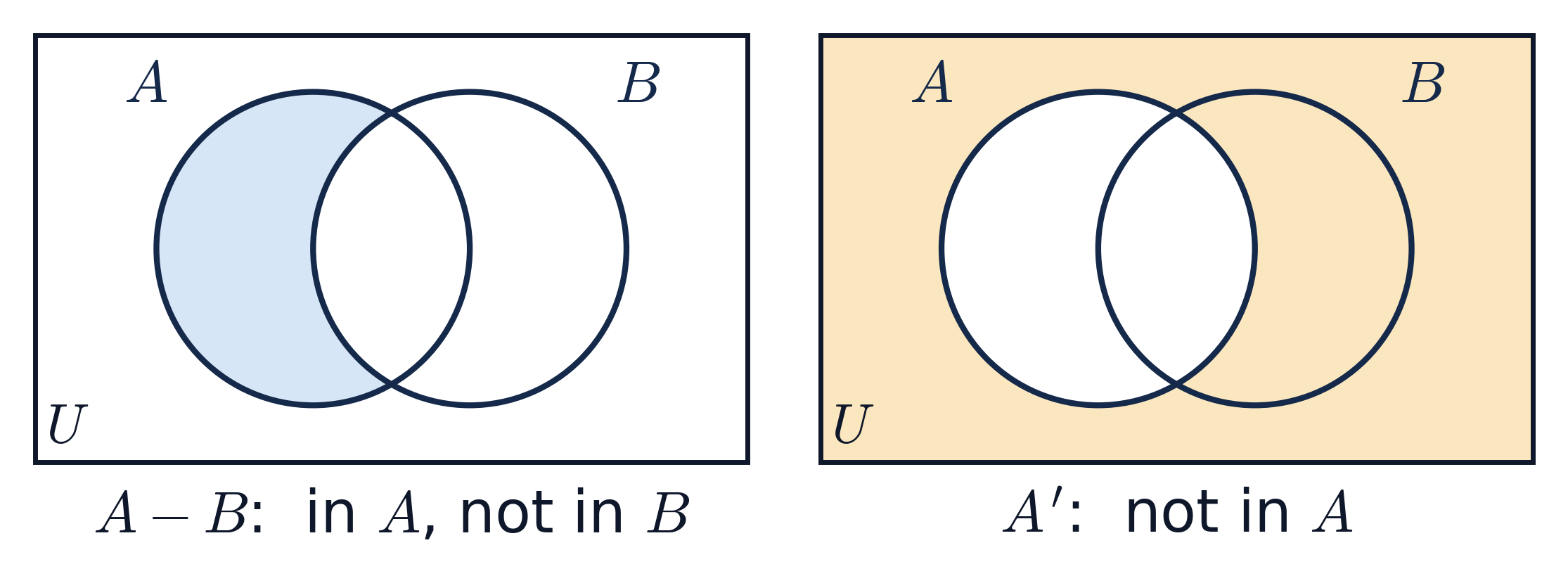
Two sets with no common element are called disjoint: A \cap B = \phi.
4. The Venn diagram
Draw a rectangle for U. Inside it draw two circles, A and B, that overlap. The picture has four separate regions.
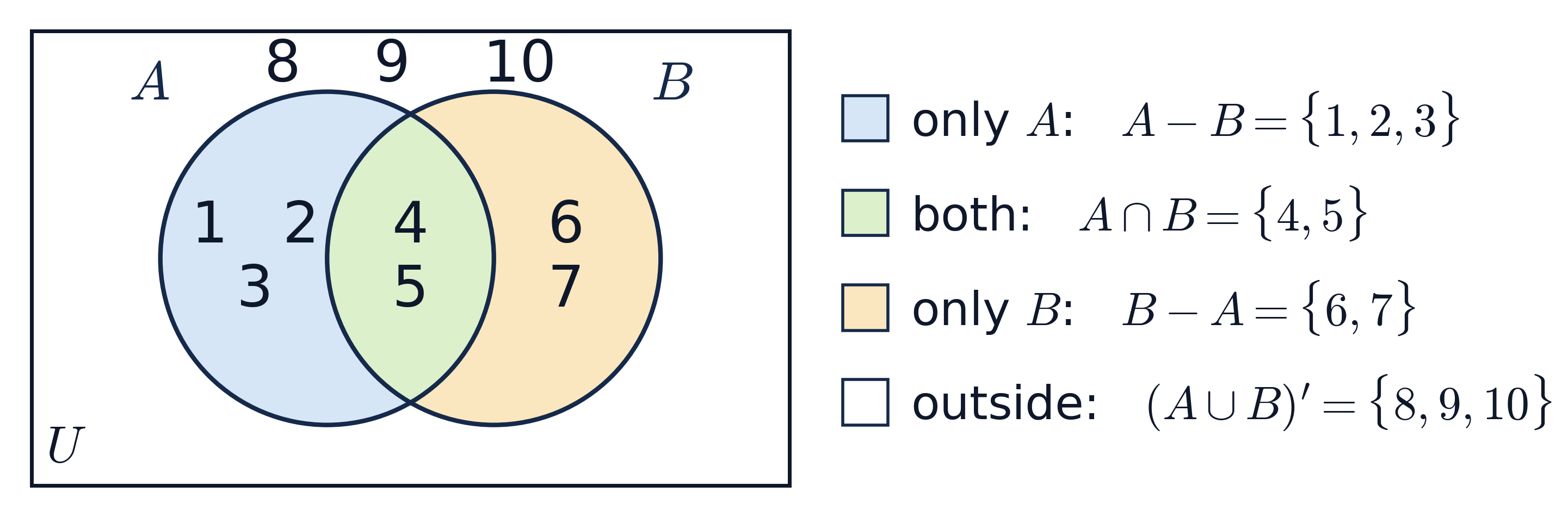
| Region | In symbols | In the example |
|---|---|---|
| Only in A | A - B | \{1, 2, 3\} |
| In both | A \cap B | \{4, 5\} |
| Only in B | B - A | \{6, 7\} |
| Outside both circles | (A \cup B)' | \{8, 9, 10\} |
Three facts can be read from the picture, and the exam uses them again and again:
- A = (A - B) \cup (A \cap B): the circle A is its "only A" part and the common part.
- A \cup B = (A - B) \cup (A \cap B) \cup (B - A): the union is the three regions inside the circles.
- A - B = A \cap B': "in A and not in B".
5. Laws to remember
| Law | Statement |
|---|---|
| Distributive | A \cup (B \cap C) = (A \cup B) \cap (A \cup C) and A \cap (B \cup C) = (A \cap B) \cup (A \cap C) |
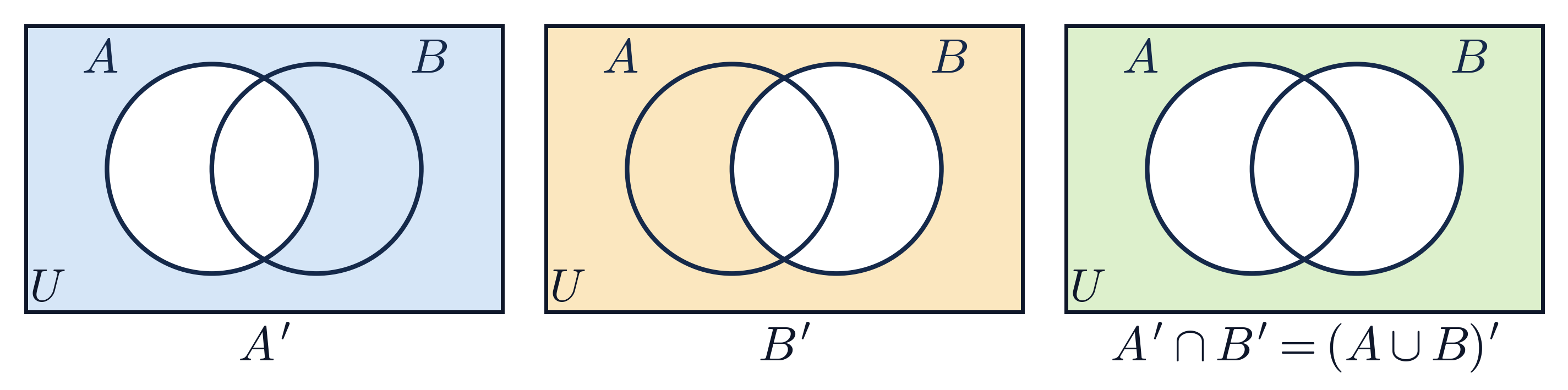
| De Morgan | (A \cup B)' = A' \cap B' and (A \cap B)' = A' \cup B' |
| Complement | A \cup A' = U, A \cap A' = \phi, (A')' = A |
| Empty and universal set | A \cup \phi = A, A \cap \phi = \phi, A \cup U = U, A \cap U = A |
| Difference | A - B = A \cap B' |
De Morgan's laws in words: when the complement sign goes inside the bracket, union changes to intersection and intersection changes to union. In the example, (A \cup B)' = \{8, 9, 10\} and A' \cap B' = \{6, 7, 8, 9, 10\} \cap \{1, 2, 3, 8, 9, 10\} = \{8, 9, 10\}. They agree.
6. Counting with sets
When we add n(A) and n(B), the common elements are counted twice. So we subtract them once:
n(A \cup B) = n(A) + n(B) - n(A \cap B)
In the example: 7 = 5 + 4 - 2.
| To find | Use |
|---|---|
| In at least one of A, B | n(A \cup B) = n(A) + n(B) - n(A \cap B) |
| Only in A | n(A) - n(A \cap B) |
| In exactly one of A, B | n(A) + n(B) - 2\,n(A \cap B) |
| In neither | n(U) - n(A \cup B) |
| In at least one of three sets | n(A \cup B \cup C) = n(A) + n(B) + n(C) - n(A \cap B) - n(B \cap C) - n(C \cap A) + n(A \cap B \cap C) |
7. Worked examples
Example 1. How many subsets does a set with 5 elements have? How many of them are not the set itself?
Number of subsets = 2^5 = 32. Leaving out the set itself, 32 - 1 = 31. (These 31 are called the proper subsets.)
Example 2. In a group of 60 people, 35 drink tea, 30 drink coffee and 10 drink both. How many drink neither? How many drink exactly one of the two?
At least one: n(T \cup C) = 35 + 30 - 10 = 55. Neither: 60 - 55 = 5.
Only tea: 35 - 10 = 25. Only coffee: 30 - 10 = 20. Exactly one: 25 + 20 = 45.
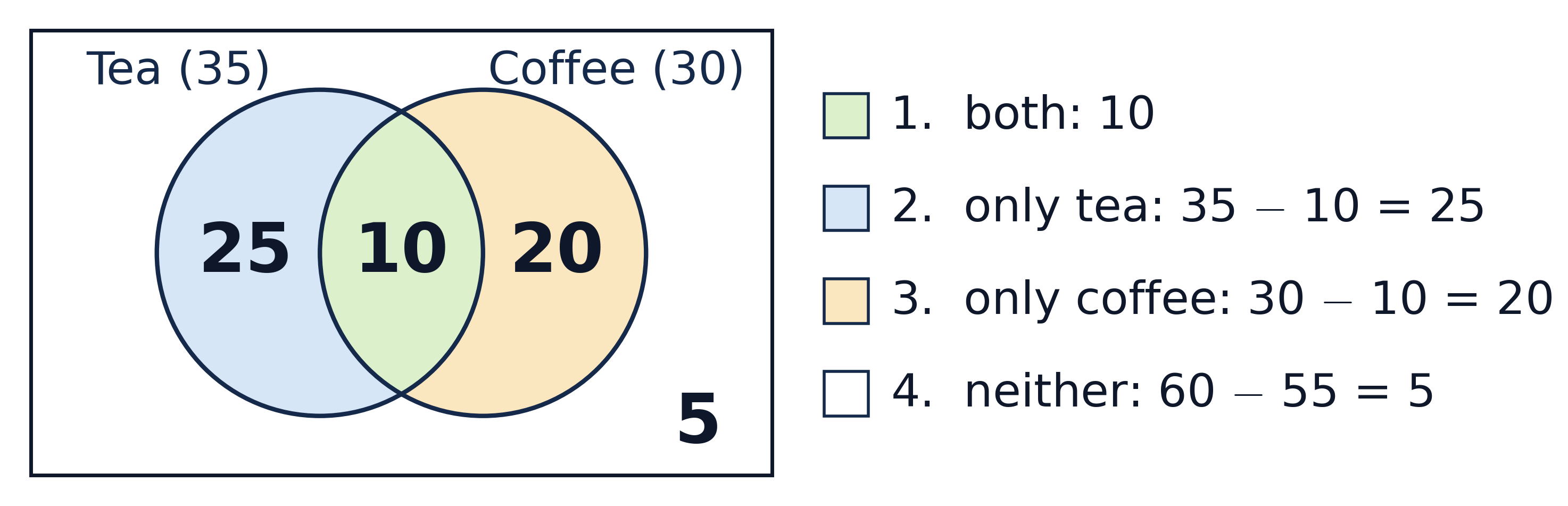
Fill such a diagram from the middle (the overlap) outwards.
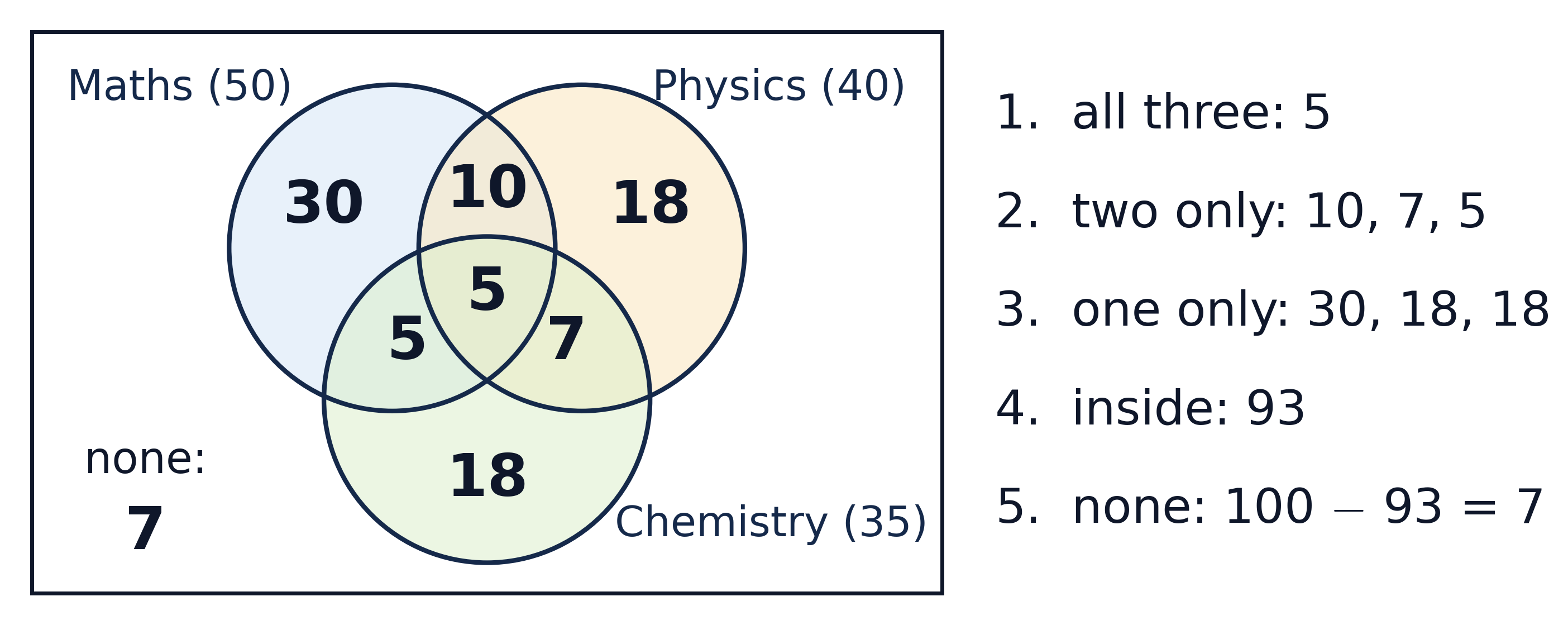
Example 3. In a class of 100 students, 50 study Mathematics, 40 study Physics and 35 study Chemistry. 15 study Mathematics and Physics, 12 study Physics and Chemistry, 10 study Mathematics and Chemistry, and 5 study all three. How many study none of the three?
n(M \cup P \cup C) = 50 + 40 + 35 - 15 - 12 - 10 + 5 = 93. So 100 - 93 = 7 students study none.
Example 4. Simplify (A \cup B) \cap (A \cup B').
By the distributive law, read from right to left, this is A \cup (B \cap B'). But B \cap B' = \phi. So the answer is A \cup \phi = A.
8. From the real papers
Try each question for 75 seconds before you read the solution.
NDA II 2025, Q11. In a class of 45 students, 34 like to play cricket and 26 like to play football. Further, each student likes to play at least one of the two games. How many students like to play exactly one game?
(a) 45 (b) 30 (c) 25 (d) 15
Solution. Every student likes at least one game, so n(C \cup F) = 45. Then 45 = 34 + 26 - n(C \cap F), which gives n(C \cap F) = 15. Exactly one game: 45 - 15 = 30. Answer (b).
NDA II 2026, Q47. A research group conducted a survey of 500 consumers and reported that 370 consumers preferred product X and 240 consumers preferred product Y. What is the least number that must have preferred both the products?
(a) 90 (b) 100 (c) 110 (d) Cannot be determined due to insufficient data
Solution. n(X \cap Y) = 370 + 240 - n(X \cup Y) = 610 - n(X \cup Y). The union cannot be more than the 500 people surveyed. So n(X \cap Y) is at least 610 - 500 = 110. Answer (c).
NDA I 2024, Q24. For any three non-empty sets A, B, C, what is (A \cup B) - \{(A - B) \cup (B - A) \cup (A \cap B)\} equal to?
(a) Null set (b) A (c) B (d) (A \cup B) - (A \cap B)
Solution. The three sets in the braces are the three regions inside the circles (section 4). Together they make A \cup B. A set minus itself is empty. Answer (a).
NDA II 2025, Q2. If A and B are non-empty subsets of a set, and A^c and B^c represent their complements, then which of the following is/are correct? I. A - B = B^c - A^c II. A - B^c = A^c - B Select the answer using the code given below.
(a) I only (b) II only (c) Both I and II (d) Neither I nor II
Solution. Use X - Y = X \cap Y^c. Statement I: A - B = A \cap B^c, and B^c - A^c = B^c \cap (A^c)^c = B^c \cap A. The same set, so I is correct. Statement II: A - B^c = A \cap B (in both), but A^c - B = A^c \cap B^c (in neither). These are different in general. Answer (a).
NDA II 2026, Q46. Consider the following statements in respect of sets A and B : I. If x \in A and A \in B, then x \in B. II. If A \subset B and x \notin B, then x \notin A. Which of the statements given above is/are correct?
(a) I only (b) II only (c) Both I and II (d) Neither I nor II
Solution. I: take A = \{1\} and B = \{\{1\}, 2\}. Then 1 \in A and A \in B, but the elements of B are \{1\} and 2, so 1 \notin B. I is wrong. II: every element of A is in B, so something that is not in B cannot be in A. II is correct. Answer (b).
Notice the method for statement questions: to show a statement is wrong, one small example is enough.
9. Mistakes that cost marks
- Mixing \in and \subset. For A = \{1, 2, 3\}: 1 \in A and \{1\} \subset A are right. 1 \subset A and \{1\} \in A are wrong.
- Taking A - B and B - A as the same. They are different regions. With A = \{1, 2, 3\} and B = \{3, 4\}: A - B = \{1, 2\} but B - A = \{4\}.
- Counting the overlap twice. n(A \cup B) is not n(A) + n(B) unless the sets are disjoint. Subtract n(A \cap B) once for "at least one" and twice for "exactly one".
10. Quick check
Do these without help. Answers are at the end.
- A = \{1, 2, 3, 4\} and B = \{3, 4, 5, 6\}. Find A \cup B, A \cap B and A - B.
- How many subsets does the set \{a, b, c, d\} have?
- n(A) = 20, n(B) = 15 and n(A \cup B) = 28. Find n(A \cap B).
- U = \{1, 2, \dots, 8\}, A = \{2, 4, 6, 8\} and B = \{1, 2, 3, 4\}. Find (A \cup B)'.
- In a class of 50 students, 30 play hockey and 25 play football. Every student plays at least one of the two. How many play exactly one?
11. Read and watch more, free
| What | Where | Language |
|---|---|---|
| Textbook | NCERT Class 11 Mathematics, Chapter 1 Sets · Hindi edition | English, Hindi |
| Self-study notes | NIOS Mathematics, Lesson 1 Sets · Hindi edition | English, Hindi |
| Video, the chapter for NDA | Defence Wallah: Complete Maths, Fast Track Series (the lesson titled "Sets", 1 to 2 hours) | Hinglish |
| Video, short lessons | Khan Academy India: Grade 11, Sets (13 short lessons) | English |
| Video, short lessons | Khan Academy India: कक्षा 11 एनसीईआरटी गणित (find the lessons on sets; the playlist is not in chapter order) | Hindi |
| Past NDA questions | ExamSIDE: Sets, Relations and Functions (no login needed) | English |
The videos were chosen from their titles, length and views; they have not yet been watched by a teacher.
Answers to the quick check
- A \cup B = \{1, 2, 3, 4, 5, 6\}, A \cap B = \{3, 4\}, A - B = \{1, 2\}.
- 2^4 = 16.
- n(A \cap B) = 20 + 15 - 28 = 7.
- A \cup B = \{1, 2, 3, 4, 6, 8\}, so (A \cup B)' = \{5, 7\}.
- Both: 30 + 25 - 50 = 5. Exactly one: 50 - 5 = 45.
Next chapter: Relations and equivalence relations.