Why this chapter matters. Permutations and combinations gave 28 questions in the 7 papers from NDA II 2023 to NDA II 2026, four in a paper on average. The questions are about numbers made from given digits, words made from given letters, groups chosen from people, and points, lines and circles. Probability (Unit 8) uses the same counting. Six real questions are solved in section 8. This chapter is longer than most; take it in two sittings (sections 1 to 3, then sections 4 to 6).
What you will be able to do
- Count with the multiplication rule and the addition rule.
- Decide whether a question is about arrangement (permutation) or selection (combination).
- Use {}^nP_r, {}^nC_r and the rule for repeated letters.
- Use four standard methods: tie together, zero cannot come first, "at least one", and counting lines and triangles.
Before you start you should know: multiplication of whole numbers and cancelling in fractions. The word "subset" from Chapter M1-1 is used once.
1. Two rules of counting
Multiplication rule ("and"). If one job can be done in m ways and, after it, a second job can be done in n ways, then both jobs together can be done in m \times n ways.
A cadet has 3 shirts and 4 trousers. He can dress in 3 \times 4 = 12 ways.
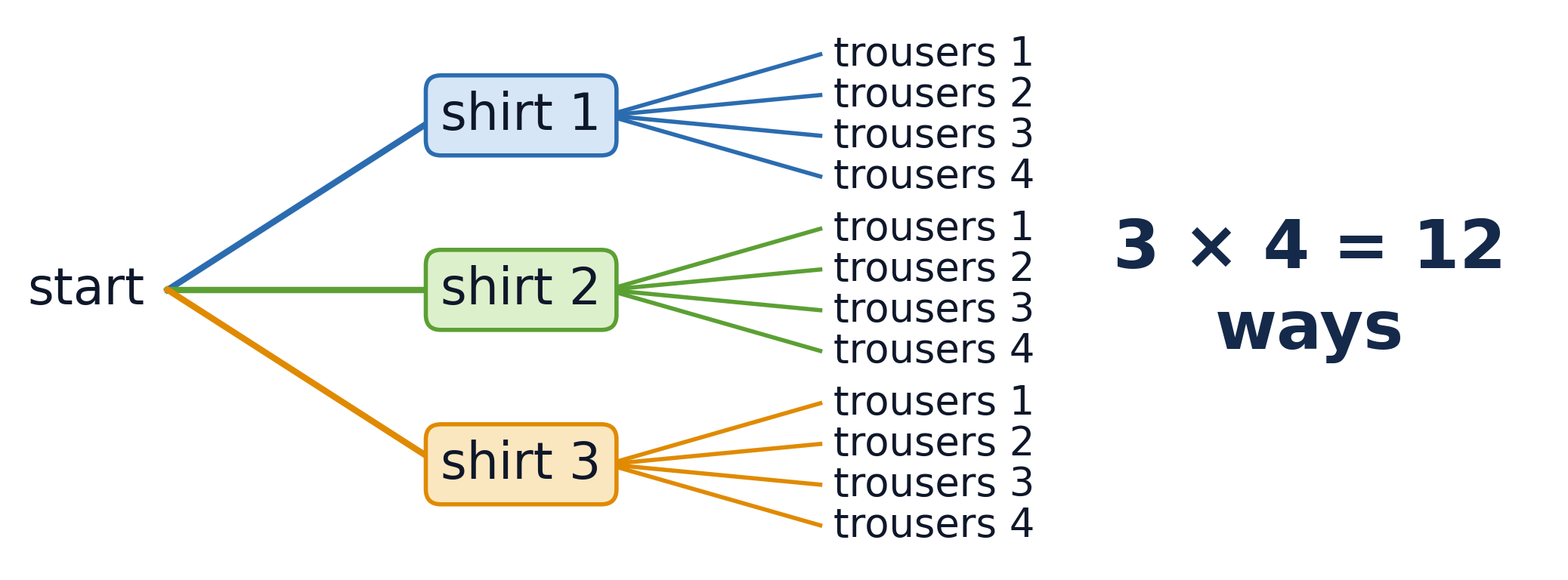
Addition rule ("or"). If a job can be done in m ways or in n other ways, and the two cannot happen together, the job can be done in m + n ways.
The box method. Draw one box for each place to be filled. Write in each box the number of choices for that place. Multiply. Fill the place with a restriction first.
How many 3-digit numbers can be made from the digits 1, 2, 3, 4, 5 with no digit repeated? The three boxes hold 5, 4 and 3: 5 \times 4 \times 3 = 60. If repetition is allowed, each box holds 5: 5^3 = 125.
2. Factorial
n! (read "n factorial") is the product of the whole numbers from 1 to n:
n! = n \times (n-1) \times (n-2) \times \dots \times 2 \times 1
So 5! = 120 and 6! = 720. By definition 0! = 1. A useful step: n! = n \times (n-1)!.
3. Permutations: order matters
A permutation is an arrangement in a row. ABC and CBA are different permutations.
| What is counted | Number of ways |
|---|---|
| n different things, all arranged in a row | n! |
| r things arranged in a row, taken from n different things | {}^nP_r = \dfrac{n!}{(n-r)!} |
| r places, each filled in n ways (repetition allowed) | n^r |
| n things in a row, of which p are alike of one kind and q are alike of another kind | \dfrac{n!}{p!\,q!} |
| n different things round a circle | (n-1)! |
For example, {}^5P_3 = \dfrac{5!}{2!} = 5 \times 4 \times 3 = 60. In practice {}^nP_r is the product of r numbers going down from n.
Repeated letters. The word LEVEL has 5 letters with L twice and E twice. The number of arrangements is \dfrac{5!}{2!\,2!} = 30.
4. Combinations: order does not matter
A combination is a selection. The group {A, B, C} is the same group in any order.
Each selection of r things can be arranged in r! ways. So the number of selections is the number of arrangements divided by r!:
{}^nC_r = \frac{n!}{r!\,(n-r)!} = \frac{{}^nP_r}{r!}
For example, {}^{10}C_3 = \dfrac{10 \times 9 \times 8}{3 \times 2 \times 1} = 120. The papers also write {}^nC_r as C(n, r) or \binom{n}{r}.
Five facts to remember:
| Fact | Example | |
|---|---|---|
| 1 | {}^nC_0 = {}^nC_n = 1 and {}^nC_1 = n | {}^7C_0 = 1, {}^7C_1 = 7 |
| 2 | {}^nC_r = {}^nC_{n-r} | {}^{10}C_7 = {}^{10}C_3 = 120 |
| 3 | If {}^nC_a = {}^nC_b, then a = b or a + b = n | {}^nC_4 = {}^nC_6 gives n = 10 |
| 4 | {}^nC_r + {}^nC_{r-1} = {}^{n+1}C_r | {}^7C_3 + {}^7C_2 = 35 + 21 = 56 = {}^8C_3 |
| 5 | {}^nC_0 + {}^nC_1 + \dots + {}^nC_n = 2^n | A set of 4 elements has 2^4 = 16 subsets |
5. Arrangement or selection?
Ask one question: if I change the order, do I get a new result?
| The question says | Order matters? | Use |
|---|---|---|
| numbers from digits, words from letters, people in a row, first and second prize | Yes | permutation |
| a team, a committee, a group, a hand of cards, points joined to make a triangle | No | combination |
Choosing a captain and a vice-captain from 11 players: order matters, {}^{11}P_2 = 110. Choosing 2 players from 11: order does not matter, {}^{11}C_2 = 55.
6. Four standard methods
Tie together. If some things must stay together, tie them into one block. Arrange the block with the other things, then arrange the things inside the block. Multiply.
Zero cannot come first. In a number, the first digit cannot be 0. Fill the first place before the others.
"At least one" is all minus none. Count all the ways without the condition. Subtract the ways in which the thing does not happen at all.
Points, lines and circles. Two points fix a line and three points fix a triangle, so these are selections.
| What is counted | Number |
|---|---|
| Lines through n points, no three on one line | {}^nC_2 |
| Triangles with corners among n points, no three on one line | {}^nC_3 |
| Diagonals of a polygon with n sides | {}^nC_2 - n = \dfrac{n(n-3)}{2} |
| Greatest number of points where n straight lines can cut one another | {}^nC_2 |
| Greatest number of points where n circles can cut one another | 2 \times {}^nC_2 |
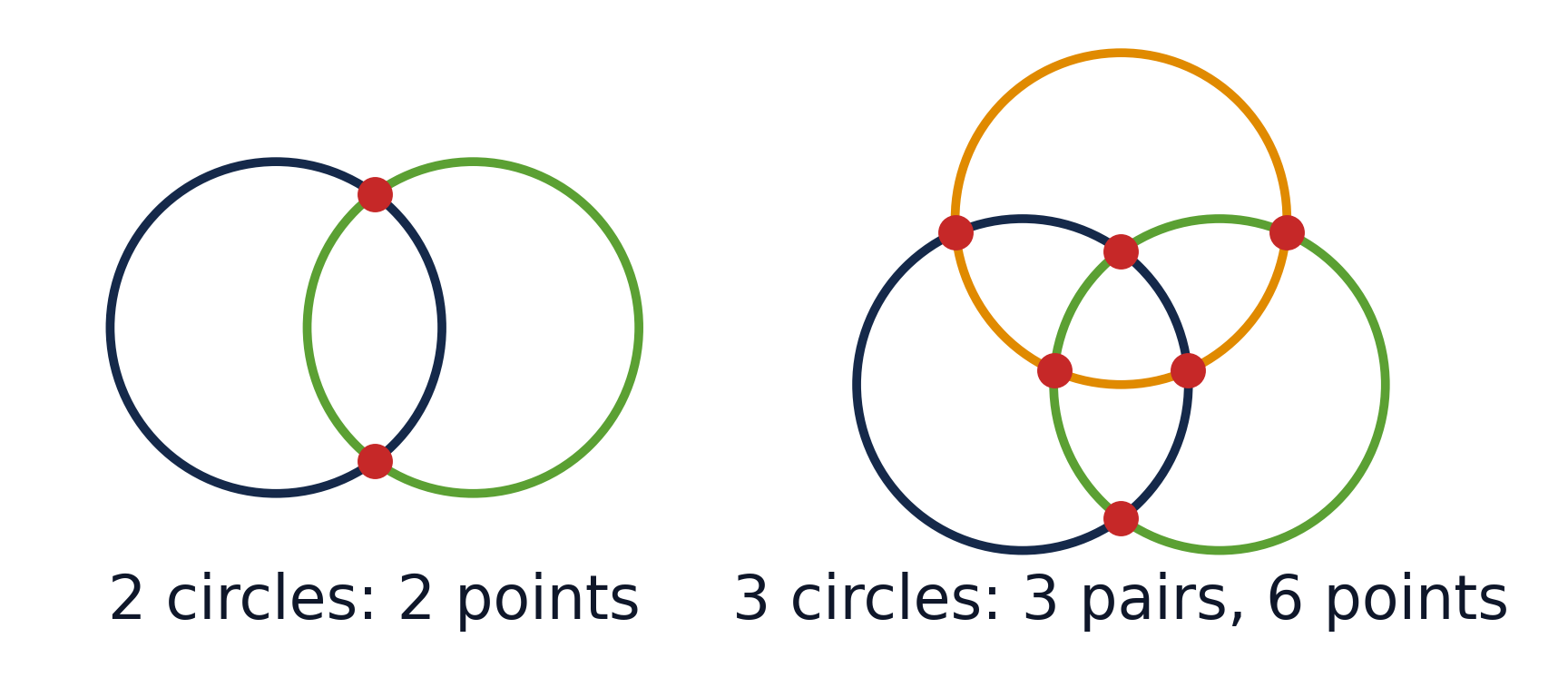
If some of the points lie on one line, three of them do not make a triangle. Subtract those selections.
7. Worked examples
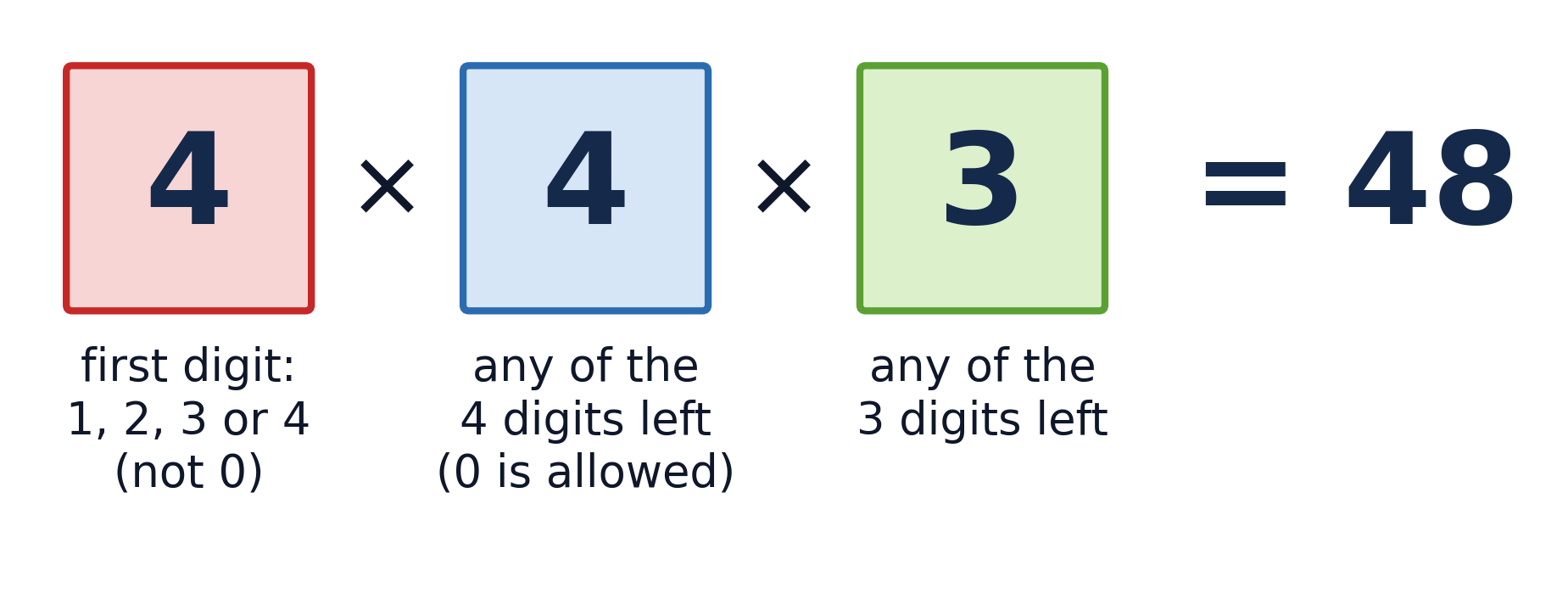
Example 1. How many 3-digit numbers can be made from the digits 0, 1, 2, 3, 4 with no digit repeated?
The first box cannot hold 0: 4 choices. The second box can hold any of the 4 digits left (0 is now allowed). The third box has 3 choices. Number = 4 \times 4 \times 3 = 48.
Example 2. In how many ways can the letters of the word KOLKATA be arranged?
There are 7 letters. K comes twice and A comes twice. Number = \dfrac{7!}{2!\,2!} = \dfrac{5040}{4} = 1260.
Example 3. A committee of 5 is to be chosen from 6 men and 4 women. In how many ways can it be done if the committee has (i) exactly 2 women, (ii) at least one woman?
(i) Choose 2 women and 3 men: {}^4C_2 \times {}^6C_3 = 6 \times 20 = 120.
(ii) All committees: {}^{10}C_5 = 252. Committees with no woman: {}^6C_5 = 6. So at least one woman: 252 - 6 = 246.
Example 4. In how many arrangements of the letters of MONDAY are the two vowels together? In how many are they not together?
Tie O and A into one block. Now there are 5 things: the block and M, N, D, Y. They can be arranged in 5! = 120 ways. Inside the block, O and A can be arranged in 2! = 2 ways. Together: 120 \times 2 = 240.
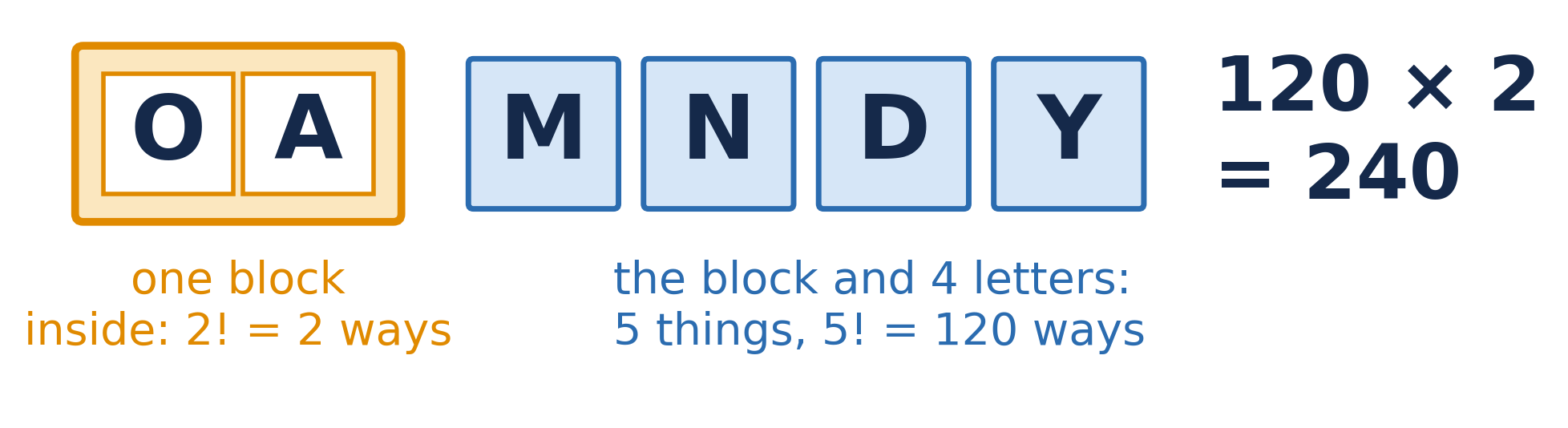
All arrangements: 6! = 720. Not together: 720 - 240 = 480.
Example 5. How many even 4-digit numbers can be made from the digits 0, 2, 3, 5, 7 with no digit repeated?
An even number here ends in 0 or 2. Take the two cases separately, because 0 also affects the first place.
- Ends in 0: the first three places are filled from 2, 3, 5, 7 in 4 \times 3 \times 2 = 24 ways.
- Ends in 2: the first place cannot be 0, so it has 3 choices (3, 5, 7). The two middle places are filled from the 3 digits left in 3 \times 2 = 6 ways. That is 3 \times 6 = 18 ways.
Total (one case or the other): 24 + 18 = 42.
8. From the real papers
Try each question for 75 seconds before reading the solution.
NDA II 2023, Q13. What is the maximum number of points of intersection of 10 circles?
(a) 45 (b) 60 (c) 90 (d) 120
Solution. Two circles cut in at most 2 points. The number of pairs of circles is {}^{10}C_2 = 45. The greatest number of points is 2 \times 45 = 90. Answer (c).
NDA I 2024, Q13. How many four-digit natural numbers are there such that all of the digits are even?
(a) 625 (b) 500 (c) 400 (d) 256
Solution. The even digits are 0, 2, 4, 6, 8. The first place cannot hold 0, so it has 4 choices. Each of the other three places has 5 choices, because repetition is allowed. Number = 4 \times 5 \times 5 \times 5 = 500. Answer (b).
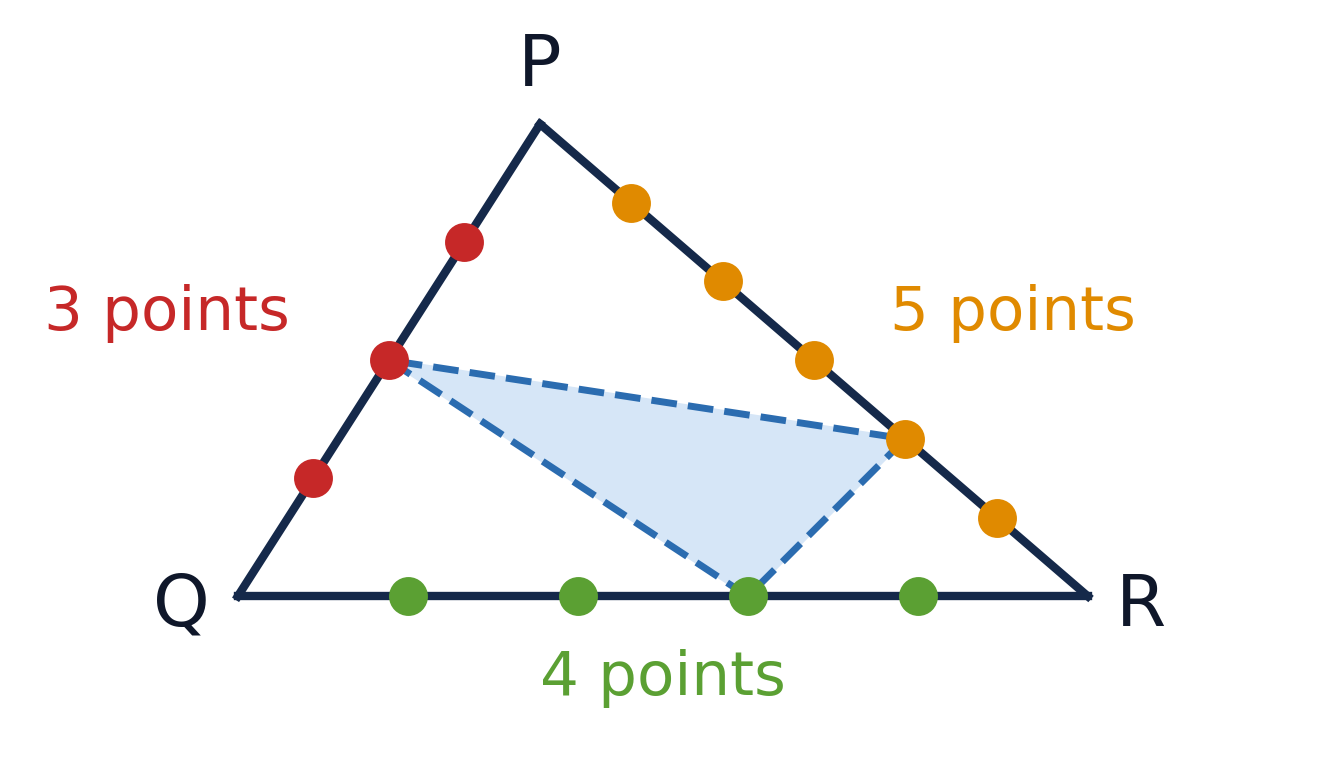
NDA I 2024, Q6. A triangle PQR is such that 3 points lie on the side PQ, 4 points on QR and 5 points on RP respectively. Triangles are constructed using these points as vertices. What is the number of triangles so formed?
(a) 205 (b) 206 (c) 215 (d) 220
Solution. There are 12 points. Any 3 can be chosen in {}^{12}C_3 = 220 ways. Three points from the same side lie on one line and make no triangle: {}^3C_3 + {}^4C_3 + {}^5C_3 = 1 + 4 + 10 = 15. Number of triangles = 220 - 15 = 205. Answer (a).
NDA I 2025, Q15. How many 7-letter words (with or without meaning) can be constructed using all the letters of the word CAPITAL so that all consonants come together in each word?
(a) 360 (b) 300 (c) 288 (d) 240
Solution. The consonants are C, P, T, L. The vowels are A, I, A. Tie the four consonants into one block. Now arrange 4 things: the block, A, A, I. Because A comes twice, this can be done in \dfrac{4!}{2!} = 12 ways. Inside the block the 4 consonants can be arranged in 4! = 24 ways. Number = 12 \times 24 = 288. Answer (c).
NDA I 2025, Q28. If the number of selections of r as well as (n + r) things from 5n different things are equal, then what is the value of r?
(a) n (b) 2n (c) 3n (d) 4n
Solution. We are told that {}^{5n}C_r = {}^{5n}C_{n+r}. The two lower numbers are different, so by fact 3 they add up to the upper number: r + (n + r) = 5n. So 2r = 4n and r = 2n. Answer (b).
NDA II 2026, Q24. 4-digit numbers are formed with 1, 2, 3 and 4. What is the number of the 4-digit numbers in which at least one digit is repeated?
(a) 256 (b) 244 (c) 232 (d) 220
Solution. "At least one" is all minus none. All numbers, with repetition allowed: 4^4 = 256. Numbers with no digit repeated: 4! = 24. So 256 - 24 = 232. Answer (c).
Notice that each of the six questions used one of the four standard methods of section 6, or one fact from section 4.
9. Mistakes that cost marks
- Arranging when the question asks for a selection, or the other way. A committee of 3 from 8 is {}^8C_3 = 56, not {}^8P_3 = 336. Ask whether a change of order gives a new result.
- Letting 0 come first. From the digits 0, 1, 2, 3, 4 there are 48 three-digit numbers with no digit repeated, not 5 \times 4 \times 3 = 60.
- Forgetting repeated letters. The letters of LEVEL give 30 arrangements, not 5! = 120.
- Adding when you should multiply. "2 women and 3 men" means multiply the two counts. Add only when the cases are "this or that" and cannot happen together.
10. Quick check
Do these without help. Answers are at the end.
- Find {}^7P_3.
- Find {}^{10}C_3.
- In how many ways can the letters of the word INDIA be arranged?
- How many diagonals does a polygon with 10 sides have?
- In how many ways can 5 people sit round a table?
11. Read and watch more, free
| What | Where | Language |
|---|---|---|
| Textbook | NCERT Class 11 Mathematics, Chapter 6 Permutations and Combinations · Hindi edition | English, Hindi |
| Self-study notes | NIOS Mathematics, Lesson 11 Permutations and Combinations · Hindi edition | English, Hindi |
| Video, the chapter for NDA | Defence Wallah: NDA Maths, SHAKTI 2026 (the class "P&C", about 4 hours) | Hinglish |
| Video, theory then questions | Defence Wallah: Maths, SHAKTI 2.0 (the lesson "P&C", 1.5 to 2 hours) | Hinglish |
| Video, short school lessons | Khan Academy India: कक्षा 11 एनसीईआरटी गणित (the lessons on permutations and combinations) | Hindi |
| Past NDA questions with answers | ExamSIDE: Permutations and Combinations | English |
The videos were chosen from their titles, length and views; they have not yet been watched by a teacher.
Answers to the quick check
- 7 \times 6 \times 5 = 210.
- \dfrac{10 \times 9 \times 8}{3 \times 2 \times 1} = 120.
- I comes twice: \dfrac{5!}{2!} = 60.
- \dfrac{10 \times 7}{2} = 35.
- (5 - 1)! = 4! = 24.
Next chapter: Binomial theorem.