Why this chapter matters. Complex numbers gave 31 questions in the 7 papers from NDA II 2023 to NDA II 2026: between 3 and 6 in every paper. Three ideas cover almost all of them: the powers of i, the modulus, and the cube roots of unity (12 of the 31 questions used \omega). The questions look heavy, but most are solved in three or four lines by a student who knows the facts in the tables below. Six real questions are solved in section 8. This is a long chapter; take it in two sittings, sections 1 to 4 first.
What you will be able to do
- Reduce any power of i, and add, multiply and divide complex numbers.
- Find the conjugate, modulus and argument of a complex number, and write it in polar form.
- Find a high power with De Moivre's theorem, and a square root of a complex number.
- Use \omega^3 = 1 and 1 + \omega + \omega^2 = 0 to simplify expressions with cube roots of unity.
Before you start you should know: real numbers and |x| (Chapter M1-3), the formula for the roots of a quadratic equation, and the values of sine and cosine at 30^\circ, 45^\circ, 60^\circ and 90^\circ. Angles here are in radians: \pi radians is 180^\circ, so \frac{\pi}{6}, \frac{\pi}{4} and \frac{\pi}{3} are 30^\circ, 45^\circ and 60^\circ (Chapter M3-1 treats radians fully).
1. The number i and its powers
No real number has a negative square. So we define a new number i with i^2 = -1, that is i = \sqrt{-1}. Then \sqrt{-9} = 3i.
The powers of i repeat in a cycle of four:
| i^1 | i^2 | i^3 | i^4 | i^5 | i^6 | i^7 | i^8 |
|---|---|---|---|---|---|---|---|
| i | -1 | -i | 1 | i | -1 | -i | 1 |
Rule. To find i^n, divide n by 4 and keep the remainder. For example, 2027 = 4 \times 506 + 3, so i^{2027} = i^3 = -i.
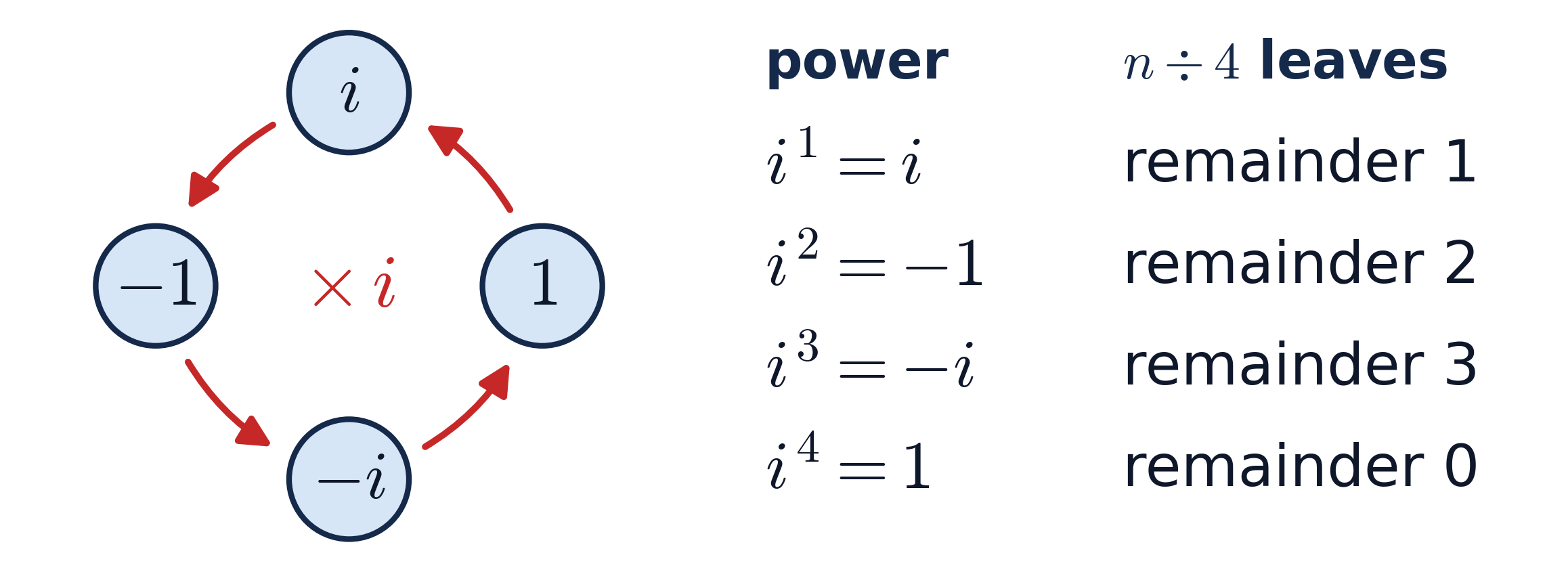
Two facts follow. The sum of any four powers of i in a row is i - 1 - i + 1 = 0. And \dfrac{1}{i} = -i.
2. Complex numbers and their arithmetic
A complex number is z = a + ib, where a and b are real. a is the real part, \text{Re}(z), and b is the imaginary part, \text{Im}(z). Two complex numbers are equal only when both parts are equal.
- Add or subtract the real parts and the imaginary parts separately: (2 + 3i) + (1 - 5i) = 3 - 2i.
- Multiply like brackets and put i^2 = -1: (2 + 3i)(4 - i) = 8 - 2i + 12i - 3i^2 = 11 + 10i.
Two squares are worth learning: (1 + i)^2 = 2i and (1 - i)^2 = -2i.
Complex numbers have no order. We cannot say that 1 + 4i is greater or less than 3 + 2i. Only real numbers can be compared with < and >.
3. Conjugate, modulus and division
For z = a + ib:
- the conjugate is \bar{z} = a - ib (change the sign of the imaginary part);
- the modulus is |z| = \sqrt{a^2 + b^2}, a real number that is never negative;
- their link is z\bar{z} = a^2 + b^2 = |z|^2.
For z = 3 + 4i: \bar{z} = 3 - 4i, |z| = \sqrt{9 + 16} = 5 and z\bar{z} = 25.
To divide, multiply the top and the bottom by the conjugate of the bottom. The bottom becomes real:
\frac{1 + 2i}{3 - 4i} = \frac{(1 + 2i)(3 + 4i)}{(3 - 4i)(3 + 4i)} = \frac{-5 + 10i}{25} = -\frac{1}{5} + \frac{2}{5}i
| Rules for the modulus | Rules for the conjugate |
|---|---|
| \lvert z_1 z_2 \rvert = \lvert z_1 \rvert \, \lvert z_2 \rvert | \overline{z_1 + z_2} = \bar{z}_1 + \bar{z}_2 |
| \left\lvert \dfrac{z_1}{z_2} \right\rvert = \dfrac{\lvert z_1 \rvert}{\lvert z_2 \rvert} | \overline{z_1 z_2} = \bar{z}_1 \, \bar{z}_2 |
| \lvert z^n \rvert = \lvert z \rvert^n | z + \bar{z} = 2\,\text{Re}(z) |
| \lvert \bar{z} \rvert = \lvert z \rvert | z - \bar{z} = 2i\,\text{Im}(z) |
With these rules a modulus can often be found without multiplying out: |(1 + i)^{10}| = (\sqrt{2})^{10} = 32.
4. The Argand plane, argument and polar form
Plot z = a + ib as the point (a, b): the real part along the x-axis and the imaginary part along the y-axis. This is the Argand plane. Then |z| is the distance of the point from the origin, and |z_1 - z_2| is the distance between two points.
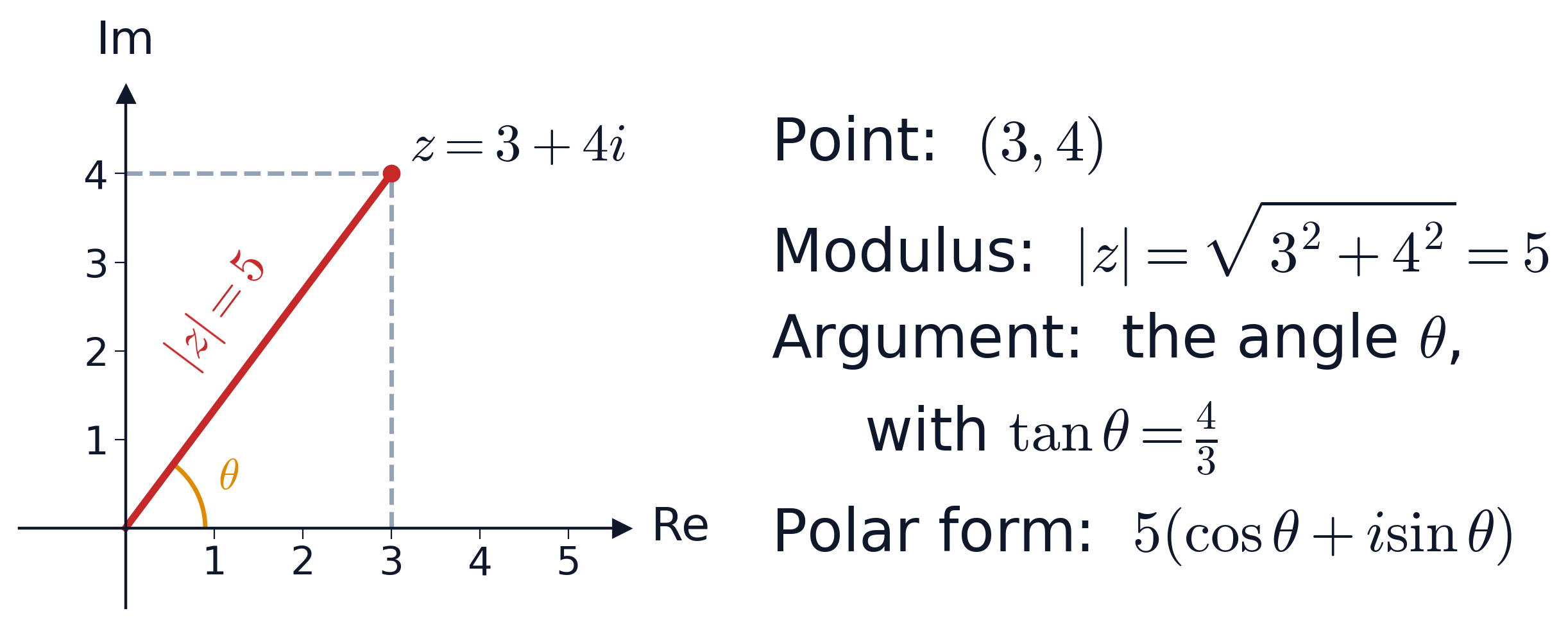
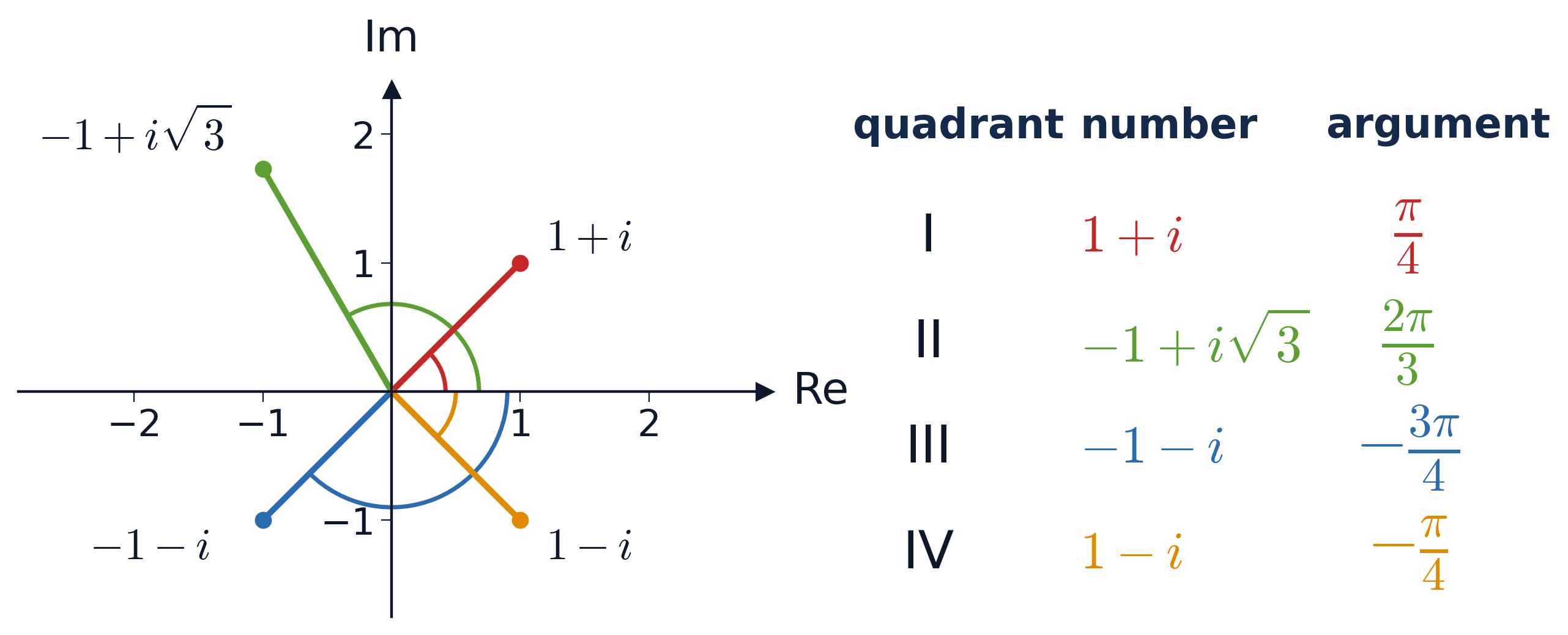
The argument (or amplitude) of z is the angle \theta that the line from the origin to z makes with the positive x-axis. The principal argument lies in -\pi < \theta \le \pi. To find it, first find the acute angle \alpha with \tan\alpha = \left|\dfrac{b}{a}\right|. Then look at the quadrant:
| Quadrant of (a, b) | I | II | III | IV |
|---|---|---|---|---|
| Principal argument | \alpha | \pi - \alpha | -(\pi - \alpha) | -\alpha |
For a point on an axis, read the angle directly: the argument of 2 is 0, of -2 is \pi, of i is \frac{\pi}{2} and of -i is -\frac{\pi}{2}.
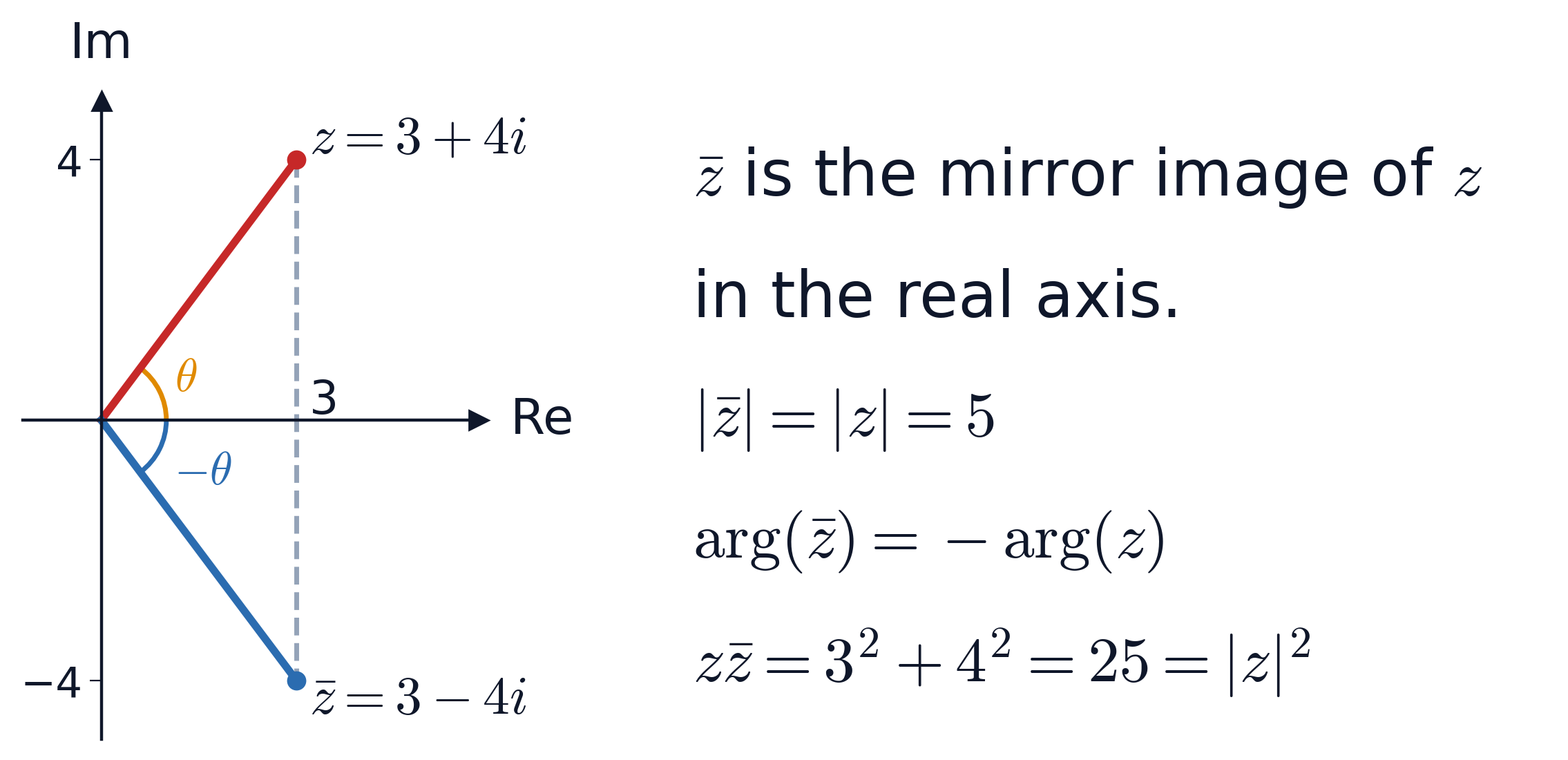
The conjugate \bar{z} is the mirror image of z in the real axis. It has the same modulus and the opposite argument.
With r = |z|, the polar form is
z = r(\cos\theta + i\sin\theta)
For example, 1 + i has r = \sqrt{2} and \theta = \frac{\pi}{4}, so 1 + i = \sqrt{2}\left(\cos\frac{\pi}{4} + i\sin\frac{\pi}{4}\right).
When complex numbers are multiplied, the moduli are multiplied and the arguments are added. When they are divided, the arguments are subtracted. (If the result falls outside the principal range, add or subtract 2\pi.) Also \arg(\bar{z}) = -\arg(z). Repeating the multiplication gives De Moivre's theorem:
\left[r(\cos\theta + i\sin\theta)\right]^n = r^n(\cos n\theta + i\sin n\theta)
So (1 + i)^8 = (\sqrt{2})^8(\cos 2\pi + i\sin 2\pi) = 16.
5. Square root of a complex number
To find \sqrt{a + ib}, let it be x + iy with x, y real. Squaring and comparing the parts, and also the moduli, gives three equations:
x^2 - y^2 = a, \qquad 2xy = b, \qquad x^2 + y^2 = \sqrt{a^2 + b^2}
Add and subtract the first and third to get x^2 and y^2. The sign of b tells whether x and y have the same sign (b > 0) or opposite signs (b < 0). There are always two square roots, one the negative of the other. Example 5 shows the method.
6. Cube roots of unity
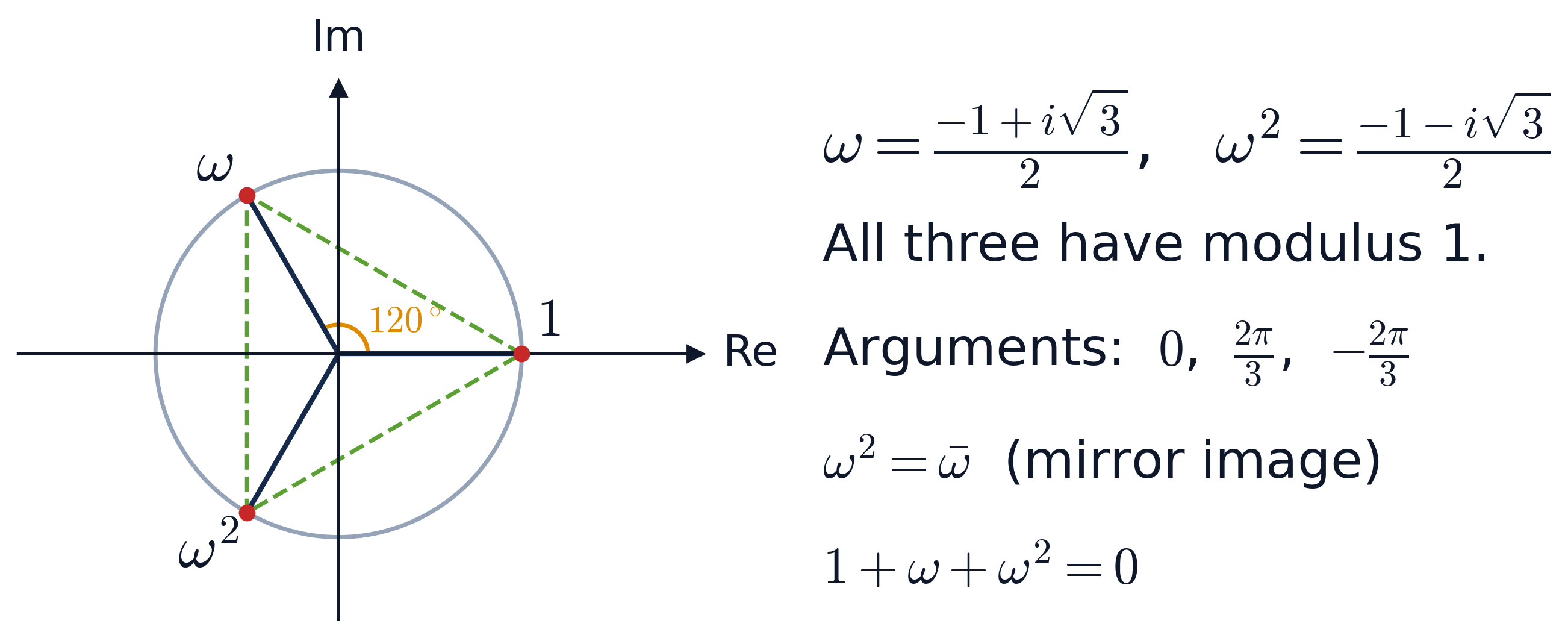
Solve x^3 = 1: x^3 - 1 = (x - 1)(x^2 + x + 1) = 0. So x = 1, or x^2 + x + 1 = 0, which gives x = \dfrac{-1 \pm i\sqrt{3}}{2}. The three cube roots of unity are
1, \qquad \omega = \frac{-1 + i\sqrt{3}}{2}, \qquad \omega^2 = \frac{-1 - i\sqrt{3}}{2}
On the Argand plane the three roots lie on the circle of radius 1, 120^\circ apart.
| Fact | Use |
|---|---|
| \omega^3 = 1 | Divide the power by 3 and keep the remainder: \omega^{100} = \omega, because 100 = 3 \times 33 + 1 |
| 1 + \omega + \omega^2 = 0 | 1 + \omega = -\omega^2, \ 1 + \omega^2 = -\omega, \ \omega + \omega^2 = -1 |
| \omega^2 = \bar{\omega} = \dfrac{1}{\omega} and \lvert \omega \rvert = 1 | Each non-real root is the square, the conjugate and the reciprocal of the other |
| x^2 + x + 1 = 0 has roots \omega, \omega^2 | x^2 - x + 1 = 0 has roots -\omega, -\omega^2 |
| The cube roots of a^3 are a, a\omega, a\omega^2 | The cube roots of -8 are -2, -2\omega, -2\omega^2 |
7. Worked examples
Example 1. Find i^{35} and i^{10} + i^{11} + i^{12} + i^{13}.
35 = 4 \times 8 + 3, so i^{35} = i^3 = -i. The second is a sum of four powers in a row, so it is 0.
Example 2. Write \dfrac{3 + 2i}{1 - i} in the form a + ib.
Multiply top and bottom by 1 + i: \dfrac{(3 + 2i)(1 + i)}{(1 - i)(1 + i)} = \dfrac{3 + 3i + 2i + 2i^2}{2} = \dfrac{1 + 5i}{2} = \dfrac{1}{2} + \dfrac{5}{2}i.
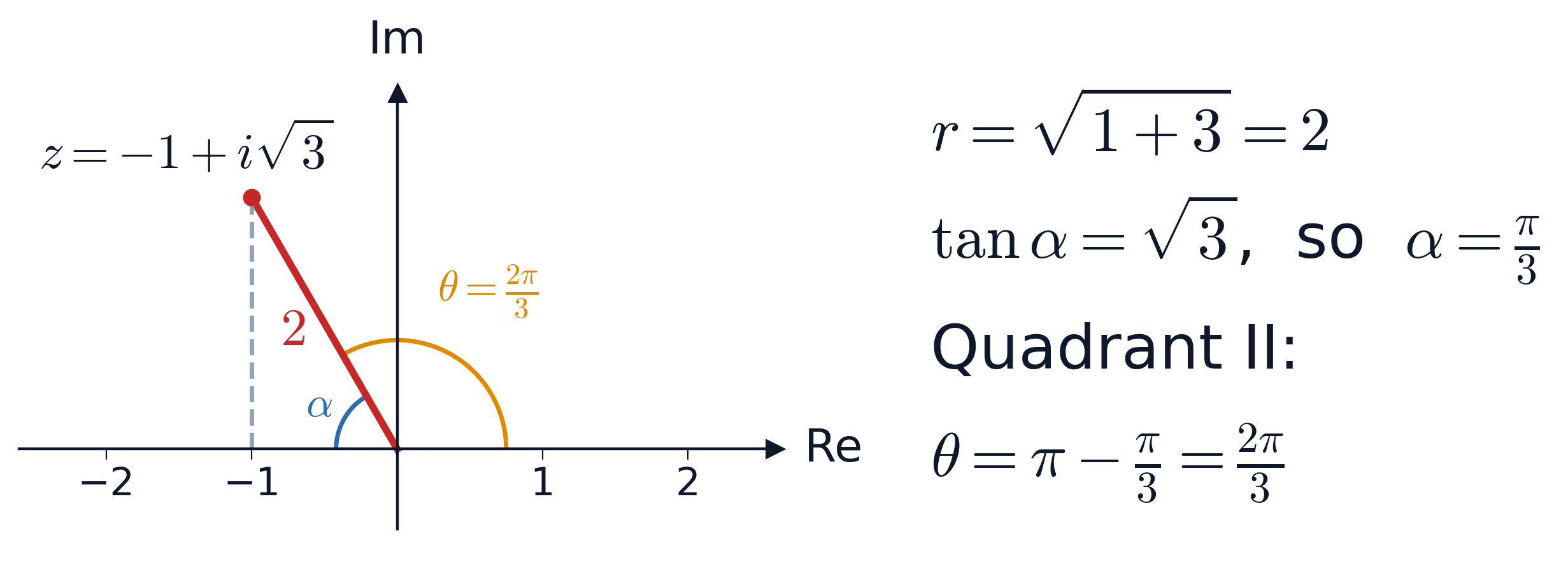
Example 3. Find the modulus and principal argument of z = -1 + i\sqrt{3}, and write z in polar form.
r = \sqrt{1 + 3} = 2. \tan\alpha = \sqrt{3}, so \alpha = \frac{\pi}{3}. The point (-1, \sqrt{3}) is in quadrant II, so \theta = \pi - \frac{\pi}{3} = \frac{2\pi}{3}. Polar form: z = 2\left(\cos\frac{2\pi}{3} + i\sin\frac{2\pi}{3}\right).
Example 4. Find (\sqrt{3} + i)^6.
r = \sqrt{3 + 1} = 2 and \theta = \frac{\pi}{6} (quadrant I, \tan\alpha = \frac{1}{\sqrt{3}}). By De Moivre's theorem, (\sqrt{3} + i)^6 = 2^6(\cos\pi + i\sin\pi) = 64 \times (-1) = -64.
Example 5. Find the square roots of -5 + 12i.
Let the root be x + iy. Then x^2 - y^2 = -5, 2xy = 12 and x^2 + y^2 = \sqrt{25 + 144} = 13. Adding the first and third: 2x^2 = 8, so x = \pm 2. Subtracting: 2y^2 = 18, so y = \pm 3. Since 2xy is positive, x and y have the same sign. The square roots are 2 + 3i and -2 - 3i. Check: (2 + 3i)^2 = 4 + 12i - 9 = -5 + 12i.
Example 6. Find (1 - \omega + \omega^2)^5 + (1 + \omega - \omega^2)^5.
Use 1 + \omega^2 = -\omega in the first bracket: it is -\omega - \omega = -2\omega. Use 1 + \omega = -\omega^2 in the second: it is -2\omega^2. The sum is (-2\omega)^5 + (-2\omega^2)^5 = -32(\omega^5 + \omega^{10}) = -32(\omega^2 + \omega) = -32 \times (-1) = 32.
8. From the real papers
Try each question for 75 seconds before you read the solution.
NDA I 2024, Q15. What is (1 + i)^4 + (1 - i)^4 equal to, where i = \sqrt{-1}?
(a) 4 (b) 0 (c) -4 (d) -8
Solution. (1 + i)^2 = 2i, so (1 + i)^4 = (2i)^2 = -4. In the same way (1 - i)^4 = (-2i)^2 = -4. The sum is -8. Answer (d).
NDA II 2023, Q3. What is the value of \sqrt{12 + 5i} + \sqrt{12 - 5i}, where i = \sqrt{-1}?
(a) 24 (b) 25 (c) 5\sqrt{2} (d) 5(\sqrt{2} - 1)
Solution. Call the sum S and square it: S^2 = (12 + 5i) + (12 - 5i) + 2\sqrt{(12 + 5i)(12 - 5i)}. The product inside the root is z\bar{z} = 144 + 25 = 169. So S^2 = 24 + 2 \times 13 = 50 and S = 5\sqrt{2}. Answer (c).
NDA I 2026, Q4. Let Z_1 and Z_2 be complex numbers such that \frac{3Z_1}{4Z_2} is purely imaginary. What is \left|\frac{Z_1 + Z_2}{Z_1 - Z_2}\right| equal to?
(a) 2 (b) \frac{3}{2} (c) \frac{5}{4} (d) 1
Solution. \frac{Z_1}{Z_2} is also purely imaginary; write it as ik with k real. Divide the top and bottom of the required fraction by Z_2: it becomes \frac{ik + 1}{ik - 1}. Now |ik + 1| = \sqrt{1 + k^2} and |ik - 1| = \sqrt{1 + k^2}. The modulus of a quotient is the quotient of the moduli, which is 1. Answer (d).
NDA I 2025, Q13. What is \left(\frac{\sqrt{3}+i}{\sqrt{3}-i}\right)^3 equal to?
(a) -1 (b) 0 (c) 1 (d) 3
Solution. Multiply top and bottom by \sqrt{3} + i: \frac{(\sqrt{3} + i)^2}{3 + 1} = \frac{2 + 2\sqrt{3}i}{4} = \frac{1 + i\sqrt{3}}{2} = \cos\frac{\pi}{3} + i\sin\frac{\pi}{3}. By De Moivre's theorem its cube is \cos\pi + i\sin\pi = -1. Answer (a).
NDA I 2024, Q4. If x, y and z are the cube roots of unity, then what is the value of xy + yz + zx?
(a) 0 (b) 1 (c) 2 (d) 3
Solution. Take x = 1, y = \omega, z = \omega^2. Then xy + yz + zx = \omega + \omega^3 + \omega^2 = \omega + 1 + \omega^2 = 0. Answer (a).
NDA II 2025, Q8. If \alpha = \frac{-1 + \sqrt{-3}}{2} then what is the value of (1 + \alpha^{19} - \alpha^{35})^{100} - (1 - 3\alpha^{25} + \alpha^{38})^{50}?
(a) -2 (b) -1 (c) 0 (d) 2
Solution. \alpha is \omega. Reduce the powers by 3: \omega^{19} = \omega, \omega^{35} = \omega^2, \omega^{25} = \omega, \omega^{38} = \omega^2. First bracket: 1 + \omega - \omega^2 = -\omega^2 - \omega^2 = -2\omega^2, and (-2\omega^2)^{100} = 2^{100}\omega^{200} = 2^{100}\omega^2. Second bracket: 1 + \omega^2 - 3\omega = -\omega - 3\omega = -4\omega, and (-4\omega)^{50} = 4^{50}\omega^{50} = 2^{100}\omega^2. The two are equal, so the difference is 0. Answer (c).
Notice that no question needed a long multiplication. Each one gave way to a single fact: (1 + i)^2 = 2i, z\bar{z} = |z|^2, the modulus of a quotient, or 1 + \omega + \omega^2 = 0.
9. Mistakes that cost marks
- Writing \sqrt{-4} \times \sqrt{-9} = \sqrt{36} = 6. Change to i first: 2i \times 3i = 6i^2 = -6.
- Putting i inside the modulus. |3 + 4i| = \sqrt{3^2 + 4^2} = 5. It is not \sqrt{3^2 + (4i)^2} and it is not 3 + 4.
- Finding the argument without looking at the quadrant. For -1 + i\sqrt{3} the argument is \frac{2\pi}{3}, not -\frac{\pi}{3}. Plot the point first.
- Reducing powers of \omega by 4. Powers of i repeat every 4; powers of \omega repeat every 3.
10. Quick check
Do these without help. Answers are at the end.
- Find i^{99}.
- Multiply (2 - 3i)(1 + i).
- Find |5 - 12i|.
- Find the principal argument of -1 + i.
- Find \omega^{10} + \omega^{20}.
11. Read and watch more, free
| What | Where | Language |
|---|---|---|
| Textbook: i, arithmetic, modulus, conjugate, Argand plane | NCERT Class 11 Mathematics, Chapter 4 Complex Numbers and Quadratic Equations · Hindi edition | English, Hindi |
| Self-study notes: the same, with argument, polar form and square roots | NIOS Mathematics, Lesson 8 Complex Numbers · Hindi edition | English, Hindi |
| Video, the chapter for NDA | Defence Wallah: Complete Maths, Fast Track Series (the lesson titled "Complex Number", 1 to 2 hours) | Hinglish |
| Video, concept with past questions | Doon Defence Dreamers: NDA Maths One Shot (the video on Complex Number; it is very long) | Hinglish |
| Video, short lessons | Khan Academy India: कक्षा 11 एनसीईआरटी गणित (find the lessons on complex numbers; the playlist is not in chapter order) | Hindi |
| Past NDA questions | ExamSIDE: Complex Numbers (no login needed) | English |
Cube roots of unity and De Moivre's theorem are not in the NCERT chapter or the NIOS lesson. For these two, use section 4 and section 6 of this lesson and the NDA videos.
The videos were chosen from their titles, length and views; they have not yet been watched by a teacher.
Answers to the quick check
- 99 = 4 \times 24 + 3, so i^{99} = i^3 = -i.
- 2 + 2i - 3i - 3i^2 = 5 - i.
- \sqrt{25 + 144} = 13.
- \tan\alpha = 1, so \alpha = \frac{\pi}{4}. The point (-1, 1) is in quadrant II: \theta = \frac{3\pi}{4}.
- \omega^{10} = \omega and \omega^{20} = \omega^2. The sum is \omega + \omega^2 = -1.
Next chapter: Binary numbers.