Why this chapter matters. Logarithms gave 7 questions in the 7 papers from NDA II 2023 to NDA II 2026, one in a paper on average. They also appear inside questions of other chapters: progressions, quadratic equations and calculus all use \log and \ln. The questions need only the definition and seven laws. Six real questions are solved in section 8.
What you will be able to do
- Change a statement from power form to logarithm form and back.
- Use the seven laws of logarithms to simplify an expression.
- Solve a simple equation with logarithms and reject the values that are not allowed.
- Find the number of digits of a large power.
Before you start you should know: the laws of powers, a^m \times a^n = a^{m+n}, (a^m)^n = a^{mn}, a^0 = 1 and a^{-n} = \dfrac{1}{a^n}. The tests for AP and GP (Chapter M1-6) are used in section 6.
1. What a logarithm is
A logarithm is a power. The question "2 to what power gives 8?" has the answer 3. We write this answer as \log_2 8 = 3.
\log_a x = y \quad \text{means} \quad a^y = x
The number a is called the base. It must be positive and not equal to 1. The number x must be positive, because a power of a positive number is always positive. So the logarithm of zero or of a negative number does not exist.
| Power form | Logarithm form |
|---|---|
| 2^3 = 8 | \log_2 8 = 3 |
| 10^3 = 1000 | \log_{10} 1000 = 3 |
| 3^{-4} = \dfrac{1}{81} | \log_3 \dfrac{1}{81} = -4 |
| a^0 = 1 | \log_a 1 = 0 |
| a^1 = a | \log_a a = 1 |
The last two rows are true for every base. Learn them.
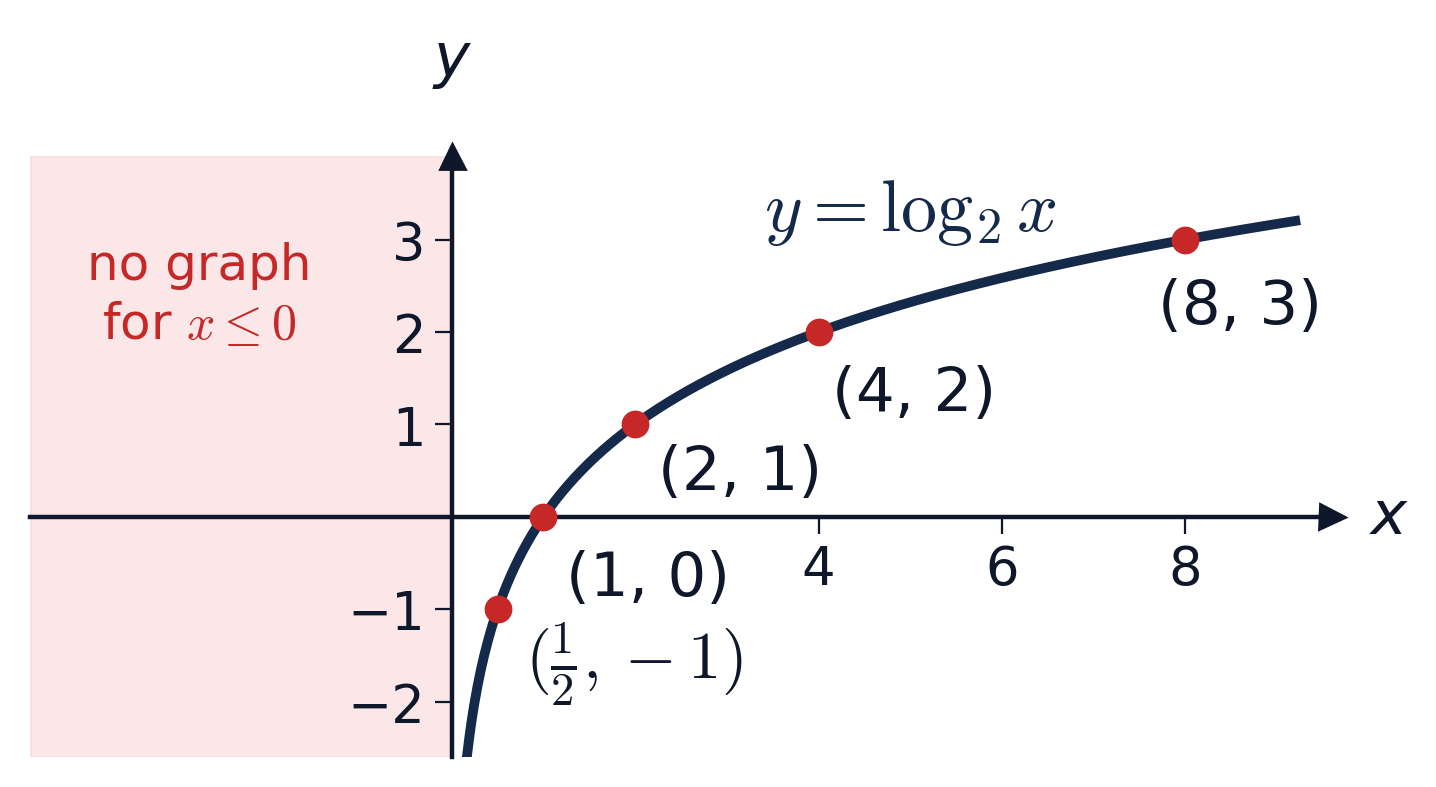
The graph of y = \log_2 x shows the same facts. Each point is a row of such a table, and there is no graph for x \le 0.
2. The seven laws
In every law the numbers inside the logarithms are positive, and the bases are positive and not 1.
| Law | Example | |
|---|---|---|
| 1 | \log_a (xy) = \log_a x + \log_a y | \log_{10} 2 + \log_{10} 5 = \log_{10} 10 = 1 |
| 2 | \log_a \dfrac{x}{y} = \log_a x - \log_a y | \log_3 54 - \log_3 2 = \log_3 27 = 3 |
| 3 | \log_a x^n = n \log_a x | \log_2 8^5 = 5 \log_2 8 = 15 |
| 4 | Change of base: \log_a x = \dfrac{\log_b x}{\log_b a} | \log_4 8 = \dfrac{\log_2 8}{\log_2 4} = \dfrac{3}{2} |
| 5 | \log_a b = \dfrac{1}{\log_b a}, so \log_a b \times \log_b a = 1 | \log_8 2 = \dfrac{1}{\log_2 8} = \dfrac{1}{3} |
| 6 | \log_{a^k} x = \dfrac{1}{k} \log_a x | \log_4 x = \dfrac{1}{2} \log_2 x |
| 7 | a^{\log_a x} = x | 2^{\log_2 7} = 7 |
Laws 1, 2 and 3 are the laws of powers written in another way. Laws 5 and 6 come from law 4.
3. Two special bases
- Common logarithm: base 10. It is often written \log x with no base shown.
- Natural logarithm: base e, where e is a fixed number close to 2.718. It is written \ln x. You will meet it again in calculus.
All seven laws hold for both. Two values are given in many questions: \log_{10} 2 = 0.3010 and \log_{10} 3 = 0.4771.
4. Equations with logarithms
If \log_a x = \log_a y, then x = y. This lets you remove the logarithms from an equation.
Follow three steps:
- Use the laws to bring each side to a single logarithm with the same base (or to a number).
- Remove the logarithms and solve.
- Check every answer. Each number inside a logarithm in the first equation must be positive. Throw away an answer that makes one of them zero or negative.
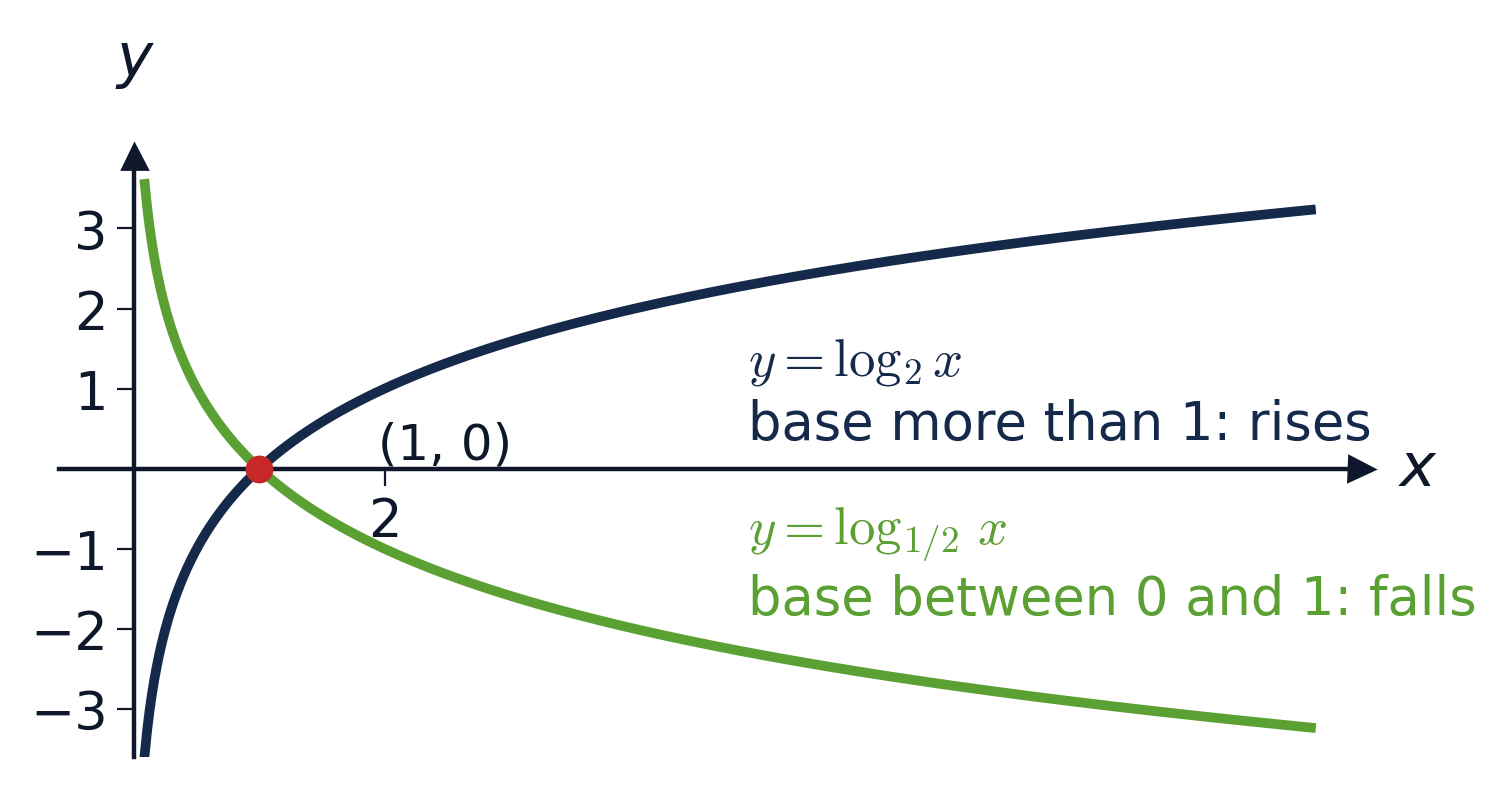
One more fact about size. If the base is more than 1, a larger number has a larger logarithm. If the base is between 0 and 1, a larger number has a smaller logarithm.
5. The number of digits
\log_{10} 100 = 2 and \log_{10} 1000 = 3. So a 3-digit number, which lies from 100 to 999, has a common logarithm from 2 up to just below 3. In general:
Number of digits of a whole number N = (whole-number part of \log_{10} N) + 1.
For example, \log_{10} 3^{20} = 20 \times 0.4771 = 9.542. The whole-number part is 9, so 3^{20} has 10 digits.
6. A link with progressions
If x, y, z are positive and in GP, then y^2 = xz. Take logarithms: 2\log y = \log x + \log z. So
if x, y, z are in GP, then \log x, \log y, \log z are in AP.
The reverse is also true. The exam uses this link often.
7. Worked examples
Example 1. Find \log_2 32, \log_3 \dfrac{1}{81}, \log_{10} 0.001 and \log_{\sqrt{2}} 8.
- 2^5 = 32, so \log_2 32 = 5.
- 3^{-4} = \dfrac{1}{81}, so the value is -4.
- 0.001 = 10^{-3}, so the value is -3.
- (\sqrt{2})^2 = 2 and 2^3 = 8, so (\sqrt{2})^6 = 8. The value is 6.
Example 2. Given \log_{10} 2 = 0.3010 and \log_{10} 3 = 0.4771, find \log_{10} 12 and \log_{10} 5.
12 = 2^2 \times 3, so \log_{10} 12 = 2(0.3010) + 0.4771 = 1.0791.
5 = \dfrac{10}{2}, so \log_{10} 5 = \log_{10} 10 - \log_{10} 2 = 1 - 0.3010 = 0.6990.
Example 3. Find the value of \log_2 3 \times \log_3 4 \times \log_4 5 \times \log_5 6 \times \log_6 7 \times \log_7 8.
Change every logarithm to the same base (law 4): the product is \dfrac{\log 3}{\log 2} \times \dfrac{\log 4}{\log 3} \times \dots \times \dfrac{\log 8}{\log 7}. Everything cancels except \dfrac{\log 8}{\log 2} = \log_2 8 = 3.
Example 4. Solve \log_2 x + \log_2 (x - 2) = 3.
By law 1, \log_2 \left[x(x - 2)\right] = 3, so x(x - 2) = 2^3 = 8. Then x^2 - 2x - 8 = 0, so (x - 4)(x + 2) = 0 and x = 4 or x = -2.
Check: x = -2 would need \log_2 (-2), which does not exist. So the only solution is x = 4. (Indeed \log_2 4 + \log_2 2 = 2 + 1 = 3.)
Example 5. How many digits does 2^{100} have? Take \log_{10} 2 = 0.3010.
\log_{10} 2^{100} = 100 \times 0.3010 = 30.10. The whole-number part is 30, so 2^{100} has 31 digits.
8. From the real papers
Try each question for 75 seconds before reading the solution.
NDA I 2024, Q7. If \log_b a = p, \log_d c = 2p and \log_f e = 3p, then what is (ace)^{\frac{1}{p}} equal to?
(a) bd^2f^3 (b) bdf (c) b^3d^2f (d) b^2d^2f^2
Solution. Change each statement to power form: a = b^p, c = d^{2p}, e = f^{3p}. So ace = b^p d^{2p} f^{3p} = (bd^2f^3)^p. Raise to the power \frac{1}{p}: the value is bd^2f^3. Answer (a).
NDA I 2024, Q27. What is the number of solutions of \log_4(x - 1) = \log_2(x - 3)?
(a) Zero (b) One (c) Two (d) Three
Solution. Both logarithms must exist, so x > 3. By law 6, \log_4 (x - 1) = \frac{1}{2}\log_2 (x - 1). The equation becomes \log_2 (x - 1) = 2\log_2 (x - 3) = \log_2 (x - 3)^2. So x - 1 = (x - 3)^2, that is x^2 - 7x + 10 = 0, giving x = 2 or x = 5. Only x = 5 is more than 3. There is one solution. Answer (b).
NDA II 2025, Q5. If (10 + \log_{10} x), (10 + \log_{10} y) and (10 + \log_{10} z) are in AP, then consider the following statements : I. The GM of x and z is y^2. II. The AM of \log_{10} x and \log_{10} z is \log_{10} y. Which of the statements given above is/are correct?
(a) I only (b) II only (c) Both I and II (d) Neither I nor II
Solution. Take 10 away from each term; the terms stay in AP. So \log_{10} x, \log_{10} y, \log_{10} z are in AP, and 2\log_{10} y = \log_{10} x + \log_{10} z. This is statement II. The same line gives y^2 = xz, so the GM of x and z is \sqrt{xz} = y, not y^2. Statement I is wrong. Answer (b).
NDA II 2025, Q23 and Q24. These two questions use the same data. Let p = \sum_{j=1}^{n} \log_{10} 2^j and q = \sum_{j=1}^{n} \log_{10} 5^j.
Q23. If p + q = 66, then which one of the following is correct?
(a) n < 7 (b) 7 < n < 9 (c) 9 < n < 12 (d) n > 12
Solution. Add term by term: \log_{10} 2^j + \log_{10} 5^j = \log_{10} 10^j = j. So p + q = 1 + 2 + \dots + n = \dfrac{n(n+1)}{2}. Put this equal to 66: n(n + 1) = 132 = 11 \times 12, so n = 11. Answer (c).
Q24. If p + q = 15, then what is q - p equal to?
(a) \log_{10} 2.5 (b) 5\log_{10} 2.5 (c) 10\log_{10} 2.5 (d) 15\log_{10} 2.5
Solution. \dfrac{n(n+1)}{2} = 15 gives n = 5. Now \log_{10} 5^j - \log_{10} 2^j = j\log_{10} \dfrac{5}{2} = j\log_{10} 2.5. Add for j = 1 to 5: q - p = (1 + 2 + 3 + 4 + 5)\log_{10} 2.5 = 15\log_{10} 2.5. Answer (d).
NDA I 2026, Q13. If 1 - \log_{10} 2 = \log_{10}(5^x + 4^x + 3^x + 2^x + 1), then what is a value of x?
(a) 10 (b) 5 (c) 1 (d) 0
Solution. Write 1 as \log_{10} 10. The left side is \log_{10} 10 - \log_{10} 2 = \log_{10} 5. So 5^x + 4^x + 3^x + 2^x + 1 = 5. With x = 0 every power is 1 and the sum is 5. Answer (d).
Notice the two moves that came again and again: change the logarithm to power form, and join logarithms with laws 1 and 2.
9. Mistakes that cost marks
- \log (x + y) = \log x + \log y is wrong. The law is for a product: \log (xy) = \log x + \log y. Check: \log_{10} (2 + 3) = \log_{10} 5, but \log_{10} 2 + \log_{10} 3 = \log_{10} 6.
- \dfrac{\log x}{\log y} = \log \dfrac{x}{y} is wrong. By law 4, \dfrac{\log x}{\log y} = \log_y x. Check: \dfrac{\log 8}{\log 2} = 3, but \log \dfrac{8}{2} = \log 4.
- (\log x)^2 = \log x^2 is wrong. \log x^2 = 2\log x. With base 2 and x = 8: (\log_2 8)^2 = 9, but \log_2 8^2 = 6.
- Keeping an answer that makes a logarithm impossible. In Example 4, x = -2 must be thrown away.
10. Quick check
Do these without help. Answers are at the end.
- Find \log_5 125.
- Find \log_{10} 25 + \log_{10} 4.
- Find \log_8 2.
- Take \log_{10} 2 = 0.3010. How many digits does 2^{50} have?
- Solve \log_3 (2x + 1) = 2.
11. Read and watch more, free
The NCERT and NIOS mathematics books have no chapter on logarithms, so the reading for this chapter is from other free sources.
| What | Where | Language |
|---|---|---|
| Lessons with exercises | Khan Academy: Algebra 2, Unit 8 Logarithms | English |
| Textbook | OpenStax Algebra and Trigonometry 2e: Chapter 6 Exponential and Logarithmic Functions · Section 6.5 Logarithmic Properties | English |
| Video, the chapter for NDA | Defence Wallah: Logarithm and Function in One Shot (1 hour 36 minutes) | Hinglish |
| Video, short lessons from zero | Khan Academy India: Logarithmic functions, Class 11 (19 short lessons, dubbed) | Hindi |
| Video, one idea at a time | Mohit Tyagi: Logarithm (5 lessons; they go deeper than NDA needs) | Hinglish |
| Past NDA questions with answers | ExamSIDE: Logarithms | English |
The videos were chosen from their titles, length and views; they have not yet been watched by a teacher.
Answers to the quick check
- 5^3 = 125, so the value is 3.
- \log_{10} (25 \times 4) = \log_{10} 100 = 2.
- 8^{\frac{1}{3}} = 2, so the value is \dfrac{1}{3}.
- 50 \times 0.3010 = 15.05. The whole-number part is 15, so there are 16 digits.
- 2x + 1 = 3^2 = 9, so x = 4.
Next chapter: Types of matrices and operations (Unit 2, Matrices and Determinants).