Why this chapter matters. Relations gave 11 questions in the 7 papers from NDA II 2023 to NDA II 2026, with three in NDA II 2026 alone. The questions are of three kinds: counting the pairs in a Cartesian product, finding the domain and range of a relation, and testing whether a relation is reflexive, symmetric or transitive. There is little to calculate: you need exact definitions and the habit of looking for one example that fails. Five real questions are solved in section 7.
What you will be able to do
- Write the Cartesian product A \times B and count its elements.
- Find the domain and range of a relation and tell them from the codomain.
- Test a relation for the three properties: reflexive, symmetric, transitive.
- Recognise an equivalence relation and its equivalence classes.
Before you start you should know: sets, subsets and the number of subsets of a set (Chapter M1-1).
1. Ordered pairs and the Cartesian product
In an ordered pair (a, b) the order matters: a is the first element and b is the second. So (2, 3) \ne (3, 2), and (a, b) = (c, d) only when a = c and b = d.
The Cartesian product A \times B is the set of all ordered pairs with the first element from A and the second from B:
A \times B = \{(a, b) : a \in A,\ b \in B\}
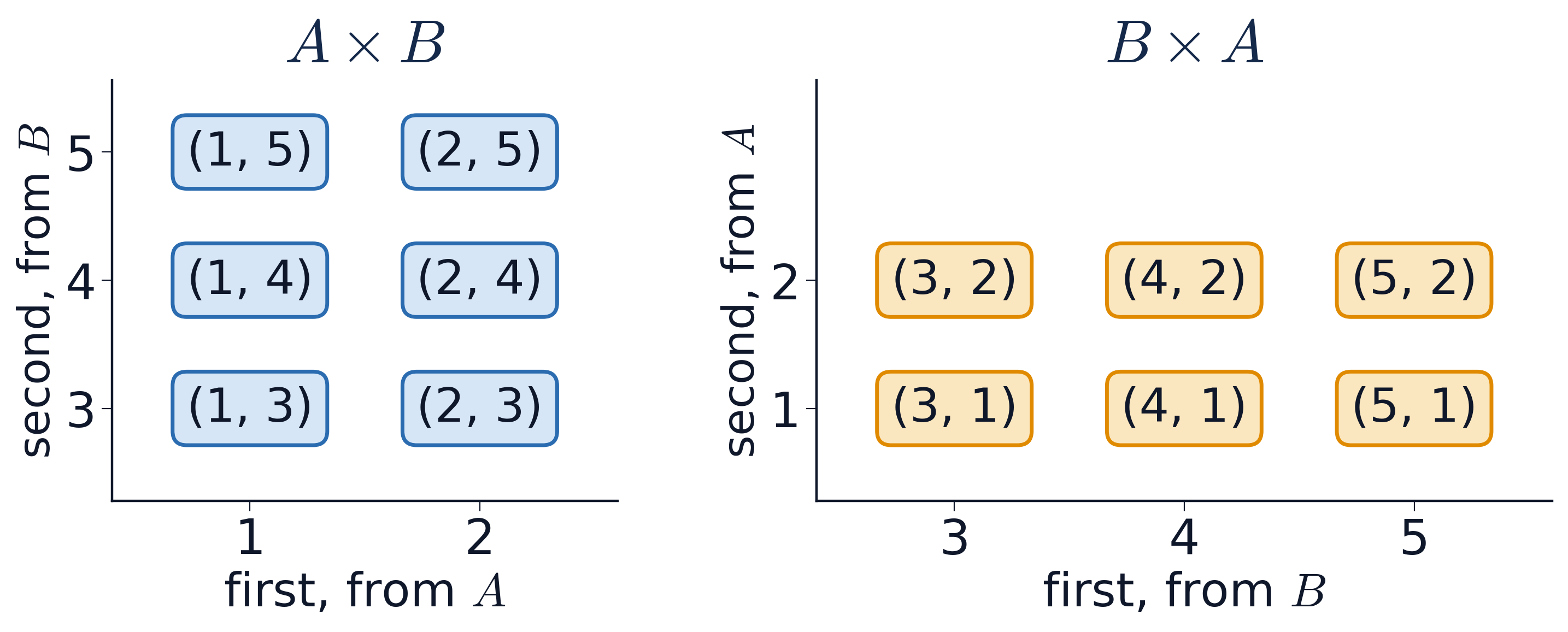
For A = \{1, 2\} and B = \{3, 4, 5\}:
A \times B = \{(1, 3), (1, 4), (1, 5), (2, 3), (2, 4), (2, 5)\}.
Two facts to remember:
- n(A \times B) = n(A) \times n(B). Here 2 \times 3 = 6. So A \times A has n(A)^2 elements.
- A \times B and B \times A are different sets (unless A = B), because (1, 3) is not (3, 1).
2. What a relation is
A relation R from A to B is any subset of A \times B. It is usually given by a rule that picks out some of the pairs.
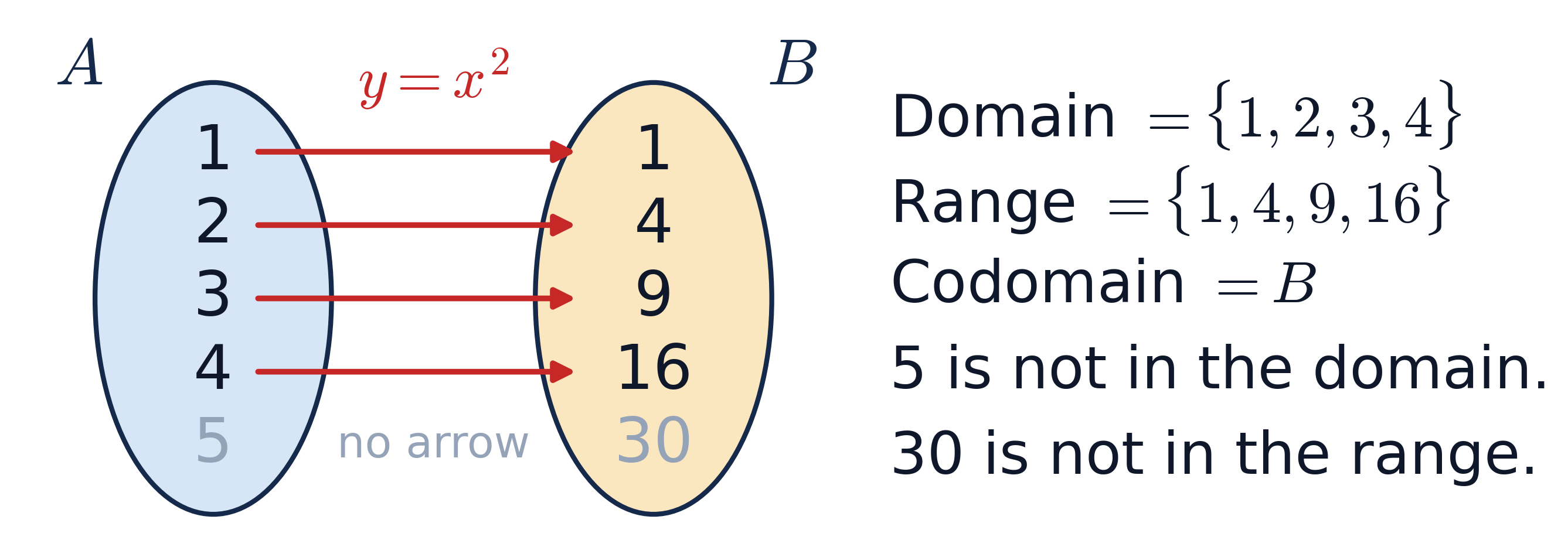
Take A = \{1, 2, 3, 4, 5\}, B = \{1, 4, 9, 16, 30\} and the rule "y is the square of x":
R = \{(x, y) : y = x^2,\ x \in A,\ y \in B\} = \{(1, 1), (2, 4), (3, 9), (4, 16)\}.
| Word | Meaning | In the example |
|---|---|---|
| Domain | the first elements that are used in R | \{1, 2, 3, 4\} |
| Range | the second elements that are used in R | \{1, 4, 9, 16\} |
| Codomain | the whole of the second set B | \{1, 4, 9, 16, 30\} |
The domain is a part of A and the range is a part of the codomain. They may be smaller: here 5 is not in the domain and 30 is not in the range.
How many relations? A \times B has mn elements when n(A) = m and n(B) = n. Each subset is a relation, so there are 2^{mn} relations from A to B. For n(A) = 3 and n(B) = 4 that is 2^{12} = 4096 relations.
3. A relation on a set: three properties
A relation on A is a subset of A \times A. We write aRb to mean (a, b) \in R.
| Property | R has it if | To show it fails, find |
|---|---|---|
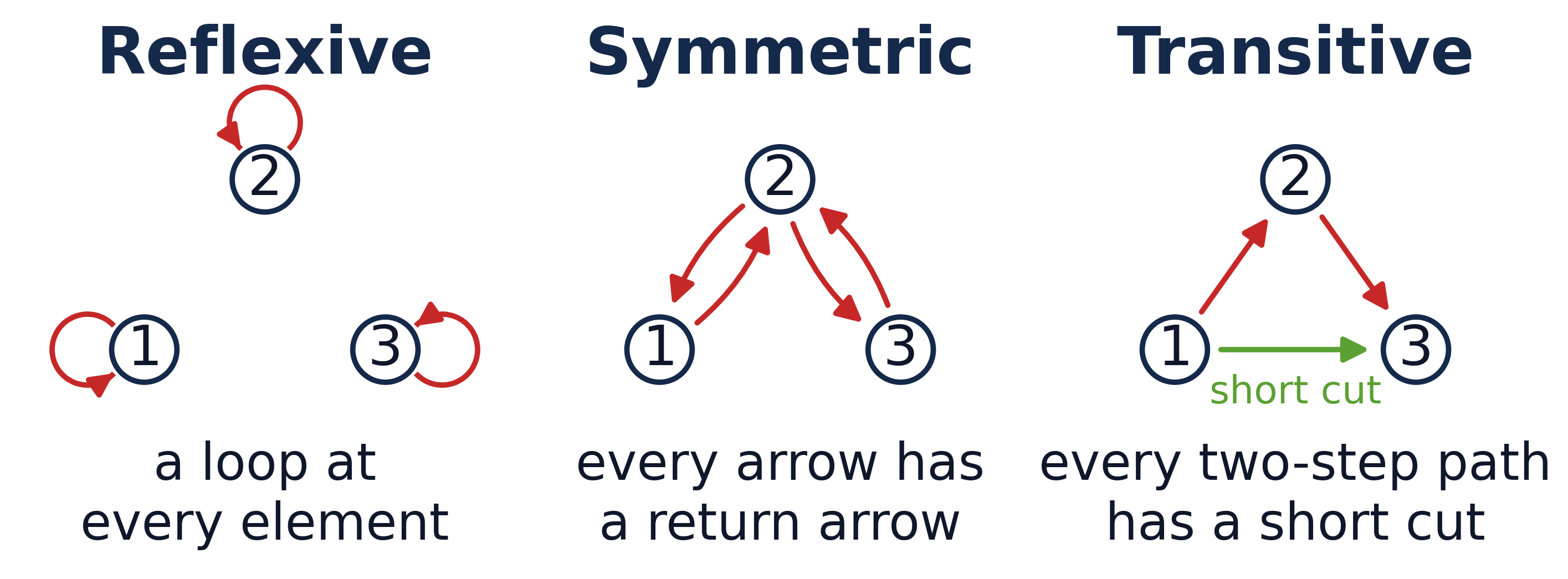
| Reflexive | (a, a) \in R for every a in A | one element a with (a, a) missing |
| Symmetric | whenever (a, b) \in R, also (b, a) \in R | one pair in R whose reverse is missing |
| Transitive | whenever (a, b) \in R and (b, c) \in R, also (a, c) \in R | one chain a \to b \to c with (a, c) missing |
Drawn with arrows on the set \{1, 2, 3\}, the three properties look like this.
Example: on the integers, let aRb mean a \le b.
- Reflexive: yes, a \le a for every a.
- Symmetric: no. 2 \le 3 but 3 \le 2 is false.
- Transitive: yes. If a \le b and b \le c then a \le c.
4. Equivalence relations
A relation that is reflexive, symmetric and transitive is called an equivalence relation.
Example: on the integers, let aRb mean "a - b is divisible by 3".
- Reflexive: a - a = 0, and 0 is divisible by 3.
- Symmetric: if a - b is divisible by 3, so is b - a = -(a - b).
- Transitive: if a - b and b - c are divisible by 3, so is their sum a - c.
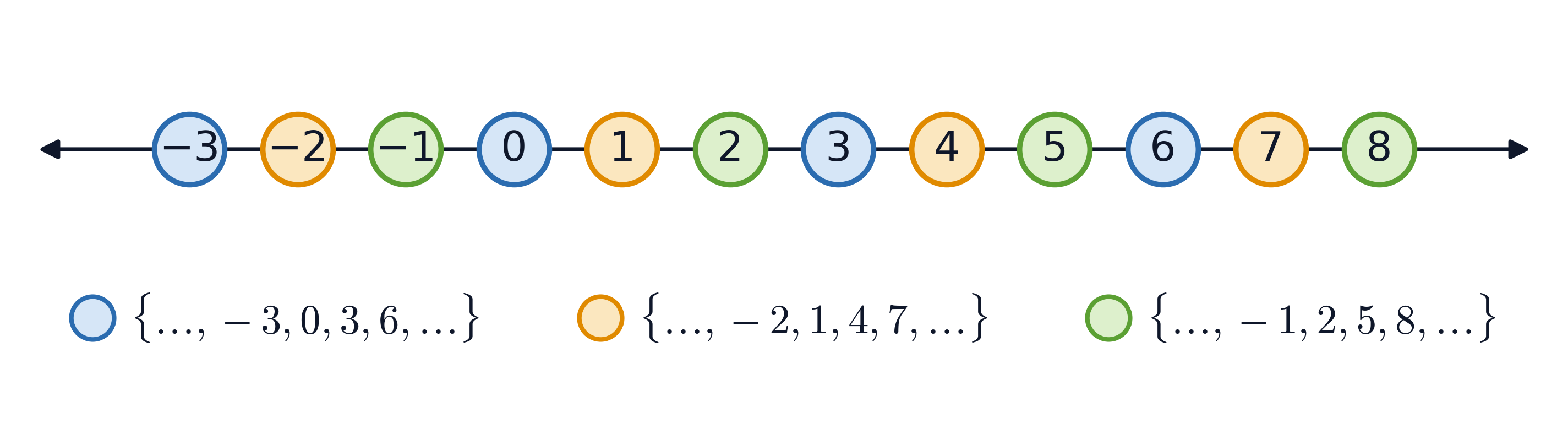
An equivalence relation cuts the set into separate groups called equivalence classes. Elements in one class are all related to each other, and no element is in two classes. Here there are three classes:
\{\dots, -3, 0, 3, 6, \dots\}, \{\dots, -2, 1, 4, 7, \dots\} and \{\dots, -1, 2, 5, 8, \dots\}.
5. Three special relations
On a non-empty set A:
| Relation | What it contains | Properties |
|---|---|---|
| Empty (void) relation | no pairs at all | symmetric and transitive, but not reflexive |
| Universal relation | every pair: the whole of A \times A | an equivalence relation |
| Identity relation | only the pairs (a, a) | an equivalence relation |
The empty relation is symmetric and transitive because there is no pair in it that can fail the test.
6. Worked examples
Example 1. R = \{(x, y) : x + 2y = 10\}, where x and y are natural numbers. Write R in roster form and find its domain and range.
Put y = 1, 2, 3, 4: then x = 8, 6, 4, 2. For y = 5, x = 0, which is not a natural number. So R = \{(8, 1), (6, 2), (4, 3), (2, 4)\}. Domain = \{2, 4, 6, 8\}. Range = \{1, 2, 3, 4\}.
Example 2. A = \{1, 2, 3\} and R = \{(1, 1), (2, 2), (3, 3), (1, 2), (2, 3)\}. Which of the three properties does R have?
- Reflexive: yes. (1, 1), (2, 2) and (3, 3) are all present.
- Symmetric: no. (1, 2) \in R but (2, 1) \notin R.
- Transitive: no. (1, 2) and (2, 3) are in R but (1, 3) is not.
Example 3. On the integers, aRb means "a + b is even". Show that R is an equivalence relation.
- Reflexive: a + a = 2a is even.
- Symmetric: a + b = b + a, so if one is even the other is.
- Transitive: if a + b and b + c are even, their sum a + 2b + c is even. Take away the even number 2b: a + c is even.
There are two equivalence classes: the even integers and the odd integers.
Example 4. On the integers, aRb means |a - b| \le 1. Is R an equivalence relation?
It is reflexive (|a - a| = 0) and symmetric (|a - b| = |b - a|). But 1R2 and 2R3, while |1 - 3| = 2, so 1R3 is false. R is not transitive, so it is not an equivalence relation.
7. From the real papers
Try each question for 75 seconds before you read the solution.
NDA II 2025, Q42. Set X contains 3n elements and set Y contains 2n elements, and they have n elements in common. How many elements does (X - Y) \times (Y - X) have?
(a) 5n^2 (b) 4n^2 (c) 3n^2 (d) 2n^2
Solution. X - Y has 3n - n = 2n elements and Y - X has 2n - n = n elements. The product has 2n \times n = 2n^2 pairs. Answer (d).
NDA II 2023, Q22. Let A = \{1, 2, 3, \ldots, 20\}. Define a relation R from A to A by R = \{(x, y) : 4x - 3y = 1\}, where x, y \in A. Which of the following statements is/are correct? 1. The domain of R is \{1, 4, 7, 10, 13, 16\}. 2. The range of R is \{1, 5, 9, 13, 17\}. 3. The range of R is equal to codomain of R. Select the correct answer using the code given below :
(a) 1 only (b) 2 only (c) 1 and 2 (d) 2 and 3
Solution. y = \dfrac{4x - 1}{3} is a whole number for x = 1, 4, 7, 10, 13, 16, giving y = 1, 5, 9, 13, 17, 21. But 21 is not in A, so the pair with x = 16 is not in R. Domain = \{1, 4, 7, 10, 13\}: statement 1 is wrong. Range = \{1, 5, 9, 13, 17\}: statement 2 is correct. The codomain is all of A, which is larger than the range: statement 3 is wrong. Answer (b).
NDA I 2024, Q23. Let R be a relation on the open interval (-1, 1) and is given by R = \{(x, y) : |x + y| < 2\}. Then which one of the following is correct?
(a) R is reflexive but neither symmetric nor transitive (b) R is reflexive and symmetric but not transitive (c) R is reflexive and transitive but not symmetric (d) R is an equivalence relation
Solution. For any x and y between -1 and 1, the sum x + y lies between -2 and 2. So |x + y| < 2 is always true and every pair is in R. This is the universal relation, which is an equivalence relation (section 5). Answer (d).
NDA I 2026, Q41. Let R be a relation on the set N of natural numbers defined by R = \{(x, y) : x, y \in N \text{ and } x = y^3\}. Which of the following statements is/are correct? I. R is symmetric relation II. R is transitive relation Select the answer using the code given below :
(a) I only (b) II only (c) Both I and II (d) Neither I nor II
Solution. (8, 2) \in R because 8 = 2^3, but (2, 8) \notin R because 2 \ne 8^3. Not symmetric. Next, (512, 8) \in R and (8, 2) \in R, but (512, 2) \notin R because 2^3 = 8, not 512. Not transitive. Answer (d).
NDA II 2026, Q23. Let S be the set of all real numbers and R be a relation on S defined by xRy \Rightarrow |x| \le y. Then R is
(a) reflexive only (b) transitive only (c) both reflexive and transitive (d) neither reflexive nor transitive
Solution. Reflexive needs |x| \le x for every real x. For x = -1 this says 1 \le -1, which is false. Not reflexive. Transitive: let |x| \le y and |y| \le z. The first shows y \ge 0, so |y| = y and then y \le z. Hence |x| \le y \le z, which means xRz. Transitive. Answer (b).
Notice the pattern: to show a property fails, give one example. To show it holds, argue for every element.
8. Mistakes that cost marks
- Treating (a, b) like \{a, b\}. In a set, order does not matter. In an ordered pair it does: (2, 3) \ne (3, 2), and so A \times B \ne B \times A in general.
- Mixing range and codomain. The codomain is the whole second set. The range is only the part that is used. They are equal only in special cases.
- Thinking "symmetric and transitive" gives "reflexive". It does not. On \{1, 2, 3\}, R = \{(1, 1), (1, 2), (2, 1), (2, 2)\} is symmetric and transitive, but (3, 3) is missing.
9. Quick check
Do these without help. Answers are at the end.
- n(A) = 3 and n(B) = 2. Find n(A \times B) and the number of relations from A to B.
- A = \{1, 2, 3, 4, 5, 6\} and R = \{(x, y) : y = x + 2\} is a relation on A. Write R in roster form, with its domain and range.
- On A = \{1, 2, 3\}, R = \{(1, 2), (2, 1)\}. Is R reflexive? Symmetric? Transitive?
- On the natural numbers, aRb means "a divides b". Which of the three properties does R have?
- On the integers, aRb means "a - b is divisible by 5". How many equivalence classes are there?
10. Read and watch more, free
| What | Where | Language |
|---|---|---|
| Textbook: Cartesian product, relations, domain and range | NCERT Class 11 Mathematics, Chapter 2 Relations and Functions · Hindi edition | English, Hindi |
| Textbook: reflexive, symmetric, transitive, equivalence | NCERT Class 12 Mathematics, Chapter 1 Relations and Functions · Hindi edition | English, Hindi |
| Self-study notes | NIOS Mathematics: Lesson 2 Relations and Functions-I · Hindi edition · Lesson 23 Relations and Functions-II · Hindi edition | English, Hindi |
| Video, the chapter for NDA | Defence Wallah: Complete Maths, Fast Track Series (the lesson titled "Relations", 1 to 2 hours) | Hinglish |
| Video, short lessons | Khan Academy India: कक्षा 11 एनसीईआरटी गणित (find the lessons on relations; the playlist is not in chapter order) | Hindi |
| Past NDA questions | ExamSIDE: Sets, Relations and Functions (no login needed) | English |
The videos were chosen from their titles, length and views; they have not yet been watched by a teacher.
Answers to the quick check
- n(A \times B) = 6. Number of relations = 2^6 = 64.
- R = \{(1, 3), (2, 4), (3, 5), (4, 6)\}. Domain = \{1, 2, 3, 4\}. Range = \{3, 4, 5, 6\}.
- Symmetric only. It is not reflexive ((1, 1) is missing). It is not transitive: (1, 2) and (2, 1) are in R, so (1, 1) would be needed.
- Reflexive (a divides a) and transitive (if a divides b and b divides c, then a divides c). Not symmetric: 2 divides 4 but 4 does not divide 2.
- Five: one class for each remainder 0, 1, 2, 3, 4 on division by 5.
Next chapter: Real numbers and the number line.