Why this chapter matters. This chapter gave 4 questions in the 7 papers from NDA II 2023 to NDA II 2026: one in NDA II 2023 and three in NDA I 2024. None of them asked the student to mark a number on a line. All four were about integers: remainders, factorials and divisibility. So this chapter does two things. It gives the number line, intervals and |x|, which every later chapter uses. Then it gives the three integer tools the real questions need. All four real questions are solved in section 7.
What you will be able to do
- Name the families of numbers and tell a rational number from an irrational one.
- Read and write intervals, and use |x - a| as a distance on the number line.
- Find the power of a prime in n! and the number of zeros at the end of n!.
- Find the remainder when a large power is divided by a small number.
Before you start you should know: the set signs \in and \subset (Chapter M1-1), and how to divide one whole number by another with a remainder.
1. The families of numbers
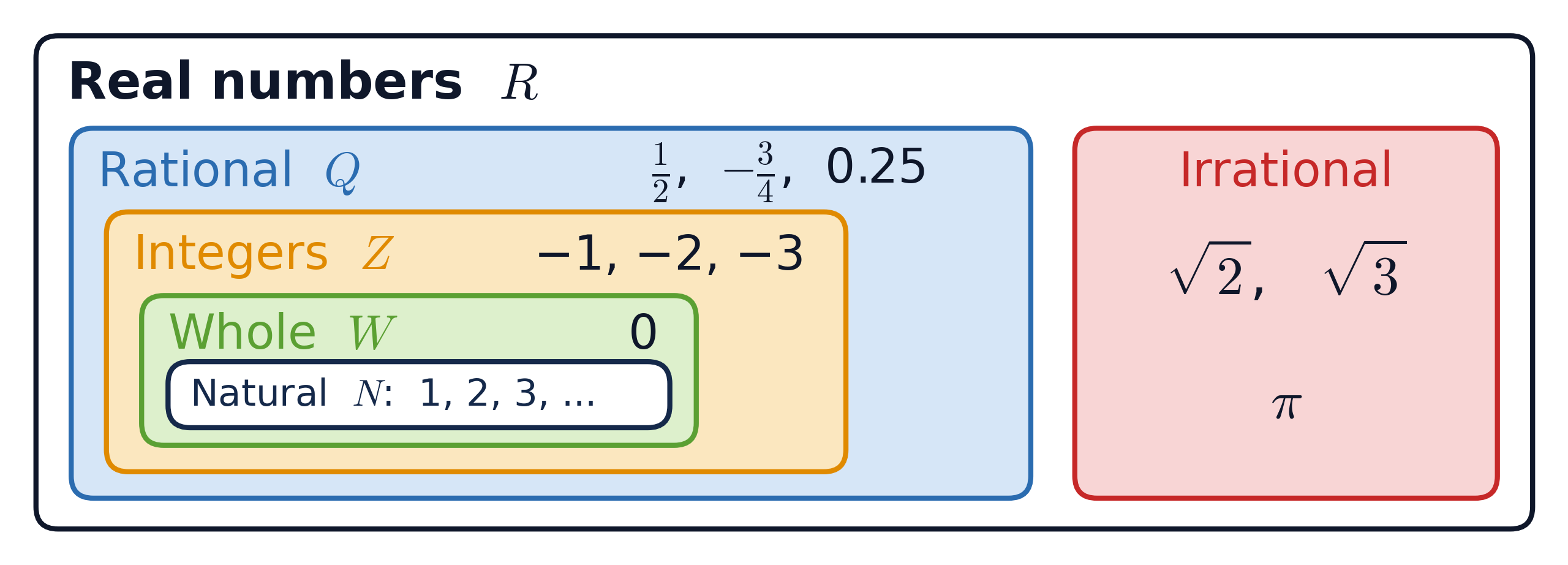
| Family | Symbol | Members |
|---|---|---|
| Natural numbers | N | 1, 2, 3, \dots |
| Whole numbers | W | 0, 1, 2, 3, \dots |
| Integers | Z | \dots, -2, -1, 0, 1, 2, \dots |
| Rational numbers | Q | numbers of the form \dfrac{p}{q}, with p and q integers and q \ne 0 |
| Irrational numbers | numbers that cannot be written as \dfrac{p}{q}: \sqrt{2}, \sqrt{3}, \pi | |
| Real numbers | R | all rational and all irrational numbers together |
Each family sits inside the next: N \subset W \subset Z \subset Q \subset R.
2. Rational or irrational?
Look at the decimal form.
- If the decimal ends (0.25) or repeats (0.3636\ldots), the number is rational.
- If the decimal goes on for ever without repeating, the number is irrational.
A repeating decimal is written with a bar over the repeating digits: 0.3636\ldots = 0.\overline{36}. To change it to a fraction, let x = 0.\overline{36}. Then 100x = 36.\overline{36}. Subtract: 99x = 36, so x = \dfrac{36}{99} = \dfrac{4}{11}.
Three rules:
- \sqrt{n} is irrational unless n is a perfect square. \sqrt{16} = 4 is rational; \sqrt{7} is irrational.
- Rational + irrational is always irrational. So 2 + \sqrt{3} is irrational.
- Irrational \times irrational can be either. \sqrt{2} \times \sqrt{2} = 2 is rational; \sqrt{2} \times \sqrt{3} = \sqrt{6} is irrational.
3. The number line and intervals
Draw a straight line, mark a point 0 and a point 1 to its right. Now every real number has exactly one point on the line, and every point has exactly one real number. Larger numbers lie to the right: a < b means a is to the left of b.
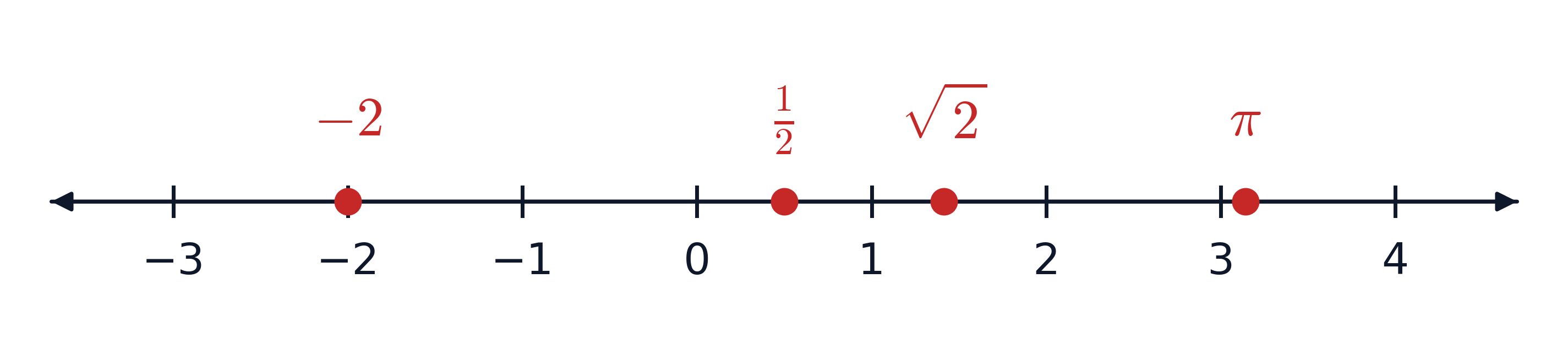
The line has no gaps and no "next" number. Between any two different real numbers there are infinitely many rational numbers and infinitely many irrational numbers.
A piece of the line between two numbers is called an interval. For a < b:
| Interval | Meaning | End points |
|---|---|---|
| (a, b) | a < x < b | both left out (open) |
| [a, b] | a \le x \le b | both included (closed) |
| [a, b) | a \le x < b | a included, b left out |
| (a, b] | a < x \le b | a left out, b included |
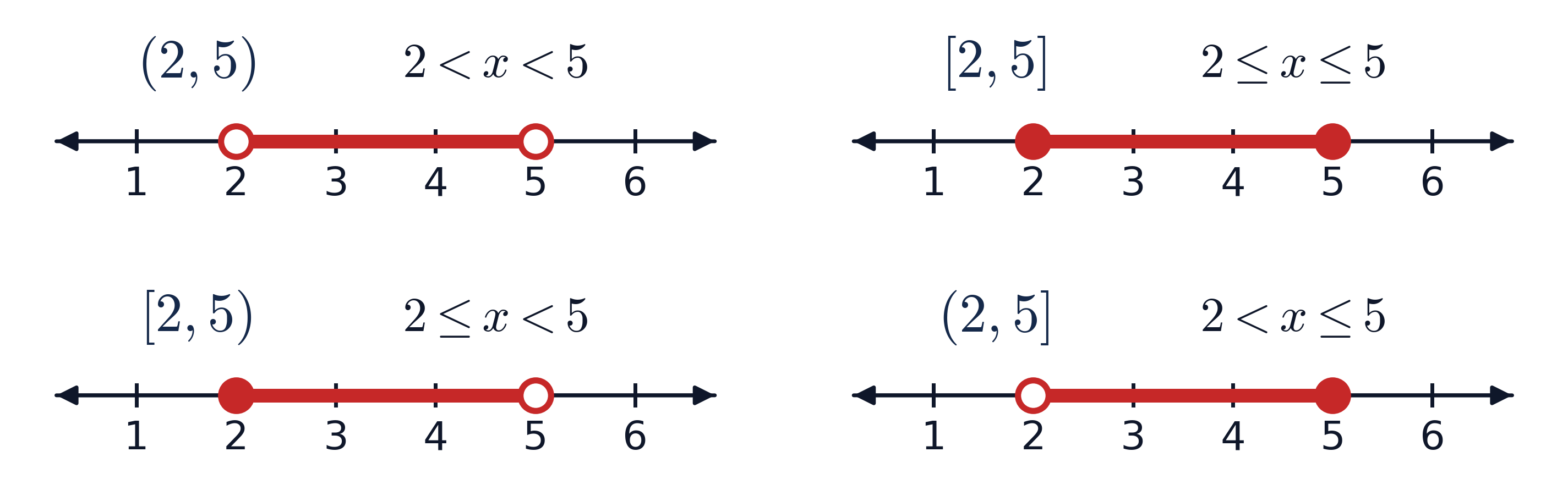
On the line, an open circle shows an end point that is left out and a filled circle shows one that is included. For example, [2, 5) contains 2 and 4.99 but not 5. The pieces that go on for ever are written with \infty: (3, \infty) means x > 3.
4. Absolute value: distance on the line
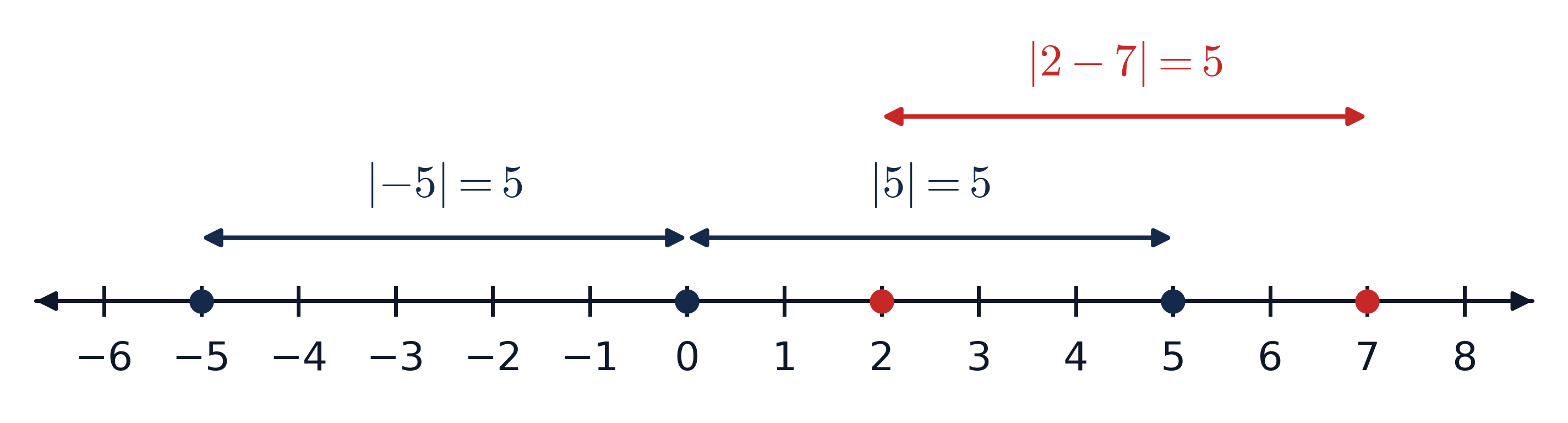
The absolute value (or modulus) |x| is the distance of x from 0. It is never negative.
|x| = x \ \text{ if } x \ge 0, \qquad |x| = -x \ \text{ if } x < 0
So |5| = 5 and |-5| = 5. In the same way, |x - a| is the distance between x and a. For example, |2 - 7| = 5.
For a positive number a:
| Statement | Means | On the line |
|---|---|---|
| \lvert x \rvert = a | x = a or x = -a | two points |
| \lvert x \rvert < a | -a < x < a | the interval (-a, a) |
| \lvert x \rvert > a | x < -a or x > a | two separate pieces |
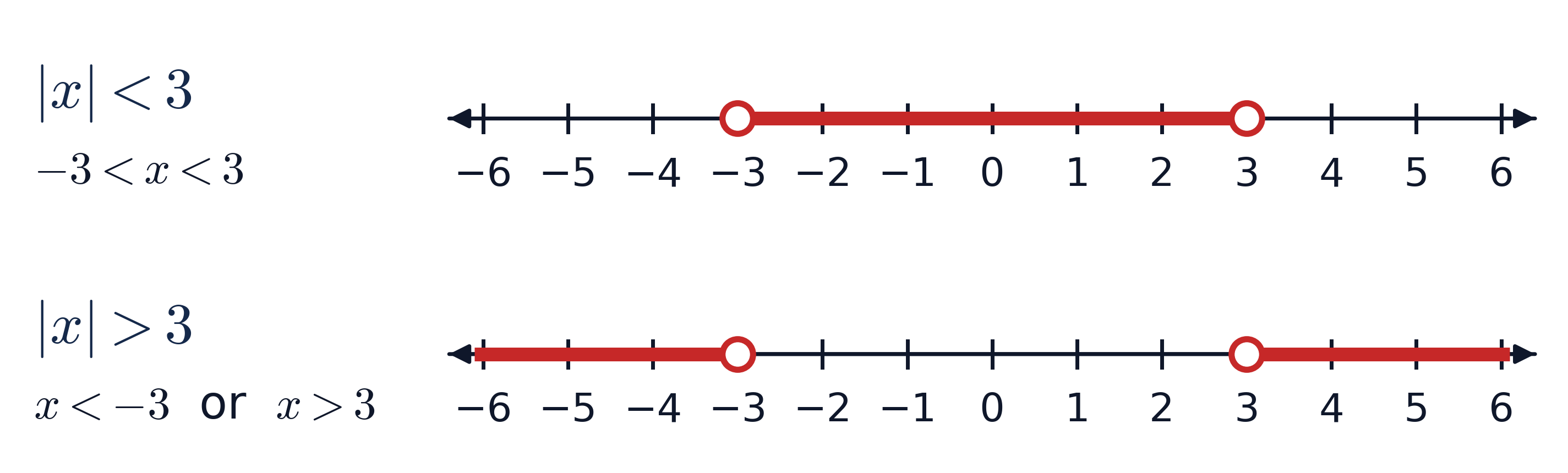
Two more facts: \sqrt{x^2} = |x|, and |x + y| \le |x| + |y| for all real x and y.
5. Integers: three tools the exam uses
Tool 1: a factorial contains every smaller factorial. n! means 1 \times 2 \times 3 \times \dots \times n. So 4! = 24, and 5! = 5 \times 4!, 6! = 6 \times 5 \times 4!, and so on. Every factorial from 4! onwards is divisible by 24.
Tool 2: the power of a prime p in n!. Count the multiples of p, then of p^2, then of p^3, up to n:
\text{power of } p \text{ in } n! = \left\lfloor \frac{n}{p} \right\rfloor + \left\lfloor \frac{n}{p^2} \right\rfloor + \left\lfloor \frac{n}{p^3} \right\rfloor + \dots
The sign \lfloor\ \rfloor means "divide and drop the fraction part". For example, the power of 2 in 10! is \left\lfloor \frac{10}{2} \right\rfloor + \left\lfloor \frac{10}{4} \right\rfloor + \left\lfloor \frac{10}{8} \right\rfloor = 5 + 2 + 1 = 8.
Tool 3: remainders of powers. When numbers are multiplied, their remainders are multiplied too. So if some power a^k leaves remainder 1, every power of a^k also leaves remainder 1. Look for that power first. For example, 3^2 = 9 leaves remainder 1 on division by 8, so 3^{100} = (3^2)^{50} also leaves remainder 1.
6. Worked examples
Example 1. Write 0.4777\ldots = 0.4\overline{7} as a fraction.
Let x = 0.4\overline{7}. Then 10x = 4.\overline{7} and 100x = 47.\overline{7}. Subtract: 90x = 43, so x = \dfrac{43}{90}.
Example 2. Solve |2x - 3| \le 5 and write the answer as an interval.
-5 \le 2x - 3 \le 5. Add 3: -2 \le 2x \le 8. Divide by 2: -1 \le x \le 4. The answer is [-1, 4].
Example 3. How many zeros are at the end of 50!?
Each zero needs one factor 10, that is one 2 and one 5. There are fewer 5s than 2s, so count the 5s (Tool 2): \left\lfloor \frac{50}{5} \right\rfloor + \left\lfloor \frac{50}{25} \right\rfloor = 10 + 2 = 12. There are 12 zeros.
Example 4. What is the remainder when 3^{101} is divided by 8?
3^2 = 9 leaves remainder 1 (Tool 3). Write 3^{101} = (3^2)^{50} \times 3. The first factor leaves remainder 1, so the product leaves the remainder of 1 \times 3 = 3.
7. From the real papers
Try each question for 75 seconds before you read the solution.
NDA II 2023, Q2. If 1! + 3! + 5! + 7! + \ldots + 199! is divided by 24, what is the remainder?
(a) 3 (b) 6 (c) 7 (d) 9
Solution. 4! = 24, so 5!, 7!, \ldots, 199! are all divisible by 24 (Tool 1). Only 1! + 3! = 1 + 6 = 7 is left. Answer (c).
NDA I 2024, Q18. What is the remainder when 2^{120} is divided by 7?
(a) 1 (b) 3 (c) 5 (d) 6
Solution. 2^3 = 8 leaves remainder 1 on division by 7 (Tool 3). 2^{120} = (2^3)^{40}, so it also leaves remainder 1. Answer (a).
NDA I 2024, Q10. If 26! = n8^k, where k and n are positive integers, then what is the maximum value of k?
(a) 6 (b) 7 (c) 8 (d) 9
Solution. 8 = 2^3 is not a prime, so first count the 2s (Tool 2): \left\lfloor \frac{26}{2} \right\rfloor + \left\lfloor \frac{26}{4} \right\rfloor + \left\lfloor \frac{26}{8} \right\rfloor + \left\lfloor \frac{26}{16} \right\rfloor = 13 + 6 + 3 + 1 = 23. Each 8 uses three 2s, and \left\lfloor \frac{23}{3} \right\rfloor = 7. Answer (b).
NDA I 2024, Q33. If x^2 + mx + n is an integer for all integral values of x, then which of the following is/are correct? 1. m must be an integer 2. n must be an integer Select the correct answer using the code given below :
(a) 1 only (b) 2 only (c) Both 1 and 2 (d) Neither 1 nor 2
Solution. Put x = 0: the value is n, so n is an integer. Put x = 1: the value is 1 + m + n, an integer. Since 1 and n are integers, m is an integer too. Answer (c).
Practice questions in the exam style
The real questions above are all on integers. These two are our own questions, not from a real paper, on the other half of the chapter.
Practice 1. Consider the following statements : I. The sum of a rational number and an irrational number is always irrational. II. The product of two irrational numbers is always irrational. Which of the statements given above is/are correct?
(a) I only (b) II only (c) Both I and II (d) Neither I nor II
Solution. I is correct (section 2). II is wrong: \sqrt{2} \times \sqrt{2} = 2. Answer (a).
Practice 2. How many integers x satisfy |x - 3| < 4?
(a) 6 (b) 7 (c) 8 (d) 9
Solution. The distance of x from 3 is less than 4, so -1 < x < 7. The integers are 0, 1, 2, 3, 4, 5, 6: seven of them. Answer (b).
8. Mistakes that cost marks
- Calling a repeating decimal irrational. 0.333\ldots = \dfrac{1}{3} is rational. In the same way \dfrac{22}{7} is rational; it is only close to \pi, which is irrational.
- Writing |x| > a as one chain. -a > x > a is wrong. The right answer has two separate pieces: x < -a or x > a.
- Writing \sqrt{x^2} = x. The right form is \sqrt{x^2} = |x|. For x = -3: \sqrt{9} = 3, not -3.
- Using Tool 2 on a number that is not prime. For the power of 8 in 26!, count the 2s first and then divide by 3.
9. Quick check
Do these without help. Answers are at the end.
- Which of these are irrational: \sqrt{16}, \sqrt{7}, 0.25, \pi, 0.\overline{63}?
- Write 0.\overline{63} = 0.6363\ldots as a fraction.
- Solve |x - 2| < 3 and write the answer as an interval.
- How many zeros are at the end of 30!?
- What is the remainder when 2^{50} is divided by 7?
10. Read and watch more, free
No free textbook chapter in our checked list is only about this topic. These cover its parts.
| What | Where | Language |
|---|---|---|
| Textbook: subsets of the real numbers, intervals | NCERT Class 11 Mathematics, Chapter 1 Sets (sections 1.6.1 and 1.6.2) · Hindi edition | English, Hindi |
| Textbook: inequalities shown on the number line | NCERT Class 11 Mathematics, Chapter 5 Linear Inequalities · Hindi edition | English, Hindi |
| Self-study notes: number families and intervals | NIOS Mathematics, Lesson 1 Sets · Hindi edition | English, Hindi |
| Video, every textbook problem | Magnet Brains: Class 11 Maths (the videos on Chapter 1 and Chapter 5) | Hinglish |
| Video, short lessons | Khan Academy India: कक्षा 11 एनसीईआरटी गणित (the lessons on sets and on linear inequalities; the playlist is not in chapter order) | Hindi |
| Video, past NDA questions solved topic by topic | Chandigarh Career Group: NDA mathematics PYQ | Hinglish (judged from the titles) |
For section 5 (factorials and remainders) the checked list has no textbook chapter and no video of its own. Use the worked examples and the real questions above.
The videos were chosen from their titles, length and views; they have not yet been watched by a teacher.
Answers to the quick check
- \sqrt{7} and \pi. (\sqrt{16} = 4, and 0.25 and 0.\overline{63} end or repeat, so they are rational.)
- Let x = 0.\overline{63}. Then 100x - x = 63, so x = \dfrac{63}{99} = \dfrac{7}{11}.
- -3 < x - 2 < 3, so -1 < x < 5: the interval (-1, 5).
- \left\lfloor \frac{30}{5} \right\rfloor + \left\lfloor \frac{30}{25} \right\rfloor = 6 + 1 = 7.
- 2^3 = 8 leaves remainder 1. 2^{50} = (2^3)^{16} \times 2^2, so the remainder is that of 1 \times 4 = 4.
Next chapter: Complex numbers.