Why this chapter matters. The binomial theorem gave 24 questions in the 7 papers from NDA II 2023 to NDA II 2026, between three and four in a paper. The questions ask for one term of an expansion (a given power of x, the term without x, the middle term), for the sum of the coefficients, or for the greatest coefficient. Six real questions are solved in section 7.
What you will be able to do
- Expand (a + b)^n for a small whole number n.
- Write the general term and use it to find any one term without expanding.
- Find the middle term and the greatest coefficient.
- Find sums of coefficients by putting x = 1 or x = -1.
Before you start you should know: the meaning and the value of {}^nC_r, and the fact {}^nC_r = {}^nC_{n-r} (Chapter M1-9), and the laws of powers such as x^m \times x^n = x^{m+n}.
1. The theorem
A binomial is an expression with two terms, such as a + b or 2x - 3. You know that (a + b)^2 = a^2 + 2ab + b^2 and (a + b)^3 = a^3 + 3a^2b + 3ab^2 + b^3. The binomial theorem gives the expansion for every whole number n:
(a + b)^n = {}^nC_0\,a^n + {}^nC_1\,a^{n-1}b + {}^nC_2\,a^{n-2}b^2 + \dots + {}^nC_n\,b^n
Four things to see in it:
- There are n + 1 terms.
- The power of a goes down from n to 0. The power of b goes up from 0 to n. In every term the two powers add up to n.
- The numbers {}^nC_0, {}^nC_1, \dots, {}^nC_n are called the binomial coefficients. They read the same from both ends, because {}^nC_r = {}^nC_{n-r}.
- For (a - b)^n write a + (-b). The signs then go +\;-\;+\;-\;\dots
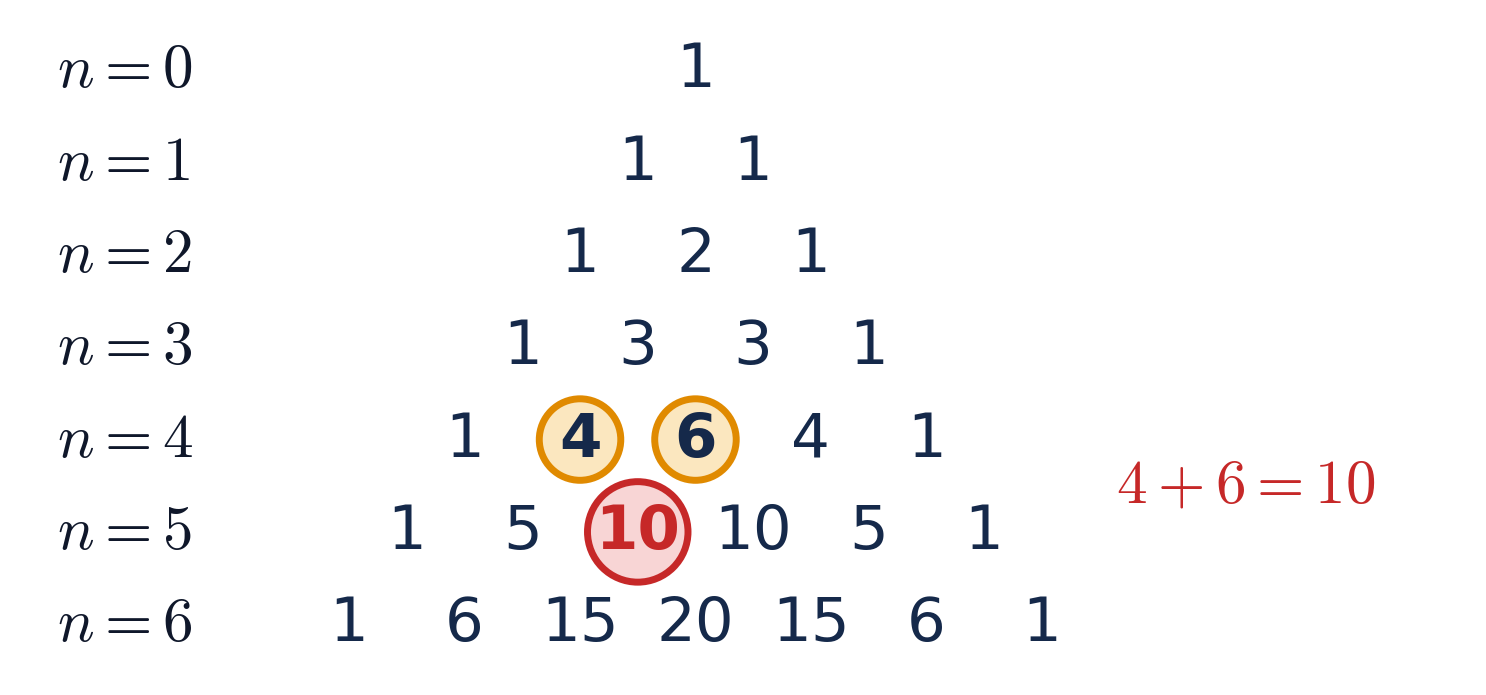
For small n the binomial coefficients can be read from Pascal's triangle. Each number is the sum of the two numbers above it.
| n | Binomial coefficients |
|---|---|
| 1 | 1, 1 |
| 2 | 1, 2, 1 |
| 3 | 1, 3, 3, 1 |
| 4 | 1, 4, 6, 4, 1 |
| 5 | 1, 5, 10, 10, 5, 1 |
For example, (x + 2)^3 = x^3 + 3x^2(2) + 3x(2)^2 + 2^3 = x^3 + 6x^2 + 12x + 8.
2. The general term
The term that contains {}^nC_r is the (r + 1)th term, because the count of r starts at 0:
T_{r+1} = {}^nC_r\,a^{n-r}\,b^r
This one formula answers most questions. Write the general term, collect the powers of x, and choose r to get the power you want.
For example, the 3rd term of (x + 2)^8 has r = 2: T_3 = {}^8C_2\,x^6\,2^2 = 28 \times 4\,x^6 = 112x^6.
3. The middle term and the greatest coefficient
(a + b)^n has n + 1 terms.
| n | Middle term | Example |
|---|---|---|
| even | one middle term, T_{\frac{n}{2}+1} | n = 10: 11 terms, the middle one is T_6 |
| odd | two middle terms, T_{\frac{n+1}{2}} and T_{\frac{n+3}{2}} | n = 7: 8 terms, the middle ones are T_4 and T_5 |
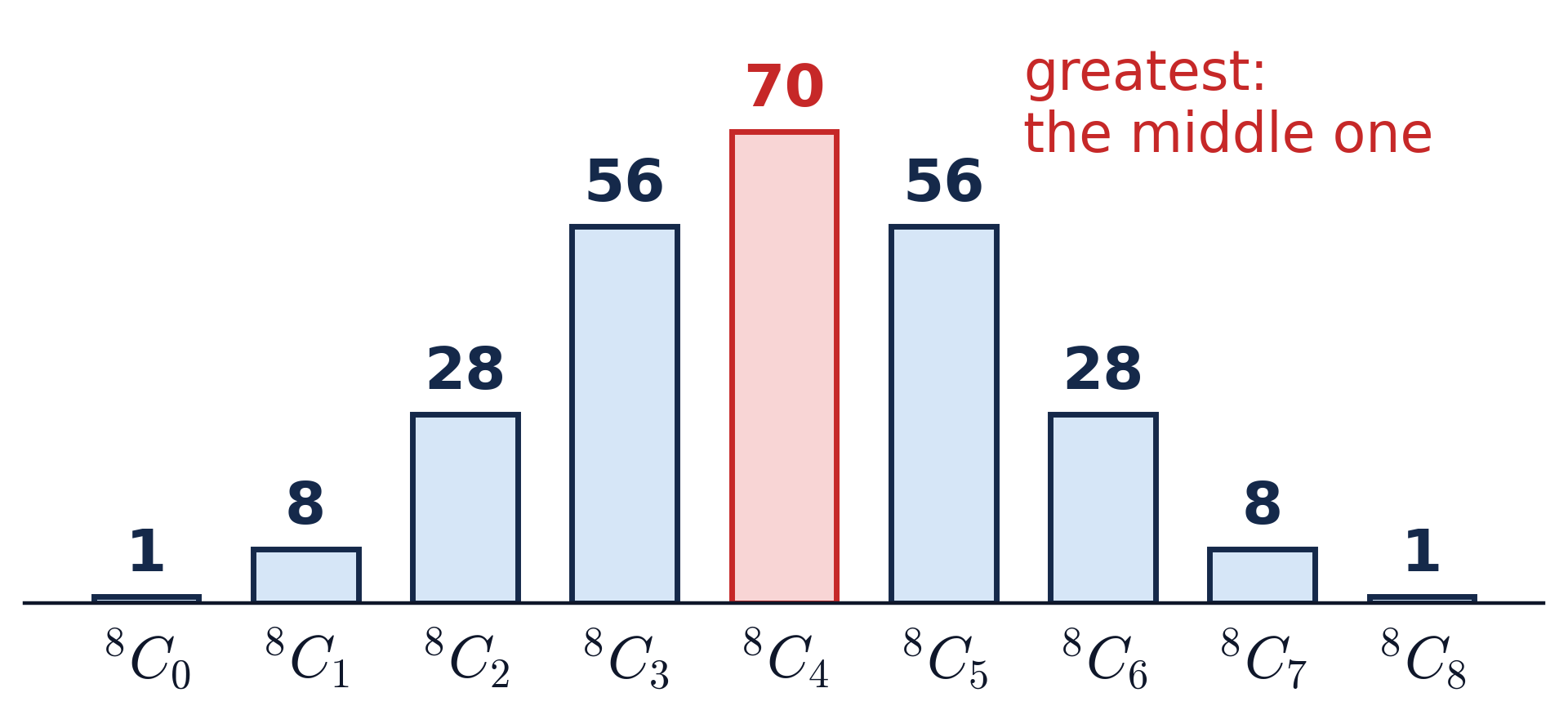
The binomial coefficients rise to the middle and then fall. So the greatest binomial coefficient is the middle one: {}^nC_{n/2} when n is even. When n is odd, the two middle coefficients are equal and are the greatest. For n = 7 they are {}^7C_3 = {}^7C_4 = 35.
4. Sums of coefficients
Write (1 + x)^n = C_0 + C_1x + C_2x^2 + \dots + C_nx^n, where C_r is short for {}^nC_r.
| Put | Result |
|---|---|
| x = 1 | C_0 + C_1 + C_2 + \dots + C_n = 2^n |
| x = -1 | C_0 - C_1 + C_2 - C_3 + \dots = 0 |
| add and subtract the two | C_0 + C_2 + C_4 + \dots = C_1 + C_3 + C_5 + \dots = 2^{n-1} |
Check with n = 5: 1 + 5 + 10 + 10 + 5 + 1 = 32 = 2^5, and 1 + 10 + 5 = 5 + 10 + 1 = 16.
The same idea works for any expansion: to get the sum of all the coefficients, put every letter equal to 1. The sum of the coefficients in (2x + 3)^4 is (2 + 3)^4 = 625.
5. Two uses that the exam likes
Remainders. To find a remainder on division by 25, write the number as (1 + a multiple of 5) and expand. For example,
6^n = (1 + 5)^n = 1 + 5n + {}^nC_2\,5^2 + {}^nC_3\,5^3 + \dots
Every term after the first two has the factor 25. So 6^n - 5n always leaves the remainder 1 when divided by 25.
A pair such as \sqrt{2} + 1 and \sqrt{2} - 1. Their product is 2 - 1 = 1, so each is the reciprocal of the other. When n is even and you add the expansions of (\sqrt{2} + 1)^n and (\sqrt{2} - 1)^n, the terms with odd powers of \sqrt{2} cancel. What is left is a whole number. For example, (\sqrt{2} + 1)^2 + (\sqrt{2} - 1)^2 = (3 + 2\sqrt{2}) + (3 - 2\sqrt{2}) = 6.
6. Worked examples
Example 1. Expand (2x + 3)^4.
The coefficients for n = 4 are 1, 4, 6, 4, 1.
(2x)^4 + 4(2x)^3(3) + 6(2x)^2(3)^2 + 4(2x)(3)^3 + 3^4 = 16x^4 + 96x^3 + 216x^2 + 216x + 81.
Example 2. Find the coefficient of x^5 in the expansion of (x + 2)^8.
T_{r+1} = {}^8C_r\,x^{8-r}\,2^r. For x^5 we need 8 - r = 5, so r = 3. The coefficient is {}^8C_3 \times 2^3 = 56 \times 8 = 448.
Example 3. Find the term independent of x (the term without x) in \left(x^2 + \dfrac{1}{x}\right)^9.
T_{r+1} = {}^9C_r\,(x^2)^{9-r}\left(\dfrac{1}{x}\right)^r = {}^9C_r\,x^{18-3r}. No x means 18 - 3r = 0, so r = 6. The term is T_7 = {}^9C_6 = 84.
Example 4. Find the middle term of \left(x - \dfrac{1}{x}\right)^{10}.
n = 10 is even, so the middle term is T_6, with r = 5.
T_6 = {}^{10}C_5\,x^5\left(-\dfrac{1}{x}\right)^5 = -{}^{10}C_5 = -252.
Example 5. Find the remainder when 6^{20} - 100 is divided by 25.
By section 5, 6^n - 5n leaves the remainder 1 for every n. With n = 20, 5n = 100. So the remainder is 1.
7. From the real papers
Try each question for 75 seconds before reading the solution.
NDA II 2023, Q40. Let (1 + x)^n = 1 + T_1 x + T_2 x^2 + T_3 x^3 + \ldots + T_n x^n. What is T_1 + T_2 + T_3 + \ldots + T_n equal to?
(a) 2^n (b) 2^n - 1 (c) 2^{n-1} (d) 2^n + 1
Solution. Put x = 1 on both sides: 2^n = 1 + T_1 + T_2 + \dots + T_n. So the sum asked is 2^n - 1. Answer (b).
NDA I 2024, Q31. If the 4th term in the expansion of \left(mx + \frac{1}{x}\right)^n is \frac{5}{2}, then what is the value of mn?
(a) -3 (b) 3 (c) 6 (d) 12
Solution. The 4th term has r = 3: T_4 = {}^nC_3\,(mx)^{n-3}\left(\dfrac{1}{x}\right)^3 = {}^nC_3\,m^{n-3}\,x^{n-6}. It is equal to \frac{5}{2}, which has no x, so n - 6 = 0 and n = 6. Then {}^6C_3\,m^3 = 20m^3 = \dfrac{5}{2}, so m^3 = \dfrac{1}{8} and m = \dfrac{1}{2}. Hence mn = 3. Answer (b).
NDA I 2025, Q20. What is the number of rational terms in the expansion of (3^{\frac{1}{2}} + 5^{\frac{1}{4}})^{12}?
(a) 2 (b) 3 (c) 4 (d) 6
Solution. T_{r+1} = {}^{12}C_r\,3^{\frac{12-r}{2}}\,5^{\frac{r}{4}}, for r = 0 to 12. The term is rational only when both powers are whole numbers. So r must be a multiple of 4: r = 0, 4, 8, 12. For each of these 12 - r is even, so the power of 3 is also a whole number. There are 4 rational terms. Answer (c).
NDA I 2025, Q21. If the sum of binomial coefficients in the expansion of (x + y)^n is 256, then the greatest binomial coefficient occurs in which one of the following terms?
(a) Third (b) Fourth (c) Fifth (d) Ninth
Solution. The sum of the binomial coefficients is 2^n. So 2^n = 256 = 2^8 and n = 8. There are 9 terms. The greatest coefficient is the middle one, {}^8C_4 = 70. It has r = 4, so it is in the fifth term. Answer (c).
NDA I 2026, Q48. Let u be a positive integer and f be a real number lying between 0 and 1. Further, (\sqrt{2} + 1)^{10} = u + f and (\sqrt{2} - 1)^{10} = v. What is the value of (v + f)?
(a) 2 (b) 1 (c) 0.5 (d) 0.25
Solution. Add the two expansions. The terms with odd powers of \sqrt{2} cancel, so (\sqrt{2} + 1)^{10} + (\sqrt{2} - 1)^{10} = u + f + v is a whole number. As u is a whole number, f + v is a whole number too. Now 0 < f < 1. Also \sqrt{2} - 1 is about 0.41, so 0 < v < 1. Hence 0 < f + v < 2, and the only whole number in that range is 1. Answer (b).
NDA II 2026, Q43. Consider the following statements in respect of the expansion of (x^2 + x^{-2} + 2)^4 : I. The number of terms in the expansion is 5. II. One of the coefficients in the expansion has a maximum value equal to 70. Which of the statements given above is/are correct?
(a) I only (b) II only (c) Both I and II (d) Neither I nor II
Solution. x^2 + \dfrac{1}{x^2} + 2 = \left(x + \dfrac{1}{x}\right)^2. So the expression is \left(x + \dfrac{1}{x}\right)^8. It has 8 + 1 = 9 terms, so I is wrong. Its coefficients are {}^8C_0, {}^8C_1, \dots, {}^8C_8, and the greatest is the middle one, {}^8C_4 = 70. So II is correct. Answer (b).
Notice that no question needed a full expansion. The general term, the middle coefficient and the substitution x = 1 did most of the work.
8. Mistakes that cost marks
- Taking {}^nC_r for the rth term. The term with {}^nC_r is the (r + 1)th term. The 4th term has r = 3.
- Losing the minus sign. In (a - b)^n the second quantity is -b. In Example 4 the middle term is -252, not 252.
- Mixing "binomial coefficient" and "coefficient". In (2x + 3)^4 the term in x^3 is 96x^3. Its binomial coefficient is 4 but its coefficient is 96. The sum of all the coefficients is 5^4 = 625, not 2^4.
- Counting n terms. (a + b)^n has n + 1 terms.
9. Quick check
Do these without help. Answers are at the end.
- How many terms are there in the expansion of (x + y)^{15}?
- Find the coefficient of x^3 in (1 + 2x)^5.
- Find the sum of all the coefficients in the expansion of (3x - 1)^6.
- Find the middle term of (x + y)^6.
- Find the term independent of x in \left(x + \dfrac{1}{x}\right)^8.
10. Read and watch more, free
| What | Where | Language |
|---|---|---|
| Textbook | NCERT Class 11 Mathematics, Chapter 7 Binomial Theorem · Hindi edition. The general term and the middle term were not found in the present edition; learn them from this lesson and the videos | English, Hindi |
| Self-study notes | NIOS Mathematics, Lesson 12 Binomial Theorem · Hindi edition | English, Hindi |
| Video, the chapter for NDA | Defence Wallah: Complete Maths, Fast Track Series (the lesson "Binomial", 1 to 2 hours) | Hinglish |
| Video, theory then questions | Defence Wallah: Maths, SHAKTI 2.0 (the lesson "Binomial", 1.5 to 2 hours) | Hinglish |
| Video, short school lessons | Khan Academy India: कक्षा 11 एनसीईआरटी गणित (the lessons on the binomial theorem) | Hindi |
| Past NDA questions with answers | ExamSIDE: Binomial Theorem | English |
The videos were chosen from their titles, length and views; they have not yet been watched by a teacher.
Answers to the quick check
- 15 + 1 = 16.
- T_4 = {}^5C_3\,(2x)^3, so the coefficient is 10 \times 8 = 80.
- Put x = 1: (3 - 1)^6 = 64.
- T_4 = {}^6C_3\,x^3y^3 = 20x^3y^3.
- T_{r+1} = {}^8C_r\,x^{8-2r}, so r = 4 and the term is {}^8C_4 = 70.
Next chapter: Logarithms.