Why this chapter matters. This chapter gave 5 questions in the 6 papers from CDS I 2024 to CDS II 2026: one in CDS II 2024, one in CDS II 2025, two in CDS I 2026 and one in CDS II 2026. That is close to one question a paper, worth 0.83 marks each. Four of the five were on X-rays, and two of those four were the same question set twice: can an X-ray be deflected by an electric or a magnetic field? (It cannot.) The other two X-ray questions were on uses and on why metal objects are removed before an X-ray picture. The fifth question gave four statements about cells and emf. So learn section 6 on X-rays first, then the meaning of emf in section 4, then the table of primary and secondary cells in section 1.
What you will be able to do
- Tell a primary cell from a secondary cell, and name the electrodes and the electrolyte of a dry cell and a lead-acid battery.
- Use the emf and the internal resistance of a cell to find the current and the terminal voltage.
- Find the total emf of cells joined in series and in parallel.
- Say how X-rays are produced, list their properties and uses, and place them in the electromagnetic spectrum.
Before you start you should know: V = IR and resistors in series and parallel (Chapter K1-14), and electrical power (Chapter K1-15).
1. What a cell is
A cell changes chemical energy into electrical energy. It has two electrodes of different materials placed in an electrolyte, a substance that conducts through its ions. Chemical reactions push electrons towards one electrode, which becomes the negative terminal. The other becomes the positive terminal. Join the terminals with a wire and a current flows.
A battery is two or more cells joined together. In everyday speech a single cell is also called a battery.
The first cell was made by Alessandro Volta in 1800. The unit of potential difference, the volt, is named after him.
| Kind of cell | Can it be recharged? | Why | Examples |
|---|---|---|---|
| Primary | No. It is thrown away when its chemicals are used up | Its chemical reaction cannot be reversed in practice | Dry cell, alkaline cell, mercury (button) cell |
| Secondary (storage cell, accumulator) | Yes, many times | Passing a current backwards through it reverses the reaction | Lead-acid battery, nickel-cadmium cell, lithium-ion battery |
While a secondary cell is being charged, electrical energy is stored in it as chemical energy. While it is used, the chemical energy becomes electrical energy again.
2. Primary cells
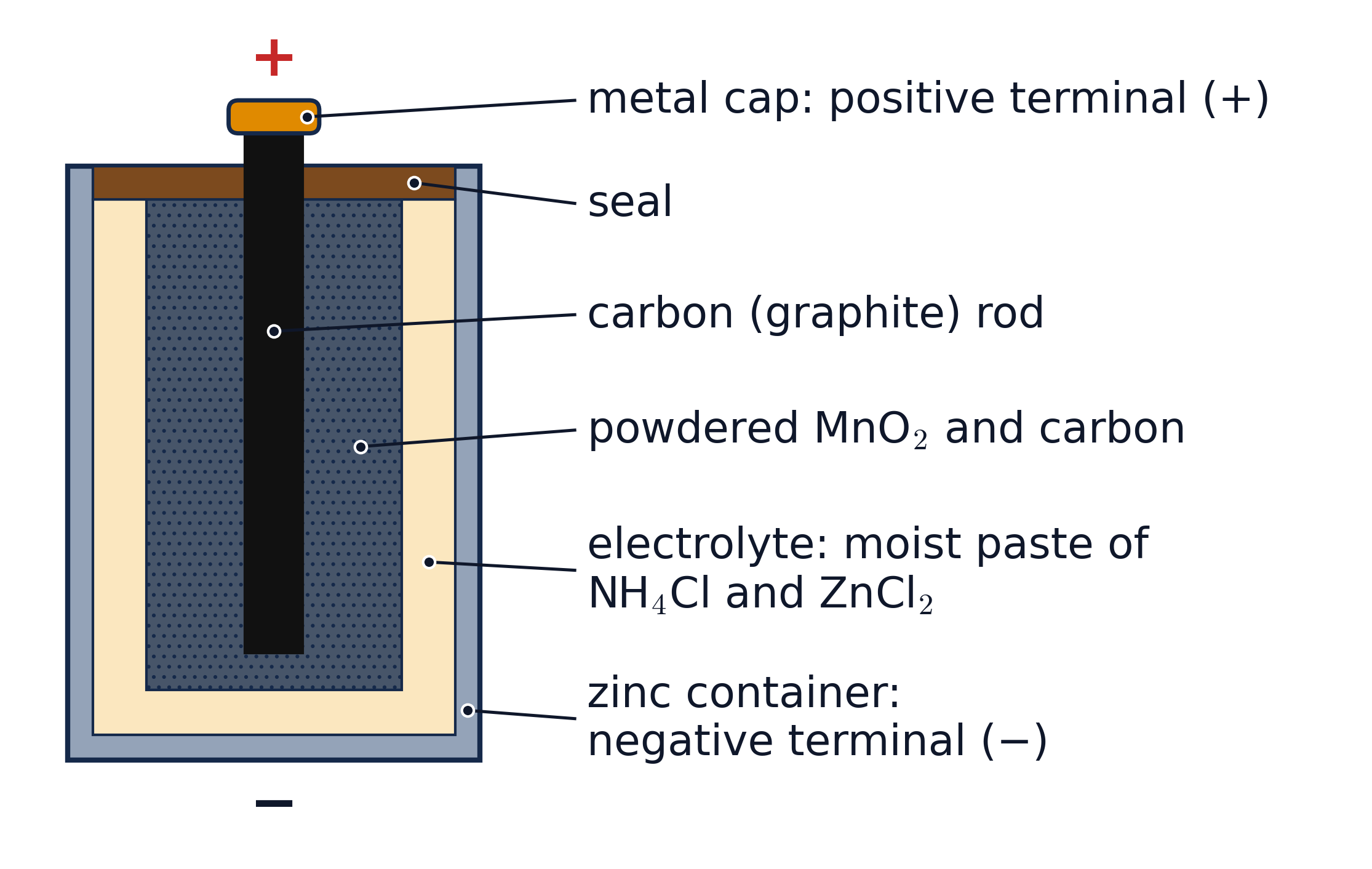
The dry cell is the common torch cell. It is called dry because its electrolyte is a moist paste and not a liquid, so it does not spill.
| Part of a dry cell | Made of | Exam fact |
|---|---|---|
| Negative terminal | The zinc container | The zinc is slowly used up as the cell works |
| Positive terminal | A carbon (graphite) rod in the centre, with a metal cap | The rod is surrounded by powdered manganese dioxide (MnO₂) and carbon |
| Electrolyte | A moist paste of ammonium chloride (NH₄Cl) and zinc chloride (ZnCl₂) | |
| emf | About 1.5 V | The size of the cell does not change its emf. A larger cell only lasts longer |
Two more primary cells:
| Cell | What is in it | emf | Used in |
|---|---|---|---|
| Mercury (button) cell | Zinc and mercury at one electrode, mercury oxide (HgO) and carbon at the other, a paste of potassium hydroxide (KOH) as electrolyte | About 1.35 V, steady through its life | Watches, hearing aids |
| Daniell cell | A zinc rod in zinc sulphate solution and a copper rod in copper sulphate solution. Zinc is the negative terminal | About 1.1 V | The laboratory |
3. Secondary cells
The lead-acid battery (lead storage battery) is the battery of cars, lorries and inverters.
| Part of a lead-acid cell | Made of |
|---|---|
| Negative plate | Lead (Pb) |
| Positive plate | Lead dioxide (PbO₂) on a lead grid |
| Electrolyte | Dilute sulphuric acid (H₂SO₄) |
| emf | About 2 V for one cell. A 12 V car battery has six cells in series |
When the battery gives current (discharges), both plates slowly turn into lead sulphate and the acid is used up, so the acid becomes more dilute:
Pb + PbO₂ + 2H₂SO₄ → 2PbSO₄ + 2H₂O
Charging drives the same reaction backwards. The plates return to lead and lead dioxide, and the acid becomes stronger again. A lead-acid battery has a very low internal resistance, so it can give the very large current that a starter motor needs for a few seconds.
The lithium-ion battery is the rechargeable battery of mobile phones, laptops and electric vehicles.
- It has two electrodes with an electrolyte between them. One electrode is usually graphite (carbon). The other is a compound of lithium with a metal and oxygen.
- When the battery is used, lithium ions move through the electrolyte from the graphite electrode to the other electrode, and electrons flow through the outside circuit.
- When it is charged, the ions are driven back.
- Lithium is the lightest metal, so the battery stores much energy for its weight. One cell gives about 3.7 V, more than twice a dry cell.
The Nobel Prize in Chemistry for 2019 was given to John Goodenough, Stanley Whittingham and Akira Yoshino for developing the lithium-ion battery.
Two things that are called cells but are not chemical cells of these kinds: a solar cell changes light directly into electricity and is made of a semiconductor such as silicon. A fuel cell is supplied with a fuel, such as hydrogen, and oxygen from outside, and makes electricity for as long as they are supplied.
4. emf and internal resistance
The electromotive force (emf) of a cell is the potential difference between its terminals when no current is being taken from it. It is measured in volts. In spite of its name it is not a force. It is the energy the cell gives to each coulomb of charge.
\varepsilon = \frac{W}{Q} = \frac{P}{I}
The second form follows from the first: divide the energy and the charge by the time, and energy per second is power while charge per second is current. So the emf is also the power the cell supplies for each ampere of current. Its unit is the volt, which is a joule per coulomb. It is not the joule and not the newton. CDS I 2026 tested exactly these points.
The current also has to pass through the cell itself, through its electrolyte and electrodes. They offer some resistance, called the internal resistance r of the cell. It behaves like a small resistor in series with the cell.
For a cell of emf \varepsilon and internal resistance r joined to an outside resistance R:
| Quantity | Formula | In words |
|---|---|---|
| Current | I = \dfrac{\varepsilon}{R + r} | The emf drives the current through both resistances |
| Terminal voltage while giving current | V = \varepsilon - Ir | Less than the emf. The part Ir is lost inside the cell |
| Terminal voltage with no current | V = \varepsilon | What a good voltmeter reads on an unused cell |
| Terminal voltage while being charged | V = \varepsilon + Ir | More than the emf |
| Largest current (terminals joined by a thick wire) | I = \dfrac{\varepsilon}{r} | The short-circuit current |
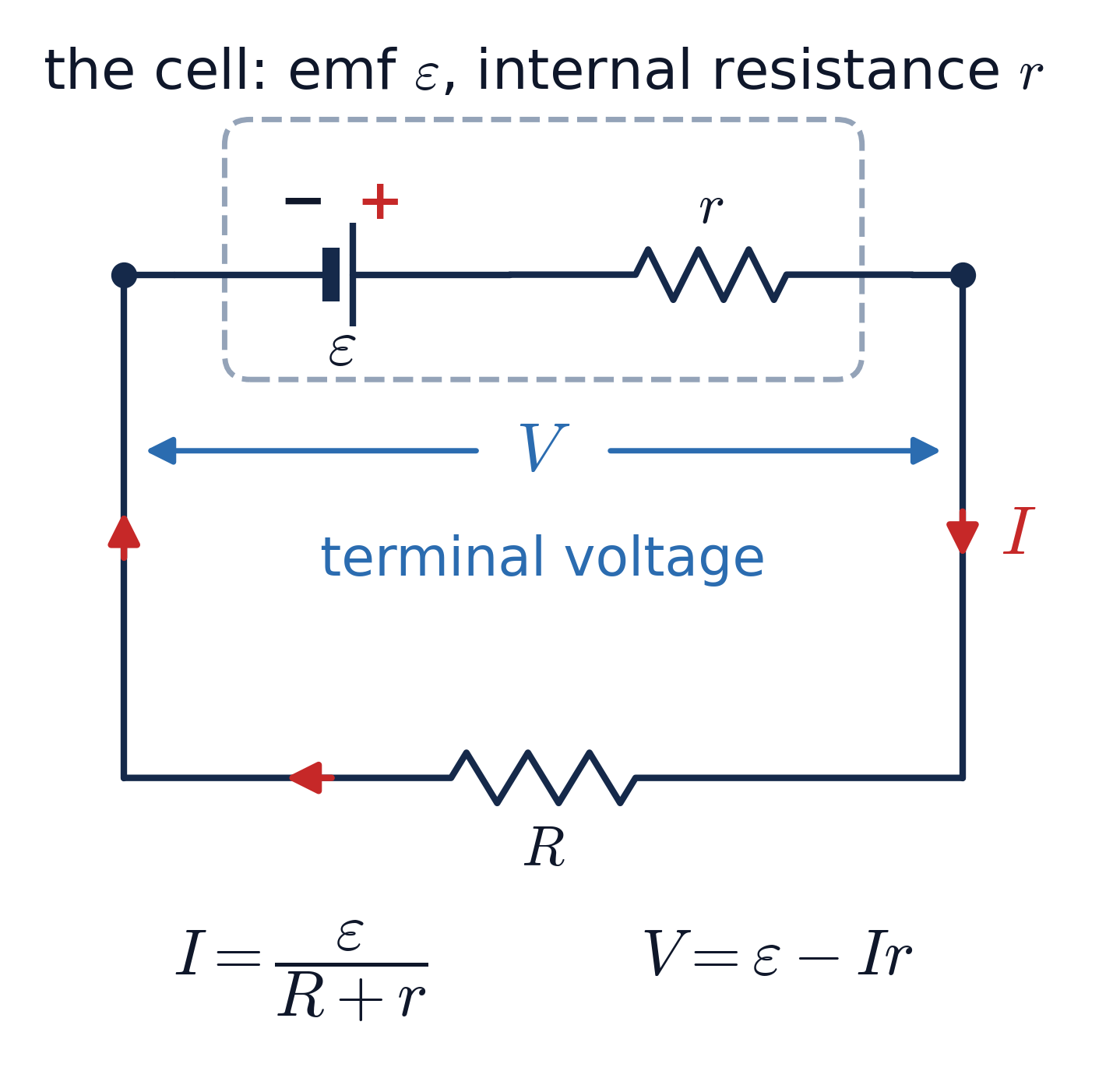
Example. A cell of emf 1.5 V and internal resistance 0.5 Ω is joined to a 2.5 Ω lamp. I = \dfrac{1.5}{2.5 + 0.5} = 0.5 A. The terminal voltage is 1.5 - 0.5 \times 0.5 = 1.25 V. The missing 0.25 V is dropped inside the cell.
The internal resistance of a dry cell rises as the cell is used. An old cell may still show nearly 1.5 V on a voltmeter and yet fail to light a torch, because most of its emf is lost inside it when a current flows.
5. Cells in series and in parallel
| n equal cells in series | n equal cells in parallel | |
|---|---|---|
| How they are joined | Positive of one to negative of the next | All positives together, all negatives together |
| Total emf | n\varepsilon | \varepsilon, the same as one cell |
| Total internal resistance | nr | \dfrac{r}{n} |
| Used when | A higher voltage is needed: a torch, a 12 V car battery | The same voltage is needed for a longer time or with a larger current |
- A cell put in backwards in a series row subtracts its emf. Three 1.5 V cells with one reversed give 1.5 + 1.5 - 1.5 = 1.5 V, not 4.5 V.
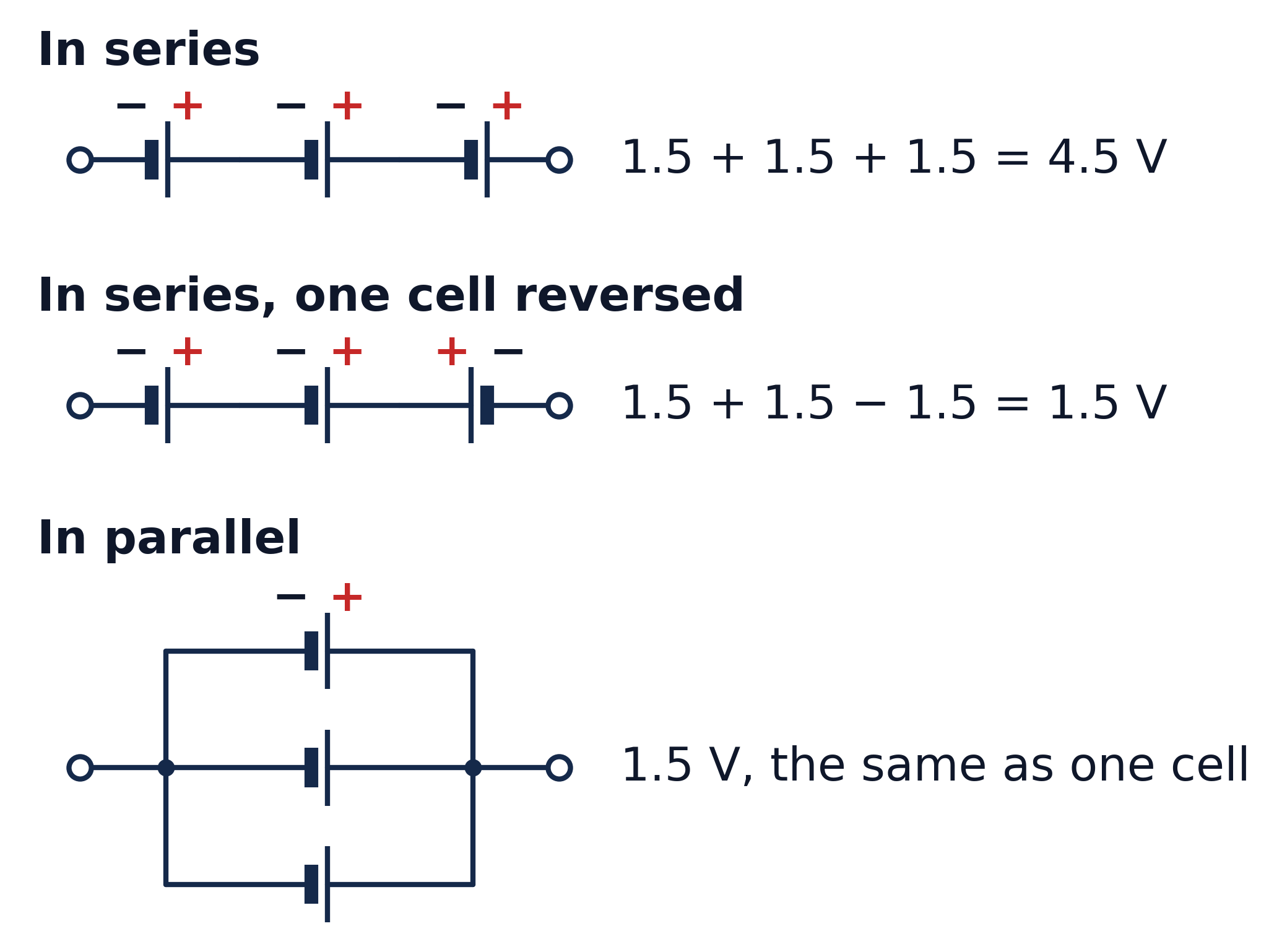
- A torch bulb has a resistance much larger than the internal resistance of the cells. It glows brightest when the cells are in series and all point the same way, because that gives the largest voltage.
- Two different cells in parallel. For cells of emf \varepsilon_1, \varepsilon_2 and internal resistances r_1, r_2, the pair acts like one cell of emf \dfrac{\varepsilon_1 r_2 + \varepsilon_2 r_1}{r_1 + r_2} and internal resistance \dfrac{r_1 r_2}{r_1 + r_2}. If r_1 = r_2, the emf is simply the average of the two.
6. X-rays
X-rays were discovered by Wilhelm Röntgen in 1895. He received the first Nobel Prize in Physics, in 1901. He called them "X" because their nature was unknown.
How X-rays are produced (the X-ray tube).
- A filament inside a glass tube with a vacuum is heated by a current and gives out electrons.
- A very high voltage, tens of thousands of volts, between the filament and a metal target pulls the electrons across the tube at great speed.
- The fast electrons hit the target, which is a heavy metal such as tungsten, and are stopped suddenly. Part of their energy comes out as X-rays. (A tube with a heated filament of this kind is called a Coolidge tube.)
- Most of the energy becomes heat, so the target must be cooled.
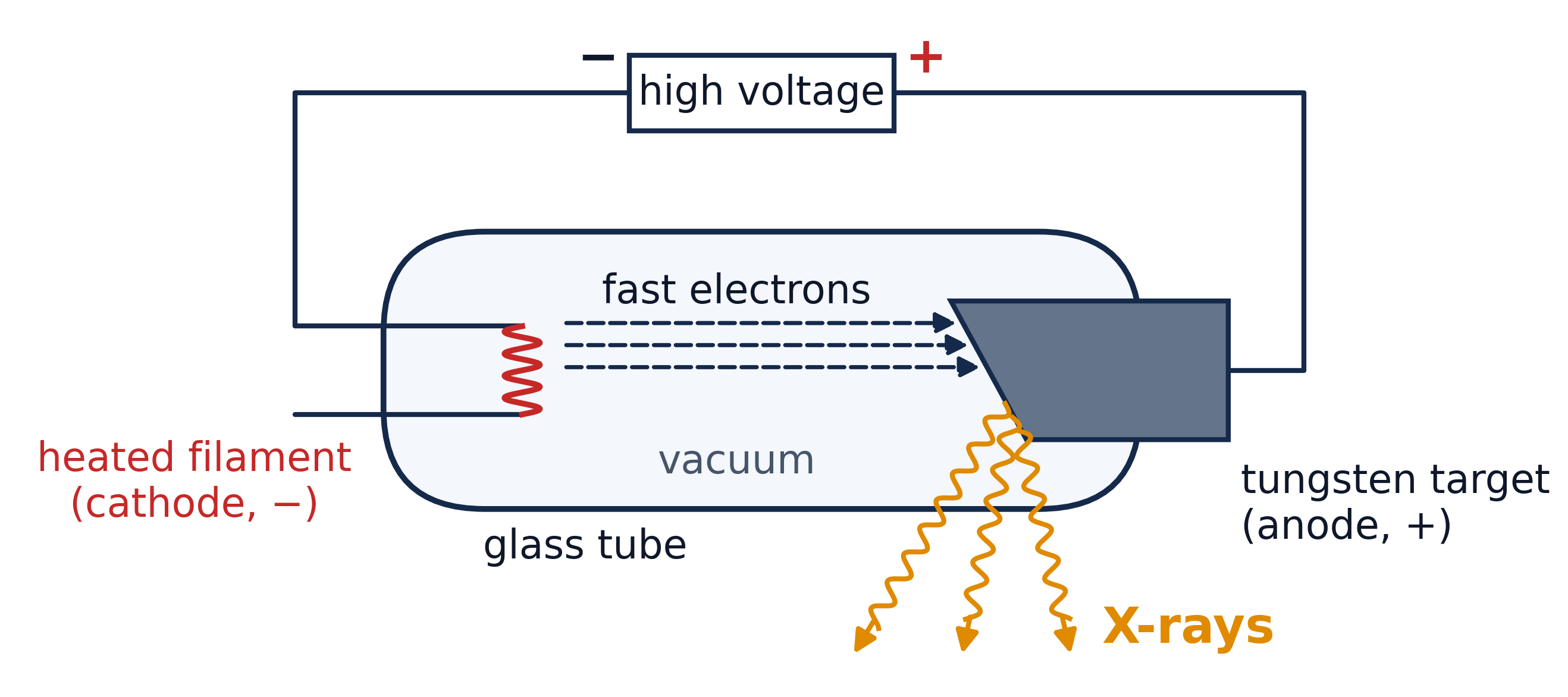
A higher voltage gives X-rays of shorter wavelength that pass through matter more easily. These are called hard X-rays.
| Property of X-rays | What to remember |
|---|---|
| Nature | Electromagnetic waves, like light. They need no medium and are transverse |
| Speed in vacuum | The speed of light, 3 \times 10^{8} m/s |
| Wavelength | Very short: from about 10 nm down to about 0.0001 nm. Shorter than ultraviolet, longer than gamma rays |
| Charge | None. They are not deflected by an electric field or by a magnetic field. CDS II 2025 and CDS I 2026 both asked this |
| Energy | High energy in each photon, because the frequency is high |
| Penetration | They pass through flesh, paper and wood. Bone absorbs more of them, and metals far more. A thick sheet of lead stops them |
| Other effects | They blacken photographic film, make some materials glow (fluorescence) and ionise gases |
| Danger | They damage living cells. Long or repeated exposure is harmful, so workers stand behind lead screens or wear lead aprons |
| Use of X-rays | How |
|---|---|
| Medicine: finding broken bones, tooth decay, chest disease | Bones absorb more than flesh, so they show as a shadow picture (a radiograph). A CT scan builds a picture from many X-ray views |
| Medicine: treating cancer (radiotherapy) | Strong X-rays kill the cancer cells |
| Security | Scanning bags at airports |
| Industry | Finding hidden cracks and flaws inside metal castings and welded joints, without cutting them open |
| Science | Studying the arrangement of atoms in crystals (X-ray diffraction) |
An ultrasound scan uses sound waves, and an MRI scan uses a magnetic field and radio waves. Neither uses X-rays.
Why metal is taken off before an X-ray picture. An X-ray picture is a shadow picture. A metal object such as a chain, a coin or a belt buckle absorbs or scatters X-rays far more strongly than flesh or bone. It leaves a solid patch on the picture and hides whatever lies behind it. The X-rays do not make the metal spark, melt or change. CDS II 2026 asked for this reason. The same idea is put to use on purpose: before an X-ray of the stomach the patient swallows a "barium meal" of barium sulphate, which absorbs X-rays well and makes the soft stomach show up.
What a field can and cannot deflect. Only a moving charged particle is pushed aside by an electric or a magnetic field (Chapter K1-15).
| Deflected by electric and magnetic fields | Not deflected |
|---|---|
| Electrons (cathode rays, beta particles), protons, alpha particles, any ion | X-rays, gamma rays, light, radio waves and every other electromagnetic wave. Neutrons also, because they have no charge |
Where X-rays stand. All electromagnetic waves travel at the same speed in vacuum. From the top of this table to the bottom the wavelength becomes shorter, and the frequency and the energy of each photon become larger.
| Wave | Wavelength | One use |
|---|---|---|
| Radio waves | Longest | Radio and television broadcasting |
| Microwaves | Radar, microwave ovens | |
| Infra-red | Remote controls, heat lamps | |
| Visible light | About 400 nm (violet) to 700 nm (red) | Seeing |
| Ultraviolet | Killing germs in water purifiers, detecting forged currency notes | |
| X-rays | About 10 nm to 0.0001 nm | Radiographs |
| Gamma rays | Shortest | Treating cancer |
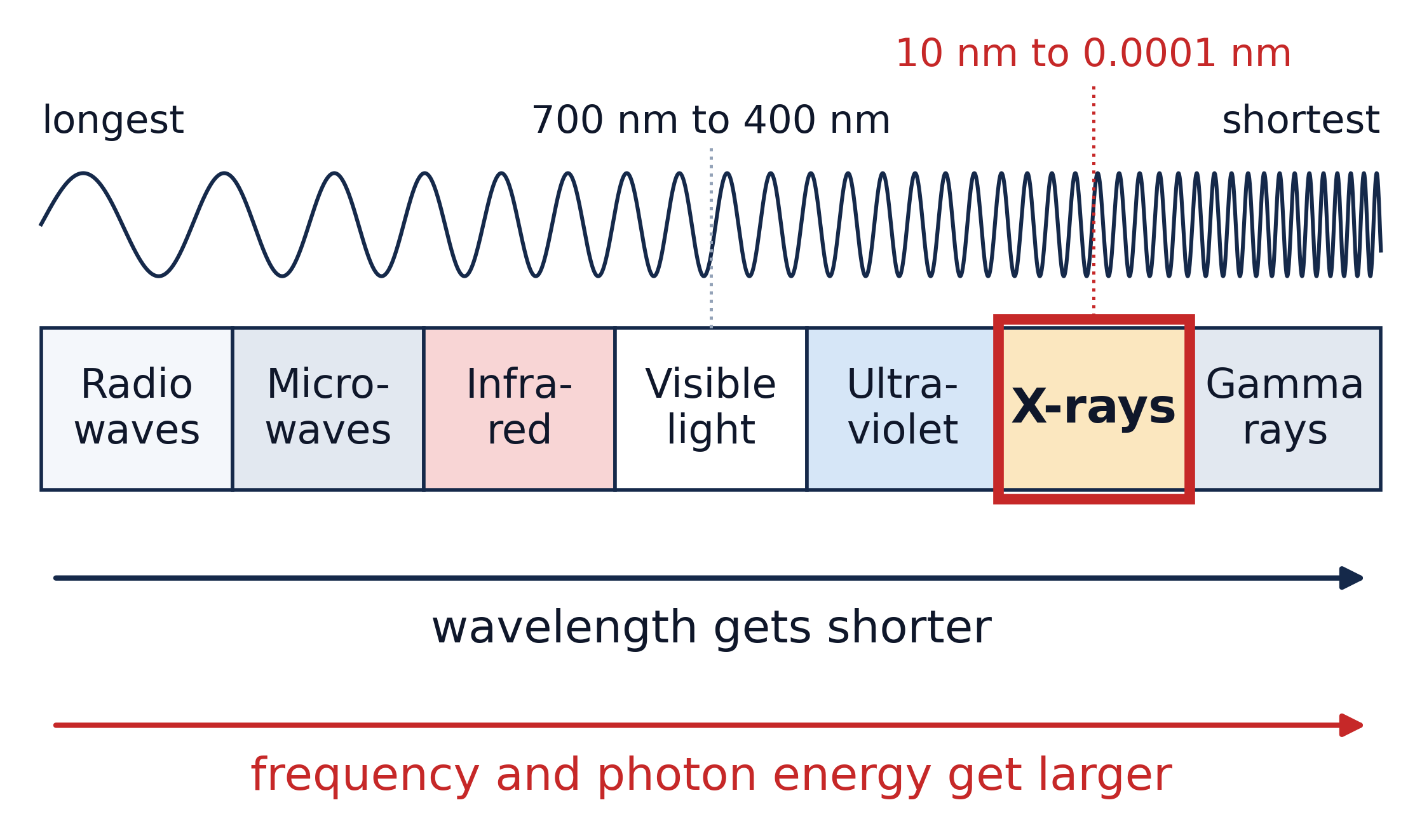
The energy of a photon is E = hf, where f is the frequency and h is Planck's constant. So X-ray photons carry far more energy than photons of light, microwaves or radio waves. Sound is not in this table at all: it is a mechanical wave and needs a medium.
What the papers have asked
These are all the questions on this chapter in the 6 papers from CDS I 2024 to CDS II 2026, in our own words.
| Paper | The idea asked | The answer in one line |
|---|---|---|
| CDS II 2024 | Whether X-rays can be used to inspect welded joints in a machine and to study the structure of crystals | Both. They show hidden flaws inside metal, and X-ray diffraction shows how the atoms of a crystal are arranged |
| CDS II 2025 | Whether an X-ray can be deflected by an electric field, a magnetic field, both or neither | Neither. X-rays are electromagnetic waves with no charge |
| CDS I 2026 | The same question again, about an X-ray beam | Neither |
| CDS I 2026 | The one correct statement about cells among four | The emf is the power supplied per unit current. A primary cell cannot be recharged, a secondary cell can, and the unit of emf is the volt |
| CDS II 2026 | The main reason for removing metal objects before X-ray imaging | Metal absorbs or scatters the X-rays strongly and leaves a patch on the picture. There are no sparks and no damage to the metal |
What this shows:
| Point | What to do about it |
|---|---|
| The deflection question came in two papers running | Say it once aloud: "no charge, no deflection". It is true for every electromagnetic wave |
| The uses of X-rays were asked as "1 only, 2 only, both or neither" | Know all five rows of the table of uses, not only the medical one |
| The cells question hid the right answer in an unusual wording, "power per unit current" | Know emf three ways: open-circuit voltage, energy per coulomb, power per ampere |
| Nothing was asked on the inside of a dry cell or on the order of the electromagnetic waves | The tables are short. Read them twice and do the drill |
Worked examples
Example 1 (a short calculation). A battery of emf 12 V and internal resistance 0.5 Ω is connected to a 5.5 Ω resistor. What is the potential difference across the terminals of the battery?
(a) 1 V (b) 11 V (c) 12 V (d) 13 V
Solution. I = \dfrac{12}{5.5 + 0.5} = 2 A. The voltage lost inside the battery is Ir = 2 \times 0.5 = 1 V, so the terminal voltage is 12 - 1 = 11 V. Option (a) is the lost voltage, not the terminal voltage. Option (c) is the emf, which is the terminal voltage only when no current flows. Answer (b).
Example 2 (statements). Consider the following statements:
- A dry cell is a primary cell and a lead-acid battery is a secondary cell.
- In a dry cell the zinc container is the positive terminal.
Which of the statements given above is/are correct?
(a) 1 only (b) 2 only (c) Both 1 and 2 (d) Neither 1 nor 2
Solution. Statement 1 is correct: a dry cell cannot be recharged, and a lead-acid battery can. Statement 2 is wrong: the zinc container is the negative terminal, and the carbon rod with its metal cap is the positive terminal. Answer (a).
Example 3 (matching). Match the cell with its electrolyte.
| Cell | Electrolyte |
|---|---|
| A. Dry cell | 1. Dilute sulphuric acid |
| B. Lead-acid battery | 2. Paste of potassium hydroxide |
| C. Mercury cell | 3. Paste of ammonium chloride and zinc chloride |
(a) A-1, B-3, C-2 (b) A-3, B-2, C-1 (c) A-2, B-1, C-3 (d) A-3, B-1, C-2
Solution. The dry cell has the ammonium chloride paste (3). The lead-acid battery has dilute sulphuric acid (1), which is why it is called "acid". The mercury cell has the potassium hydroxide paste (2). Answer (d).
Example 4. Four dry cells, each of emf 1.5 V, are put in a torch in series, but one of them is put in the wrong way round. What is the total emf?
(a) 1.5 V (b) 3.0 V (c) 4.5 V (d) 6.0 V
Solution. Three cells push one way and one pushes the other way: 1.5 + 1.5 + 1.5 - 1.5 = 3.0 V. Option (c) only leaves the reversed cell out. It forgets that the reversed cell also cancels one of the others. Option (d) is for all four the right way round. Answer (b).
Example 5 (statements). Consider the following statements about X-rays:
- They are deflected by a magnetic field.
- They travel in vacuum at the speed of light.
- Their wavelength is shorter than that of ultraviolet rays.
Which of the statements given above are correct?
(a) 1 and 2 only (b) 2 and 3 only (c) 1 and 3 only (d) 1, 2 and 3
Solution. X-rays are electromagnetic waves. They carry no charge, so a magnetic field does not bend them: statement 1 is wrong. It is the electrons inside the X-ray tube that can be deflected, not the X-rays. Statements 2 and 3 are correct. Answer (b).
Example 6. Which one of the following lists the waves in order of increasing energy of a photon?
(a) X-rays, ultraviolet, visible light, microwaves (b) Microwaves, ultraviolet, visible light, X-rays (c) Microwaves, visible light, ultraviolet, X-rays (d) Visible light, microwaves, X-rays, ultraviolet
Solution. Photon energy rises with frequency, that is, as the wavelength becomes shorter. Microwaves have the longest wavelength of the four, then visible light, then ultraviolet, then X-rays. Option (a) is the same list in the reverse order, which is the order of increasing wavelength. Answer (c).
Example 7 (how many are correct). Consider the following statements:
- The emf of a cell is the energy it gives to each coulomb of charge that passes through it.
- The SI unit of emf is the joule.
- A beam of X-rays passes undeflected through a strong magnetic field.
How many of the above statements are correct?
(a) Only one (b) Only two (c) All three (d) None
Solution. Statement 1 is the meaning of emf. Statement 2 is wrong: energy per coulomb is the volt, and the joule is the unit of energy itself. Statement 3 is correct, because X-rays carry no charge. Answer (b).
Mistakes that cost marks
- Taking the emf as the terminal voltage. They are equal only when no current flows. With a current, the terminal voltage is \varepsilon - Ir.
- Forgetting the internal resistance in the current. The current is \dfrac{\varepsilon}{R + r}, not \dfrac{\varepsilon}{R}.
- Mixing up wavelength and energy. X-rays have a short wavelength and therefore a high frequency and a high photon energy. "Smallest wavelength" and "largest energy" point to the same end of the spectrum.
- Calling X-rays particles with charge. They are electromagnetic waves with no charge. They are produced by fast electrons, but they are not electrons.
Quick check
Do these without help. Answers are at the end.
- Name the negative terminal and the electrolyte of a dry cell.
- How many lead-acid cells are joined in series to make a 12 V car battery?
- A cell of emf 2 V and internal resistance 1 Ω is joined to a 4 Ω resistor. What is the current, and what is the terminal voltage?
- Who discovered X-rays, and in which year?
- Arrange in order of increasing wavelength: infra-red, X-rays, ultraviolet, radio waves.
Read and watch more, free
NCERT and NIOS books are free on their own websites.
| What | Where | Language |
|---|---|---|
| Textbook, cells and batteries | NCERT textbooks, the book menu: Class 12 Chemistry Part I, the chapter "Electrochemistry" (the section on batteries: dry cell, mercury cell, lead storage battery, fuel cells) | English, Hindi |
| Textbook, emf and internal resistance | NCERT textbooks, the book menu: Class 12 Physics Part I, Chapter 3 "Current Electricity" (cells, emf, internal resistance, cells in series and in parallel) | English, Hindi |
| Textbook, X-rays and the spectrum | NCERT textbooks, the book menu: Class 12 Physics Part I, Chapter 8 "Electromagnetic Waves" (the electromagnetic spectrum) | English, Hindi |
| The real papers | UPSC previous question papers (General Knowledge booklets of every CDS sitting) | English, Hindi |
| Video, physics in one class | The Journey Extraordinary: CDS GS Revision Package (the physics class with six years of past questions; it is over ten hours long, so find this chapter's part) | Hinglish |
| Video, topic by topic | CDS Wallah: CDS Exam Full Playlist (the physics videos) | Hinglish |
| Video, past questions | Reveal GK: CDS past questions by subject and topic (the physics parts) | Hinglish |
The videos were chosen from their titles, length and views; they have not yet been watched by a teacher.
Answers to the quick check
- The zinc container is the negative terminal. The electrolyte is a moist paste of ammonium chloride and zinc chloride.
- Six, because each cell gives about 2 V.
- I = \dfrac{2}{4 + 1} = 0.4 A. Terminal voltage = 2 - 0.4 \times 1 = 1.6 V.
- Wilhelm Röntgen, in 1895.
- X-rays, ultraviolet, infra-red, radio waves.
Next chapter: Modern physics and space: atom and nucleus, radioactivity, semiconductors and lasers, particles, telescopes, satellites and orbits.